REVIEW 3 major objections 5 minor 2 cited by
Quantize-then-Rectify: Efficient VQ-VAE Training
T0 review · 3 major / 5 minor · reviewed 2026-08-06 · deepseek-v4-flash
Pith's one-line read The paper establishes that a pretrained continuous VAE can be converted into a discrete VQ-VAE at a fraction of the usual training cost by freezing the VAE and training only a channel multi-group quantizer and a small post rectifier with…
desk verdict A genuinely useful recipe for converting a frozen VAE into a 512-token VQ-VAE, but the headline efficiency claim omits the pre-encoding cost and compares unequal token counts. read the letter →
The pith
A machine-rendered reading of the paper's core claim, the machinery that carries it, and where it could break.
The reading
What carries the argument
The load-bearing objects are the channel multi-group quantizer and the post rectifier. Channel multi-group quantization splits the latent feature dimension into B groups, each with its own codebook, raising the effective degrees of freedom from N to N×B; the paper argues channel-wise splits yield more independent feature distributions than spatial splits. The post rectifier $g$ is a small EfficientViT block trained to invert quantization error on the frozen VAE's latent, giving $\mathbf{Z}'_e = g(q(\mathbf{Z}_e, \mathbf{C}))$ and trained by minimizing $\lVert \mathbf{Z}_e - g(q(\mathbf{Z}_e))\rVert_2^2$. A support module, non-activation reset, reinitializes unused codes near highly activated ones at the end of each epoch to prevent codebook collapse. The whole design is justified by an empirical noise-tolerance threshold: the DC-AE reconstruction survives Gaussian latent noise up to variance about 0.3, so ReVQ only needs to keep quantization error below a comparable level.
What would settle it
Re-run the Fig. 3b tolerance test using the actual distribution of quantization errors produced by the trained ReVQ codebook instead of Gaussian noise; if reconstructed images degrade at latent MSE below the 0.1 threshold used in the paper, the load-bearing premise fails. A second check is to swap in a different pre-trained VAE and see whether the $\ell^2$-only rectifier still keeps rFID competitive.
Extended reading notes
Core claim
ReVQ's central claim is that vector-quantized autoencoders do not have to be trained from scratch: a pre-trained continuous VAE already contains a decoder whose tolerance for latent noise can absorb the error introduced by quantization. The paper identifies a boundary condition — quantization noise must stay below the VAE's tolerance threshold — and then constructs a quantizer that stays within it. The quantizer splits latent channels into groups, giving each group its own codebook so the effective capacity grows from N to N×B, and resets unused codes each epoch to prevent index collapse. A post rectifier, a small EfficientViT block, then learns to map the quantized features back toward the original latent under a pure $\ell^2$ loss (Eq. 5) with the VAE frozen. On ImageNet the 512-token configuration reaches rFID 1.06, and the paper reports completing training in about 22 hours on one RTX 4090, compared with 3456 GPU-hours for MaskBit.
Load-bearing premise
The load-bearing premise is that minimizing $\ell^2$ error on the frozen VAE's latent features keeps the quantizer's noise inside the VAE's tolerance region, so the decoder produces perceptually good images without any perceptual or adversarial training signal.
Editorial extensions
If this is right
- High-compression discrete tokenizers could be produced in about a day on a single consumer GPU, cutting reported GPU-hours by 40x to 150x.
- The 512-token ReVQ variant beats prior frozen-VAE tokenizers (TokenBridge at 4096 tokens, CODA at 2560 tokens) on rFID while using far fewer tokens.
- At 256 tokens, ReVQ needs large codebooks (up to 262,144) and still trails MaskBit, so the method does not yet displace from-scratch training at the highest compression ratios.
- Channel-axis multi-group splitting consistently beats spatial splitting in rFID, supporting the claim that latent features are more independent across channels.
- Non-activation reset keeps codebook utilization above 97% even at 262,144 codes; without it, utilization drops to about 65%.
Reading between the lines
- The l2-only training objective suggests the same quantize-then-rectify recipe could be lifted to other frozen autoencoders for video, audio, or 3D data, which the paper leaves untested.
- The fitted exponential relation between token length and required codebook size implies that codebook scaling alone cannot reach TiTok-style 32-token compression; the rectifier architecture, not the codebook, is the lever the paper itself flags for future work.
- A natural extension, not tested in the paper, would be to add a lightweight perceptual or adversarial loss on the decoded output while keeping the VAE frozen, which would test whether the l2-only target is the bottleneck or the speed advantage is preserved.
Editorial analysis
A structured set of objections, weighed in public.
Referee Report
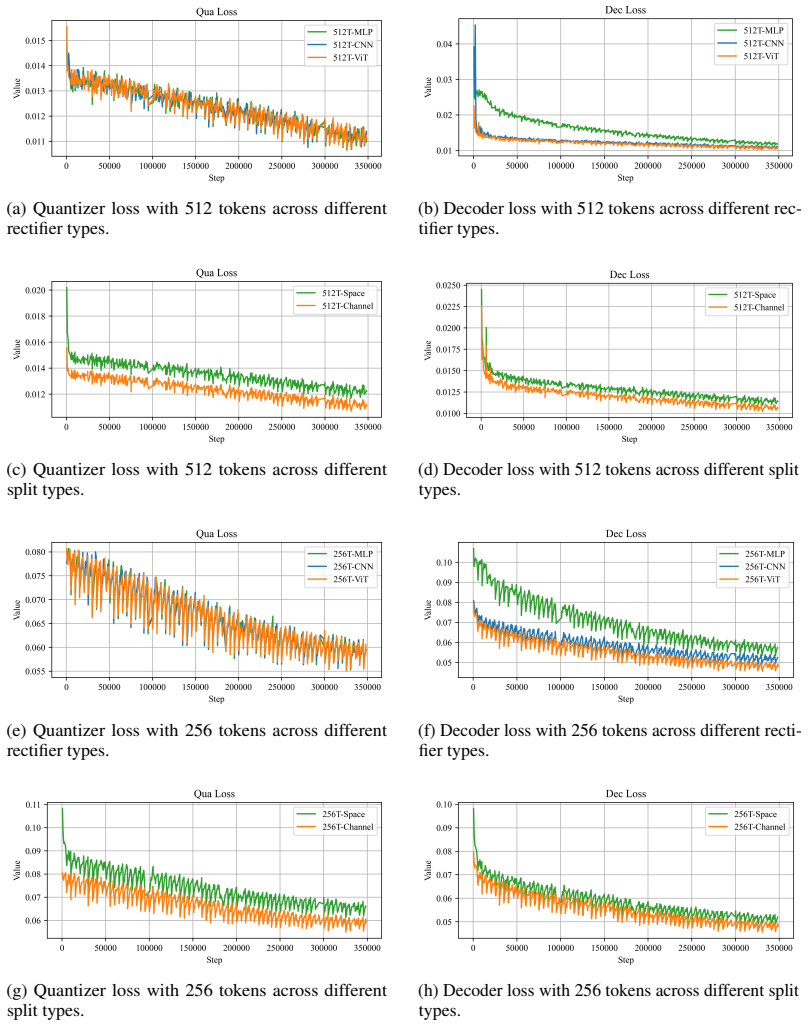
Summary. The paper proposes ReVQ, a method for converting a pre-trained continuous VAE into a discrete VQ-VAE by freezing the VAE encoder and decoder and training only a channel multi-group quantizer plus a post-quantization rectifier. The quantized latents are mapped back through the frozen decoder, and all training is done with an ℓ2 loss on the normalized latent features (Eq. 5). On ImageNet, ReVQ reports rFID 1.06 with at most 512 tokens, and the paper claims that full training takes about 22 hours on a single RTX 4090, a 40–150x reduction in GPU-hours compared with MaskBit and TiTok-S-128. The paper includes ablations on spatial vs. channel multi-group quantization, on the non-activation reset strategy, and on the rectifier architecture, as well as additional training curves and visualizations in the appendix.
Significance. The central idea — reusing a strong pre-trained VAE by training only a lightweight quantizer/rectifier — is simple and potentially valuable for making high-compression tokenizers accessible. The component-wise ablations are clear and support the design choices: channel splitting beats spatial splitting, the reset strategy improves codebook utilization, and a ViT rectifier outperforms CNN and MLP counterparts. If the efficiency claim is accurate after accounting for all preprocessing costs, the method represents a real step toward cheap discrete visual tokenization. However, the headline training-cost comparison omits the one-time pre-encoding of all 1.28M images and the pretraining cost of the frozen VAE, which is load-bearing because the main contribution is the claimed two-orders-of-magnitude speedup. The 'boundary condition' linking VAE noise tolerance to quantization error is also empirical and heuristic, rather than a formal condition, which limits the strength of the general framework claim.
major comments (3)
- [Appendix C.1, Table 3, Abstract] The claimed 'full training' time of 22 hours on one RTX 4090 (Abstract, Section 1, Table 3) excludes the one-time DC-AE encoding of all 1.28M ImageNet training images into 2048-dimensional latent vectors described in Appendix C.1. Because the paper's headline result is a two-orders-of-magnitude reduction in training cost, the total wall-clock comparison is incomplete unless the pre-encoding pass time is reported and included, and the amortized pretraining cost of DC-AE is either included or explicitly excluded with justification. The comparison also mixes 4090 GPU-hours with A100 GPU-hours without normalization, so the '40×∼150×' reduction stated in Section 4.2 is not yet established.
- [Section 3.2, Fig. 3b, Eq. (5), Appendix D.1] The 'boundary condition' for converting a VAE into a VQ-VAE is supported only by a Gaussian-noise tolerance experiment (Fig. 3b) and an empirically chosen MSE threshold of 0.1 (Appendix D.1). The paper provides no formal relation between the distribution of quantization error produced by channel multi-group quantization and Gaussian noise, and no argument that an ℓ2-optimal latent-space rectifier (Eq. 5) preserves perceptual quality after decoding. Since the method is presented as a general framework, this gap should be addressed either by analysis or by explicitly framing the threshold as an empirical observation specific to DC-AE, rather than a derived boundary condition.
- [Table 3, Section 4.2] The training-efficiency comparison is made against MaskBit and TiTok-S-128, which use different token counts (256 and 128) and are trained from scratch. TokenBridge and CODA, which also start from pre-trained VAEs and are the natural baselines for the 'frozen VAE' setting, are omitted from the training-time comparison. Reporting their training times, or otherwise restricting the efficiency claim to the from-scratch comparison, would make the speedup claim more credible and avoid the implication that ReVQ is the fastest option among all pre-trained-VAE-based tokenizers.
minor comments (5)
- [Table 2] The configuration 'ReVQ256T' is listed twice with different codebook sizes (65,536 and 262,144); the names should distinguish these two variants, e.g., ReVQ256T-S and ReVQ256T-L.
- [Table 3] The row 'ReVQ512T 262,144' appears inconsistent with Table 2 and Section 4.1, where the 262,144-codebook configuration is associated with 256 tokens; this is likely a typo and should be corrected.
- [Sections 4.1, 4.4, Table 5] The text and Table 5 interchangeably use 'decoder' and 'rectifier' for the post-quantization network, which is confusing because the frozen VAE decoder is a different module; the manuscript should consistently call the trained post-quantization network the rectifier.
- [Appendix A] The analysis of the reset strategy shows that the lower bound on quantization error can decrease after splitting a cluster, but it does not show that the specific reset operation in Eq. (3) achieves this lower bound; the empirical results in Fig. 8 partially compensate, but the wording 'This analysis demonstrates that the Reset operation can effectively reduce quantization error' is stronger than the derivation supports.
- [Section 5, Abstract] Section 5 acknowledges that ReVQ cannot reach very high compression ratios such as 32 tokens, yet the abstract and introduction emphasize 'at most 512 tokens' without this scope limitation; stating the compression-range limitation earlier would give readers a more accurate picture of the method's boundaries.
Circularity Check
No significant circularity: measured rFID benchmarks and ablations carry the claims; the only self-citation (OptVQ) is motivational, not load-bearing.
full rationale
The central claims—512-token compression with rFID 1.06 and 22-hour training on one RTX 4090—are empirical and are compared against external, published rFID and GPU-hour numbers (Tables 2–3). The training objective (Eq. 5) minimizes l2 latent error; rFID is then measured on validation images through the frozen DC-AE decoder, so the reported quality is not forced by construction. The 'tolerance threshold' argument (Fig. 3b) is used only as motivation and is not a derivation: the paper never claims to compute rFID from the Gaussian-noise threshold, and the quantizer/rectifier are not trained to a threshold. The only self-citation, OptVQ [Zhang et al., 2024], motivates codebook-collapse awareness in Sec. 3.2.2, but the non-activation reset is independently proposed, theoretically analyzed in Appendix A, and ablated in Fig. 8; the load-bearing evidence is the paper's own experiments, not the cited result. The framing that 'quantization noise within the VAE's tolerance threshold' yields acceptable reconstruction is close to tautological, but it is not used to derive the measured results. Separately, the efficiency comparison omits the one-time DC-AE pre-encoding pass (Appendix C.1), which is an accounting/correctness issue, not a circular reduction: the 22-hour figure applies to the quantizer/rectifier training stage, and the quality numbers stand independently of the cost framing.
Assumptions & free parameters
free parameters (5)
- Codebook size N =
16384 (512 tokens), 65536 or 262144 (256 tokens)
- Number of channel groups B (token length) =
512 or 256
- Noise tolerance threshold =
variance at most 0.3
- Exponential fit coefficients for codebook size vs token length =
a = -3.6, b = 12.82 in M = 10^(a log10 B + b)
- Reset perturbation epsilon =
small random noise (not specified)
assumptions (4)
- domain assumption The pre-trained DC-AE is a sufficiently good autoencoder for ImageNet reconstruction, and its decoder can reconstruct images from modified latents.
- ad hoc to paper Quantization error can be treated as analogous to Gaussian noise for the purpose of the VAE's tolerance threshold.
- domain assumption Minimizing l2 loss in latent space is sufficient to train a rectifier that improves perceptual reconstruction quality.
- standard math Independent codebooks per channel group yield N^B effective combinations.
Cite this review
Pith. "Pith review of Quantize-then-Rectify: Efficient VQ-VAE Training." pith.science (2026). https://pith.science/paper/PMVYEBDG
@misc{pith2026250710547,
  author       = {Pith},
  title        = {Pith review of: Quantize-then-Rectify: Efficient VQ-VAE Training},
  year         = {2026},
  howpublished = {\url{https://pith.science/paper/PMVYEBDG}},
  note         = {Machine review of arXiv:2507.10547}
}
read the original abstract
Visual tokenizers are pivotal in multimodal large models, acting as bridges between continuous inputs and discrete tokens. Nevertheless, training high-compression-rate VQ-VAEs remains computationally demanding, often necessitating thousands of GPU hours. This work demonstrates that a pre-trained VAE can be efficiently transformed into a VQ-VAE by controlling quantization noise within the VAE's tolerance threshold. We present \textbf{Quantize-then-Rectify (ReVQ)}, a framework leveraging pre-trained VAEs to enable rapid VQ-VAE training with minimal computational overhead. By integrating \textbf{channel multi-group quantization} to enlarge codebook capacity and a \textbf{post rectifier} to mitigate quantization errors, ReVQ compresses ImageNet images into at most 512 tokens while sustaining competitive reconstruction quality (rFID = 1.06). Significantly, ReVQ reduces training costs by over two orders of magnitude relative to state-of-the-art approaches: ReVQ finishes full training on a single NVIDIA 4090 in approximately 22 hours, whereas comparable methods require 4.5 days on 32 A100 GPUs. Experimental results show that ReVQ achieves superior efficiency-reconstruction trade-offs.
Figures


Figures from the paper (7 more)



Forward citations
Cited by 2 Pith papers
-
ChannelTok: Efficient Flexible-Length Vision Tokenization
ChannelTok introduces channel-wise tokenization with stochastic tail-dropping to achieve rFID 2.92 on ImageNet at 8.6x faster decoding and 2.1x smaller size than prior flexible tokenizers.
-
NSVQ: Mitigating Codebook Collapse by Stabilizing Encoder Drift in Vector Quantization
NSVQ mitigates codebook collapse in large-codebook VQ by addressing encoder drift via non-stationary loss, replacement, and staged freezing, improving rFID from 2.39 to 2.10 on ImageNet-1k while achieving 100% utilization.
Reference graph
Works this paper leans on
-
[1]
Cosmos world foundation model platform for physical ai
Niket Agarwal, Arslan Ali, Maciej Bala, Yogesh Balaji, Erik Barker, Tiffany Cai, Prithvijit Chattopadhyay, Yongxin Chen, Yin Cui, Yifan Ding, et al. Cosmos world foundation model platform for physical ai. arXiv, abs/2501.03575, 2025
arXiv 2025
-
[2]
Sequential modeling enables scalable learning for large vision models
Yutong Bai, Xinyang Geng, Karttikeya Mangalam, Amir Bar, Alan L Yuille, Trevor Darrell, Jitendra Malik, and Alexei A Efros. Sequential modeling enables scalable learning for large vision models. In CVPR, pages 22861--22872, 2024
work page 2024
-
[3]
Beit: Bert pre-training of image transformers
Hangbo Bao, Li Dong, Songhao Piao, and Furu Wei. Beit: Bert pre-training of image transformers. In ICLR, 2022
work page 2022
-
[4]
Estimating or propagating gradients through stochastic neurons for conditional computation
Yoshua Bengio, Nicholas L \'e onard, and Aaron Courville. Estimating or propagating gradients through stochastic neurons for conditional computation. arXiv, abs/1308.3432, 2013
arXiv 2013
-
[5]
Language models are few-shot learners
Tom B Brown. Language models are few-shot learners. arXiv, abs/2005.14165, 2020
arXiv 2005
-
[6]
Efficientvit: Lightweight multi-scale attention for high-resolution dense prediction
Han Cai, Junyan Li, Muyan Hu, Chuang Gan, and Song Han. Efficientvit: Lightweight multi-scale attention for high-resolution dense prediction. In ICCV, pages 17302--17313, 2023
work page 2023
-
[7]
Efficient-vqgan: Towards high-resolution image generation with efficient vision transformers
Shiyue Cao, Yueqin Yin, Lianghua Huang, Yu Liu, Xin Zhao, Deli Zhao, and Kaigi Huang. Efficient-vqgan: Towards high-resolution image generation with efficient vision transformers. In ICCV, pages 7368--7377, 2023
work page 2023
-
[8]
Maskgit: Masked generative image transformer
Huiwen Chang, Han Zhang, Lu Jiang, Ce Liu, and William T Freeman. Maskgit: Masked generative image transformer. In CVPR, pages 11315--11325, 2022
work page 2022
Show all 45 references
-
[9]
Deep compression autoencoder for efficient high-resolution diffusion models
Junyu Chen, Han Cai, Junsong Chen, Enze Xie, Shang Yang, Haotian Tang, Muyang Li, Yao Lu, and Song Han. Deep compression autoencoder for efficient high-resolution diffusion models. arXiv, abs/2410.10733, 2024
2024 arXiv
-
[10]
Imagenet: A large-scale hierarchical image database
Jia Deng, Wei Dong, Richard Socher, Li-Jia Li, Kai Li, and Li Fei-Fei. Imagenet: A large-scale hierarchical image database. In CVPR, pages 248--255, 2009
2009
-
[11]
Taming transformers for high-resolution image synthesis
Patrick Esser, Robin Rombach, and Bjorn Ommer. Taming transformers for high-resolution image synthesis. In CVPR, pages 12873--12883, 2021
2021
-
[12]
Making llama see and draw with seed tokenizer
Yuying Ge, Sijie Zhao, Ziyun Zeng, Yixiao Ge, Chen Li, Xintao Wang, and Ying Shan. Making llama see and draw with seed tokenizer. In ICLR, 2024
2024
-
[13]
Generative adversarial nets
Ian Goodfellow, Jean Pouget-Abadie, Mehdi Mirza, Bing Xu, David Warde-Farley, Sherjil Ozair, Aaron Courville, and Yoshua Bengio. Generative adversarial nets. NeurIPS, 27, 2014
2014
-
[14]
Gans trained by a two time-scale update rule converge to a local nash equilibrium
Martin Heusel, Hubert Ramsauer, Thomas Unterthiner, Bernhard Nessler, and Sepp Hochreiter. Gans trained by a two time-scale update rule converge to a local nash equilibrium. NeurIPS, 30, 2017
2017
-
[15]
Reducing the dimensionality of data with neural networks
Geoffrey E Hinton and Ruslan R Salakhutdinov. Reducing the dimensionality of data with neural networks. science, 313 0 (5786): 0 504--507, 2006
2006
-
[16]
Straightening out the straight-through estimator: Overcoming optimization challenges in vector quantized networks
Minyoung Huh, Brian Cheung, Pulkit Agrawal, and Phillip Isola. Straightening out the straight-through estimator: Overcoming optimization challenges in vector quantized networks. In ICML, pages 14096--14113, 2023
2023
-
[17]
Image-to-image translation with conditional adversarial networks
Phillip Isola, Jun-Yan Zhu, Tinghui Zhou, and Alexei A Efros. Image-to-image translation with conditional adversarial networks. In CVPR, pages 1125--1134, 2017
2017
-
[18]
Unified language-vision pretraining in llm with dynamic discrete visual tokenization
Yang Jin, Kun Xu, Liwei Chen, Chao Liao, Jianchao Tan, Quzhe Huang, CHEN Bin, Chengru Song, Di ZHANG, Wenwu Ou, et al. Unified language-vision pretraining in llm with dynamic discrete visual tokenization. In ICLR, 2024
2024
-
[19]
Perceptual losses for real-time style transfer and super-resolution
Justin Johnson, Alexandre Alahi, and Li Fei-Fei. Perceptual losses for real-time style transfer and super-resolution. In ECCV, pages 694--711, 2016
2016
-
[20]
Auto-encoding variational bayes
Diederik P Kingma. Auto-encoding variational bayes. arXiv, abs/1312.6114, 2013
2013 arXiv
-
[21]
Autoencoding beyond pixels using a learned similarity metric
Anders Boesen Lindbo Larsen, S ren Kaae S nderby, Hugo Larochelle, and Ole Winther. Autoencoding beyond pixels using a learned similarity metric. In ICML, pages 1558--1566, 2016
2016
-
[22]
Autoregressive image generation using residual quantization
Doyup Lee, Chiheon Kim, Saehoon Kim, Minsu Cho, and Wook-Shin Han. Autoregressive image generation using residual quantization. In CVPR, pages 11523--11532, 2022
2022
-
[23]
Imagefolder: Autoregressive image generation with folded tokens
Xiang Li, Kai Qiu, Hao Chen, Jason Kuen, Jiuxiang Gu, Bhiksha Raj, and Zhe Lin. Imagefolder: Autoregressive image generation with folded tokens. In ICLR, 2025
2025
-
[24]
Coda: Repurposing continuous vaes for discrete tokenization
Zeyu Liu, Zanlin Ni, Yeguo Hua, Xin Deng, Xiao Ma, Cheng Zhong, and Gao Huang. Coda: Repurposing continuous vaes for discrete tokenization. arXiv, abs/2503.17760, 2025
2025
-
[25]
Decoupled weight decay regularization
Ilya Loshchilov and Frank Hutter. Decoupled weight decay regularization. In ICLR, 2019
2019
-
[26]
Unitok: A unified tokenizer for visual generation and understanding
Chuofan Ma, Yi Jiang, Junfeng Wu, Jihan Yang, Xin Yu, Zehuan Yuan, Bingyue Peng, and Xiaojuan Qi. Unitok: A unified tokenizer for visual generation and understanding. arXiv, abs/2502.20321, 2025
2025
-
[27]
Finite scalar quantization: Vq-vae made simple
Fabian Mentzer, David Minnen, Eirikur Agustsson, and Michael Tschannen. Finite scalar quantization: Vq-vae made simple. arXiv, abs/2309.15505, 2023
2023 arXiv
-
[28]
Dinov2: Learning robust visual features without supervision
Maxime Oquab, Timoth \'e e Darcet, Th \'e o Moutakanni, Huy Vo, Marc Szafraniec, Vasil Khalidov, Pierre Fernandez, Daniel Haziza, Francisco Massa, Alaaeldin El-Nouby, et al. Dinov2: Learning robust visual features without supervision. arXiv, abs/2304.07193, 2023
2023 arXiv
-
[29]
Pytorch: An imperative style, high-performance deep learning library
Adam Paszke, Sam Gross, Francisco Massa, Adam Lerer, James Bradbury, Gregory Chanan, Trevor Killeen, Zeming Lin, Natalia Gimelshein, Luca Antiga, et al. Pytorch: An imperative style, high-performance deep learning library. NeurIPS, 32, 2019
2019
-
[30]
Generating diverse high-fidelity images with vq-vae-2
Ali Razavi, Aaron Van den Oord, and Oriol Vinyals. Generating diverse high-fidelity images with vq-vae-2. NeurIPS, 32, 2019
2019
-
[31]
High-resolution image synthesis with latent diffusion models
Robin Rombach, Andreas Blattmann, Dominik Lorenz, Patrick Esser, and Bj \"o rn Ommer. High-resolution image synthesis with latent diffusion models. In CVPR, pages 10684--10695, 2022
2022
-
[32]
Autoregressive model beats diffusion: Llama for scalable image generation
Peize Sun, Yi Jiang, Shoufa Chen, Shilong Zhang, Bingyue Peng, Ping Luo, and Zehuan Yuan. Autoregressive model beats diffusion: Llama for scalable image generation. arXiv, abs/2406.06525, 2024
2024 arXiv
-
[33]
Visual autoregressive modeling: Scalable image generation via next-scale prediction
Keyu Tian, Yi Jiang, Zehuan Yuan, Bingyue Peng, and Liwei Wang. Visual autoregressive modeling: Scalable image generation via next-scale prediction. In NeurIPS, 2024
2024
-
[34]
Neural discrete representation learning
Aaron Van Den Oord, Oriol Vinyals, et al. Neural discrete representation learning. NeurIPS, 30, 2017
2017
-
[35]
Bridging continuous and discrete tokens for autoregressive visual generation
Yuqing Wang, Zhijie Lin, Yao Teng, Yuanzhi Zhu, Shuhuai Ren, Jiashi Feng, and Xihui Liu. Bridging continuous and discrete tokens for autoregressive visual generation. arXiv, abs/2503.16430, 2025
2025 arXiv
-
[36]
Image quality assessment: from error visibility to structural similarity
Zhou Wang, Alan C Bovik, Hamid R Sheikh, and Eero P Simoncelli. Image quality assessment: from error visibility to structural similarity. IEEE TIP, 13 0 (4): 0 600--612, 2004
2004
-
[37]
Maskbit: Embedding-free image generation via bit tokens
Mark Weber, Lijun Yu, Qihang Yu, Xueqing Deng, Xiaohui Shen, Daniel Cremers, and Liang-Chieh Chen. Maskbit: Embedding-free image generation via bit tokens. arXiv, abs/2409.16211, 2024
2024 arXiv
-
[38]
Vector-quantized image modeling with improved vqgan
Jiahui Yu, Xin Li, Jing Yu Koh, Han Zhang, Ruoming Pang, James Qin, Alexander Ku, Yuanzhong Xu, Jason Baldridge, and Yonghui Wu. Vector-quantized image modeling with improved vqgan. In ICLR, 2022
2022
-
[39]
Language model beats diffusion-tokenizer is key to visual generation
Lijun Yu, Jose Lezama, Nitesh Bharadwaj Gundavarapu, Luca Versari, Kihyuk Sohn, David Minnen, Yong Cheng, Agrim Gupta, Xiuye Gu, Alexander G Hauptmann, et al. Language model beats diffusion-tokenizer is key to visual generation. In ICLR, 2024 a
2024
-
[40]
An image is worth 32 tokens for reconstruction and generation
Qihang Yu, Mark Weber, Xueqing Deng, Xiaohui Shen, Daniel Cremers, and Liang-Chieh Chen. An image is worth 32 tokens for reconstruction and generation. In NeurIPS, 2024 b
2024
-
[41]
Preventing local pitfalls in vector quantization via optimal transport
Borui Zhang, Wenzhao Zheng, Jie Zhou, and Jiwen Lu. Preventing local pitfalls in vector quantization via optimal transport. arXiv, abs/2412.15195, 2024
2024 arXiv
-
[42]
The unreasonable effectiveness of deep features as a perceptual metric
Richard Zhang, Phillip Isola, Alexei A Efros, Eli Shechtman, and Oliver Wang. The unreasonable effectiveness of deep features as a perceptual metric. In CVPR, pages 586--595, 2018
2018
-
[43]
Movq: Modulating quantized vectors for high-fidelity image generation
Chuanxia Zheng, Tung-Long Vuong, Jianfei Cai, and Dinh Phung. Movq: Modulating quantized vectors for high-fidelity image generation. NeurIPS, 35: 0 23412--23425, 2022
2022
-
[44]
Scaling the codebook size of vqgan to 100,000 with a utilization rate of 99\ arXiv, abs/2406.11837, 2024
Lei Zhu, Fangyun Wei, Yanye Lu, and Dong Chen. Scaling the codebook size of vqgan to 100,000 with a utilization rate of 99\ arXiv, abs/2406.11837, 2024
2024 arXiv
-
[45]
write newline
" write newline "" before.all 'output.state := FUNCTION n.dashify 't := "" t empty not t #1 #1 substring "-" = t #1 #2 substring "--" = not "--" * t #2 global.max substring 't := t #1 #1 substring "-" = "-" * t #2 global.max substring 't := while if t #1 #1 substring * t #2 gl...
Reviewed August 6, 2026 · model on record in the stance chip above.
Discussion (0). Sign in to comment.