REVIEW 3 major objections 4 minor 62 references
Lattice QCD Study of Positive Parity Dibaryons with Maximal Charm and Strangeness
T0 review · 3 major / 4 minor · reviewed 2026-08-06 · deepseek-v4-flash
Pith's one-line read Two triple-charm baryons form a spin-0 dibaryon bound by about 45 MeV in lattice QCD.
desk verdict A solid lattice calculation whose headline binding claim is not established: the Omega_ccc-Omega_ccc spin-0 shift is consistent with a bound state, but at under 2 sigma and with volume and quark-mass effects confounded, 'clear signal' is too strong. read the letter →
The pith
A machine-rendered reading of the paper's core claim, the machinery that carries it, and where it could break.
The reading
What carries the argument
The argument is carried by the finite-volume energy shift $\Delta E = E_D - 2E_B$, computed from two-point correlation matrices built from single-baryon interpolating fields in nonrelativistic and relativistic embeddings of the $H$ irreducible representation. Pauli antisymmetry in an s-wave restricts two spin-3/2 baryons to total spin $S=0$ and $S=2$, which subduce onto the $A_1$ and $E\oplus T_2$ irreducible representations of the cubic group; a generalized eigenvalue problem with up to four operators extracts the ground-state energy. The interaction is then read off by comparing $E_D$ with the two-baryon threshold across four lattice spacings and two spatial volumes, with a continuum extrapolation in $a^2$ and a zero-range finite-volume amplitude treatment used to turn the shift into a statement about binding.
What would settle it
Computing the $\Omega_{ccc}\Omega_{ccc}$ ground-state shift on three or more spatial volumes at identical quark masses and performing a finite-volume amplitude analysis would settle it: if no pole appears below the two-baryon threshold, or if the continuum extrapolation turns positive when the coarsest lattice spacing is dropped, the claimed bound state would not stand.
Extended reading notes
Core claim
The paper’s central claim is that in the $S=0$ channel the $\Omega_{ccc}\Omega_{ccc}$ system forms a bound state in pure QCD. Across all five ensembles the extracted energy shift $\Delta E = E_D - 2E_{\Omega_{ccc}}$ is negative, and a continuum extrapolation linear in $a^2$ gives $-45(24)$ MeV; a zero-range finite-volume amplitude analysis is consistent with this value. For $\Omega\Omega$, the continuum shift is $+32(34)$ MeV, i.e. indistinguishable from the two-baryon threshold. On a single fine lattice, increasing the valence quark mass from strange to charm toward bottom makes the spin-0 shift steadily more negative ($-39(27)$, $-56(30)$, $-63(23)$, and $-71(7)$ MeV), showing that attraction strengthens with quark mass. In the $S=2$ channel both dibaryons are positively shifted in the continuum by more than $3\sigma$ and are therefore unbound.
Load-bearing premise
The binding claim relies on treating the finite-volume energy shift as a bound-state signal through a zero-range scattering amplitude and on trusting a continuum extrapolation built from four lattice spacings, with only two spatial volumes and a change in the light-quark mass in one of them.
Editorial extensions
If this is right
- If the negative shift is a genuine bound-state pole, $\Omega_{ccc}\Omega_{ccc}$ is a hexaquark composed of six charm quarks whose strong decay is blocked by charm-number conservation unless an even lighter six-charm state exists.
- The spin-2 channels of both $\Omega\Omega$ and $\Omega_{ccc}\Omega_{ccc}$ show repulsion at every lattice spacing and volume, so they are excluded as bound-state candidates.
- The quark-mass trend connects the near-threshold strange system to the strongly bound beauty analogue, giving a quantitative target that models of baryon-baryon forces must reproduce.
- Electrostatic repulsion is estimated to reduce the charmed binding by about 10 MeV and the strange binding by about 1 MeV, meaning the qualitative conclusion for charm survives Coulomb effects only if the central value is taken at face value.
Reading between the lines
- If the charmed binding is a true pole rather than a scattering-state shift, the resulting hexaquark would be stable against strong decay: charm number conservation forces any strong final state to contain six charm quarks, and the two-$\Omega_{ccc}$ threshold is the lightest such two-baryon state.
- The same operator construction could be applied to six-light-quark dibaryons at heavier-than-physical pion masses, where the observed quark-mass trend provides a guide for where binding might set in.
- A decisive test is a finite-volume scattering analysis on three or more spatial volumes at the same quark masses; if that analysis finds no pole below the two-baryon threshold, the negative $\Delta E$ would be reinterpreted as an interaction shift rather than binding.
Editorial analysis
A structured set of objections, weighed in public.
Referee Report
Summary. The paper presents a lattice QCD study of spin-0 and spin-2 dibaryons made of two identical single-flavor baryons, specifically the Ω-Ω (maximal strangeness) and Ω_ccc-Ω_ccc (maximal charm) systems. The authors use MILC 2+1+1 HISQ ensembles at four lattice spacings and two spatial volumes, with overlap valence strange and charm quarks, and extract ground-state energies via GEVP from correlation matrices built from carefully constructed nonrelativistic and relativistic operators. The central result is a negative continuum energy shift ΔE = -45(24) MeV in the charm spin-0 channel, which the abstract and conclusions describe as a clear signal of a bound Ω_ccc-Ω_ccc state, while the strange spin-0 system is found to be consistent with threshold and both spin-2 systems are unbound. The paper also reports a quark-mass trend toward stronger binding for heavier valence quarks, consistent with the authors' earlier bottom-dibaryon study.
Significance. If the claimed bound Ω_ccc-Ω_ccc state is confirmed, this would be a notable first-principles result: a triply charmed hexaquark in pure QCD, with implications for baryon-baryon interactions at heavy quark masses and for quark-model predictions. The paper's strengths include the use of dynamical four-flavor ensembles, a relativistic overlap valence action, a multi-operator variational analysis with cross-checks against box-sink correlators, and a systematic comparison across valence quark masses. The lattice technology and energy extraction appear careful and the strange-sector and spin-2 conclusions are robust. However, the headline bound-state claim currently rests on a sub-2σ continuum extrapolation and an underconstrained finite-volume analysis, so the significance of the paper as a definitive discovery claim is limited; its value as a high-quality exploratory study is clear.
major comments (3)
- [Section III, Fig. 8 and Table V] The continuum charm spin-0 binding energy is ΔE = -45(24) MeV, which is only 1.9σ from zero; the abstract's description of 'a clear signal of a bound state' overstates the statistical evidence. The authors themselves estimate in Section III that electrostatic effects reduce the binding by about 10 MeV, bringing the central value to roughly -35 MeV and making the bound-state case even weaker. A quantitative significance statement, such as a p-value or an explicit hypothesis-testing criterion, is needed before the word 'bound' can be used as a definitive conclusion.
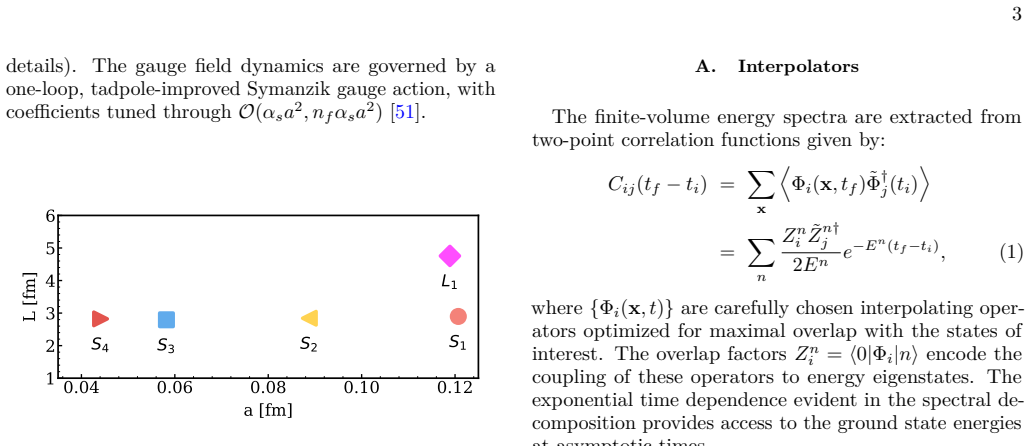
- [Section III, Fig. 7 and Table I] The volume-dependence analysis is confounded. The four S ensembles all have L ≈ 2.7-2.9 fm, so the a^2 continuum extrapolation in Fig. 8 effectively extrapolates the energy shift at essentially a single spatial volume. The only ensemble at a substantially larger volume, L1, simultaneously uses ml/ms = 1/10 instead of 1/5 and a different pion mass, so volume dependence and light-quark-mass dependence cannot be separated. This prevents the negative shift from being cleanly attributed to a genuinely volume-independent bound state rather than a finite-volume scattering-state effect.
- [Section III, zero-range Lüscher analysis] The finite-volume treatment uses a zero-range Lüscher amplitude with one energy level per volume and no constraint on the effective range. With only two volumes, one of which has a different light-quark mass, an attractive scattering state with a large scattering length can reproduce a negative energy shift of this magnitude without a bound-state pole. The paper's own concluding statement that future detailed finite-volume analyses are needed to 'clarify the pole patterns' correctly identifies this limitation; the current data therefore support an attractive interaction, but not yet a definitive identification of a bound-state pole.
minor comments (4)
- [Fig. 2 caption] The caption contains a typo: 'single-bayron' should be 'single-baryon'.
- [Figs. 7 and 8] Please state explicitly in the captions that the vertical axes are in MeV; the figure labels show units but the captions do not.
- [Appendix B] The Clebsch-Gordan and subduction coefficient tables would be much easier to check if explicit row and column labels were included; currently the tables are dense and hard to parse.
- [Section III, bootstrap procedure] Please provide a brief description of the bootstrap procedure used for the continuum-extrapolation errors, including the number of bootstrap samples and how correlations among the five ensembles were handled.
Circularity Check
No significant circularity: the binding-energy claim is a direct continuum extrapolation of independently measured finite-volume energy shifts.
full rationale
The central result, Delta E = -45(24) MeV for the spin-0 Omega_ccc-Omega_ccc system, is obtained by fitting the measured finite-volume energy shifts in Table V to f(a) = c0 + c1 a^2 and reading off c0 (Section III, Fig. 8). The input shifts Delta E = E_D - 2 E_B are extracted from GEVP correlation functions and single-baryon correlation functions on the same ensembles; the threshold subtraction is a standard definition of the energy shift rather than a parameter fitted to the target result. Nothing in the derivation defines the dibaryon operator or the extracted energy in terms of the claimed binding energy, and the continuum extrapolation is a fit of the measured shifts, not a fitted parameter renamed as a prediction. The authors' self-citations ([37], [39]-[48]) are used only to justify reuse of the lattice setup and to compare the quark-mass trend with the earlier bottom-dibaryon study; the binding claim for the charm system does not rely on those cited results. The Luscher zero-range conversion is presented as a consistency check of the same measured energies, not as a new prediction, and the paper explicitly calls for future detailed finite-volume analyses to clarify pole patterns, acknowledging the limitation rather than importing a uniqueness theorem. All seven circularity patterns were checked; none reduces a derived quantity to its own input by construction.
Assumptions & free parameters
free parameters (5)
- c0 (continuum energy shift, charm, spin 0) =
-45(24) MeV
- c0 (continuum energy shift, strange, spin 0) =
32(34) MeV
- c1 (a^2 slope, charm) =
not quoted
- c1 (a^2 slope, strange) =
not quoted
- effective scattering length (zero-range Luscher) =
not quoted
assumptions (5)
- domain assumption The heavy-flavor dibaryon interaction is insensitive to the unphysical light sea-quark masses (ml/ms = 0.1, 0.2).
- ad hoc to paper Discretization errors scale as a^2 with no significant a^4 or quark-mass-dependent lattice artifacts.
- ad hoc to paper The zero-range approximation is sufficient in the Luscher finite-volume analysis.
- domain assumption The asymmetric wall-to-point correlation matrices can be treated with the GEVP to extract the true ground state despite non-Hermiticity.
- domain assumption Only elastic s-wave scattering contributes to the extracted finite-volume levels; higher partial waves and coupled channels are negligible.
Cite this review
Pith. "Pith review of Lattice QCD Study of Positive Parity Dibaryons with Maximal Charm and Strangeness." pith.science (2026). https://pith.science/paper/4GOOLBKO
@misc{pith2026250710660,
  author       = {Pith},
  title        = {Pith review of: Lattice QCD Study of Positive Parity Dibaryons with Maximal Charm and Strangeness},
  year         = {2026},
  howpublished = {\url{https://pith.science/paper/4GOOLBKO}},
  note         = {Machine review of arXiv:2507.10660}
}
abstract
We present the ground-state energy spectra of dibaryons composed of single-flavor quarks, specifically systems with strangeness $\mathcal{S} = -6$ and charm $\mathcal{C} = 6$. Our lattice QCD study is based on $N_f=2+1+1$ MILC ensembles with highly improved staggered quark (HISQ) sea quarks, spanning four lattice spacings and two spatial volumes. We employ valence quark propagators realized using a relativistic overlap action, evaluate correlation matrices with carefully designed operator bases, and extract reliable ground-state energy estimates in the $S = 0$ and $S = 2$ spin channels. We explore their binding characteristics and interaction dynamics by examining the energy separation between the dibaryon states and the corresponding two-baryon thresholds. These results contribute to a deeper understanding of single-flavor dibaryon states as a function of the quark masses. In the $S=0$ channel, the $\Omega_{ccc}$-$\Omega_{ccc}$ system exhibits a clear signal of a bound state, while the $\Omega$-$\Omega$ system lies very close to the threshold, making it difficult to draw definitive conclusions. For $S=2$, both systems are found to be unbound.
Figures


Figures from the paper (6 more)


Reference graph
Works this paper leans on
-
[1]
P. Adlarson et al. (WASA-at-COSY), Evidence for a New Resonance from Polarized Neutron-Proton Scattering, Phys. Rev. Lett. 112, 202301 (2014), arXiv:1402.6844 [nucl-ex]
arXiv 2014
-
[2]
F. Dyson and N. H. Xuong, Y=2 States in Su(6) Theory, Phys. Rev. Lett. 13, 815 (1964)
work page 1964
-
[3]
Clement, On the History of Dibaryons and their Fi- nal Observation, Prog
H. Clement, On the History of Dibaryons and their Fi- nal Observation, Prog. Part. Nucl. Phys. 93, 195 (2017), arXiv:1610.05591 [nucl-ex]
arXiv 2017
-
[4]
Epelbaum, Few-nucleon forces and systems in chiral effective field theory, Prog
E. Epelbaum, Few-nucleon forces and systems in chiral effective field theory, Prog. Part. Nucl. Phys. 57, 654 (2006), arXiv:nucl-th/0509032
arXiv 2006
-
[5]
A. Bazavov et al., Additional Strange Hadrons from QCD Thermodynamics and Strangeness Freezeout in Heavy Ion Collisions, Phys. Rev. Lett. 113, 072001 (2014), arXiv:1404.6511 [hep-lat]
arXiv 2014
-
[6]
D. Chatterjee and I. Vida˜ na, Do hyperons exist in the interior of neutron stars?, Eur. Phys. J. A 52, 29 (2016), arXiv:1510.06306 [nucl-th]
arXiv 2016
-
[7]
The $d^*(2380)$ in neutron stars - a new degree of freedom?
I. Vida˜ na, M. Bashkanov, D. P. Watts, and A. Pastore, The d∗(2380) in neutron stars - a new degree of freedom?, Phys. Lett. B 781, 112 (2018), arXiv:1706.09701 [nucl-th]
work page Pith review arXiv 2018
-
[8]
L. Tolos and L. Fabbietti, Strangeness in Nuclei and Neutron Stars, Prog. Part. Nucl. Phys.112, 103770 (2020), arXiv:2002.09223 [nucl-ex]
arXiv 2020
Show all 62 references
-
[9]
R. J. Oakes, Baryon-Baryon Interactions and the Eight- fold Way, Phys. Rev. 131, 2239 (1963)
1963
-
[10]
Bashkanov, S
M. Bashkanov, S. J. Brodsky, and H. Clement, Novel 14 Six-Quark Hidden-Color Dibaryon States in QCD, Phys. Lett. B 727, 438 (2013), arXiv:1308.6404 [hep-ph]
2013 arXiv
-
[11]
Adlarson et al
P. Adlarson et al. (WASA-at-COSY), Search for an isospin I = 3 dibaryon, Phys. Lett. B 762, 455 (2016), arXiv:1606.02964 [nucl-ex]
2016 arXiv
-
[12]
Morita, S
K. Morita, S. Gongyo, T. Hatsuda, T. Hyodo, Y. Kamiya, and A. Ohnishi, Probing ΩΩ and pΩ dibaryons with femtoscopic correlations in relativistic heavy-ion collisions, Phys. Rev. C 101, 015201 (2020), arXiv:1908.05414 [nucl- th]
2020 arXiv
-
[13]
Bashkanov, D
M. Bashkanov, D. P. Watts, G. Clash, M. Mocanu, and M. Nicol, Dibaryons and where to find them, J. Phys. G 51, 045106 (2024), arXiv:2308.07066 [hep-ph]
2024 arXiv
-
[14]
Q. B. Li, P. N. Shen, Z. Y. Zhang, and Y. W. Yu, Dibaryon systems in chiral SU(3) quark model, Nucl. Phys. A 683, 487 (2001), arXiv:nucl-th/0009038
2001 arXiv
-
[15]
Wang, J.-l
F. Wang, J.-l. Ping, G.-h. Wu, L.-j. Teng, and J. T. Gold- man, Quark delocalization, color screening and dibaryons, Phys. Rev. C 51, 3411 (1995), arXiv:nucl-th/9512014
1995 arXiv
-
[16]
Huang, J
H. Huang, J. Ping, and F. Wang, Dynamical calculation of the ∆∆ dibaryon candidates, Phys. Rev. C 89, 034001 (2014), arXiv:1312.7756 [hep-ph]
2014 arXiv
-
[17]
Huang, X
H. Huang, X. Zhu, and J. Ping, Reanalysis of the most strange dibaryon within constituent quark models, Phys. Rev. C 101, 034004 (2020), arXiv:1912.11256 [hep-ph]
2020 arXiv
-
[18]
Huang, J
H. Huang, J. Ping, X. Zhu, and F. Wang, Fully heavy dibaryons, Eur. Phys. J. C 82, 805 (2022), arXiv:2011.00513 [hep-ph]
2022 arXiv
-
[19]
Z. Y. Zhang, Y. W. Yu, C. R. Ching, T. H. Ho, and Z.-D. Lu, Suggesting a di-omega dibaryon search in heavy ion collision experiments, Phys. Rev. C 61, 065204 (2000)
2000
-
[20]
Liu and L.-S
M.-Z. Liu and L.-S. Geng, Prediction of an ΩbbbΩbbb Dibaryon in the Extended One-Boson Exchange Model, Chin. Phys. Lett. 38, 101201 (2021), arXiv:2107.04957 [hep-ph]
2021 arXiv
-
[21]
G. P. Lepage, The Analysis of Algorithms for Lattice Field Theory, in Theoretical Advanced Study Institute in Elementary Particle Physics (1989)
1989
-
[22]
M. L. Wagman, F. Winter, E. Chang, Z. Davoudi, W. Det- mold, K. Orginos, M. J. Savage, and P. E. Shanahan, Baryon-Baryon Interactions and Spin-Flavor Symmetry from Lattice Quantum Chromodynamics, Phys. Rev. D 96, 114510 (2017), arXiv:1706.06550 [hep-lat]
2017 arXiv
-
[23]
Francis, J
A. Francis, J. R. Green, P. M. Junnarkar, C. Miao, T. D. Rae, and H. Wittig, Lattice QCD study of the H dibaryon using hexaquark and two-baryon interpolators, Phys. Rev. D 99, 074505 (2019), arXiv:1805.03966 [hep-lat]
2019 arXiv
-
[24]
Iritani, S
T. Iritani, S. Aoki, T. Doi, T. Hatsuda, Y. Ikeda, T. Inoue, N. Ishii, H. Nemura, and K. Sasaki (HAL QCD), Consis- tency between L¨ uscher’s finite volume method and HAL QCD method for two-baryon systems in lattice QCD, JHEP 03, 007, arXiv:1812.08539 [hep-lat]
-
[25]
Amarasinghe, R
S. Amarasinghe, R. Baghdadi, Z. Davoudi, W. Detmold, M. Illa, A. Parreno, A. V. Pochinsky, P. E. Shanahan, and M. L. Wagman, Variational study of two-nucleon systems with lattice QCD, Phys. Rev. D 107, 094508 (2023), arXiv:2108.10835 [hep-lat]
2023 arXiv
-
[26]
J. R. Green, A. D. Hanlon, P. M. Junnarkar, and H. Wittig, Weakly bound H dibaryon from SU(3)-flavor- symmetric QCD, Phys. Rev. Lett. 127, 242003 (2021), arXiv:2103.01054 [hep-lat]
2021 arXiv
-
[27]
Aoki and T
S. Aoki and T. Doi, Lattice QCD and Baryon-Baryon Interactions, in Handbook of Nuclear Physics , edited by I. Tanihata, H. Toki, and T. Kajino (2023) pp. 1–31, arXiv:2402.11759 [hep-lat]
2023 arXiv
-
[28]
M. L. Wagman, Lanczos, the transfer matrix, and the signal-to-noise problem, (2024), arXiv:2406.20009 [hep- lat]
2024 arXiv
-
[29]
D. C. Hackett and M. L. Wagman, Lanczos for lattice QCD matrix elements, (2024), arXiv:2407.21777 [hep-lat]
2024 arXiv
-
[30]
Chakraborty, D
D. Chakraborty, D. Sood, A. Radhakrishnan, and N. Mathur, Estimating energy levels from lattice QCD correlation functions using a transfer matrix formalism, (2024), arXiv:2412.01900 [hep-lat]
2024 arXiv
-
[31]
Ostmeyer, A
J. Ostmeyer, A. Sen, and C. Urbach, On the equivalence of Prony and Lanczos methods for Euclidean correlation functions, Eur. Phys. J. A 61, 26 (2025), arXiv:2411.14981 [hep-lat]
2025 arXiv
-
[32]
B. C. Tiburzi and A. Walker-Loud, Hyperons in Two Flavor Chiral Perturbation Theory, Phys. Lett. B 669, 246 (2008), arXiv:0808.0482 [nucl-th]
2008 arXiv
-
[33]
M. I. Buchoff, T. C. Luu, and J. Wasem, S-wave scattering of strangeness -3 baryons, Phys. Rev. D85, 094511 (2012), arXiv:1201.3596 [hep-lat]
2012 arXiv
-
[34]
Yamada, K
M. Yamada, K. Sasaki, S. Aoki, T. Doi, T. Hatsuda, Y. Ikeda, T. Inoue, N. Ishii, K. Murano, and H. Nemura (HAL QCD), ΩΩ interaction from 2+1 flavor lattice QCD, PTEP 2015, 071B01 (2015), arXiv:1503.03189 [hep-lat]
2015 arXiv
-
[35]
Gongyo et al
S. Gongyo et al. , Most Strange Dibaryon from Lat- tice QCD, Phys. Rev. Lett. 120, 212001 (2018), arXiv:1709.00654 [hep-lat]
2018 arXiv
-
[36]
Y. Lyu, H. Tong, T. Sugiura, S. Aoki, T. Doi, T. Hatsuda, J. Meng, and T. Miyamoto, Dibaryon with Highest Charm Number near Unitarity from Lattice QCD, Phys. Rev. Lett. 127, 072003 (2021), arXiv:2102.00181 [hep-lat]
2021 arXiv
-
[37]
Mathur, M
N. Mathur, M. Padmanath, and D. Chakraborty, Strongly Bound Dibaryon with Maximal Beauty Flavor from Lattice QCD, Phys. Rev. Lett. 130, 111901 (2023), arXiv:2205.02862 [hep-lat]
2023 arXiv
-
[38]
Luscher, Two particle states on a torus and their relation to the scattering matrix, Nucl
M. Luscher, Two particle states on a torus and their relation to the scattering matrix, Nucl. Phys. B 354, 531 (1991)
1991
-
[39]
Junnarkar, N
P. Junnarkar, N. Mathur, and M. Padmanath, Study of doubly heavy tetraquarks in Lattice QCD, Phys. Rev. D 99, 034507 (2019), arXiv:1810.12285 [hep-lat]
2019 arXiv
-
[40]
Mathur, M
N. Mathur, M. Padmanath, and S. Mondal, Precise pre- dictions of charmed-bottom hadrons from lattice QCD, Phys. Rev. Lett. 121, 202002 (2018), arXiv:1806.04151 [hep-lat]
2018 arXiv
-
[41]
Mathur and M
N. Mathur and M. Padmanath, Lattice QCD study of doubly-charmed strange baryons, Phys. Rev. D99, 031501 (2019), arXiv:1807.00174 [hep-lat]
2019 arXiv
-
[42]
Junnarkar and N
P. Junnarkar and N. Mathur, Deuteronlike Heavy Dibaryons from Lattice Quantum Chromodynamics, Phys. Rev. Lett. 123, 162003 (2019), arXiv:1906.06054 [hep-lat]
2019 arXiv
-
[43]
P. M. Junnarkar and N. Mathur, Study of three-flavored heavy dibaryons using lattice QCD, Phys. Rev. D 106, 054511 (2022), arXiv:2206.02942 [hep-lat]
2022 arXiv
-
[44]
Padmanath, A
M. Padmanath, A. Radhakrishnan, and N. Mathur, Bound Isoscalar Axial-Vector bcu¯d¯ Tetraquark Tbc from Lat- tice QCD Using Two-Meson and Diquark-Antidiquark Variational Basis, Phys. Rev. Lett. 132, 201902 (2024), arXiv:2307.14128 [hep-lat]
2024 arXiv
-
[45]
Radhakrishnan, M
A. Radhakrishnan, M. Padmanath, and N. Mathur, Study of the isoscalar scalar bcu¯d¯ tetraquark Tbc with lattice QCD, Phys. Rev. D 110, 034506 (2024), arXiv:2404.08109 [hep-lat]
2024 arXiv
-
[46]
N. S. Dhindsa, D. Chakraborty, A. Radhakrishnan, 15 N. Mathur, and M. Padmanath, Precise study of triply charmed baryons (Ωccc), (2024), arXiv:2411.12729 [hep- lat]
2024
-
[47]
P. M. Junnarkar and N. Mathur, Spectrum of two-flavored spin-zero heavy dibaryons in lattice QCD, Phys. Rev. D 111, 014512 (2025), arXiv:2410.08519 [hep-lat]
2025 arXiv
-
[48]
B. S. Tripathy, N. Mathur, and M. Padmanath, bbu ¯d¯ and bsu ¯d¯ tetraquarks from lattice QCD using two- meson and diquark-antidiquark variational basis, Phys. Rev. D 111, 114504 (2025), arXiv:2503.09760 [hep-lat]
2025 arXiv
-
[49]
Bazavov et al
A. Bazavov et al. (MILC), Lattice QCD Ensembles with Four Flavors of Highly Improved Staggered Quarks, Phys. Rev. D 87, 054505 (2013), arXiv:1212.4768 [hep-lat]
2013 arXiv
-
[50]
Bazavov et al
A. Bazavov et al. , B- and D-meson leptonic decay con- stants from four-flavor lattice QCD, Phys. Rev. D 98, 074512 (2018), arXiv:1712.09262 [hep-lat]
2018 arXiv
-
[51]
Follana, Q
E. Follana, Q. Mason, C. Davies, K. Hornbostel, G. P. Lep- age, J. Shigemitsu, H. Trottier, and K. Wong (HPQCD, UKQCD), Highly improved staggered quarks on the lat- tice, with applications to charm physics, Phys. Rev. D 75, 054502 (2007), arXiv:hep-lat/0610092
2007 arXiv
-
[52]
Neuberger, Exactly massless quarks on the lattice, Phys
H. Neuberger, Exactly massless quarks on the lattice, Phys. Lett. B 417, 141 (1998), arXiv:hep-lat/9707022
1998 arXiv
-
[53]
Neuberger, More about exactly massless quarks on the lattice, Phys
H. Neuberger, More about exactly massless quarks on the lattice, Phys. Lett. B 427, 353 (1998), arXiv:hep- lat/9801031
1998
-
[54]
Chakraborty, C
B. Chakraborty, C. T. H. Davies, B. Galloway, P. Knecht, J. Koponen, G. C. Donald, R. J. Dowdall, G. P. Lepage, and C. McNeile, High-precision quark masses and QCD coupling from nf = 4 lattice QCD, Phys. Rev. D 91, 054508 (2015), arXiv:1408.4169 [hep-lat]
2015 arXiv
-
[55]
A. X. El-Khadra, A. S. Kronfeld, and P. B. Mackenzie, Massive fermions in lattice gauge theory, Phys. Rev. D 55, 3933 (1997), arXiv:hep-lat/9604004
1997 arXiv
-
[56]
Basak, S
S. Basak, S. Datta, M. Padmanath, P. Majumdar, and N. Mathur, Charm and strange hadron spectra from over- lap fermions on HISQ gauge configurations, PoS LAT- TICE2012, 141 (2012), arXiv:1211.6277 [hep-lat]
2012 arXiv
-
[57]
Basak, S
S. Basak, S. Datta, A. T. Lytle, M. Padmanath, P. Majum- dar, and N. Mathur, Hadron spectra from overlap fermions on HISQ gauge configurations, PoS LATTICE2013, 243 (2014), arXiv:1312.3050 [hep-lat]
2014 arXiv
-
[58]
R. J. Hudspith, B. Colquhoun, A. Francis, R. Lewis, and K. Maltman, A lattice investigation of exotic tetraquark channels, Phys. Rev. D 102, 114506 (2020), arXiv:2006.14294 [hep-lat]
2020 arXiv
-
[59]
Basak, R
S. Basak, R. Edwards, G. T. Fleming, U. M. Heller, C. Morningstar, D. Richards, I. Sato, and S. J. Wallace (Lattice Hadron Physics (LHPC)), Clebsch-Gordan con- struction of lattice interpolating fields for excited baryons, Phys. Rev. D 72, 074501 (2005), arXiv:hep-lat/0508018
2005 arXiv
-
[60]
R. C. Johnson, ANGULAR MOMENTUM ON A LAT- TICE, Phys. Lett. B 114, 147 (1982)
1982
-
[61]
R. A. Briceno, Two-particle multichannel systems in a finite volume with arbitrary spin, Phys. Rev. D89, 074507 (2014), arXiv:1401.3312 [hep-lat]
2014 arXiv
-
[62]
Morningstar, J
C. Morningstar, J. Bulava, B. Singha, R. Brett, J. Fallica, A. Hanlon, and B. H¨ orz, Estimating the two-particleK- matrix for multiple partial waves and decay channels from finite-volume energies, Nucl. Phys. B 924, 477 (2017), arXiv:1707.05817 [hep-lat]
2017 arXiv
Reviewed August 6, 2026 · model on record in the stance chip above.
Discussion (0). Sign in to comment.