REVIEW 4 major objections 6 minor 26 references
Language Models for Adult Service Website Text Analysis
T0 review · 4 major / 6 minor · reviewed 2026-08-06 · deepseek-v4-flash
Pith's one-line read Custom BERT models trained on adult-service ad text beat general encoders on authorship verification.
desk verdict First credible ASW-specific pre-trained models, but the headline evaluation is entangled with the graph labels it was built from. read the letter →
The pith
A machine-rendered reading of the paper's core claim, the machinery that carries it, and where it could break.
The reading
What carries the argument
The machinery is a BERT-base encoder re-built for the ASW domain: a WordPiece tokenizer trained on ASW text at three vocabulary sizes, pre-training with masked language modeling or whole-word masking at sequence lengths of 64 or 128 tokens instead of 512, and a mean-pooling layer fine-tuned with contrastive learning on 4 million anchor-positive-negative triplets. The short sequence length exploits the fact that 99.7% of tokenized posts fit in 64 tokens, cutting self-attention cost enough to train on a single high-end GPU rather than a large cluster. Labels come from a graph whose edges connect posts and perceptual hashes that co-occur in ads; each non-giant connected component is assumed to be one posting entity.
What would settle it
Take a held-out set of ads whose true authorship is known from independent records, strip out phone numbers, URLs, and other direct identifiers, and measure whether the custom model still outperforms fine-tuned RoBERTa and ModernBERT; if the gap disappears, the reported gains come from memorizing identifiers rather than from linguistic understanding.
Extended reading notes
Core claim
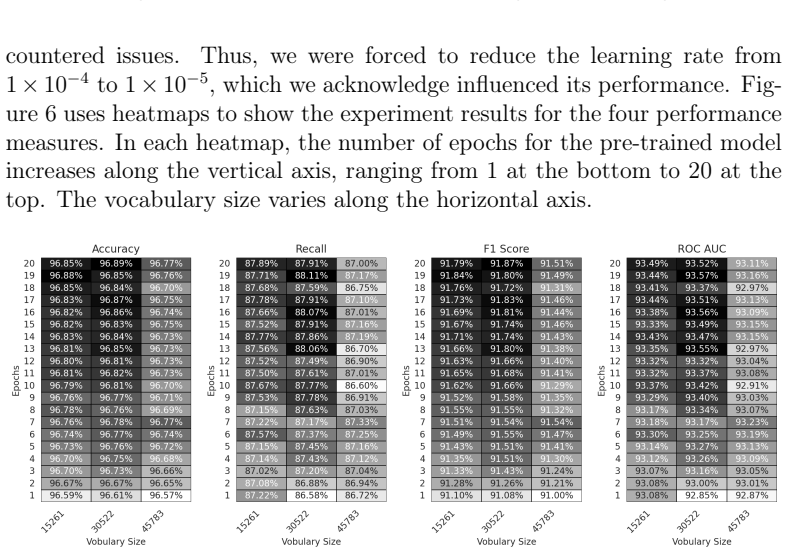
The central claim is that domain-specific pre-training on 19.8 million unique ASW post texts, using custom WordPiece tokenizers and short sequence lengths, yields sentence-encoder embeddings that are more accurate for ASW authorship verification than fine-tuned general encoders. On a one-million-pair classification dataset, the best custom configuration, BERT-New30522-MLM with a 64-token sequence length and 20 pre-training epochs, reaches performance at or near the top across accuracy, recall, F1, and ROC AUC, and it does so using dense embeddings alone, without sparse ensemble help. The authors also show the learned embeddings can filter erroneous edges in ASW data graphs, retrieve semantically similar ads, and place illicit emojis in a meaningful semantic space.
Load-bearing premise
The whole training and evaluation pipeline assumes that every non-giant connected component of the post-text and perceptual-hash graph is the work of a single posting entity, so the labels used to train and test the models inherit any mistakes in that grouping.
Editorial extensions
If this is right
- If the claim is correct, ASW-specific models can be trained cheaply and deployed on consumer hardware, with even three pre-training epochs already beating general models on authorship verification.
- Practitioners can dismantle the giant component of an ASW data graph into author-coherent clusters by setting a single cosine-similarity threshold on the custom sentence embeddings.
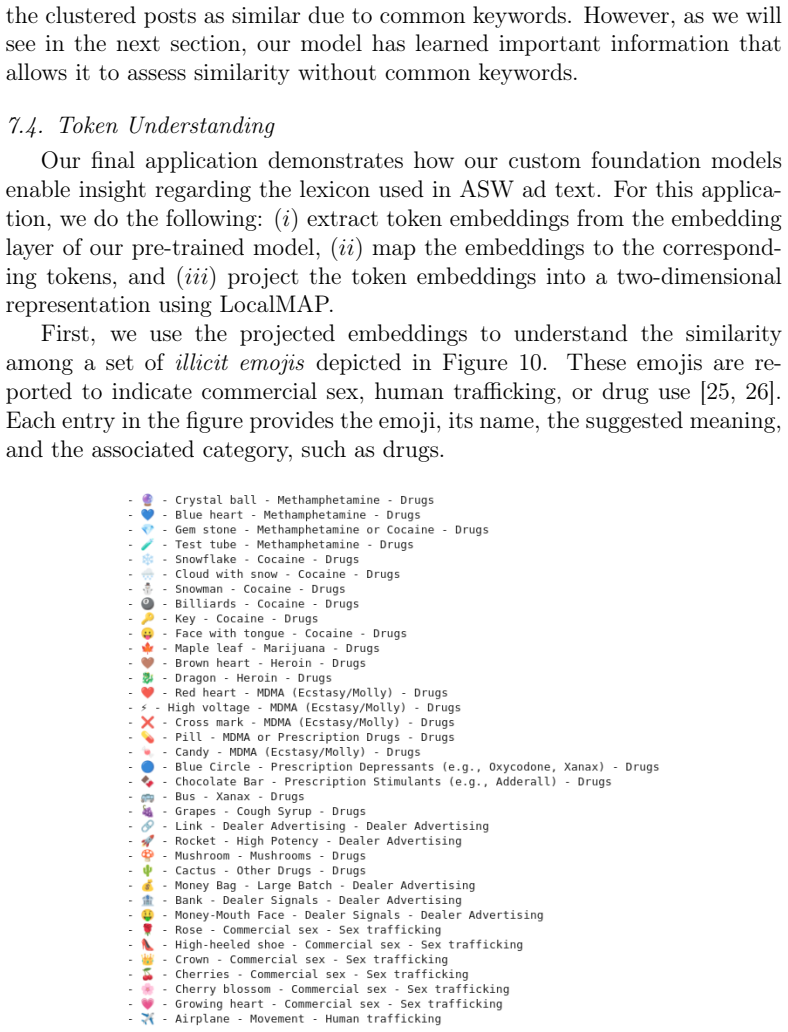
- The learned token embeddings can be used to expand known lists of illicit emojis and coded language, since the model groups drug-, dealer-, and commercial-sex-related emojis together in the projected embedding space.
- The same contrastive fine-tuning recipe is what delivers the largest measured gains, so domain pre-training plus contrastive fine-tuning is a transferable template for specialized text analysis.
Reading between the lines
- Editorial inference: the same pre-train-then-contrastive-fine-tune recipe may transfer to other short, obfuscated, emoji-heavy text domains, such as drug-market listings or spam, where general-purpose encoders also tend to underperform.
- Editorial inference: because direct identifiers like phone numbers and URLs remain in the training text, a portion of the reported improvement could come from memorizing those identifiers rather than from linguistic understanding; a redaction test would separate these signals.
- Editorial inference: the early plateau between 3 and 5 pre-training epochs suggests that most of the benefit comes from a small amount of domain adaptation, not from massive additional compute, although the paper's own curves stop at 20 epochs and show some variability.
- Editorial inference: the component-as-author label assumption is the main source of label noise, so the method's real-world ceiling depends on how often a connected component actually mixes multiple posting entities.
Editorial analysis
A structured set of objections, weighed in public.
Referee Report
Summary. This paper develops custom BERT-based language models for analyzing text from adult service websites (ASWs). The authors build a graph over post texts and perceptual hashes, treat each non-giant connected component as a single posting entity, and use that assumption to generate a 4M-triplet contrastive dataset and a 1M-pair authorship-verification classification dataset. They pre-train six custom BERT configurations (vocabulary sizes 15,261/30,522/45,783; MLM or WWMLM; sequence lengths 64 or 128) on 19.8M unique post texts, fine-tune sentence transformers on the triplet data, and train binary classifiers on the pair data. They report that the custom models, especially the 20-epoch BERT-New30522-MLM variant, outperform fine-tuned BERT-base, RoBERTa, and ModernBERT on accuracy, recall, F1, and ROC AUC. They also demonstrate three applications: decomposing the giant component of an ASW ad graph, semantic search/clustering, and token/emoji embedding analysis.
Significance. If the reported gains are real, the paper would provide a valuable domain-specific resource for ASW text analysis and a practical recipe for efficient transformer training (short sequences, bfloat16, single-GPU hardware). The scale of the pre-training corpus and the three downstream demonstrations are notable strengths. However, the central comparative claim depends on labels that are generated by the same connected-component construction that the model is later used to predict, and the training/evaluation texts may retain direct identifiers such as phone numbers and URLs. Until these threats are resolved, the results are best interpreted as a proof of concept rather than an established superiority claim. The paper does not ship machine-checked code or an open dataset, and the authors state that data availability will be subject to consultation with law enforcement partners, which limits external reproducibility.
major comments (4)
- [Sections 3.2, 3.3, 5, 6, 7.2] The labels for both the triplet dataset and the classification dataset are defined by the graph-connected-component assumption in Section 3.2: all posts in a non-giant component are assigned to one posting entity, and posts in different components are assigned to different entities. The authorship-verification model is then trained to reproduce exactly that component structure, and Section 7.2 applies it to decompose the same type of graph. If a component actually mixes multiple authors or splits one author across components, the labels contain systematic noise, and the reported accuracy, recall, F1, and ROC AUC measure agreement with the graph construction rather than with true authorship. Please validate the component labels on an external or manually annotated sample (for example, using known phone-number groupings or a small hand-labeled set) and report sensitivity to the hard-negative cosine threshold (0.2) and to the TF-IDF similarity thresholds used when building the graph.
- [Sections 3.1, 3.2, 7.1] The unique posts corpus used for pre-training, triplet construction, and classification is not scrubbed of direct identifiers: the paper states that the raw ads contain phone numbers, URLs, names, and site names, and the open application dataset uses a 'post_masked' column specifically to obfuscate numbers. If these identifiers remain in the training and evaluation texts, a model can achieve high performance by memorizing surface patterns rather than by learning linguistic similarity. This would differentially benefit the custom models, which see ASW-specific tokens during pre-training, and would invalidate the interpretation that the improvement reflects linguistic understanding. Please retrain or at least re-evaluate on a version of the corpora with identifiers removed (mirroring post_masked) and report the change in all metrics.
- [Figures 3 and 6, Sections 5 and 6] The headline heatmaps report point estimates without error bars, confidence intervals, or significance tests. The main-effects plots in Figures 4 and 5 show 95% confidence intervals, but the individual model comparisons that support the claim 'custom models outperform RoBERTa and ModernBERT' are not accompanied by any measure of uncertainty. Given that some of the reported differences appear small relative to the spread visible in the aggregate intervals, it is unclear whether the observed advantages are beyond sampling noise. Please provide per-configuration confidence intervals or repeated-run results, and use a multiple-comparison correction if pairwise tests are reported.
- [Sections 5 and 6] The paper does not specify how the 1M-pair classification dataset is split for training and evaluating the binary classifiers, and in Experiment 2 the 60 checkpoint models are evaluated on the same classification dataset that is used to select the recommended configuration. This creates a risk of selection-on-test overfitting: the reported peak performance of BERT-New30522-MLM (20 epochs) may be optimistic because the same data determines both model choice and final metrics. Please describe the train/validation/test split explicitly, and re-evaluate the chosen model on a held-out set that was not used for checkpoint selection.
minor comments (6)
- [Section 2.2.2] The model name is spelled 'RoBERTA' in the section title and once in the text; it should be 'RoBERTa'.
- [Section 4, first paragraph] The text reads 'Previous research involving AWS data'; this should be 'ASW data'.
- [Section 4.2.3] The two paragraphs describing the custom model variants repeat the same description of whole word masked language modeling almost verbatim; one of the passages should be removed.
- [Figure 2 caption] The caption mentions 'black horizontal reference lines' but the figure is not reproduced in the manuscript text; please ensure the final PDF includes the figure with those reference lines visible.
- [Section 7.3] The method is called 'LocalMAP' in the text, but the citation title refers to 'locally adjusted graphs'; please clarify whether LocalMAP is the algorithm from reference [23] or a different variant.
- [Abstract and Section 1] The expansion 'Adult Services Websites' appears in the abstract, while Section 1 uses 'Adult Services Websites' and later 'ASWs'; please ensure the expansion is consistent throughout.
Circularity Check
No circularity: the central model comparison is a controlled supervised experiment with an explicit shared label definition; the graph-component assumption is a validity limitation, not a circular dependency.
full rationale
The paper's central claim is a comparative empirical result: custom ASW-pretrained encoders outperform BERT-base, RoBERTa, and ModernBERT when all are fine-tuned on the same triplet dataset and evaluated on the same classification dataset (Sections 4.2, 5, and 6). This comparison is controlled and could plausibly have come out the other way; the custom models' advantage is not imposed by construction. The graph-component label definition in Section 3.2 ('assume the data associated with each of the 1,883,588 non-giant components can be attributed to an individual or unique posting entity') is an explicit operationalization of 'same posting entity.' Because the classification labels are defined as same-component membership, the evaluation measures component-membership prediction; whether that corresponds to true authorship is an external-validity limitation, not a circular derivation. The paper does not fit a parameter and then rename it as a prediction, nor does it invoke a self-citation as a forced justification. The self-citations ([13] and [14]) provide the graph-construction method and the open dataset used in applications; they serve as provenance rather than as the load-bearing argument. The downstream giant-component decomposition (Section 7.2) is an application of the trained model, not a validation of the training labels. Accordingly, no step in the claimed derivation reduces to its own input.
Assumptions & free parameters
free parameters (6)
- hard negative cosine threshold =
0.2
- maximum sequence length =
64 (128 in exploration)
- pre-training epochs =
3 (exploration), 20 (final)
- learning rate reduction for BERT-New45783-MLM =
1e-5 (down from 1e-4)
- GC filtering cosine thresholds =
0.05 to 0.95
- classification dataset imbalance =
20% positive
assumptions (5)
- domain assumption Each non-giant connected component of the text/hash graph corresponds to a single posting entity.
- domain assumption Co-occurrence of a post text and a perceptual hash in one ad is sufficient to link texts into an authorship component.
- domain assumption TF-IDF cosine similarity above 0.2 is a meaningful notion of text similarity for selecting hard negatives.
- standard math The BERT architecture, attention mechanism, and MLM/WWMLM objectives transfer to ASW text with a custom emoji-aware tokenizer.
- domain assumption The DEA and DarkOwl lists of illicit emojis are accurate ground truth for emoji meaning in ASW text.
Cite this review
Pith. "Pith review of Language Models for Adult Service Website Text Analysis." pith.science (2026). https://pith.science/paper/7GKVYCPC
@misc{pith2026250710743,
  author       = {Pith},
  title        = {Pith review of: Language Models for Adult Service Website Text Analysis},
  year         = {2026},
  howpublished = {\url{https://pith.science/paper/7GKVYCPC}},
  note         = {Machine review of arXiv:2507.10743}
}
read the original abstract
Sex trafficking refers to the use of force, fraud, or coercion to compel an individual to perform in commercial sex acts against their will. Adult service websites (ASWs) have and continue to be linked to sex trafficking, offering a platform for traffickers to advertise their victims. Thus, organizations involved in the fight against sex trafficking often use ASW data when attempting to identify potential sex trafficking victims. A critical challenge in transforming ASW data into actionable insight is text analysis. Previous research using ASW data has shown that ASW ad text is important for linking ads. However, working with this text is challenging due to its extensive use of emojis, poor grammar, and deliberate obfuscation to evade law enforcement scrutiny. We conduct a comprehensive study of language modeling approaches for this application area, including simple information retrieval methods, pre-trained transformers, and custom transformer models. We demonstrate that characteristics of ASW text data allow efficient custom transformer models to be trained with relatively small GPU resources and used efficiently for inference on consumer hardware. Our custom models outperform fine-tuned variants of well-known encoder-only transformer models, including BERT-base, RoBERTa, and ModernBERT, on accuracy, recall, F1 score, and ROC AUC. We demonstrate the use of our best-performing custom configuration on three tasks related to ASW data analysis: (i) decomposing the giant component in a graph representation of ASW data, (ii) clustering ASW ad text, and (iii) using the learned token embeddings to understand the use of emojis in the illicit context we study. The models we develop represent a significant advancement in ASW text analysis, which can be leveraged in a variety of downstream applications and research.
Figures


Figures from the paper (9 more)






Reference graph
Works this paper leans on
-
[1]
L. Li, O. Simek, A. Lai, M. Daggett, C. K. Dagli, C. Jones, Detection and characterization of human trafficking networks using unsupervised scalable text template matching, in: 2018 IEEE International Confer- ence on big data (big data), IEEE, 2018, pp. 3111–3120
work page 2018
-
[2]
M.-C. Lee, C. Vajiac, A. Kulshrestha, S. Levy, N. Park, C. Jones, R. Rabbany, C. Faloutsos, Infoshield: Generalizable information- theoretic human-trafficking detection, in: 2021 IEEE 37th International Conference on Data Engineering (ICDE), IEEE, 2021, pp. 1116–1127
work page 2021
-
[3]
E. Tong, A. Zadeh, C. Jones, L.-P. Morency, Combating human traffick- ing with multimodal deep models, in: R. Barzilay, M.-Y. Kan (Eds.), Proceedings of the 55th Annual Meeting of the Association for Com- putational Linguistics (Volume 1: Long Papers), Association for Com- putational Linguistics, Vancouver, Canada, 2017, pp. 1547–1556. URL: https://aclant...
-
[4]
C. Vajiac, M.-C. Lee, A. Kulshrestha, S. Levy, N. Park, A. Ol- ligschlaeger, C. Jones, R. Rabbany, C. Faloutsos, Deltashield: Infor- mation theory for human-trafficking detection, ACM Transactions on Knowledge Discovery from Data 17 (2023) 1–27
work page 2023
-
[5]
P. Nair, J. Liu, C. Vajiac, A. Olligschlaeger, D. H. Chau, M. Cazzolato, C. Jones, C. Faloutsos, R. Rabbany, T-net: Weakly supervised graph learning for combatting human trafficking, in: Proceedings of the AAAI Conference on Artificial Intelligence, volume 38, 2024, pp. 22276–22284
work page 2024
-
[6]
Y. Li, P. Nair, K. Pelrine, R. Rabbany, Extracting person names from user generated text: Named-entity recognition for combating human trafficking, in: Findings of the Association for Computational Linguis- tics: ACL 2022, 2022, pp. 2854–2868
work page 2022
-
[7]
A. R. Perez, P. Rivas, J. Turek, K. Sooksatra, E. Quevedo, G. Bichler, T. Cerny, L. Giddens, S. Petter, Decoding the obfuscated: Advanced ner techniqueson commercialsex advertisement data, in: 2023International Conference on Computational Science and Computational Intelligence (CSCI), IEEE, 2023, pp. 144–151
work page 2023
-
[8]
S. S. Esfahani, M. J. Cafarella, M. B. Pouyan, G. DeAngelo, E. Eneva, A. E. Fano, Context-specific language modeling for human trafficking detectionfrom onlineadvertisements, in: Proceedingsofthe 57th annual meeting of the association for computational linguistics, 2019, pp. 1180– 1184
work page 2019
Show all 26 references
-
[9]
J. Zhu, L. Li, C. Jones, Identification and detection of human trafficking using language models, in: 2019 European Intelligence and Security Informatics Conference (EISIC), IEEE, 2019, pp. 24–31
2019
-
[10]
R. Li, M. Tobey, M. E. Mayorga, S. Caltagirone, O. Y. Özaltın, De- tecting human trafficking: Automated classification of online customer reviews of massage businesses, Manufacturing & Service Operations Management 25 (2023) 1051–1065
2023
-
[11]
Saxena, B
V. Saxena, B. Bashpole, G. Van Dijck, G. Spanakis, Idtraffickers: An authorship attribution dataset to link and connect potential human- trafficking operations on text escort advertisements, arXiv preprint arXiv:2310.05484 (2023). 30
2023 arXiv
-
[12]
Giorgi, O
J. Giorgi, O. Nitski, B. Wang, G. Bader, Declutr: Deep contrastive learning for unsupervised textual representations, 2021. URL:https: //arxiv.org/abs/2006.03659.arXiv:2006.03659
2021 arXiv
-
[13]
B. B. Keskin, G. J. Bott, N. K. Freeman, Cracking sex trafficking: Data analysis, pattern recognition, and path prediction, Production and Operations Management 30 (2021) 1110–1135
2021
-
[14]
N. K. Freeman, G. J. Bott, B. B. Keskin, T. L. Marcantonio, A multi- site data sample for analyzing the online commercial sex ecosystem, ScientificData12(2025).doi:https://doi.org/10.1038/s41597-025- 04442-w
2025 doi
-
[15]
Vaswani, N
A. Vaswani, N. Shazeer, N. Parmar, J. Uszkoreit, L. Jones, A. N. Gomez, Ł. Kaiser, I. Polosukhin, Attention is all you need, Advances in neural information processing systems 30 (2017)
2017
-
[16]
Devlin, M.-W
J. Devlin, M.-W. Chang, K. Lee, K. Toutanova, BERT: Pre-training of deep bidirectional transformers for language understanding, in: Pro- ceedings of the 2019 Conference of the North American Chapter of the Association for Computational Linguistics: Human Language Technolo- gie...
2019 doi
-
[17]
Y. Liu, M. Ott, N. Goyal, J. Du, M. Joshi, D. Chen, O. Levy, M. Lewis, L. Zettlemoyer, V. Stoyanov, RoBERTa: A robustly opti- mized BERT pretraining approach, 2019. URL:https://arxiv.org/ abs/1907.11692.arXiv:1907.11692
2019 arXiv
-
[18]
Warner, A
B. Warner, A. Chaffin, B. Clavié, O. Weller, O. Hallström, S. Taghadouini, A. Gallagher, R. Biswas, F. Ladhak, T. Aarsen, N. Cooper, G. Adams, J. Howard, I. Poli, Smarter, better, faster, longer: A modern bidirectional encoder for fast, memory efficient, and long con- text fin...
2024 arXiv
-
[19]
Spärck Jones, A statistical interpretation of term specificity and its application in retrieval, Journal of Documentation 28 (1972) 11–21
K. Spärck Jones, A statistical interpretation of term specificity and its application in retrieval, Journal of Documentation 28 (1972) 11–21. 31
1972
-
[20]
Pedregosa, G
F. Pedregosa, G. Varoquaux, A. Gramfort, V. Michel, B. Thirion, O.Grisel, M.Blondel, P.Prettenhofer, R.Weiss, V.Dubourg, J.Vander- plas, A. Passos, D. Cournapeau, M. Brucher, M. Perrot, E. Duchesnay, Scikit-learn: Machine learning in Python, Journal of Machine Learning Researc...
2011
-
[21]
Reimers, I
N. Reimers, I. Gurevych, Sentence-bert: Sentence embeddings using siamese bert-networks, arXiv preprint arXiv:1908.10084 (2019)
2019 arXiv
-
[22]
Kalamkar, D
D. Kalamkar, D. Mudigere, N. Mellempudi, D. Das, K. Banerjee, S. Avancha, D. T. Vooturi, N. Jammalamadaka, J. Huang, H. Yuen, et al., A study of bfloat16 for deep learning training, arXiv preprint arXiv:1905.12322 (2019)
2019 arXiv
-
[23]
Y. Wang, Y. Sun, H. Huang, C. Rudin, Dimension reduction with locally adjusted graphs, 2024. URL:https://arxiv.org/abs/2412.15426. arXiv:2412.15426
2024
-
[24]
McInnes, J
L. McInnes, J. Healy, S. Astels, hdbscan: Hierarchical density based clustering, The Journal of Open Source Software 2 (2017) 205. doi:10. 21105/joss.00205
2017
-
[25]
D. E. Administration, Emoji drug code: Decoded, 2021. URL: https://www.dea.gov/sites/default/files/2021-12/Emoji% 20Decoded.pdf, accessed: 2025-03-26
2021
-
[26]
URL:https://www.darkowl.com/blog- content/the-dark-side-of-emojis-exploring-emoji-use-in- illicit-and-underground-activities/, accessed: 2025-03-26
DarkOwl, The dark side of emojis: Exploring emoji use in illicit and underground activities, 2022. URL:https://www.darkowl.com/blog- content/the-dark-side-of-emojis-exploring-emoji-use-in- illicit-and-underground-activities/, accessed: 2025-03-26. 32
2022
Reviewed August 6, 2026 · model on record in the stance chip above.
Discussion (0). Sign in to comment.