Observation of a Knotted Electron Diffusion Region in Earth's Magnetotail Reconnection
Pith reviewed 2026-05-19 04:24 UTC · model grok-4.3
The pith
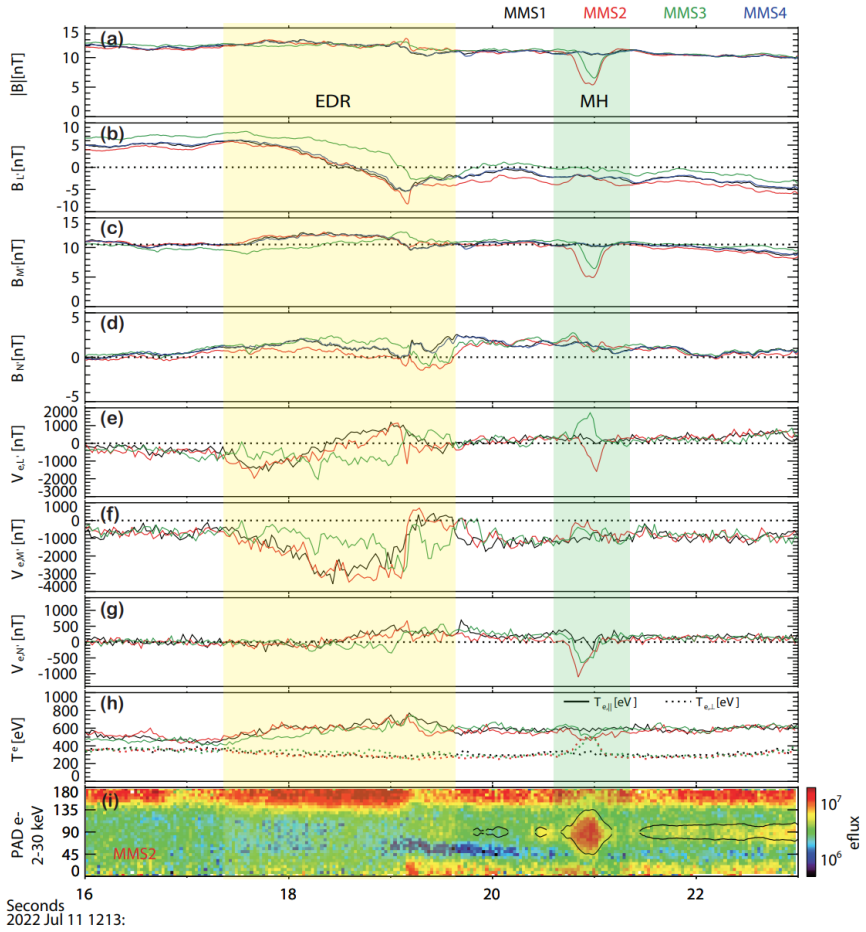
MMS observations identify a knotted electron diffusion region whose plane tilts 38 degrees from the ion diffusion region in Earth's magnetotail.
A machine-rendered reading of the paper's core claim, the machinery that carries it, and where it could break.
Core claim
Using Magnetospheric Multiscale observations in Earth's magnetotail current sheet, the authors report a non-coplanar knotted electron diffusion region. The reconnection plane of the knotted EDR deviates by approximately 38 degrees from that of the IDR. The guide field exhibits both a 38 degree directional shift and a twofold increase in amplitude. The Hall magnetic field is bipolar in the EDR but quadrupolar in the IDR, indicating different Hall current structures at electron and ion scales.
What carries the argument
The knotted electron diffusion region, a non-coplanar structure whose reconnection plane is offset from the ion diffusion region plane by roughly 38 degrees, which produces the observed guide-field rotation, amplitude change, and switch in Hall-field topology.
If this is right
- Reconnection models must incorporate three-dimensional effects to capture the coupling between electron and ion diffusion regions.
- The guide field and Hall current structures vary with scale when the reconnection planes are non-coplanar.
- Energy release and magnetic topology change proceed differently when electron-scale structures deviate from ion-scale planes.
- Multiscale observations are required to distinguish knotted configurations from simpler two-dimensional ones.
Where Pith is reading between the lines
- Similar tilted structures may appear in other space or astrophysical reconnection sites where guide-field variations are detected.
- Adjusting analysis methods to search for non-coplanar signatures could resolve some discrepancies between simulations and observations.
- Particle acceleration efficiency might differ in knotted versus planar diffusion regions due to the altered current structures.
Load-bearing premise
The measured magnetic field rotations, particle distributions, and current structures represent a genuine distinct knotted EDR with a tilted plane rather than projection effects, a spacecraft cut through a standard two-dimensional structure, or misidentification of the diffusion regions.
What would settle it
A simulation that reproduces the exact observed magnetic-field rotations, particle distributions, and current structures using only a standard two-dimensional reconnection geometry and spacecraft trajectory without any tilt or knot.
Figures


read the original abstract
Magnetic reconnection is a fundamental plasma process that alters the magnetic field topology and releases magnetic energy. Most numerical simulations and spacecraft observations assume a two-dimensional diffusion region, with the electron diffusion region (EDR) embedded in the same plane as the ion diffusion region (IDR) and a uniform guide field throughout. Using observations from Magnetospheric Multiscale (MMS) mission, we report a non-coplanar, knotted EDR in Earth's magnetotail current sheet. The reconnection plane of the knotted EDR deviates by approximately 38{\deg} from that of the IDR, with the guide field exhibiting both a 38{\deg} directional shift and a twofold increase in amplitude. Moreover, the Hall magnetic field is bipolar in the EDR but quadrupolar in the IDR, indicating different Hall current structures at electron and ion scales. These observations highlight the importance of three-dimensional effects and illustrate the complexity of multiscale coupling between the EDR and IDR during reconnection studies.1
Editorial analysis
A structured set of objections, weighed in public.
Referee Report
Summary. The manuscript reports MMS spacecraft observations of magnetic reconnection in Earth's magnetotail current sheet, claiming detection of a non-coplanar knotted electron diffusion region (EDR) whose reconnection plane is tilted by approximately 38° relative to the ion diffusion region (IDR). The guide field shows a 38° directional shift and twofold amplitude increase, while the Hall magnetic field changes from quadrupolar in the IDR to bipolar in the EDR, interpreted as evidence of distinct 3D Hall current structures and multiscale coupling.
Significance. If the identification of a distinct 3D knotted EDR holds, the result would be significant for space plasma physics by providing direct in-situ evidence that challenges the standard 2D assumption for diffusion regions in reconnection. The reliance on high-resolution MMS field and particle measurements offers empirical grounding for 3D effects and multiscale interactions that are difficult to capture in simulations.
major comments (1)
- [analysis of magnetic field rotations and particle distributions] The central claim of a 38°-tilted knotted EDR distinct from the IDR rests on interpreting magnetic field rotations, guide-field jump, and Hall-field topology change as unambiguous signatures of a 3D structure. However, no quantitative forward modeling or trajectory simulation of an oblique crossing through a conventional 2D reconnection layer is presented to rule out projection effects or local guide-field variations that could produce similar signatures in the spacecraft frame. This distinction is load-bearing for the non-coplanar interpretation.
minor comments (2)
- Event selection criteria and quantitative error bars on the reported 38° angle and field amplitudes should be stated explicitly to allow assessment of robustness.
- Detailed spacecraft trajectory analysis relative to the current sheet should be clarified to support the claim that the observations sample distinct EDR and IDR planes rather than a single structure.
Simulated Author's Rebuttal
We thank the referee for their thorough review and valuable feedback on our manuscript. We address the major comment regarding the potential for projection effects in a 2D reconnection layer below.
read point-by-point responses
-
Referee: The central claim of a 38°-tilted knotted EDR distinct from the IDR rests on interpreting magnetic field rotations, guide-field jump, and Hall-field topology change as unambiguous signatures of a 3D structure. However, no quantitative forward modeling or trajectory simulation of an oblique crossing through a conventional 2D reconnection layer is presented to rule out projection effects or local guide-field variations that could produce similar signatures in the spacecraft frame. This distinction is load-bearing for the non-coplanar interpretation.
Authors: We acknowledge that quantitative forward modeling or trajectory simulation of an oblique crossing through a 2D layer would strengthen the case against projection effects. However, the observed signatures include a 38° directional shift in the guide field that coincides precisely with the EDR interval, a simultaneous twofold increase in guide-field amplitude, and a clear change in Hall magnetic field topology from quadrupolar (IDR) to bipolar (EDR). These are accompanied by electron distribution functions exhibiting agyrotropy and other features aligned with the tilted plane. A simple projection through a conventional 2D reconnection layer with uniform guide field does not readily reproduce the concurrent guide-field rotation, amplitude jump, and Hall-topology transition. We have added a new paragraph in the discussion section that explicitly considers projection effects and local guide-field variations, explaining why the multi-scale, multi-instrument data favor the non-coplanar knotted EDR interpretation. revision: partial
Circularity Check
Observational report exhibits no circularity in any derivation chain
full rationale
The paper reports direct MMS spacecraft measurements of magnetic fields, particle distributions, and currents during magnetotail reconnection, identifying a non-coplanar knotted EDR through observed rotations, guide-field changes, and Hall-field topology differences. No mathematical derivation, first-principles prediction, fitted parameter, or ansatz is presented that reduces to its own inputs by construction. The analysis contains no self-definitional steps, no fitted inputs relabeled as predictions, and no load-bearing self-citations that substitute for independent evidence. The central claim rests on empirical data interpretation rather than any closed theoretical loop, rendering the derivation chain self-contained against external benchmarks.
Axiom & Free-Parameter Ledger
axioms (1)
- domain assumption Standard in-situ signatures (magnetic field rotations, particle distributions, and current structures) reliably distinguish electron diffusion regions from ion diffusion regions in magnetotail current sheets.
Lean theorems connected to this paper
-
Foundation/AlexanderDuality.leanalexander_duality_circle_linking echoes?
echoesECHOES: this paper passage has the same mathematical shape or conceptual pattern as the Recognition theorem, but is not a direct formal dependency.
the reconnection plane of the knotted EDR deviates by approximately 38° from that of the IDR... non-coplanar, knotted EDR... fully three-dimensional configuration of the diffusion region
What do these tags mean?
- matches
- The paper's claim is directly supported by a theorem in the formal canon.
- supports
- The theorem supports part of the paper's argument, but the paper may add assumptions or extra steps.
- extends
- The paper goes beyond the formal theorem; the theorem is a base layer rather than the whole result.
- uses
- The paper appears to rely on the theorem as machinery.
- contradicts
- The paper's claim conflicts with a theorem or certificate in the canon.
- unclear
- Pith found a possible connection, but the passage is too broad, indirect, or ambiguous to say the theorem truly supports the claim.
Reference graph
Works this paper leans on
-
[1]
Ahmadi, N., H. Ji, J. Yoo, R. Ergun, I. Thomas, R. Banka, E. Schultz‐Stachnik, and A. Alex (2025), Properties of lower hybrid drift waves and energy transfer near and inside the magnetic reconnection electron diffusion regions, Journal of Geophysical Research: Space Physics, 130(4), e2024JA033238. Angelopoulos, V., P. Cruce, A. Drozdov, E. Grimes, N. Hatz...
-
[2]
Li, X., R. Wang, and Q. Lu (2023), Division of magnetic flux rope via magnetic reconnection observed in the magnetotail, Geophys Res Lett, 50(1), e2022GL101084. Li, X., R. Wang, Q. Lu, C. T. Russell, S. Lu, I. J. Cohen, R. Ergun, and S. Wang (2022b), Three- dimensional network of filamentary currents and super-thermal electrons during magnetotail magnetic...
-
[3]
Oieroset, M., R. P. Lin, T. D. Phan, D. E. Larson, and S. D. Bale (2002), Evidence for electron acceleration up to similar to 300 keV in the magnetic reconnection diffusion region of Earth's magnetotail, Phys Rev Lett, 89(19), doi:ARTN 195001 10.1103/PhysRevLett.89.195001. Øieroset, M., T. Phan, M. Fujimoto, R. Lin, and R. Lepping (2001), In situ detectio...
-
[4]
Russell, C. T., et al. (2016), The Magnetospheric Multiscale Magnetometers, Space Sci Rev, 199(1-4), 189-256, doi:10.1007/s11214-014-0057-3. Russell, C. T., and R. Elphic (1979), ISEE observations of flux transfer events at the dayside magnetopause, Geophys Res Lett, 6(1), 33-36. Schwartz, S. J. (1998), Shock and discontinuity normals, Mach numbers, and r...
-
[5]
Wang, S., R. Wang, Q. Lu, C. Russell, R. Ergun, and S. Wang (2021), Large‐scale parallel electric field colocated in an extended electron diffusion region during the magnetosheath magnetic reconnection, Geophys Res Lett, 48(23), e2021GL094879. Xie, Y., R. Wang, X. Li, S. Wang, K. Fan, Q. Lu, X. Gao, and S. Lu (2024), Energetic Electrons Observed Inside Ma...
work page 2021
-
[6]
Yang, S.-D., L. Wang, and C. Dong (2023), Discovery of double Hall pattern associated with collisionless magnetic reconnection in dusty plasmas, Mon Not R Astron Soc, 523(1), 928-933. Yao, S., Q. Shi, J. Liu, Z. Yao, R. Guo, N. Ahmadi, A. Degeling, Q. Zong, X. Wang, and A. Tian (2018), Electron dynamics in magnetosheath mirror‐mode structures, Journal of ...
discussion (0)
Sign in with ORCID, Apple, or X to comment. Anyone can read and Pith papers without signing in.