Time Crystal from Self-Amplification of Spontaneous Analog Hawking Radiation
Pith reviewed 2026-05-19 03:57 UTC · model grok-4.3
The pith
Self-amplification of spontaneous Hawking radiation in a black-hole laser forms a time crystal.
A machine-rendered reading of the paper's core claim, the machinery that carries it, and where it could break.
Core claim
We propose a time crystal based on a quantum black-hole laser, where the genuinely spontaneous character of the symmetry breaking stems from the self-amplification of spontaneous Hawking radiation. The resulting Hawking time crystal is characterized by the periodic dependence of the out-of-time density-density correlation function, while equal-time observables are time independent because they embody averages over different realizations with a random oscillation phase. We prove that any parametric amplifier has associated a time operator, which leads to a unique characterization of the time-crystal formation in terms of two time operators: one associated with the initial black-hole laser and
What carries the argument
The time operator associated to any parametric amplifier, which provides a unique characterization of the time-crystal formation via two time operators linked to the initial black-hole laser and the final spontaneous Floquet state.
If this is right
- The Hawking time crystal exhibits anticorrelation bands resulting from the spontaneous quantum emission of pairs of dispersive waves and solitons into the upstream and downstream regions.
- It serves as a nonlinear periodic analog of the Andreev-Hawking effect.
- Equal-time observables average to time-independent values while out-of-time correlations remain periodic.
- Time-crystal formation is uniquely determined by the two time operators.
Where Pith is reading between the lines
- This mechanism could be realized in experiments with flowing Bose-Einstein condensates to observe the predicted periodic correlations.
- The connection between parametric amplifiers and time operators may apply to other driven quantum systems beyond analog gravity.
- Ensemble averaging over random phases highlights the importance of statistical measurements in detecting such symmetry-broken states.
Load-bearing premise
The self-amplification produces a genuinely spontaneous symmetry breaking whose phase is random across realizations, causing equal-time observables to average to time-independent values.
What would settle it
A measurement showing that out-of-time density-density correlations are periodic in time while equal-time correlations remain constant, or the absence of random phase variation between experimental runs.
Figures


read the original abstract
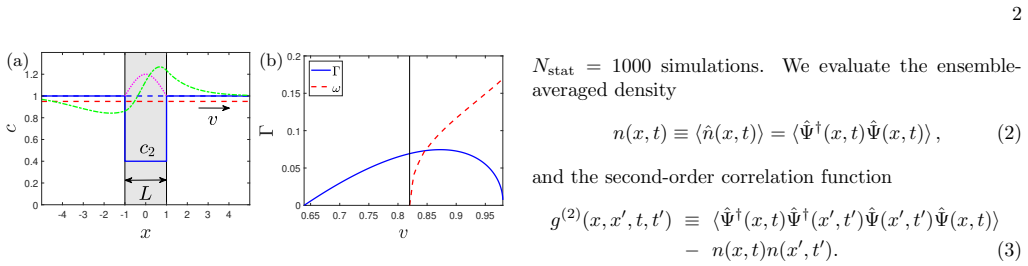
We propose a time crystal based on a quantum black-hole laser, where the genuinely spontaneous character of the symmetry breaking stems from the self-amplification of spontaneous Hawking radiation. The resulting Hawking time crystal (HTC) is characterized by the periodic dependence of the out-of-time density-density correlation function, while equal-time observables are time independent because they embody averages over different realizations with a random oscillation phase. The HTC provides a nonlinear periodic analog of the Andreev-Hawking effect, exhibiting anticorrelation bands resulting from the spontaneous, quantum emission of pairs of dispersive waves and solitons into the upstream and downstream regions. Remarkably, we prove that any parametric amplifier has associated a time operator, which leads to a unique characterization of the time-crystal formation in terms of two time operators: one associated with the initial black-hole laser and another associated with the final spontaneous Floquet state.
Editorial analysis
A structured set of objections, weighed in public.
Referee Report
Summary. The manuscript proposes a Hawking time crystal (HTC) in a quantum black-hole laser setup, where self-amplification of spontaneous Hawking radiation produces spontaneous symmetry breaking. Equal-time observables are claimed to be time-independent due to averaging over random oscillation phases across realizations, while out-of-time density-density correlation functions exhibit periodicity. The paper claims to prove that any parametric amplifier has an associated time operator, enabling a characterization of the time-crystal formation via two such operators: one linked to the initial black-hole laser and one to the final spontaneous Floquet state. It also predicts anticorrelation bands as a nonlinear periodic analog of the Andreev-Hawking effect.
Significance. If the central claims hold, this work could provide a novel mechanism for realizing time crystals in analog gravity systems, bridging Hawking radiation, parametric amplification, and Floquet physics in platforms such as Bose-Einstein condensates. The claimed proof associating time operators with any parametric amplifier represents a potential conceptual advance with possible broader utility in analyzing time-dependent quantum systems. The predicted anticorrelation bands offer concrete, falsifiable signatures. These elements, if rigorously established, would strengthen the case for spontaneous time-crystal formation without external driving.
major comments (2)
- [Discussion of spontaneous symmetry breaking and HTC signature (near the description of equal-time vs. out-of-time correl] The central distinction between time-independent equal-time observables and periodic out-of-time correlations rests on the assumption that self-amplification produces a genuinely spontaneous symmetry breaking with a phase that is uniformly random across independent realizations. No explicit demonstration is provided that the nonlinear evolution (or the associated time operators) selects phases ergodically rather than locking them to the initial black-hole laser or Floquet state. If phases are correlated or biased, equal-time observables acquire explicit time dependence and the claimed time-crystal signature collapses. This assumption is load-bearing for the HTC characterization.
- [Section presenting the proof of time operators for parametric amplifiers] The claimed proof that any parametric amplifier has an associated time operator, leading to a unique characterization with two time operators, requires more detail on the derivation steps and how it guarantees the spontaneous, random-phase nature of the final Floquet state. Without this, it is unclear whether the construction is general or reduces to the specific model assumptions.
minor comments (2)
- [Notation and definitions] Clarify the notation for the two time operators with explicit definitions or equations in the main text to improve readability.
- [Introduction] Add a brief comparison to existing proposals for time crystals in driven or undriven systems to better contextualize the novelty.
Simulated Author's Rebuttal
We thank the referee for the careful and constructive review. The comments have helped us strengthen the presentation of the spontaneous symmetry breaking and the generality of the time-operator construction. We address each major comment below and have revised the manuscript to incorporate additional derivations and clarifications.
read point-by-point responses
-
Referee: The central distinction between time-independent equal-time observables and periodic out-of-time correlations rests on the assumption that self-amplification produces a genuinely spontaneous symmetry breaking with a phase that is uniformly random across independent realizations. No explicit demonstration is provided that the nonlinear evolution (or the associated time operators) selects phases ergodically rather than locking them to the initial black-hole laser or Floquet state. If phases are correlated or biased, equal-time observables acquire explicit time dependence and the claimed time-crystal signature collapses. This assumption is load-bearing for the HTC characterization.
Authors: We agree that an explicit demonstration of the ergodic phase selection is necessary for rigor. The spontaneous character originates from the vacuum fluctuations of the initial Hawking radiation, whose phase is uniformly random. In the nonlinear regime the self-amplification is governed by a phase-insensitive parametric process; the quantum noise seeds a random initial phase that is subsequently preserved by the Floquet evolution rather than locked to any classical reference. To make this explicit we have added a new subsection that derives the phase distribution from the Bogoliubov coefficients of the linear stage and shows that the nonlinear terms induce phase diffusion, ensuring that the ensemble average over realizations remains time-independent while out-of-time correlators retain periodicity. revision: yes
-
Referee: The claimed proof that any parametric amplifier has an associated time operator, leading to a unique characterization with two time operators, requires more detail on the derivation steps and how it guarantees the spontaneous, random-phase nature of the final Floquet state. Without this, it is unclear whether the construction is general or reduces to the specific model assumptions.
Authors: We thank the referee for this observation. The original manuscript presented the time-operator construction in a condensed form. We have now expanded the relevant section with a step-by-step derivation that begins from the general squeezing Hamiltonian of a parametric amplifier, constructs the associated time operator as the generator conjugate to the squeezing phase, and applies it first to the initial black-hole laser and subsequently to the emergent spontaneous Floquet state. The construction relies only on the structure of parametric amplification and the vacuum input state; it therefore remains general and automatically incorporates the random-phase property inherited from the initial quantum fluctuations. revision: yes
Circularity Check
No significant circularity; derivation self-contained under stated assumptions
full rationale
The paper proposes a Hawking time crystal arising from self-amplification of spontaneous Hawking radiation in a quantum black-hole laser. The key step is a claimed proof that any parametric amplifier possesses an associated time operator, which then furnishes a characterization via two such operators (initial black-hole laser and final Floquet state). This is presented as an independent mathematical result rather than a redefinition or fit. The time-crystal signature—periodic out-of-time density-density correlations with time-independent equal-time observables—is explicitly tied to an averaging assumption over random oscillation phases across realizations; the abstract and description treat this as an input modeling choice, not something derived by construction from the dynamics or reduced to a fitted parameter. No equations or self-citations are shown to force the central claims back onto the inputs. The construction therefore remains self-contained against external benchmarks and the listed assumptions.
Axiom & Free-Parameter Ledger
axioms (2)
- domain assumption Analog Hawking radiation arises from quantum vacuum fluctuations near an effective event horizon in a flowing medium or optical system.
- domain assumption The black-hole laser supports a parametric-amplifier regime in which small fluctuations grow exponentially.
invented entities (2)
-
Hawking time crystal (HTC)
no independent evidence
-
Time operator associated with a parametric amplifier
no independent evidence
Lean theorems connected to this paper
-
IndisputableMonolith/Foundation/ArrowOfTime.leanarrow_from_z unclear?
unclearRelation between the paper passage and the cited Recognition theorem.
any parametric amplifier has associated a time operator... two time operators: one associated with the initial black-hole laser and another associated with the final spontaneous Floquet state
-
IndisputableMonolith/Foundation/ArithmeticFromLogic.leanembed_strictMono_of_one_lt unclear?
unclearRelation between the paper passage and the cited Recognition theorem.
equal-time observables average to time-independent values while out-of-time correlations remain periodic
What do these tags mean?
- matches
- The paper's claim is directly supported by a theorem in the formal canon.
- supports
- The theorem supports part of the paper's argument, but the paper may add assumptions or extra steps.
- extends
- The paper goes beyond the formal theorem; the theorem is a base layer rather than the whole result.
- uses
- The paper appears to rely on the theorem as machinery.
- contradicts
- The paper's claim conflicts with a theorem or certificate in the canon.
- unclear
- Pith found a possible connection, but the passage is too broad, indirect, or ambiguous to say the theorem truly supports the claim.
Forward citations
Cited by 1 Pith paper
-
Collective excitations in quantum gravity condensates
Collective excitations analogous to phonons are derived in quantum gravity condensates within a group field theory model, yielding leading beyond-mean-field corrections to emergent Friedmann dynamics.
Reference graph
Works this paper leans on
-
[1]
W. G. Unruh, Phys. Rev. Lett. 46, 1351 (1981)
work page 1981
-
[2]
L. J. Garay, J. R. Anglin, J. I. Cirac, and P. Zoller, Phys. Rev. Lett. 85, 4643 (2000)
work page 2000
- [3]
-
[4]
F. Belgiorno, S. L. Cacciatori, M. Clerici, V. Gorini, G. Ortenzi, L. Rizzi, E. Rubino, V. G. Sala, and D. Fac- cio, Phys. Rev. Lett. 105, 203901 (2010)
work page 2010
- [5]
-
[6]
B. Horstmann, B. Reznik, S. Fagnocchi, and J. I. Cirac, Phys. Rev. Lett. 104, 250403 (2010)
work page 2010
-
[7]
M. Wittemer, F. Hakelberg, P. Kiefer, J.-P. Schr¨ oder, C. Fey, R. Sch¨ utzhold, U. Warring, and T. Schaetz, Phys. Rev. Lett. 123, 180502 (2019)
work page 2019
-
[8]
S. Weinfurtner, E. W. Tedford, M. C. J. Penrice, W. G. Unruh, and G. A. Lawrence, Phys. Rev. Lett. 106, 021302 (2011)
work page 2011
- [9]
- [10]
- [11]
- [12]
-
[13]
P. ˇSvanˇ cara, P. Smaniotto, L. Solidoro, J. F. MacDon- ald, S. Patrick, R. Gregory, C. F. Barenghi, and S. We- infurtner, Nature 628, 66 (2024)
work page 2024
-
[14]
J.-C. Jaskula, G. B. Partridge, M. Bonneau, R. Lopes, J. Ruaudel, D. Boiron, and C. I. Westbrook, Phys. Rev. Lett. 109, 220401 (2012)
work page 2012
-
[15]
C.-L. Hung, V. Gurarie, and C. Chin, Science 341, 1213 (2013)
work page 2013
- [16]
- [17]
-
[18]
J. Hu, L. Feng, Z. Zhang, and C. Chin, Nature Physics 15, 785 (2019)
work page 2019
- [19]
-
[20]
S. Patrick, H. Goodhew, C. Gooding, and S. Weinfurt- ner, Phys. Rev. Lett. 126, 041105 (2021)
work page 2021
-
[21]
J. Steinhauer, M. Abuzarli, T. Aladjidi, T. Bienaim´ e, C. Piekarski, W. Liu, E. Giacobino, A. Bramati, and Q. Glorieux, Nat. Commun. 13, 2890 (2022)
work page 2022
-
[22]
C. Viermann, M. Sparn, N. Liebster, M. Hans, E. Kath, ´A. Parra-L´ opez, M. Tolosa-Sime´ on, N. S´ anchez-Kuntz, T. Haas, H. Strobel, et al., Nature 611, 260 (2022)
work page 2022
-
[23]
U. Leonhardt, T. Kiss, and P. ¨Ohberg, J. Opt. B: Quan- tum Semiclass. Opt. 5, S42 (2003)
work page 2003
-
[24]
R. Balbinot, A. Fabbri, S. Fagnocchi, A. Recati, and I. Carusotto, Phys. Rev. A 78, 21603 (2008)
work page 2008
-
[25]
I. Carusotto, S. Fagnocchi, A. Recati, R. Balbinot, and A. Fabbri, New J. Phys. 10, 103001 (2008)
work page 2008
- [26]
- [27]
- [28]
-
[29]
P. E. Larr´ e, A. Recati, I. Carusotto, and N. Pavloff, Phys. Rev. A 85, 13621 (2012)
work page 2012
-
[30]
J. R. M. de Nova, F. Sols, and I. Zapata, Phys. Rev. A 89, 043808 (2014)
work page 2014
- [31]
- [32]
-
[33]
J. R. M. de Nova, F. Sols, and I. Zapata, New J. Phys. 17, 105003 (2015)
work page 2015
- [34]
- [35]
-
[36]
C. C. H. Ribeiro, S.-S. Baak, and U. R. Fischer, Phys. Rev. D 105, 124066 (2022)
work page 2022
-
[37]
C. C. Holanda Ribeiro and U. R. Fischer, Phys. Rev. D 107, L121502 (2023)
work page 2023
-
[38]
G. Ciliberto, S. Emig, N. Pavloff, and M. Isoard, Phys. Rev. A 109, 063325 (2024)
work page 2024
-
[39]
Steinhauer, Nature Physics 12, 959 (2016)
J. Steinhauer, Nature Physics 12, 959 (2016)
work page 2016
-
[40]
J. R. M. de Nova, K. Golubkov, V. I. Kolobov, and J. Steinhauer, Nature 569, 688 (2019)
work page 2019
-
[41]
V. I. Kolobov, K. Golubkov, J. R. M. de Nova, and J. Steinhauer, Nature Physics 17, 362 (2021)
work page 2021
- [42]
-
[43]
D. Walls and G. Milburn, Quantum Optics , Springer- Link: Springer e-Books (Springer, 2008)
work page 2008
-
[44]
J. R. M. de Nova, P. F. Palacios, P. A. Guerrero, I. Za- pata, and F. Sols, Comptes Rendus. Physique 25, 1 (2024)
work page 2024
- [45]
- [46]
-
[47]
C. Barcel´ o, A. Cano, L. J. Garay, and G. Jannes, Phys. Rev. D 74, 024008 (2006)
work page 2006
-
[48]
P. Jain, A. S. Bradley, and C. Gardiner, Phys. Rev. A 76, 23617 (2007)
work page 2007
- [49]
- [50]
- [51]
-
[52]
J. R. M. de Nova, S. Finazzi, and I. Carusotto, Phys. Rev. A 94, 043616 (2016)
work page 2016
-
[53]
C. Peloquin, L.-P. Euv´ e, T. Philbin, and G. Rousseaux, Phys. Rev. D 93, 084032 (2016)
work page 2016
-
[54]
D. Berm´ udez and U. Leonhardt, Classical and Quantum Gravity 36, 024001 (2018)
work page 2018
-
[55]
R. B¨ urkle, A. Gaidoukov, and J. R. Anglin, New Jour- nal of Physics 20, 083020 (2018)
work page 2018
-
[56]
J. R. M. de Nova, P. F. Palacios, I. Carusotto, and F. Sols, New Journal of Physics 23, 023040 (2021)
work page 2021
-
[57]
J. D. Rinc´ on-Estrada and D. Berm´ udez, Annalen der Physik 533, 2000239 (2021)
work page 2021
-
[58]
Katayama, Scientific Reports 11, 19137 (2021)
H. Katayama, Scientific Reports 11, 19137 (2021)
work page 2021
- [59]
-
[60]
J. R. M. de Nova and F. Sols, Phys. Rev. Res. 5, 043282 (2023)
work page 2023
-
[61]
J. R. M. de Nova and F. Sols, Phys. Rev. A 105, 043302 (2022)
work page 2022
- [62]
- [63]
-
[64]
K. Sacha and J. Zakrzewski, Reports on Progress in Physics 81, 016401 (2017)
work page 2017
- [65]
-
[66]
D. V. Else, B. Bauer, and C. Nayak, Phys. Rev. Lett. 117, 090402 (2016)
work page 2016
-
[67]
D. Bhowmick, H. Sun, B. Yang, and P. Sengupta, Phys. Rev. B 108, 014434 (2023)
work page 2023
- [68]
- [69]
- [70]
- [71]
- [72]
-
[73]
S. Choi, J. Choi, R. Landig, G. Kucsko, H. Zhou, J. Isoya, F. Jelezko, S. Onoda, H. Sumiya, V. Khemani, et al., Nature 543, 221 (2017)
work page 2017
- [74]
- [75]
- [76]
- [77]
-
[78]
A. Kyprianidis, F. Machado, W. Morong, P. Becker, K. S. Collins, D. V. Else, L. Feng, P. W. Hess, C. Nayak, G. Pagano, N. Y. Yao, and C. Monroe, Science 372, 1192 (2021)
work page 2021
-
[79]
J. Randall, C. E. Bradley, F. V. van der Gron- den, A. Galicia, M. H. Abobeih, M. Markham, D. J. Twitchen, F. Machado, N. Y. Yao, and T. H. Taminiau, Science 374, 1474 (2021)
work page 2021
-
[80]
X. Mi, M. Ippoliti, C. Quintana, A. Greene, Z. Chen, J. Gross, F. Arute, K. Arya, J. Atalaya, R. Babbush, et al., Nature 601, 531 (2022)
work page 2022
discussion (0)
Sign in with ORCID, Apple, or X to comment. Anyone can read and Pith papers without signing in.