REVIEW 4 major objections 5 minor 7 references
GATE: Graph Attention Neural Networks with Real-Time Edge Construction for Robust Indoor Localization using Mobile Embedded Devices
T0 review · 4 major / 5 minor · reviewed 2026-08-06 · deepseek-v4-flash
Pith's one-line read GATE, a graph attention network with real-time edge construction, reports mean indoor Wi-Fi localization error of 1.98 m and worst-case 3.5 m across five buildings and seven smartphones.
desk verdict Solid GNN-based localization engineering, but the 1.98 m headline is likely inflated by test-set hyperparameter selection. read the letter →
The pith
A machine-rendered reading of the paper's core claim, the machinery that carries it, and where it could break.
The reading
What carries the argument
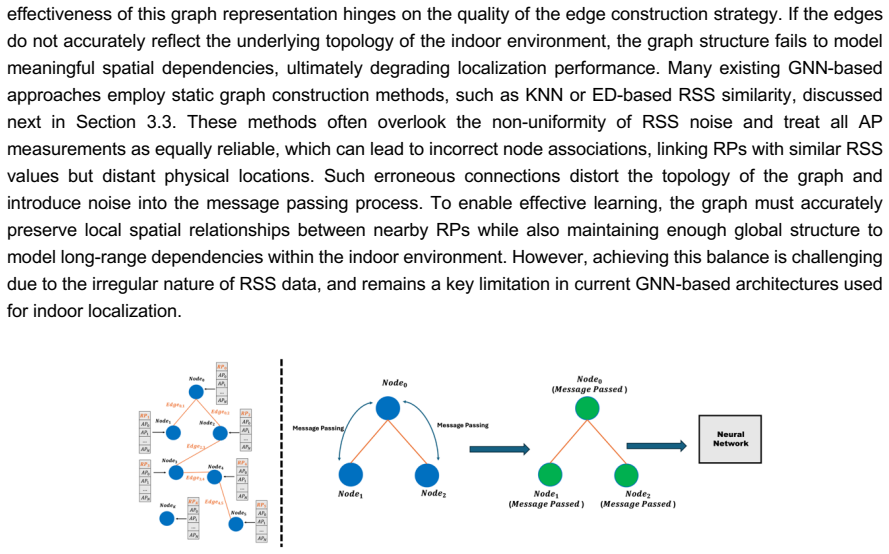
The load-bearing object is the Multi-Dimensional Hyperspace Vector (MDHV), a per-node input representation built during both training and inference from three parts: the raw RSS fingerprint, a message-passing vector formed by normalized dot-product attention over the node's neighbors (MSG), and the Attention Hyperspace Vector (AHV), an element-wise product of the node's fingerprint with each neighbor's fingerprint, normalized so every RSS feature receives its own attention weight. The three channels enter a two-layer graph convolutional network, so the model can keep edge-level influence separate from feature-level influence instead of averaging them into a single scalar. Real-Time Edge Construction (RTEC) uses the same attention formula at query time to add a temporary node and connect it to a fixed number of existing reference points, preserving the GCN's expected input shape while adapting the graph to the query. The paper's position is that this three-channel structure is what preserves the non-uniform structure of RSS noise and prevents the feature dilution it calls the GNN blind spot.
What would settle it
Rerun the five-building, seven-device protocol with the configuration locked to NB=10%, H=50%, and five training samples per reference point before any test fingerprint is examined, and compare against re-tuned baselines on the same splits. If the mean error rises above roughly 2.5 m or the margin over the best graph-attention baseline falls below the reported 1.6x, the headline numbers are artifacts of configuration selection.
Extended reading notes
Core claim
The paper's central claim is that a node representation combining an attention-weighted message vector with a feature-wise attention tensor, the Multi-Dimensional Hyperspace Vector (MDHV), lets a small graph convolutional network localize fingerprints in non-Euclidean RSS noise. GATE connects reference points by indoor topology, scores edges with normalized scalar-dot-product attention, and constructs for each node a three-part MDHV: raw RSS values, the aggregated neighbor message (MSG), and the Attention Hyperspace Vector (AHV), which element-wise compares the node's fingerprint with each neighbor's fingerprint so each RSS feature receives its own attention weight. At inference, Real-Time Edge Construction (RTEC) attaches the new fingerprint as a temporary node using the same attention scoring with a fixed number of edges, keeping the input dimension consistent with training. On five buildings with 48 to 88 meter paths and 78 to 339 visible access points, tested across seven smartphones, the full GATE variant reports 1.98 m mean error and 3.5 m worst-case error, and the paper's comparisons place it 1.6x to 4.72x lower in mean error than the compared frameworks.
Load-bearing premise
The reported accuracy numbers rest on the assumption that the configuration that produces them (10% edge connectivity, 50% compression, five training fingerprints per reference point) was chosen without seeing the test data, and that all fourteen comparison methods were implemented and tuned as carefully as GATE.
Editorial extensions
If this is right
- If GATE's reported accuracy holds, sub-2-meter mean indoor localization is achievable on ordinary smartphones across buildings with very dense access-point deployments, without retraining the model for each device.
- Because each query builds its own edges through RTEC, deployment in a new building reduces to holding the trained GCN plus the stored reference-point fingerprints, rather than precomputing a fixed graph for every possible query.
- The sensitivity study indicates that keeping edge connectivity at or below 10% of nodes holds mean error below 2 m while keeping end-to-end latency under about 1 second and energy-delay product below 0.6 J/s, which the paper reads as feasible for mobile embedded hardware.
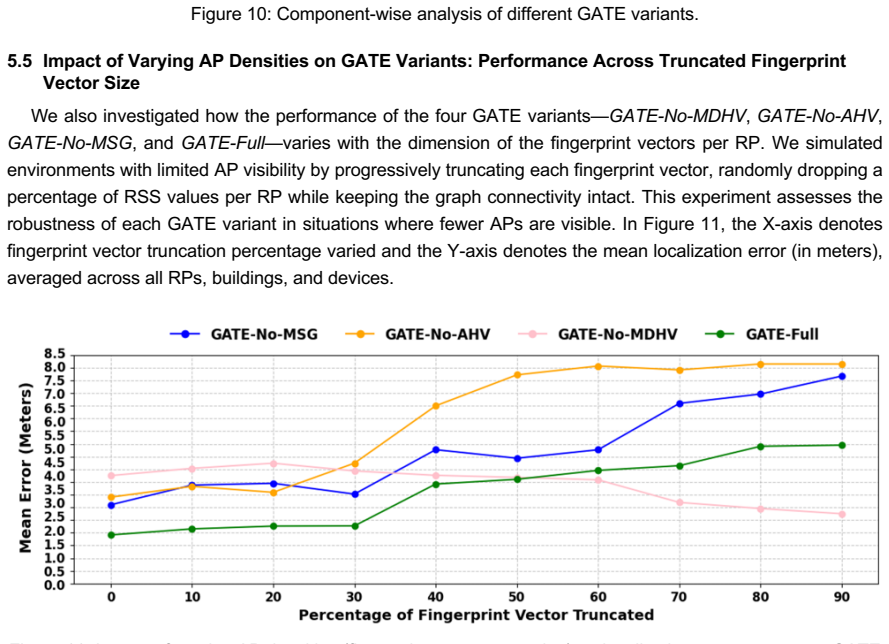
- The component ablation shows that dropping either the AHV or the MSG channel raises worst-case error and cross-device variance, so the MDHV's two channels are the part of the architecture that carries heterogeneity resilience.
- The truncation experiments imply that in low-AP-density buildings simpler graph networks may be enough, so GATE's advantage should show up mainly where high AP density creates the blind spot problem.
Reading between the lines
- A fair out-of-sample test would lock the hyperparameters before seeing test labels; until then the 1.98 m figure is a tuned point estimate rather than an unbiased prediction of deployment accuracy.
- The attention score in the paper's equations is cosine similarity; the paper does not explore learned temperatures, multi-head feature attention, or non-linear attention variants, which would be the natural next experiments.
- The blind spot is linked to oversquashing, over-smoothing, and over-dilution, but the paper does not measure those internal graph statistics; measuring whether MDHV changes information flow or feature similarity across layers would directly test the mechanism it proposes.
- The evaluation uses fixed test fingerprints collected per the same protocol as training; a harder test would be live adaptation where the device contributes continuous samples, which RTEC's design hints at but the paper does not evaluate.
Editorial analysis
A structured set of objections, weighed in public.
Referee Report
Summary. The paper proposes GATE, a graph neural network framework for Wi-Fi RSS fingerprint-based indoor localization. GATE introduces an Attention Hyperspace Vector (AHV) that performs element-wise feature attention, a Multi-Dimensional Hyperspace Vector (MDHV) that concatenates the raw fingerprint, an attention-weighted message-passing vector, and the AHV, and a Real-Time Edge Construction (RTEC) policy that connects a test fingerprint to stored reference points using normalized dot-product attention. The authors evaluate GATE on five buildings and seven smartphones, and report a mean localization error of 1.98 m and a worst-case error of 3.5 m for the full model, claiming 1.6x to 4.72x lower mean errors and 1.85x to 4.57x lower worst-case errors than 14 prior frameworks, along with favorable latency, model size, and energy metrics on mobile devices.
Significance. If the reported accuracy numbers survive independent validation, GATE would be a practically useful contribution to on-device indoor localization: the multi-building, multi-device evaluation is unusually extensive, the component ablation isolates the contributions of MSG and AHV, and the hardware metrics (latency, model size, EDP) speak directly to deployment concerns. The paper also makes a conceptual step beyond Euclidean fingerprint models by preserving per-feature attention information in the graph representation. However, the central accuracy claim is currently gated by two auditability problems: the headline configuration was selected using the same test data that later produces the headline numbers, and the 14 baselines are reimplemented without documented tuning or released code. These issues do not make the framework internally inconsistent, but they do mean the quantitative claims should be read as provisional until held-out validation and reproducible baseline comparisons are provided.
major comments (4)
- [Sections 5.2, 5.3, Figure 12, Table 1] The operating point used for the headline results is selected on the same test data that later produces those results. The aggregated error surface in Figure 7 is used to choose NB<=10% and H approximately 50%, with the text stating 'This configuration is the one we consider for subsequent analysis'; Figure 9 is then used to fix five training samples per RP, with the text stating 'Based on this analysis, we fix the number of training samples per RP to five for all subsequent experiments.' The final 1.98 m mean error and 3.5 m worst-case error in Figure 12 and Table 1 are measured on the same test devices and test fingerprints. Because the configuration was chosen by inspecting exactly these test outcomes, the reported numbers are selection results rather than unbiased estimates of generalization. Please add a held-out validation split or nested cross-validation so that no test data influences configuration choices, and report the headline errors on data untouched by model selection. In addition, no confidence intervals or significance tests are provided, so it is unclear whether differences among GATE variants and baselines are statistically reliable.
- [Section 5.6 and Table 1] The paper compares GATE against 14 baselines but gives no implementation details, hyperparameter search budgets, or tuning protocol for any of them, and no code is released. Without evidence that the baselines were tuned with comparable effort, the advertised 1.6x to 4.72x and 1.85x to 4.57x margins could be partly attributable to under-tuned competitors rather than to architectural superiority. Please document the exact configuration of every baseline (architecture, optimizer, learning rate, epochs, graph-construction parameters, and any tuning procedure) and, if possible, release code or use published implementations with their recommended settings so that the comparison is verifiable.
- [Sections 4.1, 4.2, and 4.4] The edge-construction algorithm is described inconsistently. Section 4.1 states that 'edges are first formed based on indoor topology' and that GATE employs 'a hybrid approach that considers both indoor topology and signal-based attention scores,' but Eq. (10) defines the attention score purely as a normalized dot product between RSS fingerprint vectors, and Section 4.4's RTEC selects neighbors using only these fingerprint-based attention scores. No formula or procedure is given for the topology-based edge formation or for combining topology with attention. This ambiguity prevents reproduction of the graph construction and weakens the claim that GATE preserves indoor topology. Please specify the exact edge-construction and combination procedure, including pseudocode.
- [Equation (15)] The localization error is defined as the average absolute difference between predicted and ground-truth RP indices and is reported in meters. This is only valid if consecutive RP indices correspond to locations exactly 1 m apart along the path used during evaluation. Section 5.1 describes paths with 'various shapes,' but it is not stated whether every pair of adjacent indices is 1 m apart along the path, nor how branches or non-linear segments are handled. If the indices are not a faithful 1 m path-ordered sequence, the mean and worst-case errors in Figure 12 and Table 1 do not equal physical distances. Please specify the RP indexing rule for each floorplan.
minor comments (5)
- [Abstract and Table 1] There are typos, including 'an new Real-Time Edge Construction' in the abstract and 'GRAPHLOC' in Table 1; the paper should be proofread for such errors.
- [Section 3.1, Eq. (2)] The pair notation (d, RSS) in Eq. (2) is unclear; if d is an additive offset, it would be clearer to write the shifted vector explicitly as F + d rather than as a list of pairs.
- [Eq. (13)] Eq. (13) uses the symbol ∝ for the RTEC attention score, which is notationally inconsistent with a_{i,j} in Eq. (10); unify the notation for attention scores.
- [Section 5.3] The text says that increasing training samples per RP 'consistently reduces the mean localization error and substantially lowers device variance,' but no confidence intervals or per-sample error bars are reported; please clarify whether the reported reductions are averaged over multiple runs or single-run outcomes.
- [Section 3.1 and Section 4.3] The claim that element-wise attention in AHV models the non-Euclidean structure of RSS noise is asserted rather than formally derived from the per-AP offset model in Section 3.1; adding a short explanation of why element-wise attention captures per-AP offset variability would strengthen the conceptual contribution.
Circularity Check
Headline 1.98 m / 3.5 m figures are test-set selection outcomes (NB/H/samples chosen from error surfaces on the same test devices), so the central accuracy claim is partly circular; the GATE architecture derivation itself is not.
-
fitted input called prediction
[Section 5.2 (Fig. 7), Section 5.3 (Fig. 9), Section 5.6 (Fig. 12/Table 1)]
"The sixth, aggregated plot provides a generalized view: maintaining NB at or below 10% and setting H to approximately 50% yields consistently low localization error across all environments. This configuration is the one we consider for subsequent analysis ... Empirically, this results in a mean localization error of 1.98 meters across all test devices and buildings when using five samples per RP. Based on this analysis, we fix the number of training samples per RP to five for all subsequent experiments."
Section 5.2 chooses NB<=10% and H≈50% by sweeping both hyperparameters and inspecting mean localization error averaged over the same seven test devices and five buildings (Fig. 7); Section 5.3 fixes five training samples per RP after observing device variance on those test devices (Fig. 9) and immediately reports 1.98 m. Section 5.6 (Fig. 12, Table 1) then presents 1.98 m mean / 3.5 m worst-case as GATE-Full's achieved result and builds the 1.6x–4.72x claims on it. The reported accuracy is therefore the value of the test-set objective at the configuration chosen by minimizing that same objective; it is a selection outcome rather than an independent prediction on untouched data.
full rationale
The framework's components are not defined in terms of the error metric: AHV (Eq. 12) is element-wise feature attention between fingerprint vectors, MSG (Eq. 11) is attention-weighted aggregation, MDHV concatenates F_i, MSG_i, AHV, and the GCN is trained with cross-entropy. None of these equations contains the localization error or the final 1.98 m value, so the architectural claims are not self-definitional. The self-citations ([3], [10], [15], [16], [23], [25], [26]) are used as background or as baseline competitors; they do not provide a load-bearing theorem and do not forbid alternatives. In particular, no uniqueness theorem from the authors is imported. The significant issue is the evaluation protocol: the hyperparameters NB, H, and samples-per-RP are selected by inspecting error surfaces on the same test devices/buildings that later produce the headline numbers, and the paper explicitly says the chosen configuration is used 'for subsequent analysis' and that five samples are fixed 'for all subsequent experiments.' Thus the 1.98 m / 3.5 m claim is partly a selection result, not an unbiased estimate for an untouched test set. This is a partial circularity of the fitted-input-called-prediction type; it affects the headline margin but not the internal consistency of the GATE architecture equations. Score 6 reflects one central empirical 'prediction' reducing to the selection objective while the rest of the derivation is independent.
Assumptions & free parameters
free parameters (3)
- NB (number of edges per node) =
10% of nodes
- H (GCN compression size) =
50% compression
- Training samples per RP =
5
assumptions (3)
- domain assumption RSS fingerprint vectors from a single training device (Motorola Z2) are sufficiently representative of seven other smartphones to train a classifier that generalizes across devices.
- domain assumption The physical indoor topology can be encoded by graph edges selected via cosine similarity between fingerprint vectors, with per-node degree fixed to NB%.
- ad hoc to paper Per-feature element-wise attention (AHV) adequately models the non-Euclidean noise structure of RSS fingerprints.
invented entities (2)
-
Attention Hyperspace Vector (AHV)
-
Multi-Dimensional Hyperspace Vector (MDHV)
Cite this review
Pith. "Pith review of GATE: Graph Attention Neural Networks with Real-Time Edge Construction for Robust Indoor Localization using Mobile Embedded Devices." pith.science (2026). https://pith.science/paper/67SQMI6B
@misc{pith2026250711053,
  author       = {Pith},
  title        = {Pith review of: GATE: Graph Attention Neural Networks with Real-Time Edge Construction for Robust Indoor Localization using Mobile Embedded Devices},
  year         = {2026},
  howpublished = {\url{https://pith.science/paper/67SQMI6B}},
  note         = {Machine review of arXiv:2507.11053}
}
read the original abstract
Accurate indoor localization is crucial for enabling spatial context in smart environments and navigation systems. Wi-Fi Received Signal Strength (RSS) fingerprinting is a widely used indoor localization approach due to its compatibility with mobile embedded devices. Deep Learning (DL) models improve accuracy in localization tasks by learning RSS variations across locations, but they assume fingerprint vectors exist in a Euclidean space, failing to incorporate spatial relationships and the non-uniform distribution of real-world RSS noise. This results in poor generalization across heterogeneous mobile devices, where variations in hardware and signal processing distort RSS readings. Graph Neural Networks (GNNs) can improve upon conventional DL models by encoding indoor locations as nodes and modeling their spatial and signal relationships as edges. However, GNNs struggle with non-Euclidean noise distributions and suffer from the GNN blind spot problem, leading to degraded accuracy in environments with dense access points (APs). To address these challenges, we propose GATE, a novel framework that constructs an adaptive graph representation of fingerprint vectors while preserving an indoor state-space topology, modeling the non-Euclidean structure of RSS noise to mitigate environmental noise and address device heterogeneity. GATE introduces 1) a novel Attention Hyperspace Vector (AHV) for enhanced message passing, 2) a novel Multi-Dimensional Hyperspace Vector (MDHV) to mitigate the GNN blind spot, and 3) an new Real-Time Edge Construction (RTEC) approach for dynamic graph adaptation. Extensive real-world evaluations across multiple indoor spaces with varying path lengths, AP densities, and heterogeneous devices demonstrate that GATE achieves 1.6x to 4.72x lower mean localization errors and 1.85x to 4.57x lower worst-case errors compared to state-of-the-art indoor localization frameworks.
Figures


Figures from the paper (8 more)



Reference graph
Works this paper leans on
-
[2]
This shift has driven major investments from industry leaders such as Apple, Google, Microsoft, HPE, Quuppa, and Zebra, driving innovations in AI-powered localization systems [4]. As a result, the global indoor localization market was valued at $11.9 billion (USD) in 2024, with projections indicating sustained growth fueled by the increasing adoption of i...
work page 2024
-
[3]
The Active Badge Location System
an new Real-Time Edge Construction (RTEC) approach for dynamic graph adaptation. Extensive real-world evaluations across multiple indoor spaces with varying path lengths, AP densities, and heterogeneous devices demonstrate that GATE achieves 1.6× to 4.72× lower mean localization errors and 1.85× to 4.57× lower worst-case errors compared to state-of-the-ar...
work page 1992
-
[4]
AI and Machine Learning Driven Indoor Localization and Navigation with Mobile Embedded Systems
Sudeep Pasricha. "AI and Machine Learning Driven Indoor Localization and Navigation with Mobile Embedded Systems." arXiv:2408.04797,
-
[5]
MarketsandMarkets. "Indoor Location Market by Component, Technology, Application, Vertical and Region - Global Forecast to 2028." 2024 [Online], https://www.marketsandmarkets.com/Market-Reports/indoor-location-market-989.html
work page 2024
-
[6]
Autonomous WiFi fingerprinting for indoor localization
Shilong Dai, Liang He, and Xuebo Zhang. "Autonomous WiFi fingerprinting for indoor localization." In 2020 ACM/IEEE ICCPS,
work page 2020
-
[26]
These methods enriched the training distribution and offered improved resilience to moderate noise
incorporated contrastive learning, which relies on augmentation to learn invariant representations by contrasting noisy and clean RSS samples. These methods enriched the training distribution and offered improved resilience to moderate noise. However, despite their successes, these models continued to treat fingerprint vectors as existing in a Euclidean s...
work page 2021
-
[32]
On the bottleneck of graph neural networks and its practical implications
Uri Alon, and Eran Yahav. "On the bottleneck of graph neural networks and its practical implications." arXiv:2006.05205,
arXiv 2006
Reviewed August 6, 2026 · model on record in the stance chip above.
Discussion (0). Continue with ORCID to comment.