REVIEW 3 major objections 4 minor 35 references
SketchDNN: Joint Continuous-Discrete Diffusion for CAD Sketch Generation
T0 review · 3 major / 4 minor · reviewed 2026-08-06 · deepseek-v4-flash
Pith's one-line read SketchDNN, a Gaussian-Softmax diffusion model, generates CAD sketches as sets of primitives and reports FID 7.80 and NLL 81.33 on SketchGraphs, improvements over previous autoregressive baselines.
desk verdict Empirically strong CAD sketch diffusion with a genuinely new continuous-discrete relaxation, but the reverse-process derivation has an algebra error that makes the theory wrong as written. read the letter →
The pith
A machine-rendered reading of the paper's core claim, the machinery that carries it, and where it could break.
The reading
What carries the argument
The central object is the Gaussian-Softmax distribution, the distribution of a Gaussian random vector after the softmax map pushes it onto the probability simplex; mathematically it is a variant of the logistic-normal distribution. It is used twice: in the forward process, where a clean one-hot label is noised as $y_t = \mathrm{softmax}(\sqrt{\alpha_t} \log y_0 + \sqrt{1-\alpha_t} \epsilon)$, and in the reverse process, where the model interpolates between logits of the noisy label and the predicted clean label with a variance-schedule-augmented standard deviation. A transformer without positional encodings plays the role of a permutation-equivariant denoiser, and the continuous parameters of each primitive are diffused with the standard Gaussian process in the same network. The variance schedule augmentation is a separate piece of machinery: it rescales the schedule so that the argmax of the noisy label decays at a controllable rate, which the authors show is not true of the raw cosine schedule.
What would settle it
Sample pairs $(y_0, y_t)$ from the cumulative forward transition, then estimate the conditional mean and variance of $y_{t-1}$ given $(y_t, y_0)$ by Monte Carlo at several timesteps and compare them with the paper's posterior formula. If the measured conditional variance tracks the forward marginal variance $1-\alpha_{t-1}$ rather than the claimed $\sigma_{t-1}^2$, the sampler is not drawing from the posterior the derivation announces; a retrain with the exact conditional variance would then show whether the reported FID gain survives.
Extended reading notes
Core claim
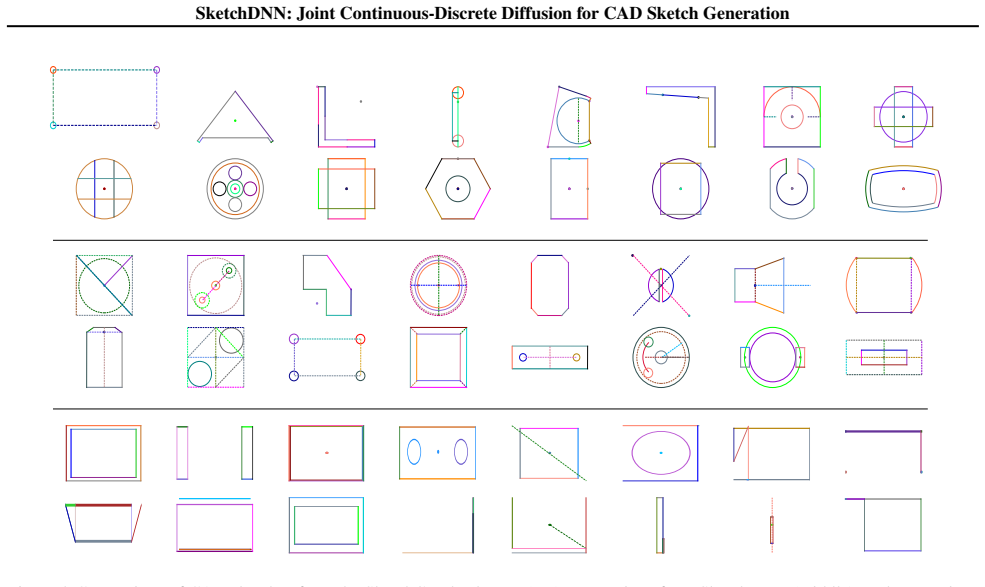
The paper's contribution is a diffusion model that works directly on CAD sketches and treats each primitive as a composite vector: a construction flag, a class label relaxed to a probability vector, and parameters for every primitive type (line, circle, arc, point). The key behavioral claim is that Gaussian-Softmax diffusion, which adds Gaussian noise to logits and projects them onto the probability simplex with a softmax, gives blended class labels and thereby destroys label information gradually instead of in one step like multinomial diffusion. With a transformer denoiser that omits positional encodings, the whole generation process is permutation equivariant: reordering primitives in the input permutes the output, so ordering never biases the learned distribution. The authors state that this joint continuous-discrete diffusion reduces FID from 16.04 to 7.80 and NLL from 84.8 to 81.33 on SketchGraphs, and their ablations attribute most of the improvement to superposition rather than permutation invariance.
Load-bearing premise
The paper's load-bearing premise is that the reverse step for discrete labels is exactly Gaussian-Softmax with variance $((1-\alpha_t)(1-\alpha_{t-1}))/(1-\alpha_t)$, since every sampling step is built on that closed-form posterior.
Editorial extensions
If this is right
- If correct, CAD sketch generation can be done as unconditional set generation: one denoising pass produces all primitives without any ordering bias.
- The reported margins over Vitruvion and SketchGen imply that diffusion with superposition is a stronger paradigm than autoregressive token generation for parametric sketches.
- The ablation contrast with categorical diffusion suggests that blended class labels, not diffusion per se, are what make the method work on discrete structural labels.
- Because constraints are excluded from the model, the same framework can be extended to generate the full sketch graph (primitives plus constraints) rather than geometry alone.
- The variance-schedule augmentation provides a way to control class-label noise in any softmax-projected diffusion model, not just CAD.
Reading between the lines
- Beyond the paper, Gaussian-Softmax diffusion is a natural fit for other set-structured categorical data, such as molecular graphs or UI layouts, where permutation invariance and heterogeneous node types matter in the same way.
- The paper's schedule augmentation leans on a Gumbel approximation for the argmax of the noisy label; how well the augmented schedule holds for exact Gaussian noise is a question a reader could probe by measuring $p(c_t = c_0)$ directly.
- A further inference is that latent diffusion underperformed partly because the VAE bottleneck discards geometric detail; a non-latent continuous-only diffusion baseline would isolate whether the discrete modeling or the data-space choice drives the gain.
- The model currently generates primitives unconditionally; conditioning on a constraint graph or a user-specified subset of primitives is the most immediate next step implied by the failure-case discussion.
Editorial analysis
A structured set of objections, weighed in public.
Referee Report
Summary. The paper proposes SketchDNN, a generative diffusion model for CAD sketches that jointly handles continuous primitive parameters and discrete class labels through a proposed Gaussian-Softmax diffusion process, and uses a permutation-equivariant transformer denoiser. The method is evaluated on the SketchGraphs dataset, where it reports FID of 7.80 versus 16.04 for the previous state-of-the-art autoregressive model Vitruvion, and NLL of 81.33 versus 84.8, with ablations showing that the Gaussian-Softmax superposition and permutation invariance each contribute to the improvement. The authors also introduce a variance-schedule augmentation heuristic, validated with Monte Carlo simulations, to make the discrete diffusion more gradual in class-label space.
Significance. If the empirical results are reproducible, the contribution is substantial: SketchDNN is the first data-space diffusion model for parametric CAD sketches and it claims large, practically meaningful improvements in both sample fidelity and diversity over strong autoregressive baselines. The idea of performing diffusion on the probability simplex via a softmax transformation of Gaussian-perturbed logits is interesting and could find applications beyond CAD. The paper also contributes a permutation-equivariant denoising architecture and a careful variance-schedule augmentation procedure with Monte Carlo validation. However, the theoretical derivation of the reverse process contains a serious algebraic error that undermines the paper's central claim that its reverse transition is derived from the true posterior, rather than being a heuristic like those in prior simplex-diffusion work. The empirical results may still hold, but the current manuscript does not support its principled-diffusion claim as written.
major comments (3)
- [Section 3.3.2, Eq. (7), and Appendix A.3] The posterior variance of the Gaussian-Softmax forward chain is algebraically incorrect. For the forward process with cumulative noise variances sigma_t^2 = 1-alpha_t, the correct posterior variance from completing the square is (1-alpha_t)(1-alpha_{t-1})/(1-alpha_t alpha_{t-1}), not (1-alpha_t)(1-alpha_{t-1})/(1-alpha_t) = 1-alpha_{t-1}. The derivation in Appendix A.3 erroneously simplifies (1/sigma_{t-1}^2 + alpha_t/sigma_t^2)^{-1} to (1-alpha_t)(1-alpha_{t-1})/(1-alpha_t) by dropping the alpha_t sigma_{t-1}^2 term in the denominator. Consequently, the reverse sampling procedure in Eq. (7) does not sample from the posterior of the stated forward process. This is load-bearing because the paper explicitly distinguishes its approach from prior simplex-diffusion methods on the grounds that it derives the reverse transition from the posterior, and the same error appears in the posterior mean. The authors must either correct the posterior derivation and the resulting sampling update or explicitly state that the reverse process is an approximation.
- [Section 3.1, Eq. (3)] The continuous-diffusion review contains the same variance error: the expression sqrt((1-alpha_t)(1-alpha_{t-1})/(1-alpha_t)) simplifies to sqrt(1-alpha_{t-1}), which is the forward marginal standard deviation, not the posterior standard deviation of the reverse step. In addition, the notation overloads alpha_t: Eq. (1) uses alpha_t as a per-step noise scale, while Eq. (2) defines alpha_t as the cumulative product, and Eq. (3) then uses alpha_t and alpha_{t-1} as if they were cumulative. This ambiguity propagates to Appendix A.3, where the forward transition p(x_t|x_{t-1}) is written with coefficient sqrt(alpha_t) and variance 1-alpha_t, but the marginal p(x_{t-1}|x_0) is simultaneously treated as having cumulative variance 1-alpha_{t-1}. The paper should adopt distinct notation for per-step and cumulative noise scales (e.g., alpha_t and bar-alpha_t) and re-derive the posterior accordingly.
- [Section 5.1 and Tables 1-2] The paper does not specify whether the Vitruvion and SketchGen results in Tables 1 and 2 were obtained by re-evaluating the released baseline models on the same preprocessed test set (the 70K CAD sketches described in Section 5.1) or taken verbatim from the original publications. This matters because the preprocessing used here differs from the original works in several ways: sketches with fewer than eight primitives are removed, duplicates are deduplicated after 8-bit quantization, and coordinates are renormalized to a unit square. If the baseline numbers come from different test sets or preprocessing pipelines, the reported FID and NLL reductions may not reflect a head-to-head comparison. The authors should state the evaluation protocol explicitly and, if the numbers are from the original papers, rerun the baselines on the same test set or clearly qualify the comparison.
minor comments (4)
- [Section 3.3 and Conclusion] The manuscript calls the Gaussian-Softmax distribution 'a novel variant of the Logistic-Normal distribution,' but the Gaussian-Softmax distribution is exactly the logistic-normal distribution introduced by Aitchison and Shen (1980); it would be more accurate to describe it as a reparameterization or special case rather than a novel variant.
- [Section 6.1] The sentence 'the ELBO, which satisfies the inequality ELBO >= NLL' is confusing: the ELBO lower-bounds the log-likelihood, so the corresponding variational bound on NLL is an upper bound, not a lower bound. The authors should rephrase to avoid implying that the reported NLL values are lower bounds when they are actually variational upper bounds.
- [Appendix A.3] The derivation uses sigma_{t-1}^2 both for the marginal variance 1-alpha_{t-1} and for the posterior variance in the same set of equations; using distinct symbols (e.g., s_t^2 for marginal and sigma_{t-1}^2 for posterior) would greatly improve clarity and prevent the kind of cancellation error noted in the major comments.
- [Figure 2] The left and right panels of Figure 2 are referenced in the caption and text as showing the raw and augmented schedules, but the panel labels themselves are not shown; adding small 'raw' and 'augmented' labels to the panels would make the figure easier to read.
Circularity Check
No circularity: the paper's central FID/NLL claims are measured on a held-out test set against external baselines; the reverse-process algebra error is a correctness issue, not a self-referential reduction.
full rationale
The central claims are empirical: FID 7.80 versus 16.04 and NLL 81.33 versus 84.80, evaluated on a held-out 70K-sketch test set against the external baselines Vitruvion and SketchGen, plus internal ablations that share architecture and training details. No reported number comes from fitting a parameter to the test set; k = 0.99, lambda = 16, and the augmented variance schedule are fixed constants or calibration heuristics, not test-set-fitted parameters. I checked the derivation chain for self-reference. The cumulative forward transition (Eq. 6) is derived from the per-step transition (Eq. 5) in Appendix A.1 by Gaussian composition and softmax shift-invariance; the reverse posterior in Appendix A.3 is derived from the forward densities by completing the square, so the sampler is not, by construction, identical to the training objective. There are no load-bearing self-citations: the authors cite no prior work of their own, and the invoked results (DDPM posterior form, Logistic-Normal density, transformer permutation equivariance) are external. One legitimate concern is that the posterior-variance algebra in Section 3.3.2 and Appendix A.3 is incorrect: with sigma_t^2 = 1 - a_t, the precision sum is 1/sigma_{t-1}^2 + a_t/sigma_t^2 = (1 - a_t a_{t-1}) / ((1 - a_t)(1 - a_{t-1})), whose reciprocal is not the paper's (1 - a_t)(1 - a_{t-1})/(1 - a_t), so the stated sigma_{t-1}^2 = 1 - a_{t-1} does not follow from the stated forward chain. This is a mathematical-correctness and reproducibility issue, not a circularity: the sampler is not forced to match the data by definition, and the empirical FID/NLL results stand or fall independently of this algebra. No pattern from the circularity taxonomy is exhibited.
Assumptions & free parameters
free parameters (3)
- k =
0.99
- lambda =
16
- max_primitives n =
16
assumptions (4)
- domain assumption The forward process in logit space is a linear Gaussian diffusion with per-step coefficient sqrt(alpha_t) and variance 1-alpha_t, and the cumulative transition sums independent Gaussian noises to variance 1 - product(alpha_i).
- ad hoc to paper Approximation of argmax of Gaussian vector by argmax of Gumbel vector to calibrate the variance schedule (Appendix A.4).
- ad hoc to paper The Gaussian-Softmax distribution's posterior after a Markov step is again Gaussian-Softmax with the derived mean and variance.
- domain assumption CAD sketches can be represented as a set of up to 16 primitives, each modeled as a superposition of all primitive types, and that this composite representation is sufficient for the generative task.
Cite this review
Pith. "Pith review of SketchDNN: Joint Continuous-Discrete Diffusion for CAD Sketch Generation." pith.science (2026). https://pith.science/paper/EISSDYVL
@misc{pith2026250711579,
  author       = {Pith},
  title        = {Pith review of: SketchDNN: Joint Continuous-Discrete Diffusion for CAD Sketch Generation},
  year         = {2026},
  howpublished = {\url{https://pith.science/paper/EISSDYVL}},
  note         = {Machine review of arXiv:2507.11579}
}
read the original abstract
We present SketchDNN, a generative model for synthesizing CAD sketches that jointly models both continuous parameters and discrete class labels through a unified continuous-discrete diffusion process. Our core innovation is Gaussian-Softmax diffusion, where logits perturbed with Gaussian noise are projected onto the probability simplex via a softmax transformation, facilitating blended class labels for discrete variables. This formulation addresses 2 key challenges, namely, the heterogeneity of primitive parameterizations and the permutation invariance of primitives in CAD sketches. Our approach significantly improves generation quality, reducing Fr\'echet Inception Distance (FID) from 16.04 to 7.80 and negative log-likelihood (NLL) from 84.8 to 81.33, establishing a new state-of-the-art in CAD sketch generation on the SketchGraphs dataset.
Figures


Figures from the paper (2 more)

Reference graph
Works this paper leans on
-
[1]
write newline
" write newline "" before.all 'output.state := FUNCTION n.dashify 't := "" t empty not t #1 #1 substring "-" = t #1 #2 substring "--" = not "--" * t #2 global.max substring 't := t #1 #1 substring "-" = "-" * t #2 global.max substring 't := while if t #1 #1 substring * t #2 global.max substring 't := if while FUNCTION format.date year duplicate empty "emp...
-
[2]
Aitchison, J. and Shen, S. M. Logistic-normal distributions: Some properties and uses. Biometrika, 67 0 (2): 0 261--272, 1980. ISSN 00063444, 14643510
work page 1980
-
[3]
D., Ho, J., Tarlow, D., and van den Berg, R
Austin, J., Johnson, D. D., Ho, J., Tarlow, D., and van den Berg, R. Structured denoising diffusion models in discrete state-spaces. In Beygelzimer, A., Dauphin, Y., Liang, P., and Vaughan, J. W. (eds.), Advances in Neural Information Processing Systems, 2021
work page 2021
-
[4]
Bond-Taylor, S., Hessey, P., Sasaki, H., Breckon, T., and Willcocks, C. G. Unleashing transformers: Parallel token prediction with discrete absorbing diffusion for fast high-resolution image generation from vector-quantized codes. In European Conference on Computer Vision, 2021
work page 2021
-
[5]
Play: Parametrically conditioned layout generation using latent diffusion
Cheng, C.-Y., Huang, F., Li, G., and Li, Y. Play: Parametrically conditioned layout generation using latent diffusion. In International Conference on Machine Learning, 2023
work page 2023
-
[6]
L., Ollion, C., and Moulines, E
Cohen, M., Quispe, G., Corff, S. L., Ollion, C., and Moulines, E. Diffusion bridges vector quantized variational autoencoders. In Chaudhuri, K., Jegelka, S., Song, L., Szepesvari, C., Niu, G., and Sabato, S. (eds.), Proceedings of the 39th International Conference on Machine Learning, volume 162 of Proceedings of Machine Learning Research, pp.\ 4141--4156...
work page 2022
-
[7]
Computer-aided design as language
Ganin, Y., Bartunov, S., Li, Y., Keller, E., and Saliceti, S. Computer-aided design as language. In Ranzato, M., Beygelzimer, A., Dauphin, Y., Liang, P., and Vaughan, J. W. (eds.), Advances in Neural Information Processing Systems, volume 34, pp.\ 5885--5897. Curran Associates, Inc., 2021
work page 2021
-
[8]
Han, X., Kumar, S., and Tsvetkov, Y. Ssd-lm: Semi-autoregressive simplex-based diffusion language model for text generation and modular control. In Annual Meeting of the Association for Computational Linguistics, 2022
work page 2022
Show all 35 references
-
[9]
Denoising diffusion probabilistic models
Ho, J., Jain, A., and Abbeel, P. Denoising diffusion probabilistic models. In Larochelle, H., Ranzato, M., Hadsell, R., Balcan, M., and Lin, H. (eds.), Advances in Neural Information Processing Systems, volume 33, pp.\ 6840--6851. Curran Associates, Inc., 2020
2020
-
[10]
Argmax flows and multinomial diffusion: Learning categorical distributions
Hoogeboom, E., Nielsen, D., Jaini, P., Forr \'e , P., and Welling, M. Argmax flows and multinomial diffusion: Learning categorical distributions. In Beygelzimer, A., Dauphin, Y., Liang, P., and Vaughan, J. W. (eds.), Advances in Neural Information Processing Systems, 2021
2021
-
[11]
A., Bastings, J., Poole, B., van den Berg, R., and Salimans, T
Hoogeboom, E., Gritsenko, A. A., Bastings, J., Poole, B., van den Berg, R., and Salimans, T. Autoregressive diffusion models. In International Conference on Learning Representations, 2022
2022
-
[12]
Huijben, I. A. M., Kool, W., Paulus, M. B., and van Sloun, R. J. G. A review of the gumbel-max trick and its extensions for discrete stochasticity in machine learning. IEEE Transactions on Pattern Analysis and Machine Intelligence, 45: 0 1353--1371, 2021
2021
-
[13]
Categorical reparameterization with gumbel-softmax
Jang, E., Gu, S., and Poole, B. Categorical reparameterization with gumbel-softmax. In International Conference on Learning Representations, 2017
2017
-
[14]
TESS : Text-to-text self-conditioned simplex diffusion
Karimi Mahabadi, R., Ivison, H., Tae, J., Henderson, J., Beltagy, I., Peters, M., and Cohan, A. TESS : Text-to-text self-conditioned simplex diffusion. In Graham, Y. and Purver, M. (eds.), Proceedings of the 18th Conference of the European Chapter of the Association for Comput...
2024
-
[15]
Crafting papers on machine learning
Langley, P. Crafting papers on machine learning. In Langley, P. (ed.), Proceedings of the 17th International Conference on Machine Learning (ICML 2000), pp.\ 1207--1216, Stanford, CA, 2000. Morgan Kaufmann
2000
-
[16]
Dlt: Conditioned layout generation with joint discrete-continuous diffusion layout transformer
Levi, E., Brosh, E., Mykhailych, M., and Perez, M. Dlt: Conditioned layout generation with joint discrete-continuous diffusion layout transformer. 2023 IEEE/CVF International Conference on Computer Vision (ICCV), pp.\ 2106--2115, 2023
2023
-
[17]
Discrete diffusion modeling by estimating the ratios of the data distribution
Lou, A., Meng, C., and Ermon, S. Discrete diffusion modeling by estimating the ratios of the data distribution. In Salakhutdinov, R., Kolter, Z., Heller, K., Weller, A., Oliver, N., Scarlett, J., and Berkenkamp, F. (eds.), Proceedings of the 41st International Conference on Ma...
2024
-
[18]
J., Mnih, A., and Teh, Y
Maddison, C. J., Mnih, A., and Teh, Y. W. The concrete distribution: A continuous relaxation of discrete random variables. In International Conference on Learning Representations, 2017
2017
-
[19]
Nichol, A. Q. and Dhariwal, P. Improved denoising diffusion probabilistic models. In Meila, M. and Zhang, T. (eds.), Proceedings of the 38th International Conference on Machine Learning, volume 139 of Proceedings of Machine Learning Research, pp.\ 8162--8171. PMLR, 18--24 Jul 2021
2021
-
[20]
R., Bhat, S
Para, W. R., Bhat, S. F., Guerrero, P., Kelly, T., Mitra, N., Guibas, L., and Wonka, P. Sketchgen: generating constrained cad sketches. In Proceedings of the 35th International Conference on Neural Information Processing Systems, NIPS '21, Red Hook, NY, USA, 2024. Curran Assoc...
2024
-
[21]
Peebles, W. S. and Xie, S. Scalable diffusion models with transformers. 2023 IEEE/CVF International Conference on Computer Vision (ICCV), pp.\ 4172--4182, 2022
2023
-
[22]
Potapczynski, A., Loaiza-Ganem, G., and Cunningham, J. P. Invertible gaussian reparameterization: revisiting the gumbel-softmax. In Proceedings of the 34th International Conference on Neural Information Processing Systems, NIPS '20, Red Hook, NY, USA, 2020. Curran Associates I...
2020
-
[23]
Seff, A., Ovadia, Y., Zhou, W., and Adams, R. P. Sketchgraphs: A large-scale dataset for modeling relational geometry in computer-aided design. ArXiv, abs/2007.08506, 2020
2007 arXiv
-
[24]
Seff, A., Zhou, W., Richardson, N., and Adams, R. P. Vitruvion: A generative model of parametric CAD sketches. In International Conference on Learning Representations, 2022
2022
-
[25]
A., Hosseini, S., and Furukawa, Y
Shabani, M. A., Hosseini, S., and Furukawa, Y. Housediffusion: Vector floorplan generation via a diffusion model with discrete and continuous denoising. 2023 IEEE/CVF Conference on Computer Vision and Pattern Recognition (CVPR), pp.\ 5466--5475, 2022
2023
-
[26]
Deep unsupervised learning using nonequilibrium thermodynamics
Sohl-Dickstein, J., Weiss, E., Maheswaranathan, N., and Ganguli, S. Deep unsupervised learning using nonequilibrium thermodynamics. In Bach, F. and Blei, D. (eds.), Proceedings of the 32nd International Conference on Machine Learning, volume 37 of Proceedings of Machine Learni...
2015
-
[27]
N., Kaiser, L., and Polosukhin, I
Vaswani, A., Shazeer, N., Parmar, N., Uszkoreit, J., Jones, L., Gomez, A. N., Kaiser, L., and Polosukhin, I. Attention is all you need. In Proceedings of the 31st International Conference on Neural Information Processing Systems, NIPS'17, pp.\ 6000–6010, Red Hook, NY, USA, 201...
2017
-
[28]
Vq-cad: Computer-aided design model generation with vector quantized diffusion
Wang, H., Zhao, M., Wang, Y., Quan, W., and Yan, D.-M. Vq-cad: Computer-aided design model generation with vector quantized diffusion. Comput. Aided Geom. Des., 111: 0 102327, 2024
2024
-
[29]
Willis, K. D. D., Jayaraman, P. K., Lambourne, J., Chu, H., and Pu, Y. Engineering sketch generation for computer-aided design. 2021 IEEE/CVF Conference on Computer Vision and Pattern Recognition Workshops (CVPRW), pp.\ 2105--2114, 2021
2021
-
[30]
Deepcad: A deep generative network for computer-aided design models
Wu, R., Xiao, C., and Zheng, C. Deepcad: A deep generative network for computer-aided design models. 2021 IEEE/CVF International Conference on Computer Vision (ICCV), pp.\ 6752--6762, 2021
2021
-
[31]
H., Katz, M., Jayaraman, P
Wu, S., Khasahmadi, A. H., Katz, M., Jayaraman, P. K., Pu, Y., Willis, K., and Liu, B. Cadvlm: Bridging language and vision in the generation of parametric cad sketches. In Leonardis, A., Ricci, E., Roth, S., Russakovsky, O., Sattler, T., and Varol, G. (eds.), Computer Vision ...
2024
-
[32]
Permutation equivariance of transformers and its applications
Xu, H., Xiang, L., Ye, H., Yao, D., Chu, P., and Li, B. Permutation equivariance of transformers and its applications. In Proceedings of the IEEE/CVF Conference on Computer Vision and Pattern Recognition (CVPR), pp.\ 5987--5996, June 2024 a
2024
-
[33]
Xu, X., Willis, K. D. D., Lambourne, J., Cheng, C.-Y., Jayaraman, P. K., and Furukawa, Y. Skexgen: Autoregressive generation of cad construction sequences with disentangled codebooks. ArXiv, abs/2207.04632, 2022
2022 arXiv
-
[34]
K., Wang, Z., Willis, K
Xu, X., Lambourne, J., Jayaraman, P. K., Wang, Z., Willis, K. D. D., and Furukawa, Y. Brepgen: A b-rep generative diffusion model with structured latent geometry. ACM Transactions on Graphics (TOG), 43: 0 1 -- 14, 2024 b
2024
-
[35]
Yu, P., Xie, S., Ma, X., Jia, B., Pang, B., Gao, R., Zhu, Y., Zhu, S.-C., and Wu, Y. N. Latent diffusion energy-based model for interpretable text modelling. In Chaudhuri, K., Jegelka, S., Song, L., Szepesvari, C., Niu, G., and Sabato, S. (eds.), Proceedings of the 39th Intern...
2022
Reviewed August 6, 2026 · model on record in the stance chip above.
Discussion (0). Sign in to comment.