REVIEW 3 major objections 4 minor 1 cited by
Electromagnetic Dirac Cogenesis
T0 review · 3 major / 4 minor · reviewed 2026-08-06 · deepseek-v4-flash
Pith's one-line read This paper proposes that one two-body decay through an electromagnetic dipole operator generates both the baryon asymmetry and dark matter, fixing the dark matter mass near 1.9 proton masses.
desk verdict Novel cogenesis idea with a clean DM-mass prediction, but the printed Boltzmann equations swap chiralities and vanish for massless final states, so the benchmark is not supported by the equations. read the letter →
The pith
A machine-rendered reading of the paper's core claim, the machinery that carries it, and where it could break.
The reading
What carries the argument
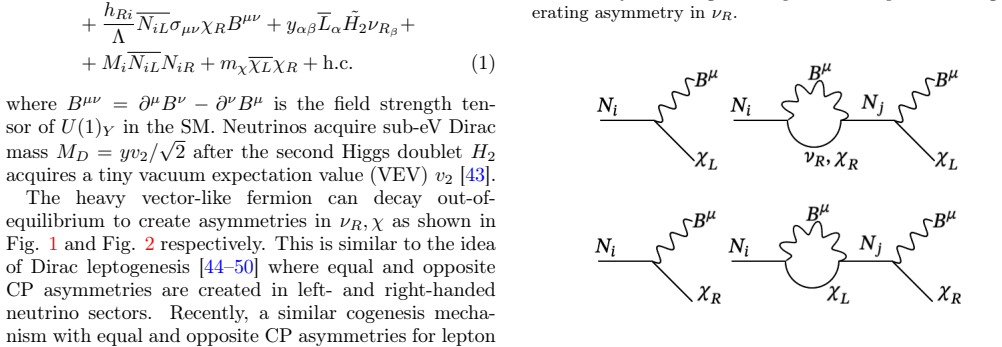
The engine is the out-of-equilibrium two-body decay of a heavy vector-like singlet fermion $N_1$ through electromagnetic dipole operators, $(1/\Lambda) N \sigma^{\mu\nu} \nu_R B_{\mu\nu}$ and $(1/\Lambda) N \sigma^{\mu\nu} \chi B_{\mu\nu}$. Interference between tree-level and one-loop diagrams produces CP asymmetries $\epsilon_{\nu_R}$, $\epsilon_{\chi_L}$, $\epsilon_{\chi_R}$ whose sum vanishes by lepton-number conservation. Coupled Boltzmann equations track the comoving asymmetries in $\nu_R$, $\chi_L$, $\chi_R$ and the $N_1$ densities, with inverse decays and $2\to2$ processes as washouts; an out-of-equilibrium condition $\Gamma^{\rm wo}_{LR} < H$ keeps the $\nu_R$ and $\chi$ asymmetries from equilibrating. The relation $|\eta_{\Delta\chi_L}+\eta_{\Delta\chi_R}|\approx\eta_{\Delta\nu_R}$, combined with $\Omega_{\rm DM}\approx 5\Omega_B$, is what converts the asymmetry bookkeeping into the mass bound $m_\chi\lesssim 1.9\, m_p$.
What would settle it
Solve the full coupled Boltzmann equations (10)–(14) over a dense grid in the $\Lambda$ – $M_1$ plane and check the asymptotic relation $|\eta_{\Delta\chi_L}+\eta_{\Delta\chi_R}|\approx\eta_{\Delta\nu_R}$. If the two final asymmetries differ by an order-one factor in most of the allowed region, the predicted dark matter mass $m_\chi\approx1.9\, m_p$ and the $\Omega_\chi$ – $\Omega_B$ link break. A separate observational falsifier: observation of neutrinoless double $\beta$ decay would rule out the pure-Dirac neutrino assumption on which the equal-opposite asymmetry rests.
Extended reading notes
Core claim
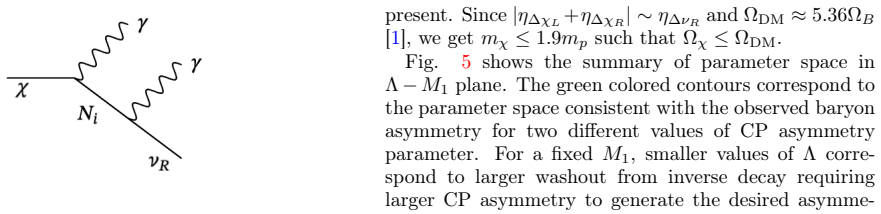
The central claim is that a single two-body decay channel, $N_i \to \chi B_\mu$ and $N_i \to \nu_R B_\mu$ via the dimension-five electromagnetic dipole operator, can simultaneously create the baryon asymmetry and the dark matter relic. Because the fermions are all Dirac-type and a global $U(1)_D$ symmetry is conserved, the loop-generated CP asymmetries satisfy $\epsilon_{\nu_R}+\epsilon_{\chi_L}+\epsilon_{\chi_R}=0$; the dark and neutrino sectors therefore carry exactly opposite asymmetries. Once the $\nu_R$ asymmetry is transferred to left-handed leptons through the neutrinophilic Higgs Yukawa and reprocessed by sphalerons, and the $\chi$ asymmetry is identified with asymmetric dark matter, the observed ratio $\Omega_{\rm DM}\approx 5\Omega_B$ forces $m_\chi \lesssim 1.9\, m_p$. The same framework predicts a TeV-scale cogenesis scale without resonant enhancement, a long-lived $\chi$ with the three-body decay $\chi \to \gamma \gamma \nu_R$, and $\Delta N_{\rm eff}\approx 0.14$ from thermalized right-handed neutrinos.
Load-bearing premise
The central claim depends on the final imbalance in the dark particle and the final imbalance in the neutrino coming out equal in magnitude after all the early-universe processes that could erase or transfer asymmetries; the paper shows this equality for one benchmark and does not demonstrate it across the full allowed parameter space.
Editorial extensions
If this is right
- Dark matter has a fixed mass around 1.9 proton masses and decays as $\chi \to \gamma \gamma \nu_R$, making it a long-lived particle that can be sought in gamma-ray telescopes.
- Successful cogenesis can happen at scales as low as a TeV, with no resonant enhancement of the CP asymmetry needed.
- Three thermalized right-handed Dirac neutrinos give $\Delta N_{\rm eff}\approx 0.14$, within reach of future CMB experiments.
- The heavy fermions $N$ can be searched at colliders through their dipole-induced mono-photon signatures.
- The scenario is falsified if neutrinoless double beta decay is observed, since the mechanism requires Dirac neutrinos.
Reading between the lines
- The paper fixes the DM mass using one benchmark where $|\eta_{\Delta\chi_L}+\eta_{\Delta\chi_R}|\approx\eta_{\Delta\nu_R}$; a full parameter scan might reveal that differing washout rates let the final asymmetries decouple, in which case the sharp $1.9\, m_p$ prediction would loosen into a range.
- If a future CMB experiment measures $\Delta N_{\rm eff}$ between 0.1 and 0.15, it would align with exactly three thermalized right-handed neutrinos; a null measurement below 0.02 would exclude this model's dark-radiation signature while leaving the cogenesis mechanism itself untouched.
- Replacing the effective dipole operator with a renormalizable UV completion would turn the cutoff $\Lambda$ into physical mediator masses and likely add charged-lepton flavor or electric-dipole observables, giving a low-energy test of the same cogenesis setup.
Editorial analysis
A structured set of objections, weighed in public.
Referee Report
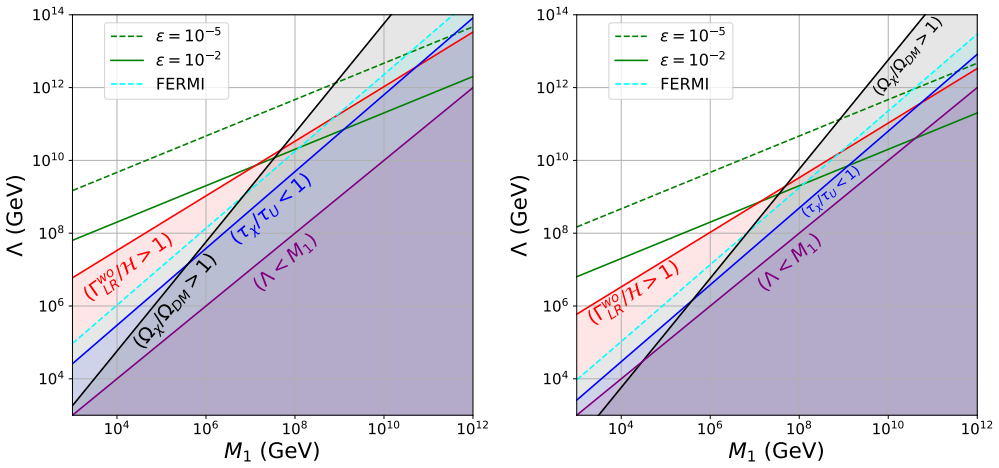
Summary. The paper proposes a cogenesis mechanism in which the out-of-equilibrium decay of heavy vector-like fermions N into dark fermions χ and right-handed Dirac neutrinos ν_R through electromagnetic dipole operators generates equal and opposite CP asymmetries in the lepton and dark sectors. The ν_R asymmetry is transferred to left-handed lepton doublets by a neutrinophilic Higgs Yukawa coupling and subsequently converted to the baryon asymmetry by electroweak sphalerons, while the χ asymmetry forms asymmetric dark matter. The authors claim that total lepton number conservation fixes the dark matter mass to m_χ ≲ 1.9 m_p, that χ decays via χ → γγν_R giving indirect-detection signals, and that thermalized ν_R yields ΔN_eff ≈ 0.14. Quantitative results are obtained from a set of Boltzmann equations in Sec. III and illustrated by one benchmark in Fig. 4 and parameter-space plots in Fig. 5. The central quantitative claims, however, rest on Boltzmann equations that are internally inconsistent with the Lagrangian and contain a divergent reaction-density formula, and on an assumed equality of final asymmetries that is not derived from the dynamics.
Significance. If the mechanism works as advertised, the paper would be of considerable interest: it connects the baryon and dark matter abundances through a calculable relic asymmetry, predicts a specific O(GeV) dark matter mass, and gives falsifiable signatures in ΔN_eff, gamma-ray telescopes, and heavy neutral lepton searches. The setup is economical and the use of electromagnetic dipole operators for two-body decays is a distinctive twist on Dirac leptogenesis and asymmetric dark matter. The paper also makes a clean, testable prediction that neutrinos are purely Dirac, testable by neutrinoless double beta decay. However, the current manuscript does not support these claims as written: the printed Boltzmann equations do not describe the model defined by Eq. (1), the decay reaction densities vanish for massless final states as defined, and the key asymmetry-equality relation underlying the dark matter mass prediction is asserted rather than demonstrated. These are load-bearing deficiencies, not presentation issues.
major comments (3)
- [Sec. III, Eqs. (10)-(14) vs Eq. (1)] The Boltzmann equations assign decay channels opposite to the chiral structure of the Lagrangian. In Eq. (1), N_{iL} couples to ν_R and χ_R (couplings λ_iα, h_Ri), while N_{iR} couples to χ_L (coupling h_Li). But Eq. (10) sources η_{Δν_R} from γ(N_{1R} → B_μν_R), Eq. (11) sources η_{Δχ_R} from γ(N_{1R} → B_μχ_R), and Eq. (12) sources η_{Δχ_L} from γ(N_{1L} → B_μχ_L). These are precisely the wrong chiral assignments, so the system solved in Fig. 4 produces asymmetries in species that do not couple to the stated initiator. The source and washout terms in Eqs. (10)-(14) therefore do not describe the model of Eq. (1); the authors must correct the channel assignments and re-solve the system.
- [Sec. III, Eq. (18)] Equation (18) defines γ_{A→B} = n_eq^A K_1(m_A/T)/K_2(m_B/T) Γ_{A→B}. Since the final-state particles are taken to be massless in Eqs. (4)-(6) (and the photon is massless regardless), K_2(m_B/T) with m_B = 0 diverges, so every decay reaction density vanishes identically. Consequently, all decay source terms and inverse-decay washout terms in Eqs. (10)-(14) are zero, and the evolution shown in Fig. 4 cannot be generated by the printed equations. The standard thermal decay density uses the decaying particle mass in the K_2 factor; this should be corrected and the numerical benchmark recomputed.
- [Sec. IV, derivation of m_χ ≲ 1.9 m_p] The load-bearing relation |η_{Δχ_L} + η_{Δχ_R}| ≈ η_{Δν_R} is introduced only by inspection of one benchmark, after the statement in the paragraph containing Eq. (24). It is not derived from the Boltzmann equations. Equations (10)-(12) contain distinct inverse-decay and scattering washout terms for ν_R, χ_R, and χ_L, so even if the CP-sum rule ϵ_νR + ϵ_χL + ϵ_χR = 0 holds, the final comoving asymmetries can differ substantially from the initially produced ones. The dark matter mass bound and the Ω_χ/Ω_B relation follow only if this equality is robust. The authors should either prove the equality from the (corrected) Boltzmann system, demonstrate it numerically across the allowed parameter space, or replace the sharp mass prediction with a range; without this, the headline O(1) GeV dark matter mass is unsupported.
minor comments (4)
- [Sec. IV and Fig. 4 caption] The text and figure caption refer to an 'axion decay constant' when describing the scale Λ of the dipole operators; this should be the cutoff scale Λ, not an axion decay constant.
- [Sec. III, Eq. (18)] Apart from the divergent K_2(m_B/T), the notation in Eq. (18) should specify whether Γ_{A→B} is the zero-temperature rest-frame partial width; as written the reader cannot check dimensions without guessing.
- [Fig. 4] The axis labels and legend in Fig. 4 are corrupted ('= 10 5', '| R|', etc.), making the benchmark difficult to interpret; the figure should be regenerated with clear labels.
- [General] Equation (2) is described as following from 'total lepton number conservation.' Since the symmetry is actually the global U(1)_D discussed in Sec. II, the wording should be aligned to avoid confusion with SM lepton number.
Circularity Check
No circular derivation: the m_chi <= 1.9 m_p bound is a standard asymmetric-dark-matter constraint using measured abundances and unitarity, not a fit or self-citation chain.
full rationale
The paper's central quantitative claim, m_chi <= 1.9 m_p, follows from the net-lepton-number-conservation relation epsilon_nuR + epsilon_chiL + epsilon_chiR = 0 (Eq. 2), the observed ratio Omega_DM ~ 5.36 Omega_B, and the final-asymmetry relation |eta_Delta chi_L + eta_Delta chi_R| ~ eta_Delta nu_R stated after the Fig. 4 benchmark. The last relation is asserted for one benchmark rather than proven over the parameter space, and the Boltzmann equations contain apparent technical defects (chiral assignments in Eqs. 13-14 relative to Eq. 1; Eq. 18 involves K2(m_B/T) which diverges for massless B). These are correctness or supportability concerns, not circularity: the mass bound is not obtained by defining the prediction in terms of itself, and the CP-asymmetry sum is derived from the displayed loop-level expressions rather than imported from a fit. The self-citations [42] and [51] are background references for the two-body decay kinematics and for a related ALP cogenesis mechanism; neither is used as the exclusive justification for the central claim. No equation in the paper reduces to its input by construction, and no fitted parameter is renamed as a prediction. Accordingly, no circular step can be exhibited under the required standard, and the appropriate finding is no significant circularity.
Assumptions & free parameters
free parameters (6)
- M1 (heavy fermion mass) =
10^3 to 10^12 GeV
- Lambda (dipole operator cutoff) =
10^6 to 10^14 GeV; benchmark 1.5e9 GeV
- m_chi (dark fermion mass) =
about 1.9 GeV
- lambda, h_L, h_R couplings =
1 or 0.1
- CP asymmetry scale epsilon =
10^-5 or 10^-2
- Dirac Yukawa y =
>= 10^-8
assumptions (5)
- domain assumption Global U(1)_D symmetry is exactly conserved, forbidding Majorana mass terms and keeping neutrinos purely Dirac.
- domain assumption The dimension-5 dipole EFT is valid with Lambda > M1.
- standard math The electroweak sphaleron conversion factor C_sph = 8/23 with N_H=2, N_f=3 and S=27.3 is applied.
- domain assumption The nu_R Yukawa interaction with H2 is in equilibrium before sphaleron decoupling (y >= 10^-8), and nu_R <-> chi scatterings remain out of equilibrium (Gamma_wo_LR < H).
- ad hoc to paper The final asymmetries satisfy |eta_Delta chi_L + eta_Delta chi_R| approx eta_Delta nu_R.
invented entities (4)
-
Heavy vector-like singlet fermions N_L,R
independent evidence
-
Dark fermion chi_L,R
independent evidence
-
Right-chiral Dirac neutrino nu_R (three copies)
independent evidence
-
Neutrinophilic second Higgs doublet H2
Cite this review
Pith. "Pith review of Electromagnetic Dirac Cogenesis." pith.science (2026). https://pith.science/paper/EJGXF4LZ
@misc{pith2026250711607,
  author       = {Pith},
  title        = {Pith review of: Electromagnetic Dirac Cogenesis},
  year         = {2026},
  howpublished = {\url{https://pith.science/paper/EJGXF4LZ}},
  note         = {Machine review of arXiv:2507.11607}
}
abstract
We propose a novel cogenesis mechanism by utilising the two-body decay of heavy vector-like fermions to dark matter (DM) $\chi$ and right chiral part of light Dirac neutrino $\nu_R$ via the electromagnetic dipole operator. This leads to generation of asymmetry in dark fermion $\chi$ as well as $\nu_R$ with the latter getting transferred to left-handed lepton doublets via Yukawa interactions with a neutrinophilic Higgs doublet. While lepton asymmetry is converted into baryon asymmetry of the Universe via electroweak sphalerons, the dark fermion asymmetry results in asymmetric dark matter. Since CP asymmetries in lepton and dark sector are equal and opposite due to net lepton number conservation, DM mass is restricted to a fixed value $\sim \mathcal{O}(1)$ GeV. Long-lived nature of DM keeps indirect detection prospects at gamma-ray telescopes alive while thermalised light Dirac neutrinos lead to observable dark radiation at cosmic microwave background (CMB) experiments. Heavy vector-like fermions can be probed at terrestrial experiments via their electromagnetic dipole interactions.
Figures

Figures from the paper (2 more)

Forward citations
Cited by 1 Pith paper
-
Imprint of matter-antimatter asymmetry on collapsing domain walls
Radiative corrections from an asymmetric Dirac fermion generate a bias that collapses domain walls, producing gravitational waves that encode the asymmetry level and temperature.
Reference graph
Works this paper leans on
- [51]
-
[42]
Electromagnetic leptogenesis with light-heavy sterile neutrinos
D. Borah and A. Dasgupta,Electromagnetic leptogenesis with light-heavy sterile neutrinos, Phys. Lett. B 866 (2025) 139557 [2501.13150]
work page Pith review arXiv 2025
-
[1]
Planck collaboration, Planck 2018 results. VI. Cosmological parameters, Astron. Astrophys.641 (2020) A6 [1807.06209]
arXiv 2020
-
[2]
Particle Data Group collaboration, Review of particle physics, Phys. Rev. D110 (2024) 030001
2024
- [3]
-
[4]
G. Jungman, M. Kamionkowski and K. Griest, Supersymmetric dark matter, Phys. Rept. 267 (1996) 195 [hep-ph/9506380]
arXiv 1996
-
[5]
G. Bertone, D. Hooper and J. Silk,Particle dark matter: Evidence, candidates and constraints, Phys. Rept. 405 (2005) 279 [hep-ph/0404175]
arXiv 2005
-
[6]
Weinberg,Cosmological Production of Baryons, Phys
S. Weinberg,Cosmological Production of Baryons, Phys. Rev. Lett.42 (1979) 850
work page 1979
Show all 71 references
-
[7]
Kolb and S
E.W. Kolb and S. Wolfram,Baryon Number Generation in the Early Universe, Nucl. Phys. B172 (1980) 224
1980
-
[8]
Fukugita and T
M. Fukugita and T. Yanagida,Baryogenesis Without Grand Unification, Phys. Lett. B174 (1986) 45
1986
-
[9]
Nussinov,TECHNOCOSMOLOGY: COULD A TECHNIBARYON EXCESS PROVIDE A ’NATURAL’ MISSING MASS CANDIDATE?, Phys
S. Nussinov,TECHNOCOSMOLOGY: COULD A TECHNIBARYON EXCESS PROVIDE A ’NATURAL’ MISSING MASS CANDIDATE?, Phys. Lett. B165 (1985) 55
1985
-
[10]
Davoudiasl and R.N
H. Davoudiasl and R.N. Mohapatra,On Relating the Genesis of Cosmic Baryons and Dark Matter, New J. Phys. 14 (2012) 095011 [1203.1247]
2012 arXiv
-
[11]
Petraki and R.R
K. Petraki and R.R. Volkas,Review of asymmetric dark matter, Int. J. Mod. Phys. A28 (2013) 1330028 [1305.4939]
2013 arXiv
-
[12]
Zurek,Asymmetric Dark Matter: Theories, Signatures, and Constraints, Phys
K.M. Zurek,Asymmetric Dark Matter: Theories, Signatures, and Constraints, Phys. Rept. 537 (2014) 91 [1308.0338]
2014 arXiv
-
[13]
Barman, D
B. Barman, D. Borah, S.J. Das and R. Roshan, Non-thermal origin of asymmetric dark matter from inflaton and primordial black holes, JCAP 03 (2022) 031 [2111.08034]
2022 arXiv
-
[14]
Borah, S
D. Borah, S. Mahapatra, P.K. Paul, N. Sahu and P. Shukla,Asymmetric self-interacting dark matter with a canonical seesaw model, Phys. Rev. D110 (2024) 035033 [2404.14912]
2024 arXiv
-
[15]
Yoshimura,Unified Gauge Theories and the Baryon Number of the Universe, Phys
M. Yoshimura,Unified Gauge Theories and the Baryon Number of the Universe, Phys. Rev. Lett.41 (1978) 281
1978
-
[16]
Barr,Comments on Unitarity and the Possible Origins of the Baryon Asymmetry of the Universe, Phys
S.M. Barr,Comments on Unitarity and the Possible Origins of the Baryon Asymmetry of the Universe, Phys. Rev. D19 (1979) 3803
1979
-
[17]
Baldes, N.F
I. Baldes, N.F. Bell, K. Petraki and R.R. Volkas, Particle-antiparticle asymmetries from annihilations, Phys. Rev. Lett.113 (2014) 181601 [1407.4566]
2014 arXiv
-
[18]
Y. Cui, L. Randall and B. Shuve,A WIMPy Baryogenesis Miracle, JHEP 04 (2012) 075 [1112.2704]
2012 arXiv
-
[19]
Bernal, F.-X
N. Bernal, F.-X. Josse-Michaux and L. Ubaldi, Phenomenology of WIMPy baryogenesis models, JCAP 01 (2013) 034 [1210.0094]
2013 arXiv
-
[20]
Bernal, S
N. Bernal, S. Colucci, F.-X. Josse-Michaux, J. Racker and L. Ubaldi,On baryogenesis from dark matter annihilation, JCAP 10 (2013) 035 [1307.6878]
2013 arXiv
-
[21]
Kumar and P
J. Kumar and P. Stengel,WIMPy Leptogenesis With Absorptive Final State Interactions, Phys. Rev. D89 (2014) 055016 [1309.1145]
2014 arXiv
-
[22]
Racker and N
J. Racker and N. Rius,Helicitogenesis: WIMPy baryogenesis with sterile neutrinos and other realizations, JHEP 11 (2014) 163 [1406.6105]
2014 arXiv
-
[23]
Borah, A
D. Borah, A. Dasgupta and S.K. Kang,TeV Scale Leptogenesis via Dark Sector Scatterings, Eur. Phys. J. C 80 (2020) 498 [1806.04689]
2020 arXiv
-
[24]
Borah, A
D. Borah, A. Dasgupta and S.K. Kang,Two-component dark matter with cogenesis of the baryon asymmetry of the Universe, Phys. Rev. D100 (2019) 103502 [1903.10516]
2019 arXiv
-
[25]
Dasgupta, P.S
A. Dasgupta, P.S. Bhupal Dev, S.K. Kang and Y. Zhang,New mechanism for matter-antimatter asymmetry and connection with dark matter, Phys. Rev. D 102 (2020) 055009 [1911.03013]
2020 arXiv
-
[26]
Mahanta and D
D. Mahanta and D. Borah,WIMPy leptogenesis in non-standard cosmologies, JCAP 03 (2023) 049 [2208.11295]
2023 arXiv
-
[27]
Roszkowski and O
L. Roszkowski and O. Seto,Axino dark matter from Q-balls in Affleck-Dine baryogenesis and the Omega(b) - Omega(DM) coincidence problem, Phys. Rev. Lett.98 (2007) 161304 [hep-ph/0608013]
2007 arXiv
-
[28]
Seto and M
O. Seto and M. Yamaguchi,Axino warm dark matter and Omega(b) - Omega(DM) coincidence, Phys. Rev. D 75 (2007) 123506 [0704.0510]
2007 arXiv
-
[29]
Cheung and K.M
C. Cheung and K.M. Zurek,Affleck-Dine Cogenesis, Phys. Rev. D84 (2011) 035007 [1105.4612]
2011 arXiv
-
[30]
von Harling, K
B. von Harling, K. Petraki and R.R. Volkas, Affleck-Dine dynamics and the dark sector of pangenesis, JCAP 05 (2012) 021 [1201.2200]
2012 arXiv
-
[31]
Borah, S
D. Borah, S. Jyoti Das and N. Okada,Affleck-Dine cogenesis of baryon and dark matter, JHEP 05 (2023) 004 [2212.04516]
2023 arXiv
-
[32]
Borah, S
D. Borah, S. Jyoti Das and R. Roshan,Baryon asymmetry from dark matter decay, Phys. Rev. D108 (2023) 075025 [2305.13367]
2023 arXiv
-
[33]
Baldes, S
I. Baldes, S. Blasi, A. Mariotti, A. Sevrin and K. Turbang,Baryogenesis via relativistic bubble expansion, Phys. Rev. D104 (2021) 115029 [2106.15602]
2021 arXiv
-
[34]
Azatov, M
A. Azatov, M. Vanvlasselaer and W. Yin,Baryogenesis via relativistic bubble walls, JHEP 10 (2021) 043 [2106.14913]
2021 arXiv
-
[35]
Borah, A
D. Borah, A. Dasgupta and I. Saha,Leptogenesis and dark matter through relativistic bubble walls with observable gravitational waves, JHEP 11 (2022) 136 [2207.14226]
2022 arXiv
-
[36]
Borah, A
D. Borah, A. Dasgupta and I. Saha,LIGO-Virgo constraints on dark matter and leptogenesis triggered by a first order phase transition at high scale, Phys. Rev. D 109 (2024) 095034 [2304.08888]
2024 arXiv
-
[37]
Borah, A
D. Borah, A. Dasgupta, M. Knauss and I. Saha,Baryon asymmetry from dark matter decay in the vicinity of a phase transition, Phys. Rev. D108 (2023) L091701 [2306.05459]
2023 arXiv
-
[38]
Borah and I
D. Borah and I. Saha,Filtered cogenesis of PBH dark matter and baryons, 2502.12248
-
[39]
Heeck,Leptogenesis with Lepton-Number-Violating Dirac Neutrinos, Phys
J. Heeck,Leptogenesis with Lepton-Number-Violating Dirac Neutrinos, Phys. Rev. D88 (2013) 076004 [1307.2241]
2013 arXiv
-
[40]
N.F. Bell, B. Kayser and S.S.C. Law,Electromagnetic Leptogenesis, Phys. Rev. D78 (2008) 085024 [0806.3307]
2008 arXiv
-
[41]
Choudhury, N
D. Choudhury, N. Mahajan, S. Patra and U. Sarkar, 6 Radiative leptogenesis at the TeV scale, JCAP 04 (2012) 017 [1104.1851]
2012 arXiv
-
[43]
Davidson and H.E
S.M. Davidson and H.E. Logan,LHC phenomenology of a two-Higgs-doublet neutrino mass model, Phys. Rev. D82 (2010) 115031 [1009.4413]
2010 arXiv
-
[44]
K. Dick, M. Lindner, M. Ratz and D. Wright, Leptogenesis with Dirac neutrinos, Phys. Rev. Lett.84 (2000) 4039 [hep-ph/9907562]
2000 arXiv
-
[45]
Murayama and A
H. Murayama and A. Pierce,Realistic Dirac leptogenesis, Phys. Rev. Lett.89 (2002) 271601 [hep-ph/0206177]
2002 arXiv
-
[46]
Cerdeno, A
D.G. Cerdeno, A. Dedes and T.E.J. Underwood,The Minimal Phantom Sector of the Standard Model: Higgs Phenomenology and Dirac Leptogenesis, JHEP 09 (2006) 067 [hep-ph/0607157]
2006 arXiv
-
[47]
Borah and A
D. Borah and A. Dasgupta,Common Origin of Neutrino Mass, Dark Matter and Dirac Leptogenesis, JCAP 1612 (2016) 034 [1608.03872]
2016 arXiv
-
[48]
Barman, D
B. Barman, D. Borah, A. Dasgupta and A. Ghoshal, Probing high scale Dirac leptogenesis via gravitational waves from domain walls, Phys. Rev. D106 (2022) 015007 [2205.03422]
2022 arXiv
-
[49]
Barman, D
B. Barman, D. Borah, S. Jyoti Das and I. Saha,Scale of Dirac leptogenesis and left-right symmetry in the light of recent PTA results, JCAP 10 (2023) 053 [2307.00656]
2023 arXiv
-
[50]
Borboruah, D
Z.A. Borboruah, D. Borah, L. Malhotra and U. Patel, Minimal Dirac seesaw dark matter, 2412.12267
-
[52]
D’Onofrio, K
M. D’Onofrio, K. Rummukainen and A. Tranberg, Sphaleron Rate in the Minimal Standard Model, Phys. Rev. Lett.113 (2014) 141602 [1404.3565]
2014 arXiv
-
[53]
Fermi-LAT collaboration, Fermi-LAT Observations of the Diffuse Gamma-Ray Emission: Implications for Cosmic Rays and the Interstellar Medium, Astrophys. J. 750 (2012) 3 [1202.4039]
2012 arXiv
-
[54]
Essig, E
R. Essig, E. Kuflik, S.D. McDermott, T. Volansky and K.M. Zurek,Constraining Light Dark Matter with Diffuse X-Ray and Gamma-Ray Observations, JHEP 11 (2013) 193 [1309.4091]
2013 arXiv
-
[55]
Hunter et al.,EGRET observations of the diffuse gamma-ray emission from the galactic plane, Astrophys
S.D. Hunter et al.,EGRET observations of the diffuse gamma-ray emission from the galactic plane, Astrophys. J. 481 (1997) 205
1997
-
[56]
E. Orlando et al.,Exploring the MeV sky with a combined coded mask and Compton telescope: the Galactic Explorer with a Coded aperture mask Compton telescope (GECCO), JCAP 07 (2022) 036 [2112.07190]
2022 arXiv
-
[57]
e-ASTROGAM collaboration, Science with e-ASTROGAM: A space mission for MeV–GeV gamma-ray astrophysics, JHEAp 19 (2018) 1 [1711.01265]
2018 arXiv
-
[58]
SPIE Int
AMEGO Team collaboration, AMEGO: Exploring the Extreme Multimessenger Universe, Proc. SPIE Int. Soc. Opt. Eng. 11444 (2020) 1144431 [2101.03105]
2020 arXiv
-
[59]
Dzhatdoev and E
T. Dzhatdoev and E. Podlesnyi,Massive Argon Space Telescope (MAST): A concept of heavy time projection chamber for γ-ray astronomy in the 100 MeV–1 TeV energy range, Astropart. Phys.112 (2019) 1 [1902.01491]
2019 arXiv
-
[60]
Hunter et al.,A Pair Production Telescope for Medium-Energy Gamma-Ray Polarimetry, Astropart
S.D. Hunter et al.,A Pair Production Telescope for Medium-Energy Gamma-Ray Polarimetry, Astropart. Phys. 59 (2014) 18 [1311.2059]
2014 arXiv
-
[61]
X. Wu, M. Su, A. Bravar, J. Chang, Y. Fan, M. Pohl et al.,PANGU: A High Resolution Gamma-ray Space Telescope, Proc. SPIE Int. Soc. Opt. Eng.9144 (2014) 91440F [1407.0710]
2014 arXiv
-
[62]
Aramaki, P
T. Aramaki, P. Hansson Adrian, G. Karagiorgi and H. Odaka,Dual MeV Gamma-Ray and Dark Matter Observatory - GRAMS Project, Astropart. Phys.114 (2020) 107 [1901.03430]
2020 arXiv
-
[63]
O’Donnell and T.R
K.E. O’Donnell and T.R. Slatyer,Constraints on dark matter with future MeV gamma-ray telescopes, Phys. Rev. D 111 (2025) 083037 [2411.00087]
2025 arXiv
-
[64]
H. Liu, W. Qin, G.W. Ridgway and T.R. Slatyer,Exotic energy injection in the early Universe. II. CMB spectral distortions and constraints on light dark matter, Phys. Rev. D 108 (2023) 043531 [2303.07370]
2023 arXiv
-
[65]
Mangano, G
G. Mangano, G. Miele, S. Pastor, T. Pinto, O. Pisanti and P.D. Serpico,Relic neutrino decoupling including flavor oscillations, Nucl. Phys. B 729 (2005) 221 [hep-ph/0506164]
2005 arXiv
-
[66]
Grohs, G.M
E. Grohs, G.M. Fuller, C.T. Kishimoto, M.W. Paris and A. Vlasenko,Neutrino energy transport in weak decoupling and big bang nucleosynthesis, Phys. Rev. D 93 (2016) 083522 [1512.02205]
2016 arXiv
-
[67]
de Salas and S
P.F. de Salas and S. Pastor,Relic neutrino decoupling with flavour oscillations revisited, JCAP 1607 (2016) 051 [1606.06986]
2016 arXiv
-
[68]
Abazajian et al.,CMB-S4 Science Case, Reference Design, and Project Plan, 1907.04473
K. Abazajian et al.,CMB-S4 Science Case, Reference Design, and Project Plan, 1907.04473
1907 arXiv
-
[69]
CMB-HD collaboration, Snowmass2021 CMB-HD White Paper, 2203.05728
-
[70]
Abazajian and J
K.N. Abazajian and J. Heeck,Observing Dirac neutrinos in the cosmic microwave background, Phys. Rev. D100 (2019) 075027 [1908.03286]
2019 arXiv
-
[71]
Abdullahi et al.,The present and future status of heavy neutral leptons, J
A.M. Abdullahi et al.,The present and future status of heavy neutral leptons, J. Phys. G 50 (2023) 020501 [2203.08039]. 7
2023 arXiv
Reviewed August 6, 2026 · model on record in the stance chip above.
Discussion (0). Sign in to comment.