Recognition: 2 theorem links
· Lean TheoremImprint of matter-antimatter asymmetry on collapsing domain walls
Pith reviewed 2026-05-13 20:35 UTC · model grok-4.3
The pith
Radiative corrections from an asymmetric Dirac fermion induce a bias that collapses domain walls and yields detectable gravitational waves.
A machine-rendered reading of the paper's core claim, the machinery that carries it, and where it could break.
Core claim
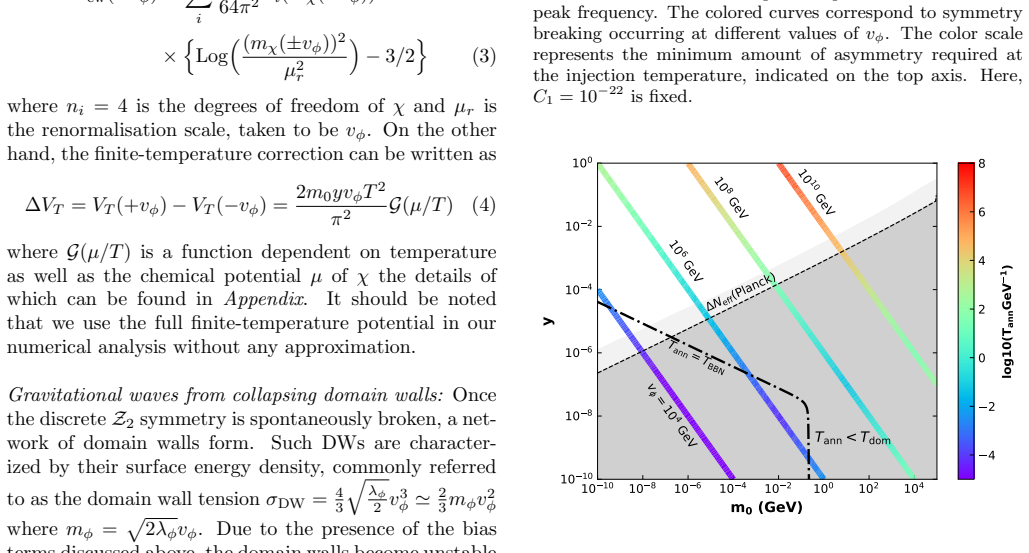
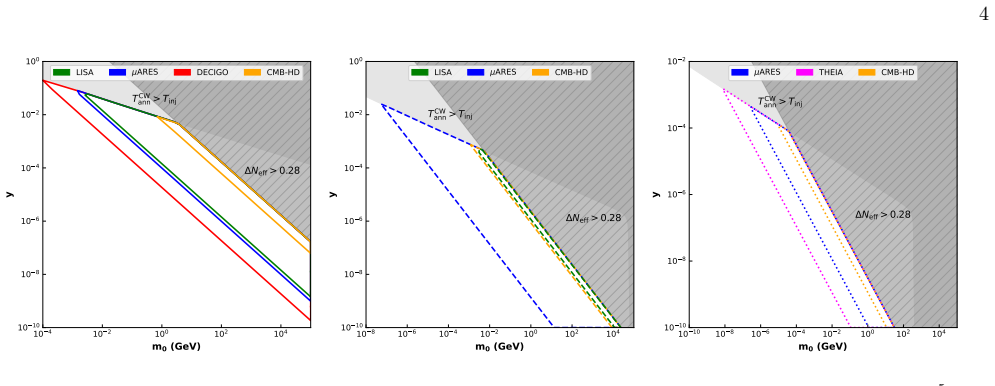
Finite-temperature radiative corrections from a Dirac fermion possessing a number-density asymmetry of approximately 0.1 generate a bias term in the scalar potential. This bias renders domain walls unstable, opening a new viable region of parameter space where the walls collapse and emit gravitational waves accessible to future experiments. The success of the scenario depends on the temperature at which the asymmetry is generated, so that observations of the resulting waves can constrain both the asymmetry magnitude and its production epoch.
What carries the argument
The bias term induced at finite temperature by one-loop radiative corrections from the asymmetric Dirac fermion, which tilts the potential between degenerate minima and drives domain-wall collapse.
If this is right
- Collapsing domain walls emit a stochastic gravitational-wave background within reach of future observatories.
- New regions of parameter space for domain-wall models become viable without explicit bias terms.
- The same asymmetry can contribute to the observed baryon asymmetry or serve as a dark-matter candidate.
- Large neutrino asymmetry becomes compatible with the domain-wall scenario.
- Gravitational-wave observations can constrain both the asymmetry size and its generation temperature.
Where Pith is reading between the lines
- The temperature dependence of the bias could allow future data to distinguish this radiative mechanism from constant explicit breaking terms.
- If the asymmetry resides in neutrinos, the scenario could connect domain-wall signals to neutrino-mass or leptogenesis models.
- Detection of the predicted waves without conflicting low-energy bounds would strengthen the case for high-scale asymmetric fermions.
Load-bearing premise
The fermion asymmetry must be generated and persist until the temperature where its radiative corrections can still produce an effective bias before domain walls would dominate the universe.
What would settle it
Absence of a gravitational-wave signal with the spectrum and amplitude predicted for collapsing domain walls in the frequency range of planned detectors, or direct constraints showing that no such asymmetry can survive to the required temperature.
Figures

read the original abstract
Spontaneous breaking of discrete symmetries play non-trivial role in many well-motivated particle physics models. However, it leads to a network of cosmologically unwanted domain walls (DWs) which can be made unstable by introducing a bias term in the scalar potential. In this letter, we provide a novel origin of such bias terms at finite temperature due to radiative corrections from a Dirac fermion with large asymmetry $\sim \mathcal{O}(0.1)$ in its number density. In addition to getting a new viable region of parameter space for collapsing DWs not explored previously and resulting gravitational waves (GWs) accessible at future experiments, the viability of the scenario crucially depends on the temperature of asymmetry generation too. This provides a unique way of probing both the amount of asymmetry and the corresponding temperature via future observations of GWs from collapsing DWs. The large asymmetry in the Dirac fermion can also have interesting implications for the observed baryon asymmetry as well as dark matter and large neutrino asymmetry.
Editorial analysis
A structured set of objections, weighed in public.
Referee Report
Summary. The paper claims that radiative corrections from a Dirac fermion carrying a large number-density asymmetry of O(0.1) generate a novel temperature-dependent bias term that destabilizes domain walls arising from spontaneous breaking of discrete symmetries. This opens a previously unexplored region of parameter space for collapsing domain walls whose gravitational-wave spectrum is accessible to future detectors; the viability of the mechanism depends on the temperature at which the asymmetry is generated and carries implications for baryon asymmetry, dark matter, and large neutrino asymmetry.
Significance. If the finite-temperature bias calculation is robust, the work supplies a concrete link between particle-physics asymmetries and the dynamics of collapsing domain walls, thereby offering a new observational handle on the magnitude and generation epoch of such asymmetries through gravitational-wave measurements.
major comments (1)
- [main calculation of the bias term (likely §3)] The central bias term is obtained from the one-loop thermal effective potential of the Dirac fermion. Standard high-T expansions (typically Matsubara sums or high-T series) assume μ/T ≪ 1, yet the quoted asymmetry ∼O(0.1) implies μ/T ∼ O(1). No explicit verification is provided that the leading bias survives without sign flip or strong suppression once the exact fermionic distribution functions are used. This assumption is load-bearing for the claimed new viable parameter space and the associated GW predictions.
minor comments (2)
- [Abstract and results section] The abstract states that viability 'crucially depends on the temperature of asymmetry generation' but does not quantify the allowed temperature window or show the corresponding GW spectra; a brief plot or table would clarify the claim.
- [Introduction] Notation for the asymmetry parameter and the resulting bias coefficient should be introduced with an explicit equation reference on first use.
Simulated Author's Rebuttal
We thank the referee for their careful reading of our manuscript and for the positive overall assessment. We address the single major comment below and will revise the manuscript accordingly to strengthen the presentation of the bias calculation.
read point-by-point responses
-
Referee: [main calculation of the bias term (likely §3)] The central bias term is obtained from the one-loop thermal effective potential of the Dirac fermion. Standard high-T expansions (typically Matsubara sums or high-T series) assume μ/T ≪ 1, yet the quoted asymmetry ∼O(0.1) implies μ/T ∼ O(1). No explicit verification is provided that the leading bias survives without sign flip or strong suppression once the exact fermionic distribution functions are used. This assumption is load-bearing for the claimed new viable parameter space and the associated GW predictions.
Authors: We agree that the high-temperature expansion employed for the one-loop effective potential assumes μ/T ≪ 1, while an asymmetry of O(0.1) corresponds to μ/T ∼ O(1). The bias term originates from the difference in the thermal potentials between the two degenerate vacua, which is driven by the asymmetric number densities. We have verified numerically that the exact expression, obtained by integrating the full Fermi-Dirac distributions without expansion, preserves the sign of the bias and yields a magnitude within a factor of a few of the approximate result throughout the relevant temperature range above the domain-wall formation scale. This confirms that the new viable parameter space and associated gravitational-wave signals remain intact. We will add an appendix containing the exact integral expression, the numerical comparison, and updated plots in the revised manuscript. revision: yes
Circularity Check
No significant circularity detected in bias term derivation
full rationale
The paper presents the finite-temperature bias as arising from standard one-loop radiative corrections involving an asymmetric Dirac fermion. The temperature of asymmetry generation is treated as an external input parameter that affects viability, not as a quantity fitted or defined in terms of the output bias itself. No load-bearing self-citation, self-definitional loop, or renaming of a known result is exhibited in the provided abstract or described claims. The central result remains independent of its inputs by construction and relies on conventional thermal field theory techniques.
Axiom & Free-Parameter Ledger
free parameters (1)
- Dirac fermion asymmetry =
~0.1
axioms (1)
- domain assumption Spontaneous breaking of discrete symmetries produces cosmologically unwanted domain walls that require a bias term to collapse
Lean theorems connected to this paper
-
IndisputableMonolith/Cost/FunctionalEquation.leanwashburn_uniqueness_aczel unclear?
unclearRelation between the paper passage and the cited Recognition theorem.
ΔV_T = V_T(+v_ϕ) − V_T(−v_ϕ) = 2 m0 y v_ϕ T²/π² G(μ/T) where G(μ/T) = −Li2(−e^{μ/T}) − Li2(−e^{-μ/T}) (Appendix Eq. 16)
-
IndisputableMonolith/Foundation/AlphaCoordinateFixation.leanJ_uniquely_calibrated_via_higher_derivative unclear?
unclearRelation between the paper passage and the cited Recognition theorem.
bias term from radiative corrections of Dirac fermion with asymmetry Y_Δχ ∼ O(0.1)
What do these tags mean?
- matches
- The paper's claim is directly supported by a theorem in the formal canon.
- supports
- The theorem supports part of the paper's argument, but the paper may add assumptions or extra steps.
- extends
- The paper goes beyond the formal theorem; the theorem is a base layer rather than the whole result.
- uses
- The paper appears to rely on the theorem as machinery.
- contradicts
- The paper's claim conflicts with a theorem or certificate in the canon.
- unclear
- Pith found a possible connection, but the passage is too broad, indirect, or ambiguous to say the theorem truly supports the claim.
Reference graph
Works this paper leans on
-
[1]
Y.B. Zeldovich, I.Y. Kobzarev and L.B. Okun, Cosmological Consequences of the Spontaneous Breakdown of Discrete Symmetry,Zh. Eksp. Teor. Fiz. 67(1974) 3
work page 1974
-
[2]
Vilenkin,Gravitational Field of Vacuum Domain Walls and Strings,Phys
A. Vilenkin,Gravitational Field of Vacuum Domain Walls and Strings,Phys. Rev. D23(1981) 852
work page 1981
-
[3]
Sikivie,Of Axions, Domain Walls and the Early Universe,Phys
P. Sikivie,Of Axions, Domain Walls and the Early Universe,Phys. Rev. Lett.48(1982) 1156
work page 1982
-
[4]
G.B. Gelmini, M. Gleiser and E.W. Kolb,Cosmology of Biased Discrete Symmetry Breaking,Phys. Rev. D39 (1989) 1558
work page 1989
-
[5]
Evading the cosmological domain wall problem
S.E. Larsson, S. Sarkar and P.L. White,Evading the cosmological domain wall problem,Phys. Rev. D55 (1997) 5129 [hep-ph/9608319]
work page Pith review arXiv 1997
- [6]
-
[7]
Baryogenesis, Domain Walls and the Role of Gravity
H. Lew and A. Riotto,Baryogenesis, domain walls and the role of gravity,Phys. Lett. B309(1993) 258 [hep-ph/9304203]
work page internal anchor Pith review Pith/arXiv arXiv 1993
- [8]
- [9]
-
[10]
D. Borah and I. Saha,Gravitational waves from seesaw assisted collapsing domain walls,2512.22339
-
[11]
D. Borah, P.K. Paul and N. Sahu,Can Dirac neutrinos destabilizeZ 2 domain wall network?,2602.07380
-
[12]
E. Ma, P.K. Paul and N. Sahu,Lepton parity dark matter and naturally unstable domain walls,Phys. Rev. D112(2025) 095020 [2508.02642]. [13]Planckcollaboration,Planck 2018 results. VI. Cosmological parameters,Astron. Astrophys.641(2020) A6 [1807.06209]
work page internal anchor Pith review Pith/arXiv arXiv 2025
-
[13]
Kibble,Topology of Cosmic Domains and Strings,J
T.W.B. Kibble,Topology of Cosmic Domains and Strings,J. Phys. A9(1976) 1387
work page 1976
-
[14]
A review of gravitational waves from cosmic domain walls
K. Saikawa,A review of gravitational waves from cosmic domain walls,Universe3(2017) 40 [1703.02576]
work page Pith review arXiv 2017
-
[15]
R. Roshan and G. White,Using gravitational waves to see the first second of the Universe,2401.04388
-
[16]
S.R. Coleman and E.J. Weinberg,Radiative Corrections as the Origin of Spontaneous Symmetry Breaking,Phys. Rev. D7(1973) 1888
work page 1973
-
[17]
On the estimation of gravitational wave spectrum from cosmic domain walls
T. Hiramatsu, M. Kawasaki and K. Saikawa,On the estimation of gravitational wave spectrum from cosmic domain walls,JCAP02(2014) 031 [1309.5001]
work page Pith review arXiv 2014
-
[18]
Axion cosmology with long-lived domain walls
T. Hiramatsu, M. Kawasaki, K. Saikawa and T. Sekiguchi,Axion cosmology with long-lived domain walls,JCAP01(2013) 001 [1207.3166]
work page Pith review arXiv 2013
- [19]
- [20]
-
[21]
S. Bhattacharya, N. Mondal, R. Roshan and D. Vatsyayan,Leptogenesis, dark matter and gravitational waves from discrete symmetry breaking, JCAP06(2024) 029 [2312.15053]
- [22]
-
[23]
Cosmological Backgrounds of Gravitational Waves,
C. Caprini and D.G. Figueroa,Cosmological Backgrounds of Gravitational Waves,Class. Quant. Grav.35(2018) 163001 [1801.04268]. [25]LISAcollaboration,Laser Interferometer Space Antenna,arXiv e-prints(2017) arXiv:1702.00786 [1702.00786]. [26]ET Collaborationcollaboration,The einstein telescope: a third-generation gravitational wave 7 observatory,Classical an...
-
[24]
J. Garcia-Bellido, H. Murayama and G. White, Exploring the Early Universe with Gaia and THEIA, 2104.04778
-
[25]
Sesana et al.,Unveiling the gravitational universe atµ-Hz frequencies,Exper
A. Sesana et al.,Unveiling the gravitational universe at µ-Hz frequencies,Exper. Astron.51(2021) 1333 [1908.11391]
-
[26]
A. Weltman et al.,Fundamental physics with the Square Kilometre Array,Publ. Astron. Soc. Austral.37(2020) e002 [1810.02680]
-
[27]
E.G. Adelberger, N.A. Collins and C.D. Hoyle,Analytic expressions for gravitational inner multipole moments of elementary solids and for the force between two rectangular solids,Class. Quant. Grav.23(2006) 125 [gr-qc/0512055]. [31]NANOGravcollaboration,The NANOGrav 15 yr Data Set: Evidence for a Gravitational-wave Background, Astrophys. J. Lett.951(2023) ...
- [28]
- [29]
- [30]
-
[31]
M. Escudero, A. Ibarra and V. Maura,Primordial lepton asymmetries in the precision cosmology era: Current status and future sensitivities from BBN and the CMB,Phys. Rev. D107(2023) 035024 [2208.03201]
- [32]
-
[33]
A. Matsumoto et al.,EMPRESS. VIII. A New Determination of Primordial He Abundance with Extremely Metal-Poor Galaxies: A Suggestion of the Lepton Asymmetry and Implications for the Hubble Tension,2203.09617
-
[34]
A.-K. Burns, T.M.P. Tait and M. Valli,Indications for a Nonzero Lepton Asymmetry in the Early Universe, 2206.00693
-
[35]
D. Borah, P.K. Paul and N. Sahu,Cogenesis of visible and dark matter in type-I Dirac seesaw,2603.24693
- [36]
-
[37]
D. Bandyopadhyay, D. Borah and A. Dasgupta,ALPy Cogenesis,2506.18970
-
[38]
D. Borah and A. Dasgupta,Large neutrino asymmetry from TeV scale leptogenesis,Phys. Rev. D108(2023) 035015 [2206.14722]
-
[39]
I. Affleck and M. Dine,A New Mechanism for Baryogenesis,Nucl. Phys. B249(1985) 361
work page 1985
discussion (0)
Sign in with ORCID, Apple, or X to comment. Anyone can read and Pith papers without signing in.