REVIEW 5 major objections 5 minor 60 references
Subgraph Generation for Generalizing on Out-of-Distribution Links
T0 review · 5 major / 5 minor · reviewed 2026-08-06 · deepseek-v4-flash
Pith's one-line read A learned graph generator can produce counterfactual subgraphs that improve link prediction under distribution shift, without hand-specifying the shift type.
desk verdict Solid empirical wrapper method with consistent gains on OOD link prediction, but the theoretical justification in Section 3.2 is asserted, not derived, and the paper should be revised before acceptance. read the letter →
The pith
A machine-rendered reading of the paper's core claim, the machinery that carries it, and where it could break.
The reading
What carries the argument
The central object is a semi-implicit graph variational auto-encoder (SIG-VAE) that generates link-specific subgraphs. The encoder is made link-aware by the zero-one labeling trick on $k$-hop enclosed subgraphs, so it can extract expressive features of a candidate link conditional on the node features; the decoder is node-aware, operating on a block-diagonal adjacency to preserve per-subgraph node counts. A threshold indicator $\tilde{p}(u,v) = p(u,v)\cdot \mathbb{I}[p(u,v)\ge\gamma]$ prunes low-probability edges, preventing the degree-bias phenomenon that would otherwise produce dense, meaningless subgraphs. The generator is trained to maximize a KL-penalized counterfactual loss while the GNN minimizes its link-prediction loss on the generated samples, which together keep the new structures different from training yet recognizable as valid links.
What would settle it
Run FLEX on a distribution-shift benchmark where the training and validation link-structure distributions are identical, so no counterfactual substructure is missing from training. If FLEX still improves over the base GNN, the gain cannot be attributed to OOD counterfactual generation; if it matches or hurts, the assumption holds. A second direct check is to reproduce the common-neighbor histogram analysis from RQ4 on shortest-path and preferential-attachment shifts, not just the CN shift.
Extended reading notes
Core claim
The paper asserts two related results. First, if a graph auto-encoder uses a semi-implicit posterior and a broad prior, then sampling from that posterior yields synthetic graphs whose node features come from the original distribution but whose edge structure is out-of-distribution relative to the training data; in the paper's notation, this generative process defines a valid OOD generation procedure. Second, when that generator is adversarially co-trained with a GNN, the generated subgraphs improve the GNN's link prediction under distribution shift without access to validation or test distributions. Empirically, the generated samples move the structural feature distribution, such as common-neighbor counts, closer to the validation distribution, and the improvement holds for both a basic GCN backbone and the stronger NCN backbone.
Load-bearing premise
FLEX only helps if the underlying data contain counterfactual substructures that the generator can learn; the paper's own limitations appendix concedes that if such substructures do not exist, FLEX is likely to decrease performance.
Editorial extensions
If this is right
- Link prediction under unknown distribution shift can be improved by a learned generative wrapper alone, without knowing the shift direction or type.
- Because FLEX tunes an already pre-trained GNN, it can be applied post-hoc to existing link predictors rather than requiring a new architecture.
- The generated subgraphs' structural distribution aligns with the validation distribution in OOD splits, so the generator is genuinely targeting structure rather than adding noise.
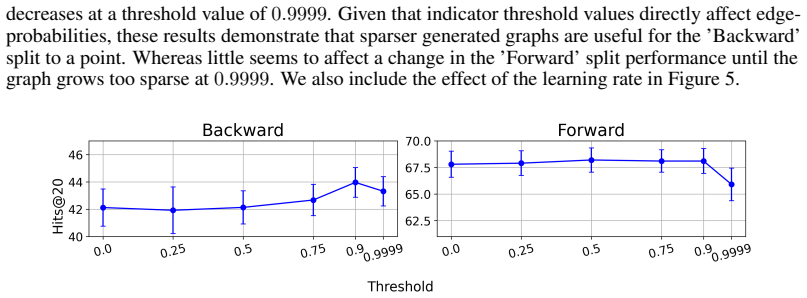
- The threshold $\gamma$ controls sparsity of generated graphs, giving a practical lever: sparser counterfactuals help backward shifts, while forward shifts remain insensitive until the graph becomes very sparse.
Reading between the lines
- The transfer assumption is the least-tested step: FLEX trains on generated subgraphs but evaluates on the full adjacency matrix, so a testable extension would be to check whether mixing generated subgraphs with a portion of real edges changes the gains.
- The same co-training recipe might generalize to other structural tasks, such as node classification or link-level tasks, wherever counterfactual substructure can be defined, although the paper only demonstrates link prediction.
- The threshold ablation suggests a broader principle: the usefulness of generated counterfactuals depends on matching the sparsity regime of the target distribution, which could potentially be tuned without labels if a structural statistic is available.
Editorial analysis
A structured set of objections, weighed in public.
Referee Report
Summary. The paper introduces FLEX, a graph generative framework that augments link prediction training data with structurally-conditioned counterfactual subgraphs. The method combines a semi-implicit variational graph auto-encoder (SIG-VAE) with a GNN in a two-stage procedure: pre-training both, then co-tuning the GNN on synthetic subgraphs. The central claims are (i) empirical: applying FLEX improves Hits@20/Hits@50 for 26/27 datasets with GCN and 27/27 with NCN, with average gains of 5.13% and 28.36%; and (ii) theoretical: the generative process in Eq. (3) is a valid procedure for generating OOD graph samples. Experiments on LPShift and ogbl-collab include ablations, hyperparameter sensitivity, and analysis of generated common-neighbor distributions.
Significance. Strengths: the empirical evaluation is unusually thorough for a preprint: multiple datasets, multiple shift types/directions, error bars, ablations of each component, hyperparameter sensitivity, and the source code is released. The consistent improvement across nearly all datasets suggests that the method is a practical plug-in augmentation for GNN link predictors. If the empirical result holds, it offers a genuine advance over the baselines tested, which often degrade performance. However, the paper's theoretical justification for why generated subgraphs should be OOD is asserted rather than proven, and the paper itself concedes in Appendix H that the method hinges on an untested counterfactual-existence assumption. The significance therefore rests primarily on the empirical claim, which is strong but needs a few clarifications to be fully convincing.
major comments (5)
- [Section 3.2, Eq. (3)] The statement that 'Eq. (3) defines a valid procedure for generating OOD graph samples' is the paper's central theoretical claim, but it is not established. The distribution qφ(ψ) is never defined; Eq. (3) samples ψ from qφ(ψ) unconditionally, which contradicts the link-conditioned posterior in Eq. (1) and the counterfactual-conditioning machinery of Section 3.3. If qφ(ψ) is meant as a broad prior, then the generated graphs are not conditioned on the target link; if it is meant as the marginal posterior, the condition qφ(ψ) ≉ qφ(ψ|Dtrain) is either vacuous or circular. In neither reading does maximizing Eq. (2) imply that samples are closer to a test-shifted distribution. Please provide a precise definition of qφ(ψ), state how Eq. (3) relates to the actual generative procedure in Algorithm 1, and either prove the OOD claim with explicit assumptions or reclassify it as a heuristic motivation.
- [Algorithm 1, line 7] The pipeline is ambiguous about which distribution is sampled when generating G'_s. If it samples from the posterior qφ(ψ|Xe,Ae), then Eq. (3) is not the actual generative process; if it samples from the prior qφ(ψ), then the link-specific conditioning that motivates FLEX is lost. This ambiguity is load-bearing for the claim that FLEX produces link-conditioned counterfactuals. Please specify exactly which distribution is used at line 7 and how it matches Eq. (3).
- [Section 3.4, Eqs. (7)-(8)] The objective is not a well-defined adversarial co-training. In Eq. (8), the GNN parameters appear only in LLP and the GGM parameters only in LGEN; there is no mechanism for the GNN's classification loss to influence the generator, despite the text stating that LLP acts as a 'check' on generation quality. Additionally, the KL-penalty objective in Eq. (7) is a heuristic with a free parameter τ tuned per dataset and split. Please clarify the min-max structure and how the GNN loss propagates to the generator, and justify the form of Eq. (7) or present it as a designed objective rather than a derived one.
- [Section 4.5 and Appendix B] The validation that generated samples align with the validation CN distribution is partially circular: the LPShift splits are constructed by thresholding on CN, SP, or PA (Table 4), and the threshold γ and target τ are tuned on the validation set. Achieving alignment on the same statistic used to construct the splits therefore does not demonstrate that FLEX discovers shift types without access to validation or test data. This weakens the claim that FLEX requires no expert knowledge. Please discuss this confound explicitly, or additionally test alignment on a statistic not used in split construction.
- [Algorithm 1 and Section 4.1] The GNN is fine-tuned on synthetic subgraphs G'_s (line 9) but evaluated on the full adjacency matrix (Section 4.1). Training on subgraphs and testing on the full graph is a distribution mismatch that is neither analyzed nor justified. The paper should show that the improvements are not an artifact of this mismatch (e.g., by also fine-tuning on real subgraphs of the same size, or by reporting performance on subgraph-based evaluation).
minor comments (5)
- [Abstract] Typo: 'two mechanism' should be 'two mechanisms'.
- [Section 3.4 and Algorithm 1] In Section 3.4, 'LGEN is defined as in Eq. (1)' should refer to Eq. (7) (or Eq. (2) for LSIVI); also, Algorithm 1 line 4 refers to 'Eq. (6)' for the labeling trick, but the labeling trick is defined in Eq. (4). Please fix the cross-references.
- [Table 1] The formatting of Table 1 makes it difficult to associate values with datasets and columns; please reformat to a standard table with clear column headers and row labels.
- [Throughout] Notation is inconsistent: the paper switches between qφ and qϕ, and between 'SIG-VAE' and 'SIVI'. Please unify notation.
- [Abstract and Appendix A] The claim that FLEX 'does not require expert knowledge' is undercut by per-split hyperparameter tuning (γ, τ, α, learning rate) as described in Appendix A; please temper the claim or report the sensitivity to these choices more prominently in the main text.
Circularity Check
Eq. (3)'s OOD-validity claim restates its own premise, and the RQ4 structural-alignment evidence is partly produced by validation-tuned thresholds.
-
self definitional
[Section 3.2, Eq. (3) and preceding paragraph]
"sampling from He ∼ qϕ(He | ψ), ψ ∼ qϕ(ψ) yields synthetic graphs ˜Ge = (Xe, ˜Ae) whose features are derived from the original dataset distribution but reveal emergent out-of-distribution (OOD) structure with respect to the training data Dtrain ∼ P(G), provided that qϕ(ψ) ̸≈ qϕ(ψ | Dtrain). That is, the complete generative process follows: ˜Ge ∼ pθ( ˜Ge | He), He ∼ qϕ(He | ψ), ψ∼ qϕ(ψ), (3) Therefore, Eq. (3) defines a valid procedure for generating OOD graph samples."
The only condition offered for OOD-ness is qϕ(ψ) ≉ qϕ(ψ | Dtrain); that condition is exactly the statement that the generative prior differs from the training posterior. Eq. (3) simply samples from that differing prior, so the conclusion 'valid OOD generation' restates the premise. The ELBO in Eq. (2) is optimized on training links and does not establish qϕ(ψ) ≉ qϕ(ψ | Dtrain); indeed Eq. (7) penalizes KL deviations toward a tuned target τ. The distribution qϕ(ψ) is never defined, so the premise is unfalsifiable and the theoretical load-bearing claim reduces to an assumption about the prior.
-
fitted input called prediction
[Section 4.5 (RQ4) with Appendix A hyperparameter tuning]
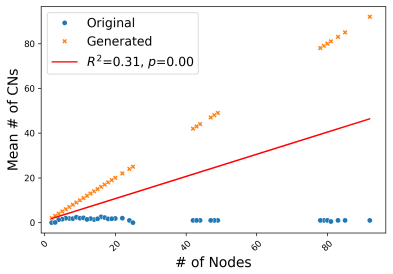
"As shown in Figure 4, the ’Flex - Generated’ sample distribution closely matches the distribution of validation samples for the ’Backward’ subplot, with none of the FLEX samples exceeding a difference of 0.17 CNs. ... A core consideration is FLEX’s ability to do this without access to validation or testing samples."
The RQ4 verification is run after FLEX hyperparameters, including the edge-pruning threshold γ, were tuned against validation performance (Appendix A). Eq. (6) removes edges with p(u,v) < γ, directly controlling subgraph density and hence the common-neighbor counts plotted in Figure 4; the paper itself notes 'the threshold function still manages to ensure that FLEX samples never exceed a CN threshold of 1.' Thus the reported match to the validation CN distribution is a consequence of the validation-tuned γ, not an independent generation result obtained without validation access. The 'without access to validation' claim is contradicted by the tuning protocol.
full rationale
The empirical headline result—FLEX improving performance on 26/27 (GCN) and 27/27 (NCN) datasets—is measured on held-out test links and therefore has independent grounding; that prevents a score of 8-10. However, the paper's central theoretical claim in Section 3.2 is self-definitional: OOD-ness is asserted as the condition qϕ(ψ) ≉ qϕ(ψ | Dtrain), and Eq. (3) is then declared a valid OOD generation procedure. That is the conclusion restating the premise, and the condition is not derived from the ELBO or from any defined qϕ(ψ); Eq. (7) shows the divergence is a penalized, tuned quantity. Additionally, the RQ4 structural-alignment evidence is partly produced by validation-tuned thresholds, undercutting the claim of generation 'without access to validation.' Overall: partial circularity of the theoretical derivation and of one supporting analysis, while the core empirical benchmark remains independent.
Assumptions & free parameters
free parameters (3)
- Indicator threshold gamma =
Tuned across {0.0, 0.25, 0.5, 0.75, 0.9, 0.99, 0.999, 0.9999} per dataset and shift direction
- KL penalty target tau =
Not reported in the paper
- Loss weight alpha =
Tuned across {0.5, 0.7, 0.95, 1.05}
assumptions (5)
- domain assumption Counterfactual substructures exist under the dataset's causal model
- domain assumption Sampling from q_phi(psi) with a broad prior and q_phi(psi) != q_phi(psi | Dtrain) yields OOD structures
- domain assumption The zero-one labeling trick provides link-specific features expressive enough for counterfactual generation
- domain assumption Training on synthetic subgraphs transfers to full-graph link prediction
- standard math Semi-implicit variational inference theory from Yin and Zhou and SIG-VAE is correctly implemented
Cite this review
Pith. "Pith review of Subgraph Generation for Generalizing on Out-of-Distribution Links." pith.science (2026). https://pith.science/paper/WKZL534Z
@misc{pith2026250711710,
  author       = {Pith},
  title        = {Pith review of: Subgraph Generation for Generalizing on Out-of-Distribution Links},
  year         = {2026},
  howpublished = {\url{https://pith.science/paper/WKZL534Z}},
  note         = {Machine review of arXiv:2507.11710}
}
read the original abstract
Graphs Neural Networks (GNNs) demonstrate high-performance on the link prediction (LP) task. However, these models often rely on all dataset samples being drawn from the same distribution. In addition, graph generative models (GGMs) show a pronounced ability to generate novel output graphs. Despite this, GGM applications remain largely limited to domain-specific tasks. To bridge this gap, we propose FLEX as a GGM framework which leverages two mechanism: (1) structurally-conditioned graph generation, and (2) adversarial co-training between an auto-encoder and GNN. As such, FLEX ensures structural-alignment between sample distributions to enhance link-prediction performance in out-of-distribution (OOD) scenarios. Notably, FLEX does not require expert knowledge to function in different OOD scenarios. Numerous experiments are conducted in synthetic and real-world OOD settings to demonstrate FLEX's performance-enhancing ability, with further analysis for understanding the effects of graph data augmentation on link structures. The source code is available here: https://github.com/revolins/FlexOOD.
Figures


Figures from the paper (4 more)



Reference graph
Works this paper leans on
-
[1]
Kipf and Max Welling
Thomas N. Kipf and Max Welling. Semi-supervised classification with graph convolutional networks. In International Conference on Learning Representations (ICLR), 2017
2017
-
[2]
The link prediction problem for social networks
David Liben-Nowell and Jon Kleinberg. The link prediction problem for social networks. In Proceedings of the twelfth international conference on Information and knowledge management, pages 556–559, 2003
2003
-
[3]
Evaluating graph neural networks for link prediction: Current pitfalls and new benchmarking
Juanhui Li, Harry Shomer, Haitao Mao, Shenglai Zeng, Yao Ma, Neil Shah, Jiliang Tang, and Dawei Yin. Evaluating graph neural networks for link prediction: Current pitfalls and new benchmarking. Advances in Neural Information Processing Systems, 36, 2024
work page 2024
-
[4]
Variational graph auto-encoders
Thomas N Kipf and Max Welling. Variational graph auto-encoders. arXiv preprint arXiv:1611.07308, 2016
arXiv 2016
-
[5]
Neural common neighbor with completion for link prediction
Xiyuan Wang, Haotong Yang, and Muhan Zhang. Neural common neighbor with completion for link prediction. In The Twelfth International Conference on Learning Representations, 2023
work page 2023
-
[6]
Neo-gnns: Neighborhood overlap-aware graph neural networks for link prediction
Seongjun Yun, Seoyoon Kim, Junhyun Lee, Jaewoo Kang, and Hyunwoo J Kim. Neo-gnns: Neighborhood overlap-aware graph neural networks for link prediction. Advances in Neural Information Processing Systems, 34:13683–13694, 2021
work page 2021
-
[7]
Lpformer: an adaptive graph transformer for link prediction
Harry Shomer, Yao Ma, Haitao Mao, Juanhui Li, Bo Wu, and Jiliang Tang. Lpformer: an adaptive graph transformer for link prediction. In Proceedings of the 30th ACM SIGKDD Conference on Knowledge Discovery and Data Mining, pages 2686–2698, 2024
work page 2024
-
[8]
Good: A graph out-of-distribution benchmark
Shurui Gui, Xiner Li, Limei Wang, and Shuiwang Ji. Good: A graph out-of-distribution benchmark. Advances in Neural Information Processing Systems, 35:2059–2073, 2022
2022
Show all 60 references
-
[9]
Ood-gnn: Out-of-distribution generalized graph neural network
Haoyang Li, Xin Wang, Ziwei Zhang, and Wenwu Zhu. Ood-gnn: Out-of-distribution generalized graph neural network. IEEE Transactions on Knowledge and Data Engineering, 2022
2022
-
[10]
Alleviating structural distribution shift in graph anomaly detection
Yuan Gao, Xiang Wang, Xiangnan He, Zhenguang Liu, Huamin Feng, and Yongdong Zhang. Alleviating structural distribution shift in graph anomaly detection. In Proceedings of the Sixteenth ACM International Conference on Web Search and Data Mining, pages 357–365, 2023
2023
-
[11]
Drugood: Out-of-distribution (ood) dataset curator and benchmark for ai-aided drug discovery–a focus on affinity prediction problems with noise annotations
Yuanfeng Ji, Lu Zhang, Jiaxiang Wu, Bingzhe Wu, Long-Kai Huang, Tingyang Xu, Yu Rong, Lanqing Li, Jie Ren, Ding Xue, et al. Drugood: Out-of-distribution (ood) dataset curator and benchmark for ai-aided drug discovery–a focus on affinity prediction problems with noise annotatio...
2022 arXiv
-
[12]
Wilds: A benchmark of in-the-wild distribution shifts
Pang Wei Koh, Shiori Sagawa, Henrik Marklund, Sang Michael Xie, Marvin Zhang, Akshay Balsubramani, Weihua Hu, Michihiro Yasunaga, Richard Lanas Phillips, Irena Gao, et al. Wilds: A benchmark of in-the-wild distribution shifts. In International conference on machine learning, p...
2021
-
[13]
Ood link prediction generalization capabilities of message-passing gnns in larger test graphs.Advances in Neural Information Processing Systems, 35:20257– 20272, 2022
Yangze Zhou, Gitta Kutyniok, and Bruno Ribeiro. Ood link prediction generalization capabilities of message-passing gnns in larger test graphs.Advances in Neural Information Processing Systems, 35:20257– 20272, 2022
2022
-
[14]
Size-invariant graph representations for graph classification extrapolations
Beatrice Bevilacqua, Yangze Zhou, and Bruno Ribeiro. Size-invariant graph representations for graph classification extrapolations. In International Conference on Machine Learning, pages 837–851. PMLR, 2021
2021
-
[15]
Understanding the generalizability of link predictors under distribution shifts on graphs
Jay Revolinsky, Harry Shomer, and Jiliang Tang. Understanding the generalizability of link predictors under distribution shifts on graphs. arXiv preprint arXiv:2406.08788, 2024
2024 arXiv
-
[16]
Invariant risk minimization
Martin Arjovsky, Léon Bottou, Ishaan Gulrajani, and David Lopez-Paz. Invariant risk minimization. arXiv preprint arXiv:1907.02893, 2019. 10
1907 arXiv
-
[17]
Out-of-distribution generalization via risk extrapolation (rex)
David Krueger, Ethan Caballero, Joern-Henrik Jacobsen, Amy Zhang, Jonathan Binas, Dinghuai Zhang, Remi Le Priol, and Aaron Courville. Out-of-distribution generalization via risk extrapolation (rex). In International conference on machine learning, pages 5815–5826. PMLR, 2021
2021
-
[18]
Graph out-of-distribution generalization via causal intervention
Qitian Wu, Fan Nie, Chenxiao Yang, Tianyi Bao, and Junchi Yan. Graph out-of-distribution generalization via causal intervention. In Proceedings of the ACM on Web Conference 2024, pages 850–860, 2024
2024
-
[19]
Tent: Fully test-time adaptation by entropy minimization
Dequan Wang, Evan Shelhamer, Shaoteng Liu, Bruno Olshausen, and Trevor Darrell. Tent: Fully test-time adaptation by entropy minimization. arXiv preprint arXiv:2006.10726, 2020
2006 arXiv
-
[20]
Feed two birds with one scone: Exploiting wild data for both out-of-distribution generalization and detection
Haoyue Bai, Gregory Canal, Xuefeng Du, Jeongyeol Kwon, Robert D Nowak, and Yixuan Li. Feed two birds with one scone: Exploiting wild data for both out-of-distribution generalization and detection. In International Conference on Machine Learning, pages 1454–1471. PMLR, 2023
2023
-
[21]
Meta ood learning for continuously adaptive ood detection
Xinheng Wu, Jie Lu, Zhen Fang, and Guangquan Zhang. Meta ood learning for continuously adaptive ood detection. In Proceedings of the IEEE/CVF International Conference on Computer Vision (ICCV), pages 19353–19364, October 2023
2023
-
[22]
Energy-based out-of-distribution detection for graph neural networks
Qitian Wu, Yiting Chen, Chenxiao Yang, and Junchi Yan. Energy-based out-of-distribution detection for graph neural networks. arXiv preprint arXiv:2302.02914, 2023
2023 arXiv
-
[23]
Counterfactual reason- ing for out-of-distribution multimodal sentiment analysis
Teng Sun, Wenjie Wang, Liqaing Jing, Yiran Cui, Xuemeng Song, and Liqiang Nie. Counterfactual reason- ing for out-of-distribution multimodal sentiment analysis. In Proceedings of the 30th ACM International Conference on Multimedia, pages 15–23, 2022
2022
-
[24]
Clear: Generative counter- factual explanations on graphs
Jing Ma, Ruocheng Guo, Saumitra Mishra, Aidong Zhang, and Jundong Li. Clear: Generative counter- factual explanations on graphs. Advances in neural information processing systems, 35:25895–25907, 2022
2022
-
[25]
Learning from counterfactual links for link prediction
Tong Zhao, Gang Liu, Daheng Wang, Wenhao Yu, and Meng Jiang. Learning from counterfactual links for link prediction. In Kamalika Chaudhuri, Stefanie Jegelka, Le Song, Csaba Szepesvari, Gang Niu, and Sivan Sabato, editors, Proceedings of the 39th International Conference on Mac...
2022
-
[26]
Labeling trick: A theory of using graph neural networks for multi-node representation learning
Muhan Zhang, Pan Li, Yinglong Xia, Kai Wang, and Long Jin. Labeling trick: A theory of using graph neural networks for multi-node representation learning. Advances in Neural Information Processing Systems, 34:9061–9073, 2021
2021
-
[27]
On the equivalence between positional node embeddings and structural graph representations
Balasubramaniam Srinivasan and Bruno Ribeiro. On the equivalence between positional node embeddings and structural graph representations. In International Conference on Learning Representations, 2019
2019
-
[28]
Link prediction based on graph neural networks
Muhan Zhang and Yixin Chen. Link prediction based on graph neural networks. Advances in neural information processing systems, 31, 2018
2018
-
[29]
Neural bellman-ford networks: A general graph neural network framework for link prediction
Zhaocheng Zhu, Zuobai Zhang, Louis-Pascal Xhonneux, and Jian Tang. Neural bellman-ford networks: A general graph neural network framework for link prediction. Advances in Neural Information Processing Systems, 34:29476–29490, 2021
2021
-
[30]
Graph neural networks for link prediction with subgraph sketching
Benjamin Paul Chamberlain, Sergey Shirobokov, Emanuele Rossi, Fabrizio Frasca, Thomas Markovich, Nils Hammerla, Michael M Bronstein, and Max Hansmire. Graph neural networks for link prediction with subgraph sketching. arXiv preprint arXiv:2209.15486, 2022
2022 arXiv
-
[31]
Demystifying structural disparity in graph neural networks: Can one size fit all? Advances in Neural Information Processing Systems, 36, 2024
Haitao Mao, Zhikai Chen, Wei Jin, Haoyu Han, Yao Ma, Tong Zhao, Neil Shah, and Jiliang Tang. Demystifying structural disparity in graph neural networks: Can one size fit all? Advances in Neural Information Processing Systems, 36, 2024
2024
-
[32]
Graphrnn: Generating realistic graphs with deep auto-regressive models
Jiaxuan You, Rex Ying, Xiang Ren, William Hamilton, and Jure Leskovec. Graphrnn: Generating realistic graphs with deep auto-regressive models. In International conference on machine learning, pages 5708–5717. PMLR, 2018
2018
-
[33]
Digress: Discrete denoising diffusion for graph generation
Clement Vignac, Igor Krawczuk, Antoine Siraudin, Bohan Wang, V olkan Cevher, and Pascal Frossard. Digress: Discrete denoising diffusion for graph generation. arXiv preprint arXiv:2209.14734, 2022
2022 arXiv
-
[34]
Graphdf: A discrete flow model for molecular graph generation
Youzhi Luo, Keqiang Yan, and Shuiwang Ji. Graphdf: A discrete flow model for molecular graph generation. In International conference on machine learning, pages 7192–7203. PMLR, 2021
2021
-
[35]
Spectre: Spectral conditioning helps to overcome the expressivity limits of one-shot graph generators
Karolis Martinkus, Andreas Loukas, Nathanaël Perraudin, and Roger Wattenhofer. Spectre: Spectral conditioning helps to overcome the expressivity limits of one-shot graph generators. In International Conference on Machine Learning, pages 15159–15179. PMLR, 2022. 11
2022
-
[36]
Autore- gressive diffusion model for graph generation
Lingkai Kong, Jiaming Cui, Haotian Sun, Yuchen Zhuang, B Aditya Prakash, and Chao Zhang. Autore- gressive diffusion model for graph generation. In International conference on machine learning, pages 17391–17408. PMLR, 2023
2023
-
[37]
Deep coral: Correlation alignment for deep domain adaptation
Baochen Sun and Kate Saenko. Deep coral: Correlation alignment for deep domain adaptation. In Computer Vision–ECCV 2016 Workshops: Amsterdam, The Netherlands, October 8-10 and 15-16, 2016, Proceedings, Part III 14, pages 443–450. Springer, 2016
2016
-
[38]
Distributionally robust neural networks for group shifts: On the importance of regularization for worst-case generalization.arXiv preprint arXiv:1911.08731, 2019
Shiori Sagawa, Pang Wei Koh, Tatsunori B Hashimoto, and Percy Liang. Distributionally robust neural networks for group shifts: On the importance of regularization for worst-case generalization.arXiv preprint arXiv:1911.08731, 2019
1911 arXiv
-
[39]
Domain-adversarial training of neural networks
Yaroslav Ganin, Evgeniya Ustinova, Hana Ajakan, Pascal Germain, Hugo Larochelle, François Laviolette, Mario March, and Victor Lempitsky. Domain-adversarial training of neural networks. Journal of machine learning research, 17(59):1–35, 2016
2016
-
[40]
In search of lost domain generalization
Ishaan Gulrajani and David Lopez-Paz. In search of lost domain generalization. arXiv preprint arXiv:2007.01434, 2020
2007 arXiv
-
[41]
Learning invariant graph representations for out-of-distribution generalization
Haoyang Li, Ziwei Zhang, Xin Wang, and Wenwu Zhu. Learning invariant graph representations for out-of-distribution generalization. Advances in Neural Information Processing Systems, 35:11828–11841, 2022
2022
-
[42]
Does invariant graph learning via environment augmentation learn invariance? Advances in Neural Information Processing Systems, 36:71486–71519, 2023
Yongqiang Chen, Yatao Bian, Kaiwen Zhou, Binghui Xie, Bo Han, and James Cheng. Does invariant graph learning via environment augmentation learn invariance? Advances in Neural Information Processing Systems, 36:71486–71519, 2023
2023
-
[43]
Dynamic graph neural networks under spatio-temporal distribution shift
Zeyang Zhang, Xin Wang, Ziwei Zhang, Haoyang Li, Zhou Qin, and Wenwu Zhu. Dynamic graph neural networks under spatio-temporal distribution shift. Advances in neural information processing systems, 35:6074–6089, 2022
2022
-
[44]
Handling distribution shifts on graphs: An invariance perspective
Qitian Wu, Hengrui Zhang, Junchi Yan, and David Wipf. Handling distribution shifts on graphs: An invariance perspective. In International Conference on Learning Representations (ICLR), 2022
2022
-
[45]
Gold: Graph out-of-distribution detection via implicit adversarial latent generation
Danny Wang, Ruihong Qiu, Guangdong Bai, and Zi Huang. Gold: Graph out-of-distribution detection via implicit adversarial latent generation. arXiv preprint arXiv:2502.05780, 2025
2025 arXiv
-
[46]
Fast unfolding of communities in large networks
Vincent D Blondel, Jean-Loup Guillaume, Renaud Lambiotte, and Etienne Lefebvre. Fast unfolding of communities in large networks. Journal of statistical mechanics: theory and experiment, 2008(10):P10008, 2008
2008
-
[47]
Edge proposal sets for link prediction
Abhay Singh, Qian Huang, Sijia Linda Huang, Omkar Bhalerao, Horace He, Ser-Nam Lim, and Austin R Benson. Edge proposal sets for link prediction. arXiv preprint arXiv:2106.15810, 2021
2021 arXiv
-
[48]
Generative adversarial networks.Communications of the ACM, 63(11):139– 144, 2020
Ian Goodfellow, Jean Pouget-Abadie, Mehdi Mirza, Bing Xu, David Warde-Farley, Sherjil Ozair, Aaron Courville, and Yoshua Bengio. Generative adversarial networks.Communications of the ACM, 63(11):139– 144, 2020
2020
-
[49]
Conditional structure generation through graph variational generative adversarial nets
Carl Yang, Peiye Zhuang, Wenhan Shi, Alan Luu, and Pan Li. Conditional structure generation through graph variational generative adversarial nets. Advances in neural information processing systems, 32, 2019
2019
-
[50]
Clustering and preferential attachment in growing networks
Mark EJ Newman. Clustering and preferential attachment in growing networks. Physical review E, 64(2):025102, 2001
2001
-
[51]
A new status index derived from sociometric analysis
Leo Katz. A new status index derived from sociometric analysis. Psychometrika, 18(1):39–43, 1953
1953
-
[52]
Graphvae: Towards generation of small graphs using variational autoencoders
Martin Simonovsky and Nikos Komodakis. Graphvae: Towards generation of small graphs using variational autoencoders. In Artificial Neural Networks and Machine Learning–ICANN 2018: 27th International Conference on Artificial Neural Networks, Rhodes, Greece, October 4-7, 2018, Pr...
2018
-
[53]
Swingnn: Rethinking permutation invariance in diffusion models for graph generation
Qi Yan, Zhengyang Liang, Yang Song, Renjie Liao, and Lele Wang. Swingnn: Rethinking permutation invariance in diffusion models for graph generation. Transactions on Machine Learning Research, 2024
2024
-
[54]
Semi-implicit variational inference
Mingzhang Yin and Mingyuan Zhou. Semi-implicit variational inference. In International conference on machine learning, pages 5660–5669. PMLR, 2018
2018
-
[55]
Semi-implicit graph variational auto-encoders
Arman Hasanzadeh, Ehsan Hajiramezanali, Krishna Narayanan, Nick Duffield, Mingyuan Zhou, and Xiaoning Qian. Semi-implicit graph variational auto-encoders. Advances in neural information processing systems, 32, 2019. 12
2019
-
[56]
Investigating and mitigating degree-related biases in graph convoltuional networks
Xianfeng Tang, Huaxiu Yao, Yiwei Sun, Yiqi Wang, Jiliang Tang, Charu Aggarwal, Prasenjit Mitra, and Suhang Wang. Investigating and mitigating degree-related biases in graph convoltuional networks. In Proceedings of the 29th ACM International Conference on Information & Knowled...
2020
-
[57]
On generalized degree fairness in graph neural networks
Zemin Liu, Trung-Kien Nguyen, and Yuan Fang. On generalized degree fairness in graph neural networks. In Proceedings of the AAAI Conference on Artificial Intelligence, volume 37, pages 4525–4533, 2023
2023
-
[58]
Adversarially regularized graph autoencoder for graph embedding
Shirui Pan, Ruiqi Hu, Guodong Long, Jing Jiang, Lina Yao, and Chengqi Zhang. Adversarially regularized graph autoencoder for graph embedding. arXiv preprint arXiv:1802.04407, 2018
2018 arXiv
-
[59]
Open graph benchmark: Datasets for machine learning on graphs
Weihua Hu, Matthias Fey, Marinka Zitnik, Yuxiao Dong, Hongyu Ren, Bowen Liu, Michele Catasta, and Jure Leskovec. Open graph benchmark: Datasets for machine learning on graphs. Advances in neural information processing systems, 33:22118–22133, 2020
2020
-
[60]
directions
Lada A Adamic and Eytan Adar. Friends and neighbors on the web. Social networks, 25(3):211–230, 2003. 13 A HyperParameter Settings Initial tuning of GCN on all tested datasets and NCN on the LPShift datasets followed a hierarchical approach. Initially, GCN was tuned for 1000 e...
2003
Reviewed August 6, 2026 · model on record in the stance chip above.
Discussion (0). Sign in to comment.