REVIEW 5 major objections 6 minor 59 references
Globalization for Scalable Short-term Load Forecasting
T0 review · 5 major / 6 minor · reviewed 2026-08-06 · deepseek-v4-flash
Pith's one-line read Global forecasting models can scale across a heterogeneous power grid without sacrificing accuracy—provided the clustering strategy is matched to the model's prediction mechanism.
desk verdict Useful clustering proposal and a broad empirical study, but the headline global-vs-local claim is not established until the oracle features are removed. read the letter →
The pith
A machine-rendered reading of the paper's core claim, the machinery that carries it, and where it could break.
The reading
What carries the argument
The machinery is a two-way split of forecasting algorithms. Feature-transforming models such as Ridge learn a single mathematical function from features to targets; for them the paper proposes model-based whole time series clustering: train a local model per series, use its coefficients as feature vectors, cluster series with K-means, then train one global model per cluster. Target-transforming models such as LightGBM and XGBoost predict by grouping and averaging training targets; for them the paper proposes weighted instance-based clustering: train an initial global model, use its feature importances as weights $\theta_r$ in a weighted Euclidean distance $d_{i,j} = \sqrt{\sum_r \theta_r (x_{i,r} - x_{j,r})^2}$, cluster samples, then train per-cluster global models. This classification explains why plain globalization helps trees but hurts linear models, and why the two clustering schemes must differ.
What would settle it
Take the Alberta pipeline and replace the hour-ahead oil and Bitcoin price features with their most recently observed values; if global LightGBM's mean nMAE advantage over local models disappears or reverses, the claimed advantage rests on the exotic hour-ahead exogenous forecast assumption rather than on globalization itself.
Extended reading notes
Core claim
The paper's central claim is that globalization is not uniformly good or bad; its effect is determined by the forecasting algorithm's operating mechanism. For target-transforming algorithms, which predict by grouping and averaging training targets, pooling more data improves robustness and drift handling, so a global LightGBM or XGBoost model beats its local counterparts and is pushed further by weighted instance-based time series clustering. For feature-transforming algorithms, which extrapolate by fitting a function, pooling introduces heterogeneity that degrades extrapolation, and model-based clustering restores most of the lost accuracy. The paper also claims that cluster-wise global models maintain high accuracy in peak-load and zero-shot hierarchical forecasting, and that in a homogeneous system (ISO New England) clustering is unnecessary because plain global models already dominate.
Load-bearing premise
The reported load-forecasting gains assume hour-ahead forecasts of external variables like oil and Bitcoin prices are available at forecast time; in real operations those forecasts carry their own errors, so the stated accuracy may not be attainable.
Editorial extensions
If this is right
- A utility forecasting 42 areas can train one global LightGBM model and beat 42 separate local models on average nMAE (2.28% versus 2.35%), then improve further to 2.22% with weighted instance clustering.
- Weighted instance-based clustering, not plain instance clustering, is the right partition for target-transforming models, while model-based whole clustering is the right partition for feature-transforming Ridge, cutting its mean nMAE and MSE.
- Global models handle data drift differently by model type: in drifting areas global LightGBM improves over its local version by 2.09%, while global Ridge degrades.
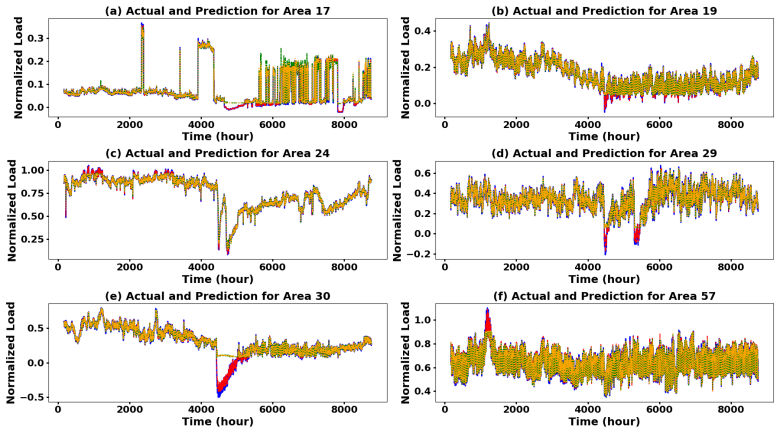
- Global models can zero-shot forecast regional and system load from area-trained models, and cluster-wise global models give lower annual peak-load errors than local models (for example, LightGBM weighted cluster-wise error 2.78% versus 4.88% local).
- In homogeneous settings such as ISO New England, clustering is unnecessary: a plain global model already matches or outperforms local models.
Reading between the lines
- A testable extension: the feature-transforming versus target-transforming split is a general design principle for other forecasting domains, prescribing model-based grouping by learned parameters for extrapolating models and weighted instance grouping for averaging models.
- Operationally, the reported gains assume hour-ahead forecasts of external variables like oil and Bitcoin prices; if those forecasts carry their own errors, the real-world advantage of the global model may be smaller than reported.
- The zero-shot hierarchical results suggest a reconciliation-free alternative to hierarchical forecasting, but the paper does not enforce coherence across levels, so explicit reconciliation could change the realized gains.
- The ISO-NE result implies a cheap heterogeneity pre-screen based on seasonality, variation, and load-ratio statistics could decide in advance whether to cluster or stay fully global.
Editorial analysis
A structured set of objections, weighed in public.
Referee Report
Summary. The paper proposes a global forecasting framework for short-term load forecasting across 42 AESO Alberta areas, contrasting feature-transforming models (Ridge) with target-transforming models (LightGBM, XGBoost). It introduces model-based whole time-series clustering for feature-transforming models and weighted instance-based clustering for target-transforming models, and compares local, global, and cluster-wise global forecasts for one-hour-ahead load, peak load, and zero-shot regional/system forecasting. An appendix extends the global-vs-local comparison to the GEFCom2017 ISO-NE data, where homogeneity is argued to favor a single global model.
Significance. If validated, the paper would strengthen the case for replacing per-area load forecasting models with a small number of global models, and its proposed clustering distinction based on model type is conceptually useful. The main strengths are the use of a real open 42-area dataset, a strict chronological train/validation/test split, explicit disclosure of the hour-ahead-forecast assumption, and a supplementary homogeneous-dataset experiment. However, the reported global advantages are small relative to cross-area variability, the headline comparison relies on target-aligned exogenous variables whose operational availability is doubtful, and no naive baseline or paired significance tests are provided; these issues currently limit the strength of the claims.
major comments (5)
- [Section 5.2, Tables 1-3] The comparison uses target-aligned t+1 values of Alberta pool price, WTI crude oil, Bitcoin, outage indicators, and LSSI under an asserted hour-ahead forecast assumption. For WTI, the daily price is forward-filled to hourly resolution and therefore cannot be known one hour before the target hour; no forecast source is identified for Bitcoin or the outage/LSSI variables. Because a global model pools all 42 areas, it can learn price-load and outage-load relationships from roughly 42 times more samples than a local model, so the reported global advantage in Tables 1-3 may be an oracle-information artifact rather than a benefit of globalization. The authors should rerun the comparison using only features that are genuinely available at forecast time (e.g., lagged-only versions) and verify that the global-vs-local ordering survives.
- [Section 5.3 and Section 5.4] No persistence or seasonal-naive baseline is reported in Tables 1-4, yet the paper itself states that both local and global single-step models tend to replicate the most recent timestep, similar to a naive forecast. Without such a baseline, the absolute nMAE values (around 2.2%) cannot be interpreted, and the practical significance of the global-vs-local differences remains unclear. Please add a persistence (lag-1) and a weekly-seasonal naive model to the comparison tables.
- [Tables 1-3] The mean nMAE differences between global and local models are small; for example, LightGBM moves from 2.35% (local) to 2.28% (global) to 2.22% (weighted instance), and these numbers are averages over only 42 areas. No paired significance test, confidence interval, or per-area summary is provided, so the claim that global target-transforming models consistently outperform their local counterparts is not statistically supported. Report per-area error distributions and apply paired tests (e.g., Diebold-Mariano or Wilcoxon signed-rank) for the global-vs-local and clustering-vs-global comparisons.
- [Section 5.6, Table 4] The zero-shot hierarchical experiment reports only global-model errors for the six regions and the system. There is no comparison against local models trained directly on those aggregate series, no reconciliation or coherency evaluation despite coherency being discussed, and no evaluation of zero-shot performance for an entirely new area. Consequently, the contribution claim of accurate zero-shot forecasting across multiple levels is not supported by the presented evidence.
- [Section 4.2, Algorithm 2] The weighted instance TSC constructs a full M-by-M Euclidean distance matrix over all pooled samples. With 42 areas and hourly data spanning more than a decade, M is of order several million, making a dense distance matrix computationally prohibitive and undermining the scalability claim. In addition, the paper does not specify how a new test-time sample is assigned to one of the trained cluster models, nor whether samples from a single area may fall into different clusters. Please clarify the algorithm's scalable implementation and the assignment rule.
minor comments (6)
- [Section 5.2] The sentence 'Fig. 2 provides a comparison between the feature coefficients...' should refer to Fig. 1, since Fig. 2 is the flowchart of the proposed methodology.
- [Table 2] The sign convention for 'Change (%)' is not defined and appears inconsistent with the text: a reduction in nMAE from 2.11 to 2.01 is reported as +4.87% improvement. Define the formula and state whether positive values indicate improvement.
- [Tables 1 and 3] The column formatting is corrupted in the rendered manuscript, with numeric values and column headers merged. The captions should also state that min/mean/max are computed across the 42 areas and that the test period is 2023.
- [Section 5.5.1] The text says model-based TSC 'slightly deteriorated' LightGBM's nMAE, but Table 1 shows nMAE improving from 2.2764% to 2.2685%; only MSE worsens. Please reconcile the text with the table.
- [Section 5.1.3] The statement that the cross-correlation is 'strong negative at lag 0' while also 'exhibits symmetry around lag -10 to +10 hours' needs clarification; define the lag sign convention and explain how both properties can hold simultaneously.
- [Appendix A] The GEFCom2017 appendix should cite the exact data source and state whether the same hyperparameters and preprocessing pipeline as the Alberta experiments were used, so that the homogeneity comparison is reproducible.
Circularity Check
No significant circularity: the global-vs-local comparison and clustering methods are evaluated on a held-out test set and do not reduce to their inputs by construction.
full rationale
The derivation chain is not circular. The central global-vs-local comparison (Tables 1-3) is a held-out evaluation: models are tuned on 2011-2021/2022 validation and retrained before scoring on 2023, and the reported nMAE/MSE are computed on that test period. The clustering steps are self-referential but not circular: model-based TSC (Eqs. 7-8) clusters series by local coefficients, and weighted instance TSC (Eqs. 9-11) weights distances by global feature importances, yet the final cluster-wise models are retrained from scratch on the training partition and none of the clustering inputs incorporate test labels; the reported improvements are therefore empirical outcomes, not identities. The paper contains two minor self-citations ([8], [15]) used for generic background statements about cold-start and federated learning; neither is load-bearing, and no uniqueness theorem is imported from the authors' prior work. The Appendix's GEFCom2017 experiment is an external benchmark that independently corroborates the global-model advantage. The hour-ahead oracle-feature assumption in Section 5.2 is an operational feasibility/correctness risk, not a circularity: those exogenous variables are not derived from the target loads, so their use does not make the prediction equal to an input. Overall, no step equates a prediction with a fitted parameter or reduces the headline claim to its own assumptions.
Assumptions & free parameters
free parameters (4)
- Number of clusters K for TSC =
Not reported
- Rolling window size (168 hours) =
168
- Model hyperparameters (Ridge alpha, LightGBM/XGBoost) =
Not fully reported
- Hand-crafted feature set =
n/a
assumptions (3)
- domain assumption Perfect hour-ahead forecasts of weather and exogenous market variables (including oil and Bitcoin prices) are available at forecast time.
- domain assumption The input time series are related enough to benefit from global parameter sharing.
- standard math Standard supervised learning assumptions: training and test samples are drawn from a consistent data-generating process except for explicit drift events.
Cite this review
Pith. "Pith review of Globalization for Scalable Short-term Load Forecasting." pith.science (2026). https://pith.science/paper/HB7C3N3D
@misc{pith2026250711729,
  author       = {Pith},
  title        = {Pith review of: Globalization for Scalable Short-term Load Forecasting},
  year         = {2026},
  howpublished = {\url{https://pith.science/paper/HB7C3N3D}},
  note         = {Machine review of arXiv:2507.11729}
}
read the original abstract
Forecasting load in power transmission networks is essential across various hierarchical levels, from the system level down to individual points of delivery (PoD). While intuitive and locally accurate, traditional local forecasting models (LFMs) face significant limitations, particularly in handling generalizability, overfitting, data drift, and the cold start problem. These methods also struggle with scalability, becoming computationally expensive and less efficient as the network's size and data volume grow. In contrast, global forecasting models (GFMs) offer a new approach to enhance prediction generalizability, scalability, accuracy, and robustness through globalization and cross-learning. This paper investigates global load forecasting in the presence of data drifts, highlighting the impact of different modeling techniques and data heterogeneity. We explore feature-transforming and target-transforming models, demonstrating how globalization, data heterogeneity, and data drift affect each differently. In addition, we examine the role of globalization in peak load forecasting and its potential for hierarchical forecasting. To address data heterogeneity and the balance between globality and locality, we propose separate time series clustering (TSC) methods, introducing model-based TSC for feature-transforming models and new weighted instance-based TSC for target-transforming models. Through extensive experiments on a real-world dataset of Alberta's electricity load, we demonstrate that global target-transforming models consistently outperform their local counterparts, especially when enriched with global features and clustering techniques. In contrast, global feature-transforming models face challenges in balancing local and global dynamics, often requiring TSC to manage data heterogeneity effectively.
Figures


Figures from the paper (16 more)




Reference graph
Works this paper leans on
-
[1]
Pinheiro, Marco G., Sara C. Madeira, and Alexandre P. Francisco. ”Short-term electricity load forecasting—A systematic approach from system level to secondary substations.” Applied Energy 332 (2023): 120493
work page 2023
-
[2]
Botman, Lola, Jonas Soenen, Konstantinos Theodorakos, Aras Yurt- man, Jessa Bekker, Koen Vanthournout, Hendrik Blockeel, Bart De Moor, and Jesus Lago. ”A scalable ensemble approach to forecast the electricity consumption of households.” IEEE Transactions on Smart Grid 14, no. 1 (2022): 757-768. 56
work page 2022
-
[3]
Hewamalage, Hansika, Christoph Bergmeir, and Kasun Bandara. ”Global models for time series forecasting: A simulation study.” Pat- tern Recognition 124 (2022): 108441
work page 2022
-
[4]
Sousa, Jo˜ ao, and Roberto Henriques. ”Intersecting reinforcement learn- ing and deep factor methods for optimizing locality and globality in forecasting: A review.” Engineering Applications of Artificial Intelli- gence 133 (2024): 108082
work page 2024
-
[6]
Sen, Rajat, Hsiang-Fu Yu, and Inderjit S. Dhillon. ”Think globally, act locally: A deep neural network approach to high-dimensional time se- ries forecasting.” Advances in neural information processing systems 32 (2019)
work page 2019
-
[7]
Ma, Shaohui. ”A hybrid deep meta-ensemble networks with application in electric utility industry load forecasting.” Information Sciences 544 (2021): 183-196
work page 2021
-
[8]
Forootani, Ali, Mohammad Rastegar, and Hamidreza Zareipour. ”Transfer learning-based framework enhanced by deep generative model for cold-start forecasting of residential EV charging behavior.” IEEE Transactions on Intelligent Vehicles 9, no. 1 (2023): 190-198
work page 2023
-
[9]
Mashlakov, Aleksei, Toni Kuronen, Lasse Lensu, Arto Kaarna, and Samuli Honkapuro. Assessing the performance of deep learning mod- els for multivariate probabilistic energy forecasting.” Applied Energy 285 (2021): 116405
work page 2021
Show all 59 references
-
[10]
”LSTM-MSNet: Leveraging forecasts on sets of related time series with multiple seasonal patterns.” IEEE Transactions on neural networks and learning systems 32, no
Bandara, Kasun, Christoph Bergmeir, and Hansika Hewamalage. ”LSTM-MSNet: Leveraging forecasts on sets of related time series with multiple seasonal patterns.” IEEE Transactions on neural networks and learning systems 32, no. 4 (2020): 1586-1599
2020
-
[11]
”Cri- teria for classifying forecasting methods.” International Journal of Fore- casting 36, no
Januschowski, Tim, Jan Gasthaus, Yuyang Wang, David Salinas, Valentin Flunkert, Michael Bohlke-Schneider, and Laurent Callot. ”Cri- teria for classifying forecasting methods.” International Journal of Fore- casting 36, no. 1 (2020): 167-177. 57
2020
-
[12]
”Re- current neural networks for time series forecasting: Current status and future directions.” International Journal of Forecasting 37, no
Hewamalage, Hansika, Christoph Bergmeir, and Kasun Bandara. ”Re- current neural networks for time series forecasting: Current status and future directions.” International Journal of Forecasting 37, no. 1 (2021): 388-427
2021
-
[13]
”Deciding When to Use a Personalized Model for Load Forecasting.” IEEE Transactions on Smart Grid (2024)
Qin, Dalin, Qingsong Wen, Zhiqiang Zhou, Liang Sun, and Yi Wang. ”Deciding When to Use a Personalized Model for Load Forecasting.” IEEE Transactions on Smart Grid (2024)
2024
-
[14]
”Local vs
Yingjie, Zhao, and Mahdi Abolghasemi. ”Local vs. Global Models for Hierarchical Forecasting.” arXiv preprint arXiv:2411.06394 (2024)
2024 arXiv
-
[15]
”Deep federated learning-based privacy- preserving wind power forecasting.” IEEE Access 11 (2022): 39521- 39530
Ahmadi, Amirhossein, Mohammad Talaei, Masod Sadipour, Ali Moradi Amani, and Mahdi Jalili. ”Deep federated learning-based privacy- preserving wind power forecasting.” IEEE Access 11 (2022): 39521- 39530
2022
-
[16]
”Privacy-preserving federated learning for residential short-term load forecasting.” Applied energy 326 (2022): 119915
Fern´ andez, Joaqu ´ ın Delgado, Sergio Potenciano Menci, Chul Min Lee, Alexander Rieger, and Gilbert Fridgen. ”Privacy-preserving federated learning for residential short-term load forecasting.” Applied energy 326 (2022): 119915
2022
-
[17]
”A global modeling framework for load forecasting in distribution networks.” IEEE Transactions on Smart Grid 14, no
Grabner, Miha, Yi Wang, Qingsong Wen, Boˇ stjan Blaˇ ziˇ c, and Vitomir ˇStruc. ”A global modeling framework for load forecasting in distribution networks.” IEEE Transactions on Smart Grid 14, no. 6 (2023): 4927- 4941
2023
-
[18]
”Time- series extreme event forecasting with neural networks at uber.” In In- ternational conference on machine learning, vol
Laptev, Nikolay, Jason Yosinski, Li Erran Li, and Slawek Smyl. ”Time- series extreme event forecasting with neural networks at uber.” In In- ternational conference on machine learning, vol. 34, pp. 1-5. sn, 2017
2017
-
[20]
”Forecasting across time series databases using recurrent neural networks on groups of similar series: A clustering approach.” Expert systems with applications 140 (2020): 112896
Bandara, Kasun, Christoph Bergmeir, and Slawek Smyl. ”Forecasting across time series databases using recurrent neural networks on groups of similar series: A clustering approach.” Expert systems with applications 140 (2020): 112896. 58
2020
-
[21]
”Improving the accuracy of global forecasting models using time series data augmentation.” Pattern Recognition 120 (2021): 108148
Bandara, Kasun, Hansika Hewamalage, Yuan-Hao Liu, Yanfei Kang, and Christoph Bergmeir. ”Improving the accuracy of global forecasting models using time series data augmentation.” Pattern Recognition 120 (2021): 108148
2021
-
[22]
”Tam- ing local effects in graph-based spatiotemporal forecasting.” Advances in Neural Information Processing Systems 36 (2024)
Cini, Andrea, Ivan Marisca, Daniele Zambon, and Cesare Alippi. ”Tam- ing local effects in graph-based spatiotemporal forecasting.” Advances in Neural Information Processing Systems 36 (2024)
2024
-
[23]
Joseph, Manu. ”Global Forecasting Models.” In Modern Time Series Forecasting with Python: Explore Industry-Ready Time Series Fore- casting Using Modern Machine Learning and Deep Learning, 225-258. Packt Publishing Ltd, 2022
2022
-
[24]
”DeepAR: Probabilistic forecasting with autoregressive recurrent networks.” International Journal of Forecasting 36, no
Salinas, David, Valentin Flunkert, Jan Gasthaus, and Tim Januschowski. ”DeepAR: Probabilistic forecasting with autoregressive recurrent networks.” International Journal of Forecasting 36, no. 3 (2020): 1181-1191
2020
-
[25]
”When and How to Use Global Forecasting Methods on Heterogeneous Datasets.” Available at SSRN 4629272 (2023)
Wellens, Arnoud P., Nikolaos Kourentzes, and Maximiliano Udenio. ”When and How to Use Global Forecasting Methods on Heterogeneous Datasets.” Available at SSRN 4629272 (2023)
2023
-
[26]
”Graph deep learning for time series forecasting.” arXiv preprint arXiv:2310.15978 (2023)
Cini, Andrea, Ivan Marisca, Daniele Zambon, and Cesare Alippi. ”Graph deep learning for time series forecasting.” arXiv preprint arXiv:2310.15978 (2023)
2023 arXiv
-
[27]
”Handling concept drift in global time series forecasting.” In Forecasting with Artificial Intelligence: Theory and Applications, pp
Liu, Ziyi, Rakshitha Godahewa, Kasun Bandara, and Christoph Bergmeir. ”Handling concept drift in global time series forecasting.” In Forecasting with Artificial Intelligence: Theory and Applications, pp. 163-189. Cham: Springer Nature Switzerland, 2023
2023
-
[28]
Webb, Slawek Smyl, and Christoph Bergmeir
Godahewa, Rakshitha, Kasun Bandara, Geoffrey I. Webb, Slawek Smyl, and Christoph Bergmeir. ”Ensembles of localised models for time series forecasting.” Knowledge-Based Systems 233 (2021): 107518
2021
-
[29]
Montero-Manso, Pablo, and Rob J. Hyndman. ”Principles and algo- rithms for forecasting groups of time series: Locality and globality.” International Journal of Forecasting 37, no. 4 (2021): 1632-1653. 59
2021
-
[30]
”Closed- loop Clustering-based Global Bandwidth Prediction in Real-Time Video Streaming.” IEEE Transactions on Machine Learning in Communica- tions and Networking, vol
Afshar, Sepideh, Reza Razavi, and Mohammad Moshirpour. ”Closed- loop Clustering-based Global Bandwidth Prediction in Real-Time Video Streaming.” IEEE Transactions on Machine Learning in Communica- tions and Networking, vol. 3, pp. 448-462, 2025
2025
-
[31]
L´ opez-Oriona,´Angel, Pablo Montero-Manso, and Jos´ e A. Vilar. ”Clus- tering of time series based on forecasting performance of global mod- els.” In International Workshop on Advanced Analytics and Learning on Temporal Data, pp. 18-33. Cham: Springer International Publish- ing, 2022
2022
-
[32]
Voß, Marcus, Christian Bender-Saebelkampf, and Sahin Albayrak. ”Res- idential short-term load forecasting using convolutional neural net- works.” In 2018 IEEE international conference on communications, con- trol, and computing technologies for smart grids (SmartGridComm), pp....
2018
-
[33]
”Specialist vs generalist: A transformer architecture for global forecasting energy time series.” In 2022 15th In- ternational Conference on Human System Interaction (HSI), pp
Rathnayaka, Prabod, Harsha Moraliyage, Nishan Mills, Daswin De Silva, and Andrew Jennings. ”Specialist vs generalist: A transformer architecture for global forecasting energy time series.” In 2022 15th In- ternational Conference on Human System Interaction (HSI), pp. 1-5. IEEE, 2022
2022
-
[34]
”Next-day Load Forecasting with Smart Meter Data Using Global Recurrent Neural Networks.”
Genov, Evgenii, Stefanos Petridis, Petros Iliadis, Luis Ramirez Ca- margo, Thierry Coosemans, Nikolaos Nikolopoulos, and Maarten Mes- sagie. ”Next-day Load Forecasting with Smart Meter Data Using Global Recurrent Neural Networks.”
-
[35]
”Deep learning for household load forecasting—A novel pooling deep RNN.” IEEE Transactions on Smart Grid 9, no
Shi, Heng, Minghao Xu, and Ran Li. ”Deep learning for household load forecasting—A novel pooling deep RNN.” IEEE Transactions on Smart Grid 9, no. 5 (2017): 5271-5280
2017
-
[36]
”Short-term forecasting of individual residential load based on deep learning and K- means clustering.” CSEE Journal of Power and Energy Systems 7, no
Han, Fujia, Tianjiao Pu, Maozhen Li, and Gareth Taylor. ”Short-term forecasting of individual residential load based on deep learning and K- means clustering.” CSEE Journal of Power and Energy Systems 7, no. 2 (2020): 261-269
2020
-
[37]
”Individual load forecasting for multi-customers with distribution-aware temporal pooling.” In IEEE 60 INFOCOM 2021-IEEE Conference on Computer Communications, pp
Yang, Eunju, and Chan-Hyun Youn. ”Individual load forecasting for multi-customers with distribution-aware temporal pooling.” In IEEE 60 INFOCOM 2021-IEEE Conference on Computer Communications, pp. 1-10. IEEE, 2021
2021
-
[38]
”Residential load forecasting based on LSTM fusing self-attention mechanism with pooling.” Energy 229 (2021): 120682
Zang, Haixiang, Ruiqi Xu, Lilin Cheng, Tao Ding, Ling Liu, Zhi- nong Wei, and Guoqiang Sun. ”Residential load forecasting based on LSTM fusing self-attention mechanism with pooling.” Energy 229 (2021): 120682
2021
-
[39]
”Individual load forecasting for multi-customers with distribution-aware temporal pooling.” In IEEE INFOCOM 2021-IEEE Conference on Computer Communications, pp
Yang, Eunju, and Chan-Hyun Youn. ”Individual load forecasting for multi-customers with distribution-aware temporal pooling.” In IEEE INFOCOM 2021-IEEE Conference on Computer Communications, pp. 1-10. IEEE, 2021
2021
-
[40]
”Temporal data pooling with meta- initialization for individual short-term load forecasting.” IEEE Transac- tions on Smart Grid 14, no
Yang, Eunju, and Chan-Hyun Youn. ”Temporal data pooling with meta- initialization for individual short-term load forecasting.” IEEE Transac- tions on Smart Grid 14, no. 4 (2022): 3246-3258
2022
-
[41]
”Personalized federated learning with theoretical guarantees: A model-agnostic meta- learning approach.” Advances in neural information processing systems 33 (2020): 3557-3568
Fallah, Alireza, Aryan Mokhtari, and Asuman Ozdaglar. ”Personalized federated learning with theoretical guarantees: A model-agnostic meta- learning approach.” Advances in neural information processing systems 33 (2020): 3557-3568
2020
-
[42]
”Personalized feder- ated learning with moreau envelopes.” Advances in neural information processing systems 33 (2020): 21394-21405
T Dinh, Canh, Nguyen Tran, and Josh Nguyen. ”Personalized feder- ated learning with moreau envelopes.” Advances in neural information processing systems 33 (2020): 21394-21405
2020
-
[43]
”Federated learning with personalization layers.” arXiv preprint arXiv:1912.00818 (2019)
Arivazhagan, Manoj Ghuhan, Vinay Aggarwal, Aaditya Kumar Singh, and Sunav Choudhary. ”Federated learning with personalization layers.” arXiv preprint arXiv:1912.00818 (2019)
2019 arXiv
-
[44]
”A transformer-based method of multienergy load fore- casting in integrated energy system.” IEEE Transactions on Smart Grid 13, no
Wang, Chen, Ying Wang, Zhetong Ding, Tao Zheng, Jiangyi Hu, and Kaifeng Zhang. ”A transformer-based method of multienergy load fore- casting in integrated energy system.” IEEE Transactions on Smart Grid 13, no. 4 (2022): 2703-2714
2022
-
[45]
”A global modeling framework for load forecasting in distribution networks.” IEEE Transactions on Smart Grid 14, no
Grabner, Miha, Yi Wang, Qingsong Wen, Boˇ stjan Blaˇ ziˇ c, and Vitomir ˇStruc. ”A global modeling framework for load forecasting in distribution networks.” IEEE Transactions on Smart Grid 14, no. 6 (2023): 4927- 4941. 61
2023
-
[46]
”Wielding Occam’s razor: Fast and frugal retail forecast- ing.” Journal of the Operational Research Society (2024): 1-20
Petropoulos, Fotios, Yael Grushka-Cockayne, Enno Siemsen, and Evan- gelos Spiliotis. ”Wielding Occam’s razor: Fast and frugal retail forecast- ing.” Journal of the Operational Research Society (2024): 1-20
2024
-
[47]
”Time-series clustering–a decade review.” Information systems 53 (2015): 16-38
Aghabozorgi, Saeed, Ali Seyed Shirkhorshidi, and Teh Ying Wah. ”Time-series clustering–a decade review.” Information systems 53 (2015): 16-38
2015
-
[48]
Hourly Load by Area and Region
Alberta Electric System Operator. Hourly Load by Area and Region. Accessed February 1, 2024. https://www.aeso. ca/market/market-and-system-reporting/data-requests/ hourly-load-by-area-and-region
2024
-
[49]
Last modified June 23, 2020
Alberta Electric System Operator(AESO), Planning Area Boundary Data. Last modified June 23, 2020. Accessed November 12, 2024. https://www.aeso.ca
2020
-
[50]
Accessed November 12, 2024
Alberta Electric System Operator (AESO), ”AESO 2021 Long-term Outlook.” Alberta, Canada, 2021. Accessed November 12, 2024. https: //www.aeso.ca
2021
-
[51]
Accessed November 12, 2024
Alberta Electric System Operator (AESO), ”2023 Annual Market Stats: Final Report.” Alberta, Canada, 2023. Accessed November 12, 2024. https://www.aeso.ca
2023
-
[52]
”Exploring progress in multivariate time series forecasting: Comprehensive benchmarking and heterogeneity analysis.” IEEE Transactions on Knowledge and Data Engineering (2024)
Shao, Zezhi, Fei Wang, Yongjun Xu, Wei Wei, Chengqing Yu, Zhao Zhang, Di Yao et al. ”Exploring progress in multivariate time series forecasting: Comprehensive benchmarking and heterogeneity analysis.” IEEE Transactions on Knowledge and Data Engineering (2024)
2024
-
[53]
Dong, Zheng, Renhe Jiang, Haotian Gao, Hangchen Liu, Jinliang Deng, Qingsong Wen, and Xuan Song. ”Heterogeneity-informed meta- parameter learning for spatiotemporal time series forecasting.” In Pro- ceedings of the 30th ACM SIGKDD conference on knowledge discovery and data min...
2024
-
[54]
”Benchmarking robustness of load forecasting models under data integrity attacks.” International Journal of Forecasting 34, no
Luo, Jian, Tao Hong, and Shu-Cherng Fang. ”Benchmarking robustness of load forecasting models under data integrity attacks.” International Journal of Forecasting 34, no. 1 (2018): 89-104. 62
2018
-
[55]
Core Concepts and Methods in Load Forecasting: With Applications in Distribution Networks
Haben, Stephen, Marcus Voss, and William Holderbaum. Core Concepts and Methods in Load Forecasting: With Applications in Distribution Networks. Springer Nature, 2023
2023
-
[56]
”Analysis and clustering of residential customers energy behavioral demand using smart meter data.” IEEE transactions on smart grid 7, no
Haben, Stephen, Colin Singleton, and Peter Grindrod. ”Analysis and clustering of residential customers energy behavioral demand using smart meter data.” IEEE transactions on smart grid 7, no. 1 (2015): 136-144
2015
-
[57]
Energy Information Administration
U.S. Energy Information Administration. ”Homes Show Greatest Sea- sonal Variation in Electricity Use.” EIA.gov. Last modified April 9,
-
[58]
Taylor, and Rob J
Taieb, Souhaib Ben, James W. Taylor, and Rob J. Hyndman. ”Coher- ent probabilistic forecasts for hierarchical time series.” In International Conference on Machine Learning, pp. 3348-3357. PMLR, 2017
2017
-
[59]
”Deep sequence to sequence Bi-LSTM neural networks for day-ahead peak load forecasting.” Expert Systems with Applications 175 (2021): 114844
Mughees, Neelam, Syed Ali Mohsin, Abdullah Mughees, and Anam Mughees. ”Deep sequence to sequence Bi-LSTM neural networks for day-ahead peak load forecasting.” Expert Systems with Applications 175 (2021): 114844
2021
-
[60]
”Mul- tivariate empirical mode decomposition based hybrid model for day- ahead peak load forecasting.” Energy 239 (2022): 122245
Huang, Yanmei, Najmul Hasan, Changrui Deng, and Yukun Bao. ”Mul- tivariate empirical mode decomposition based hybrid model for day- ahead peak load forecasting.” Energy 239 (2022): 122245. 63
2022
-
[2013]
https://www.eia.gov/todayinenergy/detail.php?id=10211& utm_source
Reviewed August 6, 2026 · model on record in the stance chip above.
Discussion (0). Sign in to comment.