REVIEW 3 major objections 6 minor 63 references
Beyond Task-Specific Reasoning: A Unified Conditional Generative Framework for Abstract Visual Reasoning
T0 review · 3 major / 6 minor · reviewed 2026-08-06 · deepseek-v4-flash
Pith's one-line read Four classic abstract visual reasoning tasks reduce to one conditional probability, and a single trained model answers all of them.
desk verdict The paper's real contribution is the empirical zero-shot transfer of a single RPM-trained model to other AVR task formats; the theoretical reduction is elementary and Proposition 3.5 has a genuine proof gap. read the letter →
The pith
A machine-rendered reading of the paper's core claim, the machinery that carries it, and where it could break.
The reading
What carries the argument
The carrying object is the predictability estimator, a conditional generative network trained to approximate $p(x\mid I^p_{\neg i})$. The argument works because the estimator factorizes the target image into $M$ discrete patch codes and models $p(Z_t\mid Z_C) = \prod_{m=1}^{M} p(Z_{t,m}\mid Z_{t,<m}, Z_C)$, so the same network produces a likelihood for candidate images and a sampler for generated answers. The instantiation UCGS-T has five modules: a VQ-VAE image encoder/decoder mapping images to and from a fixed codebook; a patch encoder with learnable class tokens that extract $K$ visual concepts per image; a concept encoder that groups concepts across context images and predicts target concepts with a shared transformer decoder; and an autoregressive patch decoder that turns predicted concepts into patch codes. The judgment functions—argmax for RPM/VAP, argmin for O3, argmax over panels for SVRT—are task-specific wrappers around this one shared score.
What would settle it
A concrete check: train UCGS-T on RAVEN and PGM as described, then evaluate it on a VAP variant whose source row uses an XOR rule and whose target row uses a progression rule over the same visual concepts. If selection accuracy on this mixed-rule VAP stays near the 25% random baseline, the learned conditional probability is not a general rule-compliance oracle and the reduction of Proposition 3.3 does not transfer beyond the rule structures seen in training.
Extended reading notes
Core claim
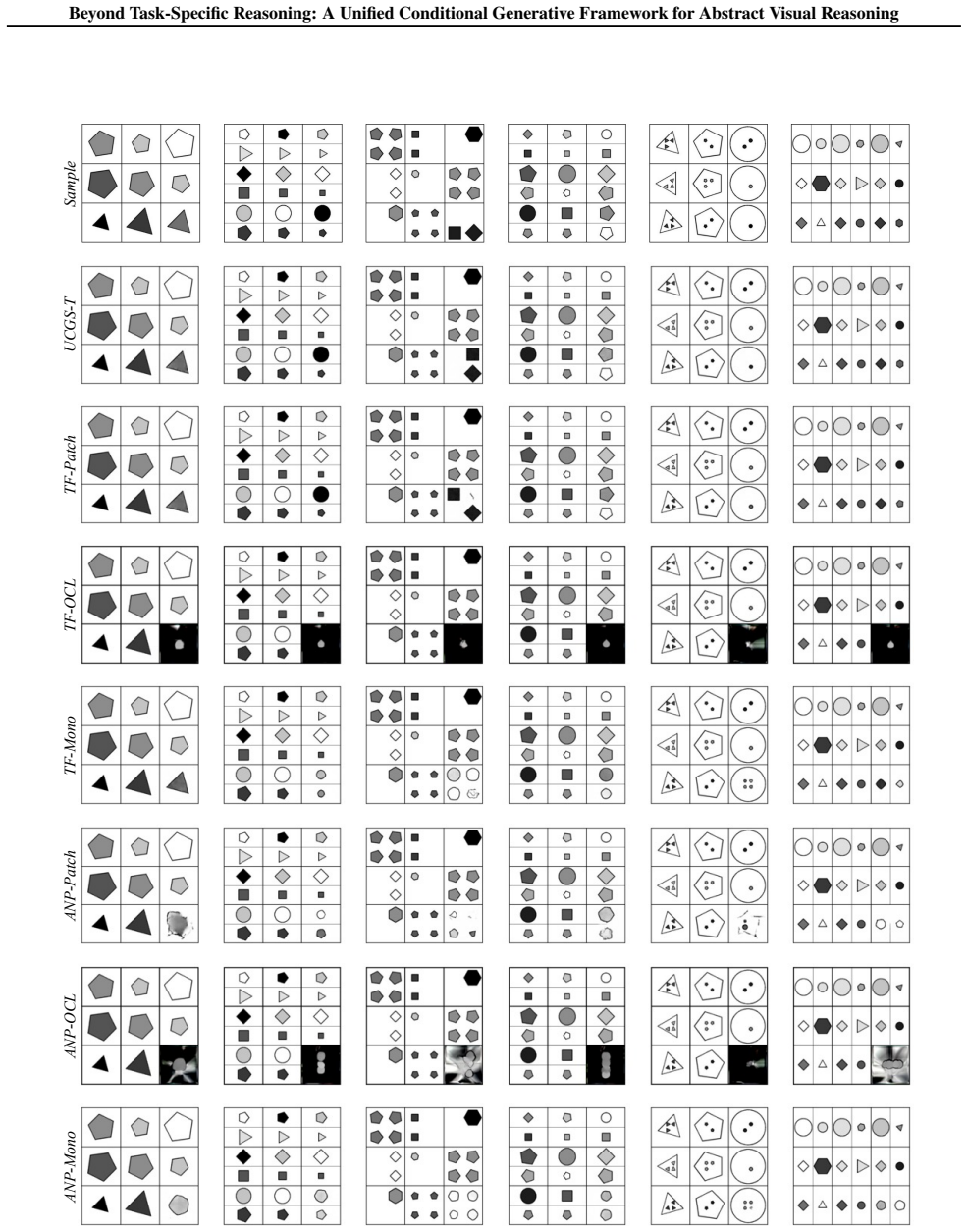
On its own terms, the paper establishes a reduction claim: for any abstract visual reasoning problem whose panel is a set of images with one distinguished slot, the correct answer is the image that maximizes the conditional predictability $p(x\mid I^p_{\neg i})$, the odd-one-out is the image that minimizes it, and an SVRT query belongs to the panel for which it is most predictable (Propositions 3.3–3.5). Because these judgments are expressed purely through one score, answer selection and answer generation are the same operation; the model can sample from $p(x\mid I^p_{\neg i})$ to create completions and evaluate candidates by the same likelihood. The paper instantiates this as UCGS-T, which first compresses each image into discrete patch codes, extracts $K$ visual concepts per image via slot attention, combines context concepts to predict target concepts, then autoregressively decodes target patches. The empirical payload is that a single multi-task training run on RAVEN and PGM produces 64.6% on RAVEN, 38.1% on PGM, and transfer to three task formats constructed from RAVEN concepts, with accuracy falling to near-random on the out-of-distribution VAP and SVRT splits.
Load-bearing premise
The load-bearing premise is that the conditional probability that an image fits a panel, learned from RAVEN and PGM training, remains a faithful measure of rule-compliance when the panel layout, task format, or rule vocabulary is new.
Editorial extensions
If this is right
- One round of multi-task training on RAVEN and PGM yields a single model that answers RPM, analogy, odd-one-out, and categorization problems, so solving a new AVR task format no longer requires retraining or architecture changes when concepts and rules are in distribution.
- Since answer generation and answer selection share one likelihood, any improvement to the generative model—better image tokenizer, decoder, or concept encoder—should improve both completion quality and selection accuracy.
- The near-random out-of-distribution results (28.8% on VAP vs 25% random, 52.8% on SVRT vs 50% random) imply that the learned predictability is not a universal rule oracle; the framework's zero-shot reach is bounded by the visual concepts and abstract rules present in training.
- The framework transfers across panel structures within the training rule vocabulary, as shown by UCGS-T scoring 35.8% on six-image VAP-ID and 33.6% on five-image O3-ID after training on nine-image RPM panels.
Reading between the lines
- A testable extension the paper leaves implicit: apply the same conditional likelihood to Bongard-style concept learning, where the context is a set of positive and negative exemplars and the score decides whether a query image fits the positive class.
- The sharp out-of-distribution drop suggests the model learns a dataset-specific rule vocabulary rather than abstract rule compliance; a calibration study comparing $p(x\mid \text{context})$ against human rule-compliance judgments could settle which.
- Because the framework requires only a panel of images with one target, it can be extended to multi-cell completion by factorizing over several missing positions, which would connect it to image-inpainting formulations.
- The discrete codebook is likely the bottleneck for real-world transfer; swapping in a higher-capacity image tokenizer while freezing the concept and panel encoders would test whether the reasoning layers, not the image compression, limit out-of-distribution generalization.
Editorial analysis
A structured set of objections, weighed in public.
Referee Report
Summary. Shi et al. propose UCGS, a framework that reduces four abstract visual reasoning benchmarks (RPM, VAP, O3, SVRT) to estimating the conditional predictability p(x|context) of a target image given the remaining panel images. The paper presents Propositions 3.3–3.5 as proofs of this reduction, then instantiates the framework in a VQ-VAE plus Transformer model (UCGS-T) trained once on RAVEN and PGM and applied without retraining to all evaluation tasks. Experiments report 64.6% on RAVEN, 38.1% on PGM, mixed results on three constructed in-distribution zero-shot tasks (O3-ID, VAP-ID, SVRT-ID), and out-of-distribution zero-shot accuracies that are close to chance on G1-set, VAP, and SVRT.
Significance. If the reduction were rigorously established, the paper would offer a genuinely unified treatment of four distinct AVR benchmarks with a single conditional generative model, and the empirical comparison (64.6% RAVEN vs. 54.5% RAISE) shows the instantiation is competitive among generative RPM solvers. The construction of ID-ZS tasks from RAVEN is a useful methodology for probing task-format generalization. However, the proof of Proposition 3.5 conflates dataset sampling probabilities with model-assigned panel likelihoods, and the OOD zero-shot results are modest, with SVRT at 52.8% versus 50% random on 253 test problems. These issues are fixable, but they currently limit the strength of the paper's central claims.
major comments (3)
- [§3.1, Proposition 3.5] The proof of the SVRT reduction is invalid as written. Definition 3.1 defines p(I^p) as the joint probability or 'correctness' of a panel under the generative model, but the proof then asserts p(I^l)=p(I^r)=1/|D| because the panels are 'sampled from the dataset D uniformly without overlap.' The marginal likelihood assigned by a trained generative model is not the empirical sampling frequency; nothing in the training objective (Eq. 9) enforces equal likelihoods for all panels in D. Consequently, argmax_{I^p} p(x|I^p) is not equivalent to argmax_{I^p} p(I^p_+x) unless the panel priors are equal or the model is calibrated to the uniform sampling distribution. The reduction can be repaired by stating an explicit uniform prior over the two panels in the SVRT decision rule, or by treating the rule as a heuristic, but as written the proof does not go through.
- [§3.1, Proposition 3.4] Equation (2) writes p(I^p_¬i)=p(I^p)/p(I^p_i|I^p_¬i) and then argues that removing the odd image leaves a 'large' panel probability. This requires p(I^p_i|I^p_¬i)>0; if the model assigns zero conditional probability to the odd image, the expression is an indeterminate 0/0 form. The proof also relies on an informal threshold ('large' vs. '→0') without specifying how to compare panels of different sizes. Please state regularity conditions (strict positivity of conditional probabilities and a separation between rule-compliant and rule-violating panels) or recast Proposition 3.4 as a heuristic decision rule rather than a theorem.
- [§4.1, Table 1] The zero-shot claims rest on single-run accuracies with no error bars or significance tests. The OOD gains are modest: G1-set 30.4% vs. 22.5% random, VAP 28.8% vs. 25% random, and SVRT 52.8% vs. 50% random. With only 253 SVRT test problems, the SVRT result is within binomial sampling noise (standard error approximately 3.1 percentage points). Please report multiple seeds and confidence intervals, or at least a binomial test for SVRT, to support the claim that UCGS exhibits zero-shot reasoning on unseen tasks. The near-chance SVRT result in particular weakens that claim as currently stated.
minor comments (6)
- [Table 1, random-guess row] The random-guess baseline for O3-ID is listed as 11.1%, but with five images and one odd image the chance level is 20%. Please correct the table and any related discussion.
- [Appendix B.1, Patch Decoder] The text says 'The panel encoder is a 12-layer Transformer decoder' in the Patch Decoder paragraph; this appears to be a copy-paste error and should refer to the patch decoder.
- [Figure 2 and §3.2.3] The terms 'concept encoder' and 'panel encoder' are used interchangeably across Figure 2, the section heading, and the body text; please standardize the terminology.
- [§4.1.4] The GPT-4o comparison uses subsets of different sizes (700, 1K, 253) without confidence intervals; a brief note on sampling variability would improve the comparison.
- [§3.1, Propositions 3.3–3.5] The propositions are stated as mathematical proofs, but they rely on the true data distribution ranking rule-compliant panels above rule-violating ones. Since the model is trained on a finite sample, this is an empirical assumption; consider stating it explicitly as a condition rather than leaving it implicit.
- [General] The paper does not state whether code or trained models will be released. For reproducibility, please provide code or clearly state the release plan.
Circularity Check
The reduction proofs are consequences of the paper's own definition of correctness as joint probability, making the theoretical unification true by construction; Proposition 3.5 adds an unsupported equality between model probability and sampling frequency.
-
self definitional
[Section 3.1, Definition 3.1 and Proposition 3.3 (proof pattern reused in 3.4 and 3.5)]
"The correctness of I p is the joint probability p(I p). I p is rule-compliant if p(I p) is large, and rule-violating if p(I p) → 0. ... The correct answer x⋆ make up the modified panel with the largest correctness, given by argmax x∈I s p(x|I p ¬N )."
The claimed reduction is the definition restated: 'correctness' is stipulated to be the joint probability, so the statement that the right completion maximizes p(x|context) (and the odd image minimizes it) adds no independent content. Eq. (1) is just the chain rule; the identification of the dataset's correct answer with 'largest correctness' is assumed, not derived. Consequently, the 'proof' that RPM/VAP/O3 reduce to predictability estimation is true by construction.
-
other
[Section 3.1, Proposition 3.5]
"Consider that I l and I r are sampled from the dataset D uniformly without overlap, in Equation 3 we have p(I l) =p(I r) = 1/|D|. Therefore, x belongs to the panel I ⋆ = argmaxI p∈{I l,I r} p(x|I p)."
The proof switches the meaning of p: Definition 3.1 defines p(I^p) as the model's joint 'correctness' probability, but here p(I^l)=1/|D| is the empirical sampling frequency. No argument or experiment shows the learned panel likelihood is calibrated to the uniform dataset prior. The equivalence argmax p(x|I^p) = argmax p(I^p_{+x}) required for SVRT depends entirely on this unproved equality, so the reduction is not established by the framework.
full rationale
The paper's central theoretical contribution—that RPM, VAP, O3, and SVRT reduce to estimating p(x|context)—is largely self-definitional: Definition 3.1 equates panel correctness with joint probability, so Propositions 3.3 and 3.4 follow immediately by construction. Proposition 3.5 has an additional unsupported identification of the model's marginal probability with the empirical sampling frequency, which is a proof gap rather than a separate circularity. These issues affect the unification proof, not the empirical instantiation: UCGS-T is trained with a standard likelihood objective on RAVEN/PGM and evaluated on external benchmarks (G1-set, VAP, SVRT), so the main experimental results are independent of the tautological proofs. The authors' self-citations (Shi et al. 2021, 2023, 2024) are background or architectural inspiration and are not load-bearing fitted constants. Overall, the reduction claims are partially circular by definition, but there is no fitting-renamed-as-prediction and no self-citation chain.
Assumptions & free parameters
assumptions (4)
- domain assumption Rule-compliant panels have high probability under the learned distribution, and rule-violating panels have low probability.
- domain assumption SVRT problem panels I_l and I_r are drawn uniformly from dataset D, giving p(I_l)=p(I_r)=1/|D|.
- domain assumption Predictability in discrete patch space p(Z_t|Z_C) approximates image-level predictability p(I_t|I_C).
- ad hoc to paper In O3 problems, removing the odd image leaves a rule-compliant panel whose probability is large, while the full panel's probability is finite.
Cite this review
Pith. "Pith review of Beyond Task-Specific Reasoning: A Unified Conditional Generative Framework for Abstract Visual Reasoning." pith.science (2026). https://pith.science/paper/IGLXYZKD
@misc{pith2026250711761,
  author       = {Pith},
  title        = {Pith review of: Beyond Task-Specific Reasoning: A Unified Conditional Generative Framework for Abstract Visual Reasoning},
  year         = {2026},
  howpublished = {\url{https://pith.science/paper/IGLXYZKD}},
  note         = {Machine review of arXiv:2507.11761}
}
read the original abstract
Abstract visual reasoning (AVR) enables humans to quickly discover and generalize abstract rules to new scenarios. Designing intelligent systems with human-like AVR abilities has been a long-standing topic in the artificial intelligence community. Deep AVR solvers have recently achieved remarkable success in various AVR tasks. However, they usually use task-specific designs or parameters in different tasks. In such a paradigm, solving new tasks often means retraining the model, and sometimes retuning the model architectures, which increases the cost of solving AVR problems. In contrast to task-specific approaches, this paper proposes a novel Unified Conditional Generative Solver (UCGS), aiming to address multiple AVR tasks in a unified framework. First, we prove that some well-known AVR tasks can be reformulated as the problem of estimating the predictability of target images in problem panels. Then, we illustrate that, under the proposed framework, training one conditional generative model can solve various AVR tasks. The experiments show that with a single round of multi-task training, UCGS demonstrates abstract reasoning ability across various AVR tasks. Especially, UCGS exhibits the ability of zero-shot reasoning, enabling it to perform abstract reasoning on problems from unseen AVR tasks in the testing phase.
Figures


Figures from the paper (4 more)



Reference graph
Works this paper leans on
-
[1]
Measuring abstract reasoning in neural networks
Barrett, D., Hill, F., Santoro, A., Morcos, A., and Lillicrap, T. Measuring abstract reasoning in neural networks. In International conference on machine learning, pp.\ 511--520. PMLR, 2018
work page 2018
-
[2]
Fleuret, F., Li, T., Dubout, C., Wampler, E. K., Yantis, S., and Geman, D. Comparing machines and humans on a visual categorization test. Proceedings of the National Academy of Sciences, 108 0 (43): 0 17621--17625, 2011
work page 2011
-
[3]
Learning to make analogies by contrasting abstract relational structure
Hill, F., Santoro, A., Barrett, D., Morcos, A., and Lillicrap, T. Learning to make analogies by contrasting abstract relational structure. In International Conference on Learning Representations, 2019
work page 2019
-
[4]
Kim, H., Mnih, A., Schwarz, J., Garnelo, M., Eslami, A., Rosenbaum, D., Vinyals, O., and Teh, Y. W. Attentive neural processes. arXiv preprint arXiv:1901.05761, 2019
arXiv 1901
-
[5]
Kingma, D. P. and Ba, J. Adam: A method for stochastic optimization. arXiv preprint arXiv:1412.6980, 2014
arXiv 2014
-
[6]
Ma \'n dziuk, J. and \.Z ychowski, A. Deepiq: A human-inspired ai system for solving iq test problems. In 2019 International Joint Conference on Neural Networks (IJCNN), pp.\ 1--8. IEEE, 2019
work page 2019
-
[7]
Learning to reason over visual objects
Mondal, S. S., Webb, T., and Cohen, J. D. Learning to reason over visual objects. arXiv preprint arXiv:2303.02260, 2023
work page Pith review arXiv 2023
-
[8]
Pytorch: An imperative style, high-performance deep learning library
Paszke, A., Gross, S., Massa, F., Lerer, A., Bradbury, J., Chanan, G., Killeen, T., Lin, Z., Gimelshein, N., Antiga, L., et al. Pytorch: An imperative style, high-performance deep learning library. Advances in neural information processing systems, 32, 2019
2019
Show all 63 references
-
[9]
Neural discrete representation learning
Van Den Oord, A., Vinyals, O., et al. Neural discrete representation learning. Advances in neural information processing systems, 30, 2017
2017
-
[10]
N., Kaiser, ., and Polosukhin, I
Vaswani, A., Shazeer, N., Parmar, N., Uszkoreit, J., Jones, L., Gomez, A. N., Kaiser, ., and Polosukhin, I. Attention is all you need. Advances in neural information processing systems, 30, 2017
2017
-
[11]
Raven: A dataset for relational and analogical visual reasoning
Zhang, C., Gao, F., Jia, B., Zhu, Y., and Zhu, S.-C. Raven: A dataset for relational and analogical visual reasoning. In Proceedings of the IEEE/CVF Conference on Computer Vision and Pattern Recognition, pp.\ 5317--5327, 2019
2019
-
[12]
write newline
" write newline "" before.all 'output.state := FUNCTION n.dashify 't := "" t empty not t #1 #1 substring "-" = t #1 #2 substring "--" = not "--" * t #2 global.max substring 't := t #1 #1 substring "-" = "-" * t #2 global.max substring 't := while if t #1 #1 substring * t #2 gl...
-
[13]
L., Almeida, D., Altenschmidt, J., Altman, S., Anadkat, S., et al
Achiam, J., Adler, S., Agarwal, S., Ahmad, L., Akkaya, I., Aleman, F. L., Almeida, D., Altenschmidt, J., Altman, S., Anadkat, S., et al. Gpt-4 technical report. arXiv preprint arXiv:2303.08774, 2023
2023 arXiv
-
[14]
Bai, Y., Geng, X., Mangalam, K., Bar, A., Yuille, A., Darrell, T., Malik, J., and Efros, A. A. Sequential modeling enables scalable learning for large vision models. arXiv preprint arXiv:2312.00785, 2023
2023 arXiv
-
[15]
Visual prompting via image inpainting
Bar, A., Gandelsman, Y., Darrell, T., Globerson, A., and Efros, A. Visual prompting via image inpainting. Advances in Neural Information Processing Systems, 35: 0 25005--25017, 2022
2022
-
[16]
Scale-localized abstract reasoning
Benny, Y., Pekar, N., and Wolf, L. Scale-localized abstract reasoning. In Proceedings of the IEEE/CVF Conference on Computer Vision and Pattern Recognition, pp.\ 12557--12565, 2021
2021
-
[17]
D., Dhariwal, P., Neelakantan, A., Shyam, P., Sastry, G., Askell, A., et al
Brown, T., Mann, B., Ryder, N., Subbiah, M., Kaplan, J. D., Dhariwal, P., Neelakantan, A., Shyam, P., Sastry, G., Askell, A., et al. Language models are few-shot learners. Advances in neural information processing systems, 33: 0 1877--1901, 2020
1901
-
[18]
Cao, X., Lai, B., Ye, W., Ma, Y., Heintz, J., Chen, J., Cao, J., and Rehg, J. M. What is the visual cognition gap between humans and multimodal llms? arXiv preprint arXiv:2406.10424, 2024
2024 arXiv
-
[19]
Cattell, R. B. Theory of fluid and crystallized intelligence: A critical experiment. Journal of educational psychology, 54 0 (1): 0 1, 1963
1963
-
[20]
Infogan: Interpretable representation learning by information maximizing generative adversarial nets
Chen, X., Duan, Y., Houthooft, R., Schulman, J., Sutskever, I., and Abbeel, P. Infogan: Interpretable representation learning by information maximizing generative adversarial nets. Advances in neural information processing systems, 29, 2016
2016
-
[21]
On the measure of intelligence
Chollet, F. On the measure of intelligence. arXiv preprint arXiv:1911.01547, 2019
1911 arXiv
-
[22]
C., Griffiths, T
Dedhia, B., Chang, M., Snell, J. C., Griffiths, T. L., and Jha, N. K. Im-promptu: In-context composition from image prompts. arXiv preprint arXiv:2305.17262, 2023
2023 arXiv
-
[23]
A., and J \"a kel, F
Depeweg, S., Rothkopf, C. A., and J \"a kel, F. Solving bongard problems with a visual language and pragmatic constraints. Cognitive Science, 48 0 (5): 0 e13432, 2024
2024
-
[24]
and Mordatch, I
Du, Y. and Mordatch, I. Implicit generation and modeling with energy based models. Advances in Neural Information Processing Systems, 32: 0 3608--3618, 2019
2019
-
[25]
Neural diffusion processes
Dutordoir, V., Saul, A., Ghahramani, Z., and Simpson, F. Neural diffusion processes. In International Conference on Machine Learning, pp.\ 8990--9012. PMLR, 2023
2023
-
[26]
J., Eslami, S., and Teh, Y
Garnelo, M., Schwarz, J., Rosenbaum, D., Viola, F., Rezende, D. J., Eslami, S., and Teh, Y. W. Neural processes. arXiv preprint arXiv:1807.01622, 2018
2018 arXiv
-
[27]
Generative adversarial nets
Goodfellow, I., Pouget-Abadie, J., Mirza, M., Xu, B., Warde-Farley, D., Ozair, S., Courville, A., and Bengio, Y. Generative adversarial nets. Advances in neural information processing systems, 27, 2014
2014
-
[28]
Gray, J. R. and Thompson, P. M. Neurobiology of intelligence: science and ethics. Nature Reviews Neuroscience, 5 0 (6): 0 471--482, 2004
2004
-
[29]
Masked autoencoders are scalable vision learners
He, K., Chen, X., Xie, S., Li, Y., Doll \'a r, P., and Girshick, R. Masked autoencoders are scalable vision learners. In Proceedings of the IEEE/CVF conference on computer vision and pattern recognition, pp.\ 16000--16009, 2022
2022
-
[30]
A neuro-vector-symbolic architecture for solving raven’s progressive matrices
Hersche, M., Zeqiri, M., Benini, L., Sebastian, A., and Rahimi, A. A neuro-vector-symbolic architecture for solving raven’s progressive matrices. Nature Machine Intelligence, 5 0 (4): 0 363--375, 2023
2023
-
[31]
Learning to make analogies by contrasting abstract relational structure
Hill, F., Santoro, A., Barrett, D., Morcos, A., and Lillicrap, T. Learning to make analogies by contrasting abstract relational structure. In International Conference on Learning Representations, 2019 a
2019
-
[32]
G., Morcos, A
Hill, F., Santoro, A., Barrett, D. G., Morcos, A. S., and Lillicrap, T. Learning to make analogies by contrasting abstract relational structure. arXiv preprint arXiv:1902.00120, 2019 b
1902 arXiv
-
[33]
Stratified rule-aware network for abstract visual reasoning
Hu, S., Ma, Y., Liu, X., Wei, Y., and Bai, S. Stratified rule-aware network for abstract visual reasoning. In Proceedings of the AAAI Conference on Artificial Intelligence, volume 35, pp.\ 1567--1574, 2021
2021
-
[34]
Kingma, D. P. and Welling, M. Auto-encoding variational bayes. arXiv preprint arXiv:1312.6114, 2013
2013 arXiv
-
[35]
R., Lewandowsky, S., and Griffiths, T
Little, D. R., Lewandowsky, S., and Griffiths, T. L. A bayesian model of rule induction in raven's progressive matrices. In Proceedings of the Annual Meeting of the Cognitive Science Society, volume 34, 2012
2012
-
[36]
Object-centric learning with slot attention
Locatello, F., Weissenborn, D., Unterthiner, T., Mahendran, A., Heigold, G., Uszkoreit, J., Dosovitskiy, A., and Kipf, T. Object-centric learning with slot attention. Advances in Neural Information Processing Systems, 33: 0 11525--11538, 2020
2020
-
[37]
A structure-mapping model of raven's progressive matrices
Lovett, A., Forbus, K., and Usher, J. A structure-mapping model of raven's progressive matrices. In Proceedings of the Annual Meeting of the Cognitive Science Society, 2010
2010
-
[38]
and Ma \'n dziuk, J
Ma ki \'n ski, M. and Ma \'n dziuk, J. Deep learning methods for abstract visual reasoning: A survey on raven's progressive matrices. arXiv preprint arXiv:2201.12382, 2022 a
2022 arXiv
-
[39]
and Ma \'n dziuk, J
Ma ki \'n ski, M. and Ma \'n dziuk, J. A review of emerging research directions in abstract visual reasoning. arXiv preprint arXiv:2202.10284, 2022 b
2022 arXiv
-
[40]
Intuitive physics
McCloskey, M. Intuitive physics. Scientific american, 248 0 (4): 0 122--131, 1983
1983
-
[41]
The colossal book of short puzzles and problems, 2007
McMillen, J. The colossal book of short puzzles and problems, 2007
2007
-
[42]
Conditional generative adversarial nets
Mirza, M. Conditional generative adversarial nets. arXiv preprint arXiv:1411.1784, 2014
2014 arXiv
-
[43]
B., Zhu, Y., and Anandkumar, A
Nie, W., Yu, Z., Mao, L., Patel, A. B., Zhu, Y., and Anandkumar, A. Bongard-logo: A new benchmark for human-level concept learning and reasoning. Advances in Neural Information Processing Systems, 33: 0 16468--16480, 2020
2020
-
[44]
Generating correct answers for progressive matrices intelligence tests
Pekar, N., Benny, Y., and Wolf, L. Generating correct answers for progressive matrices intelligence tests. arXiv preprint arXiv:2011.00496, 2020
2011 arXiv
-
[45]
Raven, J. C. and Court, J. Raven's progressive matrices. Western Psychological Services Los Angeles, CA, 1938
1938
-
[46]
Generating diverse high-fidelity images with vq-vae-2
Razavi, A., Van den Oord, A., and Vinyals, O. Generating diverse high-fidelity images with vq-vae-2. Advances in neural information processing systems, 32, 2019
2019
-
[47]
High-resolution image synthesis with latent diffusion models
Rombach, R., Blattmann, A., Lorenz, D., Esser, P., and Ommer, B. High-resolution image synthesis with latent diffusion models. In Proceedings of the IEEE/CVF conference on computer vision and pattern recognition, pp.\ 10684--10695, 2022
2022
-
[48]
Raven's progressive matrices completion with latent gaussian process priors
Shi, F., Li, B., and Xue, X. Raven's progressive matrices completion with latent gaussian process priors. In Proceedings of the AAAI Conference on Artificial Intelligence, volume 35, pp.\ 9612--9620, 2021
2021
-
[49]
Compositional law parsing with latent random functions
Shi, F., Li, B., and Xue, X. Compositional law parsing with latent random functions. In The Eleventh International Conference on Learning Representations, 2023
2023
-
[50]
Towards generative abstract reasoning: Completing raven’s progressive matrix via rule abstraction and selection
Shi, F., Li, B., and Xue, X. Towards generative abstract reasoning: Completing raven’s progressive matrix via rule abstraction and selection. In The Twelfth International Conference on Learning Representations, 2024
2024
-
[51]
Learning structured output representation using deep conditional generative models
Sohn, K., Lee, H., and Yan, X. Learning structured output representation using deep conditional generative models. Advances in neural information processing systems, 28, 2015
2015
-
[52]
Are disentangled representations helpful for abstract visual reasoning? Advances in Neural Information Processing Systems, 32, 2019
Van Steenkiste, S., Locatello, F., Schmidhuber, J., and Bachem, O. Are disentangled representations helpful for abstract visual reasoning? Advances in Neural Information Processing Systems, 32, 2019
2019
-
[53]
Abstract diagrammatic reasoning with multiplex graph networks
Wang, D., Jamnik, M., and Lio, P. Abstract diagrammatic reasoning with multiplex graph networks. arXiv preprint arXiv:2006.11197, 2020
2006 arXiv
-
[54]
S., and Cohen, J
Webb, T., Mondal, S. S., and Cohen, J. D. Systematic visual reasoning through object-centric relational abstraction. Advances in Neural Information Processing Systems, 36, 2024
2024
-
[55]
The scattering compositional learner: Discovering objects, attributes, relationships in analogical reasoning
Wu, Y., Dong, H., Grosse, R., and Ba, J. The scattering compositional learner: Discovering objects, attributes, relationships in analogical reasoning. arXiv preprint arXiv:2007.04212, 2020
2007 arXiv
-
[56]
Videogpt: Video generation using vq-vae and transformers
Yan, W., Zhang, Y., Abbeel, P., and Srinivas, A. Videogpt: Video generation using vq-vae and transformers. arXiv preprint arXiv:2104.10157, 2021
2021 arXiv
-
[57]
Compositional scene representation learning via reconstruction: A survey
Yuan, J., Chen, T., Li, B., and Xue, X. Compositional scene representation learning via reconstruction: A survey. IEEE Transactions on Pattern Analysis and Machine Intelligence, 45 0 (10): 0 11540--11560, 2023
2023
-
[58]
A deeper look at bongard problems
Yun, X., Bohn, T., and Ling, C. A deeper look at bongard problems. In Advances in Artificial Intelligence: 33rd Canadian Conference on Artificial Intelligence, Canadian AI 2020, Ottawa, ON, Canada, May 13--15, 2020, Proceedings 33, pp.\ 528--539. Springer, 2020
2020
-
[59]
Abstract spatial-temporal reasoning via probabilistic abduction and execution
Zhang, C., Jia, B., Zhu, S.-C., and Zhu, Y. Abstract spatial-temporal reasoning via probabilistic abduction and execution. In Proceedings of the IEEE/CVF Conference on Computer Vision and Pattern Recognition, pp.\ 9736--9746, 2021 a
2021
-
[60]
N., Zhu, S.-C., and Zhu, Y
Zhang, C., Xie, S., Jia, B., Wu, Y. N., Zhu, S.-C., and Zhu, Y. Learning algebraic representation for systematic generalization in abstract reasoning. arXiv preprint arXiv:2111.12990, 2021 b
2021 arXiv
-
[61]
Mmicl: Empowering vision-language model with multi-modal in-context learning
Zhao, H., Cai, Z., Si, S., Ma, X., An, K., Chen, L., Liu, Z., Wang, S., Han, W., and Chang, B. Mmicl: Empowering vision-language model with multi-modal in-context learning. arXiv preprint arXiv:2309.07915, 2023
2023 arXiv
-
[62]
Abstract reasoning with distracting features
Zheng, K., Zha, Z.-J., and Wei, W. Abstract reasoning with distracting features. Advances in Neural Information Processing Systems, 32, 2019
2019
-
[63]
and Kankanhalli, M
Zhuo, T. and Kankanhalli, M. Effective abstract reasoning with dual-contrast network. In International Conference on Learning Representations, 2021
2021
Reviewed August 6, 2026 · model on record in the stance chip above.
Discussion (0). Sign in to comment.