REVIEW 3 major objections 5 minor 67 references
CLID-MU: Cross-Layer Information Divergence Based Meta Update Strategy for Learning with Noisy Labels
T0 review · 3 major / 5 minor · reviewed 2026-08-06 · deepseek-v4-flash
Pith's one-line read A label-free divergence between two network layers can replace the clean validation set that meta-learning for noisy labels normally needs.
desk verdict Useful label-free heuristic for noisy-label meta-learning, but the core correlation evidence is between runs, not within a run; needs a temporal validation before the mechanism is convincing. read the letter →
The pith
A machine-rendered reading of the paper's core claim, the machinery that carries it, and where it could break.
The reading
What carries the argument
Cross-Layer Information Divergence (CLID): given a batch, the embedding graph G_e with entries exp(cos(z_i, z_j)/tau) and the class-probability graph G_q with entries cos(q_i, q_j), both row-normalized to valid distributions, with L_clid = -(1/$m^{2}$) sum_i sum_j hat(G)_q,ij log hat(G)_e,ij. It carries the argument in two places: as the signal that the last hidden layer's structure has converged toward the output layer's structure, and as the differentiable meta-loss whose gradient with respect to the virtually-updated model parameters defines the per-sample gradient similarity g_i in the meta-update, steering the meta-model's sample weights without ever consulting labels. A stop-gradient operation prevents trivial constant solutions, and snapshot ensembling selects the top-K checkpoints by lowest CLID for inference.
What would settle it
Run the Section 4.2 procedure on a setting outside the paper, for example a Vision Transformer on ImageNet-1K with 40% symmetric label noise, and compute the epoch-wise Pearson correlation between CLID and clean-test cross-entropy. If the correlation drops below the paper's own strong-correlation threshold (rho > 0.7), or if the top-5 snapshots picked by lowest CLID are not the most accurate models on the test set, the central premise is refuted. A cheaper check on the same data would track per-sample meta-weights under heavier instance-dependent noise to see whether clean samples keep receiving the largest weights as training progresses.
Extended reading notes
Core claim
The central discovery is the CLID metric and its use as a meta-objective. For a batch of samples, CLID builds two fully connected similarity graphs: an embedding graph with entries exp(cos(z_i, z_j)/tau) from the penultimate layer, and a class-probability graph with entries cos(q_i, q_j) from the output layer, both row-normalized into distributions. The divergence is their cross-entropy, computed with the output-layer graph as the target and the embedding graph as the prediction, justified by the observation that the classifier layer updates faster than the hidden layer, so the slower layer should align toward the faster one. The paper demonstrates empirically that the epoch-wise Relative Performance Ratio of CLID tracks that of clean-test cross-entropy and that the Pearson correlation between the two stays high across noise types, leading to the conclusion that CLID is a valid label-free proxy for model quality. Replacing the meta-loss in WNet and VRI with CLID yields accuracy that in several settings exceeds the version using a genuinely clean meta-dataset, and the method extends to semi-supervised noisy-label settings and composes with DivideMix. The paper also proves an upper bound on the exponential loss of snapshot ensembling, showing the bound decreases as the number of ensembled snapshots grows.
Load-bearing premise
The method stands or falls on the empirical correlation of Section 4.2: that CLID, measured without any labels, tracks the model's true test error across noise settings, a correlation shown only on CIFAR-10 and CIFAR-100 with ResNet-34. If that alignment signal diverges from test error for another architecture, dataset, noise type, or training schedule, the CLID-guided meta-update and snapshot selection lose their justification.
Editorial extensions
If this is right
- Meta-learning for noisy labels can run without a clean, balanced meta-dataset: a randomly sampled or unlabeled batch of the training data supplies the evaluation signal.
- In the reported experiments, CLID-MU outperforms cross-entropy on noisy meta-data and MAE-based meta-objectives, and in several settings beats even the clean-meta-dataset ceiling for both WNet and VRI.
- Plugging WNet-CLID into semi-supervised learners (UDA, FixMatch, FlexMatch) improves test accuracy under symmetric, asymmetric, and human label noise, with the largest gains at high noise ratios.
- CLID-based selection of the top-5 snapshots improves ensemble accuracy over single-model accuracy, and Theorem 1 supports the practice by bounding the exponential loss by a product that decreases as the snapshot count grows.
- CLID-MU composes with other noisy-label components such as DivideMix, MixUp, and ELR, making it an additive module rather than a competing pipeline.
Reading between the lines
- The correlation claim in Section 4.2 was measured on ResNet-34 with CIFAR-10 and CIFAR-100 only; whether CLID tracks generalization for transformers, large-scale or domain-shifted data, or other optimizers is untested, and that is the first probe of the premise's scope.
- The same label-free alignment signal could plausibly serve model selection in other weakly supervised regimes that struggle with validation-free evaluation, such as partial-label learning, which the paper itself cites as a neighboring problem; CLID's differentiability is what lets it plug into gradient-based meta-updates, and that advantage would carry over.
- Appendix D discloses a genuine cost: CLID-MU takes roughly 140 seconds per epoch versus about 14 for baselines on a single A100 GPU, a tenfold overhead that the paper mitigates only as future work (sparse top-K graphs, approximate nearest neighbor search, and less frequent meta-updates); any deployment must trade this compute against the cost of collecting clean labels.
- Because CLID is a batch-wise pairwise statistic, its signal likely depends on batch composition; the paper's own Table 6 shows accuracy improves when the meta-train batch exceeds 50 samples under the hardest real-world noise, hinting that small-batch regimes could be the failure boundary.
Editorial analysis
A structured set of objections, weighed in public.
Referee Report
Summary. The paper proposes CLID-MU, a meta-learning strategy for learning with noisy labels that avoids a clean labeled meta-dataset. The method defines an unsupervised metric, CLID, as the cross-entropy between row-normalized similarity graphs of the last hidden layer and the output layer, argues that CLID tracks model quality, and uses CLID both as the meta-loss for updating a reweighting meta-model and as the criterion for selecting snapshots for ensembling. Experiments with WNet and VRI on CIFAR-10/100 under symmetric, asymmetric, instance-dependent, and real-world noise, plus semi-supervised settings, show competitive or superior accuracy relative to baselines that use noisy or pseudo-clean meta-datasets, and sometimes relative to methods with a clean meta-dataset. The paper also states a convergence bound for snapshot ensembling.
Significance. If the central correlation claim is valid, CLID-MU is a useful contribution: it removes the clean-validation-set requirement from meta-learning approaches to label noise, is model-agnostic, is compatible with existing LNL and SSL frameworks, and comes with released code. The empirical scope is broad, including synthetic and real-world noise across multiple benchmarks and integration into DivideMix, UDA, FixMatch, and FlexMatch. However, the paper's load-bearing premise, that CLID is a reliable within-run model-quality signal, is not directly validated; the reported correlations are computed across noise settings at fixed epochs, whereas the method's meta-update and snapshot selection operate across epochs within a single run. The theoretical result on snapshot ensembling is also generic and does not involve CLID. These gaps are fixable with additional experiments and reframing, but they are central to the paper's claims.
major comments (3)
- [Section 4.4 and Appendix A, Theorem 1] The evidence that CLID tracks model quality is a between-run correlation: Definition 2 fixes an epoch t and computes Pearson's r across the set N of noise settings, and Figures 2(c)/3(c) report this quantity at each epoch. This shows that models trained under heavier noise tend to have higher CLID at the same training time, but the proposed method uses CLID as a within-run signal: Eq. (10) differentiates L_clid with respect to the virtual-updated parameters at each iteration, and Algorithm 1 (lines 8-17) together with Section 4.4 compares CLID scores of snapshots taken at different epochs of the same run and selects the lowest. No experiment in Section 4.2 or Section 5 reports the within-run relationship between CLID and clean accuracy for a fixed noise level and architecture. Figure 7 shows CLID decreasing monotonically up to 17,500 steps on CIFAR-10N Worst, but clean accuracy is not overlaid, so the plot cannot rule out the failure mode in which a memorizing model's output-probability graph becomes sharp and more aligned with the embedding graph while clean accuracy deteriorates. The sensitivity analysis in Figure 5 compares CLID scores across temperature settings, not across training time, so it also does not supply the missing temporal evidence. The paper should provide per-run plots of CLID and clean accuracy over training, and evaluate whether the minimal-CLID snapshot and the CLID-selected ensemble match the best achievable snapshot accuracy.
- [Section 5.1, Tables 1a/1b, Section 5.2] Theorem 1 is a statement about any set of snapshots, not about the CLID metric. The bound L_exp <= product_k R_k^{1/K} follows from Holder's inequality applied to the averaged predictions and holds for arbitrary f_k; no property of CLID, of the top-K selection rule, or of noisy-label training is used in the proof. The inequality in Eq. (12) is in fact an equality for real-valued f, since exp(-f/K) = (exp(-f))^{1/K}, so the only substantive step is the AM-GM/Holder step. The sentence 'Theorem 1 demonstrates an exponential decrease in the L_exp bound as we save more snapshots' is also stronger than what the bound shows: with R_k in [0,1], the product bound need not decay exponentially in K. As stated, the theorem does not support the claim that CLID-selected snapshots are good snapshots; it should be removed, reframed as a generic ensemble bound, or replaced by an analysis that actually involves the CLID selection criterion.
- [Section 5.1, Tables 1a/1b, Section 5.2] In the experimental section, 'best accuracy' is defined as the highest accuracy on the clean test set achieved at any point during training. This is an oracle quantity: in the paper's stated setting, no clean labels are available, so a practitioner cannot select the best snapshot by this criterion. The practical accuracy is the ensemble accuracy obtained from the top-K CLID snapshots, and that quantity should carry the main empirical claims. The paper should report, for each setting, the clean accuracy of the CLID-selected snapshot and of the CLID-selected ensemble, and compare these with the best-achievable snapshot accuracy; at present the reader cannot tell how much of the reported advantage of WNet-CLID/VRI-CLID depends on oracle selection. This is closely related to the within-run validation issue and should be addressed together with it.
minor comments (5)
- [Table 1a] In the WNet-CE(p) row for CIFAR-100 Sym. 60%, the reported value '63.60±71' appears to be missing a decimal point; it should likely read '63.60±0.71' or '63.60±.71'.
- [Definition 2] The formula for the Pearson correlation uses summation over n in the numerator and denominator without clearly stating that n indexes the elements of N; the notation should be made consistent with the set N defined in the text.
- [Section 4.1] The term 'divergence' is used for a quantity that is the cross-entropy between row-normalized graphs and is not symmetric; this should be stated explicitly to avoid implying that CLID is a metric in the information-geometric sense.
- [Appendix A] The proof states exp(-f_k_y(x)) <= 1; this requires f_k_y(x) >= 0, which holds when f is a probability output but should be stated explicitly, since earlier notation allows f to denote a general model output.
- [Figure 7] The axis label 'Traing step' contains a typo and should read 'Training step'.
Circularity Check
No significant circularity found: CLID is an unsupervised, label-free metric validated against held-out test accuracy, and no equation or fitted parameter reduces the claimed result to its inputs.
full rationale
The paper's central claim is that CLID, defined in Eq. (9) as the cross-entropy between row-normalized class-probability and embedding similarity graphs, correlates with model performance under label noise. This is an empirical claim established by direct measurement on CIFAR-10 and CIFAR-100 across noise settings (Figures 2 and 3). CLID is computed entirely from model outputs and data, not from clean labels, and no parameter is fitted to the clean-label CE loss or test accuracy. The meta-update in Eq. (10) and snapshot selection in Algorithm 1 use CLID as a differentiable, label-free proxy; the reported accuracies are measured on held-out clean test sets, so the evaluation is external to the CLID objective. No self-definitional reduction, fitted-input-as-prediction, or load-bearing self-citation chain is present. The concern that the Section 4.2 correlation is across noise settings rather than within a single training run is a validity threat to the method's motivation, not a circularity under the stated criteria, because CLID is not constructed from the target metric. Theorem 1 is a generic bound on snapshot ensembling that does not depend on CLID. The paper is therefore self-contained against external benchmarks, and the appropriate finding is no significant circularity.
Assumptions & free parameters
free parameters (3)
- tau (temperature scaling) =
0.5
- K (number of snapshots) =
5
- Meta-dataset size =
1000
assumptions (4)
- domain assumption Cluster assumption: samples forming a structure are more likely to belong to the same class.
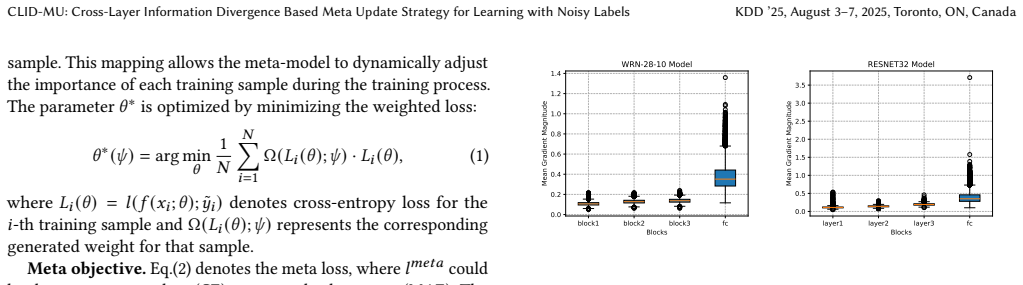
- ad hoc to paper Gradient magnitude of the classifier layer is larger than that of the hidden layer, so the hidden distribution should align with the output distribution.
- domain assumption The empirical correlation between CLID and CE loss on CIFAR-10 and CIFAR-100 generalizes to other datasets, architectures, and noise types.
- standard math The meta-learning bilevel optimization with first-order Taylor expansion and stop-gradient is a valid approximation.
invented entities (1)
-
CLID metric
independent evidence
Cite this review
Pith. "Pith review of CLID-MU: Cross-Layer Information Divergence Based Meta Update Strategy for Learning with Noisy Labels." pith.science (2026). https://pith.science/paper/RNXGU4PT
@misc{pith2026250711807,
  author       = {Pith},
  title        = {Pith review of: CLID-MU: Cross-Layer Information Divergence Based Meta Update Strategy for Learning with Noisy Labels},
  year         = {2026},
  howpublished = {\url{https://pith.science/paper/RNXGU4PT}},
  note         = {Machine review of arXiv:2507.11807}
}
read the original abstract
Learning with noisy labels (LNL) is essential for training deep neural networks with imperfect data. Meta-learning approaches have achieved success by using a clean unbiased labeled set to train a robust model. However, this approach heavily depends on the availability of a clean labeled meta-dataset, which is difficult to obtain in practice. In this work, we thus tackle the challenge of meta-learning for noisy label scenarios without relying on a clean labeled dataset. Our approach leverages the data itself while bypassing the need for labels. Building on the insight that clean samples effectively preserve the consistency of related data structures across the last hidden and the final layer, whereas noisy samples disrupt this consistency, we design the Cross-layer Information Divergence-based Meta Update Strategy (CLID-MU). CLID-MU leverages the alignment of data structures across these diverse feature spaces to evaluate model performance and use this alignment to guide training. Experiments on benchmark datasets with varying amounts of labels under both synthetic and real-world noise demonstrate that CLID-MU outperforms state-of-the-art methods. The code is released at https://github.com/ruofanhu/CLID-MU.
Figures


Figures from the paper (4 more)


Reference graph
Works this paper leans on
-
[1]
Yingyi Chen, Xi Shen, Shell Xu Hu, and Johan AK Suykens. 2021. Boosting co-teaching with compression regularization for label noise. In Proceedings of the IEEE/CVF Conference on Computer Vision and Pattern Recognition . 2688–2692
work page 2021
-
[2]
Erik Englesson and Hossein Azizpour. 2021. Generalized jensen-shannon di- vergence loss for learning with noisy labels. Advances in Neural Information Processing Systems 34 (2021), 30284–30297
work page 2021
-
[3]
Vasilii Feofanov, Malik Tiomoko, and Aladin Virmaux. 2023. Random matrix analysis to balance between supervised and unsupervised learning under the low density separation assumption. In International Conference on Machine Learning . PMLR, 10008–10033
work page 2023
-
[4]
Aritra Ghosh, Himanshu Kumar, and P. Shanti Sastry. 2017. Robust Loss Functions under Label Noise for Deep Neural Networks. In AAAI Conference on Artificial Intelligence. https://api.semanticscholar.org/CorpusID:6546734
work page 2017
-
[5]
Aritra Ghosh and Andrew Lan. 2021. Do we really need gold samples for sample weighting under label noise?. In Proceedings of the IEEE/CVF Winter Conference on Applications of Computer Vision . 3922–3931
work page 2021
-
[6]
Bo Han, Quanming Yao, Xingrui Yu, Gang Niu, Miao Xu, Weihua Hu, Ivor Tsang, and Masashi Sugiyama. 2018. Co-teaching: Robust training of deep neural net- works with extremely noisy labels. Advances in neural information processing systems 31 (2018)
work page 2018
-
[7]
Zhang, Shaoqing Ren, and Jian Sun
Kaiming He, X. Zhang, Shaoqing Ren, and Jian Sun. 2015. Deep Residual Learning for Image Recognition. 2016 IEEE Conference on Computer Vision and Pattern Recognition (CVPR) (2015), 770–778. https://api.semanticscholar.org/CorpusID: 206594692
2015
-
[8]
Dennis Hofmann, Peter VanNostrand, Huayi Zhang, Yizhou Yan, Lei Cao, Samuel Madden, and Elke Rundensteiner. 2022. A demonstration of autood: a self-tuning anomaly detection system. Proceedings of the VLDB Endowment 15, 12 (2022), 3706–3709
work page 2022
Show all 67 references
-
[9]
Dennis M Hofmann, Peter M VanNostrand, Lei Ma, Huayi Zhang, Joshua C DeOliveira, Lei Cao, and Elke A Rundensteiner. 2025. Agree to Disagree: Robust Anomaly Detection with Noisy Labels. Proceedings of the ACM on Management of Data 3, 1 (2025), 1–24
2025
-
[10]
Ruofan Hu, Dongyu Zhang, Dandan Tao, Huayi Zhang, Hao Feng, and Elke Rundensteiner. 2023. Uce-fid: Using large unlabeled, medium crowdsourced- labeled, and small expert-labeled tweets for foodborne illness detection. In 2023 IEEE International Conference on Big Data (BigData) ...
2023
-
[11]
Gao Huang, Yixuan Li, Geoff Pleiss, Zhuang Liu, John E Hopcroft, and Kilian Q Weinberger. 2017. Snapshot ensembles: Train 1, get m for free. arXiv preprint arXiv:1704.00109 (2017)
2017 arXiv
-
[12]
Lu Jiang, Zhengyuan Zhou, Thomas Leung, Li-Jia Li, and Li Fei-Fei. 2018. Mentor- net: Learning data-driven curriculum for very deep neural networks on corrupted labels. In International conference on machine learning . PMLR, 2304–2313
2018
-
[13]
Alex Krizhevsky, Geoffrey Hinton, et al. 2009. Learning multiple layers of features from tiny images. (2009)
2009
-
[14]
Junnan Li, Richard Socher, and Steven CH Hoi. 2020. Dividemix: Learning with noisy labels as semi-supervised learning. arXiv preprint arXiv:2002.07394 (2020)
2020 arXiv
-
[15]
Muyang Li, Xiaobo Xia, Runze Wu, Fengming Huang, Jun Yu, Bo Han, and Tongliang Liu. 2024. Towards realistic model selection for semi-supervised learning. In Forty-first International Conference on Machine Learning
2024
-
[16]
Xuefeng Li, Tongliang Liu, Bo Han, Gang Niu, and Masashi Sugiyama. 2021. Provably end-to-end label-noise learning without anchor points. In International conference on machine learning . PMLR, 6403–6413
2021
-
[17]
Shan, and Xilin Chen
Yifan Li, Hu Han, S. Shan, and Xilin Chen. 2023. DISC: Learning from Noisy Labels via Dynamic Instance-Specific Selection and Correction. 2023 IEEE/CVF Conference on Computer Vision and Pattern Recognition (CVPR) (2023), 24070– 24079. https://api.semanticscholar.org/CorpusID:260068694
2023
-
[18]
Sheng Liu, Jonathan Niles-Weed, Narges Razavian, and Carlos Fernandez-Granda
-
[19]
Sheng Liu, Zhihui Zhu, Qing Qu, and Chong You. 2022. Robust training under label noise by over-parameterization. In International Conference on Machine Learning. PMLR, 14153–14172
2022
-
[20]
Xingjun Ma, Hanxun Huang, Yisen Wang, Simone Romano, Sarah Monazam Erfani, and James Bailey. 2020. Normalized Loss Functions for Deep Learning with Noisy Labels. In International Conference on Machine Learning . https: //api.semanticscholar.org/CorpusID:220042066
2020
-
[21]
Deep Patel and PS Sastry. 2023. Adaptive sample selection for robust learning under label noise. InProceedings of the IEEE/CVF Winter Conference on Applications of Computer Vision. 3932–3942
2023
-
[22]
Giorgio Patrini, Alessandro Rozza, Aditya Krishna Menon, Richard Nock, and Lizhen Qu. 2017. Making deep neural networks robust to label noise: A loss correction approach. In Proceedings of the IEEE conference on computer vision and pattern recognition. 1944–1952
2017
-
[23]
Mengye Ren, Wenyuan Zeng, Bin Yang, and Raquel Urtasun. 2018. Learning to reweight examples for robust deep learning. In International conference on machine learning. PMLR, 4334–4343
2018
-
[24]
Jun Shu, Qi Xie, Lixuan Yi, Qian Zhao, Sanping Zhou, Zongben Xu, and Deyu Meng. 2019. Meta-Weight-Net: Learning an Explicit Mapping For Sample Weight- ing. In Neural Information Processing Systems . https://api.semanticscholar.org/ CorpusID:173188221
2019
-
[25]
Kihyuk Sohn, David Berthelot, Nicholas Carlini, Zizhao Zhang, Han Zhang, Colin A Raffel, Ekin Dogus Cubuk, Alexey Kurakin, and Chun-Liang Li. 2020. Fixmatch: Simplifying semi-supervised learning with consistency and confidence. Advances in neural information processing systems...
2020
-
[26]
Hwanjun Song, Minseok Kim, and Jae-Gil Lee. 2019. Selfie: Refurbishing unclean samples for robust deep learning. In International conference on machine learning . PMLR, 5907–5915
2019
-
[27]
Hwanjun Song, Minseok Kim, Dongmin Park, Yooju Shin, and Jae-Gil Lee. 2022. Learning from noisy labels with deep neural networks: A survey.IEEE transactions on neural networks and learning systems 34, 11 (2022), 8135–8153
2022
-
[28]
Haoliang Sun, Qi Wei, Lei Feng, Yupeng Hu, Fan Liu, Hehe Fan, and Yilong Yin. 2024. Variational Rectification Inference for Learning with Noisy Labels. International Journal of Computer Vision (2024), 1–20. KDD ’25, August 3–7, 2025, Toronto, ON, Canada Ruofan Hu, Dongyu Zhang...
2024
-
[29]
Mitchell Keren Taraday and Chaim Baskin. 2023. Enhanced Meta Label Correction for Coping with Label Corruption. In Proceedings of the IEEE/CVF International Conference on Computer Vision . 16295–16304
2023
-
[30]
Yuanpeng Tu, Boshen Zhang, Yuxi Li, Liang Liu, Jian Li, Jiangning Zhang, Yabiao Wang, Chengjie Wang, and Cai Rong Zhao. 2023. Learning from Noisy Labels with Decoupled Meta Label Purifier.2023 IEEE/CVF Conference on Computer Vision and Pattern Recognition (CVPR) (2023), 19934–...
2023
-
[31]
Deng-Bao Wang, Yong Wen, Lujia Pan, and Min-Ling Zhang. 2021. Learning from noisy labels with complementary loss functions. In Proceedings of the AAAI conference on artificial intelligence , Vol. 35. 10111–10119
2021
-
[32]
Qi Wang, Yue Ma, Kun Zhao, and Yingjie Tian. 2020. A comprehensive survey of loss functions in machine learning. Annals of Data Science (2020), 1–26
2020
-
[33]
Renzhen Wang, Xixi Jia, Quanziang Wang, Yichen Wu, and Deyu Meng. 2022. Imbalanced Semi-supervised Learning with Bias Adaptive Classifier. In Interna- tional Conference on Learning Representations . https://api.semanticscholar.org/ CorpusID:257279756
2022
-
[34]
Wei Wang, Dong-Dong Wu, Jindong Wang, Gang Niu, Min-Ling Zhang, and Masashi Sugiyama. 2025. Realistic Evaluation of Deep Partial-Label Learning Algorithms. arXiv preprint arXiv:2502.10184 (2025)
2025 arXiv
-
[35]
Yidong Wang, Hao Chen, Yue Fan, Wang Sun, Ran Tao, Wenxin Hou, Renjie Wang, Linyi Yang, Zhi Zhou, Lan-Zhe Guo, et al . 2022. Usb: A unified semi- supervised learning benchmark for classification. Advances in Neural Information Processing Systems 35 (2022), 3938–3961
2022
-
[36]
Jiaheng Wei, Zhaowei Zhu, Hao Cheng, Tongliang Liu, Gang Niu, and Yang Liu
-
[37]
Yang Wu, Huayi Zhang, Yizheng Jiao, Lin Ma, Xiaozhong Liu, Jinhong Yu, Dongyu Zhang, Dezhi Yu, and Wei Xu. 2024. ROSE: A Reward-Oriented Data Selection Framework for LLM Task-Specific Instruction Tuning. arXiv preprint arXiv:2412.00631 (2024)
2024 arXiv
-
[38]
Xiaobo Xia, Tongliang Liu, Bo Han, Nannan Wang, Mingming Gong, Haifeng Liu, Gang Niu, Dacheng Tao, and Masashi Sugiyama. 2020. Part-dependent label noise: Towards instance-dependent label noise. Advances in Neural Information Processing Systems 33 (2020), 7597–7610
2020
-
[39]
Xiaobo Xia, Tongliang Liu, Nannan Wang, Bo Han, Chen Gong, Gang Niu, and Masashi Sugiyama. 2019. Are anchor points really indispensable in label-noise learning? Advances in neural information processing systems 32 (2019)
2019
-
[40]
Tong Xiao, Tian Xia, Yi Yang, Chang Huang, and Xiaogang Wang. 2015. Learning from massive noisy labeled data for image classification. In Proceedings of the IEEE conference on computer vision and pattern recognition . 2691–2699
2015
-
[41]
Qizhe Xie, Zihang Dai, Eduard Hovy, Minh Thang Luong, and Quoc V. Le. 2019. Unsupervised Data Augmentation for Consistency Training. Advances in Neural Information Processing Systems 2020-Decem (4 2019). https://arxiv.org/abs/1904. 12848v6
2019
-
[42]
Youjiang Xu, Linchao Zhu, Lu Jiang, and Yi Yang. 2021. Faster meta update strategy for noise-robust deep learning. InProceedings of the IEEE/CVF Conference on Computer Vision and Pattern Recognition . 144–153
2021
-
[43]
Yu Yao, Tongliang Liu, Bo Han, Mingming Gong, Jiankang Deng, Gang Niu, and Masashi Sugiyama. 2020. Dual t: Reducing estimation error for transition matrix in label-noise learning. Advances in neural information processing systems 33 (2020), 7260–7271
2020
-
[44]
Linya Yi, Sheng Liu, Qi She, Alex McLeod, and Boyu Wang. 2022. On Learning Contrastive Representations for Learning with Noisy Labels. 2022 IEEE/CVF Conference on Computer Vision and Pattern Recognition (CVPR) (2022), 16661– 16670. https://api.semanticscholar.org/CorpusID:247223119
2022
-
[45]
LIN Yong, Renjie Pi, Weizhong Zhang, Xiaobo Xia, Jiahui Gao, Xiao Zhou, Tongliang Liu, and Bo Han. 2022. A holistic view of label noise transition matrix in deep learning and beyond. InThe Eleventh International Conference on Learning Representations
2022
-
[46]
Suqin Yuan, Lei Feng, and Tongliang Liu. 2025. Early stopping against label noise without validation data. arXiv preprint arXiv:2502.07551 (2025)
2025 arXiv
-
[47]
Sergey Zagoruyko and Nikos Komodakis. 2016. Wide Residual Networks. ArXiv abs/1605.07146 (2016). https://api.semanticscholar.org/CorpusID:15276198
2016 arXiv
-
[48]
Bowen Zhang, Yidong Wang, Wenxin Hou, Hao Wu, Jindong Wang, Manabu Okumura, and Takahiro Shinozaki. 2021. Flexmatch: Boosting semi-supervised learning with curriculum pseudo labeling. Advances in Neural Information Pro- cessing Systems 34 (2021), 18408–18419
2021
-
[49]
Dongyu Zhang, Ruofan Hu, and Elke Rundensteiner. 2024. CoLafier: Collaborative Noisy La bel Purifier With Local Intrinsic Dimensionality Guidance. InProceedings of the 2024 SIAM International Conference on Data Mining (SDM) . SIAM, 82–90
2024
-
[50]
Huayi Zhang, Lei Cao, Samuel Madden, and Elke Rundensteiner. 2021. Lancet: labeling complex data at scale. Proceedings of the VLDB Endowment 14, 11 (2021)
2021
-
[51]
Huayi Zhang, Lei Cao, Peter VanNostrand, Samuel Madden, and Elke A Run- densteiner. 2021. Elite: Robust deep anomaly detection with meta gradient. In Proceedings of the 27th ACM SIGKDD . 2174–2182
2021
-
[52]
Hongyi Zhang, Moustapha Cisse, Yann N Dauphin, and David Lopez-Paz. 2017. mixup: Beyond empirical risk minimization. arXiv preprint arXiv:1710.09412 (2017)
2017 arXiv
-
[53]
Huayi Zhang, Binwei Yan, Lei Cao, Samuel Madden, and Elke Rundensteiner
-
[54]
Xinyu Zhang, Hao Jia, Taihong Xiao, Ming-Ming Cheng, and Ming-Hsuan Yang
-
[55]
Yihua Zhang, Prashant Khanduri, Ioannis Tsaknakis, Yuguang Yao, Mingyi Hong, and Sijia Liu. 2024. An Introduction to Bilevel Optimization: Foundations and applications in signal processing and machine learning. IEEE Signal Processing Magazine 41, 1 (2024), 38–59
2024
-
[56]
Yikai Zhang, Songzhu Zheng, Pengxiang Wu, Mayank Goswami, and Chao Chen
-
[57]
Zizhao Zhang and Tomas Pfister. 2021. Learning Fast Sample Re-weighting Without Reward Data. 2021 IEEE/CVF International Conference on Computer Vision (ICCV) (2021), 705–714. https://api.semanticscholar.org/CorpusID:237431056
2021
-
[58]
In International Conference on Artificial Intelligence and Statistics
Semi-Supervised Learning with Meta-Gradient. In International Conference on Artificial Intelligence and Statistics . https://api.semanticscholar.org/CorpusID: 220404311
-
[59]
Zhilu Zhang and Mert Rory Sabuncu. 2018. Generalized Cross Entropy Loss for Training Deep Neural Networks with Noisy Labels. ArXiv abs/1805.07836 (2018). https://api.semanticscholar.org/CorpusID:29164161
2018 arXiv
-
[60]
Dengyong Zhou, Olivier Bousquet, Thomas Navin Lal, Jason Weston, and Bern- hard Scholkopf. 2003. Learning with Local and Global Consistency. In Neural Information Processing Systems. https://api.semanticscholar.org/CorpusID:508435
2003
-
[61]
arXiv preprint arXiv:2103.07756 (2021)
Learning with feature-dependent label noise: A progressive approach. arXiv preprint arXiv:2103.07756 (2021)
2021 arXiv
-
[63]
Zhilu Zhang and Mert Sabuncu. 2018. Generalized cross entropy loss for training deep neural networks with noisy labels.Advances in neural information processing systems 31 (2018)
2018
-
[66]
Dawei Zhu, Xiaoyu Shen, Marius Mosbach, Andreas Stephan, and Dietrich Klakow. 2023. Weaker Than You Think: A Critical Look at Weakly Supervised Learning. In Proceedings of the 61st Annual Meeting of the Association for Compu- tational Linguistics (Volume 1: Long Papers) , Anna...
2023 doi
-
[67]
The 50,000 training data is split into 4,000 labeled samples and 46,000 unlabeled samples
for all noise settings. The 50,000 training data is split into 4,000 labeled samples and 46,000 unlabeled samples. For CLID-MU, we sampled 1,000 instances from the unlabeled set to construct the meta-dataset, while for WNet-MAE, the meta-dataset was sampled from the labeled se...
2025
-
[2020]
Ad- vances in neural information processing systems 33 (2020), 20331–20342
Early-learning regularization prevents memorization of noisy labels. Ad- vances in neural information processing systems 33 (2020), 20331–20342
2020
-
[2021]
arXiv preprint arXiv:2110.12088 (2021)
Learning with noisy labels revisited: A study using real-world human annotations. arXiv preprint arXiv:2110.12088 (2021)
2021 arXiv
-
[2024]
Association for Computing Machinery (ACM)
Metastore: Analyzing deep learning meta-data at scale. Association for Computing Machinery (ACM)
Reviewed August 6, 2026 · model on record in the stance chip above.
Discussion (0). Sign in to comment.