Superconductivity in RbH₁₂ at low pressures: an ab initio study
Pith reviewed 2026-05-22 00:01 UTC · model grok-4.3
The pith
RbH12 phases can remain metallic and superconducting down to 10 GPa when anharmonic and quantum ion effects are included.
A machine-rendered reading of the paper's core claim, the machinery that carries it, and where it could break.
Core claim
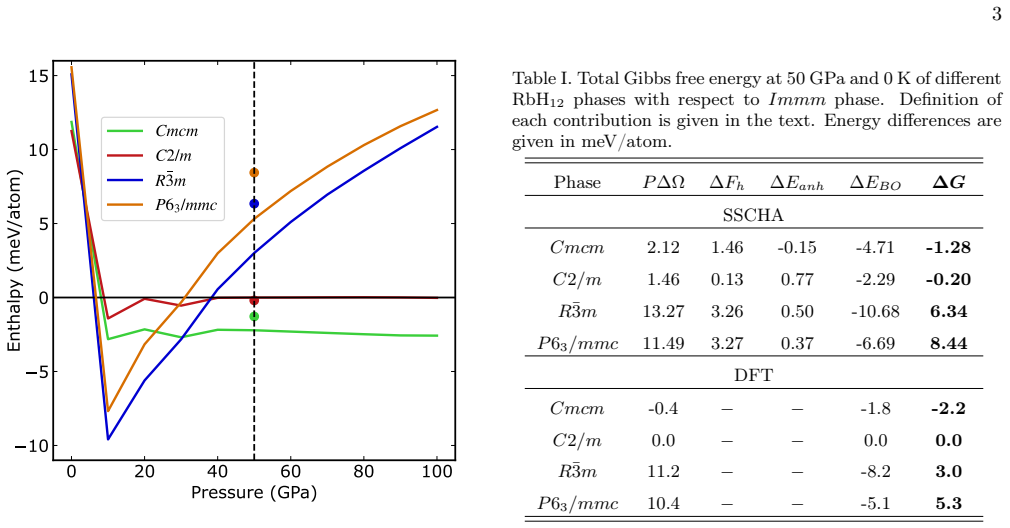
Incorporating anharmonic and quantum effects on ion dynamics, the Immm and P6₃/mmc phases of RbH12 are the most probable, potentially metastable even at pressures as low as 10 GPa. All phases exhibit metallic properties, with critical temperatures between 46 and 111 K within the pressure range they are dynamically stable.
What carries the argument
Ab initio calculations that incorporate anharmonic phonon corrections and quantum effects on ion dynamics to evaluate phase stability and electron-phonon coupling.
If this is right
- The Immm and P6₃/mmc phases are expected to dominate at low pressures once anharmonic effects are considered.
- All five phases remain metallic throughout the pressure window where they are dynamically stable.
- Superconducting critical temperatures between 46 and 111 K are predicted in the stable pressure ranges.
- These results suggest Rb-H compounds could host high-Tc superconductivity at pressures far below those required for most other polyhydrides.
Where Pith is reading between the lines
- The same computational protocol could be used to scan other alkali-metal hydrides for similarly low-pressure superconducting candidates.
- Confirmation would shift experimental focus toward synthesis routes that avoid extreme pressures.
- Accounting for finite-temperature effects or higher-order anharmonicity might further lower the predicted stability threshold.
Load-bearing premise
The chosen ab initio framework with anharmonic phonon corrections sufficiently captures the true dynamical stability and electron-phonon coupling of the RbH12 phases.
What would settle it
Experimental synthesis of RbH12 near 10 GPa followed by direct measurement of its crystal structure and superconducting transition temperature would confirm or refute the predicted low-pressure stability and Tc values.
Figures


read the original abstract
High-pressure polyhydrides are leading contenders for room temperature superconductivity. The next frontier lies in stabilizing them at ambient pressure, which would allow their practical applications. In this first-principles computational study, we investigate the potential for record-low pressure stabilization of binary superhydrides within the RbH$_{12}$ system including lattice quantum anharmonic effects in the calculations. We identify five competing phases for the pressure range between 0 and 100 GPa. Incorporating anharmonic and quantum effects on ion dynamics, we find the $Immm$ and $P6_3/mmc$ phases to be the most probable, potentially metastable even at pressures as low as 10 GPa. Notably, all phases exhibit metallic properties, with critical temperatures between 46 and 111 K within the pressure range they are dynamically stable. These findings have the potential to inspire future experimental exploration of high-temperature superconductivity at low pressures in Rb-H binary compounds.
Editorial analysis
A structured set of objections, weighed in public.
Referee Report
Summary. The manuscript reports a first-principles investigation of five RbH12 phases between 0 and 100 GPa. Incorporating anharmonic and quantum effects on the ionic dynamics (via a method such as SSCHA), the authors conclude that the Immm and P6₃/mmc structures are the most probable, remaining dynamically stable and potentially metastable down to ~10 GPa. All phases are metallic, and Eliashberg calculations yield superconducting critical temperatures in the 46–111 K range within the pressure windows of dynamical stability.
Significance. If the anharmonic free-energy ranking and the associated electron-phonon matrix elements prove robust, the work would be significant: it would identify a binary hydride candidate for high-Tc superconductivity at pressures an order of magnitude lower than most known polyhydrides, thereby motivating targeted experiments. The explicit inclusion of quantum anharmonic corrections is a methodological strength relative to purely harmonic DFT studies.
major comments (3)
- [Methods] Methods section (anharmonic phonon subsection): the central claim that Immm and P6₃/mmc remain dynamically stable at 10 GPa rests on anharmonic free-energy calculations, yet no convergence data are provided for supercell size, number of stochastic configurations, or q-grid density. Because small changes in these parameters can alter the sign of the lowest phonon frequency or the free-energy ordering, the 10 GPa metastability result is not yet load-bearing.
- [Results] Results section (Tc calculations): the reported Tc range (46–111 K) is obtained from the Eliashberg equations, but the manuscript does not report the sensitivity of these values to the Coulomb pseudopotential μ* or to the underlying DFT exchange-correlation functional. Given that μ* is typically varied between 0.1 and 0.2 and that different functionals shift the density of states by several percent, the quoted Tc interval may not be robust.
- [Results] Figure 2 or equivalent stability plot: the free-energy curves versus pressure that place Immm and P6₃/mmc lowest at low pressure lack error bars arising from the finite sampling of the anharmonic potential or from thermal fluctuations. Without these uncertainties it is impossible to judge whether the claimed crossing near 10 GPa is statistically significant.
minor comments (2)
- [Abstract] The abstract states that all phases are metallic but does not quantify the density of states at the Fermi level or the character of the states (H-s vs. Rb-d), which would help readers assess the expected electron-phonon coupling strength.
- [Table 1] Table 1 (phase summary) lists space groups and pressure ranges but omits the corresponding lattice parameters or volume per formula unit at the reported pressures, making direct comparison with future experiments more difficult.
Simulated Author's Rebuttal
We thank the referee for their positive assessment of our work and for the detailed, constructive comments. We have revised the manuscript to address the concerns on convergence, sensitivity of Tc, and uncertainties in the free-energy results. Point-by-point responses follow.
read point-by-point responses
-
Referee: [Methods] Methods section (anharmonic phonon subsection): the central claim that Immm and P6₃/mmc remain dynamically stable at 10 GPa rests on anharmonic free-energy calculations, yet no convergence data are provided for supercell size, number of stochastic configurations, or q-grid density. Because small changes in these parameters can alter the sign of the lowest phonon frequency or the free-energy ordering, the 10 GPa metastability result is not yet load-bearing.
Authors: We agree that explicit convergence tests strengthen the central claim. In the revised manuscript we have added a dedicated paragraph in the Methods section together with a new supplementary figure that reports tests for supercell sizes up to 4×4×4, 50–300 stochastic configurations, and q-grids up to 6×6×6. The lowest phonon frequencies and free-energy ordering remain unchanged within these ranges, confirming that the dynamical stability of Immm and P6₃/mmc at 10 GPa is robust. revision: yes
-
Referee: [Results] Results section (Tc calculations): the reported Tc range (46–111 K) is obtained from the Eliashberg equations, but the manuscript does not report the sensitivity of these values to the Coulomb pseudopotential μ* or to the underlying DFT exchange-correlation functional. Given that μ* is typically varied between 0.1 and 0.2 and that different functionals shift the density of states by several percent, the quoted Tc interval may not be robust.
Authors: We have performed the requested sensitivity analysis. Additional Eliashberg calculations with μ* = 0.1 and μ* = 0.2, as well as with the PBEsol functional, yield Tc values that shift by at most 15 K and remain inside the original 46–111 K window. These results are now summarized in a new table in the revised Results section, demonstrating that the reported range is robust against the usual variations in μ* and functional choice. revision: yes
-
Referee: [Results] Figure 2 or equivalent stability plot: the free-energy curves versus pressure that place Immm and P6₃/mmc lowest at low pressure lack error bars arising from the finite sampling of the anharmonic potential or from thermal fluctuations. Without these uncertainties it is impossible to judge whether the claimed crossing near 10 GPa is statistically significant.
Authors: We acknowledge that quantitative error bars improve statistical assessment. While a full bootstrap error analysis of the SSCHA free energies is computationally prohibitive, we have estimated the sampling uncertainty from the variance across the stochastic configurations and added shaded bands to the revised Figure 2. The text and figure caption now discuss these uncertainties; the free-energy crossing near 10 GPa lies outside the estimated error, supporting the metastability conclusion. revision: partial
Circularity Check
No circularity: standard ab initio derivation of phase stability and Tc
full rationale
The paper reports first-principles DFT-based calculations of electronic structure, phonon dispersions, anharmonic free energies (via quantum/anharmonic ion dynamics), dynamical stability, and Eliashberg Tc values for RbH12 phases. These quantities are computed from the underlying Hamiltonian and numerical approximations (functionals, supercells, grids) without any parameter fitting to the target stability ordering or Tc numbers, without self-citation chains that define the central results, and without renaming or re-deriving inputs as outputs. The reported predictions (Immm and P6₃/mmc metastable to ~10 GPa, Tc 46-111 K) are therefore independent of the dataset they describe and remain falsifiable against external experiment or higher-level methods.
Axiom & Free-Parameter Ledger
axioms (2)
- domain assumption Density functional theory and related approximations provide a sufficiently accurate description of the electronic structure and phonon properties of RbH12 phases.
- domain assumption Inclusion of lattice quantum anharmonic effects via the chosen computational scheme correctly modifies the dynamical stability compared with harmonic approximations.
Reference graph
Works this paper leans on
- [1]
-
[2]
J. Nagamatsu, N. Nakagawa, T. Muranaka, Y. Zenitani, and J. Akimitsu, Superconductivity at 39k in magnesium diboride, Nature 410, 63 (2001)
work page 2001
-
[3]
C. J. Pickard, I. Errea, and M. I. Eremets, Supercon- ducting hydrides under pressure, Annual Review of Con- densed Matter Physics11, 57 (2020)
work page 2020
-
[4]
M. I. Eremets, V. S. Minkov, A. P. Drozdov, P. P. Kong, V. Ksenofontov, S. I. Shylin, S. L. Bud’ko, R. Prozorov, F. F. Balakirev, D. Sun, S. Mozaffari, and L. Balicas, High-temperature superconductivity in hydrides: Exper- imental evidence and details, Journal of Superconductiv- ity and Novel Magnetism35, 965 (2022)
work page 2022
-
[5]
W. Zhao, X. Huang, Z. Zhang, S. Chen, M. Du, D. Duan, and T. Cui, Superconducting ternary hydrides: progress and challenges, National Science Review 11, nwad307 (2023), https://academic.oup.com/nsr/article- pdf/11/7/nwad307/58227815/nwad307.pdf
work page 2023
-
[6]
L. Boeri, R. Hennig, P. Hirschfeld, G. Profeta, A. Sanna, E. Zurek, W. E. Pickett, M. Amsler, R. Dias, M. I. Eremets, C. Heil, R. J. Hemley, H. Liu, Y. Ma, C. Pier- leoni, A. N. Kolmogorov, N. Rybin, D. Novoselov, V. Anisimov, A. R. Oganov, C. J. Pickard, T. Bi, R. Arita, I. Errea, C. Pellegrini, R. Requist, E. K. U. Gross, E. R. Margine, S. R. Xie, Y. Qu...
work page 2021
-
[7]
J. A. Flores-Livas, L. Boeri, A. Sanna, G. Profeta, R. Arita, and M. Eremets, A perspective on conven- tional high-temperature superconductors at high pres- sure: Methods and materials, Physics Reports 856, 1 (2020), a perspective on conventional high-temperature superconductors at high pressure: Methods and materi- als
work page 2020
-
[8]
N. W. Ashcroft, Metallic Hydrogen: A High- Temperature Superconductor?, Phys. Rev. Lett.21, 1748 (1968)
work page 1968
-
[9]
N. W. Ashcroft, Hydrogen Dominant Metallic Alloys: High Temperature Superconductors?, Phys. Rev. Lett. 92, 187002 (2004)
work page 2004
-
[10]
D. Duan, Y. Liu, F. Tian, D. Li, X. Huang, Z. Zhao, H. Yu, B. Liu, W. Tian, and T. Cui, Pressure-induced metallization of dense (H2S)2H2 with high-Tc supercon- ductivity, Scientific Reports4, 6968 (2014). 8
work page 2014
-
[11]
A. P. Drozdov, M. I. Eremets, I. A. Troyan, V. Kseno- fontov, and S. I. Shylin, Conventional superconductivity at 203 kelvin at high pressures in the sulfur hydride sys- tem, Nature 525, 73 (2015)
work page 2015
-
[12]
M. Somayazulu, M. Ahart, A. K. Mishra, Z. M. Geballe, M. Baldini, Y. Meng, V. V. Struzhkin, and R. J. Hemley, Evidence for superconductivity above 260 k in lanthanum superhydrideatmegabarpressures,Phys.Rev.Lett. 122, 027001 (2019)
work page 2019
-
[13]
A. P. Drozdov, P. P. Kong, V. S. Minkov, S. P. Besedin, M. A. Kuzovnikov, S. Mozaffari, L. Balicas, F. F. Bal- akirev, D. E. Graf, V. B. Prakapenka, E. Greenberg, D. A. Knyazev, M. Tkacz, and M. I. Eremets, Super- conductivity at 250 K in lanthanum hydride under high pressures, Nature 569, 528 (2019)
work page 2019
-
[14]
P. Kong, V. S. Minkov, M. A. Kuzovnikov, A. P. Droz- dov, S. P. Besedin, S. Mozaffari, L. Balicas, F. F. Bal- akirev, V. B. Prakapenka, S. Chariton, D. A. Knyazev, E. Greenberg, and M. I. Eremets, Superconductivity up to 243k in the yttrium-hydrogen system under high pres- sure, Nature Communications12, 5075 (2021)
work page 2021
-
[15]
I. A. Troyan, D. V. Semenok, A. G. Kvashnin, A. V. Sadakov, O. A. Sobolevskiy, V. M. Pudalov, A. G. Ivanova, V. B. Prakapenka, E. Greenberg, A. G. Gavriliuk, I. S. Lyubutin, V. V. Struzhkin, A. Bergara, I. Errea, R. Bianco, M. Calandra, F. Mauri, L. Monacelli, R. Akashi, and A. R. Oganov, Anomalous high-temperature superconduc- tivity in yh6, Advanced Mat...
-
[16]
L. Ma, K. Wang, Y. Xie, X. Yang, Y. Wang, M. Zhou, H. Liu, X. Yu, Y. Zhao, H. Wang, G. Liu, and Y. Ma, High-temperature superconducting phase in clathrate calcium hydride cah6 up to 215 k at a pressure of 172 gpa, Phys. Rev. Lett.128, 167001 (2022)
work page 2022
-
[17]
Z. Li, X. He, C. Zhang, X. Wang, S. Zhang, Y. Jia, S. Feng, K. Lu, J. Zhao, J. Zhang, B. Min, Y. Long, R. Yu, L. Wang, M. Ye, Z. Zhang, V. Prakapenka, S. Chariton, P. A. Ginsberg, J. Bass, S. Yuan, H. Liu, and C. Jin, Superconductivity above 200 k discovered in superhydrides of calcium, Nature Communications 13, 2863 (2022)
work page 2022
-
[18]
W. Chen, D. V. Semenok, X. Huang, H. Shu, X. Li, D. Duan, T. Cui, and A. R. Oganov, High-temperature superconducting phases in cerium superhydride with aTc up to 115 k below a pressure of 1 megabar, Phys. Rev. Lett. 127, 117001 (2021)
work page 2021
-
[19]
Y. Song, J. Bi, Y. Nakamoto, K. Shimizu, H. Liu, B. Zou, G. Liu, H. Wang, and Y. Ma, Stoichiometric ternary superhydride labeh8 as a new template for high- temperature superconductivity at 110 k under 80 gpa, Phys. Rev. Lett.130, 266001 (2023)
work page 2023
-
[20]
T. F. T. Cerqueira, Y.-W. Fang, I. Errea, A. Sanna, and M. A. L. Marques, Searching materials space for hydride superconductors at ambient pres- sure, Advanced Functional Materials n/a, 2404043, https://onlinelibrary.wiley.com/doi/pdf/10.1002/adfm.202404043
-
[21]
K.Gao, T.F.T.Cerqueira, A.Sanna, Y.-W.Fang, Ðorđe Dangić, I. Errea, H.-C. Wang, S. Botti, and M. A. L. Marques, The maximumtc of conventional superconduc- tors at ambient pressure (2025), arXiv:2502.18281 [cond- mat.supr-con]
- [22]
- [23]
-
[24]
Ð. Dangić, Y.-W. Fang, T. F. T. Cerqueira, A. Sanna, M. A. L. Marques, and I. Errea, Ambient pressure high temperature superconductivity in rbph3 facilitated by ionic anharmonicity (2024), arXiv:2411.03822 [cond- mat.supr-con]
-
[25]
L. Monacelli, R. Bianco, M. Cherubini, M. Calandra, I. Errea, and F. Mauri, The stochastic self-consistent har- monic approximation: calculating vibrational properties of materials with full quantum and anharmonic effects, JournalofPhysics: CondensedMatter 33,363001(2021)
work page 2021
- [27]
-
[28]
R. Bianco, I. Errea, L. Paulatto, M. Calandra, and F. Mauri, Second-order structural phase transitions, free energy curvature, and temperature-dependent anhar- monic phonons in the self-consistent harmonic approx- imation: Theory and stochastic implementation, Phys. Rev. B 96, 014111 (2017)
work page 2017
-
[29]
L. Monacelli, I. Errea, M. Calandra, and F. Mauri, Pres- sure and stress tensor of complex anharmonic crystals within the stochastic self-consistent harmonic approxi- mation, Phys. Rev. B98, 024106 (2018)
work page 2018
- [30]
- [31]
-
[32]
Y.-W. Fang, Ð. Dangić, and I. Errea, Assessing the feasi- bilityofnear-ambientconditionssuperconductivityinthe lu-n-h system, Communications Materials5, 61 (2024)
work page 2024
- [33]
- [34]
- [35]
-
[36]
R. Lucrezi, E. Kogler, S. Di Cataldo, M. Aichhorn, L. Boeri, and C. Heil, Quantum lattice dynamics and 9 their importance in ternary superhydride clathrates, Communications Physics 6, 298 (2023)
work page 2023
-
[37]
R. Lucrezi, P. P. Ferreira, M. Aichhorn, and C. Heil, Temperature and quantum anharmonic lattice effects on stability and superconductivity in lutetium trihydride, Nature Communications 15, 441 (2024)
work page 2024
-
[38]
F. Belli and E. Zurek, Efficient modelling of anharmonic- ity and quantum effects in pdcuh2 with machine learning potentials (2025), arXiv:2406.13178 [cond-mat.supr-con]
-
[39]
X.-L. He, W. Zhao, Y. Xie, A. Hermann, R. J. Hemley, H. Liu, and Y. Ma, Predicted hot supercon- ductivity in lasc<sub>2</sub>h<sub>24</sub> under pressure, Proceedings of the National Academy of Sciences 121, e2401840121 (2024), https://www.pnas.org/doi/pdf/10.1073/pnas.2401840121
- [40]
-
[41]
Y. Sun, S. Sun, X. Zhong, and H. Liu, Prediction for high superconducting ternary hydrides below megabar pres- sure, Journal of Physics: Condensed Matter34, 505404 (2022)
work page 2022
-
[42]
S. Di Cataldo, C. Heil, W. von der Linden, and L. Boeri, Labh8: Towards high-Tc low-pressure superconductivity in ternary superhydrides, Phys. Rev. B 104, L020511 (2021)
work page 2021
-
[43]
S. Li, H. Wang, W. Sun, C. Lu, and F. Peng, Supercon- ductivity in compressed ternary alkaline boron hydrides, Phys. Rev. B105, 224107 (2022)
work page 2022
-
[44]
R. Lucrezi, S. Di Cataldo, W. von der Linden, L. Boeri, and C. Heil, In-silico synthesis of lowest-pressure high-tc ternary superhydrides, npj Computational Materials 8, 119 (2022)
work page 2022
-
[45]
M. A. Kuzovnikov, B. Wang, X. Wang, T. Marqueño, H. A. Shuttleworth, C. Strain, E. Gregoryanz, E. Zurek, M. Peña Alvarez, and R. T. Howie, High pressure syn- thesis of rubidium superhydrides, Phys. Rev. Lett.134, 196102 (2025)
work page 2025
-
[46]
M. J. Hutcheon, A. M. Shipley, and R. J. Needs, Predict- ing novel superconducting hydrides using machine learn- ing approaches, Phys. Rev. B101, 144505 (2020)
work page 2020
-
[47]
J. Hooper and E. Zurek, Rubidium polyhy- drides under pressure: Emergence of the lin- ear h3- species, Chemistry – A European Journal 18, 5013 (2012), https://chemistry- europe.onlinelibrary.wiley.com/doi/pdf/10.1002/chem.201103205
-
[48]
J. P. Perdew, K. Burke, and M. Ernzerhof, Generalized gradient approximation made simple, Phys. Rev. Lett. 77, 3865 (1996)
work page 1996
-
[49]
P. Giannozzi, O. Baseggio, P. Bonfà, D. Brunato, R. Car, I. Carnimeo, C. Cavazzoni, S. de Gironcoli, P. Delugas, F. Ferrari Ruffino, A. Ferretti, N. Marzari, I. Timrov, A. Urru, and S. Baroni, Quantum ESPRESSO toward the exascale, The Journal of Chemical Physics 152, 154105 (2020), https://pubs.aip.org/aip/jcp/article- pdf/doi/10.1063/5.0005082/16721881/1...
work page doi:10.1063/5.0005082/16721881/154105_1_online.pdf 2020
-
[50]
P. Giannozzi, O. Andreussi, T. Brumme, O. Bunau, M. B. Nardelli, M. Calandra, R. Car, C. Cavazzoni, D. Ceresoli, M. Cococcioni, N. Colonna, I. Carnimeo, A. D. Corso, S. de Gironcoli, P. Delugas, R. A. DiStasio, A. Ferretti, A. Floris, G. Fratesi, G. Fugallo, R. Gebauer, U. Gerstmann, F. Giustino, T. Gorni, J. Jia, M. Kawa- mura, H.-Y. Ko, A. Kokalj, E. Kü...
work page 2017
-
[51]
P. Giannozzi, S. Baroni, N. Bonini, M. Calandra, R. Car, C. Cavazzoni, D. Ceresoli, G. L. Chiarotti, M. Cococ- cioni, I. Dabo, A. D. Corso, S. de Gironcoli, S. Fabris, G. Fratesi, R. Gebauer, U. Gerstmann, C. Gougoussis, A. Kokalj, M. Lazzeri, L. Martin-Samos, N. Marzari, F. Mauri, R. Mazzarello, S. Paolini, A. Pasquarello, L. Paulatto, C. Sbraccia, S. Sc...
work page 2009
-
[52]
N. Marzari, D. Vanderbilt, A. De Vita, and M. C. Payne, Thermal contraction and disordering of the al(110) sur- face, Phys. Rev. Lett.82, 3296 (1999)
work page 1999
-
[53]
T. Yamashita, S. Kanehira, N. Sato, H. Kino, K. Ter- ayama, H. Sawahata, T. Sato, F. Utsuno, K. Tsuda, T. Miyake, and T. Oguchi, Cryspy: a crystal structure prediction tool accelerated by machine learning, Science and Technology of Advanced Materials: Methods1, 87 (2021), https://doi.org/10.1080/27660400.2021.1943171
-
[54]
K. Momma and F. Izumi,VESTA3for three-dimensional visualization of crystal, volumetric and morphology data, Journal of Applied Crystallography44, 1272 (2011)
work page 2011
- [55]
-
[56]
L. Monacelli, I. Errea, M. Calandra, and F. Mauri, Black metal hydrogen above 360 GPa driven by proton quan- tum fluctuations, Nature Physics17, 63 (2021)
work page 2021
- [57]
-
[58]
P. B. Allen and B. Mitrović, Theory of superconducting tc (Academic Press, 1983) pp. 1–92
work page 1983
-
[59]
E. R. Margine and F. Giustino, Anisotropic migdal- eliashberg theory using wannier functions, Phys. Rev. B 87, 024505 (2013)
work page 2013
-
[60]
F. Belli, E. Zurek, and I. Errea, A chemical bonding based descriptor for predicting the impact of quantum nuclear and anharmonic effects on hydrogen-based su- perconductors (2025), arXiv:2501.14420 [cond-mat.supr- con]. 10 50 GPa Immm C2/m Cmcm R¯3m P 63/mmc λ 1.36 1.33 0.78 0.89 0.84 ωlog (K) 879 848 1103 1134 1078 ω2 (K) 1600 1587 1930 2065 2141 R dωα2...
discussion (0)
Sign in with ORCID, Apple, or X to comment. Anyone can read and Pith papers without signing in.