REVIEW 5 major objections 6 minor 42 references
Revealing the Ancient Beauty: Digital Reconstruction of Temple Tiles using Computer Vision
T0 review · 5 major / 6 minor · reviewed 2026-08-06 · deepseek-v4-flash
Pith's one-line read Four merged computer-vision stages—detection, GAN generation, super-resolution, and optimal placement—automate replacement of damaged Bankura temple tiles.
desk verdict A student thesis that documents a real heritage dataset and a sensible augmentation idea, but the core SSTF claim is untested and the math has mislabeled pieces; not ready for peer review. read the letter →
The pith
A machine-rendered reading of the paper's core claim, the machinery that carries it, and where it could break.
The reading
What carries the argument
The object that carries the argument is MosaicSlice, the augmentation scheme that turns a few hundred photographs into the roughly 177,000-sample training distribution ProTilesGAN learns from; the generation and super-resolution results stand or fall with whether those synthetic recombinations faithfully represent real tile geometry, color, and context. Around it the named components are: Fractal Convolution, a convolution whose kernel response is the box-counting fractal dimension of the patch, scaled to the range 0–254 to form a richness mask; ProTilesGAN, a progressive GAN with generator loss $\lambda L_{\text{Wasserstein}} + (1-\lambda)L_{\text{JS}}$, layer-specific learning rates, and spline-based feature mixing; Stage-Pro-SR, which upsamples in two stages with nearest-neighbor interpolation and convex feature blending $F_{\text{blended}} = \alpha F_{\text{prev}} + (1-\alpha)F_{\text{conv}}$; YOLOv8, the detector that separates damaged from intact tile regions; and the placement formulation $T'_D = \arg\min_{T_D} f(T_C^{SR}, T_D)$, which formalizes the compatibility of a generated tile with a damaged region.
What would settle it
Give expert restorers a blind forced-choice test: present SSTF-placed tiles alongside intact tiles cropped from the same wall of the Modonmohan temple and ask which one is synthetic; if experts pick the synthetic tile at or near chance across many trials, the authenticity claim fails. A complementary quantitative check is to compute a distribution distance, such as the Fréchet Inception Distance, between ProTilesGAN's output and a held-out set of genuine tiles never used in augmentation or training; a large gap would show that the reported FID values, taken against the augmented distribution, do not certify fidelity to real tile style.
Extended reading notes
Core claim
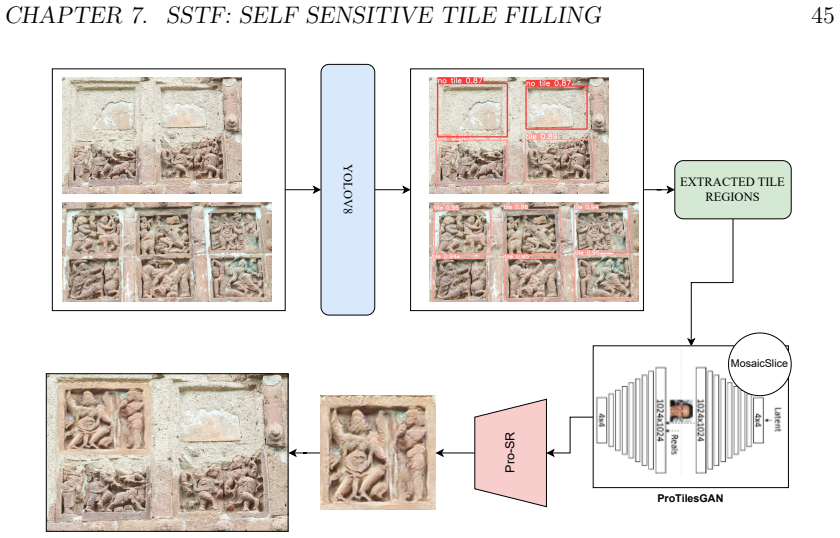
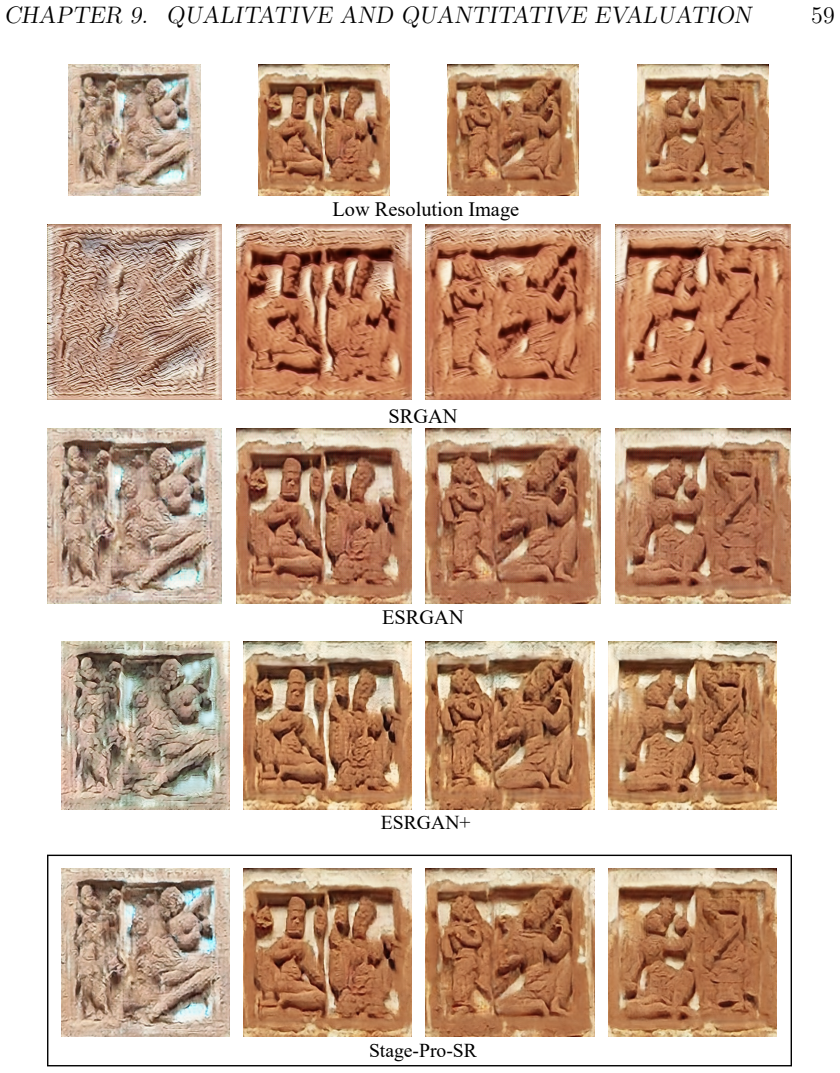
The central claim is that temple tile restoration reduces to a four-stage computational workflow, and the paper contributes each stage. Fractal Convolution uses the box-counting fractal dimension of an image patch as the value of a convolution kernel, producing a "richness" map that makes ornate regions stand out; on the paper's spire dataset, training a standard CNN on the resulting segmentation lifts F1 from about 84 to about 92. MosaicSlice manufactures training data by cutting each tile into its two figures and recombining them: within a tile, horizontal flips with blur-based boundary blending give eight variants per tile; across tiles, sepia color normalization, center-distance alignment, and median-boundary refinement merge figures from different tiles, expanding 1,400 selective photographs into roughly 177,000 augmented samples. ProTilesGAN, a progressively growing GAN whose generator loss convexly combines the Wasserstein and Jensen-Shannon terms and whose feature mixing uses spline interpolation, is reported to reach an FID of 7.64 and SSIM of 0.77 at 256×256 on the augmented data. Stage-Pro-SR splits SRGAN-style upsampling into two stages, replaces pixel-shuffle with nearest-neighbor upsampling to suppress checkerboard artifacts, and blends early and late features convexly to upscale generated tiles from 256 to 1,024 pixels. The end-to-end claim is that SSTF "provides a comprehensive solution for producing high-quality copies of missing or damaged tiles"; the paper demonstrates the full flow qualitatively in Chapter 9, while the placement step is stated only as the formal minimization $T'_D = \arg\min_{T_D} f(T_C^{SR}, T_D)$ without a reported solver or placement-error metric.
Load-bearing premise
The authenticity claim rests on the assumption that the MosaicSlice-augmented dataset — synthetic recombinations of figure halves from 352 aerial and 1,400 selected photographs — spans the real variety of Bankura terracotta tile patterns closely enough that ProTilesGAN's replacements are stylistically and contextually indistinguishable from genuine tiles, and the paper does not test this assumption with any human evaluation, distribution-distance measurement against held-out real tiles, or perceptual metric on the final placed tiles.
Editorial extensions
If this is right
- A conservator could photograph a damaged temple wall and automatically receive ready-to-place replacement tile images matched to the local terracotta style, removing the slow, interpretive step of manual reconstruction.
- The four-stage recipe is not specific to Bankura: any monument whose ornament can be photographed would supply the training signal for detection, generation, super-resolution, and placement.
- MosaicSlice-style recombination could lower the data bottleneck for generative restoration of patterned heritage surfaces elsewhere, since it creates large training sets from a few hundred source images.
- Stage-Pro-SR's two-stage nearest-neighbor upsampling is claimed to remove the checkerboard artifacts typical of SRGAN-style deconvolution, a fix that would transfer to any single-image super-resolution task.
- Fractal Convolution needs no learned weights, so it could be applied immediately to new monuments, and the paper reports that it improves classifier accuracy on spire imagery by roughly eight points.
Reading between the lines
- A decisive but unreported experiment would be a blind forced-choice test in which restorers compare SSTF-placed tiles against intact tiles from the same wall; the paper's FID and SSIM figures are computed on augmented data, so they cannot certify that experts would find the replacements indistinguishable.
- The placement step is the operational core the paper leaves open: instantiating equation 7.2 with an actual solver, a seam-cost function, and a quantitative seam-error measurement against manually restored walls would turn SSTF from a demonstrated pipeline into a deployable tool.
- MosaicSlice presumes each tile carries exactly two separable figures; single-figure tiles or continuous scrollwork, common in other terracotta traditions, would need a generalized recombination rule, so the method's portability beyond Bankura is currently untested.
- Fractal Convolution's sliding-window implementation is computationally heavy, as the paper acknowledges; expressing the same operation as a tensor or convolution (a direction the paper lists as future work) is what would make whole-wall segmentation practical at scale.
Editorial analysis
A structured set of objections, weighed in public.
Referee Report
Summary. This manuscript proposes an automated pipeline for digitally reconstructing damaged terracotta temple tiles in Bankura temples. The three main contributions are: (i) Fractal Convolution, an image-processing segmentation method that replaces convolution kernels with fractal-dimension values computed from Canny edge maps; (ii) MosaicSlice, a data augmentation scheme that recombines figure halves within and across tiles; and (iii) SSTF, a pipeline that combines YOLOv8-based damage detection, ProTilesGAN tile generation, stage-wise super-resolution, and an optimization-based placement step. The paper reports an approximately 8% improvement in CNN classification accuracy when using Fractal Convolution, FID/SSIM comparisons for ProTilesGAN, and qualitative demonstrations of the complete SSTF pipeline.
Significance. If the claims were properly supported, the work would be useful for cultural-heritage restoration because real terracotta tile data are scarce and manual reconstruction is labor-intensive. Strengths of the manuscript include the collection of new rephotography datasets from the actual temples, the originality of the fractal-convolution idea, and public code links for the fractal-convolution method. However, the load-bearing evidence is not sufficient: the classification gain appears to come from test-set hyperparameter selection, the GAN improvements are not isolated by ablations, the reported FID values lack a defined reference set, and the SSTF pipeline is evaluated only qualitatively. The central assumption that MosaicSlice-generated synthetic tiles match the real Bankura tile distribution is never tested.
major comments (5)
- [Section 9.1.3, Table 9.2] The claimed ~8% classification improvement of Fractal Convolution is not trustworthy as presented. The Canny thresholds (50, 150) are said to be 'picked out empirically' and the 8x8 patch size was selected 'after extensive testing,' but no train/validation/test split is described, so these choices may have been tuned on the test data. The table also reports only a single run with no variance or significance test. A proper validation protocol with a separated validation set is required before this improvement can be claimed.
- [Section 5.1.1, Eqs. (5.2)-(5.3)] The loss term labeled L_JS is not the Jensen-Shannon divergence; Eq. (5.2) is the standard minimax GAN (binary cross-entropy) objective. No derivation is given for why convexly combining this term with the Wasserstein loss in Eq. (5.3) should improve generation, and the choice of lambda is not discussed. Moreover, Table 9.3 attributes ProTilesGAN's gains to this and other changes without any ablation isolating the loss modification, so the contribution of this component is unsupported.
- [Table 9.3, Section 9.2] The FID and SSIM numbers are uninterpretable as reported because no reference image set is specified. FID measures a distance between generated and real distributions, but the paper does not state whether the reference is held-out real tiles, the training set, or a subset of MosaicSlice-augmented images. The number of generated samples used for evaluation is also absent. In addition, ProTilesGAN differs from ProGAN_s in loss, interpolation, and learning-rate scheduling simultaneously, so no conclusion can be drawn about which modification drives the reported improvements.
- [Section 7.4, Eq. (7.2); Section 9.5] The SSTF placement step is not actually specified: the objective function f(T_SR_C, T_D) in Eq. (7.2) is never defined, and the alignment and consistency constraints are described only verbally. The only end-to-end evaluation is a qualitative figure in Section 9.5. There is no quantitative measure of placement accuracy, visual authenticity, or comparison with any baseline. Consequently, the Abstract's claim that SSTF is a 'comprehensive solution' for producing high-quality copies while 'maintaining authenticity' is not supported by the evidence.
- [Sections 4 and 8.3] The central assumption of the generative pipeline is that MosaicSlice-augmented synthetic tiles cover the real distribution of Bankura tile patterns. This assumption is load-bearing because ProTilesGAN, the super-resolution model, and the final SSTF outputs are all trained on these synthetic tiles. The paper never tests it: there is no distribution-distance measurement against held-out real tiles, no human perceptual study, and no expert evaluation of the final placed tiles. Without such validation, the claim that generated tiles are stylistically and contextually indistinguishable from real ones remains unsupported.
minor comments (6)
- [Section 2.7] Sections 2.7.1 and 2.7.3 are verbatim duplicates, and Sections 2.7.2 and 2.7.4 are also verbatim duplicates; one copy of each should be removed.
- [Throughout] There are numerous typographical errors, including 'Jensen-Shanon,' 'MosiacSlice,' 'bechmark,' 'Genration,' and 'Algoritms'; the manuscript needs thorough proofreading.
- [Table 9.4] The YOLOv8 result is presented as a 'classification report,' but the table has no row or column headers, and the numeric entries do not form a valid confusion matrix (e.g., the No Tile row sums to 1.22). This table should be replaced with standard precision/recall/F1 or a correctly labeled confusion matrix.
- [Section 5.1.2] The layer-specific learning-rate coefficients alpha_i are never given numeric values; the text states only that they 'can be found by conducting extensive experimentation,' which makes the method unreproducible as described.
- [Section 4.2.1] The operations 'inversing R_p' and 'reverse functional derivative of the sepia filter' are not defined; Eqs. (4.4)-(4.6) specify the forward averaging and filtering but not the claimed inverse step.
- [Front matter] The manuscript contains dissertation front matter (certificates, declaration, acknowledgements) that is inappropriate for a journal submission and should be removed.
Circularity Check
No circular derivation: SSTF is an assembled pipeline, not a result forced by its inputs; self-citations are background, and the missing validation is a rigor issue, not circularity.
full rationale
After walking the derivation chain, I find no step where a prediction is equivalent to its input by construction. SSTF (Sec. 7) is a pipeline: YOLOv8 detection, ProTilesGAN generation, stage-wise super-resolution, and an under-specified argmin placement (Eq. 7.2). Each component is an external or modified architecture (ProGAN [41], SRGAN [14,15], YOLOv8 [22]); the paper's own equations (4.1-4.6, 5.1-5.3, 6.1-6.3) are design choices or standard losses, not fits renamed as predictions. MosaicSlice augments Datasets C/D with synthetic recombinations, but the central claim is not that the augmentation distribution equals the real distribution; it is an untested assumption. The FID/SSIM table (Table 9.3) lacks a stated reference set and there is no perceptual validation, so the authenticity claim is under-supported, but missing evidence is not circularity. Self-citations [1] and [40] are used for background and a minor remark; the fractal convolution method is fully specified in Algorithm 1 and Eqs. 3.1-3.2, so it does not reduce to those citations. The 'JS divergence loss' (Eq. 5.2) is a mislabeled standard GAN objective, but that is a mathematical accuracy issue, not a circular reduction. Overall, no load-bearing circular step; score 1 reflects only the presence of minor non-load-bearing self-citations and the general reliance on self-created evaluation.
Assumptions & free parameters
free parameters (8)
- Canny edge detector thresholds =
50, 150
- Fractal convolution patch size =
8x8
- FD scaling multiplier and offset =
127 and 1
- Convex combination weight lambda =
not reported
- Layer-specific learning-rate coefficients alpha_i =
not reported
- Stage-SR convex weight alpha =
not reported
- Super-resolution factor alpha =
not reported
- Augmentation brightness range =
1-3%
assumptions (5)
- domain assumption The fractal dimension of Canny edge patches is a valid measure of architectural richness.
- domain assumption MosaicSlice-mixed tiles are representative of authentic temple tile patterns.
- ad hoc to paper Combining the standard adversarial loss with a mislabeled 'JS divergence' and convexly mixing it with Wasserstein loss improves generation.
- ad hoc to paper The stage-wise SRGAN variant converges to better solutions than SRGAN/ESRGAN.
- domain assumption YOLOv8 annotations of tile/no-tile regions on 1325 images are accurate enough for the downstream pipeline.
Cite this review
Pith. "Pith review of Revealing the Ancient Beauty: Digital Reconstruction of Temple Tiles using Computer Vision." pith.science (2026). https://pith.science/paper/MHFULJZJ
@misc{pith2026250712195,
  author       = {Pith},
  title        = {Pith review of: Revealing the Ancient Beauty: Digital Reconstruction of Temple Tiles using Computer Vision},
  year         = {2026},
  howpublished = {\url{https://pith.science/paper/MHFULJZJ}},
  note         = {Machine review of arXiv:2507.12195}
}
read the original abstract
Modern digitised approaches have dramatically changed the preservation and restoration of cultural treasures, integrating computer scientists into multidisciplinary projects with ease. Machine learning, deep learning, and computer vision techniques have revolutionised developing sectors like 3D reconstruction, picture inpainting,IoT-based methods, genetic algorithms, and image processing with the integration of computer scientists into multidisciplinary initiatives. We suggest three cutting-edge techniques in recognition of the special qualities of Indian monuments, which are famous for their architectural skill and aesthetic appeal. First is the Fractal Convolution methodology, a segmentation method based on image processing that successfully reveals subtle architectural patterns within these irreplaceable cultural buildings. The second is a revolutionary Self-Sensitive Tile Filling (SSTF) method created especially for West Bengal's mesmerising Bankura Terracotta Temples with a brand-new data augmentation method called MosaicSlice on the third. Furthermore, we delve deeper into the Super Resolution strategy to upscale the images without losing significant amount of quality. Our methods allow for the development of seamless region-filling and highly detailed tiles while maintaining authenticity using a novel data augmentation strategy within affordable costs introducing automation. By providing effective solutions that preserve the delicate balance between tradition and innovation, this study improves the subject and eventually ensures unrivalled efficiency and aesthetic excellence in cultural heritage protection. The suggested approaches advance the field into an era of unmatched efficiency and aesthetic quality while carefully upholding the delicate equilibrium between tradition and innovation.
Figures


Figures from the paper (13 more)







Reference graph
Works this paper leans on
-
[1]
Digital restoration of cultural heritage with data-driven computing: A sur- vey,
A. Basu, S. Paul, S. Ghosh, S. Das, B. Chanda, C. Bhagvati, and V. Snasel, “Digital restoration of cultural heritage with data-driven computing: A sur- vey,”IEEE Access, pp. 1–1, 2023
work page 2023
-
[2]
M. Lionar and O. M. Ediz, “The influence of traditional indian architecture in balkrishna doshi’s iim complex at bangalore: A comparative analysis using fractal dimensions and lacunarity,”ITU A—Z, pp. 235–252, 2021
work page 2021
-
[3]
Fast box-counting algorithm on gpu,
J. Jim´ enez and J. Ruiz de Miras, “Fast box-counting algorithm on gpu,”Computer Methods and Programs in Biomedicine, vol. 108, no. 3, pp. 1229–1242, 2012. [Online]. Available: https://www.sciencedirect.com/ science/article/pii/S0169260712001794
work page 2012
-
[4]
How long is the coast of britain? statistical self-similarity and fractional dimension,
B. Mandelbrot, “How long is the coast of britain? statistical self-similarity and fractional dimension,”Science, vol. 156, no. 3775, pp. 636–638,
-
[5]
M. J. Ostwald and J. Vaughan,Fractal Dimensions in Architecture: Measuring the Characteristic Complexity of Buildings. Cham: Springer International Publishing, 2018, pp. 1–17. [Online]. Available: https: //doi.org/10.1007/978-3-319-70658-0 12-1
-
[6]
J. H. Lee and M. J. Ostwald, “Fractal dimension calculation and visual attention simulation: Assessing the visual character of an architectural fa¸ cade,”Buildings, vol. 11, no. 4, 2021. [Online]. Available: https://www.mdpi.com/2075-5309/11/4/163
work page 2021
-
[7]
Fractal analysis applied to ancient egyptian monumental art,
J. Robkin, “Fractal analysis applied to ancient egyptian monumental art,” 2012. 68 BIBLIOGRAPHY69
work page 2012
-
[8]
A method of compositional fractal analy- sis and its application in islamic architectural ensembles,
M. Y. Shishin and K. J. A. Ismail, “A method of compositional fractal analy- sis and its application in islamic architectural ensembles,”International Elec- tronic Journal of Mathematics Education, vol. 11, no. 5, pp. 1087–1100, 2016
work page 2016
Show all 42 references
-
[9]
A three-dimensional box-counting method to study the fractal characteristics of urban areas in shenyang, northeast china,
S. Liu and Y. Chen, “A three-dimensional box-counting method to study the fractal characteristics of urban areas in shenyang, northeast china,”Buildings, vol. 12, no. 3, 2022. [Online]. Available: https: //www.mdpi.com/2075-5309/12/3/299
2022
-
[10]
Indonesia ancient temple clas- sification using convolutional neural network,
K. P. Danukusumo, Pranowo, and M. Maslim, “Indonesia ancient temple clas- sification using convolutional neural network,” in2017 International Confer- ence on Control, Electronics, Renewable Energy and Communications (IC- CREC), 2017, pp. 50–54
2017
-
[11]
Classification of architectural heritage images using deep learning techniques,
J. Llamas, P. M. Lerones, R. Medina, E. Zalama, and J. G´ omez-Garc ´ ıa- Bermejo, “Classification of architectural heritage images using deep learning techniques,”Applied Sciences, vol. 7, no. 10, 2017. [Online]. Available: https://www.mdpi.com/2076-3417/7/10/992
2017
-
[12]
Generative adversarial networks,
I. Goodfellow, J. Pouget-Abadie, M. Mirza, B. Xu, D. Warde-Farley, S. Ozair, A. Courville, and Y. Bengio, “Generative adversarial networks,”Communi- cations of the ACM, vol. 63, no. 11, pp. 139–144, 2020
2020
-
[13]
Unsupervised representation learn- ing with deep convolutional generative adversarial networks,
A. Radford, L. Metz, and S. Chintala, “Unsupervised representation learn- ing with deep convolutional generative adversarial networks,”arXiv preprint arXiv:1511.06434, 2015
2015 arXiv
-
[15]
Esrgan: Enhanced super-resolution generative adversarial networks,
X. Wang, K. Yu, S. Wu, J. Gu, Y. Liu, C. Dong, Y. Qiao, and C. Change Loy, “Esrgan: Enhanced super-resolution generative adversarial networks,” inPro- ceedings of the ECCV(W), 2018, pp. 0–0
2018
-
[16]
You only look once: Unified, real-time object detection,
J. Redmon and A. Farhadi, “You only look once: Unified, real-time object detection,” in2015 IEEE Conference on Computer Vision and Pattern Recog- nition (CVPR). IEEE, 2015, pp. 779–788. BIBLIOGRAPHY70
2015
-
[17]
Yolov3: An incremental improvement,
——, “Yolov3: An incremental improvement,”arXiv preprint arXiv:1804.02767, 2018
2018 arXiv
-
[18]
Yolov4: Optimal speed and accuracy of object detection,
A. Bochkovskiy, C.-Y. Wang, and H.-Y. Liao, “Yolov4: Optimal speed and accuracy of object detection,” inProceedings of the IEEE/CVF Conference on Computer Vision and Pattern Recognition (CVPR), 2020
2020
-
[19]
Ssd lite: A lightweight single shot multibox detector,
W. Liu, D. Anguelov, D. Erhan, C. Szegedy, S. Reed, C.-Y. Fu, and A. C. Berg, “Ssd lite: A lightweight single shot multibox detector,” inThe IEEE Conference on Computer Vision and Pattern Recognition (CVPR). IEEE, 2018, pp. 918–926
2018
-
[20]
Ssd: Single shot multibox detector,
——, “Ssd: Single shot multibox detector,” inEuropean Conference on Com- puter Vision (ECCV). Springer, 2016, pp. 21–37
2016
-
[21]
Speed/accuracy trade-offs for object detection,
J. Huang, X. Sun, W. Liu, and K. Q. Weinberger, “Speed/accuracy trade-offs for object detection,”arXiv preprint arXiv:1706.03762, 2017
2017 arXiv
-
[22]
You only look once: Unified, real-time object detection,
J. Redmon and A. Farhadi, “You only look once: Unified, real-time object detection,” inProceedings of the IEEE Conference on Computer Vision and Pattern Recognition (CVPR), 2015
2015
-
[23]
Yolo9000: Better, faster, stronger,
——, “Yolo9000: Better, faster, stronger,” inProceedings of the IEEE Con- ference on Computer Vision and Pattern Recognition (CVPR), 2016
2016
-
[24]
Yolov3: An incremental improvement,
——, “Yolov3: An incremental improvement,” inProceedings of the IEEE Conference on Computer Vision and Pattern Recognition (CVPR), 2018
2018
-
[25]
Ultra Fast Object Detection in YOLOv5,
G. Jocher, “Ultra Fast Object Detection in YOLOv5,” Feb. 2021. [Online]. Available: https://doi.org/10.5281/zenodo.4551085
2021 doi
-
[26]
YOLOv8: The Evolution of Object Detection,
——, “YOLOv8: The Evolution of Object Detection,” Jan. 2022. [Online]. Available: https://doi.org/10.5281/zenodo.5568457
2022 doi
-
[27]
Ssd 512: Single shot multibox detector 512,
W. Liu, D. Anguelov, D. Erhan, C. Szegedy, S. Reed, C.-Y. Fu, and A. C. Berg, “Ssd 512: Single shot multibox detector 512,”arXiv preprint arXiv:1611.00593, 2017
2017 arXiv
-
[28]
Mobilenets: Efficient convolutional neural networks for mobile vision appli- cations,
A. G. Howard, M. Zhu, B. Chen, D. Kalenichenko, G. Andrew, and H. Adam, “Mobilenets: Efficient convolutional neural networks for mobile vision appli- cations,”arXiv preprint arXiv:1704.04861, 2017. BIBLIOGRAPHY71
2017 arXiv
-
[29]
Ssd refinement: Fast and accurate object detection with recurrent refinement,
C.-Y. Fu, W. Liu, and Y. Lin, “Ssd refinement: Fast and accurate object detection with recurrent refinement,”arXiv preprint arXiv:1802.07873, 2018
2018 arXiv
-
[30]
Image super-resolution using deep convolutional networks,
C. Dong, C. C. Loy, K. He, and X. Tang, “Image super-resolution using deep convolutional networks,”IEEE TPAMI, vol. 38, no. 2, pp. 295–307, 2015
2015
-
[31]
Deep back-projectinetworks for single image super-resolution,
M. Haris, G. Shakhnarovich, and N. Ukita, “Deep back-projectinetworks for single image super-resolution,”IEEE Transactions on Pattern Analysis and Machine Intelligence, vol. 43, no. 12, pp. 4323–4337, 2021
2021
-
[32]
Single image super-resolution from transformed self-exemplars,
J.-B. Huang, A. Singh, and N. Ahuja, “Single image super-resolution from transformed self-exemplars,” in2015 IEEE CVPR, 2015, pp. 5197–5206
2015
-
[33]
Esrgan+: Further improving en- hanced super-resolution generative adversarial network,
N. C. Rakotonirina and A. Rasoanaivo, “Esrgan+: Further improving en- hanced super-resolution generative adversarial network,” inICASSP 2020- 2020 IEEE ICASSP. IEEE, 2020, pp. 3637–3641
2020
-
[34]
Second-order attention network for magnification-arbitrary single image super-resolution,
R. Liu, Z. Su, G. Lin, and F. Zhou, “Second-order attention network for magnification-arbitrary single image super-resolution,” in2020 8th Interna- tional Conference on Digital Home (ICDH), 2020, pp. 127–134
2020
-
[35]
Swinir: Image restoration using swin transformer,
J. Liang, J. Cao, G. Sun, K. Zhang, L. Van Gool, and R. Timofte, “Swinir: Image restoration using swin transformer,” in2021 IEEE/CVF ICCVW, 2021, pp. 1833–1844
2021
-
[36]
Swinfir: Revisiting the swinir with fast fourier convolution and improved training for image super- resolution,
D. Zhang, F. Huang, S. Liu, X. Wang, and Z. Jin, “Swinfir: Revisiting the swinir with fast fourier convolution and improved training for image super- resolution,”arXiv preprint arXiv:2208.11247, 2022
2022 arXiv
-
[37]
A computational approach to edge detection,
J. Canny, “A computational approach to edge detection,”IEEE Transactions on Pattern Analysis and Machine Intelligence, vol. PAMI-8, no. 6, pp. 679– 698, 1986
1986
-
[38]
Design of an image edge de- tection filter using the sobel operator,
N. Kanopoulos, N. Vasanthavada, and R. Baker, “Design of an image edge de- tection filter using the sobel operator,”IEEE Journal of Solid-State Circuits, vol. 23, no. 2, pp. 358–367, 1988
1988
-
[39]
A three dimensional box counting method for measuring fractal dimensions of 3d models,
M. Suzuki, “A three dimensional box counting method for measuring fractal dimensions of 3d models,”Proceedings of the 11th IASTED International Conference on Internet and Multimedia Systems and Applications, IMSA 2007, 01 2007. BIBLIOGRAPHY72
2007
-
[40]
On regenerative and discriminative learning from digital heritages: A fractal dimension based ap- proach,
S. Ghosh, A. Basu, S. Paul, B. Chanda, and S. Das, “On regenerative and discriminative learning from digital heritages: A fractal dimension based ap- proach,” inInternational Conference on Advances in Data-driven Computing and Intelligent Systems. Springer, 2022, pp. 405–417
2022
-
[41]
Progressive growing of gans for improved quality, stability, and variation,
T. Karras, T. Aila, S. Laine, and J. Lehtinen, “Progressive growing of gans for improved quality, stability, and variation,”arXiv preprint arXiv:1710.10196, 2017
2017 arXiv
-
[42]
Photo-realistic single image super-resolution using a generative adversarial network,
C. Ledig, L. Theis, F. Husz´ ar, J. Caballero, A. Cunningham, A. Acosta, A. Aitken, A. Tejani, J. Totz, Z. Wanget al., “Photo-realistic single image super-resolution using a generative adversarial network,” inProceedings of the IEEE conference on computer vision and pattern re...
2017
-
[1967]
Available: http://www.sciencemag.org/content/156/3775/ 636.abstract
[Online]. Available: http://www.sciencemag.org/content/156/3775/ 636.abstract
Reviewed August 6, 2026 · model on record in the stance chip above.
Discussion (0). Sign in to comment.