REVIEW 3 major objections 4 minor 57 references
Bias with a Timer: Axion Domain Wall Decay and Dark Matter
T0 review · 3 major / 4 minor · reviewed 2026-08-06 · deepseek-v4-flash
Pith's one-line read Axion domain walls can be destroyed by structural instability, and this may put dark matter at a higher, fine-tuning-free decay constant.
desk verdict Plausible and carefully worked, but the headline larger-fa DM window rests on an unsimulated collapse parameter κ; the paper itself concedes the decisive simulation is future work. read the letter →
The pith
A machine-rendered reading of the paper's core claim, the machinery that carries it, and where it could break.
The reading
What carries the argument
The load-bearing object is the spectator scalar $S$ with its inflationary VEV and radiation-era scaling solution $\langle S\rangle\propto H^{1/(n-1)}$. This VEV feeds an effective PQ-violating potential $m_{PQ}^2 v_{PQ}^2 \cos(\ell a/v_{PQ}+m b/\chi+\delta)$ with $\ell$ degenerate minima. When the QCD potential with domain-wall number $N_{DW}=2$ turns on, the $(3,2)$ network cannot hold its symmetric three-wall junction; one vacuum disappears and the isolated wall segment shrinks under tension, a structural instability rather than volume pressure from a bias term. The quantitative engine is Eq. (57), built from Eq. (44) for wall-decay abundance, which scales as $\kappa^{-1} f_a^{1+\ell\alpha}$, and Eq. (49) for trapped misalignment, together with the backreaction bound Eq. (22).
What would settle it
Run a three-dimensional lattice simulation of an axion string-wall network with three degenerate pre-QCD vacua and two QCD vacua, through the crossover, using the potentials of Eqs. (13) and (15), and measure the annihilation temperature $T_{\rm ann}$ relative to $T_{\rm tr}$. If the network survives until walls dominate, or if $\kappa$ differs from $O(0.1)$ by an order of magnitude, then Eq. (44) would need revision and the claimed $f_a\simeq8\times10^{10}$ GeV dark-matter window would shift or disappear.
Extended reading notes
Core claim
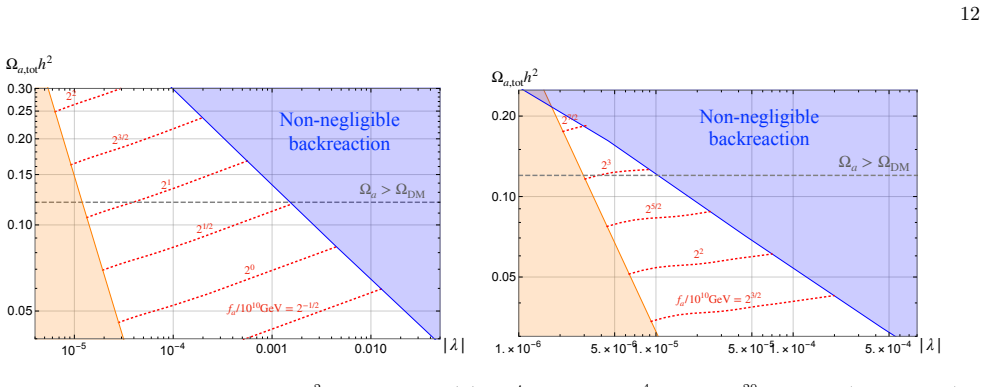
The central claim is that a light scalar field with a large, time-dependent vacuum expectation value can time the decay of axion domain walls. Its mixing term $S^m P^\ell$ creates an effective PQ-violating axion potential with $\ell$ degenerate vacua, so below $T\sim v_{PQ}$ a string-wall network forms; when the QCD potential turns on, the potential minima are deformed, and for $(\ell,N_{DW})=(3,2)$ one of the three vacua is left geometrically isolated, so the attached wall contracts and the network collapses by tension rather than by volume pressure. The collapse is parametrized as $T_{\rm ann}=\kappa T_{\rm tr}$ with $\kappa\sim O(0.1)$. The authors follow the coupled axion-spectator equations, include the backreaction bound, and combine wall decay with trapped misalignment production; for $(N_{DW},\ell,m,n)=(2,3,9,6)$, $m_S=10^{-20}\,{\rm GeV}$ and $\kappa\simeq0.5$, the total abundance reaches $\Omega_{a,\rm tot}h^2\simeq0.12$ near $f_a\simeq8\times10^{10}\,{\rm GeV}$. This is presented as realizing the correct dark-matter abundance with a larger decay constant than the conventional post-inflationary QCD axion, without fine-tuning the relative phase.
Load-bearing premise
The paper assumes, without simulation or independent derivation, that the (3,2) wall network collapses at $T_{\rm ann}=\kappa T_{\rm tr}$ soon after the QCD potential deforms the minima, with $\kappa\sim O(0.1)$; because the predicted abundance scales as $\kappa^{-1}$, the quoted $f_a$ window collapses if $\kappa$ is much smaller or if the isolated wall is metastable.
Editorial extensions
If this is right
- For $(\ell,N_{DW})=(3,2)$, the domain-wall problem is solved without a bias potential tuned to align minima; the only timing parameter is $\kappa$ in $T_{\rm ann}=\kappa T_{\rm tr}$.
- The viable decay constant is pushed up to $f_a \sim 8\times10^{10}\,{\rm GeV}$, with misalignment contributing roughly $O(10)\%$ of the total abundance.
- The isocurvature bound is evaded because the spectator's large inflationary VEV suppresses axion phase fluctuations, allowing $H_{\rm inf}\lesssim10^{15}\,{\rm GeV}$ for $\lambda_S\sim1$.
- If the collapse happens earlier ($\kappa\ll0.1$), the wall-decay abundance rises as $\kappa^{-1}$, so the upper bound on $f_a$ becomes more restrictive.
Reading between the lines
- A three-dimensional lattice simulation measuring $\kappa$ for the $(3,2)$ network would be the decisive check; the paper itself leaves this to future work, and the abundance formula scales as $\kappa^{-1}$.
- The same timer idea might apply to other axion-like particles with multiple vacua: any spectator whose VEV switches off after a second potential turns on could produce a geometric collapse, though the paper's stability analysis suggests most coprime pairs remain stable or long-lived.
- If the backreaction region is explored, the spectator phase $b$ can move and alter trapped misalignment; the paper notes this could change the final abundance and could lead to dark radiation or time-dependent neutron EDM signatures.
Editorial analysis
A structured set of objections, weighed in public.
Referee Report
Summary. The paper studies a post-inflationary QCD axion coupled to a light complex spectator scalar S. A large field value of S during and after inflation induces an effective PQ-violating term S^m P^ell, which generates an ell-fold degenerate axion potential and hence string-wall networks; the later QCD potential, with domain-wall number N_DW, can bias or destabilize these networks. The authors follow the spectator/axion equations of motion, introduce a backreaction criterion, and classify the parameter space in (m_S, |lambda|). For (ell,N_DW)=(3,2) they argue that the network can decay by 'structural instability' at T_ann = kappa T_tr rather than by volume pressure, and they estimate the axion dark matter abundance from domain-wall decay and trapped misalignment. Their benchmark (N_DW,ell,m,n)=(2,3,9,6), m_S=10^-20 GeV, kappa=0.5 gives Omega_a h^2 roughly 0.12 near f_a ~ 8x10^10 GeV, which is larger than the conventional post-inflationary QCD axion window. A supersymmetric UV completion aiming at 't Hooft natural couplings is sketched.
Significance. If the collapse mechanism is confirmed, the paper offers an interesting way to obtain axion dark matter with a larger decay constant while avoiding domain-wall overproduction. The equations-of-motion analysis and the backreaction criterion are clean, and the trapped-misalignment estimates are careful and follow established formalism; the suppression of isocurvature perturbations through the large spectator VEV is also well motivated. The structural-instability proposal for (ell,N_DW)=(3,2) is creative and could be a useful direction for numerical studies. The main quantitative claim, however, is conditional on an unsimulated timing parameter kappa and on a spectator mass that the paper itself concedes requires significant fine tuning, so the headline 'without fine tuning' and the quoted f_a window are not yet supported at the same level as the EOM analysis.
major comments (3)
- [Sec. IV B, Eq. (44)] The central abundance for the (ell,N_DW)=(3,2) network rests on the assumption that annihilation occurs at T_ann = kappa T_tr with kappa = O(0.1), introduced after the paper explicitly states that 'how much time it takes to collapse... requires a detailed simulation, which is left for a future study.' Since Eq. (44) is proportional to kappa^{-1}, the quoted f_a ~ 8x10^10 GeV window shifts by an order of magnitude for kappa = 0.01 or kappa = 1, and the model would respectively over- or under-produce axion dark matter. The structural-instability picture in Fig. 5 is plausible, but it does not supply the wall-area evolution or annihilation time needed to justify applying the scaling-law estimate in Eqs. (38)-(43) to this case. A lattice simulation, or at least a quantitative model of the collapse time with an explicit uncertainty, is required before Eq. (57) can be presented as the paper's main quantitative result.
- [Abstract / Sec. VI] The abstract's claim that the correct abundance is realized 'without fine tuning' is not supported by the paper's own model-building discussion. Section VI states that m_S = 10^-20 GeV 'requires significant fine tuning' and offers only a sequestering suggestion, with a further caveat about the cosmological effects of light saxions and axinos. Since the benchmark abundance depends on m_S in exactly this range, the claim should either be removed or replaced by a statement that the tuning is postponed to a UV model, and the residual tuning should be quantified.
- [Sec. IV B, Fig. 5] The claim that the system 'can decay due to its structural instability, rather than the volume pressure' is not established quantitatively. For (ell,N_DW)=(3,2), one of the three vacua is asserted to be isolated after V_QCD dominates, but the argument is a schematic two-dimensional picture; the paper itself notes that the fate for other combinations is unclear and requires simulations. In the (3,2) case, the time scale H^{-1} and kappa ~ O(0.1) are inferred from the hexagon picture rather than from a calculation. This would be acceptable as a phenomenological scenario only if kappa is treated explicitly as an unknown parameter in the abundance analysis rather than as an input fixed to O(0.1).
minor comments (4)
- [Fig. 2 caption] The caption appears to contain duplicated labels ('109GeV' and 'fa=108GeV' are repeated); please redraw the figure or rewrite the caption so that each curve is unambiguous.
- [Eq. (56)] The factor (10^{-2})/(Omega_mis/Omega_DM) should be parenthesized or rewritten; as printed, the nested fraction is ambiguous.
- [Eq. (33)] The definition of p_T would be easier to use if V = V_PQ + V_QCD were stated directly at the equation rather than in the surrounding text.
- [Sec. IV B] The sentence 'the abundance can be enhanced, so that the upper bound on fa would be severer' is awkward; rephrasing as 'for lower T_ann the axion abundance is enhanced, so the upper bound on fa becomes stronger' would improve clarity.
Circularity Check
No circularity: the key timing parameter κ is an assumed input, not a fitted value renamed as a prediction, and the structural-instability mechanism for (ℓ,N_DW)=(3,2) is argued independently of the self-cited spectator model.
full rationale
The paper's central new claim is not equivalent to any of its inputs by construction. The spectator-field mechanism is inherited from ref. [9] (co-authored by M. Suzuki) and the temperature-dependent axion mass and trapped-misalignment classification come from ref. [16] (co-authored by S. Nakagawa), but these are external published results that the paper also implements through its own equations of motion and numerical evolution; they do not logically force the new conclusion. The main quantitative result, Eq. (44), is obtained by integrating the scaling-law rate equations (38)-(43) under the explicitly stated assumption in Sec. IV B: 'we simply assume that the annihilation occurs after the potential minima are deformed, i.e. at T_ann = κ T_tr, with κ < 1 a numerical parameter.' This κ is an unvalidated, freely chosen parameter, not a quantity fitted to data and then relabeled as a prediction. The paper even notes that a 'detailed simulation' of the collapse 'is left for a future study.' The structural-instability scenario for (ℓ,N_DW)=(3,2) is a geometric argument (Fig. 5), not a derivation that rediscovers the assumption that produced it. The honest concerns here are correctness risks rather than circularity: the fa ≲ 8×10^10 GeV window in Eq. (44) scales as κ^{-1}, so an order-of-magnitude change in κ changes the allowed window; and the abstract's 'without fine tuning' is contradicted by the paper's own Sec. VI statement that m_S = 10^{-20} GeV 'requires significant fine tuning' unless sequestering is invoked. These are caveats about an unvalidated premise and an internal tension, not cases of an output being defined by its inputs. Self-citations exist, but they are not load-bearing in the circular sense: the new decay and abundance results stand on the paper's own equations, assumptions, and numerical solutions.
Assumptions & free parameters
free parameters (6)
- kappa (domain wall annihilation temperature ratio) =
O(0.1) assumed; 0.1 and 0.5 used in Fig. 8
- mS (spectator scalar mass) =
10^-20 GeV benchmark; must be <= 3 x 10^-11 eV
- lambdaS (spectator self-coupling) =
10^-4 (conservative); 10^-4 to 1 allowed by isocurvature
- |lambda| (PQ-violating mixing coupling) =
scanned to lambda(max), e.g. about 2 x 10^-4 for (m=9, fa=10^10, mS=10^-20)
- delta' (relative phase between V_PQ and V_QCD) =
1 (figures); pi/4 in Fig. 6
- integer parameters (ell, m, n, N_DW) =
(3, 9, 6, 2) for the main DM window
assumptions (6)
- domain assumption Scaling solutions for global strings and domain walls describe the network energy density during radiation domination.
- domain assumption The spectator field S is never thermalized and finite-temperature corrections to its potential are negligible.
- domain assumption The radial mode of the PQ field P stays at its Mexican-hat minimum throughout.
- ad hoc to paper For (ell, N_DW) = (3, 2), the string-wall network collapses at T_ann = kappa Ttr with kappa = O(0.1) due to structural instability.
- domain assumption The axion field distribution is flat over theta_ini in the post-inflationary scenario.
- standard math The temperature-dependent QCD axion mass follows the lattice fit ma(T) = ma,0 (T / Lambda_QCD)^(-3.92) for T near Lambda_QCD.
invented entities (1)
-
Light spectator complex scalar S
Cite this review
Pith. "Pith review of Bias with a Timer: Axion Domain Wall Decay and Dark Matter." pith.science (2026). https://pith.science/paper/W3RIGE3R
@misc{pith2026250712268,
  author       = {Pith},
  title        = {Pith review of: Bias with a Timer: Axion Domain Wall Decay and Dark Matter},
  year         = {2026},
  howpublished = {\url{https://pith.science/paper/W3RIGE3R}},
  note         = {Machine review of arXiv:2507.12268}
}
read the original abstract
We explore the interplay of the post-inflationary QCD axion and a light scalar field for the axion domain wall decay and dark matter (DM). The scalar field possesses a nonzero vacuum expectation value (VEV) during inflation, so that its interaction with the axion effectively serves as an explicit Peccei-Quinn (PQ) violating term. At a temperature below the PQ phase transition, the effective PQ violating interaction generates the axion potential which generally contains multiple degenerate vacua leading to the formation of the axion string-domain wall networks. The following QCD phase transition provides another contribution to the axion potential making domain walls decay before they dominate the Universe. Later, the scalar field starts to relax to the minimum of its potential with a vanishing VEV, turning off the effective PQ violating interaction so that the axion potential is aligned with the QCD vacuum. We keep track of the evolution of the axion-scalar system and discuss the production of the axion DM through the domain wall decay and the (trapped) misalignment. We find that the string-wall network in some cases can decay due to its structural instability, rather than the volume pressure, and the correct axion DM abundance is realized with the decay constant larger than that of the conventional post-inflationary QCD axion without fine tuning.
Figures


Figures from the paper (7 more)




Reference graph
Works this paper leans on
-
[9]
L. F. Abbott and P. Sikivie, Phys. Lett. B 120, 133 (1983)
1983
-
[1]
Case (A) In this case, there is no trapped regime, and the abun- dance can be basically suppressed by the adiabatic sup- pression mechanism. Assuming that the initial axion field is uniformly distributed, the number density of the axion is given by na ≃ 1 ℓ ℓX r=1 n(r) a . (47) 9 As we mentioned in Sec. IV, it is unclear if the string-wall system can coll...
-
[2]
Charting unexplored avenues in Dark Matter
Case (B) For ℓ > NDW, there are ( ℓ − NDW) trapped regimes. Assuming the flat distribution of the initial axion field, we obtain the number density of the axion, na ≃ ℓ − NDW ℓ n(trapped) a + NDW ℓ n(smooth) a , (49) where n(trapped) a and n(smooth) a are the number densities for the trapped and smooth shift regimes, respectively. The first contribution i...
-
[3]
C. A. Baker et al., Phys. Rev. Lett. 97, 131801 (2006), arXiv:hep-ex/0602020
arXiv 2006
-
[4]
J. M. Pendlebury et al., Phys. Rev. D 92, 092003 (2015), arXiv:1509.04411 [hep-ex]
arXiv 2015
-
[5]
R. D. Peccei and H. R. Quinn, Phys. Rev. Lett. 38, 1440 (1977)
1977
-
[6]
Weinberg, Phys
S. Weinberg, Phys. Rev. Lett. 40, 223 (1978)
1978
-
[7]
Wilczek, Phys
F. Wilczek, Phys. Rev. Lett. 40, 279 (1978)
1978
Show all 57 references
-
[8]
Preskill, M
J. Preskill, M. B. Wise, and F. Wilczek, Phys. Lett. B 120, 127 (1983)
1983
-
[10]
Dine and W
M. Dine and W. Fischler, Phys. Lett. B 120, 137 (1983)
1983
-
[11]
M. Ibe, S. Kobayashi, M. Suzuki, and T. T. Yanagida, Phys. Rev. D 101, 035029 (2020), arXiv:1909.01604 [hep- ph]
2020 arXiv
-
[12]
Kawasaki, F
M. Kawasaki, F. Takahashi, and M. Yamada, Phys. Lett. B 753, 677 (2016), arXiv:1511.05030 [hep-ph]
2016 arXiv
-
[13]
Higaki, K
T. Higaki, K. S. Jeong, N. Kitajima, and F. Takahashi, JHEP 06, 150 (2016), arXiv:1603.02090 [hep-ph]
2016 arXiv
-
[14]
Kawasaki, F
M. Kawasaki, F. Takahashi, and M. Yamada, JHEP 01, 053 (2018), arXiv:1708.06047 [hep-ph]
2018 arXiv
-
[15]
Nakagawa, F
S. Nakagawa, F. Takahashi, and M. Yamada, JCAP 05, 062 (2021), arXiv:2012.13592 [hep-ph]
2021 arXiv
-
[16]
Di Luzio, B
L. Di Luzio, B. Gavela, P. Quilez, and A. Ringwald, JHEP 05, 184 (2021), arXiv:2102.00012 [hep-ph]
2021 arXiv
-
[17]
Di Luzio, B
L. Di Luzio, B. Gavela, P. Quilez, and A. Ringwald, JCAP 10, 001 (2021), arXiv:2102.01082 [hep-ph]
2021 arXiv
-
[18]
K. S. Jeong, K. Matsukawa, S. Nakagawa, and F. Taka- hashi, JCAP 03, 026 (2022), arXiv:2201.00681 [hep-ph]
2022 arXiv
-
[19]
Nakagawa, F
S. Nakagawa, F. Takahashi, M. Yamada, and W. Yin, Phys. Lett. B 839, 137824 (2023), arXiv:2210.10022 [hep- ph]
2023 arXiv
-
[20]
Di Luzio and P
L. Di Luzio and P. Sørensen, JHEP 10, 239 (2024), arXiv:2408.04623 [hep-ph]
2024 arXiv
-
[21]
J. E. Kim, Phys. Rev. Lett. 43, 103 (1979)
1979
-
[22]
M. A. Shifman, A. I. Vainshtein, and V. I. Zakharov, Nucl. Phys. B 166, 493 (1980)
1980
-
[23]
A. R. Zhitnitsky, Sov. J. Nucl. Phys. 31, 260 (1980)
1980
-
[24]
M. Dine, W. Fischler, and M. Srednicki, Phys. Lett. B 104, 199 (1981)
1981
-
[25]
Harigaya, M
K. Harigaya, M. Ibe, M. Kawasaki, and T. T. Yanagida, JCAP 11, 003 (2015), arXiv:1507.00119 [hep-ph]
2015 arXiv
-
[26]
A. R. Liddle and R. J. Scherrer, Phys. Rev. D 59, 023509 (1999), arXiv:astro-ph/9809272
1999 arXiv
-
[27]
J. Lee, K. Murai, F. Takahashi, and W. Yin, (2025), arXiv:2507.07075 [hep-ph]
2025
- [28]
-
[29]
Grilli di Cortona, E
G. Grilli di Cortona, E. Hardy, J. Pardo Vega, and G. Villadoro, JHEP 01, 034 (2016), arXiv:1511.02867 [hep-ph]
2016 arXiv
-
[30]
Gorghetto and G
M. Gorghetto and G. Villadoro, JHEP 03, 033 (2019), arXiv:1812.01008 [hep-ph]
2019
-
[31]
Kitajima, J
N. Kitajima, J. Lee, K. Murai, F. Takahashi, and W. Yin, Phys. Lett. B 851, 138586 (2024), arXiv:2306.17146 [hep-ph]
2024 arXiv
-
[32]
B. Cyr, S. Cotterill, and R. Battye, (2025), arXiv:2504.02076 [astro-ph.CO]
2025 arXiv
-
[33]
Notari, F
A. Notari, F. Rompineve, and F. Torrenti, JCAP 07, 049 (2025), arXiv:2504.03636 [astro-ph.CO]
2025 arXiv
-
[34]
Babichev, I
E. Babichev, I. Dankovsky, D. Gorbunov, S. Ramazanov, and A. Vikman, (2025), arXiv:2504.07902 [hep-ph]
2025
-
[35]
Kawasaki, K
M. Kawasaki, K. Saikawa, and T. Sekiguchi, Phys. Rev. D 91, 065014 (2015), arXiv:1412.0789 [hep-ph]
2015 arXiv
-
[36]
A. D. Linde, Phys. Rev. D 53, R4129 (1996), arXiv:hep- th/9601083
1996
- [37]
-
[38]
D. H. Lyth, Phys. Rev. D 45, 3394 (1992)
1992
-
[39]
A. D. Linde, Phys. Lett. B 259, 38 (1991)
1991
-
[40]
Kobayashi, R
T. Kobayashi, R. Kurematsu, and F. Takahashi, JCAP 09, 032 (2013), arXiv:1304.0922 [hep-ph]
2013 arXiv
-
[41]
Akrami et al
Y. Akrami et al. (Planck), Astron. Astrophys. 641, A10 (2020), arXiv:1807.06211 [astro-ph.CO]
2020 arXiv
-
[42]
C. D. Froggatt and H. B. Nielsen, Nucl. Phys. B 147, 277 (1979)
1979
-
[43]
Goto and M
T. Goto and M. Yamaguchi, Phys. Lett. B 276, 103 (1992)
1992
-
[44]
G. B. Gelmini, M. Gleiser, and E. W. Kolb, Phys. Rev. D 39, 1558 (1989)
1989
- [45]
-
[46]
Lalak, B
Z. Lalak, B. A. Ovrut, and S. Thomas, Phys. Rev. D 51, 5456 (1995)
1995
-
[47]
Lalak, S
Z. Lalak, S. Lola, B. A. Ovrut, and G. G. Ross, Nucl. Phys. B 434, 675 (1995), arXiv:hep-ph/9404218
1995 arXiv
-
[48]
Coulson, Z
D. Coulson, Z. Lalak, and B. A. Ovrut, Phys. Rev. D 53, 4237 (1996)
1996
-
[49]
S. E. Larsson, S. Sarkar, and P. L. White, Phys. Rev. D 55, 5129 (1997), arXiv:hep-ph/9608319
1997 arXiv
-
[50]
J. R. C. C. C. Correia, I. S. C. R. Leite, and C. J. A. P. Martins, Phys. Rev. D 90, 023521 (2014), arXiv:1407.3905 [hep-ph]. 16
2014 arXiv
-
[51]
J. R. C. C. C. Correia, I. S. C. R. Leite, and C. J. A. P. Martins, Phys. Rev. D 97, 083521 (2018), arXiv:1804.10761 [astro-ph.CO]
2018 arXiv
-
[52]
Krajewski, J
T. Krajewski, J. H. Kwapisz, Z. Lalak, and M. Lewicki, Phys. Rev. D 104, 123522 (2021), arXiv:2103.03225 [astro-ph.CO]
2021 arXiv
-
[53]
Gonzalez, N
D. Gonzalez, N. Kitajima, F. Takahashi, and W. Yin, Phys. Lett. B 843, 137990 (2023), arXiv:2211.06849 [hep- ph]
2023 arXiv
-
[54]
Kitajima, J
N. Kitajima, J. Lee, F. Takahashi, and W. Yin, JCAP 07, 053 (2025), arXiv:2311.14590 [hep-ph]
2025 arXiv
-
[55]
Sehgal et al., Bull
N. Sehgal et al., Bull. Am. Astron. Soc. 51, 1 (2019), arXiv:1906.10134 [astro-ph.CO]
2019 arXiv
- [56]
-
[57]
P. W. Graham and S. Rajendran, Phys. Rev. D 84, 055013 (2011), arXiv:1101.2691 [hep-ph]
2011 arXiv
Reviewed August 6, 2026 · model on record in the stance chip above.
Discussion (0). Sign in to comment.