REVIEW 3 major objections 4 minor 42 references
Enhancement of Indistinguishable Photon Emission from a GaAs Quantum Dot via Charge Noise Suppression
T0 review · 3 major / 4 minor · reviewed 2026-08-06 · deepseek-v4-flash
Pith's one-line read Stabilizing the charge environment of a GaAs quantum dot with diode bias lifts two-photon visibility to 97% and approaches the Fourier limit.
desk verdict Solid experimental study of charge-noise suppression in GaAs QDs, but the headline 97% visibility is a time-filtered value, not the raw two-photon visibility. read the letter →
The pith
A machine-rendered reading of the paper's core claim, the machinery that carries it, and where it could break.
The reading
What carries the argument
The n-i-p diode plus electrically contacted circular Bragg grating cavity provides voltage control of the charge environment and a photon extraction efficiency of $(37\pm2)\%$. The theoretical engine is a three-level model ($|g\rangle$, $|e\rangle$, $|p\rangle$) whose two-time correlation function $C(t,\tau)$ is computed with the adjoint master equation and the quantum regression theorem; two-photon visibility follows from the intensity-correlation integral. The load-bearing input is the assumption, taken from prior work on quantum-dot light-emitting diodes, that low-frequency charge noise scales as $S\propto I^2$, so the pure dephasing rate becomes $\gamma_{\rm deph} = \alpha I^2 + \gamma_{\rm pure}^{(0)}$. Rate-equation modeling of blinking, with an on-off ratio parameter $\beta$, describes region I where charge-state switching dominates.
What would settle it
Measure Hong-Ou-Mandel visibility and coherence time on the same device while sweeping diode current over a wider range, including currents above $10^{-4}$ A, or on several quantum dots with independently calibrated charge-noise spectra; if the visibility decay deviates from $1/I^2$ or $T_2$ no longer follows $2/(\alpha I^2 + \gamma_{\rm deph}^{(0)} + \gamma_{\rm rad})$, the proposed scaling law is falsified. A direct test would compare the device's low-frequency voltage-noise power spectrum against the predicted $S\propto I^2$ dependence.
Extended reading notes
Core claim
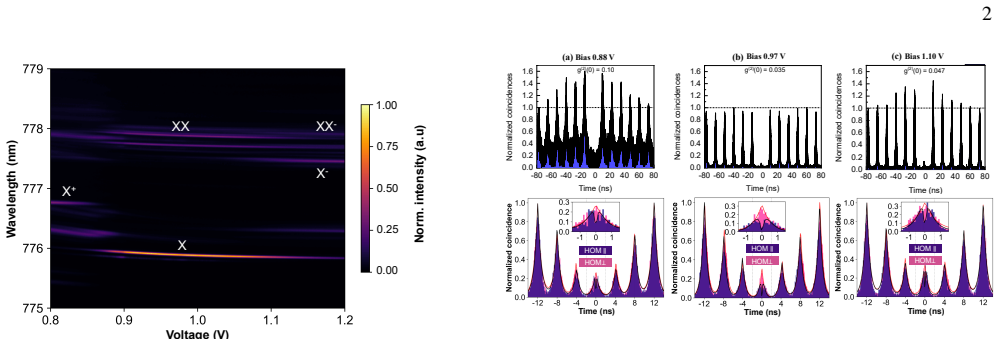
Using two droplet-etched GaAs quantum dots deterministically integrated into electrically contacted circular Bragg grating resonators, the authors identify three bias regions: a low-voltage region where random hole capture causes blinking, an intermediate plateau where the charge environment is stable, and a forward-bias region where diode current injects charge noise. The central quantitative result is that in the plateau region the neutral exciton reaches $T_2/T_1 = 1.8\pm0.1$ and $T_2^* = (6.8\pm0.5)$ ns, giving a corrected Hong-Ou-Mandel visibility of 97% at 0.97 V under LO-phonon-assisted quasi-resonant excitation. Degradation above the plateau is captured by a quantum optical model in which the pure dephasing rate is $\gamma_{\rm deph} = \alpha I^2 + \gamma_{\rm pure}^{(0)}$, consistent with a measured $1/I^2$ falloff of visibility. The same model, with fitted $\alpha$, $\gamma_p$, and $\gamma_{\rm pure}^{(0)}$, reproduces the bias-dependent coherence time $T_2 = 2/(\alpha I^2 + \gamma_{\rm deph}^{(0)} + \gamma_{\rm rad})$ and the reappearance of bunching in autocorrelation.
Load-bearing premise
The argument assumes that diode current produces charge noise that scales exactly as current squared up to $10^{-4}$ A, and that this macroscopic scaling translates into a local dephasing rate $\gamma_{\rm deph} = \alpha I^2 + \gamma_{\rm pure}^{(0)}$ with the proportionality constant determined by fitting rather than measured independently.
Editorial extensions
If this is right
- Operating a GaAs quantum dot at the charge-stable bias point yields 97% corrected two-photon visibility without resonant excitation or echo sequences, bringing noisy dots close to the performance of the best low-noise dots.
- The $1/I^2$ visibility law defines a usable operating window: once forward current rises, indistinguishability degrades predictably, so bias control alone can tune the source between high indistinguishability and controlled dephasing.
- The n-i-p diode and eCBG cavity combine electrical charge control with $(37\pm2)\%$ extraction efficiency, a combination relevant for scalable single-photon sources in quantum repeaters and distributed quantum computing.
- Extending the model from regions II and III to region I would require a microscopic blinking model; until then, the theory covers the current-dominated regime only.
Reading between the lines
- The same $\gamma_{\rm deph} = \alpha I^2 + \gamma_{\rm pure}^{(0)}$ ansatz, if generic, implies that any device where current leaks into the active region will show a universal $1/I^2$ indistinguishability penalty, making leakage suppression a direct engineering target.
- The demonstration that a nominally blinking QD can be brought to near-Fourier-limited operation suggests that pre-screening against blinking may be unnecessary for many applications, lowering the fabrication bar for GaAs QD sources.
- A testable extension: applying the same bias-sweep protocol under strictly resonant excitation, once the cavity polarization limitation is overcome, should recover transform-limited linewidth and push corrected visibility above 97%, because the residual limitation here is attributed to quasi-resonant timing jitter.
- The inverse-square law implies that at fixed current noise density, reducing diode current by a factor of two quadruples the available visibility headroom, which could guide pulsed electrical operation schemes.
Editorial analysis
A structured set of objections, weighed in public.
Referee Report
Summary. The manuscript reports a study of droplet-etched GaAs quantum dots (QDs) embedded in an n-i-p diode and deterministically integrated into an electrically contacted circular Bragg grating (eCBG) cavity. The authors measure Hong-Ou-Mandel (HOM) two-photon interference, exciton lifetime, coherence time, linewidth, and current-voltage characteristics as a function of applied bias under quasi-resonant excitation. They observe a raw two-photon visibility that increases from about 12% to a maximum of about 33% at an optimal bias, then decreases at higher forward bias, alongside a coherence-to-lifetime ratio T2/T1 = 1.8±0.1 and a pure dephasing time T2* = (6.8±0.5) ns. They also report a time-filtered maximum visibility of 97% at zero delay. The degradation of visibility in forward bias is modeled using a pure dephasing rate γ_deph = αI^2 + γ_pure^(0), with three fitted parameters, and the model reproduces the visibility and T2 trends. The central claim is that charge-noise suppression via the n-i-p diode yields near-Fourier-limited coherence and high photon indistinguishability under quasi-resonant excitation.
Significance. If the core results hold, the work has practical value for quantum communication and distributed quantum computing: it demonstrates a relatively simple electrical method to stabilize the charge environment of GaAs QDs and achieve long coherence times without echo sequences, while maintaining a high extraction efficiency of (37±2)% from the eCBG. The qualitative trends—raw visibility rising as charge noise is suppressed and then degrading with forward current, accompanied by matching linewidth changes—are credible and support the charge-noise-suppression narrative. The T2/T1 = 1.8±0.1 ratio is a defensible extraction and a useful quantitative result. However, the headline 97% visibility is a time-filtered, zero-delay value rather than the raw integrated visibility, and the 1/I^2 scaling is an assumed functional form fitted to the data rather than independently derived. These caveats undermine the more aggressive quantitative claims in the abstract, although the underlying qualitative and coherence results retain significance.
major comments (3)
- [Abstract; §3, Fig. 3(b)] The headline claim of 97% two-photon visibility is a time-filtered, zero-delay value obtained by fitting the central HOM peak, not the raw integrated visibility, which is (33±3)% at the optimum bias (p. 4). Time filtering selects coincidences at equal delay and can inflate the apparent visibility beyond the true indistinguishability; indeed, the maximum unfiltered visibility set by T2/(2T1) = 0.90±0.05 is exceeded by the 97% value. The comparison with the 93% raw visibility of Ref. [18] therefore mixes a corrected quantity with a raw one and is not a valid benchmark. The abstract and Section 3 should clearly state that 97% is a time-filtered maximum visibility and should not be presented as equivalent to unfiltered literature values.
- [§3, Eq. (2) and Fig. 3(a)–(c)] The model assumes γ_deph = αI^2 + γ_pure^(0) and uses α, γ_p, and γ_pure^(0) as free parameters to fit the visibility data; the subsequent agreement of T2 in Fig. 3(c) uses the same fitted parameters and thus serves as a consistency check, not an independent verification of the 1/I^2 scaling. The S∝I^2 relation is cited from Ref. [38], but its applicability to the local QD dephasing rate for currents up to 10^-4 A is an assumption that is not directly tested. The manuscript should explicitly state that the 1/I^2 law is an assumed model form fitted to the data, and ideally provide a separate observable, such as linewidth versus current in region III, that tests the scaling without sharing the same fitted parameters.
- [Abstract; §3, regions II–III] The abstract states that 'the reduction in visibility from a maximum ... follows an inverse square dependence' with diode current, but the model is applied only in regions II and III; region I is explicitly excluded because it is dominated by a distinct blinking mechanism (p. 4). The 1/I^2 dependence is therefore a partial description of the bias dependence, not a global law, and the abstract overgeneralizes. The wording should be qualified to reflect that the inverse-square scaling applies only to the forward-current region where the model is valid.
minor comments (4)
- [Fig. 3(b) and §3] The figure labels the quantity 'time-filtered maximum two-photon visibility' while the text refers to it as 'maximum visibility' and 'at zero time'; these terms should be defined once and used consistently to avoid ambiguity.
- [§2, experimental methods] The statement that no QD emission was detected under strictly resonant excitation is an important limitation of the excitation scheme; it should be mentioned in the abstract or conclusion, since it affects the interpretation of the visibility values.
- [Eq. (1)] In the piecewise expression for C(t,τ), the second line corresponding to γ_p = γ_rad appears to have a missing or implicit prefactor; please check the derivation and present the formula with an explicit limiting form.
- [References] Reference [26] is listed as 'See the supplemental material...' which is a self-reference rather than a standard citation; if it points to an actual supplement, please provide a DOI or a proper link, or move the description into the main text.
Circularity Check
The 1/I^2 visibility law is an assumed, fitted functional form, not a derived prediction; the T2 match uses the same fitted parameters and is a consistency check.
-
fitted input called prediction
[Theoretical modeling after Eq. (1); Fig. 3(a)-(c)]
"The pure dephasing rate is given byγ deph =αI 2 +γ (0) pure with the proportionality constantαand a small bias-independent offsetγ (0) pure. ... Usingα,γ p andγ (0) pure as fitting parameters, the model accurately reproduces the measured values of two photon visibility in regions II and III (see Fig. 3 (a)). Applying the same parameters, the measured coherence timeT 2 also is well described byT 2 =2/(αI 2 +γ (0) deph +γ rad)(see Fig. 3 (c))."
The I^2 dependence is inserted before any comparison: the paper posits γ_deph = αI^2 + γ_pure^(0), then explicitly uses α, γ_p, and γ_pure^(0) as fitting parameters to reproduce the measured raw visibility Vraw(I). Because Vraw is computed from the correlation function that contains γ_deph(I), the model's agreement with the visibility data is guaranteed by the fit; the abstract's claim that visibility degradation is proportional to 1/I^2 restates the assumed ansatz plus fitted constant. The T2 agreement is a consistency check, not an independent prediction, since T2 = 2/(αI^2 + γ_deph^(0) + γ_rad) uses the same fitted α.
full rationale
The qualitative result—blinking suppression by biasing into the charge plateau, raw HOM visibility rising from ~12% to ~33%, and degrading with forward current—is grounded in the raw coincidence data and is not circular. However, the paper's most distinctive quantitative claim, the 1/I^2 visibility degradation law, is an assumed functional form γ_deph = αI^2 + γ_pure^(0), with the proportionality constant fitted to the same visibility data it is then said to reproduce. The T2 comparison uses that same fitted α and is therefore a consistency check rather than a prediction. The 97% 'time-filtered maximum' visibility is a corrected/derived quantity relative to the raw 33% value and is compared with a raw literature value, but this is an analysis and benchmarking issue rather than a circular reduction. No load-bearing self-citation chain was found: Ref. [38] provides the external S∝I^2 relation, and the master-equation calculation is standard. Score 6 reflects that the central scaling claim reduces to a fit by construction, while the qualitative dataset and the measured T2* retain independent content.
Assumptions & free parameters
free parameters (3)
- alpha (charge-noise coefficient) =
not stated
- gamma_p (pump-state relaxation rate) =
not stated
- gamma_pure^(0) (bias-independent pure dephasing offset) =
not stated
assumptions (4)
- domain assumption Charge noise power scales as S ∝ I^2 for diode currents up to 10^-4 A, as reported by Dobrzanski (Ref. 38).
- standard math Quantum regression theorem and the adjoint master equation yield the two-time correlation function in Eq. (1).
- domain assumption Quasi-resonant excitation timing jitter can be represented by a single auxiliary pump state |p⟩ with relaxation rate γ_p.
- domain assumption The measured linewidth in region II is inhomogeneously broadened while the T2 extracted from HOM interferometry reflects the homogeneous coherence.
Cite this review
Pith. "Pith review of Enhancement of Indistinguishable Photon Emission from a GaAs Quantum Dot via Charge Noise Suppression." pith.science (2026). https://pith.science/paper/XZAQIVO6
@misc{pith2026250712641,
  author       = {Pith},
  title        = {Pith review of: Enhancement of Indistinguishable Photon Emission from a GaAs Quantum Dot via Charge Noise Suppression},
  year         = {2026},
  howpublished = {\url{https://pith.science/paper/XZAQIVO6}},
  note         = {Machine review of arXiv:2507.12641}
}
read the original abstract
The generation of indistinguishable single photons is a fundamental requirement for future quantum technologies, particularly in quantum repeater networks and for distributed quantum computing based on entanglement distribution. However, spectral jitter, often induced by charge noise in epitaxial quantum dots, leads to exciton dephasing, thereby limiting their practical usage in quantum applications. We present a straightforward approach to mitigate charge noise-induced decoherence in droplet-etched GaAs quantum dots embedded in an n-i-p diode structure and integrated deterministically into an electrically contacted circular Bragg grating resonator for emission enhancement. The quantum device allows for the stabilization of the charge environment by applying an external electrical field while producing a photon extraction efficiency of approximately (37 +- 2)%. Hong-Ou-Mandel two-photon interference measurements reveal a strong voltage dependence of the exciton dephasing time and interference visibility on the applied bias in excellent agreement with our theoretical predictions. Notably, the reduction in visibility from a maximum, charge-stabilized corrected value of 97 percent at the optimum bias point follows an inverse square dependence (proportional to 1/I^2) with increasing diode current (I) in forward direction. Under a quasi-resonant excitation scheme, we achieve a maximum exciton dephasing time (T2*) of approximately (6.8 +-0.5) ns, reaching nearly the Fourier limit (T2 = 2T1) without the need for complex echo schemes like Ramsey or Carr-Purcell-Meiboom-Gill sequences. These findings are consistent with theoretical predictions from rate equation modeling and quantum optical analysis as well as voltage-dependent linewidth measurements, demonstrating optimized electrical control of exciton dephasing.
Figures

Reference graph
Works this paper leans on
-
[18]
Liang Zhai, Giang N Nguyen, Clemens Spinnler, Julian Ritz- mann, Matthias C Löbl, Andreas D Wieck, Arne Ludwig, Al- isa Javadi, and Richard J Warburton. Quantum interference of identical photons from remote gaas quantum dots.Nature Nan- otechnology, 17(8):829–833, 2022
work page 2022
-
[38]
Lech Dobrzanski. Low-frequency noise and charge transport in light-emitting diodes with quantum dots.Journal of Applied Physics, 96(8):4135–4142, 2004
work page 2004
-
[1]
Push-button photon entangle- ment.Nature Photonics, 8(3):174–176, 2014
Chao-Yang Lu and Jian-Wei Pan. Push-button photon entangle- ment.Nature Photonics, 8(3):174–176, 2014
work page 2014
-
[2]
Statistical properties of the quantum internet.Phys- ical Review Letters, 124(21):210501, 2020
Samuraí Brito, Askery Canabarro, Rafael Chaves, and Daniel Cavalcanti. Statistical properties of the quantum internet.Phys- ical Review Letters, 124(21):210501, 2020
work page 2020
-
[3]
Quantum advantage and noise reduction in distributed quantum computing.Physical Review A, 104(5):052404, 2021
J Avron, Ofer Casper, and Ilan Rozen. Quantum advantage and noise reduction in distributed quantum computing.Physical Review A, 104(5):052404, 2021
2021
-
[4]
Tobias Heindel, Je-Hyung Kim, Niels Gregersen, Armando Rastelli, and Stephan Reitzenstein. Quantum dots for photonic quantum information technology.Advances in Optics and Pho- tonics, 15(3):613–738, 2023
work page 2023
-
[5]
Florian Hornung, Ulrich Pfister, Stephanie Bauer, Dee Rock- ing Cyrlyson’s, Dongze Wang, Ponraj Vijayan, Ailton J Gar- cia Jr, Saimon Filipe Covre da Silva, Michael Jetter, Simone L Portalupi, et al. Highly indistinguishable single photons from droplet-etched gaas quantum dots integrated in single-mode waveguides and beamsplitters.Nano Letters, 24(4):1184...
work page 2024
-
[6]
Manuel Gschrey, Alexander Thoma, Peter Schnauber, Mark Seifried, Ronny Schmidt, Benjamin Wohlfeil, Luzy Krüger, J- H Schulze, Tobias Heindel, Sven Burger, et al. Highly indistin- guishable photons from deterministic quantum-dot microlenses utilizing three-dimensional in situ electron-beam lithography. Nature Communications, 6(1):7662, 2015
work page 2015
Show all 42 references
-
[7]
Storage of single photons from a semiconductor quantum dot in a room- temperature atomic vapor memory with on-demand retrieval
Benjamin Maaß, Avijit Barua, Norman Vincenz Ewald, Eliz- abeth Robertson, Kartik Gaur, Suk In Park, Sven Rodt, Jin- Dong Song, Stephan Reitzenstein, and Janik Wolters. Storage of single photons from a semiconductor quantum dot in a room- temperature atomic vapor memory with on...
2025
-
[8]
Transform-limited single photons from a single quantum dot.Nature Communications, 6(1):8204, 2015
Andreas V Kuhlmann, Jonathan H Prechtel, Julien Houel, Arne Ludwig, Dirk Reuter, Andreas D Wieck, and Richard J Warbur- ton. Transform-limited single photons from a single quantum dot.Nature Communications, 6(1):8204, 2015
2015
-
[9]
Size-dependent fine-structure splitting in self- organized InAs/GaAs quantum dots.Physical Review Letters, 95(25):257402, 2005
R Seguin, A Schliwa, S Rodt, K Pötschke, UW Pohl, and D Bimberg. Size-dependent fine-structure splitting in self- organized InAs/GaAs quantum dots.Physical Review Letters, 95(25):257402, 2005
2005
-
[10]
Nuclear spin physics in quantum dots: An op- tical investigation.Reviews of Modern Physics, 85(1):79–133, 2013
Bernhard Urbaszek, Xavier Marie, Thierry Amand, Olivier Krebs, Paul V oisin, Patrick Maletinsky, Alexander Högele, and Atac Imamoglu. Nuclear spin physics in quantum dots: An op- tical investigation.Reviews of Modern Physics, 85(1):79–133, 2013
2013
-
[11]
Quantum interface of an electron and a nuclear ensemble.Science, 364(6435):62– 66, 2019
DA Gangloff, Gabriel Ethier-Majcher, Constantin Lang, EV Denning, JH Bodey, DM Jackson, Edmund Clarke, Maxime Hugues, Claire Le Gall, and Mete Atatüre. Quantum interface of an electron and a nuclear ensemble.Science, 364(6435):62– 66, 2019
2019
-
[12]
Highly uniform and strain-free GaAs quantum dots fabricated by filling of self- assembled nanoholes.Applied Physics Letters, 94(18), 2009
Ch Heyn, A Stemmann, T Köppen, Ch Strelow, T Kipp, M Grave, S Mendach, and W Hansen. Highly uniform and strain-free GaAs quantum dots fabricated by filling of self- assembled nanoholes.Applied Physics Letters, 94(18), 2009
2009
-
[13]
Ultra-small excitonic fine structure splitting in highly symmetric quantum dots on gaas (001) substrate.Applied Physics Letters, 102(15), 2013
YH Huo, A Rastelli, and OG Schmidt. Ultra-small excitonic fine structure splitting in highly symmetric quantum dots on gaas (001) substrate.Applied Physics Letters, 102(15), 2013
2013
-
[14]
An artificial rb atom in a semiconductor with lifetime-limited linewidth.Phys- ical Review B, 92(24):245439, 2015
Jan-Philipp Jahn, Mathieu Munsch, Lucas Béguin, Andreas V Kuhlmann, Martina Renggli, Yongheng Huo, Fei Ding, Rinaldo Trotta, Marcus Reindl, Oliver G Schmidt, et al. An artificial rb atom in a semiconductor with lifetime-limited linewidth.Phys- ical Review B, 92(24):245439, 2015
2015
-
[15]
Electrically-pumped wavelength-tunable gaas quantum dots in- terfaced with rubidium atoms.ACS Photonics, 4(4):868–872, 2017
Huiying Huang, Rinaldo Trotta, Yongheng Huo, Thomas Let- tner, Johannes S Wildmann, Javier Martín-Sánchez, Daniel Huber, Marcus Reindl, Jiaxiang Zhang, Eugenio Zallo, et al. Electrically-pumped wavelength-tunable gaas quantum dots in- terfaced with rubidium atoms.ACS Photonics...
2017
-
[16]
Solid-state ensemble of highly entangled photon sources at rubidium atomic transi- tions.Nature Communications, 8(1):15501, 2017
Robert Keil, Michael Zopf, Yan Chen, Bianca Höfer, Jiaxiang Zhang, Fei Ding, and Oliver G Schmidt. Solid-state ensemble of highly entangled photon sources at rubidium atomic transi- tions.Nature Communications, 8(1):15501, 2017
2017
-
[17]
Enhanced electron- spin coherence in a gaas quantum emitter.Physical Review Let- ters, 131(21):210805, 2023
Giang N Nguyen, Clemens Spinnler, Mark R Hogg, Liang Zhai, Alisa Javadi, Carolin A Schrader, Marcel Erbe, Marcus Wyss, Julian Ritzmann, Hans-Georg Babin, et al. Enhanced electron- spin coherence in a gaas quantum emitter.Physical Review Let- ters, 131(21):210805, 2023
2023
-
[19]
Strain-tunable gaas quantum dot: a nearly dephasing-free source of entangled photon pairs on demand
Daniel Huber, Marcus Reindl, Saimon Filipe Covre da Silva, Christian Schimpf, Javier Martín-Sánchez, Huiying Huang, Giovanni Piredda, Johannes Edlinger, Armando Rastelli, and Rinaldo Trotta. Strain-tunable gaas quantum dot: a nearly dephasing-free source of entangled photon pa...
2018
-
[20]
Size-dependent line broadening in the emission spectra of single GaAs quantum dots: Impact of surface charge on spectral diffusion.Physical Review B, 92(7):075306, 2015
Neul Ha, Takaaki Mano, Ying-Lin Chou, Yu-Nien Wu, Shun- Jen Cheng, Juanita Bocquel, Paul M Koenraad, Akihiro Ohtake, Yoshiki Sakuma, Kazuaki Sakoda, et al. Size-dependent line broadening in the emission spectra of single GaAs quantum dots: Impact of surface charge on spectral ...
2015
-
[21]
On-demand semi- conductor source of 780-nm single photons with controlled temporal wave packets.Physical Review B, 97(20):205304, 2018
Lucas Béguin, Jan-Philipp Jahn, Janik Wolters, Marcus Reindl, Yongheng Huo, Rinaldo Trotta, Armando Rastelli, Fei Ding, Oliver G Schmidt, Philipp Treutlein, et al. On-demand semi- conductor source of 780-nm single photons with controlled temporal wave packets.Physical Review B...
2018
-
[22]
Deep donor levels (dx centers) in iii-v semicon- ductors.Journal of Applied Physics, 67(3):R1–R26, 1990
PM Mooney. Deep donor levels (dx centers) in iii-v semicon- ductors.Journal of Applied Physics, 67(3):R1–R26, 1990
1990
-
[23]
Techniques to minimize dx center deleterious effects in iii-v device perfor- mance.Journal of Applied Physics, 73(10):4988–4997, 1993
E Munoz, E Calleja, I Izpura, F Garcia, AL Romero, JL Sánchez-Rojas, AL Powell, and J Castagne. Techniques to minimize dx center deleterious effects in iii-v device perfor- mance.Journal of Applied Physics, 73(10):4988–4997, 1993
1993
-
[24]
Low-noise GaAs quan- tum dots for quantum photonics.Nature Communications, 11(1):4745, 2020
Liang Zhai, Matthias C Löbl, Giang N Nguyen, Julian Ritz- mann, Alisa Javadi, Clemens Spinnler, Andreas D Wieck, Arne Ludwig, and Richard J Warburton. Low-noise GaAs quan- tum dots for quantum photonics.Nature Communications, 11(1):4745, 2020
2020
-
[25]
Charge tunable GaAs quantum dots in a photonic nip diode
Hans Georg Babin, Julian Ritzmann, Nikolai Bart, Marcel Schmidt, Timo Kruck, Liang Zhai, Matthias C Löbl, Gi- ang N Nguyen, Clemens Spinnler, Leonardo Ranasinghe, et al. Charge tunable GaAs quantum dots in a photonic nip diode. Nanomaterials, 11(10):2703, 2021
2021
-
[26]
See the supplemental material for a brief overview of the sam- 6 ple structure, numerical simulation, device fabrication, experi- mental methods, theoretical modelling and data analysis
-
[27]
Bright electrically con- tacted circular bragg grating resonators with deterministically integrated quantum dots.ACS Nano, 18(46):31834–31845, 2024
Setthanat Wijitpatima, Normen Auler, Priyabrata Mudi, Timon Funk, Avijit Barua, Binamra Shrestha, Johannes Schall, Imad Limame, Sven Rodt, Dirk Reuter, et al. Bright electrically con- tacted circular bragg grating resonators with deterministically integrated quantum dots.ACS N...
2024
-
[28]
Scalable deterministic integration of two quantum dots into an on-chip quantum circuit.ACS Photonics, 10(8):2846–2853, 2023
Shulun Li, Yuhui Yang, Johannes Schall, Martin von Helversen, Chirag Palekar, Hanqing Liu, Léo Roche, Sven Rodt, Haiqiao Ni, Yu Zhang, et al. Scalable deterministic integration of two quantum dots into an on-chip quantum circuit.ACS Photonics, 10(8):2846–2853, 2023
2023
-
[29]
Optical emission from a charge-tunable quan- tum ring.Nature, 405(6789):926–929, 2000
Richard J Warburton, C Schäflein, Dirk Haft, F Bickel, Axel Lorke, Khaled Karrai, Jorge M Garcia, W Schoenfeld, and Pierre M Petroff. Optical emission from a charge-tunable quan- tum ring.Nature, 405(6789):926–929, 2000
2000
-
[30]
A solid-state source of strongly entangled photon pairs with high brightness and indis- tinguishability.Nature Nanotechnology, 14(6):586–593, 2019
Jin Liu, Rongbin Su, Yuming Wei, Beimeng Yao, Saimon Fil- ipe Covre da Silva, Ying Yu, Jake Iles-Smith, Kartik Srinivasan, Armando Rastelli, Juntao Li, et al. A solid-state source of strongly entangled photon pairs with high brightness and indis- tinguishability.Nature Nanotec...
2019
-
[31]
Electric-field control of photon indistinguishability in cascaded decays in quantum dots.Nano Letters, 25(17):7121– 7127, 2025
Gabriel Undeutsch, Maximilian Aigner, Ailton J Garcia Jr, Jo- hannes Reindl, Melina Peter, Simon Mader, Christian Wei- dinger, Saimon F Covre da Silva, Santanu Manna, Eva Schöll, et al. Electric-field control of photon indistinguishability in cascaded decays in quantum dots.Na...
2025
-
[32]
Heralded preparation of spin qubits in droplet-etched GaAs quantum dots using quasireso- nant excitation.Physical Review B, 104(7):075301, 2021
Caspar Hopfmann, Nand Lal Sharma, Weijie Nie, Robert Keil, Fei Ding, and Oliver G Schmidt. Heralded preparation of spin qubits in droplet-etched GaAs quantum dots using quasireso- nant excitation.Physical Review B, 104(7):075301, 2021
2021
-
[33]
P. Michler. Single semiconductor quantum dots (nanoscience and technology).Springer, 2009
2009
-
[34]
Pfenning
Jaewon Kim, Jochen Kaupp, Yorick Reum, Giora Peniakov, Jo- hannes Michl, Felix Kohr, Monika Emmerling, Martin Kamp, Yong-Hoon Cho, Tobias Huber-Loyola, Sven Höfling, and An- dreas T. Pfenning. Two-photon interference from an InAs quantum dot emitting in the telecom c-band.arXi...
2025 arXiv
-
[35]
Interference and correlation of two independent photons.The European Physi- cal Journal D-Atomic, Molecular , Optical and Plasma Physics, 22:295–301, 2003
J Bylander, I Robert-Philip, and I Abram. Interference and correlation of two independent photons.The European Physi- cal Journal D-Atomic, Molecular , Optical and Plasma Physics, 22:295–301, 2003
2003
-
[36]
Two-photon interference from two blinking quantum emitters.Physical Review B, 96(7):075430, 2017
Klaus D Jöns, Katarina Stensson, Marcus Reindl, Marcin Swillo, Yongheng Huo, Val Zwiller, Armando Rastelli, Rinaldo Trotta, and Gunnar Björk. Two-photon interference from two blinking quantum emitters.Physical Review B, 96(7):075430, 2017
2017
-
[37]
Subnanosecond spectral diffusion measurement using photon correlation.Na- ture Photonics, 4(10):696–699, 2010
Gregory Sallen, Adrien Tribu, Thomas Aichele, Régis André, Lucien Besombes, Catherine Bougerol, Maxime Richard, Serge Tatarenko, Kuntheak Kheng, and J-Ph Poizat. Subnanosecond spectral diffusion measurement using photon correlation.Na- ture Photonics, 4(10):696–699, 2010
2010
-
[39]
OUP Oxford, 2002
Heinz-Peter Breuer and Francesco Petruccione.The theory of open quantum systems. OUP Oxford, 2002
2002
-
[40]
Springer Science & Business Media, 2013
Howard J Carmichael.Statistical methods in quantum optics 1: master equations and F okker-Planck equations. Springer Science & Business Media, 2013
2013
-
[41]
P Kaer, Peter Lodahl, A-P Jauho, and J Mork. Microscopic the- ory of indistinguishable single-photon emission from a quan- tum dot coupled to a cavity: The role of non-markovian phonon-induced decoherence.Physical Review B—Condensed Matter and Materials Physics, 87(8):081308, 2013
2013
-
[42]
Impact of phonon lifetimes on the single-photon indistinguishability in quantum emitters based on two-dimensional materials.Physical Review B, 111(19):195431, 2025
Alexander Steinhoff, Steffen Wilksen, Ivan Solovev, Chris- tian Schneider, and Christopher Gies. Impact of phonon lifetimes on the single-photon indistinguishability in quantum emitters based on two-dimensional materials.Physical Review B, 111(19):195431, 2025
2025
Reviewed August 6, 2026 · model on record in the stance chip above.
Discussion (0). Sign in to comment.