REVIEW 3 major objections 5 minor 20 references
Magnetic Triple-q State in Antiferromagnetic Monolayer Interfaced with Bismuthene
T0 review · 3 major / 5 minor · reviewed 2026-08-06 · deepseek-v4-flash
Pith's one-line read The bismuthene-covered manganese monolayer on Ag(111) has a noncoplanar 3Q3 magnetic ground state, and its uniaxial anisotropy makes the spin domains switch with external magnetic field.
desk verdict First 3Q state in a bismuthene/magnetic-monolayer interface, but the paper's own DFT omits the 2Q competitor from the SOC comparison, so the ground-state claim is not established as written. read the letter →
The pith
A machine-rendered reading of the paper's core claim, the machinery that carries it, and where it could break.
The reading
What carries the argument
The central object is the 3Q spin texture: a noncoplanar arrangement formed by superposing three symmetry-equivalent spin spirals, giving four spins per (2x2) cell at tetrahedral angles close to 109.5 degrees. The argument is carried by three pieces of machinery: DFT total-energy comparisons that decompose the energy landscape into higher-order spin interactions (fourth-order terms stabilize the 3Q state while sixth-order terms distort it), spin-orbit-coupling calculations that scan 3Q orientations and registry shifts relative to the bismuthene lattice, and SP-STM image simulations that reproduce the measured checkerboard and stripe contrasts. The bismuthene registry selects a single in-plane anisotropy axis, which explains the absence of rotational domains and the field-driven switching between 3Q3-up and 3Q3-down.
What would settle it
A structural determination of the same islands, for example a bias-dependent STM series or a local diffraction or spectroscopy probe that distinguishes the two relaxed atomic models, would settle the assignment; if the true structure is the Mn honeycomb on BiAg3, the 3Q claim does not transfer. Separately, a spin-polarized scan with the tip magnetization rotated in-plane could test whether the site-resolved spin pattern is tetrahedral 3Q3 rather than collinear c-AFM order.
Extended reading notes
Core claim
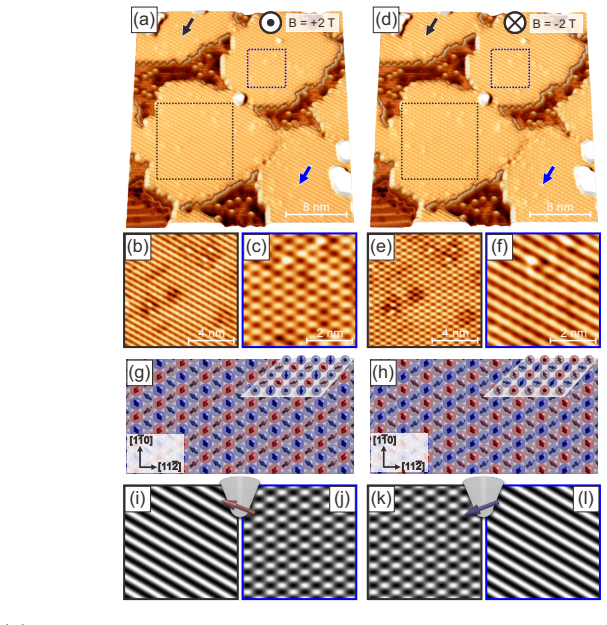
The central claim is that in the bismuthene-covered p(1x1)-Mn/Ag(111) system, the magnetic ground state is a 3Q3-like noncoplanar spin texture rather than a collinear antiferromagnet or a single-spiral state. The authors show that the 3Q state is energetically favored in DFT, that simulated SP-STM images of this state reproduce the checkerboard and stripe contrasts seen in experiment, and that the bismuthene overlayer induces a uniaxial magnetic anisotropy such that the 3Q3-up and 3Q3-down domains switch under an external out-of-plane magnetic field. They conclude that the measured islands are bismuthene on a p(1x1)-Mn monolayer with a (2x2) magnetic supercell, and that the measurements validate the energetically preferred structure while supporting the magnetic 3Q interpretation.
Load-bearing premise
The measured islands really are bismuthene on a p(1x1)-Mn monolayer rather than the nearly identical Mn honeycomb lattice on BiAg3; the two relaxed models cannot be distinguished by STM topography, and only the bismuthene-on-Mn model gives the 3Q ground state and matching SP-STM contrast.
Editorial extensions
If this is right
- The bismuthene/Mn/Ag(111) interface becomes a concrete two-dimensional antiferromagnet with noncoplanar 3Q order that can be imaged in real space.
- Checkerboard and stripe SP-STM patterns can serve as fingerprints distinguishing a 3Q spin texture from a collinear c-AFM order in this system.
- Reversing an external out-of-plane magnetic field swaps the 3Q3-up and 3Q3-down domains, giving a deterministic way to manipulate the noncoplanar magnetic state.
- The uniaxial anisotropy means rotational domains are absent, so field-driven switching happens along a single magnetic axis.
- Because noncoplanar 3Q configurations can carry topological orbital moments, the system is a candidate for emergent topological Hall effects without spin-orbit interaction.
Reading between the lines
- Beyond the paper: the structural assignment is the load-bearing step, since the two relaxed models look nearly identical in STM topography and only the bismuthene-on-Mn model yields the 3Q ground state; a direct structural probe of the islands would settle whether the 3Q interpretation transfers to the measured sample.
- Beyond the paper: a spin-resolved measurement that isolates the in-plane spin components at each sublattice site could test the tetrahedral 3Q3 spin arrangement against the collinear c-AFM alternative without relying on image matching.
- Beyond the paper: sweeping the magnetic field through intermediate values may reveal domain walls or partial spin reorientation, providing additional evidence for the uniaxial anisotropy mechanism.
- Beyond the paper: similar growth recipes on other group-V Xene overlayers could produce related noncoplanar antiferromagnetic spin textures and expand the family of two-dimensional magnetic/topological interfaces.
Editorial analysis
A structured set of objections, weighed in public.
Referee Report
Summary. The manuscript reports the fabrication of a bismuthene-covered Mn monolayer on Ag(111), imaging of checkerboard and stripe magnetic patterns by spin-polarized scanning tunneling microscopy (SP-STM), and a combined experimental/theoretical interpretation in which the magnetic ground state is a noncoplanar 3Q3 spin texture. Field-dependent SP-STM shows exchange of checkerboard and stripe domains upon reversal of the out-of-plane field component, which the authors attribute to uniaxial magnetic anisotropy of the 3Q3 state induced by the bismuthene overlayer. DFT calculations are used to argue that the 3Q3 state is energetically favored and that its simulated SP-STM images reproduce the observed contrast.
Significance. If the central claim holds, the paper would provide a new experimental realization of a magnetic triple-q state in a bismuthene/Mn heterostructure, with the additional feature of uniaxial anisotropy and field-induced switching between 3Q3-up and 3Q3-down domains. This would be of interest for the growing field of noncollinear antiferromagnets and 2D topological-material/magnet interfaces. The experimental work is careful: the same scan area is imaged with two different Cr tip magnetizations, and the field-dependent measurements are supported by supplementary images. The DFT simulations provide an independent energy argument rather than a fit to the images, which is a strength. However, the theoretical ground-state claim is currently under-supported because a direct competitor of the 3Q state is not evaluated with spin-orbit coupling, and the structural model selection is not fully conclusive. The paper is therefore promising but not yet ready in its present form.
major comments (3)
- [Results and discussion, Fig. 5(a) and 5(c)] The no-SOC energy path in Fig. 5(a) shows that the 2Q state and a distorted 3Q state are minima 2–3 meV/Mn below the ideal 3Q state, as the text states explicitly. The SOC-included comparison in Fig. 5(c), however, contains only the 3Q_i shifted structures and collinear 1Q states; the 2Q and distorted-3Q candidates are never re-evaluated with SOC. Since the SOC shifts in Fig. 5(c) are up to about 5 meV/Mn, larger than the 2–3 meV/Mn no-SOC gap, the 2Q or distorted-3Q state could remain lower in total energy once SOC is included. As presented, the DFT evidence does not support the abstract and conclusions claim that the 3Q3-like spin texture is the ground state. The authors should either compute the SOC energies of the 2Q and distorted-3Q states or explicitly justify why these competitors can be excluded.
- [Results and discussion, near Fig. 2(d) and Fig. 3] The manuscript states that the two DFT-relaxed structural models, Mn honeycomb on BiAg3/Ag(111) and bismuthene on p(1x1)-Mn/Ag(111), 'appear nearly identical and can not be clearly distinguished on the basis of STM measurements and simulations.' The subsequent assignment of the measured islands to the bismuthene/p(1x1)-Mn model is then based on the magnetic ground state and on the SP-STM image match. This reasoning is not fully independent: the structural identification relies on the magnetic assignment, while the magnetic assignment is made within one of the two structures. The alternative Mn-honeycomb model is also computed to have an antiferromagnetic ground state whose simulated SP-STM contrast (Fig. 3(g,h)) includes a checkerboard pattern. To make the central claim load-bearing, the authors should provide a structural discrimination criterion that does not presuppose the 3Q ground state, or they should explicitly state that the sample structure remains ambiguous and correspondingly weaken the conclusions.
- [Results and discussion, Fig. 4(i)-(l) and Methods] The field-dependent SP-STM simulations reproduce the checkerboard and stripe patterns and their exchange only after introducing a canted tip magnetization with both in-plane and out-of-plane components (inset of Fig. 4(i,j)). This canted tip direction is an adjustable input rather than an independently measured quantity. Because the simulated contrast depends on the tip magnetization, the match in Fig. 4(k,l) is partly a consequence of this choice. The authors should quantify how sensitive the 3Q3 assignment is to the canting angle and to the relative spin/charge contributions, or provide an independent justification for the selected tip magnetization direction.
minor comments (5)
- [Abstract and Conclusions] The substrate formula appears as '(p x root3)-Bi/Ag(111' with an unmatched parenthesis in both the abstract and the conclusions; this should be corrected to '(p x sqrt(3))-Bi/Ag(111)'.
- [Fig. 4 caption] The caption contains duplicate panel labels '(i) ,(j)' for two different sets of simulated images; the second occurrence should refer to panels (k) and (l).
- [Page 12, text near Fig. 4] 'stimulated SP-STM results' should be 'simulated SP-STM results'.
- [Page 13, text near Fig. 5(b)] The notation '3Qi + y3, and Q i + xy' appears garbled; it should likely read '3Qi + y' and '3Qi + xy'.
- [Methods, DFT calculations] The relaxations are performed with PBE while the non-collinear energies are computed with LDA in the PBE-optimized geometry. Since the energy differences in Fig. 5(a) are only a few meV/Mn, the authors should comment on the sensitivity of the magnetic energy ordering to this functional choice.
Circularity Check
No significant circularity: the 3Q3 ground-state claim rests on independent DFT energy calculations, and the SP-STM simulations are forward calculations rather than fits; the structural ambiguity is an acknowledged model-selection issue, not a definitional reduction.
full rationale
The paper's central assertion is that the 3Q3-like spin texture is the magnetic ground state of bismuthene-covered p(1x1)-Mn/Ag(111), supported by DFT total energies (Fig. 3(a); Fig. 5) and by SP-STM image simulations. The energy ordering of magnetic states is computed ab initio for a relaxed structural model and is not extracted from the measured checkerboard/stripe images; hence the core physics claim has independent content. The simulated SP-STM contrasts are forward calculations from the relaxed spin structures, with the tip magnetization treated as an input and varied systematically (Supplementary Figs. S6, S7, S10-S12); the contrast reversal upon inverting the out-of-plane tip component is a qualitative prediction, not a fitted reproduction of a fitted quantity. The acknowledged indistinguishability of the two DFT-relaxed structures on the basis of topography (text near Fig. 2(d)) means that the bismuthene/Mn identification is partly inferred from the success of the 3Q simulations; this weakens the structural assignment but is an abductive hypothesis test rather than a circular reduction of the derivation to its inputs. The cited 3Q prediction for Mn/Cu(111) (Ref. 13) includes some present authors but is only motivational and is re-derived here by new DFT calculations, so self-citation is not load-bearing. The omission of 2Q and distorted-3Q states from the SOC comparison (Fig. 5(c) vs 5(a)) is a completeness/correctness concern about whether 3Q3 is the true ground state, not a circularity. No step in the claimed derivation chain reduces by construction to its own inputs.
Assumptions & free parameters
free parameters (2)
- SP-STM simulation tip magnetization orientation =
Canted mixture of in-plane and out-of-plane components, value not quantified
- Higher-order spin interaction expansion (up to 10th order) =
Expansion order and coefficients not tabulated
assumptions (4)
- domain assumption LDA/GGA exchange-correlation functionals, without Hubbard U, adequately describe Mn 3d magnetism in this monolayer.
- domain assumption The measured STM contrast is dominated by the magnetic spin polarization of the sample, as captured by the SP-STM simulations.
- domain assumption Higher-order spin interactions, rather than two-spin Heisenberg terms, control the relative stability of 2Q, 3Q, and 1Q states on the considered path.
- domain assumption The bulk Cr tip is antiferromagnetic, and voltage pulses or field sweeps change the tip apex magnetization as assumed.
Cite this review
Pith. "Pith review of Magnetic Triple-q State in Antiferromagnetic Monolayer Interfaced with Bismuthene." pith.science (2026). https://pith.science/paper/OQ4YCRQZ
@misc{pith2026250712946,
  author       = {Pith},
  title        = {Pith review of: Magnetic Triple-q State in Antiferromagnetic Monolayer Interfaced with Bismuthene},
  year         = {2026},
  howpublished = {\url{https://pith.science/paper/OQ4YCRQZ}},
  note         = {Machine review of arXiv:2507.12946}
}
read the original abstract
We have successfully fabricated the bismuthene covered Mn monolayer on Ag(111) by evaporating Mn atoms onto (p x root3)-Bi/Ag(111) at room temperature. By using spin-polarized scanning tunneling microscopy (SP-STM), we have resolved the magnetic triple-q (3Q) state. In combination with density-functional theory (DFT) calculations, the 3Q3-like spin texture is the magnetic ground state for the bismuthene covered Mn monolayer/Ag(111). Interestingly, the uniaxial magnetic anisotropy of 3Q3 state triggered by the bismuthene on top of Mn monolayer/Ag(111) has been revealed, which is consistent with the switching of 3Q3up and 3Q3down domains observed by SP-STM measurements with external magnetic fields.
Figures


Figures from the paper (2 more)

Reference graph
Works this paper leans on
-
[1]
Y.; Kubetzka, A.; von Bergmann, K.; Pietzsch, O.; Bode, M.; Kirschner, J.; Oepen, H
(1) Vedmedenko, E. Y.; Kubetzka, A.; von Bergmann, K.; Pietzsch, O.; Bode, M.; Kirschner, J.; Oepen, H. P.; Wiesendanger, R. Domain Wall Orientation in Magnetic Nanowires. Phys. Rev. Lett.2004, 92, 077207. (2) Bode, M.; Heide, M.; von Bergmann, K.; Ferriani, P.; Heinze, S.; Bihlmayer, G.; Ku- betzka, A.; Pietzsch, O.; Bl¨ ugel, S.; Wiesendanger, R. Chiral...
work page 2004
-
[14]
(37) Liu, Q.; Zhang, X.; Abdalla, L. B.; Fazzio, A.; Zunger, A. Switching a Normal Insulator into a Topological Insulator via Electric Field with Application to Phosphorene. Nano. Lett. 2015, 15, 1222–1228. 20 (38) Xian, L.; Paz, A. P.; Bianco, E.; Ajayan, P. M.; Rubio, A. Square Selenene and Tel- lurene: Novel Group VI Elemental 2D Materials with Nontriv...
work page 2015
-
[15]
22 (54) Chang, C.-Z.; Zhang, J.; Feng, X.; Shen, J.; Zhang, Z.; Guo, M.; Li, K.; Ou, Y.; Wei, P.; Wang, L.-L.; Ji, Z.-Q.; Feng, Y.; Ji, S.; Chen, X.; Jia, J.; Dai, X.; Fang, Z.; Zhang, S.- C.; He, K.; Wang, Y. et al.Experimental Observation of the Quantum Anomalous Hall Effect in a Magnetic Topological Insulator. Science 2013, 340, 167–170. (55) Tokura, Y...
work page 2013
-
[156]
(7) von Bergmann, K.; Kubetzka, A.; Pietzsch, O.; Wiesendanger, R. Interface-induced chiral domain walls, spin spirals and skyrmions revealed by spin-polarized scanning tunneling microscopy. J. Phys. Condens. Matter2014, 26, 394002. (8) Yoshimura, Y.; Kim, K.-J.; Taniguchi, T.; Tono, T.; Ueda, K.; Hiramatsu, R.; Moriyama, T.; Yamada, K.; Nakatani, Y.; Ono...
work page 2016
-
[190]
(3) Parkin, S. S. P.; Hayashi, M.; Thomas, L. Magnetic domain-wall racetrack memory. Science 2008, 320, 190–194. 16 (4) Romming, N.; Hanneken, C.; Menzel, M.; Bickel, J. E.; Wolter, B.; von Bergmann, K.; Kubetzka, A.; Wiesendanger, R. Writing and Deleting Single Magnetic Skyrmions. Science 2013, 636,
work page 2008
-
[341]
Topological properties and dynamics of magnetic skyrmions
(5) Nagaosa, N.; Tokura, Y. Topological properties and dynamics of magnetic skyrmions. Nat. Nanotech.2013, 8, 899–911. (6) Fert, A.; Cros, V.; Sampaio, J. Skyrmions on the track. Nat. Nanotech. 2013, 8, 152–
work page 2013
-
[511]
S.; Wiesendanger, R.; Rachel, S.; Morr, D
(25) Bedow, J.; Mascot, E.; Posske, T.; Uhrig, G. S.; Wiesendanger, R.; Rachel, S.; Morr, D. K. Topological superconductivity induced by a triple-q magnetic structure. Phys. Rev. B2020, 102, 180504(R). (26) Novoselov, K. S.; Geim, A. K.; Morozov, S. V.; Jiang, D.; Zhang, Y.; Dubonos, S. V.; Grigorieva, I. V.; Firsov, A. A. Electric Field Effect in Atomica...
work page 2004
-
[523]
(67) Wortmann, D.; Michalicek, G.; Baadji, N.; Betzinger, M.; Bihlmayer, G.; Br¨ oder, J.; Burnus, T.; Enkovaara, J.; Freimuth, F.; Friedrich, C.; Gerhorst, C.-R.; Granberg Cauchi, S.; Grytsiuk, U.; Hanke, A.; Hanke, J.-P.; Heide, M.; Heinze, S.; Hilgers, R.; Janssen, H.; Kl¨ uppelberg, D. A. et al. FLEUR: MaX-R6.2, Zenodo. 2023; https://doi.org/10.5281/z...
Show all 20 references
-
[961]
H.; Ju, W.; Cho, E.-J.; Noh, H.-J.; Han, M
18 (21) Park, P.; Cho, W.; Kim, C.; An, Y.; Kang, Y.-G.; Avdeev, M.; Sibille, R.; Iida, K.; Kajimoto, R.; Lee, K. H.; Ju, W.; Cho, E.-J.; Noh, H.-J.; Han, M. J.; Zhang, S.-S.; Batista, C. D.; Park, J.-G. Tetrahedral triple-Q magnetic ordering and large spon- taneous Hall condu...
2023
-
[1106]
Multiple-q states and the skyrmion lattice of the triangular-lattice Heisenberg antiferromagnet under magnetic fields
(14) Okubo, T.; Chung, S.; Kawamura, H. Multiple-q states and the skyrmion lattice of the triangular-lattice Heisenberg antiferromagnet under magnetic fields. Phys. Rev. Lett. 2012, 108, 017206. (15) Haldar, S.; Meyer, S.; Kubetzka, A.; Heinze, S. Distorted 3q state driven by ...
2012
-
[1350]
Three-dimensional spin structure on a two-dimensional lattice: Mn/Cu(111)
(13) Kurz, P.; Bihlmayer, G.; Hirai, K.; Bl¨ ugel, S. Three-dimensional spin structure on a two-dimensional lattice: Mn/Cu(111). Phys. Rev. Lett.2001, 86,
2001
-
[1495]
Spin-polarized scanning tunnelling microscopy
(66) Bode, M. Spin-polarized scanning tunnelling microscopy. Rep. Prog. Phys.2003, 66,
2003
-
[1672]
V.; Sokolov, I
(52) Averyanov, D. V.; Sokolov, I. S.; Taldenkov, A. N.; Parfenov, O. E.; Karateev, I. A.; Kondratev, O. A.; Tokmachev, A. M.; Storchak, V. G. Exchange Bias State at the Crossover to 2D Ferromagnetism. ACS Nano 2022, 16, 19482–19490. (53) Matetskiy, A. V.; Milotti, V.; Sheverd...
2022
-
[1854]
M.; Averyanov, D
(51) Tokmachev, A. M.; Averyanov, D. V.; Parfenov, O. E.; Taldenkov, A. N.; Kara- teev, I. A.; Sokolov, I. S.; Kondratev, O. A.; Storchak, V. G. Emerging two-dimensional ferromagnetism in silicene materials. Nat. Commun. 2018, 9,
2018
-
[2081]
Discovery of magnetic single- and triple-q states in Mn/Re(0001)
(19) Spethmann, J.; Meyer, S.; von Bergmann, K.; Wiesendanger, R.; Heinze, S.; Kubet- zka, A. Discovery of magnetic single- and triple-q states in Mn/Re(0001). Phys. Rev. Lett. 2020, 124, 227203. (20) Takagi, H.; Takagia, R.; Minami, S.; Nomoto, T.; Ohishi, K.; Suzuki, M.-T.; ...
2020
-
[3865]
H.; Wilk, L.; Nusair, M
(70) Vosko, S. H.; Wilk, L.; Nusair, M. Accurate spin-dependent electron liquid correlation energies for local spin density calculations: a critical analysis. Canadian Journal of physics 1980, 58 (8),
1980
-
[5764]
Spin-polarized scanning tunnelling microscopy
(17) Nickel, F.; Kubetzka, A.; Haldar, S.; Wiesendanger, R.; Heinze, S.; von Bergmann, K. Spin-polarized scanning tunnelling microscopy. Phys. Rev. B2023, 108, L180411. (18) Momoi, T.; Kubo, K.; Niki, K. Possible chiral phase transition in two-dimensional solid 3He. Phys. Rev....
1997
-
[6313]
Quan- tum Anomalous Hall Effect in Graphene Proximity Coupled to an Antiferromagnetic Insulator
(46) Qiao, Z.; Ren, W.; Chen, H.; Bellaiche, L.; Zhang, Z.; MacDonald, A.; Niu, Q. Quan- tum Anomalous Hall Effect in Graphene Proximity Coupled to an Antiferromagnetic Insulator. Phys. Rev. Lett.2014, 112, 116404. (47) Wang, Z.; Tang, C.; Sachs, R.; Barlas, Y.; Shi, J. Proxim...
2014
-
[7112]
Q.; Mandrus, D
(49) Zhou, B.; Balgley, J.; Lampen-Kelley, P.; Yan, J. Q.; Mandrus, D. G.; Henriksen, E. A. Evidence for charge transfer and proximate magnetism in graphene- α-RuCl3 het- erostructures. Phys. Rev. B2019, 100, 165426. (50) Hu, W.; Wang, C.; Tan, H.; Duan, H.; Li, G.; Li, N.; Ji...
2021
-
[8346]
Topological orbital magnetization and emergent hall effect of an atomic-scale spin lattice at a surface
(22) Hoffmann, M.; Weischenberg, J.; Dup´ e, B.; Freimuth, F.; Ferriani, P.; Mokrousov, Y.; Heinze, S. Topological orbital magnetization and emergent hall effect of an atomic-scale spin lattice at a surface. Phys. Rev. B2015, 92, 020401(R). (23) Hanke, J.-P.; Freimuth, F.; Nan...
2020
Reviewed August 6, 2026 · model on record in the stance chip above.
Discussion (0). Sign in to comment.