REVIEW 3 major objections 8 minor 4 cited by
FantasyPortrait: Enhancing Multi-Character Portrait Animation with Expression-Augmented Diffusion Transformers
T0 review · 3 major / 8 minor · reviewed 2026-08-06 · deepseek-v4-flash
Pith's one-line read A diffusion-transformer framework animates single- and multi-character portraits from one driving video using implicit expression features and latent-space attention masks.
desk verdict Solid systems paper with a real multi-character contribution, but the masking equation is misdescribed and no code is released—fix those and it deserves acceptance. read the letter →
The pith
A machine-rendered reading of the paper's core claim, the machinery that carries it, and where it could break.
The reading
What carries the argument
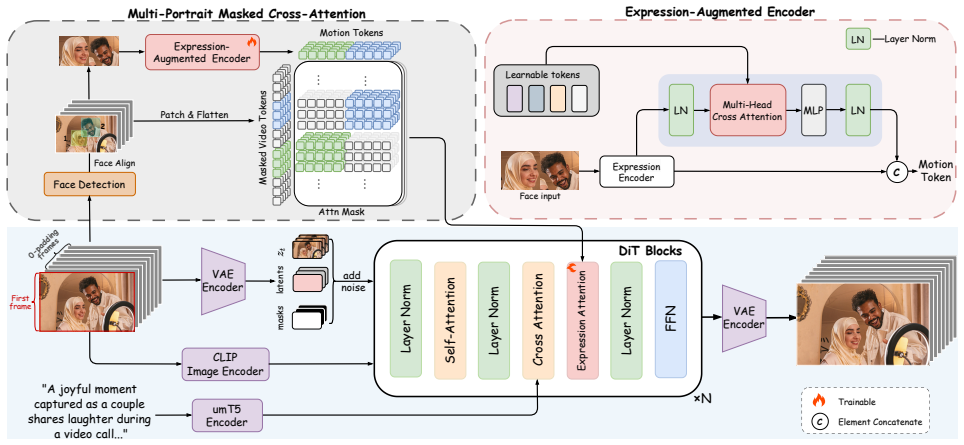
Two mechanisms carry the argument. First, the expression-augmented encoder $E_a$ takes the emotion and lip features ($e_{emo}$, $e_{lip}$) produced by the pretrained implicit extractor and decomposes them into learnable sub-feature tokens that attend to semantically aligned video tokens, capturing region-specific muscle and emotion dynamics; these are concatenated with head pose and eye features into a motion embedding $e_m$. Second, the masked cross-attention mechanism of Eq. 4 computes, in each DiT block, $Z'_i = Z_i + \mathrm{softmax}((M \odot Q_i K_i^\top)/\sqrt{d_K}) V_i$, where the latent mask $M$ is obtained by trilinear interpolation of the detected face mask into the DiT latent space and is multiplied inside the softmax so tokens of one portrait cannot attend to another portrait's motion tokens. The paper's strongest single piece of evidence for this mechanism is the ablation in Table 3, where removing the mask raises cross-reenactment AED on ExprBench-Multi from 34.63 to 73.18.
What would settle it
Run the extractor on a scripted dataset in which many identities perform the same expression set; if the resulting embeddings cluster by identity rather than by expression, the identity-agnostic premise is false. Separately, retrain on ExprBench-Multi with the mask in Eq. 4 ablated; the paper's Table 3 predicts cross-reenactment AED rises from 34.63 to 73.18, so a markedly smaller change would indicate the mask is not the mechanism preventing inter-character interference.
Extended reading notes
Core claim
The central claim is that a single diffusion-transformer framework can control both single- and multi-character portrait animation by decomposing facial dynamics into four implicit components, namely lip motion, eye gaze and blink, head pose, and emotion, and injecting them through cross-attention, with the lip and emotion components passed through an expression-augmented encoder that learns fine-grained sub-features. The authors argue that this avoids the identity leakage and alignment artifacts of landmark- or 3DMM-based controls. To keep multiple characters independent, the cross-attention in every diffusion-transformer block is masked: queries can only attend to motion tokens inside their own character's face mask, mapped into the latent grid by trilinear interpolation. On ExprBench, FantasyPortrait reports the best FID, FVD, LMD, MAE, AED, and APD among the compared methods, and the ablation supports the mask as the decisive component for multi-character control, with cross-reenactment AED worsening from 34.63 to 73.18 when the mask is removed.
Load-bearing premise
The load-bearing premise is that the pretrained implicit expression extractor yields identity-agnostic dynamics and that the face mask, mapped into the DiT latent grid by trilinear interpolation, correctly localizes each character's tokens; if the extractor leaks identity or the mask misaligns, cross-identity and multi-character independence collapse.
Editorial extensions
If this is right
- Cross-identity reenactment no longer needs per-target keypoint adaptation or explicit geometry, so portrait animation can be driven across faces of different ethnicity, age, gender, or even stylized characters.
- Multi-character scenes can be generated in one latent diffusion pass instead of segmenting and compositing faces in pixel space, which removes a class of boundary and discontinuity artifacts.
- Selective augmentation of non-rigid expression features, namely lips and emotion, captures most of the fidelity gain; augmenting head pose and eye features adds little, so compute can be focused on the hard part.
- The release of multi-character training data and a standard benchmark makes multi-character expression animation testable and comparable, which the paper argues was missing from the field.
Reading between the lines
- If the extractor truly separates identity from expression, the same augmented encoder could serve other driving modalities such as audio, text, or synthesized motion; the paper does not test this.
- The masked cross-attention design is not face-specific: any per-object mask could be plugged into Eq. 4, suggesting applications to multi-object or multi-pose animation beyond portraits; this is an extension, not a paper claim.
- Because ExprBench is constructed by the same authors, an external multi-character benchmark would clarify how much of the gain comes from the architecture versus the new training data.
- The reported metrics do not yet measure identity preservation; an identity-retrieval test on generated frames would separate expression fidelity from accidental identity drift.
Editorial analysis
A structured set of objections, weighed in public.
Referee Report
Summary. The paper proposes FantasyPortrait, a diffusion-transformer-based portrait animation framework for single- and multi-character settings. It replaces explicit geometric priors with implicit expression features extracted by a pretrained encoder, adds an expression-augmented module for lip and emotion features, and introduces a masked cross-attention mechanism (Eq. 4) intended to prevent cross-character feature interference. The authors also contribute the Multi-Expr training dataset and the ExprBench evaluation benchmark. Experiments on ExprBench report state-of-the-art quantitative results, a user study, and ablations; the strongest single result is the multi-character AED improvement from 73.18 to 34.63 when the masked cross-attention is used (Table 3). The central claim is that the masked cross-attention provides independent yet coordinated multi-character expression control.
Significance. If the results hold, the paper addresses a real gap: most portrait animation methods are single-character, and multi-character animation suffers from expression leakage. The proposed Multi-Expr dataset and ExprBench benchmark are potentially useful community contributions, and the architecture is coherent with the DiT-based portrait animation trend. The Table 3 ablation suggests the masked cross-attention has a large effect, and the user study is consistent with the method's qualitative advantage. The paper is empirical and does not make parameter-free or theoretical claims; its contribution rests on the validity of the evaluation and the correctness of the mechanism description. These are not yet fully established, as detailed below.
major comments (3)
- [Sec. 3.3, Eq. (4)] This is a single comment.
- [Sec. 4.4, Tables 1 and 2] A second comment.
- [Sec. 3.2] A third comment.
minor comments (8)
- [Author list, p. 1] The name 'Y onggang Qi' contains a spacing artifact and should read 'Yonggang Qi'.
- [Conclusion, Sec. 5] The phrase 'effectively soluting expression leakage' should be 'effectively solving expression leakage'.
- [Sec. 4.1] The text 'dathe Laplacian operator' should read 'the Laplacian operator'.
- [Sec. 3.1, Eq. (1)] The symbols z1 and z0 are used in the loss before they are defined; reorder the definitions for clarity.
- [Table 1] The caption should define all abbreviations, especially MAE, and state the units and direction of each metric; the current text only explains LMD, AED, and APD multipliers.
- [Sec. 4.4, User Studies] The user study reports only mean scores from 32 participants without a description of the protocol, the number of samples per participant, or variance; please provide these details or cite the accompanying materials.
- [Sec. 3.3] The text says face detection uses Huang et al. 2020 (CurricularFace), which is primarily a face recognition method; clarify whether the same model is used for detection and alignment or whether an additional detector is used.
- [Figure 2] Figure 2 is dense and difficult to read at print size; enlarging the diagram and highlighting the mask construction and the Eq. (4) path would improve reproducibility.
Circularity Check
No significant circularity: the central multi-character claim is supported by direct ablations and external pretrained components, not by self-referential fits.
full rationale
FantasyPortrait's derivation chain is empirical rather than definitional. The masked cross-attention mechanism in Eq. 4 is an architectural proposal, and Table 3 directly ablates it: removing MCA raises multi-character AED from 34.63 to 73.18, so the claimed benefit is an experimental finding, not a quantity fitted from the benchmark or defined into existence. The implicit expression extractor Ee is taken from Wang et al. 2023a, an external CVPR method unrelated to the current authors, and the base model Wan2.1 is likewise external. Self-citations such as FantasyTalking appear only as related-work examples and are not load-bearing for the paper's predictions. The author-created ExprBench and Multi-Expr are used for training and evaluation, but comparisons are made against external baselines using standard metrics (FID, FVD, PSNR, SSIM, LMD, MAE, AED, APD), and the strongest internal evidence is a controlled ablation rather than a renaming of inputs. The apparent ambiguity in Eq. 4 -- element-wise mask multiplication instead of additive -inf logit masking -- is an implementation-description or correctness concern, not a circularity, because it does not make the output equivalent to the input by construction. No load-bearing step reduces to its own inputs or to a self-citation chain.
Assumptions & free parameters
free parameters (5)
- Classifier-free guidance scale =
4.5
- Learning rate =
1e-4
- Conditional dropout rate =
0.2
- Inference sampling steps =
30
- Number of learnable expression tokens =
Not reported
assumptions (5)
- domain assumption Wan2.1-I2V-14B provides a strong pretrained video prior that can be adapted to portrait animation with light fine-tuning.
- domain assumption The pretrained implicit expression extractor of Wang et al. 2023a encodes identity-agnostic facial dynamics from driving videos.
- domain assumption Face detection with CurricularFace and landmark alignment with MediaPipe localize faces accurately enough for cropping and mask computation.
- standard math Flow matching and standard latent diffusion objectives are valid training targets for this task.
- domain assumption Videos from OpenVid-1M and OpenHumanVid cover the facial expressions and multi-character layouts needed to learn the task.
Cite this review
Pith. "Pith review of FantasyPortrait: Enhancing Multi-Character Portrait Animation with Expression-Augmented Diffusion Transformers." pith.science (2026). https://pith.science/paper/3VGCUTPZ
@misc{pith2026250712956,
  author       = {Pith},
  title        = {Pith review of: FantasyPortrait: Enhancing Multi-Character Portrait Animation with Expression-Augmented Diffusion Transformers},
  year         = {2026},
  howpublished = {\url{https://pith.science/paper/3VGCUTPZ}},
  note         = {Machine review of arXiv:2507.12956}
}
read the original abstract
Producing expressive facial animations from static images is a challenging task. Prior methods relying on explicit geometric priors (e.g., facial landmarks or 3DMM) often suffer from artifacts in cross reenactment and struggle to capture subtle emotions. Furthermore, existing approaches lack support for multi-character animation, as driving features from different individuals frequently interfere with one another, complicating the task. To address these challenges, we propose FantasyPortrait, a diffusion transformer based framework capable of generating high-fidelity and emotion-rich animations for both single- and multi-character scenarios. Our method introduces an expression-augmented learning strategy that utilizes implicit representations to capture identity-agnostic facial dynamics, enhancing the model's ability to render fine-grained emotions. For multi-character control, we design a masked cross-attention mechanism that ensures independent yet coordinated expression generation, effectively preventing feature interference. To advance research in this area, we propose the Multi-Expr dataset and ExprBench, which are specifically designed datasets and benchmarks for training and evaluating multi-character portrait animations. Extensive experiments demonstrate that FantasyPortrait significantly outperforms state-of-the-art methods in both quantitative metrics and qualitative evaluations, excelling particularly in challenging cross reenactment and multi-character contexts. Our project page is https://fantasy-amap.github.io/fantasy-portrait/.
Figures


Figures from the paper (3 more)


Forward citations
Cited by 4 Pith papers
-
HelloWorld: Enabling Socially Interactive Characters in Video World Models
A video world model that supports button-triggered, viewer-directed social interactions from characters via self-distillation finetuning and a training-free temporal attention mask.
-
ID-V2V: Identity-Preserving Video Restylization
ID-V2V restyles video by conditioning a diffusion model on edited keyframes, depth, relit faces, and face normals, so scene edits propagate while facial identity and performance are preserved.
-
Aura: Consistent Multi-Subject Video Generation via VLM-Grounded Semantic Alignment
Aura combines VLM meta-queries, T5-teacher alignment, subject-aware RoPE shifts, memory tokens, and a large AIGC-curated dataset to claim SOTA multi-element subject-to-video generation under OpenS2V-Eval Total score.
-
FantasyTalking2: Timestep-Layer Adaptive Preference Optimization for Audio-Driven Portrait Animation
A three-part system, Talking-Critic, Talking-NSQ, and TLPO, aligns diffusion portrait animation models to human preferences and improves lip-sync, motion naturalness, and visual quality.
Reference graph
Works this paper leans on
-
[1]
R.; Bai, B.; Chellappa, R.; and Graf, H
Balaji, Y.; Min, M. R.; Bai, B.; Chellappa, R.; and Graf, H. P. 2019. Conditional GAN with Discriminative Filter Generation for Text-to-Video Synthesis. In IJCAI, volume 1, 2
2019
-
[2]
Blattmann, A.; Dockhorn, T.; Kulal, S.; Mendelevitch, D.; Kilian, M.; Lorenz, D.; Levi, Y.; English, Z.; Voleti, V.; Letts, A.; et al. 2023. Stable video diffusion: Scaling latent video diffusion models to large datasets. arXiv preprint arXiv:2311.15127
arXiv 2023
-
[3]
Cao, C.; Zhou, J.; Li, S.; Liang, J.; Yu, C.; Wang, F.; Xue, X.; and Fu, Y. 2025. Uni3C: Unifying Precisely 3D-Enhanced Camera and Human Motion Controls for Video Generation. arXiv preprint arXiv:2504.14899
arXiv 2025
-
[4]
Chu, M.; Xie, Y.; Mayer, J.; Leal-Taix \'e , L.; and Thuerey, N. 2020. Learning temporal coherence via self-supervision for GAN-based video generation. ACM Transactions on Graphics (TOG), 39(4): 75--1
work page 2020
-
[5]
W.; Constant, N.; Garcia, X.; Roberts, A.; Tay, Y.; Narang, S.; and Firat, O
Chung, H. W.; Constant, N.; Garcia, X.; Roberts, A.; Tay, Y.; Narang, S.; and Firat, O. 2023. Unimax: Fairer and more effective language sampling for large-scale multilingual pretraining. arXiv preprint arXiv:2304.09151
arXiv 2023
-
[6]
Clark, A.; Donahue, J.; and Simonyan, K. 2019. Adversarial video generation on complex datasets. arXiv preprint arXiv:1907.06571
arXiv 2019
-
[7]
Cui, J.; Chen, Y.; Xu, M.; Shang, H.; Chen, Y.; Zhan, Y.; Dong, Z.; Yao, Y.; Wang, J.; and Zhu, S. 2025 a . Hallo4: High-Fidelity Dynamic Portrait Animation via Direct Preference Optimization and Temporal Motion Modulation. arXiv preprint arXiv:2505.23525
arXiv 2025
-
[8]
Cui, J.; Li, H.; Zhan, Y.; Shang, H.; Cheng, K.; Ma, Y.; Mu, S.; Zhou, H.; Wang, J.; and Zhu, S. 2025 b . Hallo3: Highly dynamic and realistic portrait image animation with video diffusion transformer. In Proceedings of the Computer Vision and Pattern Recognition Conference, 21086--21095
2025
Show all 64 references
-
[9]
Deng, Y.; Wang, D.; Ren, X.; Chen, X.; and Wang, B. 2024. Portrait4d: Learning one-shot 4d head avatar synthesis using synthetic data. In Proceedings of the IEEE/CVF Conference on Computer Vision and Pattern Recognition, 7119--7130
2024
-
[10]
Dhariwal, P.; and Nichol, A. 2021. Diffusion models beat gans on image synthesis. Advances in neural information processing systems, 34: 8780--8794
2021
-
[11]
Drobyshev, N.; Chelishev, J.; Khakhulin, T.; Ivakhnenko, A.; Lempitsky, V.; and Zakharov, E. 2022. Megaportraits: One-shot megapixel neural head avatars. In Proceedings of the 30th ACM International Conference on Multimedia, 2663--2671
2022
-
[12]
A.; Tewari, A.; Wuhrer, S.; Zollhoefer, M.; Beeler, T.; Bernard, F.; Bolkart, T.; Kortylewski, A.; Romdhani, S.; et al
Egger, B.; Smith, W. A.; Tewari, A.; Wuhrer, S.; Zollhoefer, M.; Beeler, T.; Bernard, F.; Bolkart, T.; Kortylewski, A.; Romdhani, S.; et al. 2020. 3d morphable face models—past, present, and future. ACM Transactions on Graphics (ToG), 39(5): 1--38
2020
-
[13]
Esser, P.; Kulal, S.; Blattmann, A.; Entezari, R.; M \"u ller, J.; Saini, H.; Levi, Y.; Lorenz, D.; Sauer, A.; Boesel, F.; et al. 2024. Scaling rectified flow transformers for high-resolution image synthesis. In Forty-first international conference on machine learning
2024
-
[14]
Goodfellow, I.; Pouget-Abadie, J.; Mirza, M.; Xu, B.; Warde-Farley, D.; Ozair, S.; Courville, A.; and Bengio, Y. 2020. Generative adversarial networks. Communications of the ACM, 63(11): 139--144
2020
-
[15]
Gu, Y.; Xu, H.; Xie, Y.; Song, G.; Shi, Y.; Chang, D.; Yang, J.; and Luo, L. 2024. Diffportrait3d: Controllable diffusion for zero-shot portrait view synthesis. In Proceedings of the IEEE/CVF Conference on Computer Vision and Pattern Recognition, 10456--10465
2024
-
[16]
Guo, J.; Zhang, D.; Liu, X.; Zhong, Z.; Zhang, Y.; Wan, P.; and Zhang, D. 2024. Liveportrait: Efficient portrait animation with stitching and retargeting control. arXiv preprint arXiv:2407.03168
2024 arXiv
-
[17]
Guo, Y.; Yang, C.; Rao, A.; Liang, Z.; Wang, Y.; Qiao, Y.; Agrawala, M.; Lin, D.; and Dai, B. 2023. Animatediff: Animate your personalized text-to-image diffusion models without specific tuning. arXiv preprint arXiv:2307.04725
2023 arXiv
-
[18]
Han, Y.; Zhu, J.; He, K.; Chen, X.; Ge, Y.; Li, W.; Li, X.; Zhang, J.; Wang, C.; and Liu, Y. 2024. Face-Adapter for Pre-trained Diffusion Models with Fine-Grained ID and Attribute Control. In European Conference on Computer Vision, 20--36. Springer
2024
-
[19]
Heusel, M.; Ramsauer, H.; Unterthiner, T.; Nessler, B.; and Hochreiter, S. 2017. Gans trained by a two time-scale update rule converge to a local nash equilibrium. Advances in neural information processing systems, 30
2017
-
[20]
Ho, J.; Jain, A.; and Abbeel, P. 2020. Denoising diffusion probabilistic models. Advances in neural information processing systems, 33: 6840--6851
2020
-
[21]
Ho, J.; and Salimans, T. 2022. Classifier-free diffusion guidance. arXiv preprint arXiv:2207.12598
2022 arXiv
-
[22]
Hong, W.; Wang, W.; Ding, M.; Yu, W.; Lv, Q.; Wang, Y.; Cheng, Y.; Huang, S.; Ji, J.; Xue, Z.; et al. 2024. Cogvlm2: Visual language models for image and video understanding. arXiv preprint arXiv:2408.16500
2024 arXiv
-
[23]
Huang, Y.; Wang, Y.; Tai, Y.; Liu, X.; Shen, P.; Li, S.; Li, J.; and Huang, F. 2020. Curricularface: adaptive curriculum learning loss for deep face recognition. In proceedings of the IEEE/CVF conference on computer vision and pattern recognition, 5901--5910
2020
-
[24]
Khmel, I. 2021. Humanization of Virtual Communication: from Digit to Image. Philosophy and Cosmology, 27(27): 126--134
2021
-
[25]
P.; Welling, M.; et al
Kingma, D. P.; Welling, M.; et al. 2013. Auto-encoding variational bayes
2013
-
[26]
Kong, W.; Tian, Q.; Zhang, Z.; Min, R.; Dai, Z.; Zhou, J.; Xiong, J.; Li, X.; Wu, B.; Zhang, J.; et al. 2024. Hunyuanvideo: A systematic framework for large video generative models. arXiv preprint arXiv:2412.03603
2024 arXiv
-
[27]
Kong, Z.; Gao, F.; Zhang, Y.; Kang, Z.; Wei, X.; Cai, X.; Chen, G.; and Luo, W. 2025. Let Them Talk: Audio-Driven Multi-Person Conversational Video Generation. arXiv preprint arXiv:2505.22647
2025 arXiv
-
[28]
Li, H.; Xu, M.; Zhan, Y.; Mu, S.; Li, J.; Cheng, K.; Chen, Y.; Chen, T.; Ye, M.; Wang, J.; et al. 2025. Openhumanvid: A large-scale high-quality dataset for enhancing human-centric video generation. In Proceedings of the Computer Vision and Pattern Recognition Conference, 7752--7762
2025
-
[29]
Li, R.; Zhang, H.; Zhang, Y.; Zhang, Y.; Zhang, Y.; Guo, J.; Zhang, Y.; Li, X.; and Liu, Y. 2024. Lodge++: High-quality and long dance generation with vivid choreography patterns. arXiv preprint arXiv:2410.20389
2024 arXiv
-
[30]
T.; Ben-Hamu, H.; Nickel, M.; and Le, M
Lipman, Y.; Chen, R. T.; Ben-Hamu, H.; Nickel, M.; and Le, M. 2022. Flow matching for generative modeling. arXiv preprint arXiv:2210.02747
2022 arXiv
-
[31]
Liu, L.; Ma, T.; Li, B.; Chen, Z.; Liu, J.; Li, G.; Zhou, S.; He, Q.; and Wu, X. 2025. Phantom: Subject-consistent video generation via cross-modal alignment. arXiv preprint arXiv:2502.11079
2025 arXiv
-
[32]
G.; Lee, J.; et al
Lugaresi, C.; Tang, J.; Nash, H.; McClanahan, C.; Uboweja, E.; Hays, M.; Zhang, F.; Chang, C.-L.; Yong, M. G.; Lee, J.; et al. 2019. Mediapipe: A framework for building perception pipelines. arXiv preprint arXiv:1906.08172
2019 arXiv
-
[33]
Ma, Y.; Liu, H.; Wang, H.; Pan, H.; He, Y.; Yuan, J.; Zeng, A.; Cai, C.; Shum, H.-Y.; Liu, W.; et al. 2024. Follow-your-emoji: Fine-controllable and expressive freestyle portrait animation. In SIGGRAPH Asia 2024 Conference Papers, 1--12
2024
-
[34]
Nan, K.; Xie, R.; Zhou, P.; Fan, T.; Yang, Z.; Chen, Z.; Li, X.; Yang, J.; and Tai, Y. 2024. Openvid-1m: A large-scale high-quality dataset for text-to-video generation. arXiv preprint arXiv:2407.02371
2024 arXiv
-
[35]
Peebles, W.; and Xie, S. 2023. Scalable diffusion models with transformers. In Proceedings of the IEEE/CVF international conference on computer vision, 4195--4205
2023
-
[36]
Podell, D.; English, Z.; Lacey, K.; Blattmann, A.; Dockhorn, T.; M \"u ller, J.; Penna, J.; and Rombach, R. 2023. Sdxl: Improving latent diffusion models for high-resolution image synthesis. arXiv preprint arXiv:2307.01952
2023 arXiv
-
[37]
Qiu, D.; Fei, Z.; Wang, R.; Bai, J.; Yu, C.; Fan, M.; Chen, G.; and Wen, X. 2025. Skyreels-a1: Expressive portrait animation in video diffusion transformers. arXiv preprint arXiv:2502.10841
2025 arXiv
-
[38]
W.; Hallacy, C.; Ramesh, A.; Goh, G.; Agarwal, S.; Sastry, G.; Askell, A.; Mishkin, P.; Clark, J.; et al
Radford, A.; Kim, J. W.; Hallacy, C.; Ramesh, A.; Goh, G.; Agarwal, S.; Sastry, G.; Askell, A.; Mishkin, P.; Clark, J.; et al. 2021. Learning transferable visual models from natural language supervision. In International conference on machine learning, 8748--8763. PmLR
2021
-
[39]
Reis, D.; Kupec, J.; Hong, J.; and Daoudi, A. 2023. Real-time flying object detection with YOLOv8. arXiv preprint arXiv:2305.09972
2023 arXiv
-
[40]
P.; Danecek, R.; Abrevaya, V
Retsinas, G.; Filntisis, P. P.; Danecek, R.; Abrevaya, V. F.; Roussos, A.; Bolkart, T.; and Maragos, P. 2024. 3D facial expressions through analysis-by-neural-synthesis. In Proceedings of the IEEE/CVF Conference on Computer Vision and Pattern Recognition, 2490--2501
2024
-
[41]
Rombach, R.; Blattmann, A.; Lorenz, D.; Esser, P.; and Ommer, B. 2022. High-resolution image synthesis with latent diffusion models. In Proceedings of the IEEE/CVF conference on computer vision and pattern recognition, 10684--10695
2022
-
[42]
Ronneberger, O.; Fischer, P.; and Brox, T. 2015. U-net: Convolutional networks for biomedical image segmentation. In Medical image computing and computer-assisted intervention--MICCAI 2015: 18th international conference, Munich, Germany, October 5-9, 2015, proceedings, part II...
2015
-
[43]
Seawead, T.; Yang, C.; Lin, Z.; Zhao, Y.; Lin, S.; Ma, Z.; Guo, H.; Chen, H.; Qi, L.; Wang, S.; et al. 2025. Seaweed-7b: Cost-effective training of video generation foundation model. arXiv preprint arXiv:2504.08685
2025 arXiv
-
[44]
Siarohin, A.; Lathuili \`e re, S.; Tulyakov, S.; Ricci, E.; and Sebe, N. 2019. First order motion model for image animation. Advances in neural information processing systems, 32
2019
-
[45]
Unterthiner, T.; Van Steenkiste, S.; Kurach, K.; Marinier, R.; Michalski, M.; and Gelly, S. 2019. FVD: A new metric for video generation
2019
-
[46]
Wan, T.; Wang, A.; Ai, B.; Wen, B.; Mao, C.; Xie, C.-W.; Chen, D.; Yu, F.; Zhao, H.; Yang, J.; et al. 2025. Wan: Open and advanced large-scale video generative models. arXiv preprint arXiv:2503.20314
2025 arXiv
-
[47]
Wang, D.; Deng, Y.; Yin, Z.; Shum, H.-Y.; and Wang, B. 2023 a . Progressive disentangled representation learning for fine-grained controllable talking head synthesis. In Proceedings of the IEEE/CVF Conference on Computer Vision and Pattern Recognition, 17979--17989
2023
-
[48]
Wang, J.; Yuan, H.; Chen, D.; Zhang, Y.; Wang, X.; and Zhang, S. 2023 b . Modelscope text-to-video technical report. arXiv preprint arXiv:2308.06571
2023 arXiv
-
[49]
Wang, M.; Wang, Q.; Jiang, F.; Fan, Y.; Zhang, Y.; Qi, Y.; Zhao, K.; and Xu, M. 2025. Fantasytalking: Realistic talking portrait generation via coherent motion synthesis. arXiv preprint arXiv:2504.04842
2025 arXiv
-
[50]
Wang, Y.; Bilinski, P.; Bremond, F.; and Dantcheva, A. 2020. Imaginator: Conditional spatio-temporal gan for video generation. In Proceedings of the IEEE/CVF winter conference on applications of computer vision, 1160--1169
2020
-
[51]
C.; Sheikh, H
Wang, Z.; Bovik, A. C.; Sheikh, H. R.; and Simoncelli, E. P. 2004. Image quality assessment: from error visibility to structural similarity. IEEE transactions on image processing, 13(4): 600--612
2004
-
[52]
Xie, Y.; Xu, H.; Song, G.; Wang, C.; Shi, Y.; and Luo, L. 2024. X-portrait: Expressive portrait animation with hierarchical motion attention. In ACM SIGGRAPH 2024 Conference Papers, 1--11
2024
-
[53]
Xu, Z.; Yu, Z.; Zhou, Z.; Zhou, J.; Jin, X.; Hong, F.-T.; Ji, X.; Zhu, J.; Cai, C.; Tang, S.; et al. 2025. Hunyuanportrait: Implicit condition control for enhanced portrait animation. In Proceedings of the Computer Vision and Pattern Recognition Conference, 15909--15919
2025
-
[54]
Yang, Z.; Teng, J.; Zheng, W.; Ding, M.; Huang, S.; Xu, J.; Yang, Y.; Hong, W.; Zhang, X.; Feng, G.; et al. 2024. Cogvideox: Text-to-video diffusion models with an expert transformer. arXiv preprint arXiv:2408.06072
2024 arXiv
-
[55]
Yang, Z.; Zeng, A.; Yuan, C.; and Li, Y. 2023. Effective whole-body pose estimation with two-stages distillation. In Proceedings of the IEEE/CVF International Conference on Computer Vision, 4210--4220
2023
-
[56]
Ye, Z.; Zhong, T.; Ren, Y.; Yang, J.; Li, W.; Huang, J.; Jiang, Z.; He, J.; Huang, R.; Liu, J.; et al. 2024. Real3d-portrait: One-shot realistic 3d talking portrait synthesis. arXiv preprint arXiv:2401.08503
2024 arXiv
-
[57]
Yeh, H.-H.; Yang, C.-Y.; Lee, M.-S.; and Chen, C.-S. 2013. Video aesthetic quality assessment by temporal integration of photo-and motion-based features. IEEE transactions on multimedia, 15(8): 1944--1957
2013
-
[58]
Yu, W.; Fan, Y.; Zhang, Y.; Wang, X.; Yin, F.; Bai, Y.; Cao, Y.-P.; Shan, Y.; Wu, Y.; Sun, Z.; et al. 2023. Nofa: Nerf-based one-shot facial avatar reconstruction. In ACM SIGGRAPH 2023 conference proceedings, 1--12
2023
-
[59]
Yuan, S.; Huang, J.; He, X.; Ge, Y.; Shi, Y.; Chen, L.; Luo, J.; and Yuan, L. 2025. Identity-preserving text-to-video generation by frequency decomposition. In Proceedings of the Computer Vision and Pattern Recognition Conference, 12978--12988
2025
-
[60]
Zeng, B.; Liu, X.; Gao, S.; Liu, B.; Li, H.; Liu, J.; and Zhang, B. 2023. Face animation with an attribute-guided diffusion model. In Proceedings of the IEEE/CVF Conference on Computer Vision and Pattern Recognition, 628--637
2023
-
[61]
Zhang, Y.; Wang, Q.; Jiang, F.; Fan, Y.; Xu, M.; and Qi, Y. 2025. Fantasyid: Face knowledge enhanced id-preserving video generation. arXiv preprint arXiv:2502.13995
2025 arXiv
-
[62]
Zheng, G.; Li, T.; Jiang, R.; Lu, Y.; Wu, T.; and Li, X. 2024. Cami2v: Camera-controlled image-to-video diffusion model. arXiv preprint arXiv:2410.15957
2024 arXiv
-
[63]
, " * write output.state after.block = add.period write newline
ENTRY address archivePrefix author booktitle chapter edition editor eid eprint howpublished institution isbn journal key month note number organization pages publisher school series title type volume year label extra.label sort.label short.list INTEGERS output.state before.all...
-
[64]
write newline
" write newline "" before.all 'output.state := FUNCTION n.dashify 't := "" t empty not t #1 #1 substring "-" = t #1 #2 substring "--" = not "--" * t #2 global.max substring 't := t #1 #1 substring "-" = "-" * t #2 global.max substring 't := while if t #1 #1 substring * t #2 gl...
Reviewed August 6, 2026 · model on record in the stance chip above.
Discussion (0). Sign in to comment.