REVIEW 3 major objections 7 minor 243 references
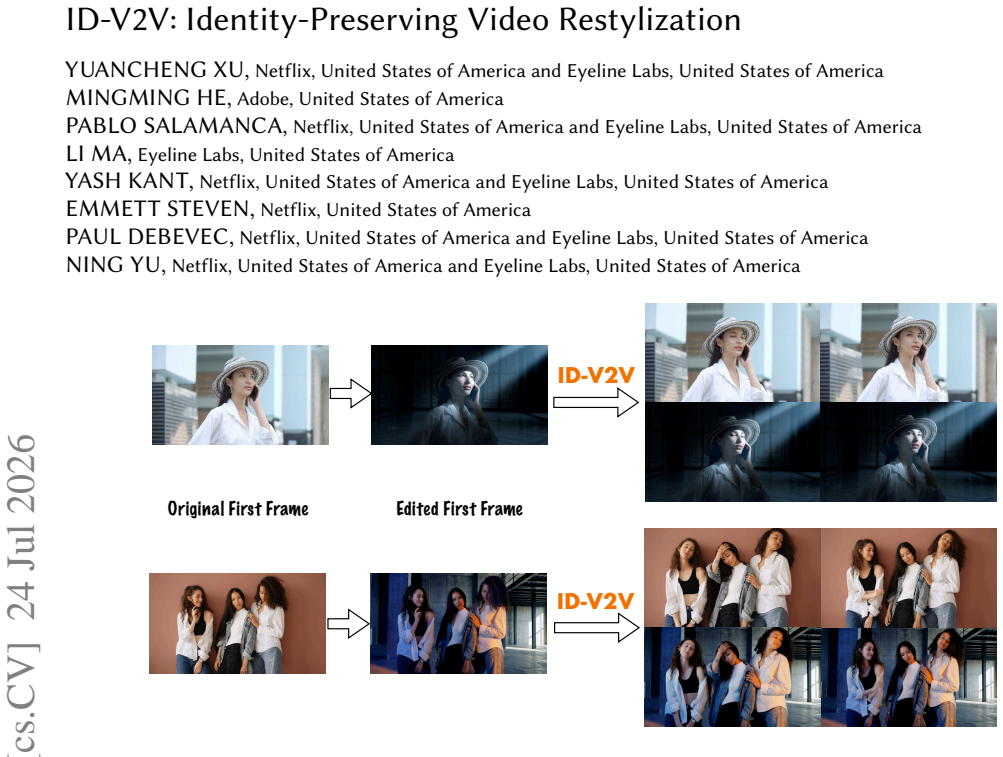
A video-to-video framework that propagates scene, lighting, and style edits from an edited keyframe across a video while preserving facial identity and fine-grained facial performance, by decoupling edit-driven synthesis from source-grounde
Reviewed by Pith at T0; open to challenge. T0 means a machine referee read the full paper against a public rubric. the ladder, T0–T4 →
T0 review · deepseek-v4-flash
2026-08-01 04:22 UTC pith:6Y5DFVDH
load-bearing objection A credible, practically useful video restylization system with a clever single-video training recipe; the main unresolved risk is the unmeasured fidelity of the relighting model that generates the training conditions. the 3 major comments →
ID-V2V: Identity-Preserving Video Restylization
The pith
A machine-rendered reading of the paper's core claim, the machinery that carries it, and where it could break.
Core claim
The paper's core discovery is that identity preservation and edit propagation can be decoupled, and that identity preservation can be treated as a video relighting problem. Under identity-preserving restylization, facial structure and expression are invariant; illumination is the primary permissible variation. ID-V2V therefore conditions the video generator on relit face regions (the source face with its lighting normalized) and facial normal maps to anchor likeness and performance, while the edited keyframe plus a depth sequence drives the synthesis of the new scene and lighting across time. Training pairs are synthesized from a single stylized video by relighting faces to a regular top-lit
What carries the argument
The key machinery is the two-channel conditioning scheme. 'Relit face video' — the source face with illumination normalized to a fixed top-lit configuration by a dedicated image-based relighting model — supplies pixel-level appearance cues so the generator learns to transform regular lighting into the stylized lighting of the edited keyframe. Facial normal maps add geometric constraints that resolve lighting/shape ambiguity and prevent identity drift. On the synthesis side, the edited first frame and a source depth sequence specify the target scene and motion. All controls are injected through a shared multi-control diffusion branch whose features are summed before entering the main video tr
Load-bearing premise
The method assumes the source video was captured under roughly regular, top-lit illumination matching the training relighting target, and that the relighting model used to build training pairs preserves identity and expressions; if either gives way, the identity-preservation channel is corrupted.
What would settle it
Run ID-V2V on a set of source videos with deliberately non-top-lit illumination (strong colored light, hard shadows, underlighting), edit the first frame to a neutral look, and measure AdaFace and expression-preservation scores in later frames. If residual color casts or shadows reappear and identity/expression scores drop systematically, the claim that illumination is the primary permissible variation holds only inside a narrow training-lighting regime.
If this is right
- A capture-first workflow becomes practical: shoot under simple lighting, edit one keyframe to set the look, and generate the whole restyled video with identity and performance intact.
- Paired training data is no longer a bottleneck: synthetic pairs derived from single videos via relighting are sufficient to train the model.
- Fine-grained facial performance cues such as lip sync, gaze, and micro-expressions are retained at levels that landmark- or embedding-based video generators do not reach.
- Multi-subject sequences remain coherent: each person's identity and their facial interactions are preserved while the scene is restyled.
- The relighting-based control generalizes beyond the face at inference, extending to full-scene relighting of body, objects, and background without explicit training for it.
Where Pith is reading between the lines
- The fidelity ceiling of the whole pipeline is set by the relighting model: any identity or expression distortion introduced when synthesizing the relit training faces will propagate into the restyled video, so improving relighting quality is a direct lever on the method's core claim.
- The fixed top-lit training target quietly restricts the method to source footage with ordinary illumination; training with a distribution of canonical lighting conditions would be a natural extension to cover the colored-light and hard-shadow failure documented in the paper.
- The decoupling principle generalizes: any edit that leaves facial structure and performance invariant, such as makeup or hairstyle changes, could reuse the same identity-preservation channel, with new synthesis-side controls for the edit type.
- The single-video synthetic-pair construction is a transferable recipe for video-editing tasks that suffer from scarce paired corpora, not just for lighting-driven restylization.
Editorial analysis
A structured set of objections, weighed in public.
Referee Report
Summary. The paper formalizes identity-preserving video restylization, in which an edited first frame specifies scene/lighting/style edits that must propagate across a source video while preserving facial identity and fine-grained facial performance (expressions, gaze, lip sync). The proposed system, ID-V2V, decouples edit-driven synthesis (conditioned on the edited keyframe and a depth sequence) from source-grounded identity preservation (conditioned on relit face regions and facial normal maps). Training pairs are synthesized from single videos: a learned image-based relighting model converts cinematic training faces to a fixed 'regular' top-lit condition, and the video model is trained to map those relit faces back to the original cinematic target. At inference, the original source-face pixels replace the relit-face condition. Experiments on 100 single-subject and 60 two-subject videos report large gains over baselines in AdaFace, Exp-AU, Exp-EMOCA, and user-study win rates, with ablations showing both relit-face and normal controls contribute. The paper also qualitatively demonstrates multi-subject (>2) restylization and full-scene relighting.
Significance. If the central claim holds, ID-V2V would be a practically valuable contribution: it enables a capture-first, restyle-later workflow for human-centric video editing, with an elegant solution to the paired-data scarcity problem via single-video training-pair construction. The decoupling insight and the use of relit faces as a proxy for source video lighting are conceptually clean. The reported quantitative gains are large and consistent, and the user-study preferences are strong. The paper releases code, which supports reproducibility. However, the significance is contingent on the validity of the relighting-model-based training pipeline and on the statistical reliability of the evaluations; both currently have gaps.
major comments (3)
- [§3.2, §3.3] The training and inference protocols create a distributional gap that is load-bearing for the central claim. The model is trained on relit face regions produced by a learned relighting model, but at inference it is conditioned on the original source-face pixels. The paper asserts (Fig. 2, §3.2) that relit faces 'simulate the lighting conditions of the source video at inference,' but the relighting model's fidelity is never quantitatively evaluated. If the relighting model distorts identity, expression, gaze, or lip shape, the video model learns a mapping from a corrupted condition, and at inference the undistorted source face is off-distribution. This would degrade identity/performance preservation even under the intended regular-lighting regime, a failure more fundamental than the acknowledged extreme-lighting limitation. The paper reports only qualitative examples (Fig. 6). Please repo
- [Table 1, §4.1, §4.2] The claim that ID-V2V 'significantly outperforms' baselines is not statistically substantiated. Table 1 reports point estimates without error bars, confidence intervals, or significance tests. The evaluation datasets are self-curated (100+60 videos) with manual filtering of edited keyframes (§4.1), and the face-related metrics are computed only on frames with detected faces (§4.2). The user study uses 26 participants and 20 samples per setting, but win rates are reported without variance or significance. Please provide per-metric uncertainty (e.g., bootstrap CIs) and paired significance tests (e.g., Wilcoxon signed-rank) for the facial metrics and user-study results, and describe the manual filtering criteria to assess potential selection bias.
- [§4.1, Fig. 8] The paper lists multi-subject support as a key contribution, but the quantitative evaluation is limited to two subjects; the more-than-two-subject results are only qualitative (Fig. 8). Given that existing baselines are 'unable to reliably handle more subjects' and thus are not compared, the evidence for the claimed multi-subject advantage is thin. Please either provide quantitative results for datasets with three or more subjects or explicitly scope the claim to two subjects, with the >2-subject case presented as a qualitative demonstration.
minor comments (7)
- [Author affiliations] The affiliations contain duplicated 'and' (e.g., 'United States of America and and Eyeline Labs'). Please correct.
- [§3.2] The citation 'LuxPostFacto [Debevec et al. 2000]' is incorrect: LuxPostFacto is Mei et al. 2025, while Debevec et al. 2000 is the OLAT data source. Please fix the reference.
- [§3.2] In the Relighting Model Training paragraph, the OLAT data description cites '[Debevec et al. 2000]' twice; the first mention should likely cite Mei et al. 2025 for the LuxPostFacto hybrid dataset.
- [Fig. 1] The text says 'illustrated in 1' — should be 'Fig. 1'.
- [§3.2] The sentence 'The model takes the edited keyframe together with a depth sequence extracted from the source video using DepthAnything 2 [Yang et al. 2024a].' is missing a period after 'DepthAnything 2' and the citation placement is awkward.
- [§4.3] The user study description says 'each containing 20 samples, with 26 participants,' but Table 1 reports win rates as percentages. Clarify the denominator (e.g., total pairwise responses) and report exact counts or confidence intervals.
- [Table 1] The VBench metrics (Subject Consistency, Background Consistency, Temporal Flickering, Human Anatomy) are reported to three decimals without any uncertainty; consider consolidating these or reporting with appropriate precision.
Circularity Check
No significant circularity: training pairs are self-supervised, evaluation is on held-out videos with independently edited keyframes, and source-pixel conditioning is the intended mechanism rather than a postdicted fit.
full rationale
ID-V2V's derivation chain is not circular. The missing paired data are addressed by constructing training pairs from a single video via a relighting model: cinematic training faces are relit to a regular top-lit condition, and the video model is trained to map that relit face plus keyframe/depth controls back to the original cinematic target (Sec. 3.2). This is self-supervised pair construction, not a postdiction of the evaluation metrics. Evaluation (Sec. 4) uses 100 single-subject and 60 two-subject held-out videos with keyframes edited by an independent image-editing model (Qwen-Image-Edit), and identity/performance metrics compare generated videos against the source. No parameter is fitted to the test set. Using original source face pixels at inference (Sec. 3.3) is an explicit design for the task, not a hidden equivalence: the edited keyframe still must be propagated, and ablations (Table 1) show identity metrics degrade when face-video or normal signals are removed, so scores are not forced by construction. Author-overlapping citations (LuxPostFacto, DifFRelight, OLAT) are implementation/data references, not load-bearing uniqueness claims. The acknowledged failure under extreme source lighting (Sec. 4.3, Fig. 5, Limitations) is an honest boundary on the claim, and the unquantified fidelity of the relighting model is a validation gap, not a circular step. Therefore no circularity is warranted.
Axiom & Free-Parameter Ledger
free parameters (2)
- Top-lighting HDRI configuration =
vertically half-white/half-black HDRI (hand-chosen)
- Face curation thresholds =
up to 5 faces/frame; discard videos with >40% frames lacking faces
axioms (4)
- domain assumption Facial structure and expression remain invariant under restylization; illumination is the primary permissible facial variation.
- domain assumption The image relighting model converts arbitrary cinematic lighting to regular top lighting without changing identity or performance.
- domain assumption At inference, source videos are captured under approximately regular lighting that matches the top-lit training condition.
- domain assumption Pretrained DepthAnythingV2, DAViD, SCRFD, AdaFace, and EMOCA provide adequate depth, normals, face detection, and expression estimates.
read the original abstract
In visual storytelling, human performances are central to creative intent and narrative meaning. However, preserving human identity and performance while enabling flexible visual edits remains challenging for generative video models. We formalize this challenge as identity-preserving video restylization, which propagates scene, lighting, and style changes specified by an edited keyframe across a source video, while preserving facial likeness and performance, including expressions, eye gaze, and lip synchronization. A key obstacle is the absence of paired training data, as identity-preserving restylized video pairs are rare in real-world settings. To address this, we propose a decoupling of source-grounded identity preservation and edit-driven video synthesis. Our key insight is that facial appearance and expression should remain invariant, with illumination being the primary permissible variation. We therefore cast identity preservation as a video relighting problem, while modeling visual edit propagation as controlled video synthesis guided by the edited keyframe. Building on this formulation, we introduce ID-V2V, a video-to-video generative framework integrating complementary control signals: relit facial regions and facial normal maps tightly constrain facial likeness and performance, while edited keyframes and depth sequences enable flexible and temporally coherent generation. This design enables constructing training pairs from a single video, eliminating the need for scarce paired data. Extensive experiments demonstrate that ID-V2V significantly outperforms existing methods in preserving facial likeness and fine-grained facial performance, supports both single- and multi-subject scenarios, and delivers high visual quality, highlighting its potential as a human-centric tool for real-world content production. The code is available at: https://github.com/Eyeline-Labs/ID-V2V.
Figures


Reference graph
Works this paper leans on
-
[1]
ICLR , year=
Animatediff: Animate your personalized text-to-image diffusion models without specific tuning , author=. ICLR , year=
-
[2]
CVPR , year=
Align your latents: High-resolution video synthesis with latent diffusion models , author=. CVPR , year=
-
[3]
arXiv , year=
Cogvideox: Text-to-video diffusion models with an expert transformer , author=. arXiv , year=
-
[4]
ECCV , year=
Sparsectrl: Adding sparse controls to text-to-video diffusion models , author=. ECCV , year=
-
[5]
arXiv , year=
Stable video diffusion: Scaling latent video diffusion models to large datasets , author=. arXiv , year=
-
[6]
2024 , author=
Video generation models as world simulators. 2024 , author=. URL https://openai. com/research/video-generation-models-as-world-simulators , year=
2024
-
[7]
ICLR , year=
Language Model Beats Diffusion--Tokenizer is Key to Visual Generation , author=. ICLR , year=
-
[8]
arXiv , year=
Latte: Latent diffusion transformer for video generation , author=. arXiv , year=
-
[9]
CVPR , year=
Peekaboo: Interactive video generation via masked-diffusion , author=. CVPR , year=
-
[10]
SIGGRAPH , year=
Direct-a-video: Customized video generation with user-directed camera movement and object motion , author=. SIGGRAPH , year=
-
[11]
SIGGRAPH , year=
Motionctrl: A unified and flexible motion controller for video generation , author=. SIGGRAPH , year=
-
[12]
SIGGRAPH , year=
Motion-i2v: Consistent and controllable image-to-video generation with explicit motion modeling , author=. SIGGRAPH , year=
-
[13]
ECCV , year=
Draganything: Motion control for anything using entity representation , author=. ECCV , year=
-
[14]
arXiv , year=
MotionClone: Training-Free Motion Cloning for Controllable Video Generation , author=. arXiv , year=
-
[15]
NeurIPS , year=
Videocomposer: Compositional video synthesis with motion controllability , author=. NeurIPS , year=
-
[16]
ICLR , year=
Tokenflow: Consistent diffusion features for consistent video editing , author=. ICLR , year=
-
[17]
AAAI , year=
Scalable Motion Style Transfer with Constrained Diffusion Generation , author=. AAAI , year=
-
[18]
arXiv , year=
Anyv2v: A plug-and-play framework for any video-to-video editing tasks , author=. arXiv , year=
-
[19]
arXiv , year=
Collaborative Video Diffusion: Consistent Multi-video Generation with Camera Control , author=. arXiv , year=
-
[20]
arXiv , year=
CamCo: Camera-Controllable 3D-Consistent Image-to-Video Generation , author=. arXiv , year=
-
[21]
ICLR , year=
How I Warped Your Noise: a Temporally-Correlated Noise Prior for Diffusion Models , author=. ICLR , year=
-
[22]
arXiv , year=
Continuous 3D Perception Model with Persistent State , author=. arXiv , year=
-
[23]
arXiv , year=
SG-I2V: Self-Guided Trajectory Control in Image-to-Video Generation , author=. arXiv , year=
-
[24]
2022 , booktitle=
LoRA: Low-Rank Adaptation of Large Language Models , author=. 2022 , booktitle=
2022
-
[25]
CVPR , year=
Space-time diffusion features for zero-shot text-driven motion transfer , author=. CVPR , year=
-
[26]
ICCV , year=
Preserve your own correlation: A noise prior for video diffusion models , author=. ICCV , year=
-
[27]
arXiv , year=
Control-a-video: Controllable text-to-video generation with diffusion models , author=. arXiv , year=
-
[28]
arXiv , year=
Infinite-Resolution Integral Noise Warping for Diffusion Models , author=. arXiv , year=
-
[29]
SIGGRAPH Asia , year=
DifFRelight: Diffusion-Based Facial Performance Relighting , author=. SIGGRAPH Asia , year=
-
[30]
URL https://github.com/deep-floyd/IF?tab=readme-ov-file , year=
DeepFloyd IF , author=. URL https://github.com/deep-floyd/IF?tab=readme-ov-file , year=
-
[31]
CVPR , year=
Vbench: Comprehensive benchmark suite for video generative models , author=. CVPR , year=
-
[32]
arXiv , year=
The 2017 davis challenge on video object segmentation , author=. arXiv , year=
2017
-
[33]
CVPR , year=
Dl3dv-10k: A large-scale scene dataset for deep learning-based 3d vision , author=. CVPR , year=
-
[34]
CVPR , year=
Wonderjourney: Going from anywhere to everywhere , author=. CVPR , year=
-
[35]
ECCV , year=
Raft: Recurrent all-pairs field transforms for optical flow , author=. ECCV , year=
-
[36]
2021 , publisher=
Learning Blender , author=. 2021 , publisher=
2021
-
[37]
NeurIPS , year=
MotionCraft: Physics-based Zero-Shot Video Generation , author=. NeurIPS , year=
-
[38]
International Conference on Learning Representations (ICLR) , year=
Real-time Photorealistic Dynamic Scene Representation and Rendering with 4D Gaussian Splatting , author=. International Conference on Learning Representations (ICLR) , year=
-
[39]
ICLR , year=
Score-based generative modeling through stochastic differential equations , author=. ICLR , year=
-
[40]
NeurIPS , year=
Denoising diffusion probabilistic models , author=. NeurIPS , year=
-
[41]
ICLR , year=
Denoising diffusion implicit models , author=. ICLR , year=
-
[42]
NeurIPS , year=
Elucidating the design space of diffusion-based generative models , author=. NeurIPS , year=
-
[43]
arXiv , year=
Glide: Towards photorealistic image generation and editing with text-guided diffusion models , author=. arXiv , year=
-
[44]
arXiv , year=
Classifier-free diffusion guidance , author=. arXiv , year=
-
[45]
CVPR , year=
High-resolution image synthesis with latent diffusion models , author=. CVPR , year=
-
[46]
arXiv , year=
Sdxl: Improving latent diffusion models for high-resolution image synthesis , author=. arXiv , year=
-
[47]
ICML , year=
Learning transferable visual models from natural language supervision , author=. ICML , year=
-
[48]
JMLR , year=
Exploring the limits of transfer learning with a unified text-to-text transformer , author=. JMLR , year=
-
[49]
CVPR , year=
Instructpix2pix: Learning to follow image editing instructions , author=. CVPR , year=
-
[50]
ICCV , year=
Adding conditional control to text-to-image diffusion models , author=. ICCV , year=
-
[51]
CVPR , year=
Repurposing diffusion-based image generators for monocular depth estimation , author=. CVPR , year=
-
[52]
ICLR , year=
Sdedit: Guided image synthesis and editing with stochastic differential equations , author=. ICLR , year=
-
[53]
Liu, Guan-Horng and Vahdat, Arash and Huang, De-An and Theodorou, Evangelos A and Nie, Weili and Anandkumar, Anima , booktitle=. I \^
-
[54]
NeurIPS , year=
Resshift: Efficient diffusion model for image super-resolution by residual shifting , author=. NeurIPS , year=
-
[55]
ICCV , year=
Scalable diffusion models with transformers , author=. ICCV , year=
-
[56]
arXiv , year=
Videocrafter1: Open diffusion models for high-quality video generation , author=. arXiv , year=
-
[57]
CVPR , year=
Hierarchical spatio-temporal decoupling for text-to-video generation , author=. CVPR , year=
-
[58]
ECCV , year=
Dynamicrafter: Animating open-domain images with video diffusion priors , author=. ECCV , year=
-
[59]
arXiv , year=
StoryDiffusion: Consistent Self-Attention for Long-Range Image and Video Generation , author=. arXiv , year=
-
[60]
arXiv , year=
Dragnuwa: Fine-grained control in video generation by integrating text, image, and trajectory , author=. arXiv , year=
-
[61]
arXiv , year=
Cameractrl: Enabling camera control for text-to-video generation , author=. arXiv , year=
-
[62]
arXiv , year=
Viewcrafter: Taming video diffusion models for high-fidelity novel view synthesis , author=. arXiv , year=
-
[63]
arXiv , year=
Training-free Camera Control for Video Generation , author=. arXiv , year=
-
[64]
arXiv , year=
ReCapture: Generative Video Camera Controls for User-Provided Videos using Masked Video Fine-Tuning , author=. arXiv , year=
-
[65]
CVPR , year=
The unreasonable effectiveness of deep features as a perceptual metric , author=. CVPR , year=
-
[66]
SSIM , author=
Image quality metrics: PSNR vs. SSIM , author=. ICPR , year=
-
[67]
ECCV , year=
Learning blind video temporal consistency , author=. ECCV , year=
-
[68]
arXiv , year=
Cotracker: It is better to track together , author=. arXiv , year=
-
[69]
arXiv , year=
Towards accurate generative models of video: A new metric & challenges , author=. arXiv , year=
-
[70]
2024 , eprint=
CogVLM: Visual Expert for Pretrained Language Models , author=. 2024 , eprint=
2024
-
[71]
2022 , eprint=
Photorealistic Text-to-Image Diffusion Models with Deep Language Understanding , author=. 2022 , eprint=
2022
-
[72]
2020 , booktitle=
NeRF: Representing Scenes as Neural Radiance Fields for View Synthesis , author=. 2020 , booktitle=
2020
- [73]
-
[74]
ICCV , year=
Mip-NeRF: A Multiscale Representation for Anti-Aliasing Neural Radiance Fields , author=. ICCV , year=
-
[75]
ICCV , year=
Zip-NeRF: Anti-Aliased Grid-Based Neural Radiance Fields , author=. ICCV , year=
-
[76]
and Bouaziz, Sofien and Goldman, Dan B and Martin-Brualla, Ricardo and Seitz, Steven M
Park, Keunhong and Sinha, Utkarsh and Hedman, Peter and Barron, Jonathan T. and Bouaziz, Sofien and Goldman, Dan B and Martin-Brualla, Ricardo and Seitz, Steven M. , title =. ACM Trans. Graph. , issue_date =. 2021 , articleno =
2021
-
[77]
Point-Based Neural Rendering with Per-View Optimization
Kopanas, Georgios and Philip, Julien and Leimkühler, Thomas and Drettakis, George. Point-Based Neural Rendering with Per-View Optimization. Computer Graphics Forum (Proceedings of the Eurographics Symposium on Rendering). 2021
2021
-
[78]
Proceedings of the IEEE/CVF Conference on Computer Vision and Pattern Recognition , pages=
Point-nerf: Point-based neural radiance fields , author=. Proceedings of the IEEE/CVF Conference on Computer Vision and Pattern Recognition , pages=
-
[79]
ACM Transactions on Graphics (ToG) , volume=
Adop: Approximate differentiable one-pixel point rendering , author=. ACM Transactions on Graphics (ToG) , volume=. 2022 , publisher=
2022
-
[80]
Computer Graphics Forum , volume=
Cinematic Gaussians: Real-Time HDR Radiance Fields with Depth , author=. Computer Graphics Forum , volume=. 2024 , organization=
2024
discussion (0)
Sign in with ORCID, Apple, or X to comment. Anyone can read and Pith papers without signing in.