REVIEW 3 major objections 4 minor 64 references
Differential-informed Sample Selection Accelerates Multimodal Contrastive Learning
T0 review · 3 major / 4 minor · reviewed 2026-08-06 · deepseek-v4-flash
Pith's one-line read Selecting image-text pairs by the gap between historical and current similarity scores lets CLIP-style training match full-data performance with 70% fewer samples.
desk verdict Useful oracle-free data selection for multimodal pretraining with a real empirical payoff, but the causal story needs one more experiment to close the loop. read the letter →
The pith
A machine-rendered reading of the paper's core claim, the machinery that carries it, and where it could break.
The reading
What carries the argument
The central object is the sample-wise differential $\delta = \mathrm{CLIPScore}_{\mathrm{hist}} - \mathrm{CLIPScore}_{\mathrm{curr}}$, where CLIPScore is a scaled positive cross-modal similarity between image and text embeddings. The historical score is obtained either from a model checkpoint after a warm-up phase or from a momentum-updated temporal ensemble, so no oracle model is needed. The differential acts as a per-sample learning-tendency indicator: clean pairs show near-zero or slightly negative $\delta$ after the early learning point, while noisy pairs show large positive $\delta$ as they are memorized. Selecting the top-$kr$ fraction of each batch by $\delta$ is the selection mechanism that carries the acceleration.
What would settle it
Measure $\delta$ on a dataset with known pair labels after the early-learning point; if the $\delta$ distributions of clean and noisy pairs overlap substantially rather than showing a growing gap, DISSect's ranking would select the wrong samples and its advantage should disappear. A direct test would inject synthetic correspondence noise with controlled timing (e.g., noise that is learned as fast as clean pairs) and check whether DISSect still beats random selection.
Extended reading notes
Core claim
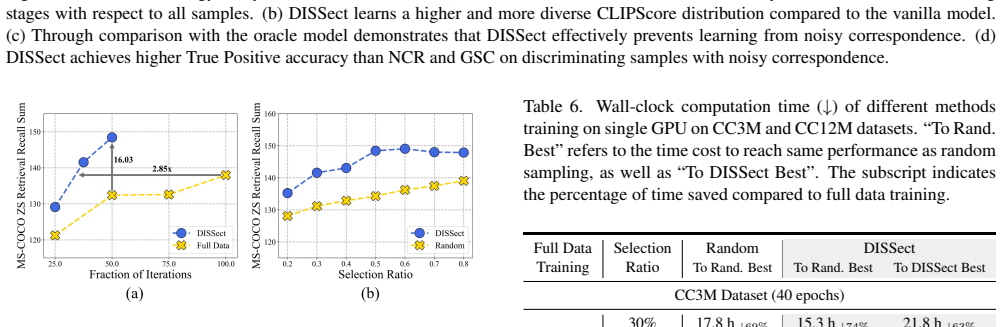
The central discovery is that the temporal trajectory of a pair's CLIPScore under CLIP-style training encodes its quality: clean correspondences reach high similarity early and then dip slightly, whereas noisy correspondences begin low and rise as the model memorizes them, so their distributions eventually overlap. Computing the differential $\delta = \mathrm{CLIPScore}_{\mathrm{hist}} - \mathrm{CLIPScore}_{\mathrm{curr}}$ between a historical model state (obtained by a short warm-up or by temporal ensembling) and the current state turns this trajectory into a per-sample separation score. Ranking each batch by $\delta$ and training only on the largest-$\delta$ samples removes noisy correspondence without a reference model, achieving zero-shot retrieval performance comparable to full-data training at 30% selection and a 2.85$\times$ speedup to reach full-data performance on CC3M.
Load-bearing premise
The method assumes that the temporal trajectory pattern observed on CC3M generalizes: across datasets, noise types, and architectures, clean pairs' self-predicted similarity peaks early and then eases while noisy pairs start low and rise late, so that the historical-minus-current differential cleanly separates them.
Editorial extensions
If this is right
- At a 30% selection ratio, DISSect reaches zero-shot retrieval performance on MS-COCO and Flickr30K comparable to full-data training on CC3M, meaning roughly 70% of iterations can be skipped without an oracle.
- On the noisier YFCC15M dataset at 50% selection, DISSect outperforms full-data training, suggesting that removing noisy correspondence improves quality, not just efficiency.
- DISSect works with different backbones: when applied only to the image-text alignment module, it improves both CLIP/ResNet101 and BLIP/ViT-B over random sampling and SCAN.
- A single-network DISSect beats dual-network noisy-correspondence methods NCR and GSC in downstream retrieval while avoiding their extra compute cost.
- The temporal-ensembling version requires no warm-up epoch and is insensitive to the momentum hyperparameter, making the method plug-and-play.
Reading between the lines
- The same historical-minus-current differential could be applied to other self-supervised losses that exhibit memorization, such as unimodal contrastive learning or masked autoencoding, where a similar clean-then-memorize trajectory may hold.
- Because DISSect is oracle-free, it could be composed with offline coreset pruning in a two-stage pipeline: first use DISSect during a short warm-up to filter the corpus, then train on the filtered set.
- The trajectory assumption could be tested as a diagnostic: datasets or training schedules that do not show the clean-peak-then-ease pattern would be poor candidates for DISSect, potentially guiding when to use selection at all.
- The reported sensitivity of final performance to selection ratio (best at 60%, stable above 50%) suggests there is an optimal budget that trades diversity against noise removal; finding it adaptively during training is a natural next step.
Editorial analysis
A structured set of objections, weighed in public.
Referee Report
Summary. The paper proposes DISSect, an online batch-level sample selection method for multimodal contrastive learning. Instead of relying on an oracle model or a static loss threshold, DISSect selects, within each batch, the samples with the largest differential delta = CLIPScore_hist - CLIPScore_curr between a historical and the current model prediction of image-text similarity. The method is evaluated on CC3M, CC12M, and YFCC15M with CLIP and BLIP backbones across image-text retrieval, NLVR2 reasoning, and COCO captioning, and it is compared with coreset, online, and noisy-correspondence baselines. The central empirical claim is that DISSect reaches performance comparable to full-data training while using only 30% of the samples, and that it outperforms oracle-based competitors on several settings.
Significance. If the central claim holds, DISSect is a practically valuable and simple contribution: it removes noisy image-text correspondence during CLIP-style pretraining without an oracle model, with reported wall-clock savings, and it is evaluated across multiple datasets, backbones, and downstream tasks. The paper also provides a plausible memorization-based explanation, compares against dual-network noisy-correspondence methods, and releases code. The main weakness is that the load-bearing mechanism is not verified under the method's own selective-training loop, and the theoretical link in Eq. (4) is asserted rather than demonstrated. The significance is therefore real but conditional on the mechanism surviving this check.
major comments (3)
- [§3.3, §3.4, Algorithm 1] The load-bearing premise of §3.4 is that the differential delta separates clean from noisy samples. The evidence for this (Figs. 3b and 3c) is obtained from vanilla full-data training, with clean/noisy labels supplied by an oracle model, and not from the selective-training loop of Algorithm 1. Under DISSect, the training distribution shifts: samples not selected in a batch do not contribute to the loss, so their CLIPScore_curr can remain near the warm-up value, while repeatedly selected samples may be reinforced. The paper does not report the per-sample delta separation under DISSect itself; Fig. 4(c,d) reports only the oracle-threshold true-positive rate of the selected set, which is an indirect measure. I request a direct diagnostic: track delta for oracle-labelled clean and noisy samples during DISSect training (e.g., ROC-AUC or class separation at several epochs) and compare with vanilla training. Without this evidence, the reported acceleration could plausibly be attributed to the reduced effective batch size or to the warm-up random phase rather than to the differential criterion.
- [§3.4, Eq. (4)] Equation (4) is introduced with the sentence "we demonstrate in detail in the Appendix," but the derivation is not present in the main text, and the displayed formula is not connected to Eq. (3) by a formal argument. As written, the right-hand side averages exp(CLIPScore)^{-1} and is not shown to be larger for noisy than for clean samples, nor is it shown that delta equals or bounds this gradient term. Please supply the full derivation, state the assumptions (notably whether the memorization result of [33] transfers from cross-entropy classification to the InfoNCE loss), and prove or state precisely the claimed relationship between delta and the gradient offset. The theory as it stands does not close the gap between the memorization heuristic and the selection rule.
- [Tables 1-5] Tables 1, 2, 3, 4, and 5 report single training runs without error bars or significance tests. Several comparisons are close (e.g., Table 1, MS-COCO 30%: DISSect-Warmup IR@10 56.40 versus InfoBatch 54.98; Table 3, NLVR2 dev 73.99 versus SCAN 72.19), and the central claim of "comparable to full data" rests on small margins. Please report at least three seeds with means and standard deviations, or otherwise establish that the reported differences are not within run-to-run noise. This is needed for the empirical claim to be load-bearing.
minor comments (4)
- [Table 1] In the Flickr30K (1K Test Set) panel, the Coreset Forgetting row at 30% selection ratio reports TR@10 = 21.30, which is lower than the corresponding TR@1 = 16.46 but implausibly close to the IR@10 value; this appears to be a typographical error and should be corrected.
- [Figure 1 caption] The caption refers to a "Bellington" example; this word is unclear and likely a typo, which should be fixed for readability.
- [Abstract and Introduction] The phrase "plays an important direction" in the abstract and similar grammatical constructions in the introduction should be revised for clarity.
- [Algorithm 1 and §3.4] The pseudo-code places "Predict CLIPScore_hist" inside the warm-up loop, which suggests it is updated only during warm-up; the text should clarify whether the historical score is fixed after warm-up or recomputed, and how this interacts with the temporal-ensembling variant in Eq. (5).
Circularity Check
No significant circularity found: the differential selection rule is empirically motivated, not fitted to the target benchmarks, and the central claims are evaluated externally.
full rationale
Walking the claimed derivation chain, every load-bearing step is empirically motivated and then tested against external benchmarks. The selection signal δ = CLIPScore_hist − CLIPScore_curr (Eq. 3) is introduced as a heuristic from the memorization curves in Fig. 3, where clean/noisy labels come from an oracle CLIP model; that partition is used only to motivate the rule, not to set its parameters or to choose the selected samples during training. The training loop (Algorithm 1) computes δ from the under-training model's own predictions, and the reported gains are measured on held-out zero-shot retrieval, NLVR2, and COCO captioning, not on quantities that the selector was fitted to reproduce. The temporal-ensembling variant (Eq. 5) is an implementation detail with reported insensitivity to β, and the theoretical connection to gradient offsets (Eq. 4) is asserted rather than fully derived, which is a rigor concern rather than a circular one. Self-citations (DivBS, GSC, and related prior work) appear as baselines and related work, not as the justification for the selection rule. I therefore find no step in which a prediction reduces by construction to an input, and no load-bearing self-citation chain.
Assumptions & free parameters
free parameters (3)
- selection ratio r =
30%, 50%, 60%, 70% used in experiments; best at 60%
- warm-up epochs Tw =
not specified in main text ('a few epochs')
- momentum beta =
not specified; stated to be in (0,1) and insensitive
assumptions (3)
- domain assumption The memorization effect theorem from ELR [33], derived for noisy labels in classification, transfers to contrastive learning with noisy correspondence.
- ad hoc to paper Clean pairs have CLIPScore trajectories that rise and then fall, while noisy pairs start low and rise late, so the historical-minus-current differential separates them.
- standard math The InfoNCE contrastive loss with in-batch negatives is a sufficient model of multimodal contrastive pretraining.
Cite this review
Pith. "Pith review of Differential-informed Sample Selection Accelerates Multimodal Contrastive Learning." pith.science (2026). https://pith.science/paper/MZ2TWWEI
@misc{pith2026250712998,
  author       = {Pith},
  title        = {Pith review of: Differential-informed Sample Selection Accelerates Multimodal Contrastive Learning},
  year         = {2026},
  howpublished = {\url{https://pith.science/paper/MZ2TWWEI}},
  note         = {Machine review of arXiv:2507.12998}
}
read the original abstract
The remarkable success of contrastive-learning-based multimodal models has been greatly driven by training on ever-larger datasets with expensive compute consumption. Sample selection as an alternative efficient paradigm plays an important direction to accelerate the training process. However, recent advances on sample selection either mostly rely on an oracle model to offline select a high-quality coreset, which is limited in the cold-start scenarios, or focus on online selection based on real-time model predictions, which has not sufficiently or efficiently considered the noisy correspondence. To address this dilemma, we propose a novel Differential-Informed Sample Selection (DISSect) method, which accurately and efficiently discriminates the noisy correspondence for training acceleration. Specifically, we rethink the impact of noisy correspondence on contrastive learning and propose that the differential between the predicted correlation of the current model and that of a historical model is more informative to characterize sample quality. Based on this, we construct a robust differential-based sample selection and analyze its theoretical insights. Extensive experiments on three benchmark datasets and various downstream tasks demonstrate the consistent superiority of DISSect over current state-of-the-art methods. Source code is available at: https://github.com/MediaBrain-SJTU/DISSect.
Figures


Figures from the paper (2 more)

Reference graph
Works this paper leans on
-
[33]
Early-learning regularization pre- vents memorization of noisy labels
Sheng Liu, Jonathan Niles-Weed, Narges Razavian, and Car- los Fernandez-Granda. Early-learning regularization pre- vents memorization of noisy labels. Advances in neural in- formation processing systems, 33:20331–20342, 2020. 4, 5
work page 2020
-
[1]
Semdedup: Data-efficient learning at web-scale through semantic deduplication
Amro Abbas, Kushal Tirumala, D ´aniel Simig, Surya Gan- guli, and Ari S Morcos. Semdedup: Data-efficient learning at web-scale through semantic deduplication. arXiv preprint arXiv:2303.09540, 2023. 3
arXiv 2023
-
[2]
Variance reduction in sgd by distributed importance sampling
Guillaume Alain, Alex Lamb, Chinnadhurai Sankar, Aaron Courville, and Yoshua Bengio. Variance reduction in sgd by distributed importance sampling. arXiv preprint arXiv:1511.06481, 2015. 8
arXiv 2015
-
[3]
Vqa: Visual question answering
Stanislaw Antol, Aishwarya Agrawal, Jiasen Lu, Margaret Mitchell, Dhruv Batra, C Lawrence Zitnick, and Devi Parikh. Vqa: Visual question answering. In Proceedings of the IEEE international conference on computer vision , pages 2425– 2433, 2015. 5
work page 2015
-
[4]
Conceptual 12m: Pushing web-scale image-text pre- training to recognize long-tail visual concepts
Soravit Changpinyo, Piyush Sharma, Nan Ding, and Radu Soricut. Conceptual 12m: Pushing web-scale image-text pre- training to recognize long-tail visual concepts. In Proceed- ings of the IEEE/CVF conference on computer vision and pattern recognition, pages 3558–3568, 2021. 5
work page 2021
-
[5]
En- hanced multimodal representation learning with cross-modal kd
Mengxi Chen, Linyu Xing, Yu Wang, and Ya Zhang. En- hanced multimodal representation learning with cross-modal kd. In Proceedings of the IEEE/CVF Conference on Com- puter Vision and Pattern Recognition , pages 11766–11775,
-
[6]
Multi-modal medical diagnosis via large-small model collaboration
Wanyi Chen, Zihua Zhao, Jiangchao Yao, Ya Zhang, Jia- jun Bu, and Haishuai Wang. Multi-modal medical diagnosis via large-small model collaboration. In Proceedings of the Computer Vision and Pattern Recognition Conference, pages 30763–30773, 2025. 2
work page 2025
-
[7]
Reproducible scal- ing laws for contrastive language-image learning
Mehdi Cherti, Romain Beaumont, Ross Wightman, Mitchell Wortsman, Gabriel Ilharco, Cade Gordon, Christoph Schuh- mann, Ludwig Schmidt, and Jenia Jitsev. Reproducible scal- ing laws for contrastive language-image learning. In Pro- ceedings of the IEEE/CVF Conference on Computer Vision and Pattern Recognition, pages 2818–2829, 2023. 1, 3, 5, 6
work page 2023
Show all 64 references
-
[8]
Selection via proxy: Efficient data se- lection for deep learning
Cody Coleman, Christopher Yeh, Stephen Mussmann, Baha- ran Mirzasoleiman, Peter Bailis, Percy Liang, Jure Leskovec, and Matei Zaharia. Selection via proxy: Efficient data se- lection for deep learning. arXiv preprint arXiv:1906.11829,
1906 arXiv
-
[9]
Unichest: Conquer-and-divide pre-training for multi-source chest x-ray classification
Tianjie Dai, Ruipeng Zhang, Feng Hong, Jiangchao Yao, Ya Zhang, and Yanfeng Wang. Unichest: Conquer-and-divide pre-training for multi-source chest x-ray classification. IEEE Trans. Medical Imaging, 43(8):2901–2912, 2024. 2
2024
-
[10]
Scan: Boot- strapping contrastive pre-training for data efficiency
Yangyang Guo and Mohan Kankanhalli. Scan: Boot- strapping contrastive pre-training for data efficiency. arXiv preprint arXiv:2411.09126, 2024. 2, 4, 5, 6
2024 arXiv
-
[11]
Co- teaching: Robust training of deep neural networks with ex- tremely noisy labels
Bo Han, Quanming Yao, Xingrui Yu, Gang Niu, Miao Xu, Weihua Hu, Ivor Tsang, and Masashi Sugiyama. Co- teaching: Robust training of deep neural networks with ex- tremely noisy labels. Advances in neural information pro- cessing systems, 31, 2018. 2
2018
-
[12]
Trustworthy machine learning: From data to models
Bo Han, Jiangchao Yao, Tongliang Liu, Bo Li, Sanmi Koyejo, Feng Liu, et al. Trustworthy machine learning: From data to models. Foundations and Trends® in Privacy and Security, 7(2-3):74–246, 2025. 2
2025
-
[13]
Momentum contrast for unsupervised visual rep- resentation learning
Kaiming He, Haoqi Fan, Yuxin Wu, Saining Xie, and Ross Girshick. Momentum contrast for unsupervised visual rep- resentation learning. In Proceedings of the IEEE/CVF con- ference on computer vision and pattern recognition , pages 9729–9738, 2020. 3
2020
-
[14]
Large- scale dataset pruning with dynamic uncertainty
Muyang He, Shuo Yang, Tiejun Huang, and Bo Zhao. Large- scale dataset pruning with dynamic uncertainty. In Proceed- ings of the IEEE/CVF Conference on Computer Vision and Pattern Recognition, pages 7713–7722, 2024. 1, 2
2024
-
[15]
Clipscore: A reference-free evaluation met- ric for image captioning
Jack Hessel, Ari Holtzman, Maxwell Forbes, Ronan Le Bras, and Yejin Choi. Clipscore: A reference-free evaluation met- ric for image captioning. arXiv preprint arXiv:2104.08718,
-
[16]
Diversified batch selection for training acceleration
Feng Hong, Yueming Lyu, Jiangchao Yao, Ya Zhang, Ivor W Tsang, and Yanfeng Wang. Diversified batch selection for training acceleration. arXiv preprint arXiv:2406.04872,
-
[17]
Learning with noisy correspondence for cross-modal matching.Advances in Neu- ral Information Processing Systems, 34:29406–29419, 2021
Zhenyu Huang, Guocheng Niu, Xiao Liu, Wenbiao Ding, Xinyan Xiao, Hua Wu, and Xi Peng. Learning with noisy correspondence for cross-modal matching.Advances in Neu- ral Information Processing Systems, 34:29406–29419, 2021. 2, 7
2021
-
[18]
Open- clip, 2021
Gabriel Ilharco, Mitchell Wortsman, Ross Wightman, Cade Gordon, Nicholas Carlini, Rohan Taori, Achal Dave, Vaishaal Shankar, Hongseok Namkoong, John Miller, Han- naneh Hajishirzi, Ali Farhadi, and Ludwig Schmidt. Open- clip, 2021. 5
2021
-
[19]
Scaling up visual and vision-language representa- tion learning with noisy text supervision
Chao Jia, Yinfei Yang, Ye Xia, Yi-Ting Chen, Zarana Parekh, Hieu Pham, Quoc Le, Yun-Hsuan Sung, Zhen Li, and Tom Duerig. Scaling up visual and vision-language representa- tion learning with noisy text supervision. In International conference on machine learning, pages 4904–4916. PMLR,
-
[20]
In-datacenter perfor- mance analysis of a tensor processing unit
Norman P Jouppi, Cliff Young, Nishant Patil, David Patter- son, Gaurav Agrawal, Raminder Bajwa, Sarah Bates, Suresh Bhatia, Nan Boden, Al Borchers, et al. In-datacenter perfor- mance analysis of a tensor processing unit. In Proceedings of the 44th annual international symposiu...
2017
-
[21]
Scaling laws for neural language models
Jared Kaplan, Sam McCandlish, Tom Henighan, Tom B Brown, Benjamin Chess, Rewon Child, Scott Gray, Alec Radford, Jeffrey Wu, and Dario Amodei. Scaling laws for neural language models. arXiv preprint arXiv:2001.08361,
2001 arXiv
-
[22]
Deep visual-semantic align- ments for generating image descriptions
Andrej Karpathy and Li Fei-Fei. Deep visual-semantic align- ments for generating image descriptions. In Proceedings of the IEEE conference on computer vision and pattern recog- nition, pages 3128–3137, 2015. 5
2015
-
[23]
Vilt: Vision- and-language transformer without convolution or region su- pervision
Wonjae Kim, Bokyung Son, and Ildoo Kim. Vilt: Vision- and-language transformer without convolution or region su- pervision. In International conference on machine learning, pages 5583–5594. PMLR, 2021. 1
2021
-
[24]
Temporal ensembling for semi- supervised learning
Samuli Laine and Timo Aila. Temporal ensembling for semi- supervised learning. arXiv preprint arXiv:1610.02242, 2016. 5
2016 arXiv
-
[25]
Clip benchmark, 2023
LAION-AI. Clip benchmark, 2023. Accessed: 2025-02-23. 5
2023
-
[26]
Dividemix: Learning with noisy labels as semi-supervised learning
Junnan Li, Richard Socher, and Steven CH Hoi. Dividemix: Learning with noisy labels as semi-supervised learning. arXiv preprint arXiv:2002.07394, 2020. 2, 4
2002 arXiv
-
[27]
Blip: Bootstrapping language-image pre-training for unified vision-language understanding and generation
Junnan Li, Dongxu Li, Caiming Xiong, and Steven Hoi. Blip: Bootstrapping language-image pre-training for unified vision-language understanding and generation. In Interna- tional conference on machine learning, pages 12888–12900. PMLR, 2022. 1, 3, 5, 7
2022
-
[28]
Blip-2: Bootstrapping language-image pre-training with frozen image encoders and large language models
Junnan Li, Dongxu Li, Silvio Savarese, and Steven Hoi. Blip-2: Bootstrapping language-image pre-training with frozen image encoders and large language models. In In- ternational conference on machine learning , pages 19730– 19742. PMLR, 2023. 3
2023
-
[29]
Visual semantic reasoning for image-text matching
Kunpeng Li, Yulun Zhang, Kai Li, Yuanyuan Li, and Yun Fu. Visual semantic reasoning for image-text matching. In Proceedings of the IEEE/CVF international conference on computer vision, pages 4654–4662, 2019. 5
2019
-
[30]
Tsang, and Zhenwen Ren
Xingfeng Li, Yuangang Pan Pan, Yinghui Sun, Quansen Sun Sun, Ivor W. Tsang, and Zhenwen Ren. Fast unpaired multi- view clustering. 2024. 2
2024
-
[31]
Tsang, and Zhenwen Ren
Xingfeng Li, Yuangang Pan Pan, Yuan Sun, Quansen Sun, Yinghui Sun, Ivor W. Tsang, and Zhenwen Ren. Incomplete multi-view clustering with paired and balanced dynamic an- chor learning. IEEE Transactions on Multimedia , pages 7087–7098, 2025. 2
2025
-
[32]
Microsoft coco: Common objects in context
Tsung-Yi Lin, Michael Maire, Serge Belongie, James Hays, Pietro Perona, Deva Ramanan, Piotr Doll´ar, and C Lawrence Zitnick. Microsoft coco: Common objects in context. In Computer Vision–ECCV 2014: 13th European Conference, Zurich, Switzerland, September 6-12, 2014, Proceeding...
2014
-
[34]
Decoupled weight decay regularization
I Loshchilov. Decoupled weight decay regularization. arXiv preprint arXiv:1711.05101, 2017. 5
2017 arXiv
-
[35]
Sieve: Multimodal dataset pruning using image captioning models
Anas Mahmoud, Mostafa Elhoushi, Amro Abbas, Yu Yang, Newsha Ardalani, Hugh Leather, and Ari S Morcos. Sieve: Multimodal dataset pruning using image captioning models. In Proceedings of the IEEE/CVF Conference on Computer Vision and Pattern Recognition, pages 22423–22432, 2024. 2
2024
-
[36]
Prioritized training on points that are learnable, worth learning, and not yet learnt
S ¨oren Mindermann, Jan M Brauner, Muhammed T Raz- zak, Mrinank Sharma, Andreas Kirsch, Winnie Xu, Benedikt H¨oltgen, Aidan N Gomez, Adrien Morisot, Sebastian Far- quhar, et al. Prioritized training on points that are learnable, worth learning, and not yet learnt. In Internati...
-
[37]
Improving multimodal datasets with image captioning
Thao Nguyen, Samir Yitzhak Gadre, Gabriel Ilharco, Se- woong Oh, and Ludwig Schmidt. Improving multimodal datasets with image captioning. Advances in Neural Infor- mation Processing Systems, 36, 2024. 2
2024
-
[38]
Repre- sentation learning with contrastive predictive coding
Aaron van den Oord, Yazhe Li, and Oriol Vinyals. Repre- sentation learning with contrastive predictive coding. arXiv preprint arXiv:1807.03748, 2018. 1, 3
2018 arXiv
-
[39]
Active learning is a strong baseline for data subset selection
Dongmin Park, Dimitris Papailiopoulos, and Kangwook Lee. Active learning is a strong baseline for data subset selection. In Has it Trained Yet? NeurIPS 2022 Workshop, 2022. 1, 2
2022
-
[40]
Pytorch: An im- perative style, high-performance deep learning library
Adam Paszke, Sam Gross, Francisco Massa, Adam Lerer, James Bradbury, Gregory Chanan, Trevor Killeen, Zeming Lin, Natalia Gimelshein, Luca Antiga, et al. Pytorch: An im- perative style, high-performance deep learning library. Ad- vances in neural information processing systems ...
2019
-
[41]
Deep learning on a data diet: Finding important ex- amples early in training
Mansheej Paul, Surya Ganguli, and Gintare Karolina Dziu- gaite. Deep learning on a data diet: Finding important ex- amples early in training. Advances in neural information processing systems, 34:20596–20607, 2021. 2
2021
-
[42]
Infobatch: Lossless training speed up by unbiased dynamic data pruning
Ziheng Qin, Kai Wang, Zangwei Zheng, Jianyang Gu, Xi- angyu Peng, Zhaopan Xu, Daquan Zhou, Lei Shang, Baigui Sun, Xuansong Xie, et al. Infobatch: Lossless training speed up by unbiased dynamic data pruning. arXiv preprint arXiv:2303.04947, 2023. 1, 2, 3, 5, 6
2023 arXiv
-
[43]
Learning transferable visual models from natural language supervi- sion
Alec Radford, Jong Wook Kim, Chris Hallacy, Aditya Ramesh, Gabriel Goh, Sandhini Agarwal, Girish Sastry, Amanda Askell, Pamela Mishkin, Jack Clark, et al. Learning transferable visual models from natural language supervi- sion. In International conference on machine learning, ...
2021
-
[44]
Accelerat- ing deep learning with dynamic data pruning
Ravi S Raju, Kyle Daruwalla, and Mikko Lipasti. Accelerat- ing deep learning with dynamic data pruning. arXiv preprint arXiv:2111.12621, 2021. 1
2021 arXiv
-
[45]
Laion-400m: Open dataset of clip-filtered 400 million image-text pairs
Christoph Schuhmann, Richard Vencu, Romain Beaumont, Robert Kaczmarczyk, Clayton Mullis, Aarush Katta, Theo Coombes, Jenia Jitsev, and Aran Komatsuzaki. Laion-400m: Open dataset of clip-filtered 400 million image-text pairs. arXiv preprint arXiv:2111.02114, 2021. 3
2021 arXiv
-
[46]
Active learning for convolu- tional neural networks: A core-set approach
Ozan Sener and Silvio Savarese. Active learning for convolu- tional neural networks: A core-set approach. arXiv preprint arXiv:1708.00489, 2017. 1
2017 arXiv
-
[47]
Machine learning and deep learning: A review of methods and applications
Koosha Sharifani and Mahyar Amini. Machine learning and deep learning: A review of methods and applications. World Information Technology and Engineering Journal , 10(07): 3897–3904, 2023. 1
2023
-
[48]
Conceptual captions: A cleaned, hypernymed, im- age alt-text dataset for automatic image captioning
Piyush Sharma, Nan Ding, Sebastian Goodman, and Radu Soricut. Conceptual captions: A cleaned, hypernymed, im- age alt-text dataset for automatic image captioning. In Pro- ceedings of the 56th Annual Meeting of the Association for Computational Linguistics (Volume 1: Long Paper...
2018
-
[49]
A corpus for reasoning about natural language grounded in photographs
Alane Suhr, Stephanie Zhou, Ally Zhang, Iris Zhang, Hua- jun Bai, and Yoav Artzi. A corpus for reasoning about natural language grounded in photographs. arXiv preprint arXiv:1811.00491, 2018. 5
2018 arXiv
-
[50]
Yfcc100m: The new data in multimedia research
Bart Thomee, David A Shamma, Gerald Friedland, Ben- jamin Elizalde, Karl Ni, Douglas Poland, Damian Borth, and Li-Jia Li. Yfcc100m: The new data in multimedia research. Communications of the ACM, 59(2):64–73, 2016. 5
2016
-
[51]
An empirical study of example forget- ting during deep neural network learning
Mariya Toneva, Alessandro Sordoni, Remi Tachet des Combes, Adam Trischler, Yoshua Bengio, and Geof- frey J Gordon. An empirical study of example forget- ting during deep neural network learning. arXiv preprint arXiv:1812.05159, 2018. 2, 5, 6
2018 arXiv
-
[52]
Too large; data reduction for vision-language pre-training
Alex Jinpeng Wang, Kevin Qinghong Lin, David Junhao Zhang, Stan Weixian Lei, and Mike Zheng Shou. Too large; data reduction for vision-language pre-training. In Proceed- ings of the IEEE/CVF International Conference on Com- puter Vision, pages 3147–3157, 2023. 2
2023
-
[53]
Cliploss and norm-based data selection methods for multimodal con- trastive learning
Yiping Wang, Yifang Chen, Wendan Yan, Alex Fang, Wen- jing Zhou, Kevin G Jamieson, and Simon S Du. Cliploss and norm-based data selection methods for multimodal con- trastive learning. Advances in Neural Information Process- ing Systems, 37:15028–15069, 2025. 1, 5, 6
2025
-
[54]
Memorization in deep learning: A survey
Jiaheng Wei, Yanjun Zhang, Leo Yu Zhang, Ming Ding, Chao Chen, Kok-Leong Ong, Jun Zhang, and Yang Xiang. Memorization in deep learning: A survey. arXiv preprint arXiv:2406.03880, 2024. 4
2024 arXiv
-
[55]
Icons: Influence consensus for vision-language data selection
Xindi Wu, Mengzhou Xia, Rulin Shao, Zhiwei Deng, Pang Wei Koh, and Olga Russakovsky. Icons: Influence consensus for vision-language data selection. arXiv preprint arXiv:2501.00654, 2024. 1, 2
2024
-
[56]
Moderate coreset: A universal method of data selection for real-world data-efficient deep learning
Xiaobo Xia, Jiale Liu, Jun Yu, Xu Shen, Bo Han, and Tongliang Liu. Moderate coreset: A universal method of data selection for real-world data-efficient deep learning. In The Eleventh International Conference on Learning Repre- sentations, 2022. 2
2022
-
[57]
Bicro: Noisy correspon- dence rectification for multi-modality data via bi-directional cross-modal similarity consistency
Shuo Yang, Zhaopan Xu, Kai Wang, Yang You, Hongxun Yao, Tongliang Liu, and Min Xu. Bicro: Noisy correspon- dence rectification for multi-modality data via bi-directional cross-modal similarity consistency. In Proceedings of the IEEE/CVF Conference on Computer Vision and Patter...
2023
-
[58]
Latent class-conditional noise model
Jiangchao Yao, Bo Han, Zhihan Zhou, Ya Zhang, and Ivor W Tsang. Latent class-conditional noise model. IEEE Trans- actions on Pattern Analysis and Machine Intelligence, 45(8): 9964–9980, 2023. 2
2023
-
[59]
On early stopping in gradient descent learning
Yuan Yao, Lorenzo Rosasco, and Andrea Caponnetto. On early stopping in gradient descent learning. Constructive ap- proximation, 26(2):289–315, 2007. 4
2007
-
[60]
From image descriptions to visual denotations: New similarity metrics for semantic inference over event descrip- tions
Peter Young, Alice Lai, Micah Hodosh, and Julia Hocken- maier. From image descriptions to visual denotations: New similarity metrics for semantic inference over event descrip- tions. Transactions of the Association for Computational Linguistics, 2:67–78, 2014. 5
2014
-
[61]
Mitigating noisy corre- spondence by geometrical structure consistency learning
Zihua Zhao, Mengxi Chen, Tianjie Dai, Jiangchao Yao, Bo Han, Ya Zhang, and Yanfeng Wang. Mitigating noisy corre- spondence by geometrical structure consistency learning. In Proceedings of the IEEE/CVF Conference on Computer Vi- sion and Pattern Recognition, pages 27381–27390, ...
2024
-
[62]
Coverage-centric coreset selection for high pruning rates
Haizhong Zheng, Rui Liu, Fan Lai, and Atul Prakash. Coverage-centric coreset selection for high pruning rates. arXiv preprint arXiv:2210.15809, 2022. 1, 2
2022 arXiv
-
[63]
Learn- ing to instruct for visual instruction tuning
Zhihan Zhou, Feng Hong, Jiaan Luo, Jiangchao Yao, Dong- sheng Li, Bo Han, Ya Zhang, and Yanfeng Wang. Learn- ing to instruct for visual instruction tuning. arXiv preprint arXiv:2503.22215, 2025. 2
2025
-
[64]
Uncover the balanced geometry in long-tailed contrastive language-image pretraining
Zhihan Zhou, Yushi Ye, Feng Hong, Peisen Zhao, Jiangchao Yao, Ya Zhang, Qi Tian, and Yanfeng Wang. Uncover the balanced geometry in long-tailed contrastive language-image pretraining. Mach. Learn., 114(4):106, 2025. 1
2025
Reviewed August 6, 2026 · model on record in the stance chip above.
Discussion (0). Sign in to comment.