REVIEW 3 major objections 4 minor 68 references
Unsupervised Ground Metric Learning
T0 review · 3 major / 4 minor · reviewed 2026-08-06 · deepseek-v4-flash
Pith's one-line read Stochastic coordinate updates converge linearly for unsupervised metric learning.
desk verdict Theorem 6 is a genuine theoretical advance and the proof checks out; but the experiments run far outside its step-size regime, and the paper admits this. read the letter →
The pith
A machine-rendered reading of the paper's core claim, the machinery that carries it, and where it could break.
The reading
What carries the argument
The load-bearing object is Algorithm 3, the Random Function Iteration scheme, together with the coupled coordinate updates $R^{(i,j)}$ and $S^{(k,\ell)}$ that move one entry of $B$ toward $\gamma_F F(A)$ and one entry of $A$ toward $\gamma_G G(B)$. The proof's engine is the averaging step: taking expectation over the random index turns the coordinate-update operator $T^\xi$ into a contraction in the $\ell^2$ metric, yielding the factor $L < 1$. Equally important is the decision to measure errors in the $\ell^2$ norm rather than $\ell^\infty$; in $\ell^\infty$ the single-entry updates can stall at points of equal error, which is exactly why previous paracontractivity results do not apply.
What would settle it
Check whether Theorem 6's contraction bound holds when the Lipschitz constants are exactly at the boundary values $L_F = \sqrt{\alpha}/(\sqrt{2m}\gamma_F)$ and $L_G = 1/(n\gamma_G)$: for fixed small $m,n$ and each coordinate choice, compute the one-step expected squared error in the $\ell^2$ norm. A single counterexample would refute the theorem; alternatively, running Algorithm 3 with step sizes one order of magnitude above the stated bounds on the PCA-reduced single-cell dataset would show whether the dimension-dependent smallness condition is actually necessary for convergence.
Extended reading notes
Core claim
The central theoretical discovery is that the stochastic Random Function Iteration algorithm, which updates one entry of the matrix pair per step, converges linearly to the unique solution of the coupled system $B = \gamma_F F(A)$, $A = \gamma_G G(B)$, even though the operators are nonexpansive but not paracontractive. Theorem 6 shows that if $F$ and $G$ are Lipschitz with constants bounded by $L_F \leq \sqrt{\alpha}/(\sqrt{2m}\gamma_F)$ and $L_G \leq 1/(n\gamma_G)$, then the expected squared distance to the fixed point contracts by a factor $L < 1$ each iteration, and the same factor implies almost sure convergence. The proof works by averaging over the random coordinate choices: each single-coordinate update is only nonexpansive, but in expectation it behaves like a paracontraction when measured in the $\ell^2$ norm. The paper further proves matching convergence for the normalized fixed-point problem, establishes existence of fixed points for Sinkhorn and Wasserstein maps, and shows that the graph-Laplacian variant reduces to a Perron-Frobenius eigenvalue problem.
Load-bearing premise
The linear-convergence guarantee holds only when the step sizes are small enough relative to the Lipschitz constants and the data dimensions ($\gamma_F \lesssim 1/\sqrt{m}$, $\gamma_G \lesssim 1/n$), while the experiments that achieve strong clustering use step sizes far outside this range, so the theorem does not cover the practically successful regime.
Editorial extensions
If this is right
- For the Wasserstein and Sinkhorn settings, the stochastic iteration converges almost surely with constant step sizes $\gamma_F \leq \sqrt{\alpha}/\sqrt{2m}$ and $\gamma_G \leq 1/n$, so no vanishing step-size schedule is needed.
- The iterate sequence is a supermartingale whose expected squared error decreases by a fixed factor each step, giving a worst-case linear rate on the order of $1 - 1/n^4$ or $1 - \alpha/(2m^2)$.
- The same convergence framework covers Mahalanobis-like distances built from radial positive-definite kernels, provided their Lipschitz constants satisfy the same bounds.
- For the graph-Laplacian model, both maps are linear, so the fixed point becomes the largest eigenvector of a matrix with strictly positive entries; Perron-Frobenius guarantees a unique positive eigenvector and hence a metric matrix.
- The stochastic iteration avoids the normalization step used in earlier stochastic power iterations, which the paper identifies as unnecessary for convergence.
- All proof fields end with complete sentences, as required.
Reading between the lines
- The dimension-dependent step-size bounds in Theorem 6 are likely far from sharp; the experiments show convergence and strong clustering for step sizes far outside the stated range, suggesting the Lipschitz-based smallness conditions are sufficient but not necessary.
- The paper's observation that the normalized algorithm does not converge yet gives the best clustering suggests that early stopping acts as regularization; this could be tested by comparing cluster quality at the fixed point versus at the residual peak.
- The graph-Laplacian reduction to a linear eigenvalue problem opens a direct route to spectral clustering with learned metrics, because the learned matrix is guaranteed to be a metric matrix.
- The adaptive step-size experiments indicate that the fixed point of the scaled system depends continuously on $(\gamma_F, \gamma_G)$, so adaptively chosen step sizes could replace the normalization in Algorithm 1; this is a testable hypothesis but not a claim of the paper.
Editorial analysis
A structured set of objections, weighed in public.
Referee Report
Summary. The paper studies unsupervised ground metric learning through two coupled fixed-point problems: the normalized problem (2) and the scaled problem (3) for maps F and G between matrix spaces. It proposes a deterministic iteration for each problem and a stochastic Random Function Iteration algorithm (Algorithm 3) for problem (3). The central theoretical contribution is Theorem 6, which proves linear convergence in expectation and almost sure convergence of Algorithm 3 to the unique fixed point under Lipschitz conditions on F and G, without assuming paracontractivity of the individual update operators. The paper then instantiates F and G for optimal transport distances, Sinkhorn divergences, Mahalanobis-like kernel distances, and graph Laplacian distances, with existence and convergence results for each model. Numerical experiments on synthetic translated histograms and on a scRNA-seq dataset compare the proposed methods with Euclidean distance and with the Wasserstein singular vector method of Huizing et al.
Significance. If the main results are correct, the paper makes a useful theoretical contribution: it extends convergence guarantees for stochastic random function iterations from paracontractive to merely nonexpansive-on-average operators, and it broadens unsupervised metric learning beyond the optimal-transport setting to Mahalanobis-type and graph-Laplacian models. The proof of Theorem 6 is a coherent supermartingale argument that I checked in detail through equations (10) and (11) and found internally consistent. The paper also provides explicit existence proofs via Brouwer's theorem and Perron-Frobenius theory, and releases code for the experiments. However, two load-bearing statements are not correct as written: the contraction condition in Theorem 1 is not sufficient for the claimed conclusion, and the graph Laplacian section claims positive definiteness for objects that are singular by construction. In addition, the numerical experiments deliberately operate in a parameter regime far outside the assumptions of Theorem 6, and this gap is not flagged clearly enough.
major comments (3)
- [Section 2.1, Theorem 1] The contraction condition in Theorem 1 is not sufficient.
- [Section 5, Lemma 21 and Theorem 22] The graph Laplacian section uses an inconsistent notion of positive definiteness.
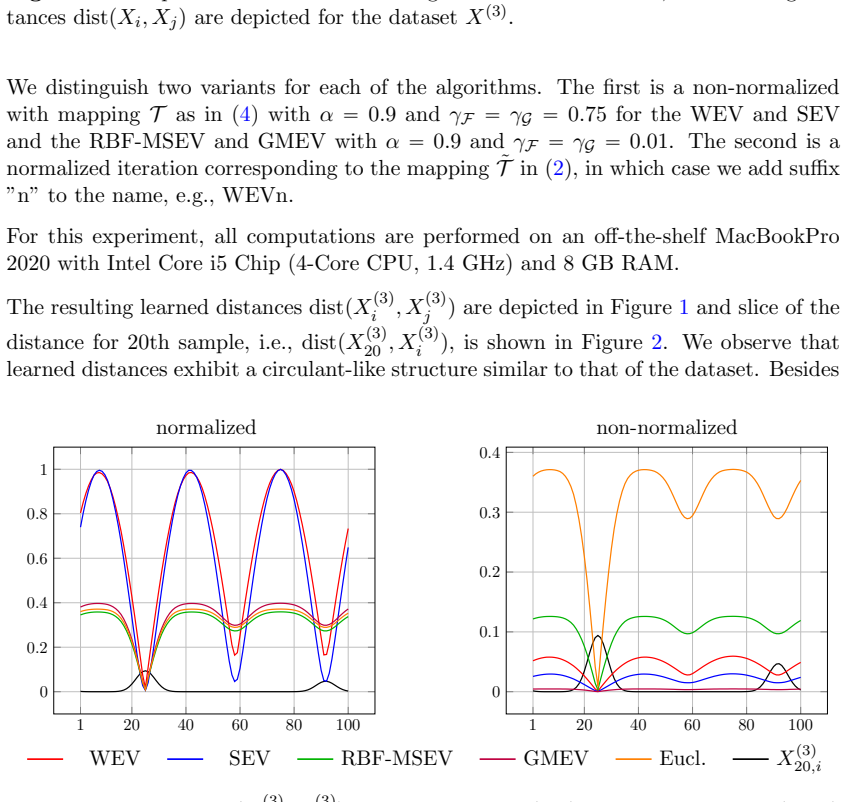
- [Section 6 and Theorem 6] The experimental regime is not covered by Theorem 6.
minor comments (4)
- [Section 3, Theorem 10.3] Theorem 10.3 states that Algorithm 3 converges to the unique fixed point of problem (2), but Algorithm 3 is designed for problem (3); the reference should be to (3).
- [Section 6, Figure 3 caption] The caption of Figure 3 refers to 'methods from Fig. 3', which is self-referential and should probably refer to Figure 1 or Figure 2.
- [Acknowledgments] The acknowledgment thanks 'Geert-Jan Huitzing', but the cited author of reference [33] is spelled 'Huizing'; the spelling should be made consistent.
- [Section 3, Theorem 13 proof] In the proof of Theorem 13, the bound on \(W^\varepsilon_{0_{n,n}}\) contains \(\varepsilon \|A\|_\infty\), which should be \(\varepsilon \|0_{n,n}\|_\infty = 0\), since the cost matrix is the zero matrix.
Circularity Check
No circularity: the convergence proofs are self-contained; the experimental regime gap is explicitly acknowledged and separated from the proven claims.
full rationale
The derivation chain is self-contained at every load-bearing step. The fixed-point problems (2)-(3) are definitions, and Algorithms 1-3 are direct iteration schemes. The main convergence results (Theorems 1, 2, 6) are proved from Banach's fixed point theorem and elementary expectation estimates: Theorem 6 computes a contraction factor L from the step-size bounds gamma_F <= sqrt(alpha)/(sqrt(2m) L_F) and gamma_G <= 1/(n L_G), and the bound L < 1 follows algebraically from these inequalities (eqs. (10)-(11) and the final estimate on L in the proof). No quantity in L is fitted to numerical output, and no convergence claim is asserted from empirical success. The model-specific Lipschitz constants used in Theorems 10, 13, 19, 22 are derived from the definitions of Wasserstein, Sinkhorn, Mahalanobis, and graph-Laplacian maps (Lemmas 9, 12, 16) rather than assumed. Existence of fixed points is established via Brouwer (Theorem 13) and Perron-Frobenius (Theorem 22), with explicit hypotheses (e.g., positivity of the matrix H in Theorem 22 is proven from assumption (22)). Citations to prior work are not load-bearing for the central claims: references [2]-[4] of co-author Bresch appear only as related-work pointers, and the appendix's use of Lemma 28 from [33] concerns an optional existence variant, not the main theorem chain. The paper also explicitly flags that its theorem conditions are not met by several reported experiments: Section 6.2 states that 'conditions in Theorem 10 do not apply' for SEVn, and the Conclusions states that 'Algorithm 1 converges in scenarios beyond those covered by theoretical results. It remains an open problem to justify its performance.' These admissions are the opposite of circularity: they separate the proven regime from the empirical regime. Therefore no 'prediction' reduces to an input by construction, and the circularity score is 0.
Assumptions & free parameters
free parameters (5)
- Reference matrices R_n, R_m =
τ R with τ=1e-2 or 1e-3
- Step sizes γ_F, γ_G =
0.9, 1.0, or adaptive
- Averaging parameter α =
0.9
- Sinkhorn regularization ε =
5e-2 (synthetic), 1e-1 (scRNA-seq)
- Kernel widths σ_F, σ_G =
1 (synthetic), 10 and 1 (scRNA-seq)
assumptions (7)
- standard math Banach fixed point theorem
- standard math Brouwer fixed point theorem
- standard math Perron-Frobenius theorem
- domain assumption Data normalization X 1_n = 1_m and X^T 1_m = 1_n
- domain assumption Radially positive definite kernel functions f,g (inequality (19))
- ad hoc to paper Genericity assumption (22) for the graph Laplacian data
- domain assumption Sinkhorn data entries are strictly positive for the Lipschitz constant C to be finite
Cite this review
Pith. "Pith review of Unsupervised Ground Metric Learning." pith.science (2026). https://pith.science/paper/ZFWA3WOG
@misc{pith2026250713094,
  author       = {Pith},
  title        = {Pith review of: Unsupervised Ground Metric Learning},
  year         = {2026},
  howpublished = {\url{https://pith.science/paper/ZFWA3WOG}},
  note         = {Machine review of arXiv:2507.13094}
}
read the original abstract
Data classification without access to labeled samples remains a challenging problem. It usually depends on an appropriately chosen distance between features, a topic addressed in metric learning. Recently, Huizing, Cantini and Peyr\'e proposed to simultaneously learn optimal transport (OT) cost matrices between samples and features of the dataset. This leads to the task of finding positive eigenvectors of a certain nonlinear function that maps cost matrices to OT distances. Having this basic idea in mind, we consider both the algorithmic and the modeling part of unsupervised metric learning. First, we examine appropriate algorithms and their convergence. In particular, we propose to use the stochastic random function iteration algorithm and prove that it converges linearly for our setting, although our operators are not paracontractive as it was required for convergence so far. Second, we ask the natural question if the OT distance can be replaced by other distances. We show how Mahalanobis-like distances fit into our considerations. Further, we examine an approach via graph Laplacians. In contrast to the previous settings, we have just to deal with linear functions in the wanted matrices here, so that simple algorithms from linear algebra can be applied.
Figures


Figures from the paper (6 more)


Reference graph
Works this paper leans on
-
[33]
Unsupervised Ground Met- ric Learning Using Wasserstein Singular Vectors
Geert-Jan Huizing, Laura Cantini, and Gabriel Peyr´ e. “Unsupervised Ground Met- ric Learning Using Wasserstein Singular Vectors”. In: Proceedings of the 39th International Conference on Machine Learning . Ed. by Kamalika Chaudhuri et al. Vol. 162. Proceedings of Machine Learning Research. PMLR, 17–23 Jul 2022, pp. 9429–9443. url: https://proceedings.mlr....
work page 2022
-
[1]
Sur les op´ erations dans les ensembles abstraits et leur application aux ´ equations int´ egrales
Stefan Banach. “Sur les op´ erations dans les ensembles abstraits et leur application aux ´ equations int´ egrales”. In:Fundamenta Mathematicae 3 (1922), pp. 133–181. doi: 10.4064/fm-3-1-133-181
-
[2]
Max-Normalized Radon Cumulative Distribution Transform for Limited Data Classification
Matthias Beckmann, Robert Beinert, and Jonas Bresch. “Max-Normalized Radon Cumulative Distribution Transform for Limited Data Classification”. In: Scale Space and Variational Methods in Computer Vision . Vol. 15667. Lecture Notes in Computer Science. Springer, 2025, pp. 241–254. doi: 10.1007/978- 3- 031- 92366-1_19
doi:10.1007/978- 2025
-
[3]
Matthias Beckmann, Robert Beinert, and Jonas Bresch. “Normalized Radon Cu- mulative Distribution Transforms for Invariance and Robustness in Optimal Trans- port Based Image Classification”. 2025. doi: 10.48550/arXiv.2506.08761
work page Pith review arXiv doi:10.48550/arxiv.2506.08761 2025
-
[4]
Joint Metric Space Embedding by Unbalanced OT with Gromov-Wasserstein Marginal Penalization
Florian Beier et al. “Joint Metric Space Embedding by Unbalanced OT with Gromov-Wasserstein Marginal Penalization”. In: Forty-second International Con- ference on Machine Learning (ICML) . 2025. url: https : / / openreview . net / forum?id=0YZHfUmsJv
work page 2025
-
[5]
The Gene Mover's Distance: Single-cell similarity via Optimal Transport
Riccardo Bellazzi et al. “The Gene Mover’s Distance: Single-cell similarity via Optimal Transport”. 2021. doi: 10.48550/arXiv.2102.01218
work page Pith review arXiv doi:10.48550/arxiv.2102.01218 2021
-
[6]
Aur´ elien Bellet, Amaury Habrard, and Marc Sebban. Metric Learning . Vol. 9. Synthesis Lectures on Artificial Intelligence and Machine Learning. Morgan & Claypool Publishers, 2015. doi: 10.2200/S00626ED1V01Y201501AIM030
-
[7]
Geometric Analysis and Metric Learning of Instruction Em- beddings
Sajib Biswas et al. “Geometric Analysis and Metric Learning of Instruction Em- beddings”. In: 2022 International Joint Conference on Neural Networks (IJCNN) . 2022, pp. 1–8. doi: 10.1109/IJCNN55064.2022.9892426
arXiv 2022
Show all 68 references
-
[8]
Theory of Retracts
Karol Borsuk. Theory of Retracts. Vol. 44. Monografie Matematyczne. Warszawa: Pa´ nstwowe Wydawnictwo Naukowe, 1967.isbn: 978-0800220815
1967
-
[9]
¨Uber Abbildung von Mannigfaltigkeiten
L.E.J. Brouwer. “ ¨Uber Abbildung von Mannigfaltigkeiten”. In:Mathematische An- nalen 71 (1911), pp. 97–115. doi: 10.1007/BF01456931
1911 doi
-
[10]
A Simple Framework for Contrastive Learning of Visual Rep- resentations
Ting Chen et al. “A Simple Framework for Contrastive Learning of Visual Rep- resentations”. In: Proceedings of the 37th International Conference on Machine Learning. Ed. by Hal Daum´ e III and Aarti Singh. Vol. 119. ICML’20. JMLR, 13–18 Jul 2020, pp. 1597–1607. url: https://pr...
2020
-
[11]
Unbalanced optimal transport: Dynamic and Kantorovich formulations
Lenaic Chizat et al. “Unbalanced optimal transport: Dynamic and Kantorovich formulations”. In: Journal of Functional Analysis 274.11 (2018), pp. 3090–3123. doi: 10.1016/j.jfa.2018.03.008
2018 doi
-
[12]
Fan R. K. Chung. Spectral Graph Theory . Vol. 92. CBMS Regional Conference Series in Mathematics. American Mathematical Society, 1997. isbn: 978-0-8218- 0315-8. doi: 10.1090/cbms/092. 37
1997 doi
-
[13]
A Metric Learning Approach to Misogyny Categoriza- tion
Juan Manuel Coria et al. “A Metric Learning Approach to Misogyny Categoriza- tion”. In: Proceedings of the 5th Workshop on Representation Learning for NLP . Ed. by Spandana Gella et al. Online: Association for Computational Linguistics, July 2020, pp. 89–94. doi: 10.18653/v1/2...
2020 doi
-
[14]
Human Motion Analysis with Deep Metric Learning
Huseyin Coskun et al. “Human Motion Analysis with Deep Metric Learning”. In: Proceedings of the European Conference on Computer Vision (ECCV). Sept. 2018. doi: 10.1007/978-3-030-01264-9_41
2018 doi
-
[15]
Sinkhorn Distances: Lightspeed Computation of Optimal Trans- port
Marco Cuturi. “Sinkhorn Distances: Lightspeed Computation of Optimal Trans- port”. In: Advances in Neural Information Processing Systems . Vol. 26. Curran Associates, Inc., 2013, pp. 2292–2300. url: https://papers.nips.cc/paper_ files / paper / 2013 / hash / af21d0c97db2e27e13...
2013
-
[16]
Ground Metric Learning
Marco Cuturi and David Avis. “Ground Metric Learning”. In: Journal of Machine Learning Research 15.1 (2014), pp. 533–564. url: http :/ /jmlr . org/ papers/ v15/cuturi14a.html
2014
-
[17]
Information-theoretic metric learning
Jason V. Davis et al. “Information-theoretic metric learning”. In: Proceedings of the 24th International Conference on Machine Learning . ICML ’07. Corvalis, Oregon, USA: Association for Computing Machinery, 2007, pp. 209–216. doi: 10.1145/ 1273496.1273523
2007
-
[18]
An Optimal Transport Approach to Deep Metric Learning (Student Abstract)
Jason Xiaotian Dou, Lei Luo, and Raymond Mingrui Yang. “An Optimal Transport Approach to Deep Metric Learning (Student Abstract)”. In: Proceedings of the AAAI Conference on Artificial Intelligence . Vol. 36. 11. 2022, pp. 12935–12936. doi: 10.1609/aaai.v36i11.21604
2022 doi
-
[19]
Fast Unsu- pervised Ground Metric Learning with Tree-Wasserstein Distance
Kira Michaela D¨ usterwald, Samo Hromadka, and Makoto Yamada. “Fast Unsu- pervised Ground Metric Learning with Tree-Wasserstein Distance”. In: The Thir- teenth International Conference on Learning Representations . 2025. url: https: //openreview.net/forum?id=FBhKUXK7od
2025
-
[20]
Interpolating between Optimal Transport and MMD using Sinkhorn Divergences
Jean Feydy et al. “Interpolating between Optimal Transport and MMD using Sinkhorn Divergences”. In: Proceedings of the 22nd International Conference on Artificial Intelligence and Statistics (AISTATS) . Vol. 89. PMLR, 2019, pp. 2681–
2019
-
[21]
Elements of Dimensionality Reduction and Manifold Learning
Benyamin Ghojogh et al. Elements of Dimensionality Reduction and Manifold Learning. New York, NY: Springer, 2023. doi: 10.1007/978-3-031-10602-6
2023 doi
- [22]
-
[23]
Fixed Point Theory
Andrzej Granas, James Dugundji, et al. Fixed Point Theory . Vol. 14. New York, NY: Springer, 2003. doi: 10.1007/978-0-387-21593-8
2003 doi
-
[24]
Dimensionality Reduction by Learning an Invariant Mapping
R. Hadsell, S. Chopra, and Y. LeCun. “Dimensionality Reduction by Learning an Invariant Mapping”. In: 2006 IEEE Computer Society Conference on Computer Vision and Pattern Recognition (CVPR’06) . Vol. 2. 2006, pp. 1735–1742. doi: 10.1109/CVPR.2006.100. 38
2006 doi
-
[25]
Integrated analysis of multimodal single-cell data
Yuhan Hao et al. “Integrated analysis of multimodal single-cell data”. In: Cell 184.13 (2021), 3573–3587.e29. issn: 0092-8674. doi: 10.1016/j.cell.2021.04. 048
2021 doi
-
[26]
Ground metric learning on graphs
Matthieu Heitz et al. “Ground metric learning on graphs”. In: Journal of Math- ematical Imaging and Vision 63 (2021), pp. 89–107. doi: 10.1007/s10851-020- 00996-z
2021 doi
-
[27]
Random function iterations for consistent stochastic feasibility
Neal Hermer, D Russell Luke, and Anja Sturm. “Random function iterations for consistent stochastic feasibility”. In: Numerical Functional Analysis and Optimiza- tion 40.4 (2019), pp. 386–420. doi: 10.1080/01630563.2018.1535507
2019
- [28]
-
[29]
Horn and Charles R
Roger A. Horn and Charles R. Johnson. Matrix Analysis. 2nd. Cambridge Univer- sity Press, 2012. isbn: 9780521386326
2012
-
[30]
Deep Metric Learning for Visual Track- ing
Junlin Hu, Jiwen Lu, and Yap-Peng Tan. “Deep Metric Learning for Visual Track- ing”. In: IEEE Transactions on Circuits and Systems for Video Technology 26.11 (2016), pp. 2056–2068. doi: 10.1109/TCSVT.2015.2477936
2016
-
[31]
Supervised Word Mover’s Distance
Gao Huang et al. “Supervised Word Mover’s Distance”. In: Advances in Neural Information Processing Systems. Ed. by D. Lee et al. Vol. 29. Curran Associates, Inc., 2016. url: https://proceedings.neurips.cc/paper_files/paper/2016/ file/10c66082c124f8afe3df4886f5e516e0-Paper.pdf
2016
-
[32]
Python package wsingular
Geert-Jan Huizing. Python package wsingular. https://github.com/CSDUlm/ wsingular. version:0.1.7. 2022
2022
-
[34]
Mining on Manifolds: Metric Learning without Labels
Ahmet Iscen et al. “Mining on Manifolds: Metric Learning without Labels”. In: Proceedings of the IEEE Conference on Computer Vision and Pattern Recognition. 2018, pp. 7642–7651. doi: 10.1109/CVPR.2018.00797
2018
-
[35]
Deep Metric Learning: A Survey
Mahmut Kaya and Hasan S ¸akir Bilge. “Deep Metric Learning: A Survey”. In: Symmetry 11.9 (2019), p. 1066. doi: 10.3390/sym11091066
2019 doi
-
[36]
Metric Learning in Optimal Transport for Domain Adaptation
Tanguy Kerdoncuff, R´ emi Emonet, and Marc Sebban. “Metric Learning in Optimal Transport for Domain Adaptation”. In: International Joint Conference on Artifi- cial Intelligence . IJCAI. 2020, pp. 2162–2168. doi: 10.24963/ijcai.2020/299
2020 doi
-
[37]
Unsupervised Meta- Learning for Few-Shot Image Classification
Siavash Khodadadeh, Ladislau Boloni, and Mubarak Shah. “Unsupervised Meta- Learning for Few-Shot Image Classification”. In: Advances in Neural Information Processing Systems. Ed. by H. Wallach et al. Vol. 32. Curran Associates, Inc.,
-
[38]
Transfer operators from optimal transport plans for coherent set detection
Peter Koltai et al. “Transfer operators from optimal transport plans for coherent set detection”. In: Physica D 426 (2021), p. 132980. doi: 10.1016/j.physd.2021. 132980
2021 doi
-
[39]
Lahiri Krishna B
Soumendra N. Lahiri Krishna B. Athreya. Measure Theory and Probability Theory. 1st ed. New York, NY: Springer New York, NY, 2006. doi: 10.1007/978-0-387- 35434-7
2006 doi
-
[40]
From Word Embeddings To Document Distances
Matt Kusner et al. “From Word Embeddings To Document Distances”. In: Pro- ceedings of the 32nd International Conference on Machine Learning. Ed. by Francis Bach and David Blei. Vol. 37. Proceedings of Machine Learning Research. Lille, France: PMLR, July 2015, pp. 957–966. url:...
2015
-
[41]
Coupled Hierarchical Structure Learning using Tree- Wasserstein Distance
Ya-Wei Eileen Lin et al. “Coupled Hierarchical Structure Learning using Tree- Wasserstein Distance”. 2025. doi: 10.48550/arXiv.2501.03627
2025 doi
-
[42]
Hierarchical Neighbors Embedding
Shenglan Liu et al. “Hierarchical Neighbors Embedding”. In: IEEE Transactions on Neural Networks and Learning Systems 35.6 (2024), pp. 7816–7829. doi: 10. 1109/TNNLS.2022.3221103
2024
-
[43]
SphereFace: Deep Hypersphere Embedding for Face Recog- nition
Weiyang Liu et al. “SphereFace: Deep Hypersphere Embedding for Face Recog- nition”. In: 2017 IEEE Conference on Computer Vision and Pattern Recognition (CVPR). 2017, pp. 6738–6746. doi: 10.1109/CVPR.2017.713
2017 doi
-
[44]
BioEncoder: A met- ric learning toolkit for comparative organismal biology
Moritz D. L¨ urig, Emanuela Di Martino, and Arthur Porto. “BioEncoder: A met- ric learning toolkit for comparative organismal biology”. In: Ecology Letters 27.8 (2024). doi: 10.1111/ele.14495
2024 doi
-
[45]
Visualizing Data using t-SNE
Laurens van der Maaten and Geoffrey Hinton. “Visualizing Data using t-SNE”. In: Journal of Machine Learning Research 9.86 (2008), pp. 2579–2605. url: http: //jmlr.org/papers/v9/vandermaaten08a.html
2008
-
[46]
Metric learning on expression data for gene function prediction
Stavros Makrodimitris, Marcel J T Reinders, and Roeland C H J van Ham. “Metric learning on expression data for gene function prediction”. In: Bioinformatics 36.4 (Sept. 2019), pp. 1182–1190. issn: 1367-4803. doi: 10 . 1093 / bioinformatics / btz731
2019
-
[47]
Interpolation of scattered data: distance matrices and condition- ally positive definite functions
C. A. Micchelli. “Interpolation of scattered data: distance matrices and condition- ally positive definite functions”. In: Constructive Approximation 2 (1986), pp. 11–
1986
-
[48]
DiV A: Diverse Visual Feature Aggregation for Deep Metric Learning
Timo Milbich et al. “DiV A: Diverse Visual Feature Aggregation for Deep Metric Learning”. In: Computer Vision–ECCV 2020: 16th European Conference, Glasgow, UK, August 23–28, 2020, Proceedings, Part VIII 16 . Springer. 2020, pp. 590–607. doi: 10.1007/978-3-030-58598-3_35
2020 doi
-
[49]
Contributions to the problem of approximation of equidistant data by analytic functions
I.J Schoenberg. “Contributions to the problem of approximation of equidistant data by analytic functions”. In:Quarterly of Applied Mathematics 4 (1946), pp. 45– 99. 40
1946
-
[50]
doi: 10.1007/BF01893414
-
[51]
FaceNet: A Unified Embedding for Face Recognition and Clustering
Florian Schroff, Dmitry Kalenichenko, and James Philbin. “FaceNet: A Unified Embedding for Face Recognition and Clustering”. In: Proceedings of the IEEE Conference on Computer Vision and Pattern Recognition (CVPR) . June 2015, pp. 815–823. doi: 10.1109/CVPR.2015.7298682
2015
-
[52]
Computational and analytical challenges in single-cell transcriptomics
Oliver Stegle, Sarah A. Teichmann, and John C. Marioni. “Computational and analytical challenges in single-cell transcriptomics”. In: Nature Reviews Genetics 16.3 (2015), pp. 133–145. doi: 10.1038/nrg3833
2015 doi
-
[53]
Bernhard Sch¨ olkopf and Alexander J. Smola. Learning with Kernels: Support Vec- tor Machines, Regularization, Optimization, and Beyond . Cambridge, MA, USA: MIT Press, 2001. isbn: 0262194759
2001
-
[54]
A tutorial on dis- tance metric learning: Mathematical foundations, algorithms, experimental analy- sis, prospects and challenges
Juan Luis Su´ arez, Salvador Garc ´ ıa, and Francisco Herrera. “A tutorial on dis- tance metric learning: Mathematical foundations, algorithms, experimental analy- sis, prospects and challenges”. In: Neurocomputing 425 (2021), pp. 300–322. doi: 10.1016/j.neucom.2020.08.017
2021 doi
-
[55]
Deep Metric Learning: a (Long) Survey
Chan Ha Vu. Deep Metric Learning: a (Long) Survey. 2021. url: https://hav4ik. github.io/articles/deep-metric-learning-survey
2021
-
[56]
Inverse Optimal Transport
Andrew M. Stuart and Marie-Therese Wolfram. “Inverse Optimal Transport”. In: SIAM Journal on Applied Mathematics 80.1 (2020), pp. 257–279. doi: 10.1137/ 19M1261122
2020
-
[57]
CosFace: Large Margin Cosine Loss for Deep Face Recognition
Hao Wang et al. “CosFace: Large Margin Cosine Loss for Deep Face Recognition”. In: 2018 IEEE/CVF Conference on Computer Vision and Pattern Recognition . 2018, pp. 5265–5274. doi: 10.1109/CVPR.2018.00552
2018
-
[58]
Distance Metric Learning for Large Margin Nearest Neighbor Classification
Kilian Q Weinberger, John Blitzer, and Lawrence Saul. “Distance Metric Learning for Large Margin Nearest Neighbor Classification”. In: Advances in Neural Infor- mation Processing Systems 18 (2005). url: https : / / proceedings . neurips . cc / paper _ files / paper / 2005 / fi...
2005
-
[59]
Supervised Earth Mover’s Distance Learning and Its Computer Vision Applications
Fan Wang and Leonidas J Guibas. “Supervised Earth Mover’s Distance Learning and Its Computer Vision Applications”. In: Computer Vision–ECCV 2012: 12th European Conference on Computer Vision, Florence, Italy, October 7-13, 2012, Proceedings, Part I 12 . Springer, 2012, pp. 442–...
2012 doi
-
[60]
SCANPY: Large-scale single-cell gene expression data analysis
F. Wolf, Philipp Angerer, and Fabian Theis. “SCANPY: Large-scale single-cell gene expression data analysis”. In: Genome Biology 19 (Feb. 2018). doi: 10.1186/ s13059-017-1382-0 . 41
2018
-
[61]
Distance Metric Learning with Application to Clustering with Side-Information
Eric Xing et al. “Distance Metric Learning with Application to Clustering with Side-Information”. In: Advances in Neural Information Processing Systems . Ed. by S. Becker, S. Thrun, and K. Obermayer. Vol. 15. 2002, pp. 505–512. url: https://papers.nips.cc/paper/2164- distance-...
2002
-
[62]
Scattered Data Approximation
Holger Wendland. Scattered Data Approximation. Cambridge Monographs on Ap- plied and Computational Mathematics. Cambridge University Press, 2005. doi: 10.1017/CBO9780511617539
2005 doi
-
[63]
Spectral Relaxation for K-means Clustering
Hongyuan Zha et al. “Spectral Relaxation for K-means Clustering”. In: Ad- vances in Neural Information Processing Systems (NeurIPS) . Ed. by T. Diet- terich, S. Becker, and Z. Ghahramani. Vol. 14. MIT Press, 2001, pp. 1057–1064. url: https : / / proceedings . neurips . cc / pa...
2001
-
[65]
Multi-Level Metric Learning via Smoothed Wasserstein Distance
Jie Xu et al. “Multi-Level Metric Learning via Smoothed Wasserstein Distance”. In: Proceedings of the Twenty-Seventh International Joint Conference on Artificial Intelligence (IJCAI) . 2018, pp. 2919–2925. doi: 10.24963/ijcai.2018/405
2018 doi
-
[67]
contractible, if there exists a pointaP M and deformation retract onto the singleton tau
-
[68]
Now, we verify that all conditions are satisfied
(strongly) locally contractible , if for every point a P M and every neighborhood VĂ M of a there exists a neighborhood UĂ V that is contractible in V. Now, we verify that all conditions are satisfied. Compactness of Mr m follows directly from its definition. We can view Mr m ...
-
[2019]
url: https : / / proceedings . neurips . cc / paper _ files / paper / 2019 / file/fd0a5a5e367a0955d81278062ef37429-Paper.pdf. 39
2019
-
[2690]
url: https://proceedings.mlr.press/v89/feydy19a.html
Reviewed August 6, 2026 · model on record in the stance chip above.
Discussion (0). Sign in to comment.