REVIEW 3 major objections 4 minor 64 references
Long-time storage of a decoherence-free subspace logical qubit in a dual-type quantum memory
T0 review · 3 major / 4 minor · reviewed 2026-08-06 · deepseek-v4-flash
Pith's one-line read A logical qubit encoded in two entangled 171Yb+ ions keeps its coherence for more than two hours after leakage events are discarded.
desk verdict A real multi-ion DFS logical memory with hour-scale lifetime, but the 'above two hours' claim is a point estimate—the 68% CI lower bound is about 1.25 h—and the post-selection calibration needs to be shown. read the letter →
The pith
A machine-rendered reading of the paper's core claim, the machinery that carries it, and where it could break.
The reading
What carries the argument
The load-bearing object is the decoherence-free subspace spanned by $|0_F1_F\rangle$ and $|1_F0_F\rangle$ of two F7/2 memory ions, which is immune to global phase noise. The dual-type scheme maps memory qubits to metastable F7/2 levels and the coolant ion to the S1/2 ground state of the same species, enabling crosstalk-free sympathetic cooling with equal masses. Storage in the DFS is followed by two microwave spin echoes to cancel residual magnetic-field gradients, and leakage to nearby F7/2 Zeeman levels is detected by a multi-state detection sequence with fidelity above 99% for $|0_F\rangle$ and 93.4% for $|1_F\rangle$; runs with detected leakage are discarded, converting leakage into an erasure error with known location.
What would settle it
Vary the fidelity of the leakage detection, for example by changing the duration of the 3432-nm transfer pulse, while keeping the storage protocol fixed, and check whether the post-selected decay constants $\tau_+$ and $\tau_-$ shift; a clean erasure post-selection should make the fitted lifetimes independent of the detection error budget.
Extended reading notes
Core claim
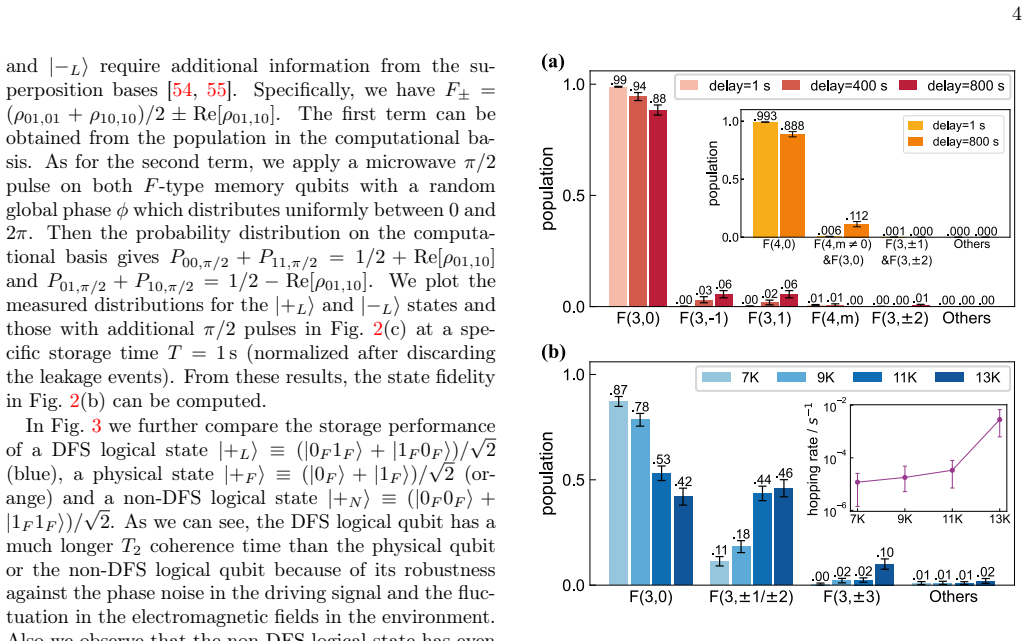
The central claim is that combining dual-type qubits, a cryogenic trap, DFS encoding, and leakage post-selection makes multi-ion quantum storage practical at the two-hour scale. For the four DFS logical states $|0_L\rangle$, $|1_L\rangle$, $|+_L\rangle$, and $|-_L\rangle$, the fitted decay constants are $\tau_0 = 3.3\times 10^4\,\mathrm{s}$, $\tau_1 = 2.9\times 10^4\,\mathrm{s}$, $\tau_+ = 7.9\times 10^3\,\mathrm{s}$, and $\tau_- = 8.0\times 10^3\,\mathrm{s}$, while the raw fidelity decays with a time constant of about $2000\,\mathrm{s}$ due to leakage. The paper attributes the leakage to collisions with background gas molecules, evidenced by increasing leakage at higher trap temperature correlated with a higher ion hopping rate. The DFS logical states are shown to be far more robust than a single physical qubit or a non-DFS logical state, demonstrating the benefit of the DFS encoding itself.
Load-bearing premise
The load-bearing premise is that post-selecting away leakage events leaves the remaining state unbiased; if the leakage detector, which is only 93.4 percent reliable for one of the two qubit levels, misclassifies states in a way that correlates with decoherence, the fitted two-hour coherence time would be inflated.
Editorial extensions
If this is right
- A logical qubit, not just a single physical qubit, can be stored for over two hours, a time more than a million times longer than the elementary gate operations for these dual-type qubits.
- DFS encoding removes the need for an ultra-stable microwave frequency reference and for long dynamical-decoupling sequences; only two spin echoes are required.
- Because the memory and coolant ions have the same mass, the scheme is expected to scale to larger ion chains without the sympathetic-cooling inefficiency of mixed-species traps.
- Detectable Zeeman leakage can be treated as an erasure error with known location, which is friendlier for quantum error correction than an unheralded error.
- The raw fidelity decay is dominated by background-gas collisions, so improving vacuum quality should directly extend the unprotected storage time.
Reading between the lines
- If the erasure post-selection is clean, the same DFS block could serve as the physical layer under a small quantum error-correcting code that exploits known erasure locations, potentially pushing the logical memory beyond the vacuum-limited lifetime even without better vacuum.
- The collision mechanism predicts a quantitative relation between background pressure and Zeeman leakage rate; measuring leakage under deliberately varied hydrogen pressure would test the model and guide vacuum specifications.
- The two-ion DFS could be generalized to N-ion symmetric DFS states, trading encoding overhead for additional robustness, provided individual addressing and crosstalk-free sympathetic cooling persist.
- One implication the authors state only implicitly is that the reported two-hour T2 is conditional on retaining runs with no detected leakage, so the heralding efficiency, the fraction of runs that survive post-selection, matters as much as the conditional coherence time for practical use.
Editorial analysis
A structured set of objections, weighed in public.
Referee Report
Summary. The paper reports a cryogenic trapped-ion quantum memory using three 171Yb+ ions in a dual-type (ground-state/metastable) encoding. Two ions serve as memory ions in the metastable F7/2 manifold, encoding a logical qubit in the decoherence-free subspace (DFS) spanned by |0F 1F> and |1F 0F>; the third ion provides sympathetic cooling without crosstalk. The authors measure storage fidelity as a function of hold time T, observe a raw fidelity decay time of about 2000 s dominated by leakage to nearby Zeeman levels, and then post-select on events where no leakage is detected. After this post-selection they fit exponential decay constants tau_+ = 7.9e3 s and tau_- = 8.0e3 s for the two entangled DFS states, and on this basis claim 'a coherence time above two hours' for the logical qubit. They also study the leakage mechanism and present evidence that it is caused by collisions with background gas molecules.
Significance. If the claimed storage time is sustained, this would be the longest reported coherence time for a multi-ion logical quantum memory and a notable demonstration of dual-type qubit storage in a DFS. The work combines several nontrivial elements: a cryogenic trap to suppress ion hopping, same-species sympathetic cooling, coherent conversion between S-type and F-type qubits, and multi-state detection to herald leakage. The comparison among DFS, physical, and non-DFS encodings in Fig. 3 is a useful controlled demonstration of the DFS advantage. The leakage-mechanism study (temperature correlation with collision rate) is a valuable diagnostic that points toward further improvements. However, the central headline claim is not fully supported by the reported confidence intervals, and the post-selection bias analysis is incomplete, so the significance is conditional on those points being resolved.
major comments (3)
- [Main text, storage lifetime and Fig. 2(b)] The central claim 'coherence time above two hours' is not supported by the reported 68% confidence intervals. For the entangled DFS states the fits give tau_+ = 7.9(+18.0,-3.4) x 10^3 s and tau_- = 8.0(+9.7,-3.1) x 10^3 s, so the one-sigma lower bounds are 4.5 x 10^3 s and 4.9 x 10^3 s, both below 7.2 x 10^3 s (two hours). At 68% confidence the coherence time could be as short as about 1.3 hours. The abstract and title should either state the point estimate with its uncertainty or provide a one-sided confidence level at which the claim 'above two hours' is actually established.
- [Main text, multi-state detection paragraph and the sentence 'such a fixed SPAM error does not affect the measurement…] The assertion that a fixed SPAM error does not affect the storage-lifetime measurement is not justified without a confusion-matrix calibration. The paper reports a |1F> detection fidelity of 93.4% and notes that leakage from |1F> to |F=4,mF=±1> cannot be directly distinguished because of equal Zeeman splittings. If some leaked population is misclassified as |1F>, it is retained in the post-selected ensemble and can either accelerate the apparent decay or, if the misclassification is state- or time-dependent, bias the fitted tau_+ and tau_-. A fixed detection offset would only rescale the exponential amplitude, but the paper does not show that the detection errors are truly constant over the storage times up to about 10^4 s and independent of the qubit state. Please provide a confusion matrix and a test of the post-selection robustness, for example by comparing the fitted tau with and without a model of the detection errors.
- [Main text, post-selection procedure and Fig. 2(c)] The post-selection of no-leakage events is treated as a clean erasure detection, but the paper does not demonstrate that the leakage detection efficiency is independent of the stored logical state and the storage time. The normalization after discarding leakage events in Fig. 2(c) assumes that the discarded events carry no information about the remaining state. If, for instance, the detection of |0F> and |1F> has different efficiencies or if the leakage rate itself depends on the stored state, the post-selected fidelities can be distorted. A control measurement at short storage time T (e.g., T=1s) showing that the post-selected fidelity matches the directly prepared state fidelity, both with and without the leakage discard, would address this concern.
minor comments (4)
- [Abstract and conclusion] The phrase 'after correcting the dominant leakage error' is imprecise: the experiment does not correct the leaked population but post-selects on no-leakage events. The wording should be changed to something like 'after post-selecting on no-leakage detection' to avoid implying that leakage is actively reversed.
- [Fig. 2(c) caption] The caption says the distributions are 'normalized after discarding the leakage events' but does not specify the normalization procedure. Please state whether the remaining populations are renormalized to sum to 1 and whether this renormalization is consistent with the post-selected fidelity computation.
- [Fig. 2(a,b) and numerical simulation] The dashed curves are described as numerical simulation results based on a simplified error model, but the model is not summarized in the main text. A brief description of the leakage and dephasing rates used in the simulation would help the reader assess the agreement without going to the Supplemental Material.
- [Fig. 4(a) inset] The inset showing the leakage probability of |1F> is a single time point (T=800s). To support the statement that the leakage rate of |1F> is 'similar' to that of |0F>, additional time points or a fitted rate would be more convincing, given that the |1F> channel cannot be fully resolved from the |F=4,mF=±1> levels.
Circularity Check
No significant circularity: the paper reports an experimental measurement with standard exponential fits; citations to prior work are toolbox references, not load-bearing premises of the claimed result.
full rationale
The paper's central claim is a measured coherence time for DFS logical states in a dual-type trapped-ion memory. The decay constants tau_0, tau_1, tau_+, and tau_- are obtained by maximum-likelihood exponential fits of measured storage fidelities to F = (1 + A e^{-T/tau})/2, which is standard parametric fitting of data and not a prediction forced by construction. The DFS encoding is not re-derived from the data; it is implemented and then compared experimentally with a physical qubit and a non-DFS logical state, providing an independent internal benchmark of the DFS advantage. The leakage mechanism is inferred from temperature-dependent leakage rates and dark-ion hopping rates, which is an external correlation, not an input to the claimed lifetime. Prior works by the same group are cited as experimental tools (dual-type qubit conversion, crosstalk-avoided gates, cryogenic traps), not as a uniqueness theorem or as the source of the two-hour claim. The brief assertion that a fixed SPAM error does not affect the storage lifetime is an assumption about error modeling rather than a circular step, since the lifetime is extracted from the time dependence of the data rather than from the SPAM model itself. No equation in the paper reduces to its own input by construction, and no fitted parameter is renamed as a prediction. The skeptical concern about post-selection bias (93.4% detection fidelity for |1F> and unresolved |F=4,mF=±1> leakage) is a correctness and calibration risk, but it is not a circularity of the derivation chain.
Assumptions & free parameters
free parameters (6)
- tau_0 =
3.3e4 s (68% CI: 1.6e4 to 6.3e4 s)
- tau_1 =
2.9e4 s (68% CI: 1.3e4 to 7.5e4 s)
- tau_plus =
7.9e3 s (68% CI: 4.5e3 to 25.9e3 s)
- tau_minus =
8.0e3 s (68% CI: 4.9e3 to 17.7e3 s)
- A (exponential amplitude) =
Not reported per state
- Leakage and dephasing rates in simplified error model =
Not stated in main text
assumptions (5)
- standard math DFS encoding is immune to collective dephasing
- domain assumption Leakage events can be detected and discarded, yielding a heralded memory
- domain assumption SPAM errors are time-independent and do not affect the fitted storage lifetime
- domain assumption Two spin echoes fully suppress the effect of magnetic field gradient between the two memory ions
- domain assumption Collision with background H2 molecules is the dominant leakage mechanism
Cite this review
Pith. "Pith review of Long-time storage of a decoherence-free subspace logical qubit in a dual-type quantum memory." pith.science (2026). https://pith.science/paper/5KBVNQL3
@misc{pith2026250713320,
  author       = {Pith},
  title        = {Pith review of: Long-time storage of a decoherence-free subspace logical qubit in a dual-type quantum memory},
  year         = {2026},
  howpublished = {\url{https://pith.science/paper/5KBVNQL3}},
  note         = {Machine review of arXiv:2507.13320}
}
read the original abstract
A quantum memory is an essential element for quantum computation, quantum network and quantum metrology. Previously, a single-qubit quantum memory with a coherence time of about an hour has been realized in a dual-species setup where a coolant ion provides sympathetic cooling for a memory ion of different species. However, the frequent random position hopping between the ions in the room-temperature trap limits the technique there only applicable to single-qubit storage. Here we report a multi-ion quantum memory in a cryogenic trap based on the dual-type scheme, and demonstrate a coherence time above two hours for a logical qubit encoded in the decoherence-free subspace, i.e. two-ion entangled states, after correcting the dominant leakage error. Our scheme alleviates the necessity of an ultra-stable frequency reference for the stored qubit, and has a preferable scalability owing to the same mass of the metastable-state memory ions and the ground-state coolant ion.
Figures


Figures from the paper (1 more)
Reference graph
Works this paper leans on
-
[1]
MA Nielsen and IL Chuang, Quantum Computation and Quantum Information (Cambridge University Press, 2000)
work page 2000
-
[2]
As we can see, the DFS logical qubit has a much longer T2 coherence time than the physical qubit or the non-DFS logical qubit because of its robustness against the phase noise in the driving signal and the fluc- tuation in the electromagnetic fields in the environment. Also we observe that the non-DFS logical state has even a shorter coherence time (about...
-
[3]
Alexander I Lvovsky, Barry C Sanders, and Wolfgang Tittel, “Optical quantum memory,” Nature photonics3, 706–714 (2009)
work page 2009
-
[4]
Quantum mem- ories: emerging applications and recent advances,
Khabat Heshami, Duncan G. England, Peter C. Humphreys, Philip J. Bustard, Victor M. Acosta, Joshua Nunn, and Benjamin J. Sussman and, “Quantum mem- ories: emerging applications and recent advances,” Jour- nal of Modern Optics 63, 2005–2028 (2016), pMID: 27695198
work page 2016
-
[5]
Theory of fault-tolerant quantum computation,
Daniel Gottesman, “Theory of fault-tolerant quantum computation,” Phys. Rev. A57, 127–137 (1998)
work page 1998
-
[6]
The physical implementation of quantum computation,
David P. DiVincenzo, “The physical implementation of quantum computation,” Fortschritte der Physik48, 771– 783 (2000)
work page 2000
-
[7]
Quantum computers,
T. D. Ladd, F. Jelezko, R. Laflamme, Y. Nakamura, C. Monroe, and J. L. O’Brien, “Quantum computers,” Nature 464, 45–53 (2010)
2010
-
[8]
Roads towards fault-tolerant universal quantum computation,
Earl T Campbell, Barbara M Terhal, and Christophe Vuillot, “Roads towards fault-tolerant universal quantum computation,” Nature 549, 172–179 (2017)
work page 2017
Show all 64 references
-
[9]
Quan- tum repeaters: The role of imperfect local operations in quantum communication,
H.-J. Briegel, W. Dür, J. I. Cirac, and P. Zoller, “Quan- tum repeaters: The role of imperfect local operations in quantum communication,” Phys. Rev. Lett. 81, 5932– 5935 (1998)
1998
-
[10]
Long-distance quantum communication with atomic en- sembles and linear optics,
L. M. Duan, M. D. Lukin, J. I. Cirac, and P. Zoller, “Long-distance quantum communication with atomic en- sembles and linear optics,” Nature414, 413 (2001)
2001
-
[11]
Quantum repeaters based on atomic ensembles and linear optics,
Nicolas Sangouard, Christoph Simon, Hugues de Ried- matten, and Nicolas Gisin, “Quantum repeaters based on atomic ensembles and linear optics,” Rev. Mod. Phys. 83, 33–80 (2011)
2011
-
[12]
Quantum sensing,
C. L. Degen, F. Reinhard, and P. Cappellaro, “Quantum sensing,” Rev. Mod. Phys.89, 035002 (2017)
2017
-
[13]
Colloquium: Trapping and manipulating photon states in atomic ensembles,
M. D. Lukin, “Colloquium: Trapping and manipulating photon states in atomic ensembles,” Rev. Mod. Phys.75, 457–472 (2003)
2003
-
[14]
Long-lived quantum memory,
R. Zhao, Y. O. Dudin, S. D. Jenkins, C. J. Campbell, D. N. Matsukevich, T. A. B. Kennedy, and A. Kuzmich, “Long-lived quantum memory,” Nature Physics5, 100– 104 (2009)
2009
-
[15]
Quantum storage of orbital angular momentum entanglement in an atomic ensem- ble,
Dong-ShengDing, WeiZhang, Zhi-YuanZhou, ShuaiShi, Guo-Yong Xiang, Xi-Shi Wang, Yun-Kun Jiang, Bao-Sen Shi, and Guang-Can Guo, “Quantum storage of orbital angular momentum entanglement in an atomic ensem- ble,” Phys. Rev. Lett.114, 050502 (2015)
2015
-
[16]
An efficient quantum light–matter interface with sub-second lifetime,
Sheng-Jun Yang, Xu-Jie Wang, Xiao-Hui Bao, and Jian- Wei Pan, “An efficient quantum light–matter interface with sub-second lifetime,” Nature Photonics10, 381–384 (2016)
2016
-
[17]
Efficient quantum memory for single- photon polarization qubits,
Yunfei Wang, Jianfeng Li, Shanchao Zhang, Keyu Su, Yiru Zhou, Kaiyu Liao, Shengwang Du, Hui Yan, and Shi-Liang Zhu, “Efficient quantum memory for single- photon polarization qubits,” Nature Photonics13, 346– 351 (2019)
2019
-
[18]
Realization of a programmable multipurpose photonic quantum memory with over-thousand qubit manipulations,
Sheng Zhang, Jixuan Shi, Zhaibin Cui, Ye Wang, Yukai Wu, Luming Duan, and Yunfei Pu, “Realization of a programmable multipurpose photonic quantum memory with over-thousand qubit manipulations,” Phys. Rev. X 14, 021018 (2024)
2024
-
[19]
Quantum storage of heralded polarization qubits in birefringent and anisotropically absorbing ma- terials,
Christoph Clausen, Félix Bussières, Mikael Afzelius, and Nicolas Gisin, “Quantum storage of heralded polarization qubits in birefringent and anisotropically absorbing ma- terials,” Phys. Rev. Lett.108, 190503 (2012)
2012
-
[20]
Quantum storage of a photonic polarization qubit in a solid,
Mustafa Gündoğan, Patrick M. Ledingham, Attaallah Almasi, Matteo Cristiani, and Hugues de Riedmatten, “Quantum storage of a photonic polarization qubit in a solid,” Phys. Rev. Lett.108, 190504 (2012)
2012
-
[21]
Realization of reliable solid- state quantum memory for photonic polarization qubit,
Zong-Quan Zhou, Wei-Bin Lin, Ming Yang, Chuan-Feng Li, and Guang-Can Guo, “Realization of reliable solid- state quantum memory for photonic polarization qubit,” Phys. Rev. Lett.108, 190505 (2012)
2012
-
[22]
Telecom- heralded entanglement between multimode solid-state quantum memories,
Dario Lago-Rivera, Samuele Grandi, Jelena V. Rakonjac, Alessandro Seri, and Hugues de Riedmatten, “Telecom- heralded entanglement between multimode solid-state quantum memories,” Nature594, 37–40 (2021)
2021
-
[23]
Storage of photonic time-bin qubits for up to 20ms in a rare-earth doped crystal,
AntonioOrtu, AdrianHolzäpfel, JeanEtesse, andMikael Afzelius, “Storage of photonic time-bin qubits for up to 20ms in a rare-earth doped crystal,” npj Quantum Infor- 6 mation 8, 29 (2022)
2022
-
[24]
Room-temperature quantum bit memory exceed- ing one second,
P. C. Maurer, G. Kucsko, C. Latta, L. Jiang, N. Y. Yao, S. D. Bennett, F. Pastawski, D. Hunger, N. Chisholm, M. Markham, D. J. Twitchen, J. I. Cirac, and M. D. Lukin, “Room-temperature quantum bit memory exceed- ing one second,” Science336, 1283–1286 (2012)
2012
-
[25]
Solid-state electronic spin coherence time approaching one second,
N. Bar-Gill, L. M. Pham, A. Jarmola, D. Budker, and R. L. Walsworth, “Solid-state electronic spin coherence time approaching one second,” Nature Communications 4, 1743 (2013)
2013
-
[26]
A ten-qubit solid-state spin register with quantum memory up to one minute,
C. E. Bradley, J. Randall, M. H. Abobeih, R. C. Berrevoets, M. J. Degen, M. A. Bakker, M. Markham, D. J. Twitchen, and T. H. Taminiau, “A ten-qubit solid-state spin register with quantum memory up to one minute,” Phys. Rev. X9, 031045 (2019)
2019
-
[27]
Long-lived qubit memory using atomic ions,
C. Langer, R. Ozeri, J. D. Jost, J. Chiaverini, B. De- Marco, A. Ben-Kish, R. B. Blakestad, J. Britton, D. B. Hume, W. M. Itano, D. Leibfried, R. Reichle, T. Rosen- band, T. Schaetz, P. O. Schmidt, and D. J. Wineland, “Long-lived qubit memory using atomic ions,” Phys. Rev. Let...
2005
-
[28]
Robust entanglement,
H. Häffner, F. Schmidt-Kaler, W. Hänsel, C. F. Roos, T. Körber, M. Chwalla, M. Riebe, J. Benhelm, U. D. Rapol, C. Becher, and R. Blatt, “Robust entanglement,” Applied Physics B81, 151–153 (2005)
2005
-
[29]
High-fidelity preparation, gates, memory, and read- out of a trapped-ion quantum bit,
T. P. Harty, D. T. C. Allcock, C. J. Ballance, L. Guidoni, H. A. Janacek, N. M. Linke, D. N. Stacey, and D. M. Lu- cas, “High-fidelity preparation, gates, memory, and read- out of a trapped-ion quantum bit,” Phys. Rev. Lett.113, 220501 (2014)
2014
-
[30]
Single-qubit quantum memory exceeding ten-minute coherence time,
Ye Wang, Mark Um, Junhua Zhang, Shuoming An, Ming Lyu, Jing-Ning Zhang, L.-M. Duan, Dahyun Yum, and Kihwan Kim, “Single-qubit quantum memory exceeding ten-minute coherence time,” Nature photonics11, 646– 650 (2017)
2017
-
[31]
Single ion qubit with estimated coherence time exceeding one hour,
Pengfei Wang, Chun-Yang Luan, Mu Qiao, Mark Um, Junhua Zhang, Ye Wang, Xiao Yuan, Mile Gu, Jingn- ing Zhang, and Kihwan Kim, “Single ion qubit with estimated coherence time exceeding one hour,” Nature communications 12, 233 (2021)
2021
-
[32]
Experimental realization of a multiqubit quantum memory in a 218-ion chain,
R. Yao, W.-Q. Lian, Y.-K. Wu, G.-X. Wang, B.-W. Li, Q.-X. Mei, B.-X. Qi, L. Yao, Z.-C. Zhou, L. He, and L.-M. Duan, “Experimental realization of a multiqubit quantum memory in a 218-ion chain,” Phys. Rev. A106, 062617 (2022)
2022
-
[33]
Engineering large stark shifts for control of individual clock state qubits,
A. C. Lee, J. Smith, P. Richerme, B. Neyenhuis, P. W. Hess, J. Zhang, and C. Monroe, “Engineering large stark shifts for control of individual clock state qubits,” Phys. Rev. A 94, 042308 (2016)
2016
-
[34]
Ob- servation of quantum superposition of topological defects in a trapped-ion quantum simulator,
Zhi-Jie Cheng, Yu-Kai Wu, Shi-Jiao Li, Quan-Xin Mei, Bo-Wen Li, Gang-Xi Wang, Yue Jiang, Bin-Xiang Qi, Zi-Chao Zhou, Pan-Yu Hou, and Lu-Ming Duan, “Ob- servation of quantum superposition of topological defects in a trapped-ion quantum simulator,” Science Advances 10, eadr9527 (2024)
2024
-
[35]
Ion-trap quantum logic using long-wavelength radiation,
Florian Mintert and Christof Wunderlich, “Ion-trap quantum logic using long-wavelength radiation,” Phys. Rev. Lett. 87, 257904 (2001)
2001
-
[36]
Ver- satile microwave-driven trapped ion spin system for quantum information processing,
Christian Piltz, Theeraphot Sriarunothai, Svetoslav S. Ivanov, Sabine Wölk, and Christof Wunderlich, “Ver- satile microwave-driven trapped ion spin system for quantum information processing,” Science Advances 2, e1600093 (2016)
2016
-
[37]
Character of motional modes for entanglement and sympathetic cool- ing of mixed-species trapped-ion chains,
K. Sosnova, A. Carter, and C. Monroe, “Character of motional modes for entanglement and sympathetic cool- ing of mixed-species trapped-ion chains,” Phys. Rev. A 103, 012610 (2021)
2021
-
[38]
Cryogenic trapped- ion system for large scale quantum simulation,
GPagano, PWHess, HBKaplan, WLTan, PRicherme, P Becker, A Kyprianidis, J Zhang, E Birckelbaw, M R Hernandez, Y Wu, and C Monroe, “Cryogenic trapped- ion system for large scale quantum simulation,” Quantum Science and Technology4, 014004 (2018)
2018
-
[39]
Realizing coherently convertible dual-type qubits with the same ion species,
H.-X. Yang, J.-Y. Ma, Y.-K. Wu, Y. Wang, M.-M. Cao, W.-X. Guo, Y.-Y. Huang, L. Feng, Z.-C. Zhou, and L.-M. Duan, “Realizing coherently convertible dual-type qubits with the same ion species,” Nature Physics 18, 1058–1061 (2022), arXiv:2106.14906
2022 arXiv
-
[40]
omg blueprint for trapped ion quantum computing with metastable states,
D. T. C. Allcock, W. C. Campbell, J. Chiaverini, I. L. Chuang, E. R. Hudson, I. D. Moore, A. Ransford, C. Ro- man, J. M. Sage, and D. J. Wineland, “omg blueprint for trapped ion quantum computing with metastable states,” Applied Physics Letters 119, 214002 (2021), arXiv:2109.01272
2021 arXiv
-
[41]
Realization of a crosstalk-avoided quan- tum network node using dual-type qubits of the same ion species,
L. Feng, Y.-Y. Huang, Y.-K. Wu, W.-X. Guo, J.-Y. Ma, H.-X. Yang, L. Zhang, Y. Wang, C.-X. Huang, C. Zhang, L. Yao, B.-X. Qi, Y.-F. Pu, Z.-C. Zhou, and L.-M. Duan, “Realization of a crosstalk-avoided quan- tum network node using dual-type qubits of the same ion species,” Nature...
2024
-
[42]
Realization of a crosstalk- freetwo-ionnodeforlong-distancequantumnetworking,
P.-C. Lai, Y. Wang, J.-X. Shi, Z.-B. Cui, Z.-Q. Wang, S. Zhang, P.-Y. Liu, Z.-C. Tian, Y.-D. Sun, X.-Y. Chang, B.-X. Qi, Y.-Y. Huang, Z.-C. Zhou, Y.-K. Wu, Y. Xu, Y.-F. Pu, and L.-M. Duan, “Realization of a crosstalk- freetwo-ionnodeforlong-distancequantumnetworking,” Phys. Re...
2025
-
[43]
Eliminating qubit-type cross-talk in the omg protocol,
Samuel R. Vizvary, Zachary J. Wall, Matthew J. Bogus- lawski, Michael Bareian, Andrei Derevianko, Wesley C. Campbell, and Eric R. Hudson, “Eliminating qubit-type cross-talk in the omg protocol,” Phys. Rev. Lett. 132, 263201 (2024)
2024
-
[44]
Long-lived metastable-qubit memory,
Xiaoyang Shi, Jasmine Sinanan-Singh, Kyle DeBry, Su- sanna L. Todaro, Isaac L. Chuang, and John Chiaverini, “Long-lived metastable-qubit memory,” Phys. Rev. A 111, L020601 (2025)
2025
-
[45]
Lifetime of the2F7/2 level in yb+ for spontaneous emission of electric octupole ra- diation,
R. Lange, A. A. Peshkov, N. Huntemann, Chr. Tamm, A. Surzhykov, and E. Peik, “Lifetime of the2F7/2 level in yb+ for spontaneous emission of electric octupole ra- diation,” Phys. Rev. Lett.127, 213001 (2021)
2021
-
[46]
Preserving coher- ence in quantum computation by pairing quantum bits,
Lu-Ming Duan and Guang-Can Guo, “Preserving coher- ence in quantum computation by pairing quantum bits,” Phys. Rev. Lett.79, 1953–1956 (1997)
1997
-
[47]
Decoherence-free subspaces for quantum computation,
D. A. Lidar, I. L. Chuang, and K. B. Whaley, “Decoherence-free subspaces for quantum computation,” Phys. Rev. Lett.81, 2594–2597 (1998)
1998
-
[48]
A decoherence-free quantum memory using trapped ions,
D. Kielpinski, V. Meyer, M. A. Rowe, C. A. Sackett, W. M. Itano, C. Monroe, and D. J. Wineland, “A decoherence-free quantum memory using trapped ions,” Science 291, 1013–1015 (2001)
2001
-
[49]
Bell states of atoms with ultralong lifetimes and their tomographic state analysis,
C. F. Roos, G. P. T. Lancaster, M. Riebe, H. Häffner, W. Hänsel, S. Gulde, C. Becher, J. Eschner, F. Schmidt- Kaler, and R. Blatt, “Bell states of atoms with ultralong lifetimes and their tomographic state analysis,” Phys. Rev. Lett. 92, 220402 (2004)
2004
-
[50]
Interactions and collisions of cold metal atoms in magnetic traps,
A A Buchachenko, Yu V Suleimanov, M M Szczęśniak, and G Chałasiński, “Interactions and collisions of cold metal atoms in magnetic traps,” Physica Scripta 80, 048109 (2009). 7
2009
-
[51]
Decoherence of a single-ion qubit immersed in a spin-polarized atomic bath,
L. Ratschbacher, C. Sias, L. Carcagni, J. M. Silver, C. Zipkes, and M. Köhl, “Decoherence of a single-ion qubit immersed in a spin-polarized atomic bath,” Phys. Rev. Lett. 110, 160402 (2013)
2013
-
[52]
Spin-orbit interactions and quantum spin dynamics in cold ion-atom collisions,
Timur V. Tscherbul, Paul Brumer, and Alexei A. Buchachenko, “Spin-orbit interactions and quantum spin dynamics in cold ion-atom collisions,” Phys. Rev. Lett. 117, 143201 (2016)
2016
-
[53]
High-fidelity light-shift gate for clock-state qubits,
C. H. Baldwin, B. J. Bjork, M. Foss-Feig, J. P. Gae- bler, D. Hayes, M. G. Kokish, C. Langer, J. A. Sedlacek, D. Stack, and G. Vittorini, “High-fidelity light-shift gate for clock-state qubits,” Phys. Rev. A103, 012603 (2021)
2021
-
[54]
See Supplemental Material at URL-will-be-inserted-by- publisher for details about the state preparation, the multi-state detection sequence, the estimation method for the storage lifetime, the leakage model used in nu- merical simulation, the experimental sequences used in dis...
-
[55]
Dissi- pative production of a maximally entangled steady state of two quantum bits,
Y. Lin, J. P. Gaebler, F. Reiter, T. R. Tan, R. Bowler, A. S. Sørensen, D. Leibfried, and D. J. Wineland, “Dissi- pative production of a maximally entangled steady state of two quantum bits,” Nature504, 415–418 (2013)
2013
-
[56]
Resource-efficient dissipative en- tanglement of two trapped-ion qubits,
Daniel C. Cole, Stephen D. Erickson, Giorgio Zaran- tonello, Karl P. Horn, Pan-Yu Hou, Jenny J. Wu, Daniel H. Slichter, Florentin Reiter, Christiane P. Koch, and Dietrich Leibfried, “Resource-efficient dissipative en- tanglement of two trapped-ion qubits,” Phys. Rev. Lett. 128...
2022
-
[57]
Codes for the quantum erasure channel,
M. Grassl, Th. Beth, and T. Pellizzari, “Codes for the quantum erasure channel,” Phys. Rev. A56, 33–38 (1997)
1997
-
[58]
Capacities of quantum erasure channels,
Charles H. Bennett, David P. DiVincenzo, and John A. Smolin, “Capacities of quantum erasure channels,” Phys. Rev. Lett. 78, 3217–3220 (1997)
1997
-
[59]
Coherent control for qubit state readout,
Conrad Roman, Anthony Ransford, Michael Ip, and Wesley C Campbell, “Coherent control for qubit state readout,” New Journal of Physics22, 073038 (2020)
2020
-
[60]
Scalable hyperfine qubit state detection via electron shelving in the 2D5/2 and 2F7/2 manifolds in 171Yb+,
C. L. Edmunds, T. R. Tan, A. R. Milne, A. Singh, M. J. Biercuk, and C. Hempel, “Scalable hyperfine qubit state detection via electron shelving in the 2D5/2 and 2F7/2 manifolds in 171Yb+,” Phys. Rev. A104, 012606 (2021)
2021
-
[61]
Phase- modulated decoupling and error suppression in qubit- oscillator systems,
Todd J. Green and Michael J. Biercuk, “Phase- modulated decoupling and error suppression in qubit- oscillator systems,” Phys. Rev. Lett.114, 120502 (2015)
2015
-
[62]
Robust 2-qubit gates in a linear ion crystal using a frequency-modulated driving force,
Pak Hong Leung, Kevin A. Landsman, Caroline Figgatt, Norbert M. Linke, Christopher Monroe, and Kenneth R. Brown, “Robust 2-qubit gates in a linear ion crystal using a frequency-modulated driving force,” Phys. Rev. Lett. 120, 020501 (2018)
2018
-
[63]
Precision characterization of the2D5/2 state and the quadratic zeeman coefficient in171Yb+,
TR Tan, CL Edmunds, AR Milne, MJ Biercuk, and C Hempel, “Precision characterization of the2D5/2 state and the quadratic zeeman coefficient in171Yb+,” Physi- cal Review A104, L010802 (2021)
2021
-
[64]
J Vanier and C Audoin,The Quantum Physics of Atomic Frequency Standards (1st ed.) (CRC Press, 1989)
1989
Reviewed August 6, 2026 · model on record in the stance chip above.
Discussion (0). Continue with ORCID to comment.