Two-photon coupling via Josephson element II: Interaction dressing, cross-Kerr coupling, and limits of low-energy bosonic model
Pith reviewed 2026-05-19 04:18 UTC · model grok-4.3
The pith
In the two-photon regime the cross-Kerr coupling between a phase qubit and resonator never vanishes because dressing from qubit asymmetry and coupler nonlinearity keeps it finite.
A machine-rendered reading of the paper's core claim, the machinery that carries it, and where it could break.
Core claim
In the bosonic two-photon regime the cross-Kerr coupling never vanishes as it dresses due to asymmetry in the qubit potential and nonlinearity of the coupler. Quantitative results depend on the bosonic approximation whose limits are approached by enumerating the minimum number of coherent energy states required to capture dressing virtual processes that climb the qubit ladder. Near two-photon resonance with a coupled resonator all other relevant renormalizations arising from nonresonant interactions are calculated and verifiable predictions for the coupling rates are supplied.
What carries the argument
Dressing of the cross-Kerr interaction by virtual processes that climb the qubit ladder, generated by the combination of qubit-potential asymmetry and SQUID nonlinearity.
If this is right
- Modified SQUID-qubit circuits can be used for two-photon detection.
- The same circuits enable quantum-nondemolition readout of a qubit that has an asymmetric potential.
- Near two-photon resonance the coupling rates receive additional renormalizations that can be calculated from nonresonant interactions.
- The bosonic approximation requires a minimum number of energy states whose value is set by the highest virtual dressing processes.
Where Pith is reading between the lines
- Residual cross-Kerr terms will appear in any two-photon gate that uses an asymmetric Josephson element unless the asymmetry is deliberately cancelled.
- The ladder-climbing diagram method offers a systematic way to test the validity of bosonic approximations in other driven nonlinear circuits.
- Engineering the degree of qubit asymmetry could provide an in-situ knob for the strength of unwanted cross-Kerr interactions in larger quantum processors.
Load-bearing premise
The low-energy bosonic model for the qubit stays valid only when enough coherent energy states are retained to include all significant dressing processes that climb the qubit ladder.
What would settle it
Measure the residual cross-Kerr shift in a qubit-resonator circuit tuned exactly to the two-photon resonance and check whether the shift remains finite when the qubit potential is made more symmetric.
Figures


read the original abstract
We study the interactions mediated by a symmetric superconducting quantum interference device (SQUID), their renormalizations, and the applicability of the anharmonic oscillator (bosonic) model for a coupled phase qubit. The latter dwells in its metastable well holding a number of anharmonic energy states. The coupling SQUID can switch between the single- and two-photon interactions in situ. We find that, in the bosonic two-photon regime, the cross-Kerr coupling never vanishes as it dresses due to asymmetry in the qubit potential and nonlinearity of the coupler. Our quantitative results also depend on the bosonic approximation. We approach determining its limits by finding the minimum number of coherent energy states required for a dressing. For that, we lay out diagrams of the dressing virtual processes that climb the qubit ladder as high as possible. Near the two-photon resonance with a coupled resonator, we systematically calculate other relevant renormalizations due to nonresonant interactions. We provide verifiable predictions for the coupling rates. Modified systems can be applied for two-photon detection and for quantum-nondemolition readout of a qubit with an asymmetrical potential.
Editorial analysis
A structured set of objections, weighed in public.
Referee Report
Summary. The paper studies interactions mediated by a symmetric SQUID between a phase qubit (with metastable well and anharmonic states) and a resonator. It derives renormalizations of single- and two-photon couplings, shows that the cross-Kerr term remains non-zero in the bosonic two-photon regime due to qubit potential asymmetry and coupler nonlinearity, and determines the validity limits of the low-energy anharmonic-oscillator model by enumerating virtual dressing processes that climb the qubit ladder. Verifiable predictions for coupling rates are given for two-photon detection and QND readout applications.
Significance. If the bosonic truncation holds, the result that cross-Kerr never vanishes under dressing provides a concrete, falsifiable correction to standard low-energy models in circuit QED. The enumeration of virtual processes and the explicit dependence on asymmetry and nonlinearity parameters constitute a strength, as does the provision of verifiable predictions. The work is of moderate significance for experiments aiming to exploit or mitigate dressed two-photon interactions.
major comments (1)
- [limits of the low-energy bosonic model] Section on limits of the low-energy bosonic model: the minimum state count for the bosonic approximation is set by enumerating perturbative virtual processes that climb the qubit ladder. This enumeration may omit resonant multi-photon transitions enabled once the SQUID nonlinearity mixes higher levels, potentially allowing a cancellation or sign change in the renormalized cross-Kerr that the truncated model misses. Direct comparison to full numerical diagonalization of the ladder dynamics near two-photon resonance is needed to bound the truncation error and support the central claim that cross-Kerr never vanishes.
minor comments (2)
- The abstract states that quantitative results depend on the bosonic approximation but does not quantify the sensitivity to the retained state number; adding a brief statement or reference to the enumeration result would improve clarity.
- Notation for the asymmetry parameter and coupler nonlinearity strength should be introduced with explicit symbols in the main text before their use in the renormalization formulas.
Simulated Author's Rebuttal
We are grateful to the referee for their detailed and constructive feedback on our manuscript. Below, we provide a point-by-point response to the major comment and indicate the revisions we intend to make.
read point-by-point responses
-
Referee: Section on limits of the low-energy bosonic model: the minimum state count for the bosonic approximation is set by enumerating perturbative virtual processes that climb the qubit ladder. This enumeration may omit resonant multi-photon transitions enabled once the SQUID nonlinearity mixes higher levels, potentially allowing a cancellation or sign change in the renormalized cross-Kerr that the truncated model misses. Direct comparison to full numerical diagonalization of the ladder dynamics near two-photon resonance is needed to bound the truncation error and support the central claim that cross-Kerr never vanishes.
Authors: We thank the referee for pointing out this potential limitation in our analysis of the bosonic approximation. The enumeration of virtual processes is derived from the complete circuit model, incorporating both the qubit potential asymmetry and the SQUID nonlinearity. These processes include contributions from higher-level mixing induced by the coupler. Nevertheless, we concur that a numerical validation would enhance the manuscript by providing quantitative bounds on the truncation error. Accordingly, in the revised version of the manuscript, we will add a comparison of our analytical results with full numerical diagonalization of the Hamiltonian in the vicinity of the two-photon resonance. This addition will support our claim that the cross-Kerr term remains non-zero under the relevant conditions. revision: yes
Circularity Check
No significant circularity; derivations self-contained from Hamiltonian
full rationale
The paper derives renormalizations of interactions and the non-vanishing cross-Kerr coupling directly from the circuit Hamiltonian, incorporating explicit asymmetry in the qubit potential and nonlinearity of the SQUID coupler as model inputs. The limits of the low-energy bosonic model are approached via explicit enumeration of dressing virtual processes that climb the qubit ladder, which constitutes a direct perturbative calculation rather than a fitted parameter, self-definition, or reduction to prior outputs. No load-bearing self-citations, ansatzes smuggled via citation, or uniqueness theorems imported from the authors' prior work are invoked to force the central claims. The quantitative results and verifiable predictions for coupling rates follow from the stated Hamiltonian parameters without circular reduction to the target quantities by construction. This is the standard case of a self-contained derivation against external circuit benchmarks.
Axiom & Free-Parameter Ledger
free parameters (2)
- asymmetry parameter in qubit potential
- coupler nonlinearity strength
axioms (2)
- domain assumption The low-energy dynamics can be captured by a finite number of anharmonic oscillator levels whose minimum count is determined by enumerating virtual dressing processes.
- domain assumption Perturbative renormalization near two-photon resonance captures all relevant frequency shifts from non-resonant interactions.
Lean theorems connected to this paper
-
IndisputableMonolith/Cost/FunctionalEquation.leanwashburn_uniqueness_aczel unclear?
unclearRelation between the paper passage and the cited Recognition theorem.
We approach determining its limits by finding the minimum number of coherent energy states required for a dressing. For that, we lay out diagrams of the dressing virtual processes that climb the qubit ladder as high as possible.
-
IndisputableMonolith/Foundation/AlphaCoordinateFixation.leanJ_uniquely_calibrated_via_higher_derivative unclear?
unclearRelation between the paper passage and the cited Recognition theorem.
the cross-Kerr coupling never vanishes as it dresses due to asymmetry in the qubit potential and nonlinearity of the coupler
What do these tags mean?
- matches
- The paper's claim is directly supported by a theorem in the formal canon.
- supports
- The theorem supports part of the paper's argument, but the paper may add assumptions or extra steps.
- extends
- The paper goes beyond the formal theorem; the theorem is a base layer rather than the whole result.
- uses
- The paper appears to rely on the theorem as machinery.
- contradicts
- The paper's claim conflicts with a theorem or certificate in the canon.
- unclear
- Pith found a possible connection, but the passage is too broad, indirect, or ambiguous to say the theorem truly supports the claim.
Reference graph
Works this paper leans on
-
[1]
Full expres- sions are provided in Appendix A
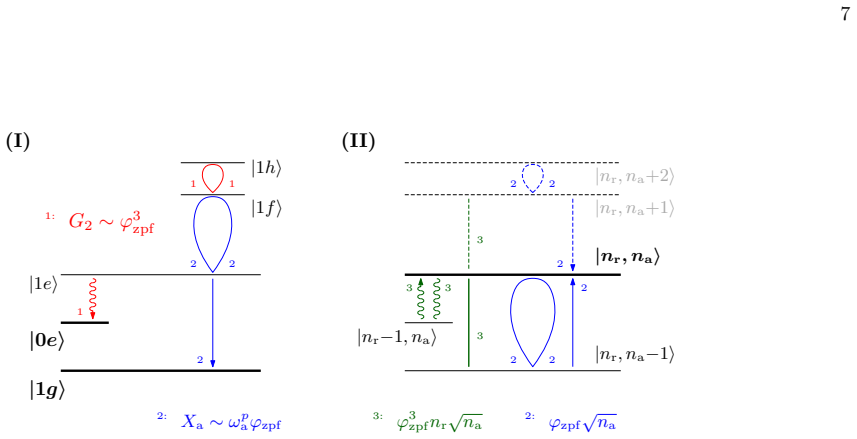
as ˜ωr ≈ω p r − K0,X 2 ,˜ω a ≈ω p a −Ξ a − K0,X 2 .(46) Here we omit other interaction-induced shifts that are of order ofg 2 ±/˜ωr,a andΞ ag2 ±/˜ω2 r,a and less. Full expres- sions are provided in Appendix A. We show in Sec. V E thatK 0,X in Eqs. (46) is also the main contribution to the cross-Kerr coupling strength as in Eq. (38). Another frequency shif...
-
[2]
(30), ˜gi 1 vanishes for the bias determined by the condition cotδ= 5 6 µφ2 a,zpf
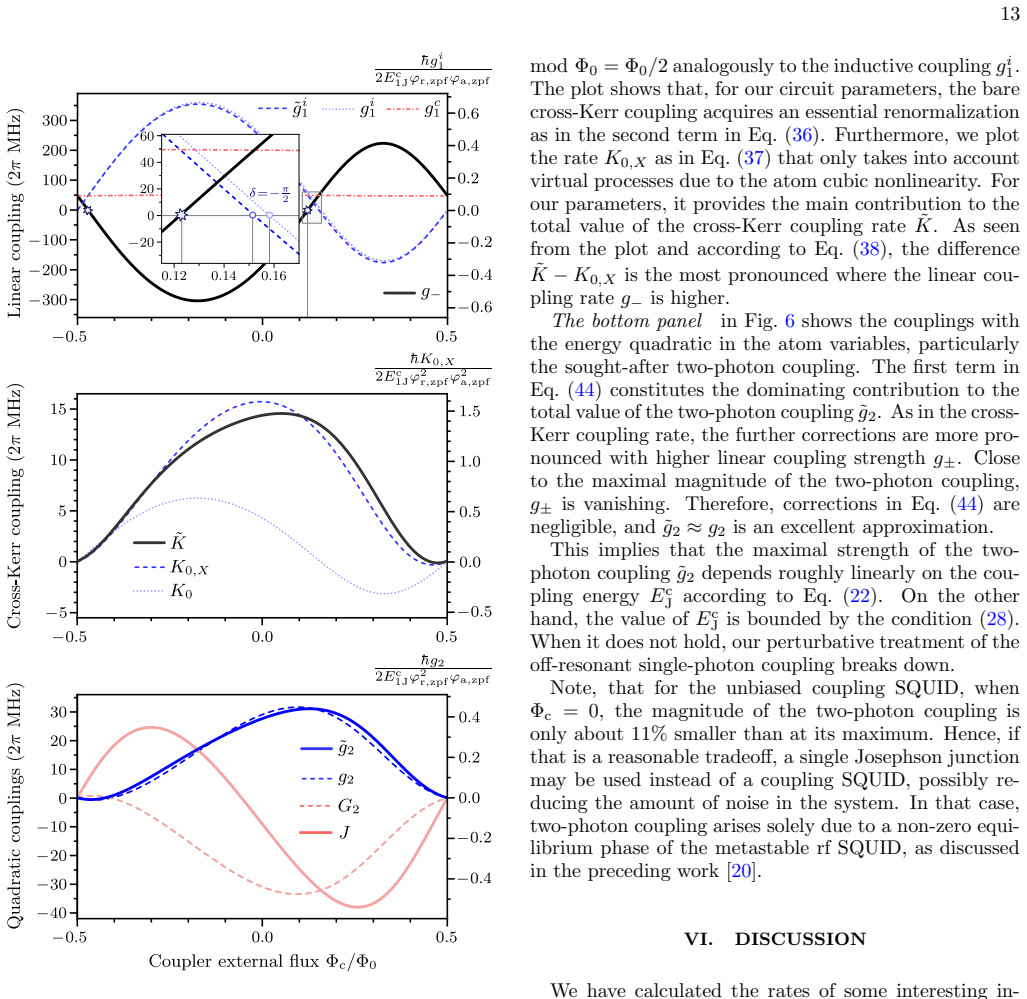
As follows from Eq. (30), ˜gi 1 vanishes for the bias determined by the condition cotδ= 5 6 µφ2 a,zpf. This zero-shifting compo- nent is proportional to the bareG 2 interaction (see lower panel) and sinδ. Hence, this component is close to its maximal magnitude right near the zero of the bare cou- plingg i
-
[3]
We mark these values of Φ c in Fig
Equation (32) suggests an important property: for specific values of the external flux Φ c, the capacitive and inductive couplings cancel each other out, and the single-photon coupling switches off [51, 67]. We mark these values of Φ c in Fig. 6. The middle panelin Fig. 6 demonstrates the cross- Kerr coupling rate ˜Kas in Eq. (38). We also plot the bare r...
work page 2023
-
[4]
(13) and (14) as a perturbation
Self-nonlinearities as a perturbation We start with treating the cubic and quartic nonlinear- ities of Eqs. (13) and (14) as a perturbation. We approx- imately diagonalize the atom Hamiltonian ˆHa in Eq. (14) using a Schrieffer-Wolff transformation [11, 62, 89], ˆHa → e−ΛaSa ˆHaeΛaSa, where Λa = Xa ωp a .(A1) The anti-Hermitian operatorS a is given by [61...
-
[5]
Apart from its definition Eq. (A1), another way to express this small parameter is Λa = 1 12 µφa,zpf ,(A7) where|µ|≲2E a J/ ˜Ea L according to Eq. (31) forE c J ≲E a J. In the Hamiltonian in Eq. (A4), we have dropped off-diagonal terms of two kinds: One is proportional to Λ aXa(b†mbn +b †nbm), wherem+nis even and 2≤m+n≤4. Another one is proportional to Λa...
-
[6]
For both types,m, n= 0,1,2, . . .andm̸=n. Elimi- nating such terms with a Schrieffer-Wolff transformation yields additional terms in the Hamiltonian with the mag- nitudes about Λ3 aXa/(m−n) andφ a,zpfΛ3 aYa/(m−n) or smaller. Here, we have used thatY a ≲φ a,zpf Xa accord- ing to Eq. (16) forE c J ≪E a J and cotϕ min a <1 as in Sec. V in the atom metastable...
-
[7]
Two-photon regime Withω a ≈2ω r, which is close to the two-photon reso- nance, the interaction Hamiltonian becomes ˆHI ℏ ≈ −g2(a†2b+b †a2)−K 0,X a†a b†b+ δ ˆHI ℏ .(A14) The first two terms here correspond to the resonant in- teractions: the bare two-photon coupling of strengthg 2 and the cross-Kerr coupling of strengthK 0,X as given by Eq. (A13). Below, w...
-
[8]
Thus, 3|g 3 +G 3| ≪ |g i 1|as follows from Eqs. (20), (23), and (25). As for the second term in Eq. (A16), it matters near the pointsδmodπ=π/2 where the bare inductive couplingg i 1 vanishes. Away from there, the entire renormalization of the lin- ear couplingg i 1 often can be negligible. The coupling strengthG 2 is of higher order in the vacuum fluctuat...
-
[9]
In that case, ˜g i 1 ≈g i 1 according to Eq
Thus, we have that 20Λ a|G2| ≪ |g i 1|as far asµφ 2 a,zpf |tanδ| ≪1. In that case, ˜g i 1 ≈g i 1 according to Eq. (A16). The second and third lines in Eq. (A15) describe non- linear interactions that result in the same transitions as the linear coupling. The number-conserving part of such interactions is known as a nonlinear Jaynes-Cummings interaction (s...
-
[10]
Calculation Beforehand, it is convenient to rewrite Eq. (A2) as Sa =− 2 3(b† −b) 3 + (b† +b) 2(b† −b)−2(b † +b).(B1) We verify this form withpyBoLaNO[95] which is based on Refs. [96, 97]. With Eq. (B1), the commutators in the BCH formula (A3) are easy to calculate, as our Hamilto- nian in Eqs. (14) and (18) depends on the dimensionless canonical coordinat...
-
[11]
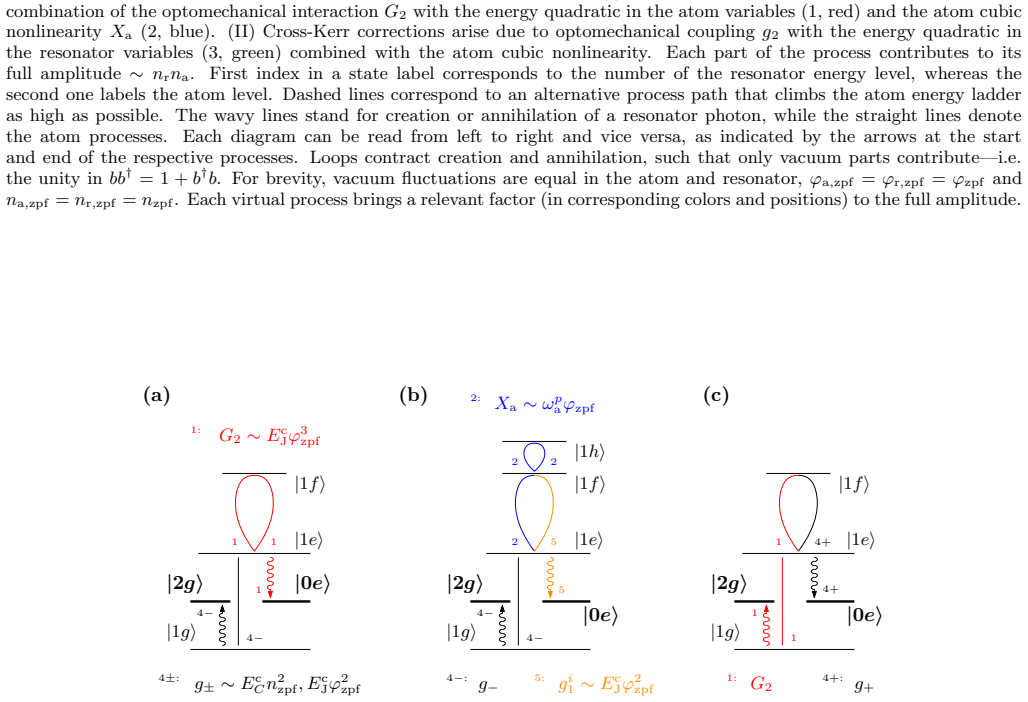
Diagrams and the number of energy levels The atom part of the diagram in Fig. 2(II) shows the process as described, among others, by the term :P M M M: similar to the second term in Eq. (B5). Contraction in a term corresponds to a loop in the dia- gram. Note that, when only taking into account the first BCH commutator as in Eq. (B3), the processes from di...
-
[12]
E. T. Jaynes and F. W. Cummings, Comparison of quan- tum and semiclassical radiation theories with application to the beam maser, Proc. IEEE51, 89 (1963)
work page 1963
-
[13]
F. Yan, P. Krantz, Y. Sung, M. Kjaergaard, D. L. Camp- bell, T. P. Orlando, S. Gustavsson, and W. D. Oliver, Tunable coupling scheme for implementing high-fidelity two-qubit gates, Phys. Rev. Appl.10, 054062 (2018)
work page 2018
-
[14]
E. A. Sete, A. Q. Chen, R. Manenti, S. Kulshreshtha, and S. Poletto, Floating tunable coupler for scalable quantum computing architectures, Phys. Rev. Appl.15, 064063 (2021)
work page 2021
-
[15]
F. Marxer, A. Veps¨ al¨ ainen, S. W. Jolin, J. Tuorila, A. Landra, C. Ockeloen-Korppi, W. Liu, O. Ahonen, A. Auer, L. Belzane, V. Bergholm, C. F. Chan, K. W. Chan, T. Hiltunen, J. Hotari, E. Hyypp¨ a, J. Ikonen, D. Janzso, M. Koistinen, J. Kotilahti, T. Li, J. Luus, M. Papic, M. Partanen, J. R¨ abin¨ a, J. Rosti, M. Savyt- skyi, M. Sepp¨ al¨ a, V. Sevriuk...
work page 2023
-
[16]
Technology and perfor- mance benchmarks of iqm’s 20-qubit quan- tum computer
L. Abdurakhimov, J. Adam, H. Ahmad, O. Aho- nen, M. Algaba, G. Alonso, V. Bergholm, R. Beriwal, M. Beuerle, C. Bockstiegel,et al., Technology and per- formance benchmarks of IQM’s 20-qubit quantum com- puter, arXiv preprint arXiv:2408.12433 (2024)
-
[17]
J. Koch, T. M. Yu, J. Gambetta, A. A. Houck, D. I. Schuster, J. Majer, A. Blais, M. H. Devoret, S. M. Girvin, and R. J. Schoelkopf, Charge-insensitive qubit design de- rived from the Cooper pair box, Phys. Rev. A76, 042319 (2007)
work page 2007
-
[18]
F. Solgun and S. Srinivasan, Direct calculation ofZZ interaction rates in multimode circuit quantum electro- dynamics, Phys. Rev. Appl.18, 044025 (2022)
work page 2022
-
[19]
R. W. Boyd,Nonlinear Optics, 3rd ed. (Academic Press, 2008)
work page 2008
-
[20]
S. Haroche, Cavity quantum electrodynamics: a review of Rydberg atom-microwave experiments on entanglement and decoherence (1999) pp. 45–66
work page 1999
-
[21]
P. Carbonaro, G. Compagno, and F. Persico, Canonical dressing of atoms by intense radiation fields, Phys. Lett. A73, 97 (1979)
work page 1979
-
[22]
A. Blais, R.-S. Huang, A. Wallraff, S. M. Girvin, and R. J. Schoelkopf, Cavity quantum electrodynamics for superconducting electrical circuits: An architecture for quantum computation, Phys. Rev. A69, 062320 (2004)
work page 2004
- [23]
- [24]
-
[25]
Y. Nakamura, Y. A. Pashkin, and J. S. Tsai, Rabi oscil- lations in a Josephson-junction charge two-level system, Phys. Rev. Lett.87, 246601 (2001)
work page 2001
-
[26]
Lisenfeld,Experiments on superconducting Josephson phase quantum bits, Ph.D
J. Lisenfeld,Experiments on superconducting Josephson phase quantum bits, Ph.D. thesis, Universit¨ at Erlangen- N¨ urnberg (2007)
work page 2007
- [27]
-
[28]
L. Garziano, R. Stassi, V. Macr` ı, A. F. Kockum, S. Savasta, and F. Nori, Multiphoton quantum Rabi os- cillations in ultrastrong cavity QED, Phys. Rev. A92, 063830 (2015)
work page 2015
-
[29]
A. V¨ alimaa, W. Crump, M. Kervinen, and M. A. Sil- lanp¨ a¨ a, Multiphonon transitions in a quantum electrome- chanical system, Phys. Rev. Appl.17, 064003 (2022)
work page 2022
- [30]
-
[31]
E. V. Stolyarov, V. L. Andriichuk, and A. M. Sokolov, Two-photon coupling via Josephson element: Breaking the symmetry with magnetic fields, Phys. Rev. B111, 214517 (2025)
work page 2025
-
[32]
W. Qin, A. F. Kockum, C. S. Mu˜ noz, A. Miranowicz, and F. Nori, Quantum amplification and simulation of strong and ultrastrong coupling of light and matter, Physics Re- ports1078, 1 (2024)
work page 2024
-
[33]
A. M. Sokolov and F. K. Wilhelm, Superconducting de- tector that counts microwave photons up to two, Phys. Rev. Applied14, 064063 (2020)
work page 2020
-
[34]
A. M. Sokolov,Photon counting in the microwave do- main and its applications to superconducting qubit read- out, Ph.D. thesis, Universit¨ at des Saarlandes (2023)
work page 2023
-
[35]
E. V. Stolyarov and R. A. Baskov, Detector of microwave photon pairs based on a Josephson photomultiplier, Phys. Rev. Res.7, 033263 (2025)
work page 2025
-
[36]
S. Felicetti, J. S. Pedernales, I. L. Egusquiza, G. Romero, L. Lamata, D. Braak, and E. Solano, Spectral collapse via two-phonon interactions in trapped ions, Phys. Rev. A92, 033817 (2015)
work page 2015
-
[37]
A. F. Linskens, I. Holleman, N. Dam, and J. Reuss, Two- photon Rabi oscillations, Phys. Rev. A54, 4854 (1996)
work page 1996
- [38]
-
[39]
A. Chakraborty, B. Bhandari, D. D. Brise˜ no-Colunga, N. Stevenson, Z. Pedramrazi, C.-H. Liu, D. I. Santiago, I. Siddiqi, J. Dressel, and A. N. Jordan, Tunable super- conducting quantum interference device coupler for flux- onium qubits (2025), arXiv:2508.16907 [quant-ph]
-
[40]
R. Khan, F. Massel, and T. T. Heikkil¨ a, Cross-Kerr non- linearity in optomechanical systems, Phys. Rev. A91, 043822 (2015)
work page 2015
-
[41]
M. Esposito, A. Ranadive, L. Planat, and N. Roch, Per- 25 spective on traveling wave microwave parametric ampli- fiers, Applied Physics Letters119, 120501 (2021)
work page 2021
-
[42]
Y.-F. Chen, D. Hover, S. Sendelbach, L. Maurer, S. T. Merkel, E. J. Pritchett, F. K. Wilhelm, and R. Mc- Dermott, Microwave photon counter based on Josephson junctions, Phys. Rev. Lett.107, 217401 (2011)
work page 2011
-
[43]
L. C. G. Govia, E. J. Pritchett, S. T. Merkel, D. Pineau, and F. K. Wilhelm, Theory of Josephson photomultipli- ers: Optimal working conditions and back action, Phys. Rev. A86, 032311 (2012)
work page 2012
-
[44]
A. Opremcak, I. V. Pechenezhskiy, C. Howington, B. G. Christensen, M. A. Beck, E. Leonard, J. Suttle, C. Wilen, K. N. Nesterov, G. J. Ribeill, T. Thorbeck, F. Schlenker, M. G. Vavilov, B. L. T. Plourde, and R. McDermott, Measurement of a superconducting qubit with a mi- crowave photon counter, Science361, 1239 (2018)
work page 2018
-
[45]
A. Opremcak, C. H. Liu, C. Wilen, K. Okubo, B. G. Christensen, D. Sank, T. C. White, A. Vainsencher, M. Giustina, A. Megrant, B. Burkett, B. L. T. Plourde, and R. McDermott, High-fidelity measurement of a su- perconducting qubit using an on-chip microwave photon counter, Phys. Rev. X11, 011027 (2021)
work page 2021
-
[46]
V. I. Shnyrkov, A. P. Shapovalov, V. Y. Lyakhno, A. O. Dumik, A. A. Kalenyuk, and P. Febvre, An RF SQUID readout for a flux qubit-based microwave single pho- ton counter, Superconductor Science and Technology36, 035005 (2023)
work page 2023
-
[47]
O. A. Ilinskaya, A. I. Ryzhov, and S. N. Shevchenko, Flux qubit based detector of microwave photons, Phys. Rev. B110, 155414 (2024)
work page 2024
-
[48]
G. Oelsner, C. K. Andersen, M. Reh´ ak, M. Schmelz, S. Anders, M. Grajcar, U. H¨ ubner, K. Mølmer, and E. Il’ichev, Detection of weak microwave fields with an underdamped Josephson junction, Phys. Rev. Applied7, 014012 (2017)
work page 2017
-
[49]
A. D’Elia, A. Rettaroli, S. Tocci, D. Babusci, C. Barone, M. Beretta, B. Buonomo, F. Chiarello, N. Chikhi, D. Di Gioacchino, G. Felici, G. Filatrella, M. Fistul, L. Foggetta, C. Gatti, E. Il’ichev, C. Ligi, M. Lisit- skiy, G. Maccarrone, F. Mattioli, G. Oelsner, S. Pagano, L. Piersanti, B. Ruggiero, G. Torrioli, and A. Zagoskin, Stepping closer to pulsed ...
work page 2023
-
[50]
R. Grimaudo, D. Valenti, B. Spagnolo, G. Filatrella, and C. Guarcello, Josephson-junction-based axion detection through resonant activation, Phys. Rev. D105, 033007 (2022)
work page 2022
-
[51]
K. Inomata, Z. Lin, K. Koshino, W. D. Oliver, J.-S. Tsai, T. Yamamoto, and Y. Nakamura, Single microwave- photon detector using an artificial Λ-type three-level sys- tem, Nat. Commun.7, 12303 (2016)
work page 2016
-
[52]
R. Lescanne, S. Del´ eglise, E. Albertinale, U. R´ eglade, T. Capelle, E. Ivanov, T. Jacqmin, Z. Leghtas, and E. Flurin, Irreversible qubit-photon coupling for the de- tection of itinerant microwave photons, Phys. Rev. X10, 021038 (2020)
work page 2020
-
[53]
L. Balembois, J. Travesedo, L. Pallegoix, A. May, E. Bil- laud, M. Villiers, D. Est` eve, D. Vion, P. Bertet, and E. Flurin, Cyclically operated microwave single-photon counter with sensitivity of 10 −22 W/ √ Hz, Phys. Rev. Appl.21, 014043 (2024)
work page 2024
-
[54]
C. Guerlin, J. Bernu, S. Del´ eglise, C. Sayrin, S. Gleyzes, S. Kuhr, M. Brune, J.-M. Raimond, and S. Haroche, Pro- gressive field-state collapse and quantum non-demolition photon counting, Nature448, 889 (2007)
work page 2007
-
[55]
B. R. Johnson, M. D. Reed, A. A. Houck, D. I. Schuster, L. S. Bishop, E. Ginossar, J. M. Gambetta, L. DiCarlo, L. Frunzio, S. M. Girvin, and R. J. Schoelkopf, Quantum non-demolition detection of single microwave photons in a circuit, Nat. Phys.6, 663 (2010)
work page 2010
-
[56]
P. J. Leek, M. Baur, J. M. Fink, R. Bianchetti, L. Steffen, S. Filipp, and A. Wallraff, Cavity quantum electrody- namics with separate photon storage and qubit readout modes, Phys. Rev. Lett.104, 100504 (2010)
work page 2010
-
[57]
S. Kono, K. Koshino, Y. Tabuchi, A. Noguchi, and Y. Nakamura, Quantum non-demolition detection of an itinerant microwave photon, Nature Physics14, 546 (2018)
work page 2018
- [58]
-
[59]
R. Dassonneville, R. Assouly, T. Peronnin, P. Rouchon, and B. Huard, Number-resolved photocounter for propa- gating microwave mode, Phys. Rev. Applied14, 044022 (2020)
work page 2020
-
[60]
J. C. Curtis, C. T. Hann, S. S. Elder, C. S. Wang, L. Frunzio, L. Jiang, and R. J. Schoelkopf, Single-shot number-resolved detection of microwave photons with er- ror mitigation, Phys. Rev. A103, 023705 (2021)
work page 2021
- [61]
- [62]
- [63]
-
[64]
C. Sukumar and B. Buck, Multi-phonon generalisation of the Jaynes-Cummings model, Physics Letters A83, 211 (1981); S. Singh, Field statistics in some generalized Jaynes-Cummings models, Phys. Rev. A25, 3206 (1982)
work page 1981
-
[65]
C. J. Villas-Boas and D. Z. Rossatto, Multiphoton Jaynes-Cummings model: Arbitrary rotations in Fock space and quantum filters, Phys. Rev. Lett.122, 123604 (2019)
work page 2019
-
[66]
E. Jeffrey, D. Sank, J. Y. Mutus, T. C. White, J. Kelly, R. Barends, Y. Chen, Z. Chen, B. Chiaro, A. Dunsworth, A. Megrant, P. J. J. O’Malley, C. Neill, P. Roushan, A. Vainsencher, J. Wenner, A. N. Cleland, and J. M. Martinis, Fast accurate state measurement with super- conducting qubits, Phys. Rev. Lett.112, 190504 (2014)
work page 2014
-
[67]
R. Barends, J. Kelly, A. Megrant, D. Sank, E. Jef- frey, Y. Chen, Y. Yin, B. Chiaro, J. Mutus, C. Neill, P. O’Malley, P. Roushan, J. Wenner, T. C. White, A. N. Cleland, and J. M. Martinis, Coherent Josephson qubit suitable for scalable quantum integrated circuits, Phys. Rev. Lett.111, 080502 (2013)
work page 2013
-
[68]
M. Steffen, M. Ansmann, R. McDermott, N. Katz, R. C. Bialczak, E. Lucero, M. Neeley, E. M. Weig, A. N. Cle- land, and J. M. Martinis, State tomography of capaci- tively shunted phase qubits with high fidelity, Phys. Rev. Lett.97, 050502 (2006)
work page 2006
-
[69]
M. Aspelmeyer, T. J. Kippenberg, and F. Marquardt, Cavity optomechanics, Rev. Mod. Phys.86, 1391 (2014)
work page 2014
- [70]
-
[71]
M. F. Dumas, B. Groleau-Par´ e, A. McDonald, M. H. Mu˜ noz-Arias, C. Lled´ o, B. D’Anjou, and A. Blais, Measurement-induced transmon ionization, Phys. Rev. X14, 041023 (2024)
work page 2024
-
[72]
T. Hillmann and F. Quijandr´ ıa, Designing Kerr inter- actions for quantum information processing via counter- rotating terms of asymmetric Josephson-junction loops, Phys. Rev. Appl.17, 064018 (2022)
work page 2022
- [73]
- [74]
-
[75]
F. Beaudoin, J. M. Gambetta, and A. Blais, Dissipation and ultrastrong coupling in circuit QED, Phys. Rev. A 84, 043832 (2011)
work page 2011
-
[76]
A. M. Sokolov and E. V. Stolyarov, Single-photon limit of dispersive readout of a qubit with a photodetector, Phys. Rev. A101, 042306 (2020)
work page 2020
-
[77]
R. Zhao, S. Park, T. Zhao, M. Bal, C. McRae, J. Long, and D. Pappas, Merged-element transmon, Phys. Rev. Appl.14, 064006 (2020)
work page 2020
-
[78]
L. Neumeier, M. Leib, and M. J. Hartmann, Single- photon transistor in circuit quantum electrodynamics, Phys. Rev. Lett.111, 063601 (2013)
work page 2013
-
[79]
R. Shillito, A. Petrescu, J. Cohen, J. Beall, M. Hauru, M. Ganahl, A. G. Lewis, G. Vidal, and A. Blais, Dynam- ics of transmon ionization, Phys. Rev. Appl.18, 034031 (2022)
work page 2022
-
[80]
M. R. Geller, E. Donate, Y. Chen, M. T. Fang, N. Le- ung, C. Neill, P. Roushan, and J. M. Martinis, Tunable coupler for superconducting Xmon qubits: Perturbative nonlinear model, Phys. Rev. A92, 012320 (2015)
work page 2015
discussion (0)
Sign in with ORCID, Apple, or X to comment. Anyone can read and Pith papers without signing in.