Free-Fermion Dynamics with Measurements: Topological Classification and Adaptive Preparation of Topological States
Pith reviewed 2026-05-25 08:26 UTC · model grok-4.3
The pith
The topology of the spacetime bulk in fermionic measurement dynamics determines the topology of the area-law entangled steady-state ensemble on the temporal boundary.
A machine-rendered reading of the paper's core claim, the machinery that carries it, and where it could break.
Core claim
In the free-fermion limit, the two frameworks are equivalent via a novel dynamical bulk-boundary correspondence: the topology of the dynamical system's spacetime bulk determines the topology of the area-law entangled steady-state ensemble living on its temporal boundary. Symmetry-invariant, post-selection-free Gaussian measurements are realizable in only four of the ten mEO classes (A, AI, BDI, D). General post-selection-free topological adaptive circuits realize topological dynamical phases in any spatial dimension for these four classes and provide a protocol for preparing topological states in all ten symmetry classes.
What carries the argument
The dynamical bulk-boundary correspondence that equates the topology of the spacetime bulk of the evolution operator to the topology of the temporal boundary steady-state ensemble.
If this is right
- Post-selection-free Gaussian measurements preserve symmetry in only classes A, AI, BDI, and D.
- Adaptive circuits can realize mEO-class-A topological dynamics steering to Chern insulator steady states in O(1) circuit depth in 2+1 dimensions.
- Topological phase transitions occur with distinct thresholds for trajectory-resolved and trajectory-averaged quantities under coherent noise.
- Dynamical domain-wall modes appear in the classified systems.
- The classification extends the tenfold way to measurement-inclusive dynamics.
Where Pith is reading between the lines
- The correspondence suggests that topological features in measurement dynamics can be diagnosed from bulk spacetime properties without direct access to the steady state.
- Extending beyond free fermions, interacting measurement dynamics might inherit similar classification if the mEO scheme holds.
- These adaptive circuits offer a route to stabilize topological order against decoherence in quantum devices.
- The separation of trajectory-resolved and averaged transitions points to new experimental signatures for topology in open quantum systems.
Load-bearing premise
The Altland-Zirnbauer tenfold way extends directly to systems including measurements for both the many-body evolution operator and the single-particle transfer matrix in the free-fermion limit.
What would settle it
A calculation or simulation of a measurement circuit in one of the six non-admissible classes showing that no symmetry-invariant post-selection-free Gaussian measurement exists that maintains the class.
Figures




read the original abstract
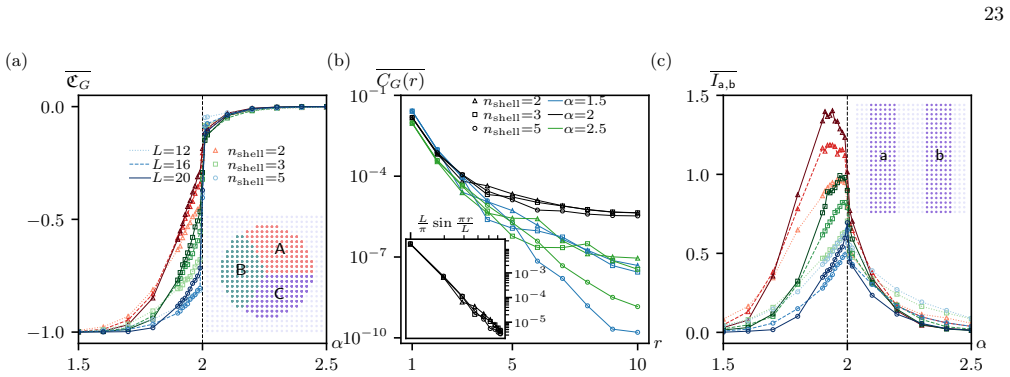
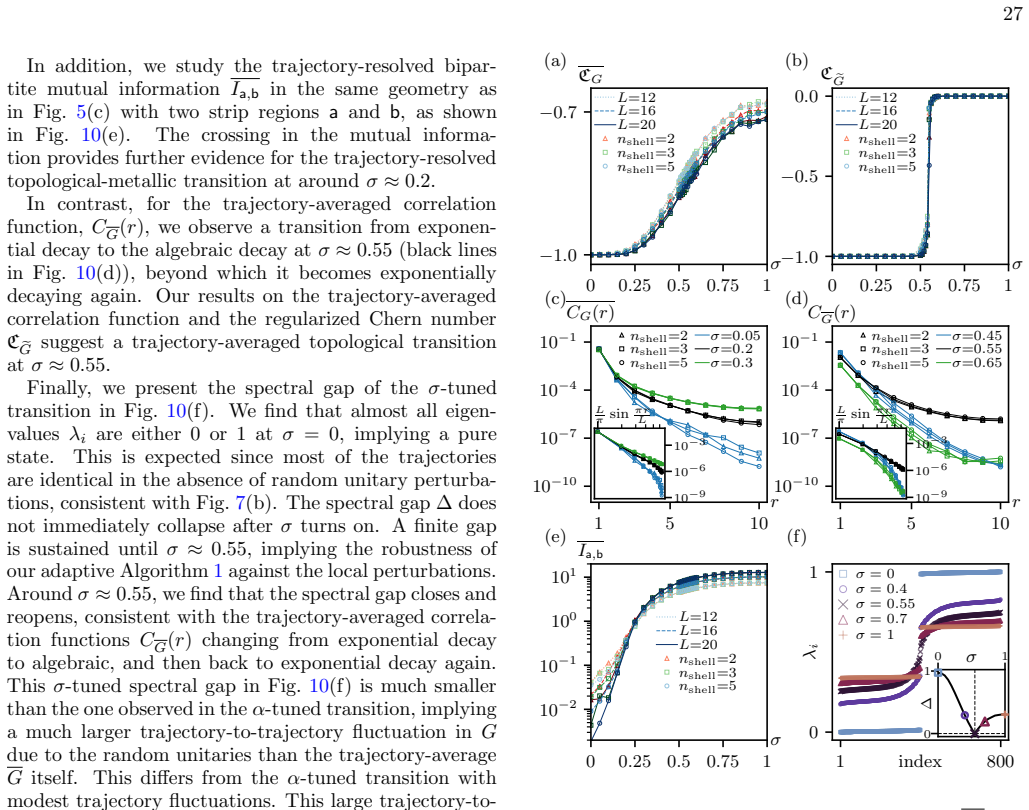
We develop a general framework for classifying fermionic dynamical systems with measurements using symmetry and topology. We introduce two complementary classification schemes based on the Altland-Zirnbauer tenfold way: (1) the many-body evolution operator (mEO) symmetry class, which classifies fermionic dynamics at the many-body level and naturally extends to interacting dynamics, and (2) the single-particle transfer matrix (sTM) symmetry class, which classifies free-fermion dynamics at the single-particle level and connects to Anderson localization physics. In the free-fermion limit, we show that these two frameworks are equivalent via a novel dynamical bulk-boundary correspondence: the topology of the dynamical system's spacetime bulk determines the topology of the area-law entangled steady-state ensemble living on its temporal boundary. Next, we prove that symmetry-invariant, post-selection-free Gaussian measurements are realizable in only four of the ten mEO classes (A, AI, BDI, D); the remaining six require either post-selection or interacting (non-Gaussian) measurements. Building on these results, we construct general post-selection-free topological adaptive circuits that realize topological dynamical phases in any spatial dimension for the four admissible mEO classes. These circuits simultaneously provide a protocol for preparing and stabilizing free-fermion topological states in all ten symmetry classes. As a concrete demonstration, we construct and simulate 2+1d adaptive circuits that realize mEO-class-A topological dynamics, steering toward a steady-state ensemble of Chern insulators in ${\cal O}(1)$ circuit depth. Finally, we numerically characterize topological phase transitions, dynamical domain-wall modes, and robustness to coherent noise, identifying finite error thresholds at which trajectory-resolved and trajectory-averaged quantities undergo distinct phase transitions.
Editorial analysis
A structured set of objections, weighed in public.
Referee Report
Summary. The paper develops a general framework for classifying fermionic dynamical systems with measurements via the Altland-Zirnbauer tenfold way. It introduces two complementary schemes—the many-body evolution operator (mEO) symmetry class at the many-body level and the single-particle transfer matrix (sTM) symmetry class at the single-particle level—and proves their equivalence in the free-fermion limit through a dynamical bulk-boundary correspondence that maps spacetime-bulk topology to the topology of the area-law entangled steady-state ensemble on the temporal boundary. The work further proves that symmetry-invariant, post-selection-free Gaussian measurements are possible in only four mEO classes (A, AI, BDI, D), constructs general post-selection-free topological adaptive circuits realizing the admissible phases in any spatial dimension, and provides a concrete 2+1d demonstration for mEO class A that steers toward a steady-state ensemble of Chern insulators in O(1) circuit depth. Numerical characterization of topological phase transitions, dynamical domain-wall modes, and robustness to coherent noise, including finite error thresholds, is also reported.
Significance. If the central claims hold, the manuscript makes a substantial contribution by extending the AZ classification to monitored free-fermion dynamics, establishing an equivalence between many-body and single-particle descriptions via a novel dynamical bulk-boundary correspondence, and supplying explicit, post-selection-free adaptive circuit constructions that simultaneously prepare and stabilize topological states across all ten symmetry classes. The restriction to four admissible mEO classes and the O(1)-depth 2+1d demonstration for Chern insulators are concrete, experimentally relevant results. The numerical analysis of distinct trajectory-resolved versus trajectory-averaged transitions supplies falsifiable predictions. These elements—explicit constructions, equivalence proof, and numerical verification—strengthen the work's impact for quantum simulation and measurement-based topological physics.
minor comments (3)
- [§3.2] §3.2: the statement that the sTM class 'connects to Anderson localization physics' would benefit from an explicit reference to the relevant localization-length or conductance scaling relation used in the equivalence proof.
- [Fig. 4] Fig. 4: the circuit diagram for the 2+1d class-A protocol does not label the measurement angles or the adaptive feedback rule; adding these annotations would improve reproducibility.
- [Numerical results] The numerical section on error thresholds reports distinct transitions for trajectory-resolved and averaged quantities but does not state the number of trajectories or the statistical uncertainty on the reported thresholds.
Simulated Author's Rebuttal
We thank the referee for their positive assessment of the manuscript, detailed summary of our contributions, and recommendation for minor revision. No specific major comments were raised in the report.
Circularity Check
No significant circularity
full rationale
The paper introduces two complementary classification schemes extending the established Altland-Zirnbauer tenfold way to dynamical systems with measurements, then asserts an equivalence in the free-fermion limit via a dynamical bulk-boundary correspondence, followed by proofs restricting Gaussian measurements to four classes and explicit circuit constructions. No equations reduce claims to self-referential definitions, no parameters are fitted and relabeled as predictions, and no load-bearing self-citations or uniqueness theorems imported from the authors' prior work appear in the provided text. The derivation chain is self-contained against external benchmarks such as the standard AZ classification and standard circuit constructions.
Axiom & Free-Parameter Ledger
axioms (1)
- domain assumption The Altland-Zirnbauer tenfold way classification extends to many-body evolution operators and single-particle transfer matrices in the presence of measurements.
Lean theorems connected to this paper
-
IndisputableMonolith/Foundation/AbsoluteFloorClosure.leanreality_from_one_distinction unclear?
unclearRelation between the paper passage and the cited Recognition theorem.
two complementary classification schemes based on the Altland-Zirnbauer tenfold way: (1) the many-body evolution operator (mEO) symmetry class... (2) the single-particle transfer matrix (sTM) symmetry class... one-to-one correspondence... dynamical bulk-boundary correspondence
-
IndisputableMonolith/Cost/FunctionalEquation.leanwashburn_uniqueness_aczel unclear?
unclearRelation between the paper passage and the cited Recognition theorem.
Table I... mEO Class KmEO... sTM Class KsTM... Post-Selection-Free Gaussian Measurements
What do these tags mean?
- matches
- The paper's claim is directly supported by a theorem in the formal canon.
- supports
- The theorem supports part of the paper's argument, but the paper may add assumptions or extra steps.
- extends
- The paper goes beyond the formal theorem; the theorem is a base layer rather than the whole result.
- uses
- The paper appears to rely on the theorem as machinery.
- contradicts
- The paper's claim conflicts with a theorem or certificate in the canon.
- unclear
- Pith found a possible connection, but the passage is too broad, indirect, or ambiguous to say the theorem truly supports the claim.
Forward citations
Cited by 3 Pith papers
-
Decoding coherent errors in toric codes on honeycomb and square lattices: duality to Majorana monitored dynamics and symmetry classes
Toric code decodability under coherent X/Z errors is dual to Majorana monitored dynamics whose symmetry class (D or DIII) dictates whether the generic transition is a measurement-induced entanglement transition or a t...
-
Absence of measurement- and unraveling-induced entanglement transitions in continuously monitored one-dimensional free fermions
Replica Keldysh analysis shows monitored 1D free fermions exhibit area-law entanglement beyond an exponentially large scale ln(l_φ,*) ~ J/[γ cos(φ)], with no genuine measurement- or unraveling-induced entanglement tra...
-
Learning error suppression strategies for dynamic quantum circuits
Empirically learned dynamical decoupling sequences reduce average error rates in dynamic quantum circuits by a factor of three and enable nontrivial process fidelity for quantum Fourier transforms on up to 20 qubits.
Reference graph
Works this paper leans on
-
[1]
Problem Statement In this appendix, we determine which symmetry classes admit ensembles of symmetry-invariant many-body evolu- tion operators (mEOs) that support nontrivial, post-selection-free Gaussian measurements—that is, Gaussian POVMs. Here, “nontrivial” excludes the case where the mEO ensemble consists purely of Gaussian unitary mEOs, which triv- ia...
-
[2]
For this class, we have G = GL(N, C) and thus M ∈ gl(N, C)
Establishing Existence of Gaussian POVMs for mEO Classes A, AI, BDI, D mEO Class A Admits Gaussian POVMs: Consider a system of N complex fermion modes with mEO class A symmetries. For this class, we have G = GL(N, C) and thus M ∈ gl(N, C). We show that there exists a symmetry- compatible ˆK(M) and weight function ω(M) that admits a Gaussian POVM for mEO c...
-
[3]
Proofs of Gaussian POVM Inadmissibility for mEO Classes AIII, C, CI, CII, DIII, and AII a. Cartan Decomposition of Classical Lie Groups In the following proofs of Gaussian POVM inadmissibility, we will repeatedly make use of the degeneracy structure of the spectrum of Hermitian Gaussian operators of the form ˆK †(M) ˆK(M), where ˆK(M) is a symmetry-invari...
-
[4]
Effective Quantum Channel on Physical Layer via Markovian Approximation The complete quantum channel, which describes the trajectory-averaged dynamics for a single cycle of our adaptive protocol, consists of four elementary measurement-feedforward operations (depletion and filling) per unit cell, followed by a sequence of random charge-conserving Gaussian...
-
[5]
Continuous-Time Embedding and Effective Lindbladian Theory Inspired by the framework of continuous-time error correction [98–101], we embed the discrete-time channel dynam- ics into a continuous-time setting by promoting the quantum channel to the generator of a continuous-time semigroup, 45 which necessarily takes the form of a Lindbladian generator [132...
-
[6]
Two-Point Operator Dynamics and Convergence Time-Scale To extract the convergence time-scale, we analyze the Heisenberg evolution of the two-point operators under the dynamics induced by the effective Lindbladian Eq. (D10). While the gain and loss components of Lcycle preserve Gaussianity—since their jump operators are linear in fermion operators—the deco...
-
[7]
B. Skinner, J. Ruhman, and A. Nahum, Measurement- Induced Phase Transitions in the Dynamics of Entan- glement, Phys. Rev. X 9, 031009 (2019). 49
work page 2019
-
[8]
Y. Li, X. Chen, and M. P. A. Fisher, Quantum Zeno ef- fect and the many-body entanglement transition, Phys. Rev. B 98, 205136 (2018)
work page 2018
-
[9]
Y. Li, X. Chen, and M. P. A. Fisher, Measurement- driven entanglement transition in hybrid quantum cir- cuits, Phys. Rev. B 100, 134306 (2019)
work page 2019
-
[10]
A. Chan, R. M. Nandkishore, M. Pretko, and G. Smith, Unitary-projective entanglement dynamics, Phys. Rev. B 99, 224307 (2019)
work page 2019
-
[11]
A. C. Potter and R. Vasseur, Entanglement Dynamics in Hybrid Quantum Circuits, in Entanglement in Spin Chains: From Theory to Quantum Technology Appli- cations, edited by A. Bayat, S. Bose, and H. Johannes- son (Springer International Publishing, Cham, 2022) pp. 211–249
work page 2022
-
[12]
M. P. A. Fisher, V. Khemani, A. Nahum, and S. Vi- jay, Random Quantum Circuits, Annual Review of Con- densed Matter Physics 14, 335 (2023)
work page 2023
-
[13]
R. Vasseur, A. C. Potter, Y.-Z. You, and A. W. W. Lud- wig, Entanglement Transitions from Holographic Ran- dom Tensor Networks, Phys. Rev. B100, 134203 (2019)
work page 2019
-
[14]
M. J. Gullans and D. A. Huse, Dynamical Purification Phase Transition Induced by Quantum Measurements, Phys. Rev. X 10, 041020 (2020)
work page 2020
-
[15]
M. J. Gullans and D. A. Huse, Scalable Probes of Measurement-Induced Criticality, Phys. Rev. Lett.125, 070606 (2020)
work page 2020
- [16]
-
[17]
S. Choi, Y. Bao, X.-L. Qi, and E. Altman, Quan- tum Error Correction in Scrambling Dynamics and Measurement-Induced Phase Transition, Phys. Rev. Lett. 125, 030505 (2020)
work page 2020
-
[18]
Y. Li, X. Chen, A. W. W. Ludwig, and M. P. A. Fisher, Conformal invariance and quantum nonlocality in crit- ical hybrid circuits, Phys. Rev. B 104, 104305 (2021)
work page 2021
-
[19]
C.-M. Jian, Y.-Z. You, R. Vasseur, and A. W. W. Lud- wig, Measurement-induced criticality in random quan- tum circuits, Phys. Rev. B 101, 104302 (2020)
work page 2020
-
[20]
Y. Bao, S. Choi, and E. Altman, Theory of the phase transition in random unitary circuits with measure- ments, Phys. Rev. B 101, 104301 (2020)
work page 2020
-
[21]
N. Lang and H. P. B¨ uchler, Entanglement transition in the projective transverse field Ising model, Phys. Rev. B 102, 094204 (2020)
work page 2020
-
[22]
X. Turkeshi, R. Fazio, and M. Dalmonte, Measurement- induced criticality in (2 + 1)-dimensional hybrid quan- tum circuits, Phys. Rev. B 102, 014315 (2020)
work page 2020
-
[23]
M. Ippoliti, M. J. Gullans, S. Gopalakrishnan, D. A. Huse, and V. Khemani, Entanglement Phase Transi- tions in Measurement-Only Dynamics, Phys. Rev. X11, 011030 (2021)
work page 2021
- [24]
- [25]
-
[26]
Y. Li, R. Vasseur, M. P. A. Fisher, and A. W. W. Ludwig, Statistical Mechanics Model for Clifford Ran- dom Tensor Networks and Monitored Quantum Cir- cuits, Phys. Rev. B 109, 174307 (2024)
work page 2024
-
[27]
S. Sang and T. H. Hsieh, Measurement-protected quan- tum phases, Phys. Rev. Res. 3, 023200 (2021)
work page 2021
- [28]
-
[29]
A. Lavasani, Y. Alavirad, and M. Barkeshli, Measurement-induced topological entanglement transitions in symmetric random quantum circuits, Nat. Phys. 17, 342 (2021)
work page 2021
-
[30]
Y. Bao, S. Choi, and E. Altman, Symmetry enriched phases of quantum circuits, Annals of Physics 435, 168618 (2021), special issue on Philip W. Anderson
work page 2021
-
[31]
U. Agrawal, A. Zabalo, K. Chen, J. H. Wilson, A. C. Potter, J. H. Pixley, S. Gopalakrishnan, and R. Vasseur, Entanglement and charge-sharpening tran- sitions in U(1) symmetric monitored quantum circuits, Phys. Rev. X 12, 041002 (2022)
work page 2022
-
[32]
F. Barratt, U. Agrawal, S. Gopalakrishnan, D. A. Huse, R. Vasseur, and A. C. Potter, Field theory of charge sharpening in symmetric monitored quantum circuits, Phys. Rev. Lett. 129, 120604 (2022)
work page 2022
-
[33]
C.-M. Jian, B. Bauer, A. Keselman, and A. W. W. Ludwig, Criticality and entanglement in nonunitary quantum circuits and tensor networks of noninteracting fermions, Phys. Rev. B 106, 134206 (2022)
work page 2022
- [34]
-
[35]
M. Fava, L. Piroli, T. Swann, D. Bernard, and A. Nahum, Nonlinear Sigma Models for Monitored Dy- namics of Free Fermions, Phys. Rev. X 13, 041045 (2023)
work page 2023
-
[36]
I. Poboiko, P. P¨ opperl, I. V. Gornyi, and A. D. Mirlin, Theory of free fermions under random projective mea- surements, Phys. Rev. X 13, 041046 (2023)
work page 2023
-
[37]
M. Fava, L. Piroli, D. Bernard, and A. Nahum, Moni- tored fermions with conserved U(1) charge, Phys. Rev. Res. 6, 043246 (2024)
work page 2024
- [38]
-
[39]
A. Chakraborty, K. Chen, A. Zabalo, J. H. Wilson, and J. H. Pixley, Charge and Entanglement Critical- ity in a U(1)-Symmetric Hybrid Circuit of Qubits, 10.48550/arXiv.2307.13038 (2023)
-
[40]
A. Lavasani, Y. Alavirad, and M. Barkeshli, Topological Order and Criticality in (2 + 1)D Monitored Random Quantum Circuits, Phys. Rev. Lett.127, 235701 (2021)
work page 2021
-
[41]
A. Nahum and B. Skinner, Entanglement and dynam- ics of diffusion-annihilation processes with Majorana de- fects, Phys. Rev. Res. 2, 023288 (2020)
work page 2020
-
[42]
J. Behrends, F. Venn, and B. B´ eri, Surface codes, quan- tum circuits, and entanglement phases, Phys. Rev. Res. 6, 013137 (2024)
work page 2024
-
[43]
H. Pan, H. Shapourian, and C.-M. Jian, Topological Modes in Monitored Quantum Dynamics (2024)
work page 2024
- [44]
-
[45]
Z. Xiao and K. Kawabata, Topology of Monitored Quantum Dynamics, arXiv e-prints , arXiv:2412.06133 (2024), arXiv:2412.06133 [cond-mat.stat-mech]
- [46]
-
[47]
A. Altland and M. R. Zirnbauer, Nonstandard symme- try classes in mesoscopic normal-superconducting hy- brid structures, Phys. Rev. B 55, 1142 (1997)
work page 1997
-
[48]
S. Ryu, A. P. Schnyder, A. Furusaki, and A. W. W. Lud- wig, Topological insulators and superconductors: Ten- fold way and dimensional hierarchy, New J. Phys. 12, 065010 (2010)
work page 2010
-
[49]
E. Altman, K. R. Brown, G. Carleo, L. D. Carr, E. Dem- ler, C. Chin, B. DeMarco, S. E. Economou, M. A. Eriks- son, K.-M. C. Fu, M. Greiner, K. R. Hazzard, R. G. Hulet, A. J. Koll´ ar, B. L. Lev, M. D. Lukin, R. Ma, X. Mi, S. Misra, C. Monroe, K. Murch, Z. Nazario, K.-K. Ni, A. C. Potter, P. Roushan, M. Saffman, M. Schleier-Smith, I. Siddiqi, R. Simmonds, ...
work page 2021
- [50]
-
[51]
A. J. Daley, I. Bloch, C. Kokail, S. Flannigan, N. Pear- son, M. Troyer, and P. Zoller, Practical quantum advan- tage in quantum simulation, Nature 607, 667 (2022)
work page 2022
-
[52]
D. Bluvstein, S. J. Evered, A. A. Geim, S. H. Li, H. Zhou, T. Manovitz, S. Ebadi, M. Cain, M. Kalinowski, D. Hangleiter, J. P. Bonilla Ataides, N. Maskara, I. Cong, X. Gao, P. Sales Ro- driguez, T. Karolyshyn, G. Semeghini, M. J. Gullans, M. Greiner, V. Vuleti´ c, and M. D. Lukin, Logical quan- tum processor based on reconfigurable atom arrays, Na- ture 6...
work page 2024
-
[53]
E. Crane, K. C. Smith, T. Tomesh, A. Eickbusch, J. M. Martyn, S. K¨ uhn, L. Funcke, M. A. DeMarco, I. L. Chuang, N. Wiebe, A. Schuckert, and S. M. Girvin, Hybrid Oscillator-Qubit Quantum Processors: Simulating Fermions, Bosons, and Gauge Fields (2024), arXiv:2409.03747 [quant-ph]
-
[54]
D. A. Puente, F. Motzoi, T. Calarco, G. Morigi, and M. Rizzi, Quantum state preparation via engineered ancilla resetting, Quantum 8, 1299 (2024), publisher: Verein zur F¨ orderung des Open Access Publizierens in den Quantenwissenschaften
work page 2024
-
[55]
S. Roy, J. T. Chalker, I. V. Gornyi, and Y. Gefen, Measurement-induced steering of quantum systems, Physical Review Research 2, 033347 (2020), publisher: American Physical Society
work page 2020
-
[56]
S. Barbarino, J. Yu, P. Zoller, and J. C. Budich, Prepar- ing Atomic Topological Quantum Matter by Adiabatic Nonunitary Dynamics, Phys. Rev. Lett. 124, 010401 (2020)
work page 2020
-
[57]
K. C. Smith, A. Khan, B. K. Clark, S. Girvin, and T.- C. Wei, Constant-depth preparation of matrix product states with adaptive quantum circuits, PRX Quantum 5, 030344 (2024)
work page 2024
-
[58]
Bravyi, Lagrangian representation for fermionic lin- ear optics, Quantum Info
S. Bravyi, Lagrangian representation for fermionic lin- ear optics, Quantum Info. Comput. 5, 216 (2005)
work page 2005
-
[59]
M. A. Nielsen and I. L. Chuang, Quantum Computation and Quantum Information: 10th Anniversary Edition , 1st ed. (Cambridge University Press, 2012)
work page 2012
-
[60]
I. de Vega and D. Alonso, Dynamics of non-Markovian open quantum systems, Rev. Mod. Phys. 89, 015001 (2017)
work page 2017
-
[61]
N. Gisin and I. C. Percival, The quantum-state diffusion model applied to open systems, J. Phys. A: Math. Gen. 25, 5677 (1992)
work page 1992
-
[62]
L. Di´ osi, N. Gisin, and W. T. Strunz, Non-Markovian quantum state diffusion, Phys. Rev. A 58, 1699 (1998)
work page 1998
-
[63]
A. W. W. Ludwig, H. Schulz-Baldes, and M. Stolz, Lya- punov Spectra for All Ten Symmetry Classes of Quasi- one-dimensional Disordered Systems of Non-interacting Fermions, J Stat Phys 152, 275 (2013)
work page 2013
-
[64]
Weyl, The Classical Groups: Their Invariants and Representations (Princeton University Press, 1946)
H. Weyl, The Classical Groups: Their Invariants and Representations (Princeton University Press, 1946)
work page 1946
-
[65]
A. P. Schnyder, S. Ryu, A. Furusaki, and A. W. W. Ludwig, Classification of topological insulators and su- perconductors in three spatial dimensions, Phys. Rev. B 78, 195125 (2008)
work page 2008
-
[66]
M. Caselle and U. Magnea, Symmetric space descrip- tion of carbon nanotubes, J. Stat. Mech. 2006, P01013 (2006)
work page 2006
-
[67]
A. P. Schnyder, S. Ryu, A. Furusaki, and A. W. W. Ludwig, Classification of Topological Insulators and Su- perconductors, AIP Conference Proceedings 1134, 10 (2009)
work page 2009
-
[68]
K. Chahine and M. Buchhold, Entanglement phases, localization, and multifractality of monitored free fermions in two dimensions, Phys. Rev. B 110, 054313 (2024)
work page 2024
-
[69]
I. Poboiko, I. V. Gornyi, and A. D. Mirlin, Measurement-Induced Phase Transition for Free Fermions above One Dimension, Phys. Rev. Lett. 132, 110403 (2024)
work page 2024
- [70]
-
[71]
D. Bernard and A. LeClair, A classification of 2D ran- dom Dirac fermions, J. Phys. A: Math. Gen. 35, 2555 (2002)
work page 2002
-
[72]
K. Kawabata, K. Shiozaki, M. Ueda, and M. Sato, Sym- metry and Topology in Non-Hermitian Physics, Phys. Rev. X 9, 041015 (2019)
work page 2019
-
[73]
O. Alberton, M. Buchhold, and S. Diehl, Entanglement Transition in a Monitored Free-Fermion Chain: From Extended Criticality to Area Law, Phys. Rev. Lett.126, 170602 (2021)
work page 2021
-
[74]
X. Turkeshi, A. Biella, R. Fazio, M. Dalmonte, and M. Schir´ o, Measurement-induced entanglement transi- tions in the quantum Ising chain: From infinite to zero clicks, Phys. Rev. B 103, 224210 (2021)
work page 2021
-
[75]
J. Merritt and L. Fidkowski, Entanglement transitions with free fermions, Phys. Rev. B 107, 064303 (2023)
work page 2023
-
[76]
K. Klocke and M. Buchhold, Majorana Loop Models for Measurement-Only Quantum Circuits, Phys. Rev. X 13, 041028 (2023)
work page 2023
-
[77]
A. W. W. Ludwig, Topological phases: Classification of topological insulators and superconductors of non- 51 interacting Fermions, and beyond, Phys. Scr. T168, 014001 (2016)
work page 2016
- [78]
-
[79]
I. Poboiko, P. P¨ opperl, I. V. Gornyi, and A. D. Mir- lin, Measurement-induced transitions for interacting fermions, Phys. Rev. B 111, 024204 (2025)
work page 2025
-
[80]
X.-L. Qi and S.-C. Zhang, Topological insulators and superconductors, Rev. Mod. Phys. 83, 1057 (2011)
work page 2011
discussion (0)
Sign in with ORCID, Apple, or X to comment. Anyone can read and Pith papers without signing in.