REVIEW 5 minor 84 references
Emergent cavity-QED dynamics along the edge of a photonic lattice
T0 review · 0 major / 5 minor · reviewed 2026-08-06 · deepseek-v4-flash
Pith's one-line read The paper predicts that a qubit at the zigzag edge of a honeycomb photonic lattice behaves as if it were coupled to a small cavity, with a power-law localized emergent mode and bulk dissipation that vanishes exactly at resonance.
desk verdict Solid extension of flat-band cavity QED to partial flat bands on lattice edges; the Markovian worry at Δ=0 is handled well enough. read the letter →
The pith
A machine-rendered reading of the paper's core claim, the machinery that carries it, and where it could break.
The reading
What carries the argument
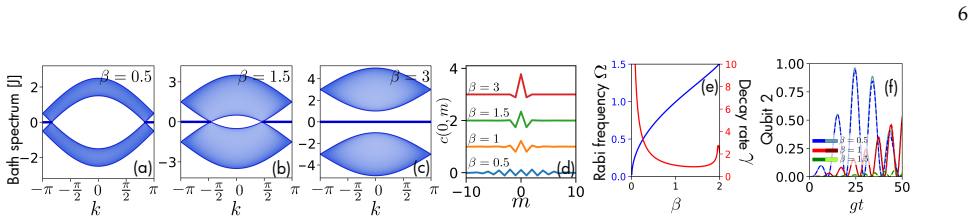
The load-bearing object is the emergent cavity mode $C$, formed by integrating the flat-band edge modes $E_k$ over the restricted Brillouin-zone region $2\pi/3<|k|\le\pi$ (for the isotropic lattice) outside the Dirac points. Because that integration domain is finite rather than the whole zone, the mode acquires power-law tails yet remains square-normalizable, giving a finite 'cavity volume' $A=1/P_{ii}(\beta)$ and a finite Rabi frequency. The analytic control comes from mapping the lattice, via a partial Fourier transform along the edge, into uncoupled one-dimensional Rice-Mele chains with momentum-dependent hopping, which makes both the edge-mode wavefunctions $\varepsilon_k(n,m)$ and the flat-band projector $P_{ij}(\beta)$ explicitly computable. The second element is the bulk self-energy: at the Dirac-point frequency the bulk density of states vanishes linearly, so the Markovian decay rate $\gamma(\Delta)$ is proportional to $|\Delta|$ and switches off exactly at resonance, which is what turns the would-be reservoir into a lossless cavity at the operating point.
What would settle it
At exactly zero detuning, compute or measure the single-qubit excited-state population over times much longer than $1/\Omega$ in an ideal infinite lattice. If the deviation from the dissipative Jaynes-Cummings solution grows faster than the predicted $(\Omega t)^{-8}$ tail — for example a logarithmic decay or a finite residual trapped population — the effective cavity-QED description fails at its operating point. Independently, imaging the single-photon mode along the edge should show $c(0,m)\propto |m|^{-2}$; exponential or compact localization would contradict the central mechanism.
Extended reading notes
Core claim
The paper's central claim is that light–matter interactions on the edge of photonic graphene reduce to a dissipative Jaynes-Cummings model. The qubit couples at rate $\Omega = g/\sqrt{A}$ to a normalizable superposition mode $C = \sqrt{A}\sum_{n,m} c(n,m)a_{nm}$ built from the partial flat band of edge modes; its amplitude decays like $|m|^{-2}$ along the edge and like $n^{-2}$ into the bulk, and it has support only on the $a$ sublattice. The dissipative part comes from bulk modes, with loss rate $\gamma(\Delta)\simeq 2g^2|\Delta|/(\sqrt{3}J^2)$ that vanishes at $\Delta=0$, so on resonance the dynamics is dominated by coherent coupling. The paper verifies this effective model against exact numerics on $600\times600$ lattices and uses it to predict undamped vacuum Rabi oscillations, two-qubit state transfer with fidelity about 0.93 at zero detuning, and a dispersionless regime with power-law dipole-dipole interactions $V(m)\sim |m|^{-2}$ when a gap $\mu>0$ is opened.
Load-bearing premise
The whole zero-detuning prediction rests on treating the lattice's bulk modes as a memoryless reservoir, even though the qubit's self-energy has a non-analytic point exactly at the operating frequency; the paper's correction for this is an asymptotic estimate, not an exact bound.
Editorial extensions
If this is right
- At $\Delta=0$ the decay into bulk modes vanishes, so an initially excited qubit undergoes several full vacuum Rabi oscillations instead of irreversible spontaneous emission.
- Two qubits coupled to different edge resonators exchange a single excitation with fidelity about 0.93 at resonance, with the beatings in the population dynamics revealing that two effective cavity modes participate.
- Lowering the anisotropy parameter $\beta$ below 1 widens the emergent mode's power-law profile and enables 0.94-fidelity state transfer over a distance of six unit cells, at the cost of a reduced Rabi frequency and a larger loss rate for a given detuning.
- Opening a gap through the sublattice imbalance $\mu>0$ makes the photon-mediated interaction dissipationless and power-law, $V(m)\sim |m|^{-2}$, suitable for long-range spin-model Hamiltonians.
- A proof-of-principle experiment with superconducting LC resonators and transmon qubits, at $J/2\pi=100$\,–\,$200$ MHz and $g/2\pi\simeq20$ MHz, should resolve the predicted dynamics on a roughly $330$ ns timescale, with disorder, stray capacitances, and qubit decay included.
Reading between the lines
- If the zero-detuning picture holds, the long-time population tail $(\Omega t)^{-8}$ is a clean experimental target: measuring a logarithmic or fractional residual decay would distinguish non-Markovian corrections from the paper's single-pole approximation.
- Because the emergent mode lives only on the $a$ sublattice, coupling a qubit to a $b$-sublattice edge resonator should instead show fractional decay rather than Rabi oscillations; this is a sharp sublattice-selective prediction that the paper notes but does not elevate into an experimental protocol.
- The same mechanism — a partial flat band with restricted Brillouin-zone support — may generate emergent cavity modes in other lattices with truncated flat bands, such as decorated or anisotropic versions of Kagome and Lieb lattices; the paper does not explore that generalization.
- The power-law mediated interactions at $\mu>0$ could be used to engineer tunable-range spin Hamiltonians on the edge, since $\beta$ controls both the exponent's prefactor and the range through $k_D$; this many-body direction is only mentioned as motivation in the conclusions.
Signed reviews
Editorial analysis
A structured set of objections, weighed in public.
Referee Report
Summary. The paper studies qubits coupled to the zigzag edge of a honeycomb photonic lattice whose edge modes form a partial flat band at the Dirac frequency. By mapping the lattice to uncoupled Rice-Mele chains, the authors derive an effective dissipative Jaynes-Cummings model in which each qubit couples with strength Ω = g/√A to a normalizable superposition mode C of edge modes, with closed-form spatial amplitudes decaying as 1/m² along the edge and 1/n² into the bulk, while the bulk modes act as a Markovian reservoir with decay rate γ(Δ) ∝ |Δ| that vanishes at resonance. Explicit formulas are given for the normalization constant A⁻¹ = √3/π − 1/3, the mode shape, the multi-qubit orthonormalization matrix, and the dispersive interaction potential. The effective model is benchmarked against exact 600×600-lattice simulations, showing vacuum Rabi oscillations and two-qubit state transfer with fidelity 0.93 at Δ = 0, and a circuit-QED implementation is discussed.
Significance. The result is significant: it identifies a new regime of light-matter interaction at a photonic edge, where a partial flat band acts as an effective cavity mode with power-law localization, in contrast to exponentially localized defect modes or compact flat-band states. The derivations are explicit and parameter-free, the predictions are falsifiable (Rabi frequency Ω = g/√A, m⁻² and n⁻² scaling, γ ∝ |Δ|), and the claims are backed by exact numerics. The acknowledged Markovian limitation at Δ = 0 (Supplement S3D) is quantitatively addressed by a branch-cut contribution scaling as (Ωt)⁻⁴ in amplitude and by exact simulations; I do not regard this as a blocker.
minor comments (5)
- [Section VIII vs. Supplement S10] The robustness claim in Section VIII states that relative frequency disorder up to 0.5%ω_r is tolerable, whereas Supplement S10 quotes σ_ω/J in the range 5–10% for the same parameter set; with ω_r/2π = 6 GHz and J/2π = 150 MHz these statements differ by a factor of two to four (0.5%ω_r corresponds to roughly 20% of J). Please reconcile the quoted disorder level and make the notation (ω_r vs ω_q) uniform.
- [Supplement S3 C, Eq. (S34)] In the expression H_MJC = g∑_{ij}(σ_i M_{ij} C_i^† + H.c.), the index structure is inconsistent with the definition C_i = ∑_j (M⁻¹)_{ij} \tilde C_j; it should read σ_j M_{ij} C_i^† (or equivalently σ_i M_{ij} C_j^†, given the symmetry of M).
- [Supplement S6] In the Tavis-Cummings solution, the second displayed equation for c_{e1}(t) should refer to c_{e2}(t).
- [Section V and Supplement S6] The two-qubit state-transfer fidelity is quoted as 0.93 in the main text and ≃94% in the supplement; please use one value or explain the difference.
- [Figures 2 and 3] The figure captions do not specify the time-axis units or the simulation window; adding this information would improve reproducibility.
Circularity Check
No significant circularity: the effective cavity mode and all rates are computed from the lattice Hamiltonian and benchmarked by exact numerics.
full rationale
The central derivation is self-contained. The effective cavity mode C is obtained by projecting the qubit's coupling Hamiltonian onto the degenerate edge-mode subspace (Eq. S25-S26), with the normalization A and the real-space amplitudes c(n,m) computed by closed-form integrals from the exact edge-mode wavefunctions (Eqs. 7-8 and S85-S88). The Rabi frequency Omega = g/sqrt(A), the bulk decay rates gamma(Delta) and gamma_ij(Delta), and the many-qubit mode-orthonormalization matrix M are all derived from the Hamiltonian eigenmodes and standard Born-Markov/Fermi-Golden-Rule procedures (S3-S4), not fitted to the predicted dynamics. The predicted vacuum Rabi oscillations and state-transfer fidelities are independently confirmed by exact numerical simulation of the full Hamiltonian (Figs. 2c-e and 3f), so the predictions are not equivalent to their inputs by construction. The non-analytic self-energy at Delta=0 discussed in Supplement S3D is a disclosed validity caveat about the Markovian approximation, not a circular step; the paper provides an explicit branch-cut tail estimate (Eq. S44) and exact numerics over the simulated window. Self-citations (e.g., Refs. 23, 32, 9, 27) are used for background or standard results and are not load-bearing for the central claim. No uniqueness theorem or ansatz is imported from the authors' prior work to force the result.
Assumptions & free parameters
assumptions (7)
- domain assumption Weak-coupling rotating-wave approximation for the qubit-lattice interaction (Eq. 2)
- domain assumption Born-Markov treatment of bulk modes with single-pole approximation of the qubit self-energy
- domain assumption Periodic boundary conditions along the edge direction e2 and thermodynamic limit
- domain assumption Exact flatness and a-sublattice support of the edge modes
- domain assumption Neglect of retardation for the many-qubit bulk reservoir
- standard math Single-excitation sector analysis for Rabi oscillations and state transfer
- standard math Second-order Schrieffer-Wolff perturbation theory in the dispersive regime (μ>0)
invented entities (1)
-
Emergent cavity mode C (superposition of flat-band edge modes E_k)
independent evidence
Cite this review
Pith. "Pith review of Emergent cavity-QED dynamics along the edge of a photonic lattice." pith.science (2026). https://pith.science/paper/O4D5VAWD
@misc{pith2026250713444,
  author       = {Pith},
  title        = {Pith review of: Emergent cavity-QED dynamics along the edge of a photonic lattice},
  year         = {2026},
  howpublished = {\url{https://pith.science/paper/O4D5VAWD}},
  note         = {Machine review of arXiv:2507.13444}
}
read the original abstract
We investigate qubits coupled to the boundary of a two dimensional photonic lattice that supports dispersionless edge modes, unlike conventional edge modes that sustain propagating photons. As a case study, we consider a honeycomb lattice (photonic graphene) of coupled resonators with a zigzag edge, where the edge modes form a flat band defined only over a restricted region of momentum space. We show that light matter interactions are effectively captured by a dissipative cavity QED model, wherein the emitter coherently couples to a fictitious cavity mode emerging as a superposition of edge modes. This mode has support on only one sublattice and, most notably, displays an unconventional power law localization around the qubit, yet remaining normalizable in the thermodynamic limit, with a spatial range that can be tuned by introducing lattice anisotropy We predict occurrence of vacuum Rabi oscillations and efficient state transfer between distant emitters. An experimental demonstration using superconducting circuits is proposed.
Figures


Reference graph
Works this paper leans on
-
[1]
M. Kim, Z. Jacob, and J. Rho, Recent advances in 2d, 3d and higher-order topological photonics, Light: Science & Applications9, 130 (2020)
2020
-
[2]
Ozawa, H
T. Ozawa, H. M. Price, A. Amo, N. Goldman, M. Hafezi, L. Lu, M. C. Rechtsman, D. Schuster, J. Simon, O. Zilber- berg, and I. Carusotto, Topological photonics, Rev. Mod. Phys.91, 015006 (2019)
2019
-
[3]
Weber, M
B. Weber, M. S. Fuhrer, X.-L. Sheng, S. A. Yang, R. Thomale, S. Shamim, L. W. Molenkamp, D. Cobden, D. Pesin, H. J. Zandvliet,et al., 2024 roadmap on 2d topo- logical insulators, Journal of Physics: Materials7, 022501 (2024)
2024
-
[4]
Barik, A
S. Barik, A. Karasahin, C. Flower, T. Cai, H. Miyake, W. DeGottardi, M. Hafezi, and E. Waks, A topological quantum optics interface, Science359, 666 (2018)
2018
-
[5]
M. Jalali Mehrabad, A. P . Foster, R. Dost, E. Clarke, P . K. Patil, A. M. Fox, M. S. Skolnick, and L. R. Wilson, Chiral topological photonics with an embedded quantum emit- ter, Optica7, 1690 (2020)
work page 2020
-
[6]
J. C. Owens, M. G. Panetta, B. Saxberg, G. Roberts, S. Chakram, R. Ma, A. Vrajitoarea, J. Simon, and D. I. Schuster, Chiral cavity quantum electrodynamics, Nature Physics18, 1048 (2022)
work page 2022
-
[7]
C. Vega, D. Porras, and A. González-Tudela, Topologi- cal multimode waveguide qed, Phys. Rev. Res.5, 023031 (2023)
2023
-
[8]
D. Suárez-Forero, M. Jalali Mehrabad, C. Vega, A. González-Tudela, and M. Hafezi, Chiral quantum optics: recent developments and future directions, Prx Quantum6, 020101 (2025)
work page 2025
Show all 84 references
-
[9]
Jouanny, L
V . Jouanny, L. Peyruchat, M. Scigliuzzo, A. Mercurio, E. Di Benedetto, D. De Bernardis, D. Sbroggiò, S. Frasca, V . Savona, F. Ciccarello,et al., Superstrong dynamics and directional emission of a giant atom in a structured bath, arXiv preprint arXiv:2509.01579 (2025)
2025
-
[10]
Pakkiam, N
P . Pakkiam, N. P . Kumar, C.-C. Chiu, D. Sommers, M. Pletyukhov, and A. Fedorov, Experimental realization of qubit-state-controlled directional edge states in waveg- uide qed, arXiv preprint arXiv:2411.05271 (2024). 7
2024 arXiv
-
[11]
N. Y. Yao, C. R. Laumann, A. V . Gorshkov, H. Weimer, L. Jiang, J. I. Cirac, P . Zoller, and M. D. Lukin, Topolog- ically protected quantum state transfer in a chiral spin liquid, Nature communications4, 1585 (2013)
2013
-
[12]
Lemonde, V
M.-A. Lemonde, V . Peano, P . Rabl, and D. G. Angelakis, Quantum state transfer via acoustic edge states in a 2d optomechanical array, New Journal of Physics21, 113030 (2019)
2019
-
[13]
Dlaska, B
C. Dlaska, B. Vermersch, and P . Zoller, Robust quantum state transfer via topologically protected edge channels in dipolar arrays, Quantum Science and Technology2, 015001 (2017)
2017
-
[14]
A. H. Castro Neto, F. Guinea, N. M. R. Peres, K. S. Novoselov, and A. K. Geim, The electronic properties of graphene, Rev. Mod. Phys.81, 109 (2009)
2009
-
[15]
Fujita, K
M. Fujita, K. Wakabayashi, K. Nakada, and K. Kusakabe, Peculiar localized state at zigzag graphite edge, Journal of the Physical Society of Japan65, 1920 (1996)
1996
-
[16]
Nakada, M
K. Nakada, M. Fujita, G. Dresselhaus, and M. S. Dres- selhaus, Edge state in graphene ribbons: Nanometer size effect and edge shape dependence, Physical Review B54, 17954 (1996)
1996
-
[17]
T. Tan, C. Li, and W. Yao, Edge state in ab-stacked bilayer graphene and its correspondence with the su-schrieffer- heeger ladder, Phys. Rev. B104, 245419 (2021)
2021
-
[18]
Kohmoto and Y
M. Kohmoto and Y. Hasegawa, Zero modes and edge states of the honeycomb lattice, Phys. Rev. B76, 205402 (2007)
2007
-
[19]
Leykam, A
D. Leykam, A. Andreanov, and S. Flach, Artificial flat band systems: from lattice models to experiments, Ad- vances in Physics: X3, 1473052 (2018)
2018
-
[20]
Park and J.-W
J.-H. Park and J.-W. Rhim, Quasi-localization and wan- nier obstruction in partially flat bands, Communications Physics7, 179 (2024)
2024
-
[21]
Rhim and B.-J
J.-W. Rhim and B.-J. Yang, Classification of flat bands ac- cording to the band-crossing singularity of Bloch wave functions, Phys. Rev. B99, 045107 (2019)
2019
-
[22]
De Bernardis, Z.-P
D. De Bernardis, Z.-P . Cian, I. Carusotto, M. Hafezi, and P . Rabl, Light-Matter Interactions in Synthetic Magnetic Fields: Landau-Photon Polaritons, Phys. Rev. Lett.126, 103603 (2021)
2021
-
[23]
Di Benedetto, A
E. Di Benedetto, A. González-Tudela, and F. Ciccarello, Dipole-dipole interactions mediated by a photonic flat band, Quantum9, 1671 (2025)
2025
-
[24]
González-Tudela and J
A. González-Tudela and J. I. Cirac, Exotic quantum dynamics and purely long-range coherent interactions in dirac conelike baths, Physical Review A97, 043831 (2018)
2018
-
[25]
Redondo-Yuste, M
J. Redondo-Yuste, M. B. de Paz, P . A. Huidobro, and A. González-Tudela, Quantum electrodynamics in anisotropic and tilted dirac photonic lattices, New Jour- nal of Physics23, 103018 (2021)
2021
-
[26]
See Supplemental Material at [url] for further details
-
[27]
Diekmann, E
O. Diekmann, E. D. Benedetto, N. Jungwirth, D. D. Bernardis, Z. Kuang, F. Ciccarello, S. Rotter, P . Rabl, A. González-Tudela, and C. González-Ballestero, En- abling deterministic passive quantum state transfer with giant atoms, arXiv preprint arXiv:2605.12018 (2026)
2026 arXiv
-
[28]
J. K. Asbóth, L. Oroszlány, and A. Pályi,A short course on topological insulators, Vol. 919 (Springer, 2016)
2016
-
[29]
Ryu and Y
S. Ryu and Y. Hatsugai, Topological origin of zero-energy edge states in particle-hole symmetric systems, Physical review letters89, 077002 (2002)
2002
-
[30]
S. M. Girvin and K. Yang,Modern Condensed Matter Physics(Cambridge University Press, 2019)
2019
-
[31]
Breuer and F
H.-P . Breuer and F. Petruccione,The theory of open quan- tum systems(OUP Oxford, 2002)
2002
-
[32]
Lorenzo, F
S. Lorenzo, F. Lombardo, F. Ciccarello, and G. M. Palma, Quantum non-Markovianity induced by Anderson local- ization, Sci Rep7, 42729 (2017)
2017
-
[33]
V . M. Pereira, F. Guinea, J. M. B. Lopes dos Santos, N. M. R. Peres, and A. H. Castro Neto, Disorder induced localized states in graphene, Phys. Rev. Lett.96, 036801 (2006)
2006
-
[34]
Y. Kim, S. Flach, and A. Andreanov, Real space decay of flat band projectors from compact localized states, arXiv preprint arXiv:2510.17258 (2025)
2025 arXiv
-
[35]
Rhim and B.-J
J.-W. Rhim and B.-J. Yang, Singular flat bands, Advances in Physics: X6, 1901606 (2021)
2021
-
[36]
Windt, M
B. Windt, M. Bello, D. Malz, and J. I. Cirac, Effects of re- tardation on many-body superradiance in chiral waveg- uide qed, Phys. Rev. Lett.134, 173601 (2025)
2025
-
[37]
J. S. Douglas, H. Habibian, C.-L. Hung, A. V . Gorshkov, H. J. Kimble, and D. E. Chang, Quantum many-body models with cold atoms coupled to photonic crystals, Nature Photon9, 326 (2015)
2015
-
[38]
González-Tudela, C.-L
A. González-Tudela, C.-L. Hung, D. E. Chang, J. I. Cirac, and H. J. Kimble, Subwavelength vacuum lattices and atom–atom interactions in two-dimensional pho- tonic crystals, Nature Photon9, 320 (2015)
2015
-
[39]
Bello, G
M. Bello, G. Platero, J. I. Cirac, and A. González-Tudela, Unconventional quantum optics in topological waveg- uide qed, Science Advances5, eaaw0297 (2019)
2019
-
[40]
N. M. Sundaresan, R. Lundgren, G. Zhu, A. V . Gor- shkov, and A. A. Houck, Interacting Qubit-Photon Bound States with Superconducting Circuits, Physical Review X 9, 011021 (2019)
2019
-
[41]
Scigliuzzo, G
M. Scigliuzzo, G. Calajó, F. Ciccarello, D. Perez Lozano, A. Bengtsson, P . Scarlino, A. Wallraff, D. Chang, P . Delsing, and S. Gasparinetti, Controlling Atom-Photon Bound States in an Array of Josephson-Junction Res- onators, Phys. Rev. X12, 031036 (2022)
2022
-
[42]
Zhang, E
X. Zhang, E. Kim, D. K. Mark, S. Choi, and O. Painter, A superconducting quantum simulator based on a photonic-bandgap metamaterial, Science379, 278 (2023)
2023
-
[43]
Leonforte, X
L. Leonforte, X. Sun, D. Valenti, B. Spagnolo, F. Illumi- nati, A. Carollo, and F. Ciccarello, Quantum optics with giant atoms in a structured photonic bath, Quantum Sci- ence and Technology10, 015057 (2024)
2024
-
[44]
Leonforte, A
L. Leonforte, A. Carollo, and F. Ciccarello, Vacancy-like dressed states in topological waveguide qed, Phys. Rev. Lett.126, 063601 (2021)
2021
-
[45]
Ritsch, P
H. Ritsch, P . Domokos, F. Brennecke, and T. Esslinger, Cold atoms in cavity-generated dynamical optical poten- tials, Rev. Mod. Phys.85, 553 (2013)
2013
-
[46]
Kohmoto and Y
M. Kohmoto and Y. Hasegawa, Zero modes and edge states of the honeycomb lattice, Physical Review B—Condensed Matter and Materials Physics76, 205402 (2007)
2007
-
[47]
Underwood, W
D. Underwood, W. Shanks, A. C. Li, L. Ateshian, J. Koch, and A. A. Houck, Imaging photon lattice states by scan- 8 ning defect microscopy, Physical Review X6, 021044 (2016)
2016
-
[48]
Morvan, M
A. Morvan, M. Féchant, G. Aiello, J. Gabelli, and J. Es- téve, Observation of topological valley hall edge states in honeycomb lattices of superconducting microwave res- onators, Optical Materials Express11, 1224 (2021)
2021
-
[49]
E. Kim, X. Zhang, V . S. Ferreira, J. Banker, J. K. Iverson, A. Sipahigil, M. Bello, A. González-Tudela, M. Mirhos- seini, and O. Painter, Quantum electrodynamics in a topological waveguide, Physical Review X11, 011015 (2021)
2021
-
[50]
O’Brien, M
K. O’Brien, M. Amouzegar, W. C. Lee, M. Ritter, and A. J. Kollár, A circuit-qed lattice system with flexible connec- tivity and gapped flat bands for photon-mediated spin models, arXiv:2505.05559 (2025)
2025
-
[51]
Jouanny, S
V . Jouanny, S. Frasca, V . J. Weibel, L. Peyruchat, M. Scigli- uzzo, F. Oppliger, F. De Palma, D. Sbroggió, G. Beaulieu, O. Zilberberg,et al., High kinetic inductance cavity arrays for compact band engineering and topology-based disor- der meters, Nature Communications16, 3396 (2025)
2025
-
[52]
V . S. Ferreira, J. Banker, A. Sipahigil, M. H. Matheny, A. J. Keller, E. Kim, M. Mirhosseini, and O. Painter, Collapse and revival of an artificial atom coupled to a structured photonic reservoir, Phys. Rev. X11, 041043 (2021)
2021
-
[53]
Chochon, A
A. Chochon, A. Bouscal, S. Mahapatra, I. Douss, V . Sautel, M. Kemiche, N. Fayard, J. Berroir, T. Ray, J.-J. Greffet, F. Raineri, A. Levenson, K. Bencheikh, C. Sauvan, A. Urvoy, and J. Laurat, Coupling slow-mode nanopho- tonics and cold atoms: a versatile waveguide qed plat- f...
2025
-
[54]
Jamadi, B
O. Jamadi, B. Real, K. Sawicki, C. Hainaut, A. Gonzalez- Tudela, N. Pernet, I. Sagnes, M. Morassi, A. Lemaitre, L. L. Gratiet, A. Harouri, S. Ravets, J. Bloch, and A. Amo, Optically defined cavities in driven-dissipative photonic lattices, arXiv preprint arXiv:2112.07753 (2021)
2021 arXiv
-
[55]
Milicevic, G
M. Milicevic, G. Montambaux, T. Ozawa, O. Jamadi, B. Real, I. Sagnes, A. Lemaitre, L. Le Gratiet, A. Harouri, J. Bloch, and A. Amo, Type-iii and tilted dirac cones emerging from flat bands in photonic orbital graphene, Phys. Rev. X9, 031010 (2019)
2019
-
[56]
Bouscal, M
A. Bouscal, M. Kemiche, S. Mahapatra, N. Fayard, J. Berroir, T. Ray, J.-J. Greffet, F. Raineri, A. Levenson, K. Bencheikh,et al., Systematic design of a robust half-w1 photonic crystal waveguide for interfacing slow light and trapped cold atoms, New Journal of Physics26, 023026 (2024)
2024
-
[57]
M. C. Rechtsman, Y. Plotnik, J. M. Zeuner, D. Song, Z. Chen, A. Szameit, and M. Segev, Topological creation and destruction of edge states in photonic graphene, Phys. Rev. Lett.111, 103901 (2013)
2013
-
[58]
Arcari, I
M. Arcari, I. Sollner, A. Javadi, S. Lindskov Hansen, S. Mahmoodian, J. Liu, H. Thyrrestrup, E. H. Lee, J. D. Song, S. Stobbe, and P . Lodahl, Near-unity coupling effi- ciency of a quantum emitter to a photonic crystal waveg- uide, Phys. Rev. Lett.113, 093603 (2014)
2014
-
[59]
Z.-X. Gong, M. F. Maghrebi, A. Hu, M. L. Wall, M. Foss- Feig, and A. V . Gorshkov, Topological phases with long- range interactions, Physical Review B93, 041102 (2016)
2016
-
[60]
Z.-X. Gong, M. F. Maghrebi, A. Hu, M. Foss-Feig, P . Richerme, C. Monroe, and A. V . Gorshkov, Kaleido- scope of quantum phases in a long-range interacting spin-1 chain, Physical Review B93, 205115 (2016)
2016
-
[61]
Žunkoviˇ c, M
B. Žunkoviˇ c, M. Heyl, M. Knap, and A. Silva, Dy- namical quantum phase transitions in spin chains with long-range interactions: Merging different concepts of nonequilibrium criticality, Physical review letters120, 130601 (2018)
2018
-
[62]
Islam, C
R. Islam, C. Senko, W. C. Campbell, S. Korenblit, J. Smith, A. Lee, E. Edwards, C.-C. Wang, J. Freericks, and C. Monroe, Emergence and frustration of magnetism with variable-range interactions in a quantum simulator, science340, 583 (2013)
2013
-
[63]
Sánchez-Burillo, D
E. Sánchez-Burillo, D. Porras, and A. González- Tudela, Limits of photon-mediated interactions in one- dimensional photonic baths, Phys. Rev. A102, 013709 (2020)
2020
-
[64]
N. W. Ashcroft and N. D. Mermin,Solid state physics (Holt, Rinehart and Winston, New York, NY, 1976)
1976
-
[65]
Bloch, Uber die Quantenmechanik der Elektronen in Kristallgittern, Z
F. Bloch, Uber die Quantenmechanik der Elektronen in Kristallgittern, Z. Physik52, 555 (1929)
1929
-
[66]
L. Chen, T. Mazaheri, A. Seidel, and X. Tang, The impos- sibility of exactly flat non-trivial Chern bands in strictly local periodic tight binding models, J. Phys. A: Math. Theor.47, 152001 (2014)
2014
-
[67]
H. C. Po, H. Watanabe, and A. Vishwanath, Fragile topology and wannier obstructions, Phys. Rev. Lett.121, 126402 (2018)
2018
-
[68]
Tavis and F
M. Tavis and F. W. Cummings, Exact solution for an n-molecule—radiation-field hamiltonian, Phys. Rev.170, 379 (1968)
1968
-
[69]
Lambropoulos, G
P . Lambropoulos, G. M. Nikolopoulos, T. R. Nielsen, and S. Bay, Fundamental quantum optics in structured reser- voirs, Rep. Prog. Phys.63, 455 (2000)
2000
-
[70]
E. N. Economou, Green’s Functions for Tight Binding Hamiltonians, inGreen’s Functions in Quantum Physics, Springer Series in Solid-State Sciences, edited by E. N. Economou (Springer, Berlin, Heidelberg, 1979) pp. 71–91
1979
-
[71]
J. M. Fink, R. Bianchetti, M. Baur, M. Goppl, L. Steffen, S. Filipp, P . J. Leek, A. Blais, and A. Wallraff, Dressed collective qubit states and the tavis-cummings model in circuit qed, Phys. Rev. Lett.103, 083601 (2009)
2009
-
[72]
Gelhausen and M
J. Gelhausen and M. Buchhold, Dissipative dicke model with collective atomic decay: Bistability, noise-driven ac- tivation, and the nonthermal first-order superradiance transition, Phys. Rev. A97, 023807 (2018)
2018
-
[73]
Bravyi, D
S. Bravyi, D. P . DiVincenzo, and D. Loss, Schrieffer–Wolff transformation for quantum many-body systems, Annals of Physics326, 2793 (2011)
2011
-
[74]
P . D. Miller,Applied asymptotic analysis, Vol. 75 (American Mathematical Soc., 2006)
2006
-
[75]
Youssefi, S
A. Youssefi, S. Kono, A. Bancora, M. Chegnizadeh, J. Pan, T. Vovk, and T. J. Kippenberg, Topological lattices real- ized in superconducting circuit optomechanics, Nature 612, 666 (2022)
2022
-
[76]
Youssefi, A
A. Youssefi, A. Motavassal, S. Kono, S. A. Jafari, and T. J. Kippenberg, Realization of tilted dirac-like microwave cone in superconducting circuit lattices, arXiv:2501.10434 (2025)
2025 arXiv
-
[77]
Vool and M
U. Vool and M. Devoret, Introduction to quantum elec- tromagnetic circuits, International Journal of Circuit The- ory and Applications45, 897 (2017). 9
2017
-
[78]
Ramachandran, A
A. Ramachandran, A. Andreanov, and S. Flach, Chiral flat bands: Existence, engineering, and stability, Phys. Rev. B96, 161104 (2017)
2017
-
[79]
P . W. Anderson, Absence of Diffusion in Certain Random Lattices, Phys. Rev.109, 1492 (1958). Supplementary Material: Emergent cavity-QED dynamics along the edge of a photonic lattice Enrico Di Benedetto ,1 Xuejian Sun,2, 1,∗ Marcel A. Pinto ,1 Luca Leonforte ,1 Chih-Ying Chan...
1958
-
[80]
Matrix elements of the decay rate matrix 18 A
Long-time non-exponential decay 17 S4. Matrix elements of the decay rate matrix 18 A. Calculation ofγ ii(∆) 18 B. Calculation ofγ i̸=j (∆) 20 S5. Exact solution of the dissipative Jaynes-Cummings model 20 S6. Two-qubit dynamics in the single-excitation sector 21 S7. Flat band ...
-
[81]
The diagonalization ofH B thereby reduces to the diagonalization ofH k, which is carried out next first for bulk modes and then for edge modes. 12 B. Bulk modes Under periodic BCs, the bulk spectrum ofH k is worked out as ω±(k,q) =± q µ2 + (βJ)2 +J 2 k +2βJJ k cosq=±Jω(k,q)(S7...
-
[82]
Fractional decay Fractional decay occurs when the resolventG e(z)has a simple pole at the originz=0 and a corresponding non-zero residueR 0. In the present system,R 0 however vanishes as R0 = 1 1−∂ zΣFB(z)−∂ zΣbulk(z) z=i0+ =lim η→0+ η2 η2[1+ (g/J)2g(N) ] −Ω 2 =0 , (S40) where...
-
[83]
Long-time non-exponential decay To investigate the long-time decay in the infinite lattice, we need to study the contribution toc e(t)[cf. Eq. (S37)] coming from the branch cut on the imaginaryi [−∞, 0] interval of the complex plane. In the long-time limit 18 (t→+∞), this bran...
-
[84]
In light of the above, the choice of circuit parameters involves a fundamental trade-off [see Fig
where all modes become spatially localized at random positions. In light of the above, the choice of circuit parameters involves a fundamental trade-off [see Fig. S3(b)]. For fixed resonator frequency, increasing the coupling strength by raising the ratioC c/CΣ improves robust...
Reviewed August 6, 2026 · model on record in the stance chip above.
Discussion (0). Continue with ORCID to comment.