REVIEW 2 major objections 6 minor 1 cited by
Model-free Reinforcement Learning for Model-based Control: Towards Safe, Interpretable and Sample-efficient Agents
T0 review · 2 major / 6 minor · reviewed 2026-08-06 · deepseek-v4-flash
Pith's one-line read Model-free reinforcement learning can learn model predictive control agents end-to-end, yielding safe, interpretable policies without needing a perfect system model.
desk verdict Useful review and taxonomy of model-free RL for MPC-style policies, but the safety claims in Section 3.1 overstate what the current theory guarantees. read the letter →
The pith
A machine-rendered reading of the paper's core claim, the machinery that carries it, and where it could break.
The reading
What carries the argument
The load-bearing mechanism is the implicit-function differentiation of the MPC policy: the policy πθ(s) = u*_0|t is defined as the first element of the optimal input sequence of the constrained optimal control problem, and its sensitivity to the policy parameters θ is obtained by differentiating the KKT conditions via Dini's implicit function theorem. This turns an optimization-based, non-explicit controller into a differentiable layer for model-free policy gradient RL. The same machinery is what lets the paper claim that model-based agents can enjoy the scalability of gradient-based learning rather than being limited to derivative-free tuning.
What would settle it
Take a small constrained MPC problem (for example, a two-state linear system with the input at its bound at the optimum) and run the IFT-based gradient update at a visited state where the active constraint set makes the KKT Jacobian singular or a multiplier zero; the gradient formula is undefined or the computed action derivative explodes, so no policy gradient step exists.
Extended reading notes
Core claim
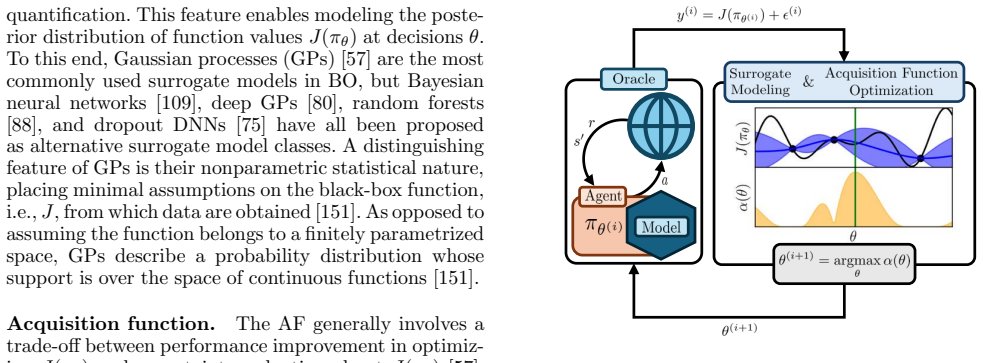
The paper's central claim is that a model predictive controller, with its dynamics, stage cost, terminal cost, and constraints treated as learnable parameters, can serve as the policy of a reinforcement learning agent in place of a deep neural network, and that learning such an agent with model-free RL yields sample-efficient, safe, and interpretable policies without sacrificing the asymptotic performance of model-free RL. It argues that a perfect model is often unnecessary: end-to-end learning can reshape the MPC components toward closed-loop performance, realizing identification for control inside policy learning. The paper stakes out three routes (Bayesian optimization, policy-gradient RL with implicit differentiation, and offline gradient evaluation) and positions the gradient-based route as the scalable one, enabled by differentiating the KKT conditions of the MPC problem.
Load-bearing premise
The gradient-based learning route stands on the assumption that every MPC optimum encountered during training is a regular point: the active constraints are linearly independent, second-order sufficient conditions hold, and strict complementarity holds, so that the KKT system can be uniquely and smoothly inverted.
Editorial extensions
If this is right
- MPC-based agents trained with model-free RL can keep the interpretability and safety of the optimizer embedded in the policy, because constraints are part of the policy parameterization rather than learned as a separate black-box.
- End-to-end tuning of the dynamics, cost, and constraints implements identification-for-control: the model is adjusted to the closed-loop reward, so a perfect model is not required for an optimal policy.
- Gradient-based policy search scales to policies with many parameters and large datasets, where Bayesian optimization's surrogate-model cost becomes prohibitive.
- Offline and imitation-learning routes can extract MPC policies from fixed datasets, with the embedded constraints mitigating out-of-distribution actions and Q-function divergence.
- Actor-critic variants enable non-episodic and off-policy learning, so the MPC policy can be updated online from individual transitions rather than full episodes.
Reading between the lines
- A testable extension the paper leaves implicit is a hybrid learner that uses Bayesian optimization for mixed-integer or non-differentiable MPC design choices (horizon, optimizer settings) and IFT-based gradients for the continuous cost, dynamics, and constraint parameters.
- The local-global perspective, where the MPC problem acts as a Q-function approximator that is globally refined through the Bellman equation, suggests that sample complexity could drop further than policy-only learning; comparing that agent against standard actor-critic baselines on a benchmark would be a direct test.
- If the regularity assumptions hold only rarely on real constrained problems, the practical route may shift to differentiating through solver iterations or mixed smoothing and penalty methods rather than pure KKT-based implicit differentiation; that would preserve the paper's architecture but replace its core gradient mechanism.
Editorial analysis
A structured set of objections, weighed in public.
Referee Report
Summary. This paper is a perspective/review on learning model-based agents—exemplified by model predictive control (MPC)—using model-free reinforcement learning. The authors define a model-based agent as a policy or Q-function approximator that embeds models of dynamics, cost, and constraints, and argue that model-free RL can adapt these components end-to-end. They contrast this with both DNN-based agents and classical model-based RL, and survey three families of policy-learning approaches: Bayesian optimization (derivative-free), policy search RL (policy gradients enabled by implicit differentiation), and gradient evaluation/offline RL (imitation learning and offline RL). The paper also proposes future research directions, including a 'local-global' interpretation of MPC as a Q-function approximator, and summarizes the approaches in a comparison table.
Significance. If the claims are properly qualified, the paper offers a useful and timely synthesis of an emerging research area. Its strengths include a clear taxonomy of learning strategies for optimization-based policies, explicit mathematical formulations of the MPC policy (Eq. 11), the policy gradient theorem (Eq. 14), and implicit differentiation via IFT (Eq. 16), and a broad citation of recent work across control and reinforcement learning. The explicit statement of regularity assumptions for IFT-based gradients is commendable. However, the central 'safe' pillar of the paradigm is overstated in its current form, and the practical scope of the gradient-based route needs a more careful discussion. The paper does not present new algorithms or empirical results; its value is conceptual and organizational.
major comments (2)
- [Section 3.1, 'Safe' bullet] The statement that 'by planning actions subject to a dynamic model, the agent can guarantee constraint satisfaction on visited state-action pairs' is not justified by the MPC formulation in Eq. (11). The constraints h(x_{k|t}, u_{k|t}) ≤ 0 are enforced on predicted states generated by the embedded model f; under model mismatch, the actual states visited in the true environment can violate h even when the predicted trajectory is feasible. The later remark in the same subsection that 'a perfect match is often not required to obtain an optimal policy' makes the safety claim especially fragile, because performance-oriented models are not the same as safety-certified models. Please either restrict the safety claim to the nominal/known-model case with recursive feasibility and robust constraint tightening, or state explicitly the additional assumptions (e.g., robust MPC with uncertainty sets) under which such a guarantee can hold.
- [Section 5.1, text after Eq. (16)] The availability of the IFT-based policy gradient is conditioned on LICQ, SOSC, and strict complementarity at every optimal solution encountered. For constrained MPC problems with active-set changes, degeneracies, or nonunique Lagrange multipliers, these conditions can fail, and the paper does not discuss how commonly this occurs or what fallback differentiation strategies are available. Since Section 1 introduces gradient-based learning of model-based agents as a 'versatile and scalable approach', this regularity assumption deserves a substantive caveat and pointers to remedies; without such a caveat, the scope of the policy-gradient route is overstated.
minor comments (6)
- [Section 1] 'understanding the rational behind agents' decisions' should read 'understanding the rationale behind agents' decisions'.
- [Section 4.1] The text 'noisy observations from the the closed-loop system' contains a duplicated 'the'; there are also spelling errors later such as 'probabalistic' and 'accomodate'.
- [Section 5.1] 'Lagranian' should be 'Lagrangian'; in the definition of the Lagrangian, the term 'u_{kt}' should read 'u_{k|t}' for consistency with Eq. (11).
- [Section 4.2, constrained optimization] The paragraph on safe-set strategies would benefit from a precise definition of the estimated safe region and a statement of the Lipschitz or barrier-function assumptions; as written, the parameter-space safety region is not clearly distinguished from state-space constraint satisfaction.
- [Section 2.3] 'Eschewing from using an environment model' is ungrammatical; 'Eschewing an environment model' would be clearer.
- [Table 1] The entry 'T rade-offs' contains a formatting artifact and should read 'Trade-offs'.
Circularity Check
The paper's safety guarantee is a definitional restatement of the MPC constraints, and its 'local-global' framing is imported from the authors' own arXiv preprint; the survey's technical core is otherwise independent.
-
self definitional
[Section 3.1, 'Safe' bullet (with Eq. (11))]
"Safe: By planning actions subject to a dynamic model, the agent can guarantee constraint satisfaction on visited state-action pairs, which can entail respecting safety considerations, limitations of the true environment, and physical laws governing the environment's dynamics. Furthermore, the policy of the model-based agent may be formulated for robustness to uncertainties in its model of the environment to ensure closed-loop stability and feasibility of the designed actions [124]."
The guarantee is exactly the constraint h(x_{k|t}, u_{k|t}) ≤ 0 of (11d), evaluated on the trajectory predicted by the embedded model f in (11b). Under a perfect model this is a tautology: the planned trajectory satisfies the constraint by construction of the optimization. Under a misspecified model it does not transfer to the true visited state-action pairs. The paper's own hedge ('may be formulated for robustness') concedes that the unconditional guarantee is not derived. The claimed safety benefit is thus a restatement of the input constraint, not an independent result, and the later 'guarantee safety and stability' statement in Section 7 inherits the same definitional status.
-
self citation load bearing
[Section 7 (Concluding Remarks); also Section 1]
"Taking a local-global perspective [10], the MPC problem in (11) can be viewed as a Q-function approximator. Globally, the model-based agent adapts its Q-function approximation to satisfy the Bellman equation for all states; locally, the model-based agent acts by taking the action that maximizes this approximation at each state."
Reference [10] is Banker, Lawrence and Mesbah, the authors' own arXiv preprint (arXiv:2503.13289). The 'local-global' interpretation is the paper's distinctive framing for why model-based agents can be safe and globally improving, and it is invoked in Section 1 for the claim that model-free RL of model-based agents 'can provide safety guarantees through a local notion of optimality'. No independent derivation or external evidence is given in the present paper; the load-bearing conceptual claim is imported from the authors' unpublished prior work, so the conclusion rests on the self-citation itself.
full rationale
The paper is a survey and perspective rather than a derivation, so most of its technical content — policy gradient theorem, Dini's implicit function theorem, Bayesian optimization components, actor-critic and offline RL schemes — is textbook-standard and independently sourced. The circularity is localized. First, the 'Safe' benefit in Section 3.1 claims the MPC policy can 'guarantee constraint satisfaction on visited state-action pairs'; that guarantee is just the constraint (11d) of the MPC optimization evaluated on the model's predicted trajectory, i.e., it holds by construction only if the embedded model is exact, and otherwise is unsupported. This is a self-definitional restatement rather than a derived property. Second, the distinctive 'local-global' framing that motivates the paradigm is attributed to [10], the authors' own arXiv preprint; the paper provides no independent derivation that local MPC optimality combined with global Bellman adaptation yields safety and near-optimality. Self-citation alone is not circularity, but here it carries a load-bearing conceptual premise. The literature review, classifications, and algorithm descriptions do not reduce to their inputs, so the paper is only partially circular. Score 4 reflects one self-definitional safety claim and one load-bearing self-citation, while the central survey content retains independent value.
Assumptions & free parameters
assumptions (7)
- standard math The Bellman optimality equation is a contraction and its fixed point characterizes the optimal Q-function (Section 2.2).
- standard math The policy gradient theorem (Theorem 1, Eq. 14) provides unbiased gradient estimates without requiring derivatives of the system dynamics.
- standard math Dini's implicit function theorem (Theorem 2, Eq. 15) can differentiate the MPC policy through its KKT conditions.
- domain assumption MPC solutions satisfy LICQ, SOSC, and strict complementarity along the learning trajectory (Eq. 16, discussed after it).
- domain assumption A perfect match between the embedded model and the true dynamics is often not required to obtain an optimal MPC policy (Section 3.1, citing [71]).
- domain assumption The finite-horizon MPC policy class in Eqs. (11)-(12) can approximate the true optimal MDP policy, and policy gradient updates converge to a near-optimal parameterization.
- ad hoc to paper The distinction between a model-based agent and model-based RL (Figure 1) is meaningful, and the agent acts as an inductive bias without sacrificing asymptotic performance.
Cite this review
Pith. "Pith review of Model-free Reinforcement Learning for Model-based Control: Towards Safe, Interpretable and Sample-efficient Agents." pith.science (2026). https://pith.science/paper/MRB45RDT
@misc{pith2026250713491,
  author       = {Pith},
  title        = {Pith review of: Model-free Reinforcement Learning for Model-based Control: Towards Safe, Interpretable and Sample-efficient Agents},
  year         = {2026},
  howpublished = {\url{https://pith.science/paper/MRB45RDT}},
  note         = {Machine review of arXiv:2507.13491}
}
read the original abstract
Training sophisticated agents for optimal decision-making under uncertainty has been key to the rapid development of modern autonomous systems across fields. Notably, model-free reinforcement learning (RL) has enabled decision-making agents to improve their performance directly through system interactions, with minimal prior knowledge about the system. Yet, model-free RL has generally relied on agents equipped with deep neural network function approximators, appealing to the networks' expressivity to capture the agent's policy and value function for complex systems. However, neural networks amplify the issues of sample inefficiency, unsafe learning, and limited interpretability in model-free RL. To this end, this work introduces model-based agents as a compelling alternative for control policy approximation, leveraging adaptable models of system dynamics, cost, and constraints for safe policy learning. These models can encode prior system knowledge to inform, constrain, and aid in explaining the agent's decisions, while deficiencies due to model mismatch can be remedied with model-free RL. We outline the benefits and challenges of learning model-based agents -- exemplified by model predictive control -- and detail the primary learning approaches: Bayesian optimization, policy search RL, and offline strategies, along with their respective strengths. While model-free RL has long been established, its interplay with model-based agents remains largely unexplored, motivating our perspective on their combined potentials for sample-efficient learning of safe and interpretable decision-making agents.
Figures


Figures from the paper (2 more)

Forward citations
Cited by 1 Pith paper
-
FlexPath: Adapting Learned Connectivity Guidance to Path Preferences
FlexPath decouples learning of task-independent feasible path priors from task-specific adaptation via imitation learning and differentiable Path Shape Objectives for image-based planning.
Reference graph
Works this paper leans on
-
[10]
Thomas Banker, Nathan P. Lawrence, and Ali Mesbah. Local-global learning of interpretable control policies: The interface between MPC and reinforcement learning, 2025. arXiv:2503.13289
work page Pith review arXiv 2025
-
[102]
MPCritic: A plug-and-play MPC architecture for reinforcement learning
Nathan P. Lawrence, Thomas Banker, and Ali Mesbah. Mpcritic: A plug-and-play MPC architecture for reinforcement learning, 2025. arXiv:2504.01086
work page Pith review arXiv 2025
-
[1]
Preference-Based Policy Learning
Riad Akrour, Marc Schoenauer, and Michele Sebag. Preference-Based Policy Learning. In Proceedings of Machine Learning and Knowledge Discovery in Databases , pages 12–27, Athens, 2011
2011
-
[2]
Ames, Samuel Coogan, Magnus Egerstedt, Gennaro Notomista, Koushil Sreenath, and Paulo Tabuada
Aaron D. Ames, Samuel Coogan, Magnus Egerstedt, Gennaro Notomista, Koushil Sreenath, and Paulo Tabuada. Control barrier functions: Theory and applications. In Proceedings of European Control Conference , pages 3420– 3431, Naples, 2019
2019
-
[3]
Concrete problems in AI safety, 2016
Dario Amodei, Chris Olah, Jacob Steinhardt, Paul Christiano, John Schulman, and Dan Man´ e. Concrete problems in AI safety, 2016. arXiv:1606.06565
arXiv 2016
-
[4]
Zico Kolter
Brandon Amos, Ivan Jimenez, Jacob Sacks, Byron Boots, and J. Zico Kolter. Differentiable MPC for End-to-end Planning and Control. In Proceedings of Advances in Neural Information Processing Systems, volume 31, Montr´ eal, 2018
2018
-
[5]
A Painless Deterministic Policy Gradient Method for Learning-based MPC
Akhil S Anand, Dirk Reinhardt, Shambhuraj Sawant, Jan Tommy Gravdahl, and Sebastien Gros. A Painless Deterministic Policy Gradient Method for Learning-based MPC. In Proceedings of European Control Conference, pages 1–7, Bucharest, 2023
2023
-
[6]
Andrychowicz et al
M. Andrychowicz et al. Hindsight Experience Replay. In Proceedings of Advances in Neural Information Processing Systems, volume 30, Long Beach, 2017
2017
Show all 197 references
-
[7]
Raul Astudillo and Peter I. Frazier. Thinking inside the box: A tutorial on grey-box Bayesian optimization. In Proceedings of Winter Simulation Conference , pages 1–15, Pheonix, 2021
2021
-
[8]
MPC-based reinforcement learning for economic problems with application to battery storage
Arash Bahari Kordabad, Wenqi Cai, and Sebastien Gros. MPC-based reinforcement learning for economic problems with application to battery storage. In Proceedings of European Control Conference, pages 2573–2578, Rotterdam, 2021
2021
-
[9]
Training a helpful and harmless assistant with reinforcement learning from human feedback, 2022
Yuntao Bai et al. Training a helpful and harmless assistant with reinforcement learning from human feedback, 2022. arXiv:2204.05862. 19 Table 1 Comparison of policy learning approaches for model-based agents. For each aspect, we denote each approach as strong/mature (✓), promi...
2022 arXiv
-
[11]
Gradient-Based Framework for Bilevel Optimization of Black-Box Functions: Synergizing Model-Free Reinforcement Learning and Implicit Function Differentiation
Thomas Banker and Ali Mesbah. Gradient-Based Framework for Bilevel Optimization of Black-Box Functions: Synergizing Model-Free Reinforcement Learning and Implicit Function Differentiation. Industrial & Engineering Chemistry Research, 64(5):2831–2844, 2025
2025
-
[12]
Bellemare, Will Dabney, and R´ emi Munos
Marc G. Bellemare, Will Dabney, and R´ emi Munos. A distributional perspective on reinforcement learning. In Proceedings of the 34th International Conference on Machine Learning , volume 70 of Proceedings of Machine Learning Research, pages 449–458, Sydney, 2017
2017
-
[13]
Bellman and R
R. Bellman and R. Kalaba. On adaptive control processes. IRE Transactions on Automatic Control , 4(2):1–9, 1959
1959
-
[14]
Richard E. Bellman. Dynamic Programming . Princeton University Press, Princeton, NJ, 1957
1957
-
[15]
Bellman and Stuart E
Richard E. Bellman and Stuart E. Dreyfus. Applied Dynamic Programming . Princeton University Press, Princeton, NJ, 1962
1962
-
[16]
Schoellig
Felix Berkenkamp, Andreas Krause, and Angela P. Schoellig. Bayesian optimization with safety constraints: safe and automatic parameter tuning in robotics. Machine Learning, 112(10):3713–3747, 2023
2023
-
[17]
Bertsekas and J.N
D. Bertsekas and J.N. Tsitsiklis. Neuro-Dynamic Programming. Athena Scientific, Nashua, NH, 1996
1996
-
[18]
Global optimality guarantees for policy gradient methods, 2022
Jalaj Bhandari and Daniel Russo. Global optimality guarantees for policy gradient methods, 2022. arXiv:1906.01786
2022 arXiv
-
[19]
Differentiable optimization-based control policy with convergence analysis, 2025
Yuexin Bian, Jie Feng, and Yuanyuan Shi. Differentiable optimization-based control policy with convergence analysis, 2025. arXiv:2411.07484
2025
-
[20]
A survey on high- dimensional gaussian process modeling with application to Bayesian optimization
Micka¨ el Binois and Nathan Wycoff. A survey on high- dimensional gaussian process modeling with application to Bayesian optimization. ACM Transactions on Evolutionary Learning and Optimization , 2(2), 2022
2022
-
[21]
Blondel and John N
Vincent D. Blondel and John N. Tsitsiklis. A survey of computational complexity results in systems and control. Automatica, 36(9):1249–1274, 2000
2000
-
[22]
Time-varying gaussian process bandit optimization
Ilija Bogunovic, Jonathan Scarlett, and Volkan Cevher. Time-varying gaussian process bandit optimization. In Proceedings of the 19th International Conference on Artificial Intelligence and Statistics , volume 51 of Proceedings of Machine Learning Research, pages 314–323, Cadiz, 2016
2016
-
[23]
Optimization of the model predictive control meta-parameters through reinforcement learning
Eivind Bøhn, Sebastien Gros, Signe Moe, and Tor Arne Johansen. Optimization of the model predictive control meta-parameters through reinforcement learning. Engineering Applications of Artificial Intelligence, 123:106211, 2023
2023
-
[24]
Safe Learning in Robotics: From Learning-Based Control to Safe Reinforcement Learning
Lukas Brunke, Melissa Greeff, Adam W Hall, Zhaocong Yuan, Siqi Zhou, Jacopo Panerati, and Angela P Schoellig. Safe Learning in Robotics: From Learning-Based Control to Safe Reinforcement Learning. Annual Review of Control, Robotics, and Autonomous Systems , 5:411–444, 2022
2022
-
[25]
On controller tuning with time-varying bayesian optimization
Paul Brunzema, Alexander Von Rohr, and Sebastian Trimpe. On controller tuning with time-varying bayesian optimization. In 2022 IEEE 61st Conference on Decision and Control (CDC) , pages 4046–4052, 2022
2022
-
[26]
Reinforcement Learning of the Prediction Horizon in Model Predictive Control
Eivind Bøhn, Sebastien Gros, Signe Moe, and Tor Arne Johansen. Reinforcement Learning of the Prediction Horizon in Model Predictive Control. IF AC-PapersOnLine, 54(6):314–320, 2021
2021
-
[27]
Kordabad, Hossein N
Wenqi Cai, Arash B. Kordabad, Hossein N. Esfahani, Anastasios M. Lekkas, and Sebastien Gros. MPC-based Reinforcement Learning for a Simplified Freight Mission of Autonomous Surface Vehicles, 2021. arXiv:2106.08634
2021 arXiv
-
[28]
Chan, Georgios Makrygiorgos, and Ali Mesbah
Kimberly J. Chan, Georgios Makrygiorgos, and Ali Mesbah. Towards personalized plasma medicine via data-efficient adaptation of fast deep learning-based MPC policies. In Proceedings of American Control Conference, pages 2769– 2775, San Diego, 2023
2023
-
[29]
Chan, Joel A
Kimberly J. Chan, Joel A. Paulson, and Ali Mesbah. Safe Explorative Bayesian Optimization - Towards Personalized Treatments in Plasma Medicine. In Proceedings of 62nd IEEE Conference on Decision and Control , pages 4106– 4111, Singapore, 2023
2023
-
[30]
Chan, Joel A
Kimberly J. Chan, Joel A. Paulson, and Ali Mesbah. A practical multiobjective learning framework for optimal hardware-software co-design of control-on-a-chip systems. IEEE Transactions on Control Systems Technology , 32(6):2178–2193, 2024
2024
-
[31]
Goal- conditioned reinforcement learning with imagined subgoals
Elliot Chane-Sane, Cordelia Schmid, and Ivan Laptev. Goal- conditioned reinforcement learning with imagined subgoals. 20 In Proceedings of the 38th International Conference on Machine Learning, volume 139 of Proceedings of Machine Learning Research, pages 1430–1440, Online, 2021
2021
-
[32]
Gnu-RL: A precocial reinforcement learning solution for building hvac control using a differentiable MPC policy
Bingqing Chen, Zicheng Cai, and Mario Berg´ es. Gnu-RL: A precocial reinforcement learning solution for building hvac control using a differentiable MPC policy. In Proceedings of the 6th ACM International Conference on Systems for Energy-Efficient Buildings, Cities, and Transp...
2019
-
[33]
Intrinsically motivated reinforcement learning
Nuttapong Chentanez, Andrew Barto, and Satinder Singh. Intrinsically motivated reinforcement learning. In Proceedings of Advances in Neural Information Processing Systems, volume 17, Vancouver, 2004
2004
-
[34]
Run- indexed time-varying Bayesian optimization with positional encoding for auto-tuning of controllers: Application to a plasma-assisted deposition process with run-to-run drifts
Kwanghyun Cho, Ketong Shao, and Ali Mesbah. Run- indexed time-varying Bayesian optimization with positional encoding for auto-tuning of controllers: Application to a plasma-assisted deposition process with run-to-run drifts. Computers & Chemical Engineering , 185:108653, 2024
2024
-
[35]
Choksi and Joel A
Naitik A. Choksi and Joel A. Paulson. Simulation-based Integrated Design and Control with Embedded Mixed- Integer MPC using Constrained Bayesian Optimization. In Proceedings of American Control Conference, pages 2114– 2120, New Orleans, 2021
2021
-
[36]
Deep reinforcement learning from human preferences
Paul F Christiano, Jan Leike, Tom Brown, Miljan Martic, Shane Legg, and Dario Amodei. Deep reinforcement learning from human preferences. In Proceedings of Advances in Neural Information Processing Systems , volume 30, Long Beach, 2017
2017
-
[37]
Model-Based Reinforcement Learning via Meta-Policy Optimization
Ignasi Clavera, Jonas Rothfuss, John Schulman, Yasuhiro Fujita, Tamim Asfour, and Pieter Abbeel. Model-Based Reinforcement Learning via Meta-Policy Optimization. In Proceedings of The 2nd Conference on Robot Learning , volume 87, pages 617–629, Z¨ urich, 2018
2018
-
[38]
G. Cybenko. Approximation by superpositions of a sigmoidal function. Mathematics of Control, Signals and Systems, 2(4):303–314, 1989
1989
-
[39]
Bayesian reinforcement learning in continuous POMDPs with gaussian processes
Patrick Dallaire, Camille Besse, Stephane Ross, and Brahim Chaib-draa. Bayesian reinforcement learning in continuous POMDPs with gaussian processes. In Proceedings of IEEE/RSJ International Conference on Intelligent Robots and Systems , pages 2604–2609, St. Louis, 2009
2009
-
[40]
Unexpected improvements to expected improvement for Bayesian optimization
Samuel Daulton, Sebastian Ament, David Eriksson, Maximilian Balandat, and Eytan Bakshy. Unexpected improvements to expected improvement for Bayesian optimization. In Proceedings of the 37th International Conference on Neural Information Processing Systems , 2023
2023
-
[41]
Differentiable Expected Hypervolume Improvement for Parallel Multi-Objective Bayesian Optimization
Samuel Daulton, Maximilian Balandat, and Eytan Bakshy. Differentiable Expected Hypervolume Improvement for Parallel Multi-Objective Bayesian Optimization. In Proceedings of Advances in Neural Information Processing Systems, volume 33, pages 9851–9864, Online, 2020
2020
-
[42]
Multi-objective Bayesian optimization over high-dimensional search spaces
Samuel Daulton, David Eriksson, Maximilian Balandat, and Eytan Bakshy. Multi-objective Bayesian optimization over high-dimensional search spaces. In Proceedings of the Thirty-Eighth Conference on Uncertainty in Artificial Intelligence, volume 180 of Proceedings of Machine Lear...
2022
-
[43]
Osborne, and Eytan Bakshy
Samuel Daulton, Xingchen Wan, David Eriksson, Maximilian Balandat, Michael A. Osborne, and Eytan Bakshy. Bayesian Optimization over Discrete and Mixed Spaces via Probabilistic Reparameterization. In Proceedings of Advances in Neural Information Processing Systems , volume 35, ...
2022
-
[44]
Mixed-Variable Bayesian Optimization
Erik Daxberger, Anastasia Makarova, Matteo Turchetta, and Andreas Krause. Mixed-Variable Bayesian Optimization. In Proceedings of the Twenty-Ninth International Joint Conference on Artificial Intelligence , pages 2633–2639, Yokohama, 2020
2020
-
[45]
Gymnasium robotics, 2024
Rodrigo de Lazcano, Kallinteris Andreas, Jun Jet Tai, Seungjae Ryan Lee, and Jordan Terry. Gymnasium robotics, 2024
2024
-
[46]
K. Deb, A. Pratap, S. Agarwal, and T. Meyarivan. A fast and elitist multiobjective genetic algorithm: Nsga-ii. IEEE Transactions on Evolutionary Computation , 6(2):182–197, 2002
2002
-
[47]
Deepseek-r1: Incentivizing reasoning capability in llms via reinforcement learning, 2025
DeepSeek-AI et al. Deepseek-r1: Incentivizing reasoning capability in llms via reinforcement learning, 2025. arXiv:2501.12948
2025 arXiv
-
[48]
Dontchev and R
Assen L. Dontchev and R. Tyrrell. Rockafellar. Implicit Functions and Solution Mappings: A View from Variational Analysis. Springer Series in Operations Research and Financial Engineering. Springer New York, New York, 2nd edition, 2014
2014
-
[49]
Additive Gaussian Processes
David K Duvenaud, Hannes Nickisch, and Carl Rasmussen. Additive Gaussian Processes. In Proceedings of Advances in Neural Information Processing Systems , volume 24, Granada, 2011
2011
-
[50]
Infinite-Horizon Differentiable Model Predictive Control, 2020
Sebastian East, Marco Gallieri, Jonathan Masci, Jan Koutnik, and Mark Cannon. Infinite-Horizon Differentiable Model Predictive Control, 2020. arXiv:2001.02244
2020 arXiv
-
[51]
High-dimensional Bayesian optimization with sparse axis-aligned subspaces
David Eriksson and Martin Jankowiak. High-dimensional Bayesian optimization with sparse axis-aligned subspaces. In Proceedings of the Thirty-Seventh Conference on Uncertainty in Artificial Intelligence , volume 161 of Proceedings of Machine Learning Research, pages 493–503, On...
2021
-
[52]
Scalable global optimization via local Bayesian optimization
David Eriksson, Michael Pearce, Jacob Gardner, Ryan D Turner, and Matthias Poloczek. Scalable global optimization via local Bayesian optimization. InProceedings of Advances in Neural Information Processing Systems , volume 32, Vancouver, 2019
2019
-
[53]
Policy Gradient Reinforcement Learning for Uncertain Polytopic LPV Systems based on MHE-MPC
Hossein Nejatbakhsh Esfahani and S´ ebastien Gros. Policy Gradient Reinforcement Learning for Uncertain Polytopic LPV Systems based on MHE-MPC. IF AC-PapersOnLine, 55(15):1–6, 2022
2022
-
[54]
Global convergence of policy gradient methods for the linear quadratic regulator
Maryam Fazel, Rong Ge, Sham Kakade, and Mehran Mesbahi. Global convergence of policy gradient methods for the linear quadratic regulator. In Proceedings of the 35th International Conference on Machine Learning , volume 80 of Proceedings of Machine Learning Research, pages 1467...
2018
-
[55]
Dynamic Regret of Policy Optimization in Non- Stationary Environments
Yingjie Fei, Zhuoran Yang, Zhaoran Wang, and Qiaomin Xie. Dynamic Regret of Policy Optimization in Non- Stationary Environments. In Proceedings of Advances in Neural Information Processing Systems , volume 33, pages 6743–6754, Online, 2020
2020
-
[56]
Rafael Figueiredo Prudencio, Marcos R. O. A. Maximo, and Esther Luna Colombini. A survey on offline reinforcement learning: Taxonomy, review, and open problems. IEEE Transactions on Neural Networks and Learning Systems , 35(8):10237–10257, 2024
2024
-
[57]
Peter I. Frazier. A tutorial on Bayesian optimization, 2018. arXiv:1807.02811
2018 arXiv
-
[58]
Fr¨ ohlich, Melanie N
Lukas P. Fr¨ ohlich, Melanie N. Zeilinger, and Edgar D. Klenske. Cautious Bayesian optimization for efficient and scalable policy search. In Proceedings of the 3rd Conference 21 on Learning for Dynamics and Control , volume 144 of Proceedings of Machine Learning Research, page...
2021
-
[59]
Fr¨ ohlich, Edgar D
Lukas P. Fr¨ ohlich, Edgar D. Klenske, Christian G. Daniel, and Melanie N. Zeilinger. Bayesian optimization for policy search in high-dimensional systems via automatic domain selection. In Proceedings of IEEE/RSJ International Conference on Intelligent Robots and Systems , pag...
2019
-
[60]
Learning robust rewards with adversarial inverse reinforcement learning,
Justin Fu, Katie Luo, and Sergey Levine. Learning robust rewards with adversarial inverse reinforcement learning,
-
[61]
Bayesian Optimization with Inequality Constraints
Jacob Gardner, Matt Kusner, Zhixiang, Kilian Weinberger, and John Cunningham. Bayesian Optimization with Inequality Constraints. In Proceedings of the 31st International Conference on Machine Learning, pages 937– 945, Beijing, 2014
2014
-
[62]
Osborne, and Philipp Hennig
Roman Garnett, Michael A. Osborne, and Philipp Hennig. Active learning of linear embeddings for gaussian processes,
-
[63]
M. Gevers. Towards a Joint Design of Identification and Control? In Essays on Control , pages 111–151. Birkh¨ auser Boston, Boston, MA, 1993
1993
-
[64]
Identification for control: From the early achievements to the revival of experiment design
Michel Gevers. Identification for control: From the early achievements to the revival of experiment design. European Journal of Control , 11(4):335–352, 2005
2005
-
[65]
Multi-objective optimization of a path-following MPC for vehicle guidance: A Bayesian optimization approach
Ali Gharib, David Stenger, Robert Ritschel, and Rick Voßwinkel. Multi-objective optimization of a path-following MPC for vehicle guidance: A Bayesian optimization approach. In Proceedings of European Control Conference, pages 2197–2204, Online, 2021
2021
-
[66]
Lawrence
Javier Gonz´ alez, Zhenwen Dai, Andreas Damianou, and Neil D. Lawrence. Preferential Bayesian optimization. In Proceedings of the 34th International Conference on Machine Learning, volume 70, pages 1282—-1291, Sydney, 2017
2017
-
[67]
Variance Reduction Techniques for Gradient Estimates in Reinforcement Learning
Evan Greensmith, Peter Bartlett, and Jonathan Baxter. Variance Reduction Techniques for Gradient Estimates in Reinforcement Learning. In Proceedings of Advances in Neural Information Processing Systems , volume 14, Vancouver, 2001
2001
-
[68]
A survey of actor-critic reinforcement learning: Standard and natural policy gradients
Ivo Grondman, Lucian Busoniu, Gabriel AD Lopes, and Robert Babuska. A survey of actor-critic reinforcement learning: Standard and natural policy gradients. IEEE Transactions on Systems, Man, and Cybernetics, part C (applications and reviews) , 42(6):1291–1307, 2012
2012
-
[69]
Learning for MPC with stability & safety guarantees.Automatica, 146:110598, 2022
Sebastien Gros and Mario Zanon. Learning for MPC with stability & safety guarantees.Automatica, 146:110598, 2022
2022
-
[70]
Safe Reinforcement Learning via Projection on a Safe Set: How to Achieve Optimality? IF AC-PapersOnLine, 53(2):8076– 8081, 2020
Sebastien Gros, Mario Zanon, and Alberto Bemporad. Safe Reinforcement Learning via Projection on a Safe Set: How to Achieve Optimality? IF AC-PapersOnLine, 53(2):8076– 8081, 2020
2020
-
[71]
Data-Driven Economic NMPC Using Reinforcement Learning
S´ ebastien Gros and Mario Zanon. Data-Driven Economic NMPC Using Reinforcement Learning. IEEE Transactions on Automatic Control , 65(2):636–648, 2020
2020
-
[72]
Reinforcement learning for mixed-integer problems based on MPC
S´ ebastien Gros and Mario Zanon. Reinforcement learning for mixed-integer problems based on MPC. IF AC- PapersOnLine, 53(2):5219–5224, 2020
2020
-
[73]
Reinforcement learning based on MPC and the stochastic policy gradient method
S´ ebastien Gros and Mario Zanon. Reinforcement learning based on MPC and the stochastic policy gradient method. In Proceedings of American Control Conference, pages 1947– 1952, New Orleans, 2021
1947
-
[74]
Guerreiro, Carlos M
Andreia P. Guerreiro, Carlos M. Fonseca, and Lu ´ ıs Paquete. The hypervolume indicator: Computational problems and algorithms. ACM Computing Surveys , 54(6), 2021
2021
-
[75]
Evolutionary optimization of high- dimensional multiobjective and many-objective expensive problems assisted by a dropout neural network
Dan Guo, Xilu Wang, Kailai Gao, Yaochu Jin, Jinliang Ding, and Tianyou Chai. Evolutionary optimization of high- dimensional multiobjective and many-objective expensive problems assisted by a dropout neural network. IEEE Transactions on Systems, Man, and Cybernetics: Systems , ...
2022
-
[76]
Soft actor-critic: Off-policy maximum entropy deep reinforcement learning with a stochastic actor
Tuomas Haarnoja, Aurick Zhou, Pieter Abbeel, and Sergey Levine. Soft actor-critic: Off-policy maximum entropy deep reinforcement learning with a stochastic actor. In Proceedings of the 35th International Conference on Machine Learning , volume 35 of Proceedings of Machine Lear...
2018
-
[77]
Mastering diverse control tasks through world models
Danijar Hafner, Jurgis Pasukonis, Jimmy Ba, and Timothy Lillicrap. Mastering diverse control tasks through world models. Nature, 640(8059):647–653, 2025
2025
-
[78]
M¨ uller, and Petros Koumoutsakos
Nikolaus Hansen, Sibylle D. M¨ uller, and Petros Koumoutsakos. Reducing the time complexity of the derandomized evolution strategy with covariance matrix adaptation (CMA-ES). Evolutionary Computation, 11(1):1– 18, 2003
2003
-
[79]
Hayes et al
Conor F. Hayes et al. A practical guide to multi-objective reinforcement learning and planning. Autonomous Agents and Multi-Agent Systems , 36(1):26, 2022
2022
-
[80]
Deep Gaussian process for multi-objective Bayesian optimization
Ali Hebbal, Mathieu Balesdent, Lo ¨ ıc Brevault, Nouredine Melab, and El-Ghazali Talbi. Deep Gaussian process for multi-objective Bayesian optimization. Optimization and Engineering, 24(3):1809–1848, 2023
2023
-
[81]
Wabersich, Marcel Menner, and Melanie N
Lukas Hewing, Kim P. Wabersich, Marcel Menner, and Melanie N. Zeilinger. Learning-Based Model Predictive Control: Toward Safe Learning in Control. Annual Review of Control, Robotics, and Autonomous Systems , 3(1):269– 296, 2020
2020
-
[82]
Stability-informed Bayesian Optimization for MPC Cost Function Learning
Sebastian Hirt, Maik Pfefferkorn, Ali Mesbah, and Rolf Findeisen. Stability-informed Bayesian Optimization for MPC Cost Function Learning. IF AC-PapersOnLine, 58(18):208–213, 2024
2024
-
[83]
Multi-objective Bayesian optimisation over sparse subspaces for model predictive control of wind farms
Kiet Tuan Hoang, Sjoerd Boersma, Ali Mesbah, and Lars Struen Imsland. Multi-objective Bayesian optimisation over sparse subspaces for model predictive control of wind farms. Renewable Energy, 247:122988, 2025
2025
-
[84]
Multilayer feedforward networks are universal approximators
Kurt Hornik, Maxwell Stinchcombe, and Halbert White. Multilayer feedforward networks are universal approximators. Neural Networks, 2(5):359–366, 1989
1989
-
[85]
Reinforced Few-Shot Acquisition Function Learning for Bayesian Optimization
Bing-Jing Hsieh, Ping-Chun Hsieh, and Xi Liu. Reinforced Few-Shot Acquisition Function Learning for Bayesian Optimization. In Proceedings of Advances in Neural Information Processing Systems , volume 34, pages 7718– 7731, Online, 2021
2021
-
[86]
Toward a theoretical foundation of policy optimization for learning control policies
Bin Hu, Kaiqing Zhang, Na Li, Mehran Mesbahi, Maryam Fazel, and Tamer Ba¸ sar. Toward a theoretical foundation of policy optimization for learning control policies. Annual Review of Control, Robotics, and Autonomous Systems , 6:123–158, 2023
2023
-
[87]
BOFormer: Learning to solve multi-objective Bayesian optimization via non- markovian rl, 2025
Yu-Heng Hung, Kai-Jie Lin, Yu-Heng Lin, Chien-Yi Wang, Cheng Sun, and Ping-Chun Hsieh. BOFormer: Learning to solve multi-objective Bayesian optimization via non- markovian rl, 2025. arXiv:2505.21974
2025 arXiv
-
[88]
Hoos, and Kevin Leyton- Brown
Frank Hutter, Holger H. Hoos, and Kevin Leyton- Brown. Sequential Model-Based Optimization for General Algorithm Configuration. In Proceedings of Learning and Intelligent Optimization , pages 507–523, Rome, 2011. 22
2011
-
[89]
J., Santosh Penubothula, Chandramouli Kamanchi, and Shalabh Bhatnagar
Prabuchandran K. J., Santosh Penubothula, Chandramouli Kamanchi, and Shalabh Bhatnagar. Novel First Order Bayesian Optimization with an Application to Reinforcement Learning. Applied Intelligence , 51(3):1565– 1579, 2021
2021
-
[90]
When to trust your model: Model-based policy optimization, 2021
Michael Janner, Justin Fu, Marvin Zhang, and Sergey Levine. When to trust your model: Model-based policy optimization, 2021. arXiv:1906.08253
2021 arXiv
-
[91]
Bilevel optimization: Convergence analysis and enhanced design
Kaiyi Ji, Junjie Yang, and Yingbin Liang. Bilevel optimization: Convergence analysis and enhanced design. In Proceedings of the 38th International Conference on Machine Learning, volume 139 of Proceedings of Machine Learning Research, pages 4882–4892, Online, 2021
2021
-
[92]
BINOCULARS for efficient, nonmyopic sequential experimental design
Shali Jiang, Henry Chai, Javier Gonzalez, and Roman Garnett. BINOCULARS for efficient, nonmyopic sequential experimental design. In Proceedings of the 37th International Conference on Machine Learning, pages 4794– 4803, Online, 2020
2020
-
[93]
Wanxin Jin, Shaoshuai Mou, and George J. Pappas. Safe Pontryagin Differentiable Programming. In Proceedings of Advances in Neural Information Processing Systems , volume 34, pages 16034–16050, Online, 2021
2021
-
[94]
Pontryagin Differentiable Programming: An End- to-End Learning and Control Framework
Wanxin Jin, Zhaoran Wang, Zhuoran Yang, and Shaoshuai Mou. Pontryagin Differentiable Programming: An End- to-End Learning and Control Framework. In Proceedings of Advances in Neural Information Processing Systems , volume 33, pages 7979–7992, Online, 2020
2020
-
[95]
Data-efficient reinforcement learning with probabilistic model predictive control
Sanket Kamthe and Marc Deisenroth. Data-efficient reinforcement learning with probabilistic model predictive control. In Proceedings of the Twenty-First International Conference on Artificial Intelligence and Statistics , volume 84 of Proceedings of Machine Learning Research ,...
2018
-
[96]
A review on genetic algorithm: past, present, and future
Sourabh Katoch, Sumit Singh Chauhan, and Vijay Kumar. A review on genetic algorithm: past, present, and future. Multimedia Tools and Applications, 80(5):8091–8126, 2021
2021
-
[97]
Lekkas, and S´ ebastien Gros
Arash Bahari Kordabad, Hossein Nejatbakhsh Esfahani, Anastasios M. Lekkas, and S´ ebastien Gros. Reinforcement learning based on scenario-tree MPC for ASVs. In Proceedings of American Control Conference, pages 1985– 1990, New Orleans, 2021
1985
-
[98]
Doyle III
Dinesh Krishnamoorthy and Francis J. Doyle III. Model- free real-time optimization of process systems using safe Bayesian optimization. AIChE Journal, 69(4):e17993, 2023
2023
-
[99]
Huynh, Ali Mesbah, and Joel A
Akshay Kudva, Melanie T. Huynh, Ali Mesbah, and Joel A. Paulson. Efficient Performance-based MPC Tuning in High Dimensions using Bayesian Optimization over Sparse Subspaces. IF AC-PapersOnLine, 58(14):458–463, 2024
2024
-
[100]
Lagoudakis and Ronald Parr
Michail G. Lagoudakis and Ronald Parr. Least-squares policy iteration. Journal of Machine Learning Research , 4:1107–1149, 2003
2003
-
[101]
Objective mismatch in model-based reinforcement learning
Nathan Lambert, Brandon Amos, Omry Yadan, and Roberto Calandra. Objective mismatch in model-based reinforcement learning. In Proceedings of the 2nd Conference on Learning for Dynamics and Control , volume 120 of Proceedings of Machine Learning Research, pages 761–770, Online, 2020
2020
-
[103]
Lawrence, Philip D
Nathan P. Lawrence, Philip D. Loewen, Michael G. Forbes, R. Bhushan Gopaluni, and Ali Mesbah. A view on learning robust goal-conditioned value functions: Interplay between RL and MPC, 2025. arXiv:2502.06996
2025
-
[104]
Schoenholz, Jeffrey Pennington, and Jascha Sohl-Dickstein
Jaehoon Lee, Yasaman Bahri, Roman Novak, Samuel S. Schoenholz, Jeffrey Pennington, and Jascha Sohl-Dickstein. Deep Neural Networks as Gaussian Processes, 2018. arXiv:1711.00165
2018 arXiv
-
[105]
Reinforcement learning and control as probabilistic inference: Tutorial and review, 2018
Sergey Levine. Reinforcement learning and control as probabilistic inference: Tutorial and review, 2018. arXiv:1805.00909
2018 arXiv
-
[106]
End-to-end training of deep visuomotor policies
Sergey Levine, Chelsea Finn, Trevor Darrell, and Pieter Abbeel. End-to-end training of deep visuomotor policies. Journal of Machine Learning Research , 17(39):1–40, 2016
2016
-
[107]
Offline Reinforcement Learning: Tutorial, Review, and Perspectives on Open Problems, 2020
Sergey Levine, Aviral Kumar, George Tucker, and Justin Fu. Offline Reinforcement Learning: Tutorial, Review, and Perspectives on Open Problems, 2020. arXiv:2005.01643
2020 arXiv
-
[108]
Lewis, Draguna Vrabie, and Kyriakos G
Frank L. Lewis, Draguna Vrabie, and Kyriakos G. Vamvoudakis. Reinforcement learning and feedback control: Using natural decision methods to design optimal adaptive controllers. IEEE Control Systems Magazine, 32(6):76–105, 2012
2012
-
[109]
Yucen Lily Li, Tim G. J. Rudner, and Andrew Gordon Wilson. A Study of Bayesian Neural Network Surrogates for Bayesian Optimization, 2024. arXiv:2305.20028
2024 arXiv
-
[110]
Lillicrap, Jonathan J
Timothy P. Lillicrap, Jonathan J. Hunt, Alexander Pritzel, Nicolas Heess, Tom Erez, Yuval Tassa, David Silver, and Daan Wierstra. Continuous control with deep reinforcement learning, 2019. arxiv:1509.02971
2019 arXiv
-
[111]
Self-improving reactive agents based on reinforcement learning, planning and teaching
Long-Ji Lin. Self-improving reactive agents based on reinforcement learning, planning and teaching. Machine Learning, 8(3):293–321, 1992
1992
-
[112]
Plan online, learn offline: Efficient learning and exploration via model-based control, 2019
Kendall Lowrey, Aravind Rajeswaran, Sham Kakade, Emanuel Todorov, and Igor Mordatch. Plan online, learn offline: Efficient learning and exploration via model-based control, 2019. arXiv:1811.01848
2019 arXiv
-
[113]
Congwen Lu and Joel A. Paulson. No-Regret Bayesian Optimization with Unknown Equality and Inequality Constraints using Exact Penalty Functions. IF AC- PapersOnLine, 55(7):895–902, 2022
2022
-
[114]
Congwen Lu and Joel A. Paulson. No-regret constrained Bayesian optimization of noisy and expensive hybrid models using differentiable quantile function approximations. Journal of Process Control, 131:103085, 2023
2023
-
[115]
Gonz´ alez, Ranjeet Kumar, and Victor M
Qiugang Lu, Leonardo D. Gonz´ alez, Ranjeet Kumar, and Victor M. Zavala. Bayesian optimization with reference models: A case study in MPC for HV AC central plants. Computers & Chemical Engineering , 154:107491, 2021
2021
-
[116]
Structured variationally auto-encoded optimization
Xiaoyu Lu, Javier Gonzalez, Zhenwen Dai, and Neil Lawrence. Structured variationally auto-encoded optimization. In Proceedings of the 35th International Conference on Machine Learning , volume 80 of Proceedings of Machine Learning Research , pages 3267–3275, Stockholm, 2018
2018
-
[117]
Multi- stage nonlinear model predictive control applied to a semi- batch polymerization reactor under uncertainty
Sergio Lucia, Tiago Finkler, and Sebastian Engell. Multi- stage nonlinear model predictive control applied to a semi- batch polymerization reactor under uncertainty. Journal of Process Control, 23(9):1306–1319, 2013
2013
-
[118]
Bonzanini, Victor Miller, and Ali Mesbah
Georgios Makrygiorgos, Angelo D. Bonzanini, Victor Miller, and Ali Mesbah. Performance-oriented model learning for control via multi-objective Bayesian optimization. Computers & Chemical Engineering , 162:107770, 2022
2022
-
[119]
Towards scalable Bayesian optimization via gradient-informed Bayesian neural networks, 2025
Georgios Makrygiorgos, Joshua Hang Sai Ip, and Ali Mesbah. Towards scalable Bayesian optimization via gradient-informed Bayesian neural networks, 2025. arXiv:2504.10076. 23
2025 arXiv
-
[120]
Paulson, and Ali Mesbah
Georgios Makrygiorgos, Joel A. Paulson, and Ali Mesbah. Gradient-Enhanced Bayesian Optimization via Acquisition Ensembles with Application to Reinforcement Learning. IF AC-PapersOnLine, 56(2):638–643, 2023
2023
-
[121]
Paulson, and Ali Mesbah
Georgios Makrygiorgos, Joel A. Paulson, and Ali Mesbah. No-Regret Bayesian Optimization with Gradients Using Local Optimality-Based Constraints: Application to Closed- Loop Policy Search. In Proceedings of 62nd IEEE Conference on Decision and Control , pages 20–25, Singapore, 2023
2023
-
[122]
Certainty equivalence is efficient for linear quadratic control
Horia Mania, Stephen Tu, and Benjamin Recht. Certainty equivalence is efficient for linear quadratic control. In Proceedings of Advances in Neural Information Processing Systems, volume 32, Vancouver, 2019
2019
-
[123]
Martinsen, Anastasios M
Andreas B. Martinsen, Anastasios M. Lekkas, and S´ ebastien Gros. Combining system identification with reinforcement learning-based MPC. IF AC-PapersOnLine, 53(2):8130– 8135, 2020
2020
-
[124]
Constrained model predictive control: Stability and optimality
David Q Mayne, James B Rawlings, Christopher V Rao, and Pierre OM Scokaert. Constrained model predictive control: Stability and optimality. Automatica, 36(6):789–814, 2000
2000
-
[125]
Nonlinear multiobjective optimization
Kaisa Miettinen. Nonlinear multiobjective optimization . Springer, New York, NY, 1 edition, 1999
1999
-
[126]
Asynchronous methods for deep reinforcement learning
Volodymyr Mnih, Adria Puigdomenech Badia, Mehdi Mirza, Alex Graves, Timothy Lillicrap, Tim Harley, David Silver, and Koray Kavukcuoglu. Asynchronous methods for deep reinforcement learning. In Proceedings of The 33rd International Conference on Machine Learning , volume 48 of ...
1928
-
[127]
Playing atari with deep reinforcement learning,
Volodymyr Mnih, Koray Kavukcuoglu, David Silver, Alex Graves, Ioannis Antonoglou, Daan Wierstra, and Martin Riedmiller. Playing atari with deep reinforcement learning,
-
[128]
Moerland, Joost Broekens, Aske Plaat, and Catholijn M
Thomas M. Moerland, Joost Broekens, Aske Plaat, and Catholijn M. Jonker. Model-based Reinforcement Learning: A Survey, 2022. arXiv:2006.16712
2022 arXiv
-
[129]
Efficient high dimensional Bayesian optimization with additivity and quadrature fourier features
Mojmir Mutny and Andreas Krause. Efficient high dimensional Bayesian optimization with additivity and quadrature fourier features. In Proceedings of Advances in Neural Information Processing Systems , volume 31, Montr´ eal, 2018
2018
-
[130]
Local policy search with Bayesian optimization
Sarah M¨ uller, Alexander von Rohr, and Sebastian Trimpe. Local policy search with Bayesian optimization. In Proceedings of Advances in Neural Information Processing Systems, volume 34, pages 20708–20720, Online, 2021
2021
-
[131]
Data-efficient hierarchical reinforcement learning
Ofir Nachum, Shixiang (Shane) Gu, Honglak Lee, and Sergey Levine. Data-efficient hierarchical reinforcement learning. In Proceedings of Advances in Neural Information Processing Systems, volume 31, Montr´ eal, 2018
2018
-
[132]
Fearing, Pieter Abbeel, Sergey Levine, and Chelsea Finn
Anusha Nagabandi, Ignasi Clavera, Simin Liu, Ronald S. Fearing, Pieter Abbeel, Sergey Levine, and Chelsea Finn. Learning to adapt in dynamic, real-world environments through meta-reinforcement learning, 2019. arXiv:1803.11347
2019 arXiv
-
[133]
Fearing, and Sergey Levine
Anusha Nagabandi, Gregory Kahn, Ronald S. Fearing, and Sergey Levine. Neural network dynamics for model-based deep reinforcement learning with model-free fine-tuning. In Proceedings of IEEE International Conference on Robotics and Automation, pages 7559––7566, 2018
2018
-
[134]
A framework for Bayesian optimization in embedded subspaces
Amin Nayebi, Alexander Munteanu, and Matthias Poloczek. A framework for Bayesian optimization in embedded subspaces. In Proceedings of the 36th International Conference on Machine Learning, volume 97 of Proceedings of Machine Learning Research , pages 4752–4761, Los Angeles, 2019
2019
-
[135]
Radford M. Neal. Priors for Infinite Networks, pages 29–53. Springer New York, New York, NY, 1996
1996
-
[136]
Ng, Daishi Harada, and Stuart J
Andrew Y. Ng, Daishi Harada, and Stuart J. Russell. Policy invariance under reward transformations: Theory and application to reward shaping. In Proceedings of the Sixteenth International Conference on Machine Learning , pages 278—-287, San Francisco, 1999
1999
-
[137]
Jorge Nocedal and Stephen J. Wright. Numerical Optimization. Springer-Verlag, New York, NY, 2 edition, 2006
2006
-
[138]
Training language models to follow instructions with human feedback
Long Ouyang et al. Training language models to follow instructions with human feedback. In Proceedings of Advances in Neural Information Processing Systems , volume 35, pages 27730–27744, New Orleans, 2022
2022
-
[139]
The effects of reward misspecification: Mapping and mitigating misaligned models, 2022
Alexander Pan, Kush Bhatia, and Jacob Steinhardt. The effects of reward misspecification: Mapping and mitigating misaligned models, 2022. arXiv:2201.03544
2022 arXiv
-
[140]
Is value learning really the main bottleneck in offline RL? In Proceedings of Advances in Neural Information Processing Systems , volume 37, pages 79029– 79056, Vancouver, 2024
Seohong Park, Kevin Frans, Sergey Levine, and Aviral Kumar. Is value learning really the main bottleneck in offline RL? In Proceedings of Advances in Neural Information Processing Systems , volume 37, pages 79029– 79056, Vancouver, 2024
2024
-
[141]
Paulson and Congwen Lu
Joel A. Paulson and Congwen Lu. COBALT: COnstrained Bayesian optimizAtion of computationaLly expensive grey- box models exploiting derivaTive information. Computers & Chemical Engineering , 160:107700, 2022
2022
-
[142]
Paulson, Farshud Sorourifar, and Ankush Chakrabarty
Joel A. Paulson, Farshud Sorourifar, and Ankush Chakrabarty. Efficient multi-step lookahead Bayesian optimization with local search constraints. In Proceedings of IEEE 61st Conference on Decision and Control , pages 123–129, Cancun, 2022
2022
-
[143]
Paulson, Farshud Sorourifar, and Ali Mesbah
Joel A. Paulson, Farshud Sorourifar, and Ali Mesbah. A tutorial on derivative-free policy learning methods for interpretable controller representations. In Proceedings of American Control Conference, pages 1295–1306, San Diego, 2023
2023
-
[144]
Reinforcement learning of motor skills with policy gradients
Jan Peters and Stefan Schaal. Reinforcement learning of motor skills with policy gradients. Neural Networks , 21(4):682–697, 2008
2008
-
[145]
Performance-oriented model learning for data- driven MPC design
Dario Piga, Marco Forgione, Simone Formentin, and Alberto Bemporad. Performance-oriented model learning for data- driven MPC design. IEEE Control Systems Letters , 3(3):577–582, 2019
2019
-
[146]
Theseus: A Library for Differentiable Nonlinear Optimization
Luis Pineda et al. Theseus: A Library for Differentiable Nonlinear Optimization. In Proceedings of Advances in Neural Information Processing Systems , volume 35, pages 3801–3818, New Orleans, 2022
2022
-
[147]
Pomerleau
Dean A. Pomerleau. Efficient training of artificial neural networks for autonomous navigation. Neural Computation, 3(1):88–97, 1991
1991
-
[148]
Temporal Difference Models: Model-Free Deep RL for Model-Based Control, 2020
Vitchyr Pong, Shixiang Gu, Murtaza Dalal, and Sergey Levine. Temporal Difference Models: Model-Free Deep RL for Model-Based Control, 2020. arXiv:1802.09081
2020 arXiv
-
[149]
Deep reinforcement learning for de novo drug design
Mariya Popova, Olexandr Isayev, and Alexander Tropsha. Deep reinforcement learning for de novo drug design. Science Advances, 4(7), 2018
2018
-
[150]
Warren B. Powell. Approximate Dynamic Programming: Solving the Curses of Dimensionality . Wiley Series in Probability and Statistics. Wiley, Hoboken, NJ, 2nd ed edition, 2011. 24
2011
-
[151]
Carl Edward Rasmussen and Christopher K. I. Williams. Gaussian processes for machine learning . Adaptive computation and machine learning. MIT Press, Cambridge, MA, 3rd edition, 2008
2008
-
[152]
Model Predictive Control: Theory, Computation, and Design
James Blake Rawlings, David Q Mayne, and Moritz Diehl. Model Predictive Control: Theory, Computation, and Design. Nob Hill Publishing, Santa Barbara, CA, 2017
2017
-
[153]
A tour of reinforcement learning: The view from continuous control
Benjamin Recht. A tour of reinforcement learning: The view from continuous control. Annual Review of Control, Robotics, and Autonomous Systems , 2:253–279, 2019
2019
-
[154]
MPC4RL – A Software Package for Reinforcement Learning based on Model Predictive Control, 2025
Dirk Reinhardt, Katrin Baumg¨ arnter, Jonathan Frey, Moritz Diehl, and Sebastien Gros. MPC4RL – A Software Package for Reinforcement Learning based on Model Predictive Control, 2025. arXiv:2501.15897
2025 arXiv
-
[155]
Synthesis of model predictive control and reinforcement learning: Survey and classification, 2025
Rudolf Reiter et al. Synthesis of model predictive control and reinforcement learning: Survey and classification, 2025. arXiv:2502.02133
2025 arXiv
-
[156]
Generalization guarantees for imitation learning
Allen Ren, Sushant Veer, and Anirudha Majumdar. Generalization guarantees for imitation learning. In Proceedings of the Conference on Robot Learning , volume 155 of Proceedings of Machine Learning Research , pages 1426–1442, London, 2021
2021
-
[157]
Actor-critic model predictive control
Angel Romero, Yunlong Song, and Davide Scaramuzza. Actor-critic model predictive control. In Proceedings of IEEE International Conference on Robotics and Automation, pages 14777–14784, Yokohama, 2024
2024
-
[158]
Learning agents for uncertain environments (extended abstract)
Stuart Russell. Learning agents for uncertain environments (extended abstract). In Proceedings of the Eleventh Annual Conference on Computational Learning Theory, pages 101– –103, 1998
1998
-
[159]
Learning for CasADi: Data- driven Models in Numerical Optimization
Tim Salzmann, Jon Arrizabalaga, Joel Andersson, Marco Pavone, and Markus Ryll. Learning for CasADi: Data- driven Models in Numerical Optimization. In Proceedings of the 6th Annual Learning for Dynamics & Control Conference, Proceedings of Machine Learning Research, pages 541–5...
2024
-
[160]
Learning-based MPC from big data using reinforcement learning, 2023
Shambhuraj Sawant, Akhil S Anand, Dirk Reinhardt, and Sebastien Gros. Learning-based MPC from big data using reinforcement learning, 2023. arXiv:2301.01667
2023 arXiv
-
[161]
Is imitation learning the route to humanoid robots? Trends in Cognitive Sciences, 3(6):233–242, 1999
Stefan Schaal. Is imitation learning the route to humanoid robots? Trends in Cognitive Sciences, 3(6):233–242, 1999
1999
-
[162]
Prioritized Experience Replay, 2016
Tom Schaul, John Quan, Ioannis Antonoglou, and David Silver. Prioritized Experience Replay, 2016. arXiv:1511.05952
2016 arXiv
-
[163]
Welch, and Donald R
Matthias Schonlau, William J. Welch, and Donald R. Jones. Global versus local search in constrained optimization of computer models. Lecture Notes-Monograph Series, 34:11– 25, 1998
1998
-
[164]
Trust Region Policy Optimization
John Schulman, Sergey Levine, Pieter Abbeel, Michael Jordan, and Philipp Moritz. Trust Region Policy Optimization. In Proceedings of the 32nd International Conference on Machine Learning , pages 1889–1897, Lille, 2015
2015
-
[165]
Jordan, and Pieter Abbeel
John Schulman, Sergey Levine, Philipp Moritz, Michael I. Jordan, and Pieter Abbeel. Trust region policy optimization,
-
[166]
High-Dimensional continuous control using generalized advantage estimation, 2018
John Schulman, Philipp Moritz, Sergey Levine, Michael Jordan, and Pieter Abbeel. High-Dimensional continuous control using generalized advantage estimation, 2018. arXiv:1506.02438
2018 arXiv
-
[167]
Proximal policy optimization algorithms, 2017
John Schulman, Filip Wolski, Prafulla Dhariwal, Alec Radford, and Oleg Klimov. Proximal policy optimization algorithms, 2017. arXiv:1707.06347
2017 arXiv
-
[168]
Convex Neural Network-Based Cost Modifications for Learning Model Predictive Control
Katrine Seel, Arash Bahari Kordabad, S´ ebastien Gros, and Jan Tommy Gravdahl. Convex Neural Network-Based Cost Modifications for Learning Model Predictive Control. IEEE Open Journal of Control Systems , 1:366–379, 2022
2022
-
[169]
Coactive preference-guided multi-objective Bayesian optimization: An application to policy learning in personalized plasma medicine
Ketong Shao, Ankush Chakrabarty, Ali Mesbah, and Diego Romeres. Coactive preference-guided multi-objective Bayesian optimization: An application to policy learning in personalized plasma medicine. IEEE Control Systems Letters, 8:3081–3086, 2024
2024
-
[170]
Time- Varying Bayesian Optimization for MPC Calibration for Run-to-Run Drifting Systems: A Study on Discrete- Temporal Kernels
Ketong Shao, Kwanghyun Cho, and Ali Mesbah. Time- Varying Bayesian Optimization for MPC Calibration for Run-to-Run Drifting Systems: A Study on Discrete- Temporal Kernels. IF AC-PapersOnLine, 58(18):214–219, 2024
2024
-
[171]
Deterministic policy gradient algorithms
David Silver, Guy Lever, Nicolas Heess, Thomas Degris, Daan Wierstra, and Martin Riedmiller. Deterministic policy gradient algorithms. In Proceedings of the 31st International Conference on Machine Learning, volume 32 of Proceedings of Machine Learning Research, pages 387–395,...
2014
-
[172]
Solis and Roger J
Francisco J. Solis and Roger J. B. Wets. Minimization by random search techniques. Mathematics of Operations Research, 6(1):19—-30, 1981
1981
-
[173]
Farshud Sorourifar, Naitik Choksi, and Joel A. Paulson. Computationally efficient integrated design and predictive control of flexible energy systems using multi-fidelity simulation-based Bayesian optimization. Optimal Control Applications and Methods , 44(2):549–576, 2023
2023
-
[174]
A data-driven automatic tuning method for MPC under uncertainty using constrained Bayesian optimization
Farshud Sorourifar, Georgios Makrygirgos, Ali Mesbah, and Joel A Paulson. A data-driven automatic tuning method for MPC under uncertainty using constrained Bayesian optimization. IF AC-PapersOnLine, 54(3):243–250, 2021
2021
-
[175]
Reinforcement learning: An introduction
Richard S Sutton and Andrew G Barto. Reinforcement learning: An introduction. MIT press, 2018
2018
-
[176]
Policy gradient methods for reinforcement learning with function approximation
Richard S Sutton, David McAllester, Satinder Singh, and Yishay Mansour. Policy gradient methods for reinforcement learning with function approximation. In Proceedings of Advances in Neural Information Processing Systems , volume 12, Denver, 1999
1999
-
[177]
Off-policy evaluation for slate recommendation
Adith Swaminathan, Akshay Krishnamurthy, Alekh Agarwal, Miro Dudik, John Langford, Damien Jose, and Imed Zitouni. Off-policy evaluation for slate recommendation. In Proceedings of Advances in Neural Information Processing Systems , volume 30, Long Beach, 2017
2017
-
[178]
Sim-to-Real: Learning agile locomotion for quadruped robots, 2018
Jie Tan et al. Sim-to-Real: Learning agile locomotion for quadruped robots, 2018. arXiv:1804.10332
2018 arXiv
-
[179]
Multi-agent reinforcement learning: independent versus cooperative agents
Ming Tan. Multi-agent reinforcement learning: independent versus cooperative agents. In Proceedings of the Tenth International Conference on International Conference on Machine Learning, pages 330—-337, 1993
1993
-
[180]
Adaptive model predictive control for linear time varying MIMO systems
Marko Tanaskovic, Lorenzo Fagiano, and Vojislav Gligorovski. Adaptive model predictive control for linear time varying MIMO systems. Automatica, 105:237–245, 2019
2019
-
[181]
Gymnasium: A standard interface for reinforcement learning environments, 2024
Mark Towers et al. Gymnasium: A standard interface for reinforcement learning environments, 2024. arXiv:2407.17032
2024 arXiv
-
[182]
Fr¨ ohlich, Kirsten Fischer, Andreas Doerr, Stefan Falkner, Frank Hutter, and Christian Daniel
Michael Volpp, Lukas P. Fr¨ ohlich, Kirsten Fischer, Andreas Doerr, Stefan Falkner, Frank Hutter, and Christian Daniel. Meta-Learning Acquisition Functions for Transfer Learning in Bayesian Optimization, 2020. arXiv:1904.02642
2020 arXiv
-
[183]
DiffTORI: Differentiable Trajectory 25 Optimization for Deep Reinforcement and Imitation Learning
Weikang Wan, Ziyu Wang, Yufei Wang, Zackory Erickson, and David Held. DiffTORI: Differentiable Trajectory 25 Optimization for Deep Reinforcement and Imitation Learning. In Proceedings of Advances in Neural Information Processing Systems, volume 37, pages 109430–109459, San Diego, 2024
2024
-
[184]
Benchmarking Model-Based Reinforcement Learning, 2019
Tingwu Wang, Xuchan Bao, Ignasi Clavera, Jerrick Hoang, Yeming Wen, Eric Langlois, Shunshi Zhang, Guodong Zhang, Pieter Abbeel, and Jimmy Ba. Benchmarking Model-Based Reinforcement Learning, 2019. arXiv:1907.02057
2019 arXiv
-
[185]
Bayesian optimization in a billion dimensions via random embeddings
Ziyu Wang, Frank Hutter, Masrour Zoghi, David Matheson, and Nando De Freitas. Bayesian optimization in a billion dimensions via random embeddings. Journal of Artificial Intelligence Research, 55(1):361––387, 2016
2016
-
[186]
Christopher J. C. H. Watkins and Peter Dayan. Q-learning. Machine Learning, 8(3):279–292, 1992
1992
-
[187]
Williams
Ronald J. Williams. Simple statistical gradient-following algorithms for connectionist reinforcement learning. Machine Learning, 8(3–4):229––256, 1992
1992
-
[188]
Using Trajectory Data to Improve Bayesian Optimization for Reinforcement Learning
Aaron Wilson, Alan Fern, and Prasad Tadepalli. Using Trajectory Data to Improve Bayesian Optimization for Reinforcement Learning. Journal of Machine Learning Research, 15(8):253–282, 2014
2014
-
[189]
Andrew Gordon Wilson, Zhiting Hu, Ruslan Salakhutdinov, and Eric P. Xing. Deep kernel learning. InProceedings of the 19th International Conference on Artificial Intelligence and Statistics, volume 51 of Proceedings of Machine Learning Research, pages 370–378, Cadiz, 2016
2016
-
[190]
Behavior regularized offline reinforcement learning, 2019
Yifan Wu, George Tucker, and Ofir Nachum. Behavior regularized offline reinforcement learning, 2019. arXiv:1911.11361
2019 arXiv
-
[191]
Constrained efficient global optimization of expensive black-box functions
Wenjie Xu, Yuning Jiang, Bratislav Svetozarevic, and Colin Jones. Constrained efficient global optimization of expensive black-box functions. In Proceedings of the 40th International Conference on Machine Learning, volume 202 of Proceedings of Machine Learning Research, pages ...
2023
-
[192]
Mopo: Model-based offline policy optimization, 2020
Tianhe Yu, Garrett Thomas, Lantao Yu, Stefano Ermon, James Zou, Sergey Levine, Chelsea Finn, and Tengyu Ma. Mopo: Model-based offline policy optimization, 2020. arXiv:2005.13239
2020 arXiv
-
[193]
Why Non-myopic Bayesian Optimization is Promising and How Far Should We Look- ahead? A Study via Rollout
Xubo Yue and Raed AL Kontar. Why Non-myopic Bayesian Optimization is Promising and How Far Should We Look- ahead? A Study via Rollout. In Proceedings of the Twenty Third International Conference on Artificial Intelligence and Statistics , pages 2808–2818, Online, 2020
2020
-
[194]
Safe Reinforcement Learning Using Robust MPC
Mario Zanon and Sebastien Gros. Safe Reinforcement Learning Using Robust MPC. IEEE Trans. Automat. Contr., 66(8):3638–3652, 2021
2021
-
[195]
Kebria, Abbas Khosravi, and Saeid Nahavandi
Maryam Zare, Parham M. Kebria, Abbas Khosravi, and Saeid Nahavandi. A survey of imitation learning: Algorithms, recent developments, and challenges. IEEE Transactions on Cybernetics, 54(12):7173–7186, 2024
2024
-
[196]
Sample efficient reinforcement learning with reinforce, 2020
Junzi Zhang, Jongho Kim, Brendan O’Donoghue, and Stephen Boyd. Sample efficient reinforcement learning with reinforce, 2020. arXiv:2010.11364
2020 arXiv
-
[197]
Preference-based MPC calibration
Mengjia Zhu, Alberto Bemporad, and Dario Piga. Preference-based MPC calibration. In Proceedings of European Control Conference, pages 638–645, Rotterdam, 2021. 26
2021
Reviewed August 6, 2026 · model on record in the stance chip above.
Discussion (0). Sign in to comment.