REVIEW 3 major objections 4 minor 1 cited by
TexGS-VolVis: Expressive Scene Editing for Volume Visualization via Textured Gaussian Splatting
T0 review · 3 major / 4 minor · reviewed 2026-08-06 · deepseek-v4-flash
Pith's one-line read TexGS-VolVis argues that textured 2D Gaussian surfels decouple appearance from geometry, enabling real-time editing and image- or text-driven stylization of volume renderings.
desk verdict A genuinely useful 2DGS-based volume editing system whose multi-scene composability claim is real but under-tested. read the letter →
The pith
A machine-rendered reading of the paper's core claim, the machinery that carries it, and where it could break.
The reading
What carries the argument
The textured 2D Gaussian primitive is the load-bearing object. It is a flat elliptical surfel defined by a mean position, two tangent axes with scales, and a normal derived from their cross product; 2DGS renders it by explicit ray-splat intersection and alpha blending rather than projected 3D covariance. Each primitive additionally carries optimizable Blinn-Phong shading attributes (ambient, diffuse, specular, shininess) and a fixed-resolution UV texture map, with texel counts allocated adaptively according to primitive size under a global texel budget. The texture's sampled color plus a shared palette color forms the view-independent appearance, and Blinn-Phong computes view-dependent color from the surfel normal and light direction. This separation is what lets TexGS-VolVis edit style without touching geometry, relight in real time, and concatenate independently trained basic models into one scene.
What would settle it
Render the concatenated composed model from novel viewpoints on a volume where one basic transfer function is cleanly disjoint from another, and compare pixel error and boundary-region artifacts against a model trained jointly on all basic transfer functions; if the composed output shows visible seams, missing regions, or measurably higher error at region boundaries, the paper's composability claim is wrong.
Extended reading notes
Core claim
The discovery is that attaching a texture map to each 2D Gaussian primitive, together with explicit Blinn-Phong shading attributes, turns a volume visualization scene into an editable object without compromising geometry. The original 2D Gaussian surfel is trained first for geometry; then shading attributes are optimized as a relightable layer; then a per-primitive texture is added and optimized with a shared palette color and sparsity regularization. During editing, the texture and palette absorb the style while geometry and shading stay frozen, so stylization cannot distort the underlying structures. Because the paper concatenates parameters of separately trained basic models, one composed model can cover multiple disjoint transfer-function regions that no single transfer function would reveal at once. The paper reports that this representation produces clearer, more detail-rich stylization than existing image-driven and text-driven baselines, while editing in minutes and rendering at interactive rates.
Load-bearing premise
The load-bearing premise is that simply concatenating independently trained basic scene models yields a single composed volume scene without boundary artifacts or interference between Gaussian primitives, so that regions hidden under any one transfer function become representable.
Editorial extensions
If this is right
- Color, opacity, light-direction, and light-magnitude edits happen at inference time with no retraining, at interactive frame rates that the paper reports as over 30 frames per second.
- A composed model formed by concatenating basic models represents regions that no single transfer function reveals at once, and each basic region can then be stylized or edited independently, as demonstrated on a five-basic-scene combustion case.
- Text-driven stylization needs only one editing pass over six views by the pretrained instruction-following model, cutting average editing time to about 1.6 minutes compared with 7 to 45 minutes for iterative baselines.
- Per-primitive textures let a single Gaussian express spatially varying color, so detailed styles need far fewer primitives than single-color splatting; the paper reports roughly 108,000 to 130,000 primitives versus 231,000 to 352,000 for baselines while claiming higher stylization quality.
Reading between the lines
- A natural next test the paper does not run is a quantitative composition check: comparing the concatenated model's novel-view error and boundary quality against a single model trained jointly on all basic transfer functions; if that comparison holds, composability becomes a general recipe for multi-region volume scenes far beyond the two-basic-scene examples shown.
- Because texture storage dominates model size, with the appendix putting it at about 114.5 MB per basic scene under a 10^7 texel budget and more than 95 percent of total size, practical deployment on low-end devices hinges on texture compression; the paper lists compression as future work but gives no savings estimate.
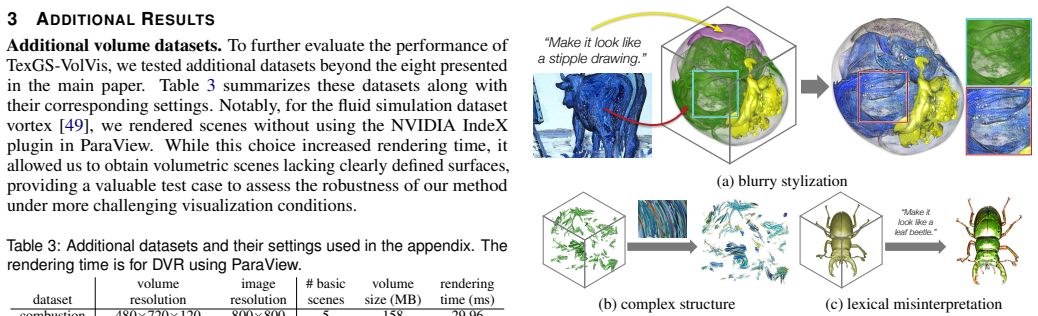
- The text-driven pipeline's ceiling is set by the pretrained editor, as the appendix's "leaf beetle" failure shows a lexical misinterpretation in the frozen model propagates into the stylized scene; a stronger or prompt-grounded 2D editor would likely improve text-driven non-photorealistic editing without changing the framework.
Editorial analysis
A structured set of objections, weighed in public.
Referee Report
Summary. The paper introduces TexGS-VolVis, a volume visualization representation and editing framework built on textured 2D Gaussian splatting with Blinn-Phong shading. The scene representation stage trains multiple basic models, each on a disjoint transfer function, and then concatenates their parameters into a composed model without additional optimization. The editing stage supports real-time photorealistic editing (color, opacity, lighting), image-driven non-photorealistic scene editing using VGG/CLIP losses, text-driven NPSE using InstructPix2Pix, and 2D-lift-3D segmentation via SAM. Experiments on eight volume datasets compare against ARF, StyleRF-VolVis, StyleSplat, IN2N, IG2G, and DGE, reporting faster text-driven editing, smaller primitive counts, and better user-study rankings.
Significance. If the composition claim holds, the paper offers a practically attractive system: multiple transfer-function regions are represented by independently trained Gaussian models that can be combined without retraining, while the per-primitive texture attribute decouples appearance from geometry and enables expressive, geometry-consistent style transfer. The paper is commendably explicit about implementation details, includes parameter studies and failure cases, and makes the central composability claim falsifiable through direct comparison against full-TF direct volume rendering. The main weakness is that the load-bearing composition property and the headline quantitative quality advantages are not yet backed by the evidence presented.
major comments (3)
- [Sec. 3 (Model Composition); Figs. 1, 4; Appendix Fig. 7] The central claim that independently trained basic models can be concatenated into a composed model that 'jointly represents all regions of interest' is supported only qualitatively. Disjoint scalar-value intervals in the basic transfer functions do not imply spatial separation of the corresponding Gaussian primitive sets; in interleaved volume structures, splats from different basic models can overlap in projection and interleave in depth, so the alpha blending in Eq. (3) can double-count opacity or let splat tails from one basic scene tint or occlude another. The paper provides visual examples (Fig. 4 and Appendix Fig. 7) but no quantitative check against the ground-truth full-TF DVR renderings that the composed model is supposed to reproduce, and no jointly trained baseline to isolate composition loss. Please add per-dataset PSNR/SSIM comparisons between renders of the composed model and full-TF DVR images for all multi-scene datasets, and, if feasible, a comparison against a jointly trained model. This is directly measurable and would settle whether the composition construction is valid.
- [Table 3, Sec. 4.3] The quantitative evidence for text-driven NPSE superiority is thin: the average CLIP similarity advantage over DGE is 0.366 vs. 0.364, and the CLIP directional similarity advantage is 0.174 vs. 0.133, with no per-dataset breakdown, no error bars, and no significance tests in the main text. Because these are the only quantitative quality metrics reported for text-driven editing, and because IP2P is stochastic, please report per-dataset scores with multiple seeds or confidence intervals, and state the number of evaluation runs. Without this, the claim of 'superiority in editing quality' rests on differences that may be within noise.
- [Table 2, Sec. 4.2] For image-driven NPSE, Table 2 reports only efficiency metrics (editing time, model size, rendering time, primitive count) and no quantitative quality metric. The paper's stated superiority in visual quality for image-driven editing is therefore supported only by the qualitative comparisons in Fig. 2 and the 10-participant user study. Please either add a quantitative style/quality metric (e.g., LPIPS or CLIP similarity with the reference style) or explicitly scope the image-driven quality claim to the user study; if the latter, the study should report variance and significance rather than only vote counts.
minor comments (4)
- [Sec. 4.3 and Appendix Fig. 9] The main text says IN2N is modified by replacing its MLP with Plenoxels, while the appendix introduces geometry-frozen variants marked with a star. Please clarify explicitly whether the starred variants in Appendix Fig. 9 are the same configurations used in Table 3, and if not, specify exactly which baseline configuration produced the quantitative results.
- [Fig. 1 caption] The caption contains garbled LaTeX-style symbols (e.g., '{ ", $!, $", %!, %", &}') that are not readable in the compiled text; these should be rendered properly or replaced with clear attribute labels.
- [Appendix Eq. (9)] The parameter-count equation is terse and could be misread; a short explanation of the terms (3 for position, 4 for quaternion, 2 for scaling, 1 for opacity) would improve clarity.
- [Sec. 3.3] The texture allocation formula uses a global Ttotal shared across all Gaussians; please state explicitly what happens when a Gaussian's computed Ui or Vi is below 1 texel, since very small primitives will still need at least a 1x1 texture map.
Circularity Check
No significant circularity: the paper's editing outputs are produced by external optimization losses and evaluated against external baselines and user judgments, not by inverting fitted parameters into predictions.
full rationale
TexGS-VolVis is a systems and empirical paper. Its claimed results — stylized renderings, relighting, segmentation-guided partial editing — are produced by optimizing Gaussian and texture attributes against losses defined by external pretrained models (CLIP, VGG, IP2P, SAM) and by geometric reconstruction losses; they are not derived by renaming an input as an output. The model-composition step concatenates independently trained basic models into a composed model, and the paper supports this only qualitatively with Figures 4 and appendix Figure 7. This is a validation gap, not circularity: the composed model is not defined as the quantity being measured, and no quantitative claim is obtained by construction from the concatenation. The self-citations (StyleRF-VolVis [56], iVR-GS [57], and other same-author papers) are used as technical borrowings or as comparison baselines, not as an external uniqueness theorem or as the sole justification for the central claim. The text-driven NPSE evaluation uses CLIP similarity, but the edited textures are optimized to match IP2P-generated edited views, and the CLIP metric is computed independently on final renderings; for image-driven NPSE the paper's headline comparisons are qualitative and user-study based, so the CLIP term in the image-driven loss is not being recycled as the reported quantitative metric. The paper also candidly lists limitations in Section 4.7 and failure cases in the appendix, further confirming that the claims are empirical rather than definitional. The missing quantitative comparison of composed models against full-TF DVR and the absence of a jointly-trained baseline are legitimate correctness risks, but they do not make the derivation circular.
Assumptions & free parameters
free parameters (5)
- lambda_s =
0.9
- Ttotal =
1e7 texels
- Opacity schedule =
2x to 0.5x target opacity
- Number of text-editing views =
6
- Iterations =
10000 (2DGS), 20000 (shading), 3000 (image NPSE), 1500 (text NPSE)
assumptions (4)
- domain assumption Blinn-Phong shading is sufficient to decompose lighting from appearance in volume-rendered multi-view images.
- domain assumption The pretrained CLIP, VGG, IP2P, and SAM models transfer to volume-rendered images.
- domain assumption Basic TFs are disjoint and cover all regions of interest, allowing naive parameter concatenation.
- domain assumption 2DGS geometry optimization is accurate for volume scenes without depth distortion regularization.
Cite this review
Pith. "Pith review of TexGS-VolVis: Expressive Scene Editing for Volume Visualization via Textured Gaussian Splatting." pith.science (2026). https://pith.science/paper/WDDFKANW
@misc{pith2026250713586,
  author       = {Pith},
  title        = {Pith review of: TexGS-VolVis: Expressive Scene Editing for Volume Visualization via Textured Gaussian Splatting},
  year         = {2026},
  howpublished = {\url{https://pith.science/paper/WDDFKANW}},
  note         = {Machine review of arXiv:2507.13586}
}
read the original abstract
Advancements in volume visualization (VolVis) focus on extracting insights from 3D volumetric data by generating visually compelling renderings that reveal complex internal structures. Existing VolVis approaches have explored non-photorealistic rendering techniques to enhance the clarity, expressiveness, and informativeness of visual communication. While effective, these methods often rely on complex predefined rules and are limited to transferring a single style, restricting their flexibility. To overcome these limitations, we advocate the representation of VolVis scenes using differentiable Gaussian primitives combined with pretrained large models to enable arbitrary style transfer and real-time rendering. However, conventional 3D Gaussian primitives tightly couple geometry and appearance, leading to suboptimal stylization results. To address this, we introduce TexGS-VolVis, a textured Gaussian splatting framework for VolVis. TexGS-VolVis employs 2D Gaussian primitives, extending each Gaussian with additional texture and shading attributes, resulting in higher-quality, geometry-consistent stylization and enhanced lighting control during inference. Despite these improvements, achieving flexible and controllable scene editing remains challenging. To further enhance stylization, we develop image- and text-driven non-photorealistic scene editing tailored for TexGS-VolVis and 2D-lift-3D segmentation to enable partial editing with fine-grained control. We evaluate TexGS-VolVis both qualitatively and quantitatively across various volume rendering scenes, demonstrating its superiority over existing methods in terms of efficiency, visual quality, and editing flexibility.
Figures


Figures from the paper (12 more)





Forward citations
Cited by 1 Pith paper
-
IntuiTF: MLLM-Guided Transfer Function Optimization for Direct Volume Rendering
IntuiTF is a framework that guides evolutionary transfer function optimization with MLLM-based human-aligned visual evaluation, achieving up to 0.85 agreement with human experts on medical volume renderings.
Reference graph
Works this paper leans on
-
[1]
K. Ai, K. Tang, and C. Wang. NLI4V olVis: Natural language interaction for volume visualization via multi-LLM agents and editable 3D Gaussian splatting. IEEE Transactions on Visualization and Computer Graphics, 32(1), 2026. Accepted. 9
work page 2026
- [2]
- [3]
-
[4]
S. Bruckner and M. E. Gröller. Style transfer functions for illustrative volume rendering. Computer Graphics Forum, 26(3):715–724, 2007. doi: 10.1111/j.1467-8659.2007.01095.x 2
arXiv 2007
-
[5]
J. Cen, J. Fang, C. Yang, L. Xie, X. Zhang, W. Shen, and Q. Tian. Segment any 3D Gaussians. arXiv preprint arXiv:2312.00860, 2023. doi: 10.48550/ arXiv.2312.00860 5
-
[6]
M. Chen, I. Laina, and A. Vedaldi. DGE: Direct Gaussian 3D editing by consistent multi-view editing. In Proceedings of European Conference on Computer Vision, pp. 74–92, 2024. doi: 10.1007/978-3-031-72904-1_5 2, 5, 7
-
[8]
S. Choi, H. Song, J. Kim, T. Kim, and H. Do. Click-Gaussian: Inter- active segmentation to any 3D Gaussians. In Proceedings of European Conference on Computer Vision, pp. 289–305, 2024. doi: 10.1007/978-3 -031-72646-0_17 5
doi:10.1007/978-3 2024
-
[9]
J. Dong and Y .-X. Wang. ViCA-NeRF: View-consistency-aware 3D edit- ing of neural radiance fields. In Proceedings of Advances in Neural Information Processing Systems, vol. 36, pp. 61466–61477, 2023. doi: 10. 48550/arXiv.2402.00864 5
Show all 72 references
-
[10]
Z. Fan, K. Wang, K. Wen, Z. Zhu, D. Xu, and Z. Wang. LightGaussian: Unbounded 3D Gaussian compression with 15× reduction and 200+ FPS. In Proceedings of Advances in Neural Information Processing Systems,
-
[11]
S. Frey, F. Sadlo, and T. Ertl. Explorable volumetric depth images from raycasting. In Proceedings of BCS Conference on Graphics, Patterns and Images, pp. 123–130, 2013. doi: 10.1109/SIBGRAPI.2013.26 2
2013 doi
-
[13]
J. Gao, C. Gu, Y . Lin, Z. Li, H. Zhu, X. Cao, L. Zhang, and Y . Yao. Relightable 3D Gaussians: Realistic point cloud relighting with BRDF decomposition and ray tracing. In Proceedings of European Conference on Computer Vision, pp. 73–89, 2024. doi: 10.1007/978-3-031-72995-9_5 2, 4
2024 doi
-
[15]
P. Gu, J. Han, D. Z. Chen, and C. Wang. Reconstructing unsteady flow data from representative streamlines via diffusion and deep learning based denoising. IEEE Computer Graphics and Applications, 41(6):111–121,
-
[16]
P. Gu, J. Han, D. Z. Chen, and C. Wang. Scalar2Vec: Translating scalar fields to vector fields via deep learning. In Proceedings of IEEE Pacific Vi- sualization Symposium, pp. 31–40, 2022. doi: 10.1109/PACIFICVIS53943 .2022.00012 2
2022
-
[17]
Gupta, P
A. Gupta, P. Incardona, A. Brock, G. Reina, S. Frey, S. Gumhold, U. Gün- ther, and I. F. Sbalzarini. Parallel compositing of volumetric depth images for interactive visualization of distributed volumes at high frame rates. In Proceedings of Eurographics Symposium on Parallel G...
2023 doi
-
[18]
J. Han, K. Tang, and C. Wang. MoE-INR: Implicit neural representation with mixture-of-experts for time-varying volumetric data compression. IEEE Transactions on Visualization and Computer Graphics, 32(1), 2026. Accepted. 2
2026
-
[19]
Han and C
J. Han and C. Wang. TSR-VFD: Generating temporal super-resolution for unsteady vector field data. Computers & Graphics, 103:168–179, 2022. doi: 10.1016/J.CAG.2022.02.001 2
2022 doi
-
[20]
Han and C
J. Han and C. Wang. VCNet: A generative model for volume completion. Visual Informatics, 6(2):62–73, 2022. doi: 10.1016/J.VISINF.2022.04. 004 2
2022 doi
-
[21]
Han and C
J. Han and C. Wang. CoordNet: Data generation and visualization gen- eration for time-varying volumes via a coordinate-based neural network. IEEE Transactions on Visualization and Computer Graphics, 29(12):4951– 4963, 2023. doi: 10.1109/TVCG.2022.3197203 2
2023
-
[23]
W. He, J. Wang, H. Guo, K.-C. Wang, H.-W. Shen, M. Raj, Y . S. G. Nashed, and T. Peterka. InSituNet: Deep image synthesis for parameter space exploration of ensemble simulations. IEEE Transactions on Visualization and Computer Graphics, 26(1):23–33, 2020. doi: 10.1109/TVCG.201...
2020 doi
-
[24]
F. Hong, C. Liu, and X. Yuan. DNN-V olVis: Interactive volume visualiza- tion supported by deep neural network. In Proceedings of IEEE Pacific Visualization Symposium, pp. 282–291, 2019. doi: 10.1109/PacificVis. 2019.00041 2
2019
- [25]
-
[26]
Huang, Z
B. Huang, Z. Yu, A. Chen, A. Geiger, and S. Gao. 2D Gaussian splat- ting for geometrically accurate radiance fields. In Proceedings of ACM SIGGRAPH Conference, pp. 32:1–32:11, 2024. doi: 10.1145/3641519. 3657428 1, 2, 3, 4, 5
2024 doi
- [27]
-
[28]
Karras, S
T. Karras, S. Laine, and T. Aila. A style-based generator architecture for generative adversarial networks. IEEE Transactions on Pattern Analysis and Machine Intelligence, 43(12):4217–4228, 2021. doi: 10.1109/TPAMI. 2020.2970919 2
2021
-
[29]
Kerbl, G
B. Kerbl, G. Kopanas, T. Leimkühler, and G. Drettakis. 3D Gaussian splatting for real-time radiance field rendering. ACM Transactions on Graphics, 42(4):139:1–139:14, 2023. doi: 10.1145/3592433 2, 3, 4
2023 doi
-
[30]
Kirillov, E
A. Kirillov, E. Mintun, N. Ravi, H. Mao, C. Rolland, L. Gustafson, T. Xiao, S. Whitehead, A. C. Berg, W.-Y . Lo, et al. Segment anything. In Pro- ceedings of IEEE/CVF International Conference on Computer Vision, pp. 4015–4026, 2023. doi: 10.1109/ICCV51070.2023.00371 1, 2, 5
2023
-
[31]
Laidlaw, E
D. Laidlaw, E. Ahrens, D. Kremers, M. Avalos, R. Jacobs, and C. Read- head. Visualizing diffusion tensor images of the mouse spinal cord. In Proceedings of IEEE Visualization , pp. 127–134, 1998. doi: 10.1109/ VISUAL.1998.745294 1
1998
-
[32]
textures
D. H. Laidlaw. Loose, artistic “textures” for visualization.IEEE Computer Graphics and Applications, 21(2):6–9, 2001. doi: 10.1109/38.909009 2
2001 doi
-
[34]
K. Liu, F. Zhan, M. Xu, C. Theobalt, L. Shao, and S. Lu. StyleGaussian: Instant 3D style transfer with Gaussian splatting. In Proceedings of ACM SIGGRAPH Asia Technical Communications, pp. 21:1–21:4, 2024. doi: 10.1145/3681758.3698002 9
2024
-
[36]
A. Lu, C. J. Morris, D. S. Ebert, P. Rheingans, and C. D. Hansen. Non- photorealistic volume rendering using stippling techniques. InProceedings of IEEE Visualization Conference , pp. 211–218, 2002. doi: 10.1109/ VISUAL.2002.1183777 1, 2
2002 arXiv
-
[37]
Y . Lu, P. Gu, and C. Wang. FCNR: Fast compressive neural representation of visualization images. In Proceedings of IEEE VIS Conference (Short Papers), pp. 31–35, 2024. doi: 10.1109/VIS55277.2024.00014 2
2024
-
[38]
J. Ma, Y . He, F. Li, L. Han, C. You, and B. Wang. Segment anything in medical images. Nature Communications, 15(1):654, 2024. doi: 10. 1038/s41467-024-44824-z 2
2024
-
[39]
R. A. Newcombe, S. Izadi, O. Hilliges, D. Molyneaux, D. Kim, A. J. Davison, P. Kohi, J. Shotton, S. Hodges, and A. Fitzgibbon. KinectFusion: Real-time dense surface mapping and tracking. In Proceedings of IEEE International Symposium on Mixed and Augmented Reality, pp. 127–136,
-
[40]
Niedermayr, C
S. Niedermayr, C. Neuhauser, K. Petkov, K. Engel, and R. Westermann. Application of 3D Gaussian splatting for cinematic anatomy on consumer class devices. In Proceedings of Vision, Modeling, and Visualization, pp. 1–13, 2024. doi: 10.2312/vmv.20241195 1, 2, 3, 4, 13
2024 doi
-
[41]
Niedermayr, J
S. Niedermayr, J. Stumpfegger, and R. Westermann. Compressed 3D Gaussian splatting for accelerated novel view synthesis. In Proceedings of IEEE/CVF Conference on Computer Vision and Pattern Recognition, pp. 10349–10358, 2024. doi: 10.1109/CVPR52733.2024.00985 9
2024
-
[42]
Patashnik, Z
O. Patashnik, Z. Wu, E. Shechtman, D. Cohen-Or, and D. Lischinski. Style- CLIP: Text-driven manipulation of StyleGAN imagery. In Proceedings of IEEE/CVF International Conference on Computer Vision, pp. 2065–2074,
-
[43]
Radford, J
A. Radford, J. W. Kim, C. Hallacy, A. Ramesh, G. Goh, S. Agarwal, G. Sastry, A. Askell, P. Mishkin, J. Clark, et al. Learning transferable visual models from natural language supervision. In Proceedings of International Conference on Machine Learning, pp. 8748–8763, 2021. 1, 2
2021
-
[44]
Remondino and S
F. Remondino and S. El-Hakim. Image-based 3D modelling: A review. The Photogrammetric Record, 21(115):269–291, 2006. doi: 10.1111/j. 1477-9730.2006.00383.x 2
2006
-
[45]
doi: 10.1109/ICCV48922.2021.00209 2
2021
- [46]
-
[47]
Sainz and R
M. Sainz and R. Pajarola. Point-based rendering techniques. Computers & Graphics, 28(6):869–879, 2004. doi: 10.1016/j.cag.2004.08.014 2
2004 doi
-
[48]
Rombach, A
R. Rombach, A. Blattmann, D. Lorenz, P. Esser, and B. Ommer. High- resolution image synthesis with latent diffusion models. In Proceedings of IEEE/CVF Conference on Computer Vision and Pattern Recognition, pp. 10674–10685, 2022. doi: 10.1109/CVPR52688.2022.01042 1, 2
2022
-
[49]
Silver and X
D. Silver and X. Wang. Tracking and visualizing turbulent 3D features. IEEE Transactions on Visualization and Computer Graphics, 3(2):129– 141, 1997. doi: 10.1109/2945.597796 11
1997
-
[50]
Simonyan and A
K. Simonyan and A. Zisserman. Very deep convolutional networks for large-scale image recognition. In Proceedings of International Conference on Learning Representations, pp. 1–14, 2015. doi: 10.48550/arXiv.1409. 1556 2
2015 doi
-
[51]
N. Shi, J. Xu, H. Li, H. Guo, J. Woodring, and H.-W. Shen. VDL-Surrogate: A view-dependent latent-based model for parameter space exploration of ensemble simulations. IEEE Transactions on Visualization and Computer Graphics, 29(1):820–830, 2023. doi: 10.1109/TVCG.2022.3209413 2
2023
- [52]
- [53]
-
[54]
H. Son, J. Noh, S. Jeon, C. Wang, and W.-K. Jeong. MC-INR: Efficient encoding of multivariate scientific simulation data using meta-learning and clustered implicit neural representations. In Proceedings of IEEE VIS Conference (Short Papers), 2025. Accepted. 2
2025
-
[55]
Tang and C
K. Tang and C. Wang. STSR-INR: Spatiotemporal super-resolution for time-varying multivariate volumetric data via implicit neural representa- tion. Computers & Graphics, 119:103874, 2024. doi: 10.1016/J.CAG. 2024.01.001 2
2024 doi
-
[56]
Tang and C
K. Tang and C. Wang. StyleRF-V olVis: Style transfer of neural radiance fields for expressive volume visualization.IEEE Transactions on Visualiza- tion and Computer Graphics, 31(1):613–623, 2025. doi: 10.1109/TVCG. 2024.3456342 1, 2, 4, 5, 6, 8
2025
-
[57]
Tang and C
K. Tang and C. Wang. ECNR: Efficient compressive neural representation of time-varying volumetric datasets. In Proceedings of IEEE Pacific Visu- alization Conference, pp. 72–81, 2024. doi: 10.1109/PACIFICVIS60374. 2024.00017 2
2024
-
[58]
Tikhonova, C
A. Tikhonova, C. D. Correa, and K.-L. Ma. Explorable images for visualiz- ing volume data. In Proceedings of IEEE Pacific Visualization Symposium, pp. 177–184, 2010. doi: 10.1109/PACIFICVIS.2010.5429595 2
2010
-
[59]
Tikhonova, C
A. Tikhonova, C. D. Correa, and K.-L. Ma. An exploratory technique for coherent visualization of time-varying volume data. Computer Graphics Forum, 29(3):783–792, 2010. doi: 10.1111/j.1467-8659.2009.01690.x 2
2010
-
[60]
K. Tang, S. Yao, and C. Wang. iVR-GS: Inverse volume rendering for explorable visualization via editable 3D Gaussian splatting. IEEE Trans- actions on Visualization and Computer Graphics, 31(6):3783–3795, 2025. doi: 10.1109/TVCG.2025.3567121 1, 2, 3, 4, 13
2025
-
[61]
Vachha and A
C. Vachha and A. Haque. Instruct-GS2GS: Editing 3D Gaussian splats with instructions. https://instruct-gs2gs.github.io/, 2024. 7
2024
-
[62]
Wang and J
C. Wang and J. Han. DL4SciVis: A state-of-the-art survey on deep learning for scientific visualization. IEEE Transactions on Visualization and Computer Graphics, 29(8):3714–3733, 2023. doi: 10.1109/TVCG. 2022.3167896 2
2023
-
[63]
Tikhonova, C
A. Tikhonova, C. D. Correa, and K.-L. Ma. Visualization by proxy: A novel framework for deferred interaction with volume data. IEEE Transactions on Visualization and Computer Graphics, 16(6):1551–1559,
-
[64]
T.-X. Xu, W. Hu, Y .-K. Lai, Y . Shan, and S.-H. Zhang. Texture-GS: Disentangling the geometry and texture for 3D Gaussian splatting editing. In Proceedings of European Conference on Computer Vision, pp. 37–53,
-
[65]
M. Yang, K. Tang, and C. Wang. Meta-INR: Efficient encoding of volumet- ric data via meta-learning implicit neural representation. In Proceedings of IEEE Pacific Visualization Conference (Visualization Notes), pp. 246–251,
-
[66]
S. Yao, J. Han, and C. Wang. GMT: A deep learning approach to general- ized multivariate translation for scientific data analysis and visualization. Computers & Graphics, 112:92–104, 2023. doi: 10.1016/J.CAG.2023.04. 002 2
2023 doi
- [67]
-
[68]
Yao and C
S. Yao and C. Wang. ReV olVE: Neural reconstruction of volumes for visualization enhancement of direct volume rendering. Computers & Graphics, 2025. Accepted. 2
2025
-
[69]
Yao and C
S. Yao and C. Wang. V olSegGS: V olumetric segmentation of dynamic visualization scenes using deformable Gaussian splatting. IEEE Transac- tions on Visualization and Computer Graphics, 32(1), 2026. Accepted. 9
2026
-
[70]
C. Ye, L. Qiu, X. Gu, Q. Zuo, Y . Wu, Z. Dong, L. Bo, Y . Xiu, and X. Han. StableNormal: Reducing diffusion variance for stable and sharp normal. ACM Transactions on Graphics, 43(6):250:1–250:18, 2024. doi: 10.1145/3687971 2
2024 doi
-
[71]
Zhang, N
K. Zhang, N. Kolkin, S. Bi, F. Luan, Z. Xu, E. Shechtman, and N. Snavely. ARF: Artistic radiance fields. In Proceedings of European Conference on Computer Vision, pp. 717–733, 2022. doi: 10.1007/978-3-031-19821-2_41 2, 5, 6
2022 doi
-
[72]
Zwicker, H
M. Zwicker, H. Pfister, J. van Baar, and M. Gross. EW A volume splatting. In Proceedings of IEEE Visualization Conference, pp. 29–538, 2001. doi: 10.1109/VISUAL.2001.964490 2
2001
-
[73]
S. Yao, Y . Lu, and C. Wang. ViSNeRF: Efficient multidimensional neural radiance field representation for visualization synthesis of dynamic volu- metric scenes. In Proceedings of IEEE Pacific Visualization Conference, pp. 235–245, 2025. doi: 10.1109/PacificVis64226.2025.00029 2
2025
-
[79]
Zwicker, H
M. Zwicker, H. Pfister, J. van Baar, and M. Gross. Surface splatting. In Proceedings of ACM SIGGRAPH Conference, pp. 371–378, 2001. doi: 10. 1145/383259.383300 2
2001
-
[2010]
doi: 10.1109/TVCG.2010.215 2
2010 doi
-
[2011]
doi: 10.1109/ISMAR.2011.6092378 13
2011
-
[2021]
doi: 10.1109/MCG.2021.3089627 2
2021
-
[2024]
doi: 10.1007/978-3-031-72698-9_3 13
Reviewed August 6, 2026 · model on record in the stance chip above.
Discussion (0). Sign in to comment.