REVIEW 4 major objections 8 minor 44 references
DailyLLM: Context-Aware Activity Log Generation Using Multi-Modal Sensors and LLMs
T0 review · 4 major / 8 minor · reviewed 2026-08-06 · deepseek-v4-flash
Pith's one-line read A 1.5-billion-parameter LLM, guided by structured prompts from phone and watch sensors, can beat a 70-billion-parameter baseline at generating context-rich activity logs.
desk verdict A well-engineered on-device LLM pipeline for activity logging, but the headline log-generation result is evaluated on a synthetic dataset built from the paper's own rules, so the real-world SOTA claim isn't established. read the letter →
The pith
A machine-rendered reading of the paper's core claim, the machinery that carries it, and where it could break.
The reading
What carries the argument
The central mechanism is a structured prompt generator combined with a hand-designed feature extractor. The extractor reduces accelerometer, gyroscope, magnetometer, and audio streams to a few hundred statistical descriptors—time-domain, frequency-domain, autocorrelation, and axis-level IMU features plus 120 Mel-frequency cepstral coefficient features—and the prompt generator wraps those descriptors, reverse-geocoded location, and semantically annotated environment readings into a fixed five-part instruction. A LoRA-fine-tuned DeepSeek-R1-1.5B model then reasons over this semantic text to predict activity, describe location, recognize scenes, and generate logs and summaries. The key idea is to project raw sensor data into the textual space where LLMs are strongest, rather than asking the model to read raw waveforms.
What would settle it
Run DailyLLM and the AutoLife-style baseline on real-world data from volunteers wearing a smartphone and smartwatch for several days, with hand-annotated ground-truth activity logs; if the 17% BERTScore precision advantage over AutoLife does not reproduce at comparable computation, the central claim fails.
Extended reading notes
Core claim
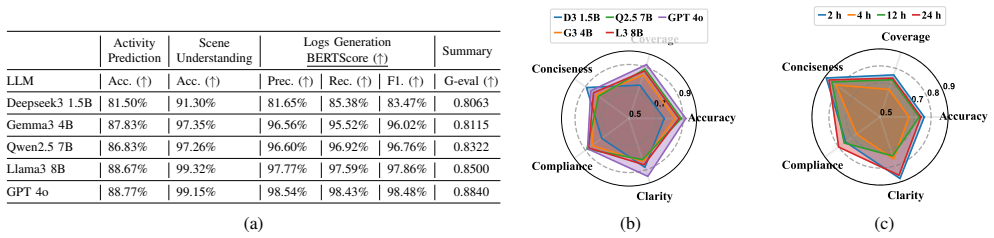
On its own terms, the paper establishes a recipe: convert raw multi-modal sensor signals into compact statistical features, wrap those features plus location and environment annotations in a structured prompt, and let a small fine-tuned LLM reason over the result. On six activity benchmarks, DailyLLM raises average F1 over the LLaSA baseline by 12.24%; on fifteen acoustic scene classes it reports 100% accuracy; and on 411 real locations it describes the place correctly 92.46% of the time. For the log generation task, it reports BERTScore precision of 81.65% versus the AutoLife baseline's 65.0%, and it summarizes two hours of activity in about four minutes on a Raspberry Pi 5.
Load-bearing premise
The load-bearing premise is that the synthetic daily-activity dataset used to evaluate log generation, which was built with the authors' own probabilistic composition rules and physiological data spliced in from a separate stress dataset, faithfully represents real daily life.
Editorial extensions
If this is right
- A personal computer or Raspberry Pi can run the full logging pipeline locally, so users' sensor data never needs to leave the device.
- Activity logs can include environment and physiology, enabling reminders about sedentary behavior, extreme darkness, heat, noise, elevated heart rate, or low oxygen.
- Smaller models become viable for sensor-to-text tasks when paired with structured feature extraction, reducing hardware cost and energy use.
- The authors plan to release their four-dimensional activity context dataset, giving other researchers a common benchmark for log generation.
Reading between the lines
- If the synthetic composition rules used for evaluation understate the messiness of real days, the reported 17% precision advantage could shrink; a field study with real users would be the natural test.
- The same feature-extraction-plus-structured-prompt recipe may transfer to other on-device sensor-to-text tasks, such as sleep staging, stress detection, or summarizing indoor mobility.
- Because the 1.5B model already benefits from semantic annotation, even smaller models with aggressive quantization might preserve much of the gain on edge hardware.
- A useful stress test would be to evaluate the pipeline on acoustic scenes and locations not well represented in LLM pretraining, to separate genuine transfer from prior knowledge.
Editorial analysis
A structured set of objections, weighed in public.
Referee Report
Summary. The paper proposes DailyLLM, an LLM-based system for generating context-aware activity logs and summaries from smartphone/smartwatch sensors, integrating location, motion, environment, and physiology. The system introduces a unified data processing module, a feature extraction strategy that converts raw sensor streams into compact semantic features, and a structured prompt generator that feeds these features into a LoRA-fine-tuned 1.5B-parameter DeepSeek model. The authors evaluate activity prediction, scene understanding, and location description on standard benchmarks (HHAR, Motion, Shoaib, UCI, DCASE, StudentLife), and evaluate log generation and summarization on a self-constructed comprehensive dataset, reporting a 17% BERTScore precision improvement over AutoLife and nearly 10x faster inference. They also present ablation studies and a sensitivity analysis of time windows and LLM backbones.
Significance. The idea of using a small, locally deployable LLM with compact multi-modal sensor features for life logging is timely and practically relevant. The system design is well-motivated, and the benchmark results on standard HAR and acoustic scene datasets are useful positive evidence. The paper also includes valuable ablation studies (feature extraction, prompt engineering) and will release its dataset. However, the headline log-generation result is evaluated on a synthetic dataset constructed from the paper's own probabilistic composition rules, so the central claim of a 17% improvement over SOTA does not yet establish performance on real daily-life sensor data. The significance of the work would be substantially higher if the evaluation included real-world data or if the claims were scoped more cautiously.
major comments (4)
- [Section IV-A1 and IV-B4] The evaluation of log generation and summarization uses a synthetic dataset built from the authors' own composition rules: 80% lying at night, 50% sitting in daytime, location changes triggering walking, stair activities followed by walking, and WESAD physiological signals spliced in as temporally trend-aligned samples. The ground-truth logs and summaries are derived from these same rules, and the prompt explicitly includes date-time and location (Section III-B2). The model can therefore achieve high BERTScore by reproducing the learned temporal and spatial priors rather than by genuinely interpreting sensor data. The reported gains over AutoLife are thus not evidence of real-world performance. The paper explicitly says the rules are intended to 'simulate real-world daily activity patterns' but never validates the simulation against any real co-occurring multimodal stream. This is a load-bearing threat to the central claim and needs to be addressed, for example by adding a real-world pilot study, or by substantially re-scoping the claim.
- [Section IV-B2, Table III] The paper reports 100% accuracy on both DCASE A and DCASE B (15 acoustic scene classes) without any error bars, confidence intervals, or confusion matrices. Perfect accuracy on a 15-class acoustic scene classification task is surprising for a system fine-tuned on only 200 labeled samples per class, and the absence of any variance measure makes this result unverifiable. Additionally, the comparison to SOTA methods (NMF and ConvNet) from the DCASE leaderboard may not be apples-to-apples: it is not stated whether those baselines used the full training set while DailyLLM used only 200 samples per class. The training and evaluation protocol for the SOTA baselines must be described explicitly, and the 100% accuracy claim should be backed by repeated runs and error analysis.
- [Section IV-B4] The 17% BERTScore precision improvement is computed by comparing DailyLLM's results on the synthetic test set to AutoLife's best reported numbers (Precision=65.0%, Recall=78.2%, F1=70.4%) taken from the AutoLife paper, rather than by running AutoLife on the same synthetic data. Since the synthetic distribution was constructed by the authors, and since AutoLife was not designed for this distribution, the comparison does not establish a fair or meaningful improvement. The authors should either re-implement and re-evaluate AutoLife on their dataset, or clearly state that the numbers are not directly comparable and present the comparison as approximate.
- [Section IV-B1, Table III] The activity prediction comparison with LLaSA is also potentially confounded. LLaSA's results are cited from its own paper, while DailyLLM uses its own feature extraction, prompt, and LoRA fine-tuning procedure. Differences in train/test splits, feature sets, and training-data sizes could easily explain the reported 12.24% F1 improvement. A like-for-like comparison (same splits, same features, same number of training samples, multiple random seeds) is needed to support the claim that DailyLLM outperforms LLaSA.
minor comments (8)
- [Section IV-E2] The sentence 'its hard to deployment on mobile devices' is ungrammatical; it should read 'it is hard to deploy on mobile devices.'
- [Section III-B2] 'These efforts facilitates deployment' should be 'These efforts facilitate deployment' (subject-verb agreement).
- [Figure 6] The model name 'Deepseek3 1.5B' in Fig. 6 is inconsistent with 'DeepSeek R1-1.5B' used in the text; please standardize the notation.
- [Figure 2] Figure 2 is very dense and the small font size makes the arrows and module labels hard to read; please enlarge the figure or redraw it for clarity.
- [Section IV-A1] The term 'temporally trend aligned physiological signals' is not defined; please explain the alignment procedure in detail.
- [Abstract and Section IV-C] The speedup is written as '10 ×' in the abstract and '10x' in Section IV-C; please use a consistent notation.
- [Section II-B] ContextLLM [6] is cited in related work but never compared or discussed again; a brief discussion of the differences between DailyLLM and ContextLLM would help position the contribution.
- [Section IV-B3] The location description accuracy (92.46%) is said to be verified by search engines and map queries, but the evaluation protocol is not described in detail; please specify how accuracy is computed and whether any inter-annotator agreement was measured.
Circularity Check
Headline BERTScore gain is measured against a synthetic dataset generated from the paper's own time/location-conditioned composition rules, so the log-generation 'prediction' largely reduces to recovering those authored priors from the prompt rather than to sensor-to-text generation.
-
self definitional
[Sec. IV-A1 (Comprehensive Activity Dataset Construction) and Sec. IV-B4 (Logs Generation and Summarization)]
"Since no existing public dataset encompasses all four contextual dimensions: location, motion, environment, and physiology, we propose a set of composition rules and constraints to construct a comprehensive activity context dataset... Specifically, a) During nighttime (00:00–08:00), activity probabilities are assigned as follows: 80% lying, and 5% each for sitting, standing, walking, and stair activities; b) during daytime (08:01–23:59), the distribution is adjusted to 5% lying, 50% sitting, 20% standing, 15% walking, and 10% stair activities..."
The log-generation evaluation is performed on a dataset constructed by the paper's own probabilistic composition rules, which fix activity labels as a function of time-of-day and location changes. The model's prompt (Sec. III-B2) explicitly supplies date-time and location, and the paper itself states that nighttime at home implies lying and daytime mall/subway implies walking. The BERTScore ground-truth references are drawn from the same authored distribution. Thus the reported 17% precision gain over AutoLife can be achieved by the LLM matching these hand-defined priors rather than by genuinely interpreting the multi-modal sensor streams.
full rationale
DailyLLM's component evaluations on external benchmarks are not circular: activity prediction uses HHAR, Motion, Shoaib, and UCI; scene understanding uses DCASE A/B; and location description uses StudentLife, all independent of the paper's design choices. The circularity is confined to the headline log-generation and summarization result. There, the 'comprehensive daily activity dataset' is built from the paper's own hand-assigned activity probabilities, transition dependencies, and WESAD-spliced physiology, and the same dataset supplies both training and test samples. Because the prompt includes the very conditioning variables (date-time, location) used by those composition rules, a model can score well by learning the authored priors, making the 17% BERTScore improvement over AutoLife an internal benchmark artifact rather than evidence of generalizable sensor-to-text generation. This warrants a partial circularity score of 6, not higher, because the external component benchmarks and the system design itself retain independent content.
Assumptions & free parameters
free parameters (5)
- Light-level semantic thresholds =
0-5, 5-50, 50-300, 300-1000, >1000 Lux
- Audio-level semantic thresholds =
<-70, -70 to -50, -50 to -30, -30 to -10, >-10 dBFS
- Temperature-level semantic thresholds =
<10, 10-18, 18-26, 26-30, >30 C
- Synthetic dataset composition probabilities =
Night 80/5/5/5/5, Day 5/50/20/15/10 (lying/sitting/standing/walking/stairs)
- Physiological signal splicing from WESAD =
Not specified
assumptions (5)
- domain assumption Pretrained LLM knowledge transfers to compact hand-crafted sensor features
- ad hoc to paper The synthetic composition rules reflect real daily activity patterns
- standard math Barometric formula gives usable altitude estimates
- domain assumption MFCC and spectral features capture scene-discriminative audio information
- domain assumption Reverse geocoding and Wi-Fi/Bluetooth fingerprints provide reliable location context
Cite this review
Pith. "Pith review of DailyLLM: Context-Aware Activity Log Generation Using Multi-Modal Sensors and LLMs." pith.science (2026). https://pith.science/paper/HLC7DITS
@misc{pith2026250713737,
  author       = {Pith},
  title        = {Pith review of: DailyLLM: Context-Aware Activity Log Generation Using Multi-Modal Sensors and LLMs},
  year         = {2026},
  howpublished = {\url{https://pith.science/paper/HLC7DITS}},
  note         = {Machine review of arXiv:2507.13737}
}
read the original abstract
Rich and context-aware activity logs facilitate user behavior analysis and health monitoring, making them a key research focus in ubiquitous computing. The remarkable semantic understanding and generation capabilities of Large Language Models (LLMs) have recently created new opportunities for activity log generation. However, existing methods continue to exhibit notable limitations in terms of accuracy, efficiency, and semantic richness. To address these challenges, we propose DailyLLM. To the best of our knowledge, this is the first log generation and summarization system that comprehensively integrates contextual activity information across four dimensions: location, motion, environment, and physiology, using only sensors commonly available on smartphones and smartwatches. To achieve this, DailyLLM introduces a lightweight LLM-based framework that integrates structured prompting with efficient feature extraction to enable high-level activity understanding. Extensive experiments demonstrate that DailyLLM outperforms state-of-the-art (SOTA) log generation methods and can be efficiently deployed on personal computers and Raspberry Pi. Utilizing only a 1.5B-parameter LLM model, DailyLLM achieves a 17% improvement in log generation BERTScore precision compared to the 70B-parameter SOTA baseline, while delivering nearly 10x faster inference speed.
Figures


Figures from the paper (2 more)

Reference graph
Works this paper leans on
-
[1]
(2025) Global smartphone penetration 2016-
Statista. (2025) Global smartphone penetration 2016-
work page 2025
-
[2]
Life-tags: a smartglasses-based system for recording and abstracting life with tag clouds,
A. Aiordachioae and R.-D. Vatavu, “Life-tags: a smartglasses-based system for recording and abstracting life with tag clouds,” Proceedings of the ACM on human-computer interaction , vol. 3, pp. 1–22, 2019
work page 2019
-
[3]
Memento: An emotion-driven lifel- ogging system with wearables,
S. Jiang, Z. Li, P. Zhou, and M. Li, “Memento: An emotion-driven lifel- ogging system with wearables,” ACM Transactions on Sensor Networks (TOSN), vol. 15, no. 1, pp. 1–23, 2019
work page 2019
-
[4]
A. Aiord ˘achioae, A. Calinciuc, and M. D. Schipor, “Integrating extended reality and neural headsets for enhanced emotional lifelogging: A technical overview,” in 2024 International Conference on Development and Application Systems (DAS) . IEEE, 2024, pp. 1–6
work page 2024
-
[5]
Autolife: Automatic life journaling with smartphones and llms,
H. Xu, P. Tong, M. Li, and M. Srivastava, “Autolife: Automatic life journaling with smartphones and llms,” arXiv:2412.15714, 2024
arXiv 2024
-
[6]
Contextllm: Meaningful context reasoning from multi-sensor and multi- device data using llms,
K. Post, R. Kuchida, M. Olapade, Z. Yin, P. Nurmi, and H. Flores, “Contextllm: Meaningful context reasoning from multi-sensor and multi- device data using llms,” in Proceedings of ACM HOTMOBILE’25 . Association for Computing Machinery (ACM), 2025
work page 2025
-
[7]
G. Asano, “Lifelog: Timelog & diary,” 2024, 2024. [Online]. Available: https://apps.apple.com/bb/app/lifelog-timelog-diary/id6473384260
work page 2024
-
[8]
(2025) Day one journal app — your journal for life
Automattic. (2025) Day one journal app — your journal for life. [Online]. Available: https://dayoneapp.com/
work page 2025
Show all 44 references
-
[9]
Foodai: Food image recognition via deep learning for smart food logging,
D. Sahoo, W. Hao, S. Ke, W. Xiongwei, H. Le, P. Achananuparp, E.-P. Lim, and S. C. Hoi, “Foodai: Food image recognition via deep learning for smart food logging,” in Proceedings of the 25th ACM SIGKDD International Conference on Knowledge Discovery & Data Mining , 2019, pp. 2260–2268
2019
-
[10]
Cyberslacking or smart work: Smart- phone usage log-analysis focused on app-switching behavior in work and leisure conditions,
Y . Jeong, H. Jung, and J. Lee, “Cyberslacking or smart work: Smart- phone usage log-analysis focused on app-switching behavior in work and leisure conditions,” International Journal of Human–Computer Interaction, vol. 36, no. 1, pp. 15–30, 2020
2020
-
[11]
Analyzing mobile application usage: generat- ing log files from mobile screen recordings,
P. Krieter and A. Breiter, “Analyzing mobile application usage: generat- ing log files from mobile screen recordings,” in Proceedings of the 20th international conference on human-computer interaction with mobile devices and services , 2018, pp. 1–10
2018
-
[12]
A novel voice interactive sleep log: concurrent validity with actigraphy and sleep diaries,
D. Lewin, C. M. Starling, E. S. Zhou, D. Greenberg, C. Shaw, and H. Arem, “A novel voice interactive sleep log: concurrent validity with actigraphy and sleep diaries,” Journal of Clinical Sleep Medicine , vol. 20, no. 2, pp. 309–312, 2024
2024
-
[13]
Lora: Low-rank adaptation of large language models
E. J. Hu, Y . Shen, P. Wallis, Z. Allen-Zhu, Y . Li, S. Wang, L. Wang, W. Chen et al., “Lora: Low-rank adaptation of large language models.” ICLR, vol. 1, no. 2, p. 3, 2022
2022
-
[14]
Llasa: Large multimodal agent for human activity analysis through wearable sensors,
S. A. Imran et al. , “Llasa: Large multimodal agent for human activity analysis through wearable sensors,” arXiv preprint arXiv:2406.14498 , 2024
2024
-
[15]
When iot meet llms: Applications and challenges,
˙I. K ¨ok, O. Demirci, and S. ¨Ozdemir, “When iot meet llms: Applications and challenges,” in 2024 IEEE International Conference on Big Data (BigData). IEEE, 2024, pp. 7075–7084
2024
-
[16]
Iot-llm: Enhancing real- world iot task reasoning with large language models,
T. An, Y . Zhou, H. Zou, and J. Yang, “Iot-llm: Enhancing real- world iot task reasoning with large language models,” arXiv preprint arXiv:2410.02429, 2024
2024
-
[17]
Iot-lm: Large multisensory language models for the internet of things,
S. Mo, R. Salakhutdinov, L.-P. Morency, and P. P. Liang, “Iot-lm: Large multisensory language models for the internet of things,” arXiv preprint arXiv:2407.09801, 2024
2024 arXiv
-
[18]
Penetrative ai: Making llms comprehend the physical world,
H. Xu, L. Han, Q. Yang, M. Li, and M. Srivastava, “Penetrative ai: Making llms comprehend the physical world,” inProceedings of the 25th International Workshop on Mobile Computing Systems and Applications, 2024, pp. 1–7
2024
-
[19]
Hargpt: Are llms zero-shot human activity recognizers?
S. Ji, X. Zheng, and C. Wu, “Hargpt: Are llms zero-shot human activity recognizers?” arXiv preprint arXiv:2403.02727 , 2024
2024 arXiv
-
[20]
Evaluating large language models as virtual annotators for time-series physical sensing data,
A. Hota, S. Chatterjee, and S. Chakraborty, “Evaluating large language models as virtual annotators for time-series physical sensing data,” ACM Trans. Intell. Syst. Technol. , Sep. 2024. [Online]. Available: https://doi.org/10.1145/3696461
2024 doi
-
[21]
Using large language models to enhance the reusability of sensor data,
A. Berenguer, A. Morej ´on, D. Tom ´as, and J.-N. Maz ´on, “Using large language models to enhance the reusability of sensor data,” Sensors, vol. 24, no. 2, p. 347, 2024
2024
-
[22]
Barometric formula — wikipedia, the free encyclopedia,
Wikipedia contributors, “Barometric formula — wikipedia, the free encyclopedia,” 2025. [Online]. Available: https://en.wikipedia.org/wiki/ Barometric formula
2025
-
[23]
Comparison of parametric representations for monosyllabic word recognition in continuously spoken sentences,
S. Davis and P. Mermelstein, “Comparison of parametric representations for monosyllabic word recognition in continuously spoken sentences,” IEEE transactions on acoustics, speech, and signal processing , vol. 28, no. 4, pp. 357–366, 1980
1980
-
[24]
Deepseek-v3 technical report,
A. Liu, B. Feng, B. Xue, B. Wang, B. Wu, C. Lu, C. Zhao, C. Deng, C. Zhang, C. Ruan et al., “Deepseek-v3 technical report,” arXiv preprint arXiv:2412.19437, 2024
2024 arXiv
-
[25]
Studentlife: assessing mental health, academic performance and behavioral trends of college students using smartphones,
R. Wang, F. Chen, Z. Chen, T. Li, G. Harari, S. Tignor, X. Zhou, D. Ben-Zeev, and A. T. Campbell, “Studentlife: assessing mental health, academic performance and behavioral trends of college students using smartphones,” in Proceedings of the 2014 ACM international joint confer...
2014
-
[26]
Smart devices are different: Assessing and mitigatingmobile sensing heterogeneities for activity recognition,
A. Stisen, H. Blunck, S. Bhattacharya, T. S. Prentow, M. B. Kjærgaard, A. Dey, T. Sonne, and M. M. Jensen, “Smart devices are different: Assessing and mitigatingmobile sensing heterogeneities for activity recognition,” in Proceedings of the 13th ACM conference on embedded netw...
2015
-
[27]
Mobile sensor data anonymization,
M. Malekzadeh, R. G. Clegg, A. Cavallaro, and H. Haddadi, “Mobile sensor data anonymization,” in Proceedings of the international confer- ence on internet of things design and implementation , 2019, pp. 49–58
2019
-
[28]
Fusion of smartphone motion sensors for physical activity recognition,
M. Shoaib, S. Bosch, O. D. Incel, H. Scholten, and P. J. Havinga, “Fusion of smartphone motion sensors for physical activity recognition,”Sensors, vol. 14, no. 6, pp. 10 146–10 176, 2014
2014
-
[29]
Transition-aware human activity recognition using smartphones,
J.-L. Reyes-Ortiz, L. Oneto, A. Sam `a, X. Parra, and D. Anguita, “Transition-aware human activity recognition using smartphones,” Neu- rocomputing, vol. 171, pp. 754–767, 2016
2016
-
[30]
Mesaros, T
A. Mesaros, T. Heittola, and T. Virtanen, in 24th European Signal Processing Conference 2016 (EUSIPCO 2016) , Budapest, Hungary, 2016
2016
-
[31]
DCASE 2017 challenge setup: Tasks, datasets and baseline system,
A. Mesaros, T. Heittola, A. Diment, B. Elizalde, A. Shah, E. Vincent, B. Raj, and T. Virtanen, “DCASE 2017 challenge setup: Tasks, datasets and baseline system,” in Proceedings of the Detection and Classification of Acoustic Scenes and Events 2017 Workshop (DCASE2017), Novembe...
2017
-
[32]
Introducing wesad, a multimodal dataset for wearable stress and affect detection,
P. Schmidt, A. Reiss, R. Duerichen, C. Marberger, and K. Van Laer- hoven, “Introducing wesad, a multimodal dataset for wearable stress and affect detection,” in Proceedings of the 20th ACM international conference on multimodal interaction , 2018, pp. 400–408
2018
-
[33]
Human activities recognition in android smartphone using support vector machine,
D. N. Tran and D. D. Phan, “Human activities recognition in android smartphone using support vector machine,” in 2016 7th international conference on intelligent systems, modelling and simulation (isms) . IEEE, 2016, pp. 64–68
2016
-
[34]
Human activity recognition using k-nearest neighbor machine learning algorithm,
S. Mohsen, A. Elkaseer, and S. G. Scholz, “Human activity recognition using k-nearest neighbor machine learning algorithm,” in Proceedings of the International Conference on Sustainable Design and Manufacturing. Springer, 2021, pp. 304–313
2021
-
[35]
Cnn-based sensor fusion techniques for multimodal hu- man activity recognition,
S. M ¨unzner, P. Schmidt, A. Reiss, M. Hanselmann, R. Stiefelhagen, and R. D ¨urichen, “Cnn-based sensor fusion techniques for multimodal hu- man activity recognition,” in Proceedings of the 2017 ACM international symposium on wearable computers , 2017, pp. 158–165
2017
-
[36]
Lstm networks for mobile human activity recognition,
Y . Chen, K. Zhong, J. Zhang, Q. Sun, and X. Zhao, “Lstm networks for mobile human activity recognition,” in 2016 International conference on artificial intelligence: technologies and applications . Atlantis Press, 2016, pp. 50–53
2016
-
[37]
Supervised nonnegative matrix factorization for acoustic scene classification,
V . Bisot, R. Serizel, S. Essid, and G. Richard, “Supervised nonnegative matrix factorization for acoustic scene classification,” DCASE2016 Challenge, Tech. Rep., September 2016
2016
-
[38]
Convolutional neural networks with binaural repre- sentations and background subtraction for acoustic scene classification,
Y . Han and J. Park, “Convolutional neural networks with binaural repre- sentations and background subtraction for acoustic scene classification,” DCASE2017 Challenge, Tech. Rep., September 2017
2017
-
[39]
Raspberry pi 5,
Raspberry, “Raspberry pi 5,” 2025. [Online]. Available: https: //www.raspberrypi.com/products/raspberry-pi-5/
2025
-
[40]
Bertscore: Evaluating text generation with bert,
T. Zhang, V . Kishore, F. Wu, K. Q. Weinberger, and Y . Artzi, “Bertscore: Evaluating text generation with bert,” arXiv preprint arXiv:1904.09675, 2019
1904 arXiv
-
[41]
G-eval: Nlg evaluation using gpt-4 with better human alignment,
Y . Liu, D. Iter, Y . Xu, S. Wang, R. Xu, and C. Zhu, “G-eval: Nlg evaluation using gpt-4 with better human alignment,” arXiv preprint arXiv:2303.16634, 2023
2023 arXiv
-
[42]
Evaluation of geographical distortions in language models,
R. Decoupes, R. Interdonato, M. Roche, M. Teisseire, and S. Valentin, “Evaluation of geographical distortions in language models,” in Interna- tional Conference on Discovery Science . Springer, 2024, pp. 86–100
2024
-
[43]
Gpt-4 technical report,
J. Achiam, S. Adler, S. Agarwal, L. Ahmad, I. Akkaya, F. L. Aleman, D. Almeida, J. Altenschmidt, S. Altman, S. Anadkat et al. , “Gpt-4 technical report,” arXiv preprint arXiv:2303.08774 , 2023
2023 arXiv
-
[2023]
Available: https://www.statista.com/statistics/203734/ global-smartphone-penetration-per-capita-since-2005/
[Online]. Available: https://www.statista.com/statistics/203734/ global-smartphone-penetration-per-capita-since-2005/
2005
Reviewed August 6, 2026 · model on record in the stance chip above.
Discussion (0). Sign in to comment.