REVIEW 2 major objections 5 minor 2 cited by
Probing the singularity at the holographic screen via $q$-holography
T0 review · 2 major / 5 minor · reviewed 2026-08-06 · deepseek-v4-flash
Pith's one-line read The classical singularity at the holographic screen is replaced by a quantum hyperbolic disk.
desk verdict A genuine probe-regime identification connecting sinh dilaton gravity to the quantum disk, but the advertised 'exact match' is uncontrolled at the finite b values used in the paper. read the letter →
The pith
A machine-rendered reading of the paper's core claim, the machinery that carries it, and where it could break.
The reading
What carries the argument
The load-bearing object is the double sine function $S_b(x)$, whose ratio $\frac{S_b(-b\Delta+b/2+\tau/(b\beta))}{S_b(b\Delta+b/2+\tau/(b\beta))}$ solves the three $q$-Ward identities generated by the $U_q(sl_2)$ operators $L_0=\Delta+z\partial_z$ and the finite-difference operators $L_{\pm 1}$. Ramanujan's summation formula (2.25) turns this correlator into a spectral integral whose integrand the probe approximation of the $\sinh$ dilaton gravity two-point function reproduces term by term: the $e^{\omega\beta/(2b^2)-\tau\omega/b^2}$ factor, the Boltzmann weight, and the double-sine matrix element. The probe regime is defined by large background energy $E$ with small probe energy $\omega$ and light operator weight $\beta_M=b\Delta\ll Q/2$, so that the $E$-saddle (3.22) is unchanged; the quantum hyperbolic disk then emerges through the non-commutativity $[\varphi,r]=-2i\log q$. Finally, rewriting the gravitational model as $q$-Liouville quantum mechanics, where the matter operator is $e^{-\Delta L}$ with $L$ the Einstein-Rosen bridge length in the effective $AdS_2$ metric, identifies the Liouville metric as the carrier of the non-commutativity.
What would settle it
Compute the exact $\sinh$ dilaton gravity two-point function (3.9) at $b=0.6$, $0.8$, and $0.9$ and compare its spectral poles and $\tau$-dependence with the probe formula (3.23) and the $q$-correlator (2.26), keeping rather than dropping the $O(b^2)$ term in (3.20); if the correlators differ measurably at these finite values of $b$, the claimed identification fails.
Extended reading notes
Core claim
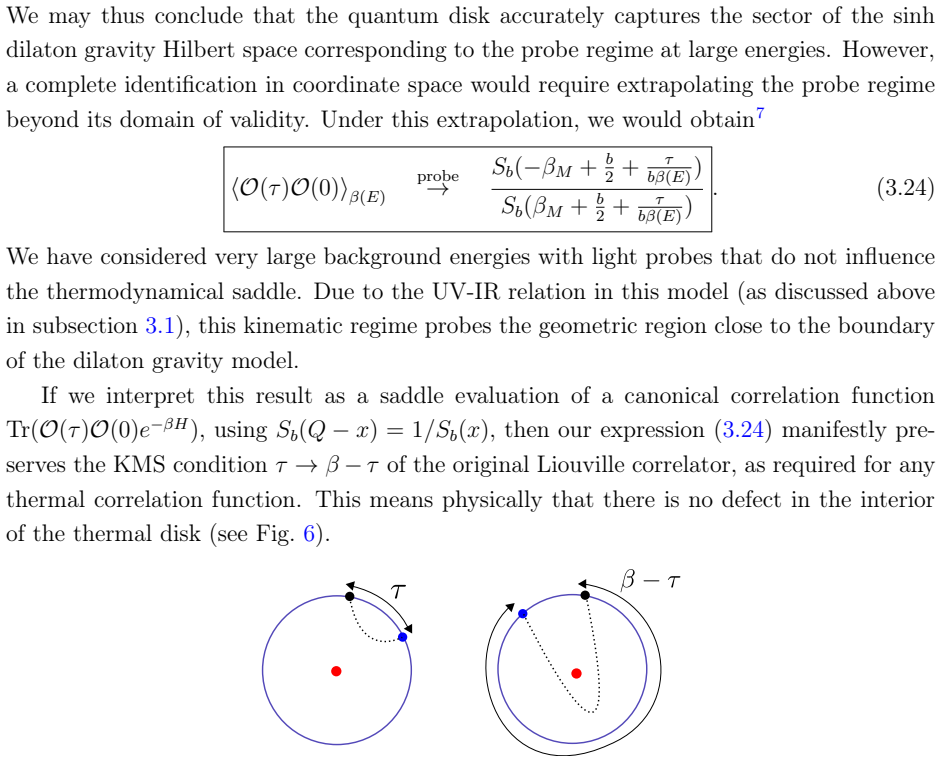
On the paper's own terms, the central discovery is that the probe limit of the $\sinh$ dilaton gravity two-point function, equation (3.23), is exactly the Fourier-space integrand of the $q$-correlator (2.26) that solves the $SL_q(2,\mathbb{R})$ Ward identities. The classical geometry has $R\to +\infty$ at the boundary, and the semiclassical $\hbar\to 0$ limit gives a thermal $AdS_2$ answer with ordinary $SL(2,\mathbb{R})$ isometries; the probe, large-energy, light-operator limit instead yields the double-sine ratio (3.24) with $q$-deformed isometries. The paper interprets this to mean the near-boundary region is a fuzzy quantum hyperbolic disk, so the singularity is resolved rather than encountered. It also notes that the exact two-point function does not have the extra poles that the extrapolated probe answer has, meaning the quantum-disk description is valid only in the probe sector of the Hilbert space.
Load-bearing premise
The central claim relies on neglecting a subleading correction proportional to $b^2$ in the probe two-point function; at the finite deformation values $b=0.6$, $0.8$, and $0.9$ used in the paper that correction is not obviously small, so the exact match with the $q$-deformed spectral decomposition could break down.
Editorial extensions
If this is right
- The near-boundary (UV) sector of sinh dilaton gravity is governed by $SL_q(2,\mathbb{R})$ isometries, not by the classical $SL(2,\mathbb{R})$ of the emergent $AdS_2$ region.
- The curvature singularity at the holographic screen is resolved by non-commutative geometry: spacetime near the screen has fuzzy cells of Planckian size set by $2|\log q|$, complexified when $q$ lies on the unit circle.
- The quasi-normal mode spectrum of the quantum disk is a double array $\omega_{n,m}=-i\frac{2\pi b}{\beta}(\beta_M+nb+m/b)$, with the second tower $m>0$ disappearing in the $b\to 0$ JT limit.
- The same $q$-deformed structure should persist for sine dilaton gravity on the complexified contour, giving a holographic description of DSSYK.
- The semiclassical and probe limits of the correlator disagree precisely because the near-boundary region is not a classical geometry; the exact correlator's lack of the extra probe poles shows the quantum disk captures only the probe sector.
Reading between the lines
- A sharper test would compute the boundary three-point function in the same probe regime and check whether it matches the known $q$-deformed three-point correlator; the paper lists this as a future direction but does not perform it.
- Because the $b\to 0$ limit of the probe answer reduces to the thermal $CFT_1$ correlator, the quantum disk can be read as a $q$-deformation of the near-boundary $AdS_2$ region, suggesting the same mechanism might resolve naked singularities in other dilaton gravity models with non-AdS asymptotics.
- The fake-disk shift by $\pm\pi b^2/2$ introduces a quantum-trace, Drinfeld-like element $K^{-1/2}$ and an effective temperature $\tilde\beta=\beta+\pi b^2$; an editorial extrapolation is that this should appear in the modular or entanglement structure of multi-boundary states.
- The probe identification is made in a restricted kinematic window ($\omega\ll E$), so the paper's coordinate-space extrapolation (3.24) is a conjecture; testing it would require controlling the exact two-point function near the boundary at finite $b$.
Editorial analysis
A structured set of objections, weighed in public.
Referee Report
Summary. This paper studies 2d sinh dilaton gravity and argues that its near-boundary UV regime is described by a q-deformed hyperbolic disk with SLq(2,R) isometries, rather than by the classical singular geometry. Section 2 solves q-Ward identities for two-point functions, obtains a 'fake disk' KMS-symmetric correlator (2.21), and gives its spectral decomposition (2.26) via Ramanujan's summation formula. Section 3 reviews the sinh dilaton gravity action and the exact boundary two-point function (3.9) from prior work, then takes a probe limit with large background energy E and small probe energy ω, arriving at the microcanonical amplitude (3.23). The main claim is that (3.23) coincides with the integrand of (2.26), so the quantum disk emerges in the probe region and the boundary curvature singularity is resolved by noncommutative geometry. The appendices supply corepresentation details, dilaton-gravity quantization, and the relevant Fourier identities.
Significance. If fully controlled, the result would be a concrete example of q-holography in a non-AdS dilaton gravity and a novel mechanism for resolving a curvature singularity through noncommutative geometry. The paper is careful with the double-sine algebra, the Ramanujan-based spectral decomposition, and the KMS property of the fake disk, and it explicitly flags several limitations of the probe approximation. However, the central matching is currently an uncontrolled approximation at the finite values of b used in Fig. 4, so the significance is prospective rather than established. The work should be credited for making the proposed identification precise enough that its regime of validity can be tested quantitatively.
major comments (2)
- [Sec. 3.2, Eqs. (3.19)-(3.23)] The exact-match claim is not controlled at the finite values of b used in the paper. The two darkblue terms dropped in (3.20) give a combined exponent correction 2π² b² ω (2Δ−1)/sqrt((4π²b⁴E)²−1); at the saddle (3.22) this equals (βω/2)(2Δ−1), which is a fraction b²(2Δ−1) of the retained leading exponent βω/(2b²). The light-probe condition (3.21) is exactly this fraction being small, yet no quantitative bound is supplied. For the parameters of Fig. 4 (β=2π, Δ=1, b=0.6, 0.8, 0.9) the fraction is 0.36, 0.64, and 0.81, none of which is ≪1; at b=0.9 the condition βM≪Q/2 is only barely satisfied. Since the correction is linear in ω with an E-independent coefficient, increasing the background energy does not suppress it. The match to the q-Ward integrand (2.26) is therefore exact only for Δ=1/2, where the correction vanishes, or is otherwise an uncontrolled approximation at the values used to support the paper's central claim.
- [Sec. 3.2, Eqs. (3.16) and (3.22)] The probe regime itself is not parametrically justified at finite b. The paper assumes large background energies with E₁≃E₂ and ω≪E, but at the saddle used in Fig. 4 the background energy is only a few times the cutoff κ: for b=0.9 and β=2π, one finds E/κ≈5.2, while the frequency scale set by the q-spectral integrand is of order 1/β, so ω/E is not parametrically small. A quantitative estimate of the neglected terms, including the second-order term in the expansion (3.16) and the subleading corrections to the double-sine asymptotics (3.17), is needed before the amplitude (3.23) can be regarded as the exact spectral integrand of the quantum-disk correlator.
minor comments (5)
- [Sec. 3.2, Eq. (3.13)] The notation dM appears without definition; it should presumably be dE dω, matching the integration variables in (3.14).
- [Sec. 3.2, Eqs. (3.19)-(3.20)] The text refers to 'darkblue' terms, but no color is visible in the printed equations; the terms meant should be named explicitly, for instance the 4π²βM bω and −2π²b²ω terms in the exponent of (3.20).
- [Fig. 4 caption] The caption uses blue both for the b=0.6 data and for the semiclassical limit curve, which makes the figure hard to read.
- [Sec. 2.1, Eq. (2.25)] The Ramanujan formula uses β both as the summation variable and as the inverse temperature in (2.19)-(2.26); renaming one of them, for example γ, would avoid confusion.
- [Sec. 3.2, text after Eq. (3.19)] The sentence 'the two last terms (in darkblue) in the exponent of (3.19)' refers to terms that actually appear in (3.20); the equation reference should be corrected.
Circularity Check
No circularity found: the probe-regime match (3.23) ↔ (2.26) is a derived approximation carried out in the paper, not a fit or a self-citation chain; the darkblue-term suppression in (3.20) is a numerical-validity concern, not a circularity.
full rationale
The central identification (3.23) ↔ (2.26) is not circular. The q-side is obtained by solving the q-Ward identities (2.10)–(2.13) and Fourier-transforming the KMS-symmetric correlator (2.21) via Ramanujan's identity (2.25); the bulk side is obtained by taking a probe/large-energy limit of the exact sinh-dilaton two-point function (3.9), which is cited from [25] and is a parameter-free prior derivation whose assumptions do not include the probe-limit match. Although [25] and [36] are (co-)authored by T. G. Mertens, the matching calculation in Eqs. (3.15)–(3.23) is performed in this paper and involves no fitted parameter and no use of the target q-Ward result as an input. The one unsupported assertion is the sentence 'Within the probe regime, the two darkblue terms in (3.20) are also subdominant' (Sec. 3.2): condition (3.21) supplies the small parameter b^2(2Δ−1), but the paper never quantifies it, and at the finite values b=0.6, 0.8, 0.9 used in Fig. 4 it equals 0.36, 0.64, 0.81, so the dropped terms are not numerically negligible. That is a correctness/rigor concern about the approximation, not a definitional or self-citational circularity: if the darkblue terms cannot be dropped, the match fails, but the two sides were not made equal by construction. The derivations are self-contained enough that the circularity score is 0.
Assumptions & free parameters
free parameters (3)
- b
- βM = bΔ
- Fake disk coordinate shift =
±πb²/2
assumptions (6)
- domain assumption The boundary two-point function is invariant under the global SLq(2) quantum group with coproduct (2.9).
- domain assumption The sinh dilaton gravity action (3.1) with the unique holographic counterterm is the correct bulk theory.
- domain assumption Exact disk amplitudes of sinh dilaton gravity, including the two-point function (3.9), the spectral density (3.7), and the matrix elements (B.27), are accepted from [25].
- standard math Ramanujan summation formula (C.1)/(C.2) and the double sine function recursion and asymptotics are standard and valid.
- domain assumption Probe regime assumptions: E large, ω much smaller than E, light probe βM much smaller than Q/2, and the background saddle (3.22) is preserved.
- domain assumption The boundary dynamics of sinh dilaton gravity reduce to the q-Schwarzian system with two SLq(2) algebras upon quantization.
Cite this review
Pith. "Pith review of Probing the singularity at the holographic screen via $q$-holography." pith.science (2026). https://pith.science/paper/IBR3ABWV
@misc{pith2026250713873,
  author       = {Pith},
  title        = {Pith review of: Probing the singularity at the holographic screen via $q$-holography},
  year         = {2026},
  howpublished = {\url{https://pith.science/paper/IBR3ABWV}},
  note         = {Machine review of arXiv:2507.13873}
}
abstract
We study the emergence of $q$-deformed spacetime in a lower-dimensional gravitational system whose asymptotic region geometrizes the global symmetry of a $q$-deformed CFT. More precisely, we consider the 2d sinh dilaton gravity model, whose classical metric solutions exhibit a curvature singularity at the holographic boundary. Our aim is to probe this UV near-boundary regime by injecting a small probe into the bulk, and identifying the geometrical features it observes. At the level of the two-point correlator, we see the emergence of $q$-deformed hyperbolic disk isometries. By formulating DSSYK in terms of the analogous sine dilaton gravity model, we expect this $q$-deformed holographic duality to persist.
Figures


Figures from the paper (6 more)




Forward citations
Cited by 2 Pith papers
-
Quantum gravity around ultracold black holes from DSSYK
Ultracold Reissner-Nordström de Sitter black hole fluctuations are proposed to be described by a gauged near-flat dilaton gravity model with a Gaussian spectral density, yielding a finite partition function and dynami...
-
A glimpse into the Ultrametric spectrum
Quantum oscillators with energies from the Vladimirov derivative on the p-adic unit circle — exponentially spaced and exponentially degenerate — give string-like square-root-of-energy entropy, modulated by log-periodi...
Reference graph
Works this paper leans on
-
[25]
Liouville quantum gravity – holography, JT and matrices,
T. G. Mertens and G. J. Turiaci, “Liouville quantum gravity – holography, JT and matrices,” JHEP 01 (2021) 073, arXiv:2006.07072 [hep-th]
arXiv 2021
-
[36]
The q-Schwarzian and Liouville gravity,
A. Blommaert, T. G. Mertens, and S. Yao, “The q-Schwarzian and Liouville gravity,” JHEP 11 (2024) 054, arXiv:2312.00871 [hep-th]
arXiv 2024
-
[1]
The LargeN limit of superconformal field theories and supergravity,
J. M. Maldacena, “The LargeN limit of superconformal field theories and supergravity,” Adv. Theor. Math. Phys. 2 (1998) 231–252, arXiv:hep-th/9711200
arXiv 1998
-
[2]
Little string theory in a double scaling limit,
A. Giveon and D. Kutasov, “Little string theory in a double scaling limit,”JHEP 10 (1999) 034, arXiv:hep-th/9909110
arXiv 1999
-
[3]
I. R. Klebanov and M. J. Strassler, “Supergravity and a confining gauge theory: Duality cascades and chi SB resolution of naked singularities,”JHEP 08 (2000) 052, arXiv:hep-th/0007191
arXiv 2000
-
[4]
Precision holography for non-conformal branes,
I. Kanitscheider, K. Skenderis, and M. Taylor, “Precision holography for non-conformal branes,” JHEP 09 (2008) 094, arXiv:0807.3324 [hep-th]
arXiv 2008
-
[5]
M. Taylor, “Lifshitz holography,”Class. Quant. Grav. 33 no. 3, (2016) 033001, arXiv:1512.03554 [hep-th]
arXiv 2016
-
[6]
Lower Dimensional Gravity,
R. Jackiw, “Lower Dimensional Gravity,”Nucl. Phys. B 252 (1985) 343–356
1985
Show all 104 references
-
[7]
Gravitation and Hamiltonian Structure in Two Space-Time Dimensions,
C. Teitelboim, “Gravitation and Hamiltonian Structure in Two Space-Time Dimensions,” Phys. Lett. B 126 (1983) 41–45
1983
-
[8]
Models of AdS2 backreaction and holography,
A. Almheiri and J. Polchinski, “Models of AdS2 backreaction and holography,” JHEP 11 (2015) 014, arXiv:1402.6334 [hep-th]
2015 arXiv
-
[9]
Chaos in AdS2 Holography,
K. Jensen, “Chaos in AdS2 Holography,” Phys. Rev. Lett. 117 no. 11, (2016) 111601, arXiv:1605.06098 [hep-th] . 35
2016 arXiv
-
[10]
Conformal symmetry and its breaking in two dimensional Nearly Anti-de-Sitter space,
J. Maldacena, D. Stanford, and Z. Yang, “Conformal symmetry and its breaking in two dimensional Nearly Anti-de-Sitter space,”PTEP 2016 no. 12, (2016) 12C104, arXiv:1606.01857 [hep-th]
2016 arXiv
-
[11]
An investigation of AdS2 backreaction and holography,
J. Engelsöy, T. G. Mertens, and H. Verlinde, “An investigation of AdS2 backreaction and holography,” JHEP 07 (2016) 139, arXiv:1606.03438 [hep-th]
2016 arXiv
-
[12]
Black Holes and Random Matrices,
J. S. Cotler, G. Gur-Ari, M. Hanada, J. Polchinski, P. Saad, S. H. Shenker, D. Stanford, A. Streicher, and M. Tezuka, “Black Holes and Random Matrices,” JHEP 05 (2017) 118, arXiv:1611.04650 [hep-th] . [Erratum: JHEP 09, 002 (2018)]
2017 arXiv
-
[13]
Fermionic Localization of the Schwarzian Theory,
D. Stanford and E. Witten, “Fermionic Localization of the Schwarzian Theory,” JHEP 10 (2017) 008, arXiv:1703.04612 [hep-th]
2017 arXiv
-
[14]
Statistical mechanics of a two-dimensional black hole,
A. Kitaev and S. J. Suh, “Statistical mechanics of a two-dimensional black hole,” JHEP 05 (2019) 198, arXiv:1808.07032 [hep-th]
2019 arXiv
-
[15]
Solving the Schwarzian via the Conformal Bootstrap,
T. G. Mertens, G. J. Turiaci, and H. L. Verlinde, “Solving the Schwarzian via the Conformal Bootstrap,” JHEP 08 (2017) 136, arXiv:1705.08408 [hep-th]
2017 arXiv
-
[16]
The Schwarzian theory — origins,
T. G. Mertens, “The Schwarzian theory — origins,”JHEP 05 (2018) 036, arXiv:1801.09605 [hep-th]
2018 arXiv
-
[17]
Shockwave S-matrix from Schwarzian Quantum Mechanics,
H. T. Lam, T. G. Mertens, G. J. Turiaci, and H. Verlinde, “Shockwave S-matrix from Schwarzian Quantum Mechanics,”JHEP 11 (2018) 182, arXiv:1804.09834 [hep-th]
2018 arXiv
-
[18]
The Factorization Problem in Jackiw-Teitelboim Gravity,
D. Harlow and D. Jafferis, “The Factorization Problem in Jackiw-Teitelboim Gravity,” JHEP 02 (2020) 177, arXiv:1804.01081 [hep-th]
2020 arXiv
-
[19]
Talks given at the Fundamental Physics Prize Symposium and KITP seminars,
A. Kitaev, “Talks given at the Fundamental Physics Prize Symposium and KITP seminars,”
-
[20]
Gapless spin fluid ground state in a random, quantum Heisenberg magnet,
S. Sachdev and J. Ye, “Gapless spin fluid ground state in a random, quantum Heisenberg magnet,” Phys. Rev. Lett. 70 (1993) 3339, arXiv:cond-mat/9212030
1993 arXiv
-
[21]
JT gravity as a matrix integral,
P. Saad, S. H. Shenker, and D. Stanford, “JT gravity as a matrix integral,” arXiv:1903.11115 [hep-th]
1903 arXiv
-
[22]
On the Dynamics of Near-Extremal Black Holes,
P. Nayak, A. Shukla, R. M. Soni, S. P. Trivedi, and V. Vishal, “On the Dynamics of Near-Extremal Black Holes,”JHEP 09 (2018) 048, arXiv:1802.09547 [hep-th] . 36
2018 arXiv
-
[23]
The statistical mechanics of near-extremal black holes,
L. V. Iliesiu and G. J. Turiaci, “The statistical mechanics of near-extremal black holes,” JHEP 05 (2021) 145, arXiv:2003.02860 [hep-th]
2021 arXiv
-
[24]
Comments on 2D dilaton gravity system with a hyperbolic dilaton potential,
H. Kyono, S. Okumura, and K. Yoshida, “Comments on 2D dilaton gravity system with a hyperbolic dilaton potential,”Nucl. Phys. B 923 (2017) 126–143, arXiv:1704.07410 [hep-th]
2017 arXiv
-
[26]
Degenerate operators in JT and Liouville (super)gravity,
T. G. Mertens, “Degenerate operators in JT and Liouville (super)gravity,”JHEP 04 (2021) 245, arXiv:2007.00998 [hep-th]
2021 arXiv
-
[27]
From quantum groups to Liouville and dilaton quantum gravity,
Y. Fan and T. G. Mertens, “From quantum groups to Liouville and dilaton quantum gravity,” JHEP 05 (2022) 092, arXiv:2109.07770 [hep-th]
2022 arXiv
-
[28]
JT gravity limit of Liouville CFT and matrix model,
K. Suzuki and T. Takayanagi, “JT gravity limit of Liouville CFT and matrix model,” JHEP 11 (2021) 137, arXiv:2108.12096 [hep-th]
2021 arXiv
-
[29]
The Virasoro minimal string,
S. Collier, L. Eberhardt, B. Mühlmann, and V. A. Rodriguez, “The Virasoro minimal string,” SciPost Phys. 16 no. 2, (2024) 057,arXiv:2309.10846 [hep-th]
2024 arXiv
-
[30]
Chord diagrams, exact correlators in spin glasses and black hole bulk reconstruction,
M. Berkooz, P. Narayan, and J. Simon, “Chord diagrams, exact correlators in spin glasses and black hole bulk reconstruction,”JHEP 08 (2018) 192, arXiv:1806.04380 [hep-th]
2018 arXiv
-
[31]
Towards a full solution of the large N double-scaled SYK model,
M. Berkooz, M. Isachenkov, V. Narovlansky, and G. Torrents, “Towards a full solution of the large N double-scaled SYK model,”JHEP 03 (2019) 079, arXiv:1811.02584 [hep-th]
2019 arXiv
-
[32]
The bulk Hilbert space of double scaled SYK,
H. W. Lin, “The bulk Hilbert space of double scaled SYK,”JHEP 11 (2022) 060, arXiv:2208.07032 [hep-th]
2022 arXiv
-
[33]
De Sitter Space, Double-Scaled SYK, and the Separation of Scales in the Semiclassical Limit,
L. Susskind, “De Sitter Space, Double-Scaled SYK, and the Separation of Scales in the Semiclassical Limit,”arXiv:2209.09999 [hep-th]
-
[34]
Krylov complexity in large q and double-scaled SYK model,
B. Bhattacharjee, P. Nandy, and T. Pathak, “Krylov complexity in large q and double-scaled SYK model,” JHEP 08 (2023) 099, arXiv:2210.02474 [hep-th]
2023 arXiv
-
[35]
Dynamical actions and q-representation theory for double-scaled SYK,
A. Blommaert, T. G. Mertens, and S. Yao, “Dynamical actions and q-representation theory for double-scaled SYK,”arXiv:2306.00941 [hep-th] . 37
-
[37]
De Sitter Space has no Chords. Almost Everything is Confined.,
L. Susskind, “De Sitter Space has no Chords. Almost Everything is Confined.,” JHAP 3 no. 1, (2023) 1–30,arXiv:2303.00792 [hep-th]
2023 arXiv
-
[38]
Large p SYK from chord diagrams,
B. Mukhametzhanov, “Large p SYK from chord diagrams,”JHEP 09 (2023) 154, arXiv:2303.03474 [hep-th]
2023 arXiv
-
[39]
Parisi’s Hypercube, Fock-Space Frustration, and Near-AdS2/Near-CFT1 Holography,
M. Berkooz, Y. Jia, and N. Silberstein, “Parisi’s Hypercube, Fock-Space Frustration, and Near-AdS2/Near-CFT1 Holography,”Phys. Rev. Lett. 132 no. 8, (2024) 081601, arXiv:2303.18182 [hep-th]
2024 arXiv
-
[40]
Correlators of double scaled SYK at one-loop,
K. Okuyama and K. Suzuki, “Correlators of double scaled SYK at one-loop,”JHEP 05 (2023) 117, arXiv:2303.07552 [hep-th]
2023 arXiv
-
[41]
Infinite Temperature’s Not So Hot,
H. Lin and L. Susskind, “Infinite Temperature’s Not So Hot,”arXiv:2206.01083 [hep-th]
-
[42]
Quantum groups, non-commutative AdS2, and chords in the double-scaled SYK model,
M. Berkooz, M. Isachenkov, M. Isachenkov, P. Narayan, and V. Narovlansky, “Quantum groups, non-commutative AdS2, and chords in the double-scaled SYK model,” JHEP 08 (2023) 076, arXiv:2212.13668 [hep-th]
2023 arXiv
-
[43]
Semiclassical geometry in double-scaled SYK,
A. Goel, V. Narovlansky, and H. Verlinde, “Semiclassical geometry in double-scaled SYK,” arXiv:2301.05732 [hep-th]
-
[44]
Double-scaled SYK and de Sitter Holography,
V. Narovlansky and H. Verlinde, “Double-scaled SYK and de Sitter Holography,” arXiv:2310.16994 [hep-th]
-
[45]
SYK Correlators from 2D Liouville-de Sitter Gravity,
H. Verlinde and M. Zhang, “SYK Correlators from 2D Liouville-de Sitter Gravity,” arXiv:2402.02584 [hep-th]
-
[46]
From Chaos to Integrability in Double Scaled Sachdev-Ye-Kitaev Model via a Chord Path Integral,
M. Berkooz, N. Brukner, Y. Jia, and O. Mamroud, “From Chaos to Integrability in Double Scaled Sachdev-Ye-Kitaev Model via a Chord Path Integral,”Phys. Rev. Lett. 133 no. 22, (2024) 221602,arXiv:2403.01950 [hep-th]
2024 arXiv
-
[47]
A symmetry algebra in double-scaled SYK,
H. W. Lin and D. Stanford, “A symmetry algebra in double-scaled SYK,”SciPost Phys. 15 no. 6, (2023) 234,arXiv:2307.15725 [hep-th]
2023 arXiv
-
[48]
Double-scaled SYK, Chords and de Sitter Gravity,
H. Verlinde, “Double-scaled SYK, Chords and de Sitter Gravity,” arXiv:2402.00635 [hep-th] . 38
-
[49]
Holography on the quantum disk,
A. Almheiri and F. K. Popov, “Holography on the quantum disk,”JHEP 06 (2024) 070, arXiv:2401.05575 [hep-th]
2024 arXiv
-
[50]
Quantum gravity of the Heisenberg algebra,
A. Almheiri, A. Goel, and X.-Y. Hu, “Quantum gravity of the Heisenberg algebra,” arXiv:2403.18333 [hep-th]
-
[51]
Sine-dilaton gravity vs double-scaled SYK: exploring one-loop quantum corrections,
L. Bossi, L. Griguolo, J. Papalini, L. Russo, and D. Seminara, “Sine-dilaton gravity vs double-scaled SYK: exploring one-loop quantum corrections,”arXiv:2411.15957 [hep-th]
-
[52]
Von Neumann Algebras in Double-Scaled SYK,
J. Xu, “Von Neumann Algebras in Double-Scaled SYK,”arXiv:2403.09021 [hep-th]
-
[53]
On Chord Dynamics and Complexity Growth in Double-Scaled SYK,
J. Xu, “On Chord Dynamics and Complexity Growth in Double-Scaled SYK,” arXiv:2411.04251 [hep-th]
-
[54]
Krylov spread complexity as holographic complexity beyond JT gravity,
M. P. Heller, J. Papalini, and T. Schuhmann, “Krylov spread complexity as holographic complexity beyond JT gravity,”arXiv:2412.17785 [hep-th]
-
[55]
Towards complexity in de Sitter space from the doubled-scaled Sachdev-Ye-Kitaev model,
S. E. Aguilar-Gutierrez, “Towards complexity in de Sitter space from the doubled-scaled Sachdev-Ye-Kitaev model,”JHEP 10 (2024) 107, arXiv:2403.13186 [hep-th]
2024 arXiv
-
[56]
A microscopic model of de Sitter spacetime with an observer,
D. Tietto and H. Verlinde, “A microscopic model of de Sitter spacetime with an observer,” arXiv:2502.03869 [hep-th]
-
[57]
Symmetry Sectors in Chord Space and Relational Holography in the DSSYK,
S. E. Aguilar-Gutierrez, “Symmetry Sectors in Chord Space and Relational Holography in the DSSYK,”arXiv:2506.21447 [hep-th]
-
[58]
Comments on Class S(YK),
M. Berkooz, T. Kukolj, and J. Seitz, “Comments on Class S(YK),” arXiv:2507.12524 [hep-th]
-
[59]
The dilaton gravity hologram of double-scaled SYK,
A. Blommaert, T. G. Mertens, and J. Papalini, “The dilaton gravity hologram of double-scaled SYK,” JHEP 06 (2025) 050, arXiv:2404.03535 [hep-th]
2025 arXiv
-
[60]
An entropic puzzle in periodic dilaton gravity and DSSYK,
A. Blommaert, A. Levine, T. G. Mertens, J. Papalini, and K. Parmentier, “An entropic puzzle in periodic dilaton gravity and DSSYK,”JHEP 07 (2025) 093, arXiv:2411.16922 [hep-th]
2025 arXiv
-
[61]
Wormholes, branes and finite matrices in sine dilaton gravity,
A. Blommaert, A. Levine, T. G. Mertens, J. Papalini, and K. Parmentier, “Wormholes, branes and finite matrices in sine dilaton gravity,”arXiv:2501.17091 [hep-th]. 39
-
[62]
Complex Liouville String,
S. Collier, L. Eberhardt, B. Mühlmann, and V. A. Rodriguez, “Complex Liouville String,” Phys. Rev. Lett. 134 no. 25, (2025) 251602,arXiv:2409.17246 [hep-th]
2025 arXiv
-
[63]
A microscopic realization of dS3,
S. Collier, L. Eberhardt, and B. Mühlmann, “A microscopic realization of dS3,” SciPost Phys. 18 no. 4, (2025) 131,arXiv:2501.01486 [hep-th]
2025 arXiv
-
[64]
Gravity and the crossed product,
E. Witten, “Gravity and the crossed product,”JHEP 10 (2022) 008, arXiv:2112.12828 [hep-th]
2022 arXiv
-
[65]
An algebra of observables for de Sitter space,
V. Chandrasekaran, R. Longo, G. Penington, and E. Witten, “An algebra of observables for de Sitter space,”JHEP 02 (2023) 082, arXiv:2206.10780 [hep-th]
2023 arXiv
-
[66]
Generalized entropy for general subregions in quantum gravity,
K. Jensen, J. Sorce, and A. J. Speranza, “Generalized entropy for general subregions in quantum gravity,”JHEP 12 (2023) 020, arXiv:2306.01837 [hep-th]
2023 arXiv
-
[67]
Black Holes Hint towards De Sitter Matrix Theory,
L. Susskind, “Black Holes Hint towards De Sitter Matrix Theory,”Universe 9 no. 8, (2023) 368, arXiv:2109.01322 [hep-th]
2023 arXiv
-
[68]
The central dogma and cosmological horizons,
E. Shaghoulian, “The central dogma and cosmological horizons,”JHEP 01 (2022) 132, arXiv:2110.13210 [hep-th]
2022 arXiv
-
[69]
Entanglement in De Sitter space,
E. Shaghoulian and L. Susskind, “Entanglement in De Sitter space,”JHEP 08 (2022) 198, arXiv:2201.03603 [hep-th]
2022 arXiv
-
[70]
Bridging the static patches: de Sitter holography and entanglement,
V. Franken, H. Partouche, F. Rondeau, and N. Toumbas, “Bridging the static patches: de Sitter holography and entanglement,”JHEP 08 (2023) 074, arXiv:2305.12861 [hep-th]
2023 arXiv
-
[71]
Entanglement Wedge Reconstruction and the Information Paradox,
G. Penington, “Entanglement Wedge Reconstruction and the Information Paradox,” JHEP 09 (2020) 002, arXiv:1905.08255 [hep-th]
2020 arXiv
-
[72]
The entropy of bulk quantum fields and the entanglement wedge of an evaporating black hole,
A. Almheiri, N. Engelhardt, D. Marolf, and H. Maxfield, “The entropy of bulk quantum fields and the entanglement wedge of an evaporating black hole,”JHEP 12 (2019) 063, arXiv:1905.08762 [hep-th]
2019 arXiv
-
[73]
Time Evolution of Entanglement Entropy from Black Hole Interiors,
T. Hartman and J. Maldacena, “Time Evolution of Entanglement Entropy from Black Hole Interiors,”JHEP 05 (2013) 014, arXiv:1303.1080 [hep-th]
2013 arXiv
-
[74]
Holographic Complexity Equals Bulk Action?,
A. R. Brown, D. A. Roberts, L. Susskind, B. Swingle, and Y. Zhao, “Holographic Complexity Equals Bulk Action?,”Phys. Rev. Lett. 116 no. 19, (2016) 191301, arXiv:1509.07876 [hep-th] . 40
2016 arXiv
-
[75]
q Deformation of SU(1,1) Conformal Ward Identities and q Strings,
D. Bernard and A. LeClair, “q Deformation of SU(1,1) Conformal Ward Identities and q Strings,” Phys. Lett. B 227 (1989) 417–423
1989
-
[76]
A Representation of Uq(su(1, 1)) on the space of quasiprimary fields and correlation functions,
T. Matsuzaki and T. Suzuki, “A Representation of Uq(su(1, 1)) on the space of quasiprimary fields and correlation functions,”Phys. Lett. B 296 (1992) 33–39
1992
-
[77]
Modular double of quantum group,
L. D. Faddeev, “Modular double of quantum group,” inConference Moshe Flato, pp. 149–156. 2000. arXiv:math/9912078
2000 arXiv
-
[78]
Partition Functions in Even Dimensional AdS via Quasinormal Mode Methods,
C. Keeler and G. S. Ng, “Partition Functions in Even Dimensional AdS via Quasinormal Mode Methods,” JHEP 06 (2014) 099, arXiv:1401.7016 [hep-th]
2014 arXiv
-
[79]
Quantum Geometry of Bosonic Strings,
A. M. Polyakov, “Quantum Geometry of Bosonic Strings,”Phys. Lett. B 103 (1981) 207–210
1981
-
[80]
Conformal Field Theory and 2D Quantum Gravity,
J. Distler and H. Kawai, “Conformal Field Theory and 2D Quantum Gravity,”Nucl. Phys. B 321 (1989) 509–527
1989
-
[81]
Conformal Field Theories Coupled to 2D Gravity in the Conformal Gauge,
F. David, “Conformal Field Theories Coupled to 2D Gravity in the Conformal Gauge,” Mod. Phys. Lett. A 3 (1988) 1651
1988
-
[82]
Fractal Structure of 2D Quantum Gravity,
V. G. Knizhnik, A. M. Polyakov, and A. B. Zamolodchikov, “Fractal Structure of 2D Quantum Gravity,” Mod. Phys. Lett. A 3 (1988) 819
1988
-
[83]
The Holographic bound in anti-de Sitter space,
L. Susskind and E. Witten, “The Holographic bound in anti-de Sitter space,” arXiv:hep-th/9805114
-
[84]
6j symbols for the modular double, quantum hyperbolic geometry, and supersymmetric gauge theories,
J. Teschner and G. Vartanov, “6j symbols for the modular double, quantum hyperbolic geometry, and supersymmetric gauge theories,”Lett. Math. Phys. 104 (2014) 527–551, arXiv:1202.4698 [hep-th]
2014 arXiv
-
[85]
Self-dual Continuous Series of Representations for Uq(sl(2)) and Uq(osp(1|2)),
L. Hadasz, M. Pawelkiewicz, and V. Schomerus, “Self-dual Continuous Series of Representations for Uq(sl(2)) and Uq(osp(1|2)),” JHEP 10 (2014) 091, arXiv:1305.4596 [hep-th]
2014 arXiv
-
[86]
A Quantum deformation of the Virasoro algebra and the Macdonald symmetric functions,
J. Shiraishi, H. Kubo, H. Awata, and S. Odake, “A Quantum deformation of the Virasoro algebra and the Macdonald symmetric functions,”Lett. Math. Phys. 38 (1996) 33–51, arXiv:q-alg/9507034
1996 arXiv
-
[87]
Quantum W(N) algebras and Macdonald polynomials,
H. Awata, H. Kubo, S. Odake, and J. Shiraishi, “Quantum W(N) algebras and Macdonald polynomials,” Commun. Math. Phys. 179 (1996) 401–416, arXiv:q-alg/9508011. 41
1996 arXiv
-
[88]
3d and 5d Gauge Theory Partition Functions asq-deformed CFT Correlators,
F. Nieri, S. Pasquetti, and F. Passerini, “3d and 5d Gauge Theory Partition Functions asq-deformed CFT Correlators,”Lett. Math. Phys. 105 no. 1, (2015) 109–148, arXiv:1303.2626 [hep-th]
2015 arXiv
-
[89]
5D partition functions, q-Virasoro systems and integrable spin-chains,
F. Nieri, S. Pasquetti, F. Passerini, and A. Torrielli, “5D partition functions, q-Virasoro systems and integrable spin-chains,”JHEP 12 (2014) 040, arXiv:1312.1294 [hep-th]
2014 arXiv
-
[90]
q-Virasoro modular double and 3d partition functions,
A. Nedelin, F. Nieri, and M. Zabzine, “q-Virasoro modular double and 3d partition functions,” Commun. Math. Phys. 353 no. 3, (2017) 1059–1102,arXiv:1605.07029 [hep-th]
2017 arXiv
-
[91]
Unitary representations of Uq(sl(2, R)), the modular double, and the multiparticle q deformed Toda chains,
S. Kharchev, D. Lebedev, and M. Semenov-Tian-Shansky, “Unitary representations of Uq(sl(2, R)), the modular double, and the multiparticle q deformed Toda chains,” Commun. Math. Phys. 225 (2002) 573–609, arXiv:hep-th/0102180
2002 arXiv
-
[92]
R operator, coproduct and Haar measure for the modular double of U(q)(sl(2,R)),
A. G. Bytsko and J. Teschner, “R operator, coproduct and Haar measure for the modular double of U(q)(sl(2,R)),”Commun. Math. Phys. 240 (2003) 171–196, arXiv:math/0208191
2003 arXiv
-
[93]
Quantization of models with non-compact quantum group symmetry: Modular XXZ magnet and lattice sinh-Gordon model,
A. G. Bytsko and J. Teschner, “Quantization of models with non-compact quantum group symmetry: Modular XXZ magnet and lattice sinh-Gordon model,”J. Phys. A 39 (2006) 12927–12981, arXiv:hep-th/0602093
2006 arXiv
-
[94]
Boundary Liouville field theory. 1. Boundary state and boundary two point function,
V. Fateev, A. B. Zamolodchikov, and A. B. Zamolodchikov, “Boundary Liouville field theory. 1. Boundary state and boundary two point function,” arXiv:hep-th/0001012
-
[95]
Remarks on Liouville theory with boundary,
J. Teschner, “Remarks on Liouville theory with boundary,”PoS tmr2000 (2000) 041, arXiv:hep-th/0009138
2000 arXiv
-
[96]
Representation of the quantum plane, its quantum double and harmonic analysis on GL+ q (2, R),
I. C.-H. Ip, “Representation of the quantum plane, its quantum double and harmonic analysis on GL+ q (2, R),” Selecta Mathematica New Series Vol 19 (4) (2013) 987–1082, arXiv:1108.5365 [math.QA]
2013 arXiv
-
[97]
Quantum group origins of edge states in double-scaled SYK,
A. Belaey, T. G. Mertens, and T. Tappeiner, “Quantum group origins of edge states in double-scaled SYK,”arXiv:2503.20691 [hep-th]
-
[98]
Liouville bootstrap via harmonic analysis on a noncompact quantum group,
B. Ponsot and J. Teschner, “Liouville bootstrap via harmonic analysis on a noncompact quantum group,”arXiv:hep-th/9911110. 42
-
[99]
Clebsch-Gordan and Racah-Wigner coefficients for a continuous series of representations of U(q)(sl(2,R)),
B. Ponsot and J. Teschner, “Clebsch-Gordan and Racah-Wigner coefficients for a continuous series of representations of U(q)(sl(2,R)),”Commun. Math. Phys. 224 (2001) 613–655, arXiv:math/0007097
2001 arXiv
-
[100]
Solvable models of quantum black holes: a review on Jackiw–Teitelboim gravity,
T. G. Mertens and G. J. Turiaci, “Solvable models of quantum black holes: a review on Jackiw–Teitelboim gravity,”Living Rev. Rel. 26 no. 1, (2023) 4, arXiv:2210.10846 [hep-th]
2023 arXiv
-
[101]
Deformations of JT Gravity and Phase Transitions,
E. Witten, “Deformations of JT Gravity and Phase Transitions,”arXiv:2006.03494 [hep-th]
2006 arXiv
-
[102]
Semi-classical dilaton gravity and the very blunt defect expansion,
J. Kruthoff and A. Levine, “Semi-classical dilaton gravity and the very blunt defect expansion,” arXiv:2402.10162 [hep-th]
-
[103]
Quantum exponentials for the modular double and applications in gravity models,
T. G. Mertens, “Quantum exponentials for the modular double and applications in gravity models,” JHEP 09 (2023) 106, arXiv:2212.07696 [hep-th]
2023 arXiv
-
[104]
On the perturbative expansion of exact bi-local correlators in JT gravity,
L. Griguolo, J. Papalini, and D. Seminara, “On the perturbative expansion of exact bi-local correlators in JT gravity,”JHEP 05 (2021) 140, arXiv:2101.06252 [hep-th]. 43
2021 arXiv
Reviewed August 6, 2026 · model on record in the stance chip above.
Discussion (0). Sign in to comment.