REVIEW 3 major objections 6 minor 106 references
Quantum gravity around ultracold black holes from DSSYK
T0 review · 3 major / 6 minor · reviewed 2026-08-06 · deepseek-v4-flash
Pith's one-line read This paper argues that the near-horizon quantum fluctuations of the ultracold Reissner-Nordström de Sitter black hole are governed by a gauged near-flat dilaton gravity model whose partition function is a convergent Gaussian integral…
desk verdict A carefully worked 4d-2d dictionary for the ultracold RNdS black hole, but the central Gaussian partition function rests on an analogy-based gauging step that is not derived from the full reduced potential. read the letter →
The pith
A machine-rendered reading of the paper's core claim, the machinery that carries it, and where it could break.
The reading
What carries the argument
The load-bearing object is the two-sided phase-space Hamiltonian of the near-flat model, $H_{\rm flat}(\ell,p)=\sqrt{2\ell}\,\cos p$, together with its discrete shift symmetry $p\to p+2\pi$. Promoting that shift to a gauge symmetry discretizes the conjugate length $\ell=n$, turning the Schrödinger equation into the Hermite-polynomial recurrence; the orthogonality of Hermite polynomials then produces the Gaussian spectral density $\rho(E)=e^{-E^2}$. The same structure is the flat-space limit of sine dilaton gravity and double-scaled SYK, and that embedding is what justifies the gauging choice.
What would settle it
Compute the full one-loop determinant of the four-dimensional ultracold Reissner-Nordström de Sitter saddle without imposing the gauging; if the resulting low-temperature partition function behaves as $Z\sim T^6$, $Z\sim T^{3/2}$, or $Z\sim T^2$ (the three results cited in the paper) rather than as $Z\sim e^{\beta^2\delta_{Q^2}^2/(256G_4)}$, the proposed Gaussian spectral density is falsified. Equivalently, a direct two-sided quantization of $H=\sqrt{2\ell}\cos p$ that keeps $p$ non-compact should be shown to diverge; if it instead yields a finite non-Gaussian density, the gauging step is unnecessary.
Extended reading notes
Core claim
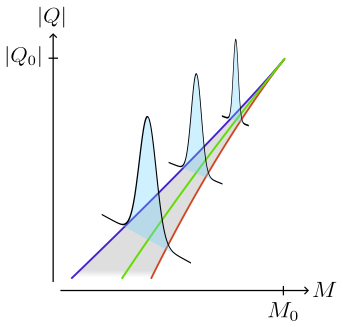
On its own terms, the paper's discovery is that the near-horizon fluctuations of the ultracold Reissner-Nordström de Sitter black hole are described by the near-flat dilaton gravity model $S = \frac{1}{16\pi G_N}\int d^2x \sqrt{-g}\left(\phi R + 2 - |\log q|\phi^2\right)$, and that the correct quantization is obtained by treating the discrete shift $p\to p+2\pi$ of the flat Hamiltonian $H=\sqrt{2\ell}\cos p$ as a gauge redundancy. Gauging discretizes the conjugate wormhole length $\ell$ into integers, and the Schrödinger problem becomes the three-term recurrence of Hermite polynomials, whose orthogonality yields the Gaussian spectral density $\rho(E)=\exp\left(-\frac{64G_4}{\delta_{Q^2}^2}E^2\right)$ and the partition function $Z(\beta)=\int_{-\infty}^{\infty} dE\,\exp\left(-\frac{64G_4}{\delta_{Q^2}^2}E^2-\beta E\right)$. This makes the thermal ensemble finite, with positive heat capacity and an essential singularity at $T=0$, and it suppresses high-energy states that would fall outside the four-dimensional sharkfin diagram and hence create naked singularities.
Load-bearing premise
The load-bearing premise is that the discrete shift symmetry p to p+2π of the near-flat Hamiltonian should be treated as a gauge redundancy rather than as a real symmetry; this step is imported from sine dilaton gravity and double-scaled SYK by analogy, not derived from the four-dimensional reduction or from the two-dimensional path integral.
Editorial extensions
If this is right
- The thermal partition function of the dominant near-ultracold fluctuations is finite for all positive $\beta$, with positive heat capacity, resolving the divergence and negative-heat-capacity problems of flat JT gravity and of its first subleading correction.
- At low temperature the partition function has an essential singularity at $T=0$, so the low-temperature expansion is non-perturbative in $G_4$, in sharp contrast to the cold and Nariai regimes.
- The wormhole length is quantized with spacing $\Delta L = \sqrt{\frac{8}{|\delta_{Q^2}|}}\frac{G_4}{\Phi_0^2}\hbar$, which grows as the solution approaches the ultracold point.
- The Gaussian suppression of high energies acts as a dynamical cosmic-censorship mechanism: states that would move outside the sharkfin and create naked singularities are removed from the Hilbert space.
- The final partition function coincides with the large-$N$ limit of an $O(N)^2\times O(2)$ fermionic matrix model, giving a concrete many-body realization of the black hole sector.
Reading between the lines
- Beyond the paper: the gauging mechanism may be a general template for quantizing any triple-horizon coincidence limit, since the universality argument in Section 9 treats any three-root metric with slowly varying prefactors and yields the same near-flat model.
- Beyond the paper: the equivalence with the $O(N)^2\times O(2)$ matrix model suggests a concrete numerical test—simulate that model at large $N$ and check whether its low-temperature free energy grows as $-1/T$ with the coefficient fixed by $\delta_{Q^2}/G_4$.
- Beyond the paper: the essential singularity at $T=0$ implies that perturbative one-loop calculations around the ultracold saddle are inherently ambiguous; the disagreements among $Z\sim T^6$, $Z\sim T^{3/2}$, and $Z\sim T^2$ quoted in the paper may reflect the absence of a perturbative regime rather than mere calculational error.
- Beyond the paper: if the gauging is interpreted as a choice of ensemble, quantum cosmic censorship may be understood not as a new dynamical force but as a boundary condition that selects which fluctuations are physical.
Editorial analysis
A structured set of objections, weighed in public.
Referee Report
Summary. The paper proposes a quantum description of the near-ultracold Reissner-Nordström de Sitter black hole. Starting from the four-dimensional Einstein-Maxwell action, the authors perform a spherical dimensional reduction and obtain, after a near-ultracold expansion, a two-dimensional dilaton gravity model with potential V(ϕ)=2−|logq|ϕ^2 (Eq. (2.58)). They argue that the leading flat-JT limit has a Hagedorn spectrum and divergent partition function, that the quadratic correction breaks the degeneracy but still yields an unbounded Hamiltonian, and that a consistent quantization requires gauging the discrete shift symmetry p→p+2π of the near-flat Hamiltonian H_flat=√(2ℓ)cos p (Section 6). This gauging leads to a Gaussian spectral density ρ(E)=e^{-E^2}, a convergent partition function Z(β)=∫ dE exp(−64G4/δ_Q^2 E^2) e^{−βE} (Eq. (8.1)), a discretized wormhole length with spacing (8.4), an essential singularity at T=0, and a dynamical suppression of states interpreted as quantum cosmic censorship. The model is embedded in sine dilaton gravity and double-scaled SYK in Section 7.
Significance. If the central quantization proposal is correct, the paper provides a rare solvable quantum-gravity description of a triple-horizon black hole, with explicit, falsifiable predictions: the Gaussian partition function (8.1), the low-temperature essential singularity (8.2), the discrete wormhole-length spacing (8.4), and a concrete holographic screen at r_holo = r_+ + i∞ (7.12). The dimensional reduction in Section 2 is careful and the classical dictionary between the 2d dilaton model and the 4d parameters is worked out in detail, including the sharkfin bijection in Appendix A. The authors are also transparent about the limits of their derivation, explicitly stating in Section 6 that the gauging is proposed and in Section 8 that the semi-classical bulk understanding is not fully clear. However, the decisive quantization step is not derived from the four-dimensional or two-dimensional theory but imported by analogy from sine dilaton gravity and DSSYK, and the final parameter conversion contains apparent algebraic inconsistencies. The significance is therefore conditional on resolving these load-bearing issues.
major comments (3)
- [Section 6, Eqs. (5.27)–(5.33) and (6.1)–(6.5)] The discrete shift symmetry p→p+2π that is gauged in Section 6 is an exact symmetry of the two-sided Hamiltonian (5.28) only for the quadratic dilaton potential V(ϕ)=2−|logq|ϕ^2. The exact dimensionally reduced potential (2.43) contains higher-order terms in ϕ; once those are included, the prepotential W(ϕ) in Eq. (3.18) is no longer the cubic used in (5.27), and the resulting Hamiltonian is not periodic in the momentum. The paper itself acknowledges in Section 7.2 that these higher-order corrections were neglected and that the sine dilaton embedding is 'particularly natural' rather than a derivation. Because the Gaussian density (6.5) and the final partition function (8.1) depend entirely on this gauging, the central claim is currently a conjecture. The authors should either derive the gauging from a symmetry of the full reduced action, or quantify the corrections from the omitted terms and specify the order of limits between the |logq|→0 expansion and the gauge quotient.
- [Section 6, Eq. (6.12), and Section 8, Eqs. (8.1) and (8.4)] The conversion from the two-dimensional spectral density to the four-dimensional partition function appears inconsistent with the stated dictionary. In (5.27)–(5.28) the Hamiltonian H is defined as 8πG_N times the ADM energy, so the Gaussian exponent in (6.5) is −(8πG_N E_ADM)^2. Using E_ADM from (4.7), together with a=2/(αΦ0) (5.19), G_N=G4/(4πΦ0^2α) (2.52), and α=|logq|Φ0^2 (2.57), gives a coefficient in the ϕ_h exponent of −δQ^4 α^2/(16Φ0^2) (equivalently −4G4^2/(Φ0^4α^2) E_ADM^2), not the −ϕ_h^2/(4πG_N) written in (6.12) nor the −64G4/δQ^2 E^2 in (8.1). Similarly, the first equality in (8.4), ΔL=8πG_N|logq|^{1/2}, evaluates with the given dictionary to 2G4/(Φ0^4|logq|^{1/2}) = 2√2 G4/(Φ0^2√|δQ^2|), not √(8|δQ^2|G4/Φ0^2). Unless a different definition of the 4d energy E is intended, the quantitative predictions (8.1)–(8.4) need to be recalculated.
- [Section 8, 'Cosmic censorship' paragraph] The interpretation that the Gaussian spectral density dynamically enforces cosmic censorship is not quantitatively tied to the classical sharkfin bound. The classical bound in the 2d model is |E| ≤ sqrt(8/(9|logq|)) from (5.8), while the Gaussian width in (6.13)/(8.5) is a different function of δQ^2 and G4; no derivation shows that the suppression scale coincides with the boundary beyond which naked singularities appear. The paper refers to an 'approximate version' of quantum cosmic censorship, but the argument would be substantially stronger if the Gaussian width were matched to the sharkfin boundary using the dictionary (5.14)/(5.18). As it stands, the censorship claim is qualitative.
minor comments (6)
- [Abstract and Section 7] The abstract describes the result as coming from 'a specific flat space limit of the double-scaled SYK model', but the explicit embedding in Section 7 is a limit of sine dilaton gravity; the precise logical relation between these two statements should be stated in the introduction to avoid confusion.
- [Section 5.3, Eq. (5.27)] The notation H=8πG_N H in (5.27) is very confusing because the same symbol H is used for the ADM energy and for the dimensionless combination; please introduce distinct symbols (for example E and 𝓔) and use them consistently through Sections 5, 6 and 8.
- [References] Reference [79] is listed as 'work in progress (2026)'; this is not a standard citation and should be either replaced by a named reference or removed.
- [Section 9] The text contains a formatting artifact in 'Inönü-Wigner' (rendered as '˙In¨on¨u-Wigner'); please correct all such typographical issues in the final version.
- [Figure 1] The caption of Figure 1 is too terse: it does not define the sharkfin diagram or identify which density of states is being compared to it; a more explicit caption would improve readability.
- [Section 7.2, Eq. (7.9)] The solution ϕ(ρ)=π/2+i log(ρ+i cos ϕ_h) is complex; please clarify the chosen branch and the reality/convergence conditions under which this defines a valid holographic boundary.
Circularity Check
Final Gaussian spectrum is imported from the authors' sine-dilaton/DSSYK machinery; the 4d reduction fixes the parameter dictionary but not the gauged quantization.
-
ansatz smuggled in via citation
[Section 7.1, after Eq. (7.5); gauging introduced in Section 6]
"The spectral density (6.5), which was our final proposal for the quantization of the near-flat dilaton model, comes directly from the flat space limit (7.3) of gauged sine dilaton gravity (or DSSYK) spectral density (7.5)."
The Gaussian spectral density (6.5) is the central input for the final partition function (8.1), and the paper states that it comes directly from the flat-space limit of gauged sine dilaton gravity/DSSYK, a framework developed in refs. [30–32] with overlapping authorship. The 4d reduction in Section 2.2 yields the quadratic dilaton action (2.58); the exact reduced potential (2.43) is not periodic, and the p -> p+2π symmetry invoked for the gauging is exact only for the truncated Hamiltonian (5.33). Thus the gauging is an ansatz imported via citation rather than a consequence of Einstein–Maxwell reduction, and the Gaussian suppression—and hence Z(β)—is inherited, not independently derived.
-
self citation load bearing
[Section 1, Introduction, paragraph after Eq. (1.1)]
"Moreover, the gravitational dual of the double-scaled SYK model has recently been established at the disk level in terms of a dilaton model with a sine potential [30–32], providing a new and powerful perspective on these questions. Indeed, we show in this work that sine dilaton gravity can act as a similar gravitational bridge, connecting higher-dimensional black holes in de Sitter space and the double-scaled SYK model."
The bridge between the 4d black hole and the final quantum model is sine dilaton gravity, and the sine-dilaton/DSSYK correspondence is cited to the authors' own previous work [30–32]. The final quantization—gauging p -> p+2π and the resulting q-Hermite discretization—is precisely the quantization of sine dilaton gravity developed in those papers. Since [30–32] include two of the present authors, the central construction is justified by a self-citation chain rather than by an independent derivation from Einstein–Maxwell theory; without that chain the 'novel quantization' has no independent source.
full rationale
The paper contains no fitted-parameter circularity: the dictionary (2.52)-(2.57), (5.14) is a parameter identification rather than a fit, and Z(β) is not tested against data. The dimensional reduction of RNdS4 to (2.58) is self-contained and appears consistent within its stated approximations. However, the central quantization step is not derived from that reduction. The gauging of p -> p+2π is proposed in Section 6 and then stated in Section 7.1 to come 'directly from the flat space limit of gauged sine dilaton gravity (or DSSYK)', a framework established in refs. [30–32] by overlapping authors. The exact 4d-reduced potential (2.43) is not periodic, so the discrete shift symmetry is exact only for the quadratic truncation (5.1)/(5.33); importing the gauging therefore imports the Gaussian spectral density and the discrete length spacing. This is a self-citation load-bearing step: the black-hole side supplies the parameter dictionary, while the quantum content is inherited from the same authors' sine-dilaton/DSSYK model. The internal Hermite-polynomial derivation of (6.5) from (6.1) is mathematically consistent, but (6.1) itself is an adopted ansatz, not a consequence of Einstein–Maxwell theory. The paper is transparent about the provenance, noting that Z(β) already appeared in [37] as a toy model, which is a mitigating factor, but the main 'prediction' nonetheless reduces to previously constructed DSSYK/sine-dilaton machinery. Hence a moderate-to-partial circularity score of 6.
Assumptions & free parameters
free parameters (2)
- ϕ_0 =
3δ_Q²/4
- α =
-(δ_Q² - 9δ_Q⁴/16)/(2Φ_0⁴) ≈ -δ_Q²/(2Φ_0⁴)
assumptions (4)
- domain assumption The s-wave sector dominates the near-horizon dynamics, justifying dimensional reduction to 2d dilaton gravity
- domain assumption The near-ultracold hierarchy |δ| << λ << r_0 holds
- ad hoc to paper The p → p+2π shift symmetry of H_flat should be promoted to a gauge symmetry
- domain assumption The DSSYK/sine dilaton gravity duality is valid, including the gauged quantization
Cite this review
Pith. "Pith review of Quantum gravity around ultracold black holes from DSSYK." pith.science (2026). https://pith.science/paper/MFIDOXGL
@misc{pith2026260804745,
  author       = {Pith},
  title        = {Pith review of: Quantum gravity around ultracold black holes from DSSYK},
  year         = {2026},
  howpublished = {\url{https://pith.science/paper/MFIDOXGL}},
  note         = {Machine review of arXiv:2608.04745}
}
read the original abstract
We propose a quantum description of the ultracold Reissner-Nordstr\"om de Sitter black hole via a specific flat space limit of the double-scaled SYK model. Fluctuations in this regime reduce to flat JT gravity, which is ill-behaved as a quantum system. We show that including the first subleading correction to the dilaton potential breaks the leading order Hagedorn degeneracy but does not resolve the structural problem. Finally, we leverage the gauged description of the sine dilaton gravity model to propose a novel quantization of the near-horizon dynamics of ultracold black holes. This leads to a new proposal for the partition function where states in the asymptotics of the spectrum are suppressed dynamically, and features of a discretized spacetime arise. We obtain a non-perturbative low temperature behavior of the partition function, which is quite different than the cold and Nariai physics. Our result can be interpreted as a dynamical way to enforce cosmic censorship on the quantum system.
Figures


Figures from the paper (5 more)


Reference graph
Works this paper leans on
-
[37]
Quantum gravity of the Heisenberg algebra,
A. Almheiri, A. Goel, and X.-Y. Hu, “Quantum gravity of the Heisenberg algebra,” JHEP08(2024) 098,arXiv:2403.18333 [hep-th]
arXiv 2024
-
[52]
On the phase of the de Sitter density of states,
Y. Chen, D. Stanford, H. Tang, and Z. Yang, “On the phase of the de Sitter density of states,”JHEP05(2026) 068,arXiv:2511.01400 [hep-th]
arXiv 2026
-
[80]
P. Arnaudo, G. Bonelli, and A. Tanzini, “One loop corrections to the thermodynamics of near-extremal Kerr-(A)dS black holes from Heun equation,” JHEP12(2025) 018,arXiv:2506.08959 [hep-th]
arXiv 2025
-
[81]
Flat JT gravity and the BMS-Schwarzian,
H. Afshar and B. Oblak, “Flat JT gravity and the BMS-Schwarzian,”JHEP11 (2022) 172,arXiv:2112.14609 [hep-th]
arXiv 2022
-
[1]
The statistical mechanics of near-extremal black holes,
L. V. Iliesiu and G. J. Turiaci, “The statistical mechanics of near-extremal black holes,”JHEP05(2021) 145,arXiv:2003.02860 [hep-th]
arXiv 2021
-
[2]
The statistical mechanics of near-BPS black holes,
M. Heydeman, L. V. Iliesiu, G. J. Turiaci, and W. Zhao, “The statistical mechanics of near-BPS black holes,”J. Phys. A55no. 1, (2022) 014004,arXiv:2011.01953 [hep-th]. 30 The factordϕ 2{dr2 is included sinceVprqtransforms like a metric component not a polynomial, however since the discriminate is homogeneous under rescaling this does not effect the argume...
arXiv 2022
-
[3]
Thermodynamics of the near-extremal Kerr spacetime,
I. Rakic, M. Rangamani, and G. J. Turiaci, “Thermodynamics of the near-extremal Kerr spacetime,”JHEP06(2024) 011,arXiv:2310.04532 [hep-th]
arXiv 2024
-
[4]
Logarithmic Corrections to Kerr Thermodynamics,
D. Kapec, A. Sheta, A. Strominger, and C. Toldo, “Logarithmic Corrections to Kerr Thermodynamics,”Phys. Rev. Lett.133no. 2, (2024) 021601,arXiv:2310.00848 [hep-th]
arXiv 2024
Show all 106 references
-
[5]
Lower Dimensional Gravity,
R. Jackiw, “Lower Dimensional Gravity,”Nucl. Phys. B252(1985) 343–356
1985
-
[6]
Gravitation and Hamiltonian Structure in Two Space-Time Dimensions,
C. Teitelboim, “Gravitation and Hamiltonian Structure in Two Space-Time Dimensions,”Phys. Lett. B126(1983) 41–45
1983
-
[7]
Solvable Models of Quantum Black Holes: A Review on Jackiw-Teitelboim Gravity,
T. G. Mertens and G. J. Turiaci, “Solvable Models of Quantum Black Holes: A Review on Jackiw-Teitelboim Gravity,”arXiv:2210.10846 [hep-th]
-
[8]
Chaos in AdS 2 Holography,
K. Jensen, “Chaos in AdS 2 Holography,”Phys. Rev. Lett.117no. 11, (2016) 111601, arXiv:1605.06098 [hep-th]
2016 arXiv
-
[9]
Conformal symmetry and its breaking in two dimensional Nearly Anti-de-Sitter space,
J. Maldacena, D. Stanford, and Z. Yang, “Conformal symmetry and its breaking in two dimensional Nearly Anti-de-Sitter space,”PTEP2016no. 12, (2016) 12C104, arXiv:1606.01857 [hep-th]
2016 arXiv
-
[10]
An investigation of AdS2 backreaction and holography,
J. Engels¨ oy, T. G. Mertens, and H. Verlinde, “An investigation of AdS2 backreaction and holography,”JHEP07(2016) 139,arXiv:1606.03438 [hep-th]
2016 arXiv
-
[11]
Fermionic Localization of the Schwarzian Theory,
D. Stanford and E. Witten, “Fermionic Localization of the Schwarzian Theory,” JHEP10(2017) 008,arXiv:1703.04612 [hep-th]
2017 arXiv
-
[12]
Solving the Schwarzian via the Conformal Bootstrap,
T. G. Mertens, G. J. Turiaci, and H. L. Verlinde, “Solving the Schwarzian via the Conformal Bootstrap,”JHEP08(2017) 136,arXiv:1705.08408 [hep-th]
2017 arXiv
-
[13]
Sachdev–Ye–Kitaev model as Liouville quantum mechanics,
D. Bagrets, A. Altland, and A. Kamenev, “Sachdev–Ye–Kitaev model as Liouville quantum mechanics,”Nucl. Phys. B911(2016) 191–205,arXiv:1607.00694 [cond-mat.str-el]
2016 arXiv
-
[14]
The Quantum Gravity Dynamics of Near Extremal Black Holes,
Z. Yang, “The Quantum Gravity Dynamics of Near Extremal Black Holes,”JHEP05 (2019) 205,arXiv:1809.08647 [hep-th]
2019 arXiv
-
[15]
The Schwarzian Theory - A Wilson Line Perspective,
A. Blommaert, T. G. Mertens, and H. Verschelde, “The Schwarzian Theory - A Wilson Line Perspective,”JHEP12(2018) 022,arXiv:1806.07765 [hep-th]
2018 arXiv
-
[16]
An exact quantization of Jackiw-Teitelboim gravity,
L. V. Iliesiu, S. S. Pufu, H. Verlinde, and Y. Wang, “An exact quantization of Jackiw-Teitelboim gravity,”JHEP11(2019) 091,arXiv:1905.02726 [hep-th]
2019 arXiv
-
[17]
The evaporation of charged black holes,
A. R. Brown, L. V. Iliesiu, G. Penington, and M. Usatyuk, “The evaporation of charged black holes,”JHEP01(2026) 109,arXiv:2411.03447 [hep-th]. 46
2026 arXiv
-
[18]
The evaporation of black holes in supergravity,
G. Lin, L. V. Iliesiu, and M. Usatyuk, “The evaporation of black holes in supergravity,”JHEP08(2025) 220,arXiv:2504.21077 [hep-th]
2025 arXiv
-
[19]
Quantum-corrected Hawking radiation from near-extremal Kerr-Newman black holes,
S. Maulik, X. Meng, and L. A. Pando Zayas, “Quantum-corrected Hawking radiation from near-extremal Kerr-Newman black holes,”JHEP02(2026) 205, arXiv:2501.08252 [hep-th]
2026
-
[20]
Quantum cross-section of near-extremal black holes,
R. Emparan, “Quantum cross-section of near-extremal black holes,”JHEP04(2025) 122,arXiv:2501.17470 [hep-th]
2025 arXiv
-
[21]
Following the state of an evaporating charged black hole into the quantum gravity regime,
A. Biggs, “Following the state of an evaporating charged black hole into the quantum gravity regime,”arXiv:2503.02051 [hep-th]
-
[22]
Quantum transparency of near-extremal black holes,
R. Emparan and S. Trezzi, “Quantum transparency of near-extremal black holes,” JHEP10(2025) 023,arXiv:2507.03398 [hep-th]
2025
-
[23]
Near-extremal quantum cross-section for charged fields and superradiance,
P. Betzios, O. Papadoulaki, and Y. Zhou, “Near-extremal quantum cross-section for charged fields and superradiance,”JHEP11(2025) 114,arXiv:2507.13896 [hep-th]
2025
-
[24]
A simple model of quantum holography
A. Kitaev, “A simple model of quantum holography.” http://online.kitp.ucsb.edu/online/entangled15/kitaev/,http: //online.kitp.ucsb.edu/online/entangled15/kitaev2/, 2015
2015
-
[25]
Remarks on the Sachdev-Ye-Kitaev model,
J. Maldacena and D. Stanford, “Remarks on the Sachdev-Ye-Kitaev model,”Phys. Rev. D94no. 10, (2016) 106002,arXiv:1604.07818 [hep-th]
2016 arXiv
-
[26]
The soft mode in the Sachdev-Ye-Kitaev model and its gravity dual,
A. Kitaev and S. J. Suh, “The soft mode in the Sachdev-Ye-Kitaev model and its gravity dual,”JHEP05(2018) 183,arXiv:1711.08467 [hep-th]
2018 arXiv
-
[27]
Chord diagrams, exact correlators in spin glasses and black hole bulk reconstruction,
M. Berkooz, P. Narayan, and J. Simon, “Chord diagrams, exact correlators in spin glasses and black hole bulk reconstruction,”JHEP08(2018) 192,arXiv:1806.04380 [hep-th]
2018 arXiv
-
[28]
Towards a full solution of the large N double-scaled SYK model,
M. Berkooz, M. Isachenkov, V. Narovlansky, and G. Torrents, “Towards a full solution of the large N double-scaled SYK model,”JHEP03(2019) 079, arXiv:1811.02584 [hep-th]
2019 arXiv
-
[29]
The bulk Hilbert space of double scaled SYK,
H. W. Lin, “The bulk Hilbert space of double scaled SYK,”JHEP11(2022) 060, arXiv:2208.07032 [hep-th]
2022 arXiv
-
[30]
The dilaton gravity hologram of double-scaled SYK,
A. Blommaert, T. G. Mertens, and J. Papalini, “The dilaton gravity hologram of double-scaled SYK,”JHEP06(2025) 050,arXiv:2404.03535 [hep-th]
2025 arXiv
-
[31]
An entropic puzzle in periodic dilaton gravity and DSSYK,
A. Blommaert, A. Levine, T. G. Mertens, J. Papalini, and K. Parmentier, “An entropic puzzle in periodic dilaton gravity and DSSYK,”JHEP07(2025) 093, arXiv:2411.16922 [hep-th]. 47
2025 arXiv
-
[32]
Wormholes, branes and finite matrices in sine dilaton gravity,
A. Blommaert, A. Levine, T. G. Mertens, J. Papalini, and K. Parmentier, “Wormholes, branes and finite matrices in sine dilaton gravity,”JHEP09(2025) 123, arXiv:2501.17091 [hep-th]
2025
-
[33]
Supersymmetric, cold and lukewarm black holes in cosmological Einstein-Maxwell theory,
L. J. Romans, “Supersymmetric, cold and lukewarm black holes in cosmological Einstein-Maxwell theory,”Nucl. Phys. B383(1992) 395–415, arXiv:hep-th/9203018
1992 arXiv
-
[34]
Cosmological production of charged black hole pairs,
R. B. Mann and S. F. Ross, “Cosmological production of charged black hole pairs,” Phys. Rev. D52(1995) 2254–2265,arXiv:gr-qc/9504015
1995 arXiv
-
[35]
Cosmological pair production of charged and rotating black holes,
I. S. Booth and R. B. Mann, “Cosmological pair production of charged and rotating black holes,”Nucl. Phys. B539(1999) 267–306,arXiv:gr-qc/9806056
1999 arXiv
-
[36]
Gravitational dynamics of near-extreme Kerr (Anti-)de Sitter black holes,
F. Mariani and C. Toldo, “Gravitational dynamics of near-extreme Kerr (Anti-)de Sitter black holes,”JHEP02(2026) 052,arXiv:2505.02674 [hep-th]
2026 arXiv
-
[38]
Cosmological pair creation of charged and rotating black holes,
I. S. N. Booth and R. B. Mann, “Cosmological pair creation of charged and rotating black holes,” in7th Canadian Conference on General Relativity and Relativistic Astrophysics (CCGRRA 7). 6, 1997.arXiv:gr-qc/9711038
1997 arXiv
-
[39]
Action Integrals and Partition Functions in Quantum Gravity,
G. W. Gibbons and S. W. Hawking, “Action Integrals and Partition Functions in Quantum Gravity,”Phys. Rev. D15(1977) 2752–2756
1977
-
[40]
The minus sign in the first law of de Sitter horizons,
B. Banihashemi, T. Jacobson, A. Svesko, and M. Visser, “The minus sign in the first law of de Sitter horizons,”JHEP01(2023) 054,arXiv:2208.11706 [hep-th]
2023 arXiv
-
[41]
de Sitter Black Holes, Schottky Peaks, and Continuous Heat Engines,
C. V. Johnson, “de Sitter Black Holes, Schottky Peaks, and Continuous Heat Engines,”arXiv:1907.05883 [hep-th]
1907 arXiv
-
[42]
On the Euclidean action of de Sitter black holes and constrained instantons,
E. K. Morvan, J. P. van der Schaar, and M. R. Visser, “On the Euclidean action of de Sitter black holes and constrained instantons,”SciPost Phys.14no. 2, (2023) 022, arXiv:2203.06155 [hep-th]
2023 arXiv
-
[43]
Action, entropy and pair creation rate of charged black holes in de Sitter space,
E. K. Morvan, J. P. van der Schaar, and M. R. Visser, “Action, entropy and pair creation rate of charged black holes in de Sitter space,”JHEP08(2024) 207, arXiv:2212.12713 [hep-th]
2024 arXiv
-
[44]
P. F. Byrd and M. D. Friedman,Handbook of Elliptic Integrals for Engineers and Physicists, vol. 67 ofGrundlehren der mathematischen Wissenschaften. Springer-Verlag, Berlin, 1954
1954
-
[45]
On the Dynamics of Near-Extremal Black Holes,
P. Nayak, A. Shukla, R. M. Soni, S. P. Trivedi, and V. Vishal, “On the Dynamics of Near-Extremal Black Holes,”JHEP09(2018) 048,arXiv:1802.09547 [hep-th]. 48
2018 arXiv
-
[46]
An Attractor mechanism for nAdS 2/nCFT1 holography,
F. Larsen, “An Attractor mechanism for nAdS 2/nCFT1 holography,”JHEP04 (2019) 055,arXiv:1806.06330 [hep-th]
2019 arXiv
-
[47]
Near-AdS2 Spectroscopy: Classifying the Spectrum of Operators and Interactions in N=2 4D Supergravity,
A. Castro and E. Verheijden, “Near-AdS2 Spectroscopy: Classifying the Spectrum of Operators and Interactions in N=2 4D Supergravity,”Universe7no. 12, (2021) 475, arXiv:2110.04208 [hep-th]
2021 arXiv
-
[48]
Near-extremal limits of de Sitter black holes,
A. Castro, F. Mariani, and C. Toldo, “Near-extremal limits of de Sitter black holes,” JHEP07(2023) 131,arXiv:2212.14356 [hep-th]
2023 arXiv
-
[49]
Quantum hair on black holes,
S. R. Coleman, J. Preskill, and F. Wilczek, “Quantum hair on black holes,”Nucl. Phys. B378(1992) 175–246,arXiv:hep-th/9201059
1992 arXiv
-
[50]
Duality between electric and magnetic black holes,
S. W. Hawking and S. F. Ross, “Duality between electric and magnetic black holes,” Phys. Rev. D52(1995) 5865–5876,arXiv:hep-th/9504019
1995 arXiv
-
[51]
Complexity of Jackiw-Teitelboim gravity,
A. R. Brown, H. Gharibyan, H. W. Lin, L. Susskind, L. Thorlacius, and Y. Zhao, “Complexity of Jackiw-Teitelboim gravity,”Phys. Rev. D99no. 4, (2019) 046016, arXiv:1810.08741 [hep-th]
2019 arXiv
-
[53]
Probing the singularity at the holographic screen viaq-holography,
A. Belaey, T. G. Mertens, and J. Papalini, “Probing the singularity at the holographic screen viaq-holography,”arXiv:2507.13873 [hep-th]
-
[54]
Observables for two-dimensional black holes,
J. Gegenberg, G. Kunstatter, and D. Louis-Martinez, “Observables for two-dimensional black holes,”Phys. Rev. D51(1995) 1781–1786, arXiv:gr-qc/9408015
1995 arXiv
-
[55]
Two-dimensional quantum gravity in Minkowski space,
T. Banks and M. O’Loughlin, “Two-dimensional quantum gravity in Minkowski space,”Nucl. Phys. B362(1991) 649–664
1991
-
[56]
Deformations of JT Gravity and Phase Transitions,
E. Witten, “Deformations of JT Gravity and Phase Transitions,”arXiv:2006.03494 [hep-th]
2006 arXiv
-
[57]
The Factorization Problem in Jackiw-Teitelboim Gravity,
D. Harlow and D. Jafferis, “The Factorization Problem in Jackiw-Teitelboim Gravity,”JHEP02(2020) 177,arXiv:1804.01081 [hep-th]
2020 arXiv
-
[58]
Liouville quantum gravity – holography, JT and matrices,
T. G. Mertens and G. J. Turiaci, “Liouville quantum gravity – holography, JT and matrices,”JHEP01(2021) 073,arXiv:2006.07072 [hep-th]
2021 arXiv
-
[59]
From quantum groups to Liouville and dilaton quantum gravity,
Y. Fan and T. G. Mertens, “From quantum groups to Liouville and dilaton quantum gravity,”JHEP05(2022) 092,arXiv:2109.07770 [hep-th]
2022 arXiv
-
[60]
The Virasoro minimal string,
S. Collier, L. Eberhardt, B. M¨ uhlmann, and V. A. Rodriguez, “The Virasoro minimal string,”SciPost Phys.16no. 2, (2024) 057,arXiv:2309.10846 [hep-th]. 49
2024 arXiv
-
[61]
Complex Liouville String,
S. Collier, L. Eberhardt, B. M¨ uhlmann, and V. A. Rodriguez, “Complex Liouville String,”Phys. Rev. Lett.134no. 25, (2025) 251602,arXiv:2409.17246 [hep-th]
2025 arXiv
-
[62]
The path integral of 3D gravity near extremality; or, JT gravity with defects as a matrix integral,
H. Maxfield and G. J. Turiaci, “The path integral of 3D gravity near extremality; or, JT gravity with defects as a matrix integral,”JHEP01(2021) 118, arXiv:2006.11317 [hep-th]
2021 arXiv
-
[63]
Matrix Models and Deformations of JT Gravity,
E. Witten, “Matrix Models and Deformations of JT Gravity,”Proc. Roy. Soc. Lond. A476no. 2244, (2020) 20200582,arXiv:2006.13414 [hep-th]
2020 arXiv
-
[64]
Semi-classical dilaton gravity and the very blunt defect expansion,
J. Kruthoff and A. Levine, “Semi-classical dilaton gravity and the very blunt defect expansion,”JHEP07(2025) 211,arXiv:2402.10162 [hep-th]
2025 arXiv
-
[65]
Black hole thermodynamics and information loss in two-dimensions,
T. M. Fiola, J. Preskill, A. Strominger, and S. P. Trivedi, “Black hole thermodynamics and information loss in two-dimensions,”Phys. Rev. D50(1994) 3987–4014,arXiv:hep-th/9403137
1994 arXiv
-
[66]
Flat space holography and the complex Sachdev-Ye-Kitaev model,
H. Afshar, H. A. Gonz´ alez, D. Grumiller, and D. Vassilevich, “Flat space holography and the complex Sachdev-Ye-Kitaev model,”Phys. Rev. D101no. 8, (2020) 086024, arXiv:1911.05739 [hep-th]
2020 arXiv
-
[67]
Finite-cutoff JT gravity and self-avoiding loops,
D. Stanford and Z. Yang, “Finite-cutoff JT gravity and self-avoiding loops,” arXiv:2004.08005 [hep-th]
2004 arXiv
-
[68]
New boundary conditions for AdS 2,
V. Godet and C. Marteau, “New boundary conditions for AdS 2,”JHEP12(2020) 020,arXiv:2005.08999 [hep-th]
2020 arXiv
-
[69]
Comments on the thermodynamics of little string theory,
D. Kutasov and D. A. Sahakyan, “Comments on the thermodynamics of little string theory,”JHEP02(2001) 021,arXiv:hep-th/0012258
2001 arXiv
-
[71]
The q-Schwarzian and Liouville gravity,
A. Blommaert, T. G. Mertens, and S. Yao, “The q-Schwarzian and Liouville gravity,” JHEP11(2024) 054,arXiv:2312.00871 [hep-th]
2024 arXiv
-
[72]
Dynamical actions and q-representation theory for double-scaled SYK,
A. Blommaert, T. G. Mertens, and S. Yao, “Dynamical actions and q-representation theory for double-scaled SYK,”JHEP02(2024) 067,arXiv:2306.00941 [hep-th]
2024 arXiv
-
[73]
Sine-dilaton gravity vs double-scaled SYK: exploring one-loop quantum corrections,
L. Bossi, L. Griguolo, J. Papalini, L. Russo, and D. Seminara, “Sine-dilaton gravity vs double-scaled SYK: exploring one-loop quantum corrections,”JHEP06(2025) 152, arXiv:2411.15957 [hep-th]
2025 arXiv
-
[74]
Lectures on celestial amplitudes,
S. Pasterski, “Lectures on celestial amplitudes,”Eur. Phys. J. C81no. 12, (2021) 1062,arXiv:2108.04801 [hep-th]. 50
2021 arXiv
-
[75]
Carrollian physics and holography,
R. Ruzziconi, “Carrollian physics and holography,”Phys. Rept.1182(2026) 1–87, arXiv:2602.02644 [hep-th]
2026
-
[76]
Hagedorn Temperature in LargeNMajorana Quantum Mechanics,
G. Gaitan, I. R. Klebanov, K. Pakrouski, P. N. Pallegar, and F. K. Popov, “Hagedorn Temperature in LargeNMajorana Quantum Mechanics,”Phys. Rev. D101no. 12, (2020) 126002,arXiv:2002.02066 [hep-th]
2020 arXiv
-
[77]
A microscopic model of de Sitter spacetime with an observer,
D. Tietto and H. Verlinde, “A microscopic model of de Sitter spacetime with an observer,”arXiv:2502.03869 [hep-th]
-
[78]
Quantum corrections to the path integral of near extremal de Sitter black holes,
M. J. Blacker, A. Castro, W. Sybesma, and C. Toldo, “Quantum corrections to the path integral of near extremal de Sitter black holes,”JHEP08(2025) 120, arXiv:2503.14623 [hep-th]
2025 arXiv
-
[79]
work in progress (2026),
M. J. Blacker, F. Mariani, W. Sybesma, and C. Toldo, “work in progress (2026),”
2026
-
[82]
Fine Structure of Jackiw-Teitelboim Quantum Gravity,
A. Blommaert, T. G. Mertens, and H. Verschelde, “Fine Structure of Jackiw-Teitelboim Quantum Gravity,”JHEP09(2019) 066,arXiv:1812.00918 [hep-th]
2019 arXiv
-
[83]
A proposal for 3d quantum gravity and its bulk factorization,
T. G. Mertens, J. Sim´ on, and G. Wong, “A proposal for 3d quantum gravity and its bulk factorization,”arXiv:2210.14196 [hep-th]
-
[84]
Liouville bootstrap via harmonic analysis on a noncompact quantum group,
B. Ponsot and J. Teschner, “Liouville bootstrap via harmonic analysis on a noncompact quantum group,”arXiv:hep-th/9911110
-
[85]
R operator, coproduct and Haar measure for the modular double of U(q)(sl(2,R)),
A. G. Bytsko and J. Teschner, “R operator, coproduct and Haar measure for the modular double of U(q)(sl(2,R)),”Commun. Math. Phys.240(2003) 171–196, arXiv:math/0208191 [math-qa]
2003 arXiv
-
[86]
Representation of the quantum plane, its quantum double and harmonic analysis onGL ` qp2, Rq,
I. C.-H. Ip, “Representation of the quantum plane, its quantum double and harmonic analysis onGL ` qp2, Rq,”Selecta Mathematica New SeriesVol 19 (4)(2013) 987–1082,arXiv:1108.5365 [math.QA]
2013 arXiv
-
[87]
Grand Canonical vs Canonical Krylov Complexity in Double-Scaled Complex SYK Model,
S. Forste, Y. Kruse, and S. Natu, “Grand Canonical vs Canonical Krylov Complexity in Double-Scaled Complex SYK Model,”arXiv:2512.07715 [hep-th]
-
[88]
The DSSYK Model: Charge and Holography,
M. Arundine, “The DSSYK Model: Charge and Holography,” master thesis, 12, 2025. 51
2025
-
[89]
Quantum groups, non-commutative AdS 2, and chords in the double-scaled SYK model,
M. Berkooz, M. Isachenkov, M. Isachenkov, P. Narayan, and V. Narovlansky, “Quantum groups, non-commutative AdS 2, and chords in the double-scaled SYK model,”JHEP08(2023) 076,arXiv:2212.13668 [hep-th]
2023 arXiv
-
[90]
Quantum group origins of edge states in double-scaled SYK,
A. Belaey, T. G. Mertens, and T. Tappeiner, “Quantum group origins of edge states in double-scaled SYK,”JHEP02(2026) 184,arXiv:2503.20691 [hep-th]
2026
-
[91]
The von Neumann algebraic quantum group SUqp1,1q¸Z 2 and the DSSYK model,
K. Schouten and M. Isachenkov, “The von Neumann algebraic quantum group SUqp1,1q¸Z 2 and the DSSYK model,”arXiv:2512.10101 [math-ph]
-
[92]
Quantum symmetry and geometry in double-scaled SYK,
J. van der Heijden, E. Verlinde, and J. Xu, “Quantum symmetry and geometry in double-scaled SYK,”Journal of High Energy Physics2026no. 5, (May, 2026) 148
2026
-
[93]
On the contraction of groups and their representations,
E. Inonu and E. P. Wigner, “On the contraction of groups and their representations,” Proceedings of the National Academy of Sciences of the United States of America39 no. 6, (1953) 510–524
1953
-
[94]
JT gravity as a matrix integral,
P. Saad, S. H. Shenker, and D. Stanford, “JT gravity as a matrix integral,” arXiv:1903.11115 [hep-th]
1903 arXiv
-
[95]
JT gravity with matter, generalized ETH, and Random Matrices,
D. L. Jafferis, D. K. Kolchmeyer, B. Mukhametzhanov, and J. Sonner, “JT gravity with matter, generalized ETH, and Random Matrices,”arXiv:2209.02131 [hep-th]
-
[96]
Discrete analogue of the Weil-Petersson volume in double scaled SYK,
K. Okuyama, “Discrete analogue of the Weil-Petersson volume in double scaled SYK,”JHEP09(2023) 133,arXiv:2306.15981 [hep-th]
2023 arXiv
-
[97]
Cap Amplitudes in Random Matrix Models,
K. Okuyama, “Cap Amplitudes in Random Matrix Models,”PTEP2026no. 3, (2026) 033B06,arXiv:2509.03930 [hep-th]
2026 arXiv
-
[98]
The volume of the black hole interior at late times,
L. V. Iliesiu, M. Mezei, and G. S´ arosi, “The volume of the black hole interior at late times,”JHEP07(2022) 073,arXiv:2107.06286 [hep-th]
2022 arXiv
-
[99]
Fiducial observers and the thermal atmosphere in the black hole quantum throat,
T. G. Mertens, T. Tappeiner, and B. de S. L. Torres, “Fiducial observers and the thermal atmosphere in the black hole quantum throat,”JHEP04(2026) 145, arXiv:2507.20983 [hep-th]
2026 arXiv
-
[100]
Generalized dilaton gravity in 2d,
D. Grumiller, R. Ruzziconi, and C. Zwikel, “Generalized dilaton gravity in 2d,” SciPost Phys.12no. 1, (2022) 032,arXiv:2109.03266 [hep-th]
2022 arXiv
-
[101]
Gravity in two space-time dimensions,
T. Strobl, “Gravity in two space-time dimensions,” habilitation thesis, 5, 1999
1999
-
[102]
String Model with Dynamical Geometry and Torsion,
M. O. Katanaev and I. V. Volovich, “String Model with Dynamical Geometry and Torsion,”Phys. Lett. B175(1986) 413–416,arXiv:hep-th/0209014
1986 arXiv
-
[103]
Two-Dimensional Gravity with Dynamical Torsion and Strings,
M. O. Katanaev and I. V. Volovich, “Two-Dimensional Gravity with Dynamical Torsion and Strings,”Annals Phys.197(1990) 1. 52
1990
-
[104]
Exact solution of discrete two-dimensionalR 2 gravity,
V. A. Kazakov, M. Staudacher, and T. Wynter, “Exact solution of discrete two-dimensionalR 2 gravity,”Nucl. Phys. B471(1996) 309–333, arXiv:hep-th/9601069
1996 arXiv
-
[105]
Fractal Structure of 2D Quantum Gravity,
V. G. Knizhnik, A. M. Polyakov, and A. B. Zamolodchikov, “Fractal Structure of 2D Quantum Gravity,”Mod. Phys. Lett. A3(1988) 819
1988
-
[106]
QuantumR 2 gravity in two-dimensions,
H. Kawai and R. Nakayama, “QuantumR 2 gravity in two-dimensions,”Phys. Lett. B 306(1993) 224–232,arXiv:hep-th/9303006
1993 arXiv
-
[107]
I. M. Gelfand, M. M. Kapranov, and A. V. Zelevinsky,Discriminants, Resultants, and Multidimensional Determinants. Modern Birkh¨ auser Classics. Birkh¨ auser Boston, Boston, MA, 1 ed., 1994.https://doi.org/10.1007/978-0-8176-4771-1. 53
1994 doi
Reviewed August 6, 2026 · model on record in the stance chip above.
Discussion (0). Sign in to comment.