REVIEW 4 major objections 4 minor 69 references
Toward Temporal Causal Representation Learning with Tensor Decomposition
T0 review · 4 major / 4 minor · reviewed 2026-08-06 · deepseek-v4-flash
Pith's one-line read CaRTeD jointly learns latent phenotypes and their temporal causal network from irregular tensors, with convergence to a stationary point.
desk verdict CaRTeD is a genuinely new joint framework for temporal causal phenotyping from irregular tensors, but the main convergence theorem only covers a simplified consensus problem and Table 2 looks misreported. read the letter →
The pith
A machine-rendered reading of the paper's core claim, the machinery that carries it, and where it could break.
The reading
What carries the argument
The load-bearing object is the joint objective of Eq. (4): the PARAFAC2 reconstruction loss plus the dynamic-Bayesian-network least-squares term on the latent trajectories $\tilde U_k=U_kS_k$, with sparsity penalties and the differentiable acyclicity constraint $h(W)=\mathrm{tr}(e^{W\circ W})-d=0$. The optimization is carried out by block-coordinate descent with consensus ADMM inside each block; the nonconvex constraint $U_k=Q_kH$, $Q_k^\top Q_k=I$, is enforced by projecting onto the feasible set through an Orthogonal Procrustes step. The projection, together with Lipschitz smoothness of the quadratic subproblems and a coercivity argument, is what lets the proof conclude that every limit point is a stationary point.
What would settle it
Simulate a cohort made of two subgroups with opposite true causal directions (or one subgroup whose true $W$ changes partway through the visits), run CaRTeD, and check whether the recovered $W$ and $A^{(p)}$ match either subgroup's graph; a mixture or a high-FDR graph would falsify the shared-DBN premise.
Extended reading notes
Core claim
On the paper's own terms, the contribution is the joint objective of Eq. (4), in which the PARAFAC2 reconstruction loss $\sum_k \tfrac12\|X_k-U_kS_kV^\top\|_F^2$ is regularized by the causal least-squares term $\tfrac{1}{2I_k}\|U_kS_k-U_kS_kW-\sum_{p=1}^P U_k^{I_k-p}S_kA^{(p)}\|_F^2$, with $\ell^1$ penalties on $W$ and $A^{(p)}$ and the acyclicity constraint $h(W)=\mathrm{tr}(e^{W\circ W})-d=0$. The paper argues that solving this joint problem by alternating between the tensor block and the causal block recovers both the latent trajectories and the shared matrices $W$ and $\{A^{(p)}\}$ that define the contemporaneous and lagged causal phenotype network. The theorems show that the tensor block's consensus ADMM, despite the nonconvex PARAFAC2 constraint, produces a bounded sequence whose limit points are stationary points of the augmented Lagrangian, provided the penalty parameters are sufficiently large. In simulations the joint fit improves decomposition quality and causal graph recovery over a two-step baseline, and on the MIMIC-III electronic health records it yields clinically plausible edges such as hypertension preceding kidney disease.
Load-bearing premise
The load-bearing premise is that a single time-invariant Dynamic Bayesian Network with shared matrices $W$ and $A^{(p)}$ governs every patient's visit-indexed latent trajectory, so the recovered graph is not a well-defined temporal causal structure if the population is heterogeneous, the dynamics drift over time, or visits are irregularly spaced in real time.
Editorial extensions
If this is right
- A single run outputs both the phenotype membership matrix $V$ and the causal network $W$, $A^{(p)}$, so downstream tasks can read the causal structure directly from the tensor factors.
- The convergence proof transfers to other PARAFAC2-style decompositions with convex regularizers, giving a template for AO-ADMM algorithms on irregular tensors.
- Joint training improves tensor recovery (CPI, SIM, RR) and causal recovery (SHD, TPR, FDR) over the constrained PARAFAC2 and two-step structural-learning baselines, and the gap is largest when the patient cohort is small.
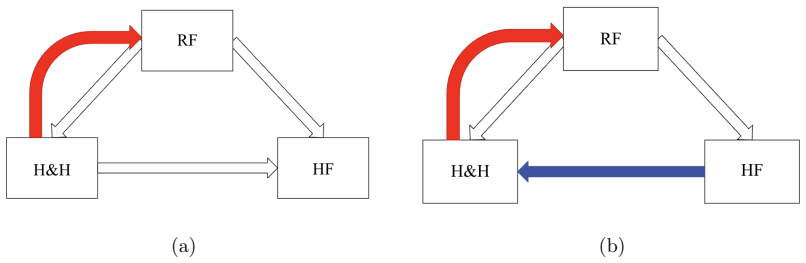
- On EHR data the method reproduces clinically interpretable phenotypes while adding causal edges consistent with the medical literature, such as hypertension driving kidney disease and heart failure driving respiratory failure.
- A warm-start initialization of $V$ markedly improves decomposition accuracy and computational efficiency.
Reading between the lines
- If the shared time-invariant DBN assumption fails, the recovered $W$ and $A^{(p)}$ should be read as population-level summaries rather than per-patient causal effects; a mixed-membership variant would be needed for heterogeneous cohorts.
- Because the time index is visit count rather than real clock time, patients with different inter-visit durations are treated as having the same lag structure, so a continuous-time extension of Eq. (3) would directly test whether the recovered $A^{(p)}$ is biased.
- The causal term acts as a smooth regularizer on $U_k$ and $S_k$, so part of the measured recovery gain may come from trajectory stabilization rather than causal identifiability; ablating the causal penalty while keeping the quadratic structure would separate those effects.
- The proof requires exact inner solves and sufficiently large penalties, so finite-iteration runs are only near-stationary; reporting ADMM residual norms at termination would give an empirical certificate for each run.
Editorial analysis
A structured set of objections, weighed in public.
Referee Report
Summary. The paper proposes CaRTeD, a joint framework that integrates temporal causal phenotype network learning with PARAFAC2-based irregular tensor decomposition. The model learns latent phenotype trajectories U_k S_k from irregular EHR-like tensors and simultaneously estimates a shared contemporaneous causal graph W and lagged graphs A(p) under a DAG constraint. The algorithm alternates between a PARAFAC2 block solved by consensus ADMM and a causal block solved by an aggregated ADMM with continuous acyclicity penalty. The main theoretical claim is that the tensor-block updates converge to a stationary point, which the authors state fills a gap in convergence guarantees for irregular tensor decomposition. Experiments on synthetic data and MIMIC-III are reported, with comparisons against COPA and a two-step DBN approach.
Significance. If the central claims were fully established, the paper would contribute a useful integration of two previously separate lines of work: score-based temporal causal discovery and constrained PARAFAC2 decomposition. The availability of public code and the framing of downstream tasks (phenotyping plus causal network recovery) are strengths, and a rigorous convergence result for AO-ADMM under the nonconvex PARAFAC2 constraint would indeed be a valuable addition to the tensor-decomposition literature. However, the convergence guarantee as written applies to a surrogate problem rather than the original objective, and the experimental record contains anomalies that weaken the empirical claims. The significance of the contribution is therefore conditional on repairing the theoretical argument and cleaning up the reported results.
major comments (4)
- [§4.2, Theorem 2 and Eq. (34)] The central convergence claim is not established for the problem the paper actually solves. Theorem 2 states only that every limit point of {(U_t, \hat U_t, \mu_t)} is a stationary point of the augmented Lagrangian L(U,\hat U,\mu) of the one-auxiliary consensus problem (34). It does not prove stationarity for the original objective (4); a primal-feasibility or equivalence argument connecting the consensus problem back to Eq. (4) is absent. In addition, the proof analyzes a different formulation than the algorithm: Eq. (7) introduces two auxiliary variables \tilde U_k and \hat U_k, while Eq. (34) and Theorem 2 use only \hat U_k. In the proof of Lemma 5, the multiplier \mu^{(t+1)}_{\tilde U_k} is used inside a Lagrangian L that contains only \mu_{\hat U_k}, so the subgradient bound is not derived for the analyzed model. Consequently, the abstract's and Section 4's assertion that the algorithm converges to a stationary point of the joint objective is not supported by the supplied argument.
- [§4.1–4.2, Lemmas 3–5 and Theorem 1] The convergence statements are conditional on hypotheses that are never tied to the implemented algorithm. Lemmas 3 and Theorem 1 require 'sufficiently large' penalty parameters, and Lemma 5 requires exact inner solves in the limit, but the implementation sets \rho_{u_k} and \rho_{s_k} through Eq. (28), grows \rho_1 and \rho_2 through Eq. (32), and adopts the heuristic stopping criterion of Roald et al. without verifying Lemma 3's condition \rho_k \gamma_k(\rho_k) \ge 2L_k^2 or any exact-solve condition. The claim that Theorem 2.4 of Hong et al. applies is also asserted rather than demonstrated, since the required assumptions are stated to be 'verified' without verification. The theoretical guarantee is therefore conditional in a way that is not discharged by the paper.
- [§5.4, Table 2] The reported noise-level experiment is not credible as presented. For CaRTeD, the CPI, SIM, and RR values are identical to three decimals for noise levels 0.10, 0.25, 0.50, and 1.00; for W-CaRTeD the SIM and RR rows are identical across all nonzero noise levels and the CPI values differ only in the third decimal. Since Section 5.4 states that the noise level is varied over these values, one would expect at least small differences in the recovery metrics. This suggests either that the noise was not incorporated into the data generation or that the reported numbers are insensitive to the data in an unexplained way. Either way, the claim of stable performance under noise and the comparison with COPA are weakened.
- [§6, application text and Table 4] The prose states that DDBN 'fails to produce any inter-slice edges', but Table 4 reports nonzero TPR values (0.25–0.375) and nonzero SHD values for DDBN on the inter-slice network. This is an internal inconsistency in the experimental reporting, and it makes the qualitative comparison in that paragraph difficult to interpret.
minor comments (4)
- [§2.4] There is a typo: 'separetable' should be 'separable'. Also, the lag index in Eq. (3) is written inconsistently with the shift-matrix notation introduced later in Eq. (12); please align the notation for \tilde U^{(i)}_k and M_i.
- [§5.4, Table 4] If DDBN truly produces no inter-slice edges, the TPR and SHD entries in Table 4 would be 0 and the edge-count of the true graph, respectively; please correct either the table or the text.
- [§6, Table 6] The description for ICD code 5859 contains a typo: 'chronic kidney diseased' should be 'chronic kidney disease'.
- [§7] The limitation that a single time-invariant DBN is assumed for all patients and all visit indices is acknowledged, but the paper does not offer any diagnostic or sensitivity check for this assumption. Given that the causal interpretation of W and A(p) depends on it, a brief empirical check (e.g., subgroup analysis) would strengthen the application.
Circularity Check
No material circularity: CaRTeD's joint objective and convergence theorem stand on their own; self-citations are peripheral and non-load-bearing.
full rationale
The paper's central derivation is a coupled optimization over tensor factors and DBN parameters. The causal residual in Eq. (4) acts both as a regularizer in the tensor block and as the fitting objective in the causal block, but this dual use is an intended joint-estimation fixed point rather than a reduction of the output to the input: W and A(p) are estimated from the latent trajectories, while the latent trajectories are estimated jointly with W and A(p) under the same objective. No fitted parameter is renamed as a prediction, and the synthetic evaluation inverts the paper's own generative model, which is standard practice and not circular. The convergence claim is an independent mathematical statement: Theorem 2 and its supporting lemmas (Lipschitz continuity, monotonic decrease, subgradient bound) do not presuppose the conclusion, though the proof's applicability to the implemented algorithm is questionable (e.g., the theorem analyzes the one-auxiliary consensus form (34) while Section 3.1 introduces two auxiliary variables, and the 'sufficiently large rho' and exact-solve conditions are not verified). Those are correctness concerns, not circularity. The authors cite their own earlier work [28,29,34] for motivation, penalty-parameter heuristics, and an ADMM aggregation strategy, but the load-bearing convergence analysis for the causal block is attributed to an external result (Ng et al. [40]), and the main theorem is proved in the paper; therefore no step of the derivation chain is forced by self-citation. Overall, the derivation is self-contained and no circular step can be exhibited from the text.
Assumptions & free parameters
free parameters (7)
- lambda_W =
0.5 (synthetic), 0.2 (MIMIC-III)
- lambda_A =
0.5 (synthetic), 0.2 (MIMIC-III)
- threshold_W =
0.3 (synthetic), 0.03 (MIMIC-III)
- threshold_A =
0.1 (synthetic), 0.03 (MIMIC-III)
- rank R =
4 in all experiments
- lag order P =
not explicitly stated, appears to be 1 in simulations
- ADMM penalty parameters rho_u, rho_s and growth rates phi1, phi2 =
rho_u and rho_s set by heuristic formula in Eq. (28); phi1, phi2 unspecified in the main text
assumptions (5)
- domain assumption The latent phenotype trajectories U_k S_k follow a single, time-invariant linear DBN with shared matrices W and A(p) across all patients.
- standard math The acyclicity constraint h(W) = tr(e^{W circ W}) - d = 0 exactly characterizes DAGs, as established by Zheng et al.
- domain assumption The PARAFAC2 constraint U_k = Q_k H with Q_k^T Q_k = I yields identifiable factor matrices, and the latent causal structure on the factors is recoverable from the decomposition.
- domain assumption Each block sub-problem has a unique minimizer and is solved exactly in the limit of infinitely many inner ADMM iterations, so the outer AO loop reaches a stationary point.
- domain assumption Visit indices are treated as equally spaced discrete time steps; the temporal lag p is defined in terms of visit count rather than actual time.
Cite this review
Pith. "Pith review of Toward Temporal Causal Representation Learning with Tensor Decomposition." pith.science (2026). https://pith.science/paper/BRH2RYTH
@misc{pith2026250714126,
  author       = {Pith},
  title        = {Pith review of: Toward Temporal Causal Representation Learning with Tensor Decomposition},
  year         = {2026},
  howpublished = {\url{https://pith.science/paper/BRH2RYTH}},
  note         = {Machine review of arXiv:2507.14126}
}
read the original abstract
Temporal causal representation learning is a powerful tool for uncovering complex patterns in observational studies, which are often represented as low-dimensional time series. However, in many real-world applications, data are high-dimensional with varying input lengths and naturally take the form of irregular tensors. To analyze such data, irregular tensor decomposition is critical for extracting meaningful clusters that capture essential information. In this paper, we focus on modeling causal representation learning based on the transformed information. First, we present a novel causal formulation for a set of latent clusters. We then propose CaRTeD, a joint learning framework that integrates temporal causal representation learning with irregular tensor decomposition. Notably, our framework provides a blueprint for downstream tasks using the learned tensor factors, such as modeling latent structures and extracting causal information, and offers a more flexible regularization design to enhance tensor decomposition. Theoretically, we show that our algorithm converges to a stationary point. More importantly, our results fill the gap in theoretical guarantees for the convergence of state-of-the-art irregular tensor decomposition. Experimental results on synthetic and real-world electronic health record (EHR) datasets (MIMIC-III), with extensive benchmarks from both phenotyping and network recovery perspectives, demonstrate that our proposed method outperforms state-of-the-art techniques and enhances the explainability of causal representations.
Figures


Figures from the paper (5 more)



Reference graph
Works this paper leans on
-
[2]
A review of causal discovery methods for molecular network analysis
Jack Kelly, Carlo Berzuini, Bernard Keavney, Maciej Tomaszewski, and Hui Guo. A review of causal discovery methods for molecular network analysis. Molecular Genetics and Genomic Medicine, 10(10):e2055, 2022. doi: 10.1002/mgg3.2055
-
[3]
Guilherme J. M. Rosa, Bruno D. Valente, Gustavo de los Campos, Xiao-Lin Wu, Daniel Gianola, and Martinho A. Silva. Inferring causal phenotype networks using structural equation models. Genetics Selection Evolution , 43(1):6, 2011. doi: 10.1186/1297-9686-43-6
-
[5]
Joyce C. Ho, Joydeep Ghosh, Steve R. Steinhubl, Walter F. Stewart, Joshua C. Denny, Bradley A. Malin, and Jimeng Sun. Limestone: High-throughput candidate phenotype genera- tion via tensor factorization. Journal of Biomedical Informatics, 52:199–211, 2014. ISSN 1532-
work page 2014
-
[6]
Denny, Abel Kho, You Chen, Bradley A
Yichen Wang, Robert Chen, Joydeep Ghosh, Joshua C. Denny, Abel Kho, You Chen, Bradley A. Malin, and Jimeng Sun. Rubik: Knowledge guided tensor factorization and completion for health data analytics. In Proceedings of the 21th ACM SIGKDD Interna- tional Conference on Knowledge Discovery and Data Mining , KDD ’15, page 1265–1274, New York, NY, USA, 2015. As...
arXiv 2015
-
[7]
Florian Becker, Age K. Smilde, and Evrim Acar. Unsupervised ehr-based phenotyping via matrix and tensor decompositions. WIREs Data Mining and Knowledge Discovery , 13(4): e1494, 2023. doi: https://doi.org/10.1002/widm.1494. URL https://wires.onlinelibrary. wiley.com/doi/abs/10.1002/widm.1494
-
[8]
Discrimina- tive and distinct phenotyping by constrained tensor factorization
Yejin Kim, Robert El-Kareh, Jimeng Sun, Hwanjo Yu, and Xiaoqian Jiang. Discrimina- tive and distinct phenotyping by constrained tensor factorization. Scientific Reports , 7(1): 1114, 2017. doi: 10.1038/s41598-017-01139-y. URL https://www.nature.com/articles/ s41598-017-01139-y
-
[9]
R. A. Harshman. Parafac2: Mathematical and technical notes. UCLA Working Papers in Phonetics, 22:30–44, 1972
work page 1972
-
[10]
Chi Zhang, Hadi Fanaee-T, and Magne Thoresen. Feature extraction from unequal length heterogeneous ehr time series via dynamic time warping and tensor decomposition. Data Min. Knowl. Discov. , 35(4):1760–1784, July 2021. ISSN 1384-5810. doi: 10.1007/ s10618-020-00724-6. URL https://doi.org/10.1007/s10618-020-00724-6
Show all 69 references
-
[11]
Papalexakis, Fei Wang, Richard Vuduc, Elizabeth Searles, Michael Thompson, and Jimeng Sun
Ioakeim Perros, Evangelos E. Papalexakis, Fei Wang, Richard Vuduc, Elizabeth Searles, Michael Thompson, and Jimeng Sun. Spartan: Scalable parafac2 for large & sparse data. In Proceedings of the 23rd ACM SIGKDD International Conference on Knowledge Discovery and Data Mining , 2...
2017
-
[12]
Papalexakis, Elizabeth Searles, Joyce Ho, and Jimeng Sun
Ardavan Afshar, Ioakeim Perros, Evangelos E. Papalexakis, Elizabeth Searles, Joyce Ho, and Jimeng Sun. Copa: Constrained parafac2 for sparse & large datasets. In Proceedings of the 27th ACM International Conference on Information and Knowledge Management , 2018. doi: 10.1145/3...
2018
-
[13]
Yifei Ren, Jian Lou, Li Xiong, and Joyce C. Ho. Robust irregular tensor factorization and completion for temporal health data analysis. In Proceedings of the 29th ACM International Conference on Information & Knowledge Management, CIKM ’20, page 1295–1304, New York, NY, USA, 2...
2020
-
[14]
Ho, William K
Kejing Yin, Ardavan Afshar, Joyce C. Ho, William K. Cheung, Chao Zhang, and Jimeng Sun. Logpar: Logistic parafac2 factorization for temporal binary data with missing values. In Proceedings of the 26th ACM SIGKDD International Conference on Knowledge Discovery & Data Mining , p...
2020
-
[15]
Ho, Xiaoqian Jiang, and Sivasubramanium Bhavani
Yifei Ren, Jian Lou, Li Xiong, Joyce C. Ho, Xiaoqian Jiang, and Sivasubramanium Bhavani. Multipar: Supervised irregular tensor factorization with multi-task learning. arXiv preprint arXiv:2208.00993, 2022. URL https://arxiv.org/abs/2208.00993. 30
2022 arXiv
-
[16]
Who learns better bayesian network structures: Accuracy and speed of structure learning algorithms, 2019
Marco Scutari, Catharina Elisabeth Graafland, and Jos´ e Manuel Guti´ errez. Who learns better bayesian network structures: Accuracy and speed of structure learning algorithms, 2019. URL https://arxiv.org/abs/1805.11908
2019 arXiv
-
[17]
Elements of Causal Inference: Foun- dations and Learning Algorithms
Jonas Peters, Dominik Janzing, and Bernhard Schlkopf. Elements of Causal Inference: Foun- dations and Learning Algorithms . The MIT Press, 2017. ISBN 0262037319
2017
-
[18]
Kevin P. Murphy. Dynamic Bayesian Networks: Representation, Inference and Learning. Ph.d. thesis, University of California, Berkeley, 2002
2002
-
[19]
Ravikumar, and Eric P
Xun Zheng, Bryon Aragam, Pradeep K. Ravikumar, and Eric P. Xing. Dags with no tears: Continuous optimization for structure learning. In Advances in Neural Information Processing Systems 31 , pages 9472–9483. Curran Associates, Inc., 2018
2018
-
[20]
A graph autoencoder approach to causal structure learning, 2019
Ignavier Ng, Shengyu Zhu, Zhitang Chen, and Zhuangyan Fang. A graph autoencoder approach to causal structure learning, 2019. URL https://arxiv.org/abs/1911.07420
2019 arXiv
-
[21]
Gradient- based neural dag learning, 2020
S´ ebastien Lachapelle, Philippe Brouillard, Tristan Deleu, and Simon Lacoste-Julien. Gradient- based neural dag learning, 2020. URL https://arxiv.org/abs/1906.02226
2020 arXiv
-
[22]
Dag-wgan: Causal structure learning with wasserstein generative adversarial networks
Hristo Petkov, Colin Hanley, and Feng Dong. Dag-wgan: Causal structure learning with wasserstein generative adversarial networks. In Embedded Systems and Applications , page 109–120. Academy and Industry Research Collaboration Center (AIRCC), March 2022. doi: 10.5121/csit.2022...
2022
-
[23]
Razvan Pamfil, Stefan Bauer, Bernhard Sch¨ olkopf, and Joachim M. Buhmann. DYNOTEARS: Structure learning from time-series data. In Proceedings of the 23rd International Conference on Artificial Intelligence and Statistics (AISTATS). PMLR, 2020. URL http://proceedings. mlr.pres...
2020
-
[24]
Hidalgo, Nicholas Blumm, Albert-L´ aszl´ o Barab´ asi, and Nicholas A
Cesar A. Hidalgo, Nicholas Blumm, Albert-L´ aszl´ o Barab´ asi, and Nicholas A. Christakis. A dynamic network approach for the study of human phenotypes. PLoS Computational Biology, 5(4):e1000353, 2009. doi: 10.1371/journal.pcbi.1000353
2009 doi
-
[25]
Keller, Alan D
Elias Chaibub Neto, Mark P. Keller, Alan D. Attie, and Brian S. Yandell. Causal graphical models in systems genetics: A unified framework for joint inference of causal network and genetic architecture for correlated phenotypes. arXiv preprint arXiv:1010.1402 , 2010. URL https:...
-
[26]
Regina Castro, Pedro J
Xinpeng Shen, Sisi Ma, Prashanthi Vemuri, M. Regina Castro, Pedro J. Caraballo, and Gy¨ orgy J. Simon. A novel method for causal structure discovery from ehr data and its application to type-2 diabetes mellitus. Scientific Reports , 11:21025, 2021. doi: 10.1038/ s41598-021-99990-7
2021
-
[27]
Causal discovery from temporal data: An overview and new perspectives
Chang Gong, Chuzhe Zhang, Di Yao, Jingping Bi, Wenbin Li, and YongJun Xu. Causal discovery from temporal data: An overview and new perspectives. ACM Comput. Surv. , 57 (4), December 2024. ISSN 0360-0300. doi: 10.1145/3705297. URL https://doi.org/10. 1145/3705297
2024 doi
-
[28]
Semi-supervised parafac2 decomposition for compu- tational phenotyping using electronic health records
Elif Konyar and Mostafa Reisi Gahrooei. Semi-supervised parafac2 decomposition for compu- tational phenotyping using electronic health records. IEEE Journal of Biomedical and Health Informatics, pages 1–11, 2025. doi: 10.1109/JBHI.2025.3530271. 31
2025
-
[29]
Fedpar: Federated parafac2 tensor factorization for computational phenotyping
Meng Zhao and Mostafa Reisi Gahrooei and. Fedpar: Federated parafac2 tensor factorization for computational phenotyping. IISE Transactions on Healthcare Systems Engineering, 14(3): 264–275, 2024. doi: 10.1080/24725579.2024.2333261
2024
-
[30]
Sch¨ onemann
Peter H. Sch¨ onemann. A generalized solution of the orthogonal procrustes problem. Psy- chometrika, 31:1–10, 1966. URL https://api.semanticscholar.org/CorpusID:121676935
1966
-
[31]
Calhoun, T¨ ulay Adali, Rasmus Bro, Jeremy E
Marie Roald, Carla Schenker, Vince D. Calhoun, T¨ ulay Adali, Rasmus Bro, Jeremy E. Cohen, and Evrim Acar. An ao-admm approach to constraining parafac2 on all modes. SIAM Journal on Mathematics of Data Science , 4(3):1191–1222, August 2022. ISSN 2577-0187. doi: 10.1137/ 21m145...
2022 doi
-
[32]
Sidiropoulos, and Athanasios P
Kejun Huang, Nicholas D. Sidiropoulos, and Athanasios P. Liavas. A flexible and efficient algorithmic framework for constrained matrix and tensor factorization. Trans. Sig. Proc. , 64(19):5052–5065, October 2016. ISSN 1053-587X. doi: 10.1109/TSP.2016.2576427. URL https://doi.o...
2016
-
[33]
Cohen, and Evrim Acar
Carla Schenker, J´ er´ emy E. Cohen, and Evrim Acar. A flexible optimization framework for regularized matrix-tensor factorizations with linear couplings. IEEE Journal of Selected Topics in Signal Processing, 15:506–521, 2020. URL https://api.semanticscholar.org/CorpusID: 220646578
2020
-
[34]
Federated learning of dynamic bayesian network via continuous optimization from time series data, 2025
Jianhong Chen, Ying Ma, and Xubo Yue. Federated learning of dynamic bayesian network via continuous optimization from time series data, 2025. URL https://arxiv.org/abs/2412. 09814
2025
-
[35]
P. Tseng. Convergence of a block coordinate descent method for nondifferentiable min- imization. J. Optim. Theory Appl. , 109(3):475–494, June 2001. ISSN 0022-3239. doi: 10.1023/A:1017501703105. URL https://doi.org/10.1023/A:1017501703105
2001 doi
-
[36]
Distributed optimization and statistical learning via the alternating direction method of multipliers
Stephen Boyd, Neal Parikh, Eric Chu, Borja Peleato, and Jonathan Eckstein. Distributed optimization and statistical learning via the alternating direction method of multipliers. Foun- dations and Trends® in Machine Learning , 3(1):1–122, 2011
2011
-
[37]
Parafac2—part i
Henk Kiers, Jos Berge, and Rasmus Bro. Parafac2—part i. a direct fitting algorithm for the parafac2 model. Journal of Chemometrics , 13:275–294, 05 1999. doi: 10.1002/(SICI) 1099-128X(199905/08)13:3/43.3.CO;2-2
1999 doi
-
[38]
Introductory Lectures on Convex Optimization: A Basic Course , volume 87 of Applied Optimization
Yurii Nesterov. Introductory Lectures on Convex Optimization: A Basic Course , volume 87 of Applied Optimization. Kluwer Academic Publishers, Boston, MA, 2003
2003
-
[39]
Convergence analysis of alternating direction method of multipliers for a family of nonconvex problems
Mingyi Hong, Zhi-Quan Luo, and Meisam Razaviyayn. Convergence analysis of alternating direction method of multipliers for a family of nonconvex problems. SIAM Journal on Opti- mization, 26(1):337–364, 2016. doi: 10.1137/140990309
2016 doi
-
[40]
On the convergence of continuous constrained optimization for structure learning, 2022
Ignavier Ng, S´ ebastien Lachapelle, Nan Rosemary Ke, Simon Lacoste-Julien, and Kun Zhang. On the convergence of continuous constrained optimization for structure learning, 2022. URL https://arxiv.org/abs/2011.11150
2022 arXiv
-
[41]
Tensorly: Tensor learning in python
Jean Kossaifi, Yannis Panagakis, Anima Anandkumar, and Maja Pantic. Tensorly: Tensor learning in python. Journal of Machine Learning Research , 20(26):1–6, 2019. URL http: //jmlr.org/papers/v20/18-277.html. 32
2019
-
[42]
Mimic-iii, a freely accessible critical care database
Alistair Johnson, Tom Pollard, Lu Shen, Li-wei Lehman, Mengling Feng, Mohammad Ghas- semi, Benjamin Moody, Peter Szolovits, Leo Celi, and Roger Mark. Mimic-iii, a freely accessible critical care database. Scientific Data , 3:160035, 05 2016. doi: 10.1038/sdata.2016.35
2016 doi
-
[43]
Hypertension as cardiovascular risk factor in chronic kidney disease
Michel Burnier and Aikaterini Damianaki. Hypertension as cardiovascular risk factor in chronic kidney disease. Circulation Research, 132(8):1050–1063, 2023. doi: 10.1161/CIRCRESAHA. 122.321762
2023 doi
-
[44]
M. A. Iqbal and M. Gupta. Cardiogenic pulmonary edema. StatPearls [Internet], jan 2025. Updated 2023 Apr 7. Treasure Island (FL): StatPearls Publishing; 2025 Jan–. Available from: https://www.ncbi.nlm.nih.gov/books/NBK544260/
2025
-
[45]
Respiratory failure: A rare complication of chronic kidney disease mineral and bone disorder
Julian Yaxley and Tahira Scott. Respiratory failure: A rare complication of chronic kidney disease mineral and bone disorder. Ochsner Journal, 19(3):282–285, Fall 2019. doi: 10.31486/ toj.18.0177. URL https://www.ncbi.nlm.nih.gov/pmc/articles/PMC6735597/
2019
-
[46]
Siragy and Robert M
Helmy M. Siragy and Robert M. Carey. Role of the intrarenal renin-angiotensin-aldosterone system in chronic kidney disease. American Journal of Nephrology , 31(6):541–550, 2010. doi: 10.1159/000313363. URL https://doi.org/10.1159/000313363. Epub 2010 May 18
2010 doi
-
[47]
Heart failure in patients with chronic kidney disease: A systematic integrative review
Liviu Segall, Ionut Nistor, and Adrian Covic. Heart failure in patients with chronic kidney disease: A systematic integrative review. BioMed Research International, 2014:937398, 2014. doi: 10.1155/2014/937398. URL https://doi.org/10.1155/2014/937398. Epub 2014 May 15
2014 doi
-
[48]
Nadar and Gregory Y
Sunil K. Nadar and Gregory Y. H. Lip. The heart in hypertension. Journal of Human Hypertension, 35:383–386, 2021. doi: 10.1038/s41371-020-00427-x. URL https://doi.org/ 10.1038/s41371-020-00427-x
2021 doi
-
[49]
Frohlich, Carl Apstein, Aram V
Edward D. Frohlich, Carl Apstein, Aram V. Chobanian, Richard B. Devereux, Harriet P. Dustan, Victor Dzau, Fetnat Fauad-Tarazi, Michael J. Horan, Melvin Marcus, Barry Massie, Marc A. Pfeffer, Richard N. Re, Edward J. Roccella, Daniel Savage, and Clarence Shub. The heart in hype...
1992 doi
-
[50]
Development of hypotension in patients newly diagnosed with heart failure in uk general practice: retrospective cohort and nested case-control analyses
Mar ´ ıa Mart ´ ın-P´ erez, Andreas Michel, Ma Ma, and Luis A Garc ´ ıa Rodr ´ ıguez. Development of hypotension in patients newly diagnosed with heart failure in uk general practice: retrospective cohort and nested case-control analyses. BMJ Open, 9(7):e028750, July 2019. doi...
2019
-
[51]
Sepsis-induced myocardial dysfunction: pathophysiology and management
Yoshiki Kakihana, Takashi Ito, Masaru Nakahara, Keisuke Yamaguchi, and Takahiro Yasuda. Sepsis-induced myocardial dysfunction: pathophysiology and management. Journal of Inten- sive Care, 4(1):22, April 2016. doi: 10.1186/s40560-016-0148-1. Epub 2016 Apr 6
2016 doi
-
[52]
Matthay, Kathleen D
Elisa Antonucci, Brittany Garcia, Dian Chen, Michael A. Matthay, Kathleen D. Liu, and Mathilde Legrand. Incidence of acute kidney injury and attributive mortality in acute respira- tory distress syndrome randomized trials. Intensive Care Medicine , 50(8):1240–1250, August
-
[53]
Gandhi, John C
Sanjay K. Gandhi, John C. Powers, Abdel-Mohsen Nomeir, Karen Fowle, Dalane W. Kitz- man, Kevin M. Rankin, and William C. Little. The pathogenesis of acute pulmonary edema associated with hypertension. New England Journal of Medicine , 344(1):17–22, 2001. doi: 10.1056/NEJM20010...
2001 doi
-
[54]
Le Song, Mladen Kolar, and Eric P. Xing. Time-varying dynamic bayesian networks. In Proceedings of the 22nd International Conference on Neural Information Processing Sys- tems, NIPS’09, page 1732–1740, Red Hook, NY, USA, 2009. Curran Associates Inc. ISBN 9781615679119
2009
-
[55]
Learning the structure of a nonstationary vector au- toregression
Daniel Malinsky and Peter Spirtes. Learning the structure of a nonstationary vector au- toregression. In Kamalika Chaudhuri and Masashi Sugiyama, editors, Proceedings of the Twenty-Second International Conference on Artificial Intelligence and Statistics , volume 89 of Proceed...
2019
-
[56]
Identification of time-dependent causal model: a gaussian process treatment
Biwei Huang, Kun Zhang, and Bernhard Sch¨ olkopf. Identification of time-dependent causal model: a gaussian process treatment. In Proceedings of the 24th International Conference on Artificial Intelligence, IJCAI’15, page 3561–3568. AAAI Press, 2015. ISBN 9781577357384
2015
-
[57]
Physics-based gaussian process for the health monitoring for a rolling bearing
Xiaoning Jin, Jun Ni, et al. Physics-based gaussian process for the health monitoring for a rolling bearing. Acta astronautica, 154:133–139, 2019
2019
-
[58]
Multi-task gaussian process upper confidence bound for hyperparameter tuning and its application for simulation studies of additive manufacturing
Bo Shen, Raghav Gnanasambandam, Rongxuan Wang, and Zhenyu James Kong. Multi-task gaussian process upper confidence bound for hyperparameter tuning and its application for simulation studies of additive manufacturing. IISE Transactions, 55(5):496–508, 2023
2023
-
[59]
Deep gaussian process for enhanced bayesian optimization and its application in additive manufacturing
Raghav Gnanasambandam, Bo Shen, Andrew Chung Chee Law, Chaoran Dou, and Zhenyu Kong. Deep gaussian process for enhanced bayesian optimization and its application in additive manufacturing. IISE Transactions, pages 1–14, 2024
2024
-
[60]
A statistical machine learning approach for adapting reduced-order models using projected gaussian process
Xiao Liu and Xinchao Liu. A statistical machine learning approach for adapting reduced-order models using projected gaussian process. arXiv preprint arXiv:2410.14090 , 2024
2024 arXiv
-
[61]
Bryan Andrews, Joseph Ramsey, and Gregory F. Cooper. Learning high-dimensional directed acyclic graphs with mixed data-types. In Proceedings of Machine Learning Research, volume 104 of Proceedings of Machine Learning Research , pages 4–21. PMLR, 05 Aug 2019. URL https://procee...
2019
-
[62]
Global convergence of admm in nonconvex nonsmooth optimization
Yu Wang, Wotao Yin, and Jinshan Zeng. Global convergence of admm in nonconvex nonsmooth optimization. J. Sci. Comput. , 78(1):29–63, January 2019. ISSN 0885-7474. doi: 10.1007/ s10915-018-0757-z. URL https://doi.org/10.1007/s10915-018-0757-z
2019 doi
-
[63]
A block coordinate descent method for regularized multiconvex optimization with applications to nonnegative tensor factorization and completion
Yangyang Xu and Wotao Yin. A block coordinate descent method for regularized multiconvex optimization with applications to nonnegative tensor factorization and completion. SIAM Journal on Imaging Sciences , 6(3):1758–1789, 2013. doi: 10.1137/120887795
2013 doi
-
[64]
Convergence of descent methods for semi- algebraic and tame problems: Proximal algorithms, forward-backward splitting, and reg- ularized gauss-seidel methods
Hedy Attouch, J´ erˆ ome Bolte, and Benar Svaiter. Convergence of descent methods for semi- algebraic and tame problems: Proximal algorithms, forward-backward splitting, and reg- ularized gauss-seidel methods. Mathematical Programming, 137, 01 2011. doi: 10.1007/ s10107-011-0484-9
2011
-
[65]
Tyrrell Rockafellar and Roger J
R. Tyrrell Rockafellar and Roger J. B. Wets. Variational Analysis . Grundlehren der mathematischen Wissenschaften. Springer-Verlag, Berlin, Heidelberg, 1 edition, 1998. ISBN 978-3-540-62772-2. doi: 10.1007/978-3-642-02431-3. URL https://doi.org/10.1007/ 978-3-642-02431-3 . Sof...
2010 doi
-
[69]
(37) When updating the Sk block for k ∈ [K]. The first-order optimality condition is ∇fk S(t+1) k + µ(t) ˜Sk + ρk S(t+1) k − ˜S(t+1) k = 0 Combining this with the dual-update step, µ(t+1) ˜Sk = µ(t) ˜Sk + ρk S(t+1) k − ˜S(t+1) k , =⇒ ∇fk S(t+1) k = −µ(t+1) ˜Sk (38) By Lemma.1,...
-
[70]
To prove this lemma, we need to show that each block of ∂L can be controlled by some constant depending on ρ
(45) 38 we know ∂L U t+1 k , ˆU t+1 k , µt+1 ˆUk = ∇Uk L, ∇ ˆUk L, ∇µ ˆUk L ! U t+1 k , ˆU t+1 k , µt+1 ˆUk . To prove this lemma, we need to show that each block of ∂L can be controlled by some constant depending on ρ. For µ ˆUk block, we have ∇µ ˆUk L = X k U (t+1) k − ˆU (t...
-
[71]
uk and set it equal to zero: uk = 1 Ik Φ⊤Φ + ρk I −1 ρk v(t) k
Take derivative w.r.t. uk and set it equal to zero: uk = 1 Ik Φ⊤Φ + ρk I −1 ρk v(t) k . We can reshape the vector back to matrix as ˜Uk = mat 1 Ik Φ⊤Φ + ρk I −1 ρk v(t) k . B.3 Closed form of H The gradient of the Frobenius norm term ∥A − QkH∥2 F with respect to H is: ∇H = ρkQ...
-
[464]
URL https://www.sciencedirect
doi: https://doi.org/10.1016/j.jbi.2014.07.001. URL https://www.sciencedirect. com/science/article/pii/S1532046414001488. Special Section: Methods in Clinical Re- search Informatics. 29
2014 doi
-
[2022]
URL https://arxiv.org/abs/2208.12397
- [2024]
Reviewed August 6, 2026 · model on record in the stance chip above.
Discussion (0). Sign in to comment.