REVIEW 4 major objections 5 minor 46 references
DIVER-0 : A Fully Channel Equivariant EEG Foundation Model
T0 review · 4 major / 5 minor · reviewed 2026-08-07 · deepseek-v4-flash
Pith's one-line read A fully channel-equivariant EEG foundation model matches or beats prior baselines using only 10% of the pretraining data.
desk verdict Clean equivariance-by-design architecture, but the performance comparison rests on unreproducible baselines and the cross-montage generalization claim is untested. read the letter →
The pith
A machine-rendered reading of the paper's core claim, the machinery that carries it, and where it could break.
The reading
What carries the argument
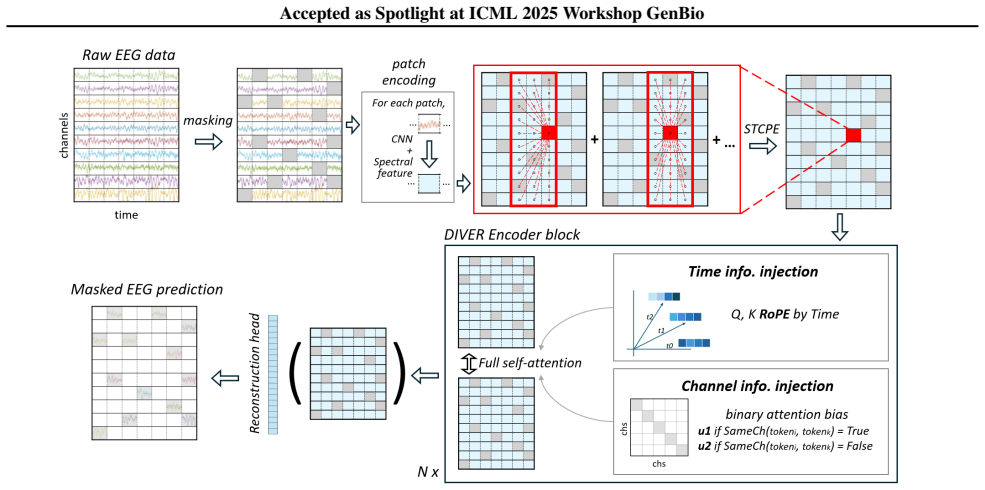
The DIVER transformer block computes attention scores as $E_{ij,mn} = (W_Q x_{i,m})^T R_{i-j}(W_K x_{j,n}) + u_1 \mathbf{1}\{m=n\} + u_2 \mathbf{1}\{m \neq n\}$, where $R_{i-j}$ is the rotary projection matrix encoding relative temporal distance and $u_1, u_2$ are learnable scalars per head that mark whether two tokens come from the same channel. This combines RoPE for temporal relationships with binary attention bias for channel differentiation while remaining invariant to channel ordering. STCPE then produces positional encodings by sliding a stack of such blocks across the temporal dimension, aggregating information over a windowed set of time patches; the design is intended to preserve both temporal translation equivariance and channel permutation equivariance, allowing arbitrary electrode configurations at test time.
What would settle it
Compute the model's output on the same EEG segment twice, once with channels in a fixed order and once with channels permuted, and measure the maximum difference in the final layer's embeddings or logits; if that difference exceeds numerical floating-point precision for any input, the claimed permutation equivariance is violated. The same test can be run on STCPE alone by shifting the temporal window by one patch and checking whether the resulting positional encodings are identical.
Extended reading notes
Core claim
The paper's central claim is that a unified full spatio-temporal attention transformer, with RoPE encoding relative time and binary biases encoding same-channel versus cross-channel pairs, can achieve strong downstream BCI performance while being exactly equivariant to channel permutation. The introduced STCPE generates positional information by sliding a transformer block along the temporal dimension while processing all channels together, so positional encodings carry no absolute channel or absolute time reference. On FACED, DIVER-0 reaches 59.2% balanced accuracy, above every baseline including CBraMod's 55.1%; on PhysioNet-MI it reaches 62.8%, close to CBraMod's 64.2%. Across all four intact-versus-permuted pretraining and finetuning combinations, FACED balanced accuracy stays within 59.0-59.6%, which the paper presents as evidence that the encoder is genuinely order-agnostic rather than adapting to a specific electrode layout.
Load-bearing premise
The claim that STCPE preserves both temporal translation equivariance and channel permutation equivariance is asserted in Section 2.1.2 without a proof, and the experiments only test channel permutation on FACED, so if the sliding-window positional encoding leaks any absolute channel or time-position information, the cross-dataset generalization property fails.
Editorial extensions
If this is right
- A model pretrained on 10% of TUEG beats all compared baselines on FACED (59.2% balanced accuracy), suggesting that unified spatio-temporal attention is more data-efficient for emotion decoding than segregated spatial-temporal designs.
- Performance on FACED is effectively unchanged when channels are permuted during pretraining, finetuning, or both, so a single checkpoint can be fine-tuned on data with any electrode ordering without channel re-alignment.
- Replacing DIVER blocks with vanilla transformer blocks causes the largest FACED drop (3.9 percentage points), indicating that the RoPE-plus-binary-bias attention design itself, not just the pretraining scale, is what drives the gain.
- On motor imagery, ablations that remove spectral embedding or use CBraMod blocks slightly outperform the full model, implying that for spatially localized cortical tasks, more constrained attention may be preferable despite losing permutation equivariance.
- The permutation robustness result is independent of the exact baseline numbers, so even if the CBraMod comparisons are irreproducible, the order-invariance property stands on its own.
Reading between the lines
- If STCPE's equivariance guarantee extends to montages with different channel counts and non-standard positions, DIVER-0 could be fine-tuned on small clinical datasets recorded with unusual electrode caps, which absolute channel embeddings cannot handle; the paper does not test this directly.
- The binary attention bias treats all cross-channel pairs alike, so injecting relative channel-position information while preserving equivariance could recover spatial detail and possibly improve localized tasks like motor imagery, at the cost of extra parameters and some of the order-agnostic simplicity.
- The appendix shows that CBraMod's published baseline numbers could not be reproduced with released code and weights, so the reported margins against CBraMod should be read cautiously, but the permutation-robustness result does not rely on those baselines.
- The 10% pretraining result hints that the architecture may be near data-saturation at this scale; scaling to the full TUEG corpus might yield larger gains for full spatio-temporal attention than for the ablated variants.
Editorial analysis
A structured set of objections, weighed in public.
Referee Report
Summary. The paper proposes DIVER-0, an EEG foundation model that applies full spatio-temporal transformer attention with Rotary Position Embedding (RoPE) for temporal relations and binary attention biases for channel identity, and introduces Sliding Temporal Conditional Positional Encoding (STCPE) to maintain temporal translation equivariance and channel permutation equivariance. The model is pretrained on 10% of the TUEG corpus (with a full-data pretraining run also described but not evaluated) and finetuned on FACED emotion recognition and PhysioNet-MI motor imagery. The paper reports competitive balanced accuracy on both tasks, an ablation study of architectural components, and a channel-permutation analysis on FACED showing near-identical performance across intact/permuted pretraining and finetuning configurations. The authors argue that these results validate unified spatio-temporal attention and strict permutation equivariance as design principles for cross-dataset generalization.
Significance. If the claims hold, DIVER-0 would provide a useful data point for EEG foundation model design: it shows that full spatio-temporal attention can be made channel-permutation-equivariant without sacrificing downstream performance, and that competitive results are attainable with only 10% of the pretraining corpus. The explicit reproducibility failure analysis of CBraMod in Appendix B is a commendable transparency practice, and the ablation studies give concrete, if mixed, evidence about which components matter. However, the significance is tempered by two issues: the reported baseline numbers are internally inconsistent with the authors' own reimplementations, and the central equivariance/generalization claim is supported only for permutations of the same channel set, not for temporal shifts or genuinely unseen montages. The paper's central assertion—that STCPE enables robust adaptation to arbitrary electrode configurations—is therefore not yet established by the experiments.
major comments (4)
- [Table 1 and Appendix B] The central performance comparison is undermined by a baseline discrepancy. Table 1 quotes CBraMod at 55.1% balanced accuracy on FACED and 64.2% on PhysioNet-MI from Wang et al. (2024b), but Appendix B (Table 5) reports the authors' own reimplementation of CBraMod at 56.6% on FACED and 61.2% on PhysioNet-MI. More importantly, the reimplemented LaBraM-Base achieves 64.7% on PhysioNet-MI, which is higher than DIVER-0's 62.8% reported in Table 1. Since the paper's claim of 'competitive performance' and 'outperforming existing foundation models on emotion recognition' relies on the quoted CBraMod numbers, the authors must either use a consistent set of baselines (e.g., their own reimplementations throughout) or explain why the quoted numbers are the appropriate comparison. As written, the reader cannot tell whether DIVER-0 actually surpasses or trails the strongest baseline on each task.
- [Section 2.1.2 and Section 3.3] STCPE is asserted to maintain both temporal translation equivariance and channel permutation equivariance, but no proof is given and the only supporting experiment (Section 3.3) tests channel permutation on the same 32 FACED channels, not temporal translation equivariance or a genuinely novel montage. There are concrete mechanisms by which temporal translation equivariance could fail: the sliding-window aggregation gives boundary patches fewer window contributions unless special padding or renormalization is specified, and the FFT pathway in patch encoding may align phase information to absolute patch boundaries, so a sub-patch temporal shift would change the encoding. The paper should either provide a formal argument for these properties (including the effect of the sliding window at sequence boundaries) or add experiments that temporally shift the input and test on a montage with a different number of channels (e.g., pretrained 19-channel TUEG applied to 32- or 64-channel data).
- [Equation (1) and Section 3.3] The claim of 'robust generalization to arbitrary electrode configurations unseen during pretraining' is not supported by the experiments. The binary attention bias in Eq. (1) only distinguishes same-channel from cross-channel pairs, so when the number of channels C changes, the ratio of same-channel to cross-channel keys in the softmax normalization changes; permutation equivariance alone does not guarantee that the model's behavior remains appropriate when moving from C=19 (pretraining) to C=32 or C=64. The permutation analysis in Table 3 only permutes the same 32 FACED channels, which is a symmetry the architecture was designed to satisfy. The authors should test finetuning on datasets with different channel counts or at least explicitly discuss and empirically probe the effect of changing C.
- [Section 3.1 and Table 1] The paper mentions full-dataset pretraining (Section 2.2) but never reports results for the model pretrained on the full TUEG corpus. All tables show only 'DIVER 10%'. Without full-data results, the claim that DIVER-0 'achieves competitive performance with only 10% of pretraining data' cannot be properly contextualized: it is possible that the 10% model is unrepresentative or that full-data training yields substantially different results. The authors should either report the full-data model's downstream performance or explicitly state that full-data evaluation was not performed and adjust the claim accordingly.
minor comments (5)
- [Appendix A.1] The description of non-convergent trials is ambiguous: the authors state that some trials 'did not show convergence' and that the learning rate was changed to 5e-5 for those trials, but the table captions for Tables 2 and 3 do not indicate which rows used the adjusted learning rate. Please add footnotes or markers to clarify which configurations were trained with the altered hyperparameters, so the reader can interpret the reported numbers correctly.
- [Section 2.1.2] The notation for the final patch embedding, Xo = X + PE = {xi,j + pei,j | i in [1,...,C], j in [1,...,N]}, is imprecise because pei,j is not explicitly defined as the aggregated sliding-window output. Please define the aggregation operation (e.g., sum or mean over windows) and state whether any normalization is applied at sequence boundaries.
- [Appendix B / Table 5] There is a typo in the table header: 'PhsyioNet-MI' should be 'PhysioNet-MI'. Also, the text references 'Table 6' before introducing it; please reorder or renumber so the tables are referenced in order.
- [Section 3.2] The ablation results show that on PhysioNet-MI, removing the spectral embedding improves balanced accuracy (63.4% vs 62.8%), which contradicts the general framing that each component contributes positively. The discussion does acknowledge this, but the abstract and conclusion still state that 'full spatio-temporal attention ... achieves superior performance'; consider softening the claim to reflect the task-dependent nature of component contributions.
- [Figure 1] The caption of Figure 1 mentions masked patch reconstruction as the pretraining objective, but the main text (Section 2.2) does not describe the masking strategy or reconstruction loss. Please add a brief description to the text or a reference to a previous work for the masking scheme.
Circularity Check
No circularity: the equivariance result is a designed property check, and the central performance claims rest on external benchmarks and ablations, not on self-citation or fitted predictions.
full rationale
The paper's derivation chain is not circular. DIVER-0 is trained end-to-end; no parameter is fitted to a subset of data and then renamed as a prediction. The channel-permutation invariance in Table 3 follows directly from Eq. (1): the attention bias depends on channels only through the equality indicators 1{m=n} and 1{m!=n}, so the model is permutation equivariant by construction, and the experiment verifies the implementation rather than testing an empirical hypothesis. This is a property check, not a circular derivation of a predicted result. The STCPE section (2.1.2) asserts 'temporal translation equivariance and channel-wise permutation equivariance' without proof, and Section 3.3 tests only permutations of the same 32 FACED channels rather than genuinely unseen montages or temporal shifts; these are correctness/evidence limitations, not circularity. Citations to CBraMod and MOIRAI are external prior work with no author overlap, and the paper's own ablations (Table 2) show component effects that are not forced by construction. Appendix B's inability to reproduce CBraMod baselines is a reproducibility concern, not a circularity concern. Overall, no load-bearing step reduces to its own input.
Assumptions & free parameters
free parameters (2)
- STCPE temporal window size =
7 seconds
- Patch length =
1 second (200 samples at 200 Hz)
assumptions (3)
- standard math RoPE provides temporal translation equivariance as described in Su et al. (2024)
- domain assumption Binary attention biases u1, u2 are sufficient to encode all task-relevant spatial information
- ad hoc to paper STCPE maintains temporal translation equivariance and channel permutation equivariance
Cite this review
Pith. "Pith review of DIVER-0 : A Fully Channel Equivariant EEG Foundation Model." pith.science (2026). https://pith.science/paper/BNREE5PG
@misc{pith2026250714141,
  author       = {Pith},
  title        = {Pith review of: DIVER-0 : A Fully Channel Equivariant EEG Foundation Model},
  year         = {2026},
  howpublished = {\url{https://pith.science/paper/BNREE5PG}},
  note         = {Machine review of arXiv:2507.14141}
}
read the original abstract
Electroencephalography (EEG) is a non-invasive technique widely used in brain-computer interfaces and clinical applications, yet existing EEG foundation models face limitations in modeling spatio-temporal brain dynamics and lack channel permutation equivariance, preventing robust generalization across diverse electrode configurations. To address these challenges, we propose DIVER-0, a novel EEG foundation model that demonstrates how full spatio-temporal attention-rather than segregated spatial or temporal processing-achieves superior performance when properly designed with Rotary Position Embedding (RoPE) for temporal relationships and binary attention biases for channel differentiation. We also introduce Sliding Temporal Conditional Positional Encoding (STCPE), which improves upon existing conditional positional encoding approaches by maintaining both temporal translation equivariance and channel permutation equivariance, enabling robust adaptation to arbitrary electrode configurations unseen during pretraining. Experimental results demonstrate that DIVER-0 achieves competitive performance with only 10% of pretraining data while maintaining consistent results across all channel permutation conditions, validating its effectiveness for cross-dataset generalization and establishing key design principles for handling the inherent heterogeneity of neural recording setups.
Figures
Reference graph
Works this paper leans on
-
[1]
write newline
" write newline "" before.all 'output.state := FUNCTION n.dashify 't := "" t empty not t #1 #1 substring "-" = t #1 #2 substring "--" = not "--" * t #2 global.max substring 't := t #1 #1 substring "-" = "-" * t #2 global.max substring 't := while if t #1 #1 substring * t #2 global.max substring 't := if while FUNCTION format.date year duplicate empty "emp...
-
[2]
Atcherson, S. R., Gould, H. J., Pousson, M. A., and Prout, T. M. Variability of electrode positions using electrode caps. Brain topography, 20: 0 105--111, 2007
work page 2007
-
[3]
Bagchi, S. and Bathula, D. R. Eeg-convtransformer for single-trial eeg-based visual stimulus classification. Pattern Recognition, 129: 0 108757, 2022
work page 2022
-
[4]
Population transformer: Learning population-level representations of neural activity
Chau, G., Wang, C., Talukder, S., Subramaniam, V., Soedarmadji, S., Yue, Y., Katz, B., and Barbu, A. Population transformer: Learning population-level representations of neural activity. ArXiv, pp.\ arXiv--2406, 2025
work page 2025
-
[5]
A large finer-grained affective computing eeg dataset
Chen, J., Wang, X., Huang, C., Hu, X., Shen, X., and Zhang, D. A large finer-grained affective computing eeg dataset. Scientific Data, 10 0 (1): 0 740, 2023
work page 2023
-
[6]
Chien, H.-Y. S., Goh, H., Sandino, C. M., and Cheng, J. Y. Maeeg: Masked auto-encoder for eeg representation learning. arXiv preprint arXiv:2211.02625, 2022
arXiv 2022
-
[7]
Cohen, M. X. Where does eeg come from and what does it mean? Trends in neurosciences, 40 0 (4): 0 208--218, 2017
work page 2017
-
[8]
Craik, A., He, Y., and Contreras-Vidal, J. L. Deep learning for electroencephalogram (eeg) classification tasks: a review. Journal of neural engineering, 16 0 (3): 0 031001, 2019
work page 2019
Show all 46 references
-
[9]
K., and McIntosh, A
Deco, G., Jirsa, V. K., and McIntosh, A. R. Emerging concepts for the dynamical organization of resting-state activity in the brain. Nature reviews neuroscience, 12 0 (1): 0 43--56, 2011
2011
-
[10]
A., Ingolfsson, T
Dimofte, A., Bucagu, G. A., Ingolfsson, T. M., Wang, X., Cossettini, A., Benini, L., and Li, Y. Cerebro: Compact encoder for representations of brain oscillations using efficient alternating attention. arXiv preprint arXiv:2501.10885, 2025
2025
-
[11]
A mechanism for cognitive dynamics: neuronal communication through neuronal coherence
Fries, P. A mechanism for cognitive dynamics: neuronal communication through neuronal coherence. Trends in cognitive sciences, 9 0 (10): 0 474--480, 2005
2005
-
[12]
L., Amaral, L
Goldberger, A. L., Amaral, L. A., Glass, L., Hausdorff, J. M., Ivanov, P. C., Mark, R. G., Mietus, J. E., Moody, G. B., Peng, C.-K., and Stanley, H. E. Physiobank, physiotoolkit, and physionet: components of a new research resource for complex physiologic signals. circulation,...
2000
-
[13]
M., Ahmed, S
Hameed, I., Khan, D. M., Ahmed, S. M., Aftab, S. S., and Fazal, H. Enhancing motor imagery eeg signal decoding through machine learning: A systematic review of recent progress. Computers in Biology and Medicine, 185: 0 109534, 2025
2025
-
[14]
Eeg-based motor imagery classification using convolutional neural networks with local reparameterization trick
Huang, W., Chang, W., Yan, G., Yang, Z., Luo, H., and Pei, H. Eeg-based motor imagery classification using convolutional neural networks with local reparameterization trick. Expert Systems with Applications, 187: 0 115968, 2022
2022
-
[15]
Large brain model for learning generic representations with tremendous eeg data in bci
Jiang, W.-B., Zhao, L.-M., and Lu, B.-L. Large brain model for learning generic representations with tremendous eeg data in bci. arXiv preprint arXiv:2405.18765, 2024
2024 arXiv
-
[16]
10/20, 10/10, and 10/5 systems revisited: their validity as relative head-surface-based positioning systems
Jurcak, V., Tsuzuki, D., and Dan, I. 10/20, 10/10, and 10/5 systems revisited: their validity as relative head-surface-based positioning systems. Neuroimage, 34 0 (4): 0 1600--1611, 2007
2007
-
[17]
Neurophysiological analysis in motor and sensory cortices for improving motor imagination
Kim, S.-H., Kim, S.-J., and Lee, D.-H. Neurophysiological analysis in motor and sensory cortices for improving motor imagination. In 2025 13th International Conference on Brain-Computer Interface (BCI), pp.\ 1--4. IEEE, 2025
2025
-
[18]
Bendr: Using transformers and a contrastive self-supervised learning task to learn from massive amounts of eeg data
Kostas, D., Aroca-Ouellette, S., and Rudzicz, F. Bendr: Using transformers and a contrastive self-supervised learning task to learn from massive amounts of eeg data. Frontiers in Human Neuroscience, 15: 0 653659, 2021
2021
-
[19]
Crafting papers on machine learning
Langley, P. Crafting papers on machine learning. In Langley, P. (ed.), Proceedings of the 17th International Conference on Machine Learning (ICML 2000), pp.\ 1207--1216, Stanford, CA, 2000. Morgan Kaufmann
2000
-
[20]
J., Solon, A
Lawhern, V. J., Solon, A. J., Waytowich, N. R., Gordon, S. M., Hung, C. P., and Lance, B. J. Eegnet: a compact convolutional neural network for eeg-based brain--computer interfaces. Journal of neural engineering, 15 0 (5): 0 056013, 2018
2018
-
[21]
Motor imagery eeg classification algorithm based on cnn-lstm feature fusion network
Li, H., Ding, M., Zhang, R., and Xiu, C. Motor imagery eeg classification algorithm based on cnn-lstm feature fusion network. Biomedical signal processing and control, 72: 0 103342, 2022
2022
-
[22]
The eeg microstate representation of discrete emotions
Liu, J., Hu, X., Shen, X., Lv, Z., Song, S., and Zhang, D. The eeg microstate representation of discrete emotions. International Journal of Psychophysiology, 186: 0 33--41, 2023
2023
-
[23]
Moirai-moe: Empowering time series foundation models with sparse mixture of experts
Liu, X., Liu, J., Woo, G., Aksu, T., Liang, Y., Zimmermann, R., Liu, C., Savarese, S., Xiong, C., and Sahoo, D. Moirai-moe: Empowering time series foundation models with sparse mixture of experts. arXiv preprint arXiv:2410.10469, 2024
-
[24]
A review of classification algorithms for eeg-based brain--computer interfaces
Lotte, F., Congedo, M., L \'e cuyer, A., Lamarche, F., and Arnaldi, B. A review of classification algorithms for eeg-based brain--computer interfaces. Journal of neural engineering, 4 0 (2): 0 R1, 2007
2007
-
[25]
H., Stevanovi \'c Kari \'c , M., McConnell, M., Rupp, G., Richard, C., Hamilton, J., Salat, D., and Berka, C
Meghdadi, A. H., Stevanovi \'c Kari \'c , M., McConnell, M., Rupp, G., Richard, C., Hamilton, J., Salat, D., and Berka, C. Resting state eeg biomarkers of cognitive decline associated with alzheimer’s disease and mild cognitive impairment. PloS one, 16 0 (2): 0 e0244180, 2021
2021
-
[26]
Noninvasive electroencephalogram based control of a robotic arm for reach and grasp tasks
Meng, J., Zhang, S., Bekyo, A., Olsoe, J., Baxter, B., and He, B. Noninvasive electroencephalogram based control of a robotic arm for reach and grasp tasks. Scientific Reports, 6 0 (1): 0 38565, 2016
2016
-
[27]
Eeg2rep: enhancing self-supervised eeg representation through informative masked inputs
Mohammadi Foumani, N., Mackellar, G., Ghane, S., Irtza, S., Nguyen, N., and Salehi, M. Eeg2rep: enhancing self-supervised eeg representation through informative masked inputs. In Proceedings of the 30th ACM SIGKDD Conference on Knowledge Discovery and Data Mining, pp.\ 5544--5...
2024
-
[28]
Nicolas-Alonso, L. F. and Gomez-Gil, J. Brain computer interfaces, a review. sensors, 12 0 (2): 0 1211--1279, 2012
2012
-
[29]
and Picone, J
Obeid, I. and Picone, J. The temple university hospital eeg data corpus. Frontiers in neuroscience, 10: 0 196, 2016
2016
-
[30]
A network model of the emotional brain
Pessoa, L. A network model of the emotional brain. Trends in cognitive sciences, 21 0 (5): 0 357--371, 2017
2017
-
[31]
J., Hinterberger, T., Birbaumer, N., and Wolpaw, J
Schalk, G., McFarland, D. J., Hinterberger, T., Birbaumer, N., and Wolpaw, J. R. Bci2000: a general-purpose brain-computer interface (bci) system. IEEE Transactions on biomedical engineering, 51 0 (6): 0 1034--1043, 2004
2004
-
[32]
T., Springenberg, J
Schirrmeister, R. T., Springenberg, J. T., Fiederer, L. D. J., Glasstetter, M., Eggensperger, K., Tangermann, M., Hutter, F., Burgard, W., and Ball, T. Deep learning with convolutional neural networks for eeg decoding and visualization. Human brain mapping, 38 0 (11): 0 5391--...
2017
-
[33]
Fome: A foundation model for eeg using adaptive temporal-lateral attention scaling
Shi, E., Zhao, K., Yuan, Q., Wang, J., Hu, H., Yu, S., and Zhang, S. Fome: A foundation model for eeg using adaptive temporal-lateral attention scaling. arXiv preprint arXiv:2409.12454, 2024
2024 arXiv
-
[34]
M., Weaver, K
Smith, M. M., Weaver, K. E., Grabowski, T. J., Rao, R. P., and Darvas, F. Non-invasive detection of high gamma band activity during motor imagery. Frontiers in human neuroscience, 8: 0 817, 2014
2014
-
[35]
Eeg conformer: Convolutional transformer for eeg decoding and visualization
Song, Y., Zheng, Q., Liu, B., and Gao, X. Eeg conformer: Convolutional transformer for eeg decoding and visualization. IEEE Transactions on Neural Systems and Rehabilitation Engineering, 31: 0 710--719, 2022
2022
-
[36]
J., Nolte, G., and Daffertshofer, A
Stam, C. J., Nolte, G., and Daffertshofer, A. Phase lag index: assessment of functional connectivity from multi channel eeg and meg with diminished bias from common sources. Human brain mapping, 28 0 (11): 0 1178--1193, 2007
2007
-
[37]
Roformer: Enhanced transformer with rotary position embedding
Su, J., Ahmed, M., Lu, Y., Pan, S., Bo, W., and Liu, Y. Roformer: Enhanced transformer with rotary position embedding. Neurocomputing, 568: 0 127063, 2024
2024
-
[38]
Valderrama, C. E. and Sheoran, A. Identifying relevant eeg channels for subject-independent emotion recognition using attention network layers. Frontiers in Psychiatry, 16: 0 1494369, 2025
2025
-
[39]
The brainweb: phase synchronization and large-scale integration
Varela, F., Lachaux, J.-P., Rodriguez, E., and Martinerie, J. The brainweb: phase synchronization and large-scale integration. Nature reviews neuroscience, 2 0 (4): 0 229--239, 2001
2001
-
[40]
Eegpt: Pretrained transformer for universal and reliable representation of eeg signals
Wang, G., Liu, W., He, Y., Xu, C., Ma, L., and Li, H. Eegpt: Pretrained transformer for universal and reliable representation of eeg signals. Advances in Neural Information Processing Systems, 37: 0 39249--39280, 2024 a
2024
-
[41]
Cbramod: A criss-cross brain foundation model for eeg decoding
Wang, J., Zhao, S., Luo, Z., Zhou, Y., Jiang, H., Li, S., Li, T., and Pan, G. Cbramod: A criss-cross brain foundation model for eeg decoding. arXiv preprint arXiv:2412.07236, 2024 b
2024
-
[42]
Unified training of universal time series forecasting transformers
Woo, G., Liu, C., Kumar, A., Xiong, C., Savarese, S., and Sahoo, D. Unified training of universal time series forecasting transformers. International Conference on Machine Learning, 2024
2024
-
[43]
Cross-dataset variability problem in eeg decoding with deep learning
Xu, L., Xu, M., Ke, Y., An, X., Liu, S., and Ming, D. Cross-dataset variability problem in eeg decoding with deep learning. Frontiers in human neuroscience, 14: 0 103, 2020
2020
-
[44]
Learning topology-agnostic eeg representations with geometry-aware modeling
Yi, K., Wang, Y., Ren, K., and Li, D. Learning topology-agnostic eeg representations with geometry-aware modeling. Advances in Neural Information Processing Systems, 36: 0 53875--53891, 2023
2023
-
[45]
Brant: Foundation model for intracranial neural signal
Zhang, D., Yuan, Z., Yang, Y., Chen, J., Wang, J., and Li, Y. Brant: Foundation model for intracranial neural signal. Advances in Neural Information Processing Systems, 36: 0 26304--26321, 2023
2023
-
[46]
Human mind control of rat cyborg’s continuous locomotion with wireless brain-to-brain interface
Zhang, S., Yuan, S., Huang, L., Zheng, X., Wu, Z., Xu, K., and Pan, G. Human mind control of rat cyborg’s continuous locomotion with wireless brain-to-brain interface. Scientific reports, 9 0 (1): 0 1321, 2019
2019
Reviewed August 7, 2026 · model on record in the stance chip above.
Discussion (0). Sign in to comment.