REVIEW 3 major objections 5 minor 2 cited by
Universal parameters of the $\Lambda(1380)$, the $\Lambda(1405)$ and their isospin partners from a combined analysis of Lattice QCD and experimental results
T0 review · 3 major / 5 minor · reviewed 2026-08-06 · deepseek-v4-flash
Pith's one-line read A global fit of lattice spectra and experimental cross sections shows that the Λ(1405) and Λ(1380) form a genuine two-pole system, with the lower pole's width still scheme-dependent.
desk verdict A careful combined lattice-plus-experiment analysis that solidifies the two-pole structure, but the claimed scheme dependence of the Lambda(1380) at the lattice point is not fully earned. read the letter →
The pith
A machine-rendered reading of the paper's core claim, the machinery that carries it, and where it could break.
The reading
What carries the argument
The load-bearing object is the unitarized chiral scattering amplitude. A chiral potential $V(s)$ (Weinberg-Tomozawa term, with optional Born and next-to-leading-order terms) is iterated through the algebraic Bethe-Salpeter equation $T(s) = -V(s)\big(1 - V(s)G(s)\big)^{-1}$, with $G(s)$ the two-body meson-baryon loop function. This yields a unitary amplitude whose poles on the unphysical Riemann sheets are the resonances. The same amplitude is fed into the finite-volume quantization condition to predict the lattice energy levels, so one set of low-energy constants and subtraction constants is constrained by both experiment and lattice QCD. Three regularization schemes ($S1$, $S2$, $S3$) and three kernels ($M1$, $M2$, $M3$) generate the systematic error band; the Akaike and Bayes information criteria are used to compare models with different numbers of parameters.
What would settle it
Recompute the finite-volume spectrum with a full three-body quantization condition that includes the $\pi\pi\Lambda$ channel and refit the same experimental data; if the extracted $\Lambda(1405)$ pole moves outside the Table I systematic band, or if the $\Lambda(1380)$ stays a broad resonance in the $S2$ and $S3$ schemes, the claimed universal pole parameters are falsified.
Extended reading notes
Core claim
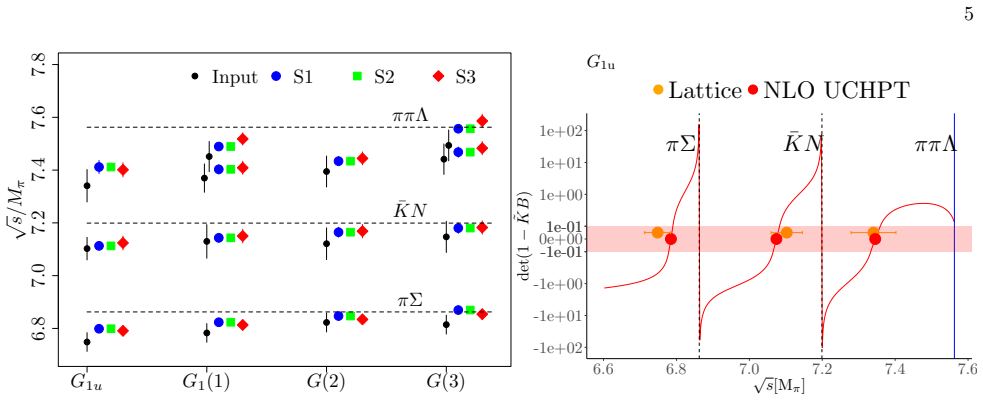
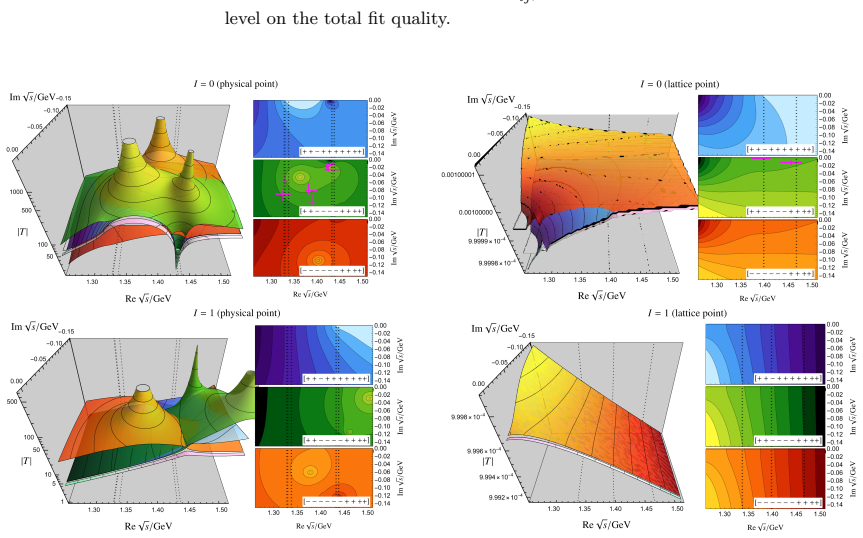
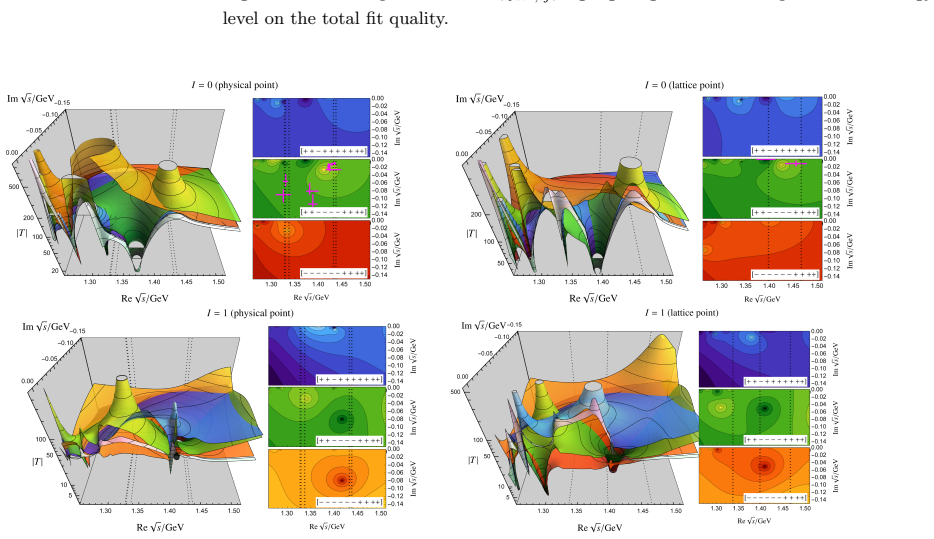
The central claim is that the $\Lambda(1405)$ and $\Lambda(1380)$ exist as a genuine two-pole structure and that a single unitarized chiral amplitude can describe, at once, the finite-volume lattice spectrum and the experimental cross sections, threshold ratios, and kaonic-hydrogen shift. Using a next-to-leading-order kernel with Born terms and varied regularizations, the combined fits reach $\chi^2_\mathrm{dof}\approx 1$, and the extracted isoscalar poles at the physical point agree with previous phenomenological values. At the lattice quark masses, the higher pole lands near the lattice determination, while the lower pole is either a broad resonance or a virtual bound state below the $\pi\Sigma$ threshold depending on the regularization; the parameter-free and one-parameter schemes favored by the information criteria place it on the real axis. The paper therefore claims that the existence of two poles is now solid, but that the width of the $\Lambda(1380)$ is not yet fixed by current data.
Load-bearing premise
Everything rests on the two-body unitarized equations being reliable at the pole energies; the paper itself notes that the neglected $\pi\pi\Lambda$ three-body intermediate states have a right-hand cut starting between the two physical-point poles, so those states could shift the $\Lambda(1405)$ pole by an amount that is not included in the quoted systematic uncertainties.
Editorial extensions
If this is right
- Isoscalar pole positions can be quoted with separate statistical and systematic errors from a single combined analysis of lattice and experimental input.
- Lattice QCD data alone, at current precision, support the existence of two poles but cannot pin both pole positions once model variation is included.
- The lower $\Lambda(1380)$ pole at the lattice point is not uniquely a resonance: within the models preferred by information criteria it is a virtual bound state, so its width should not be treated as a measured number.
- The isovector partner remains poorly constrained, with broad poles whose positions vary strongly with the model; new isovector lattice spectra are needed.
Reading between the lines
- If the neglected $\pi\pi\Lambda$ three-body cut shifts the physical-point $\Lambda(1405)$ pole, then the pole positions in Table I should be read as two-body-model values rather than universal parameters, and future three-body calculations may move them by more than the quoted errors.
- The scheme dependence of the $\Lambda(1380)$ width suggests a model-selection test: use the fitted amplitudes to predict an unmeasured observable, such as the $\pi\Sigma$ line shape in photoproduction, where a bound-state pole and a resonance pole produce different near-threshold energy dependence.
- The same methodology could be extended to the isovector sector once lattice spectra with $I=1$ are available; the paper's prediction of very broad poles implies these spectra will be needed to settle the existence of the isovector partner.
Editorial analysis
A structured set of objections, weighed in public.
Referee Report
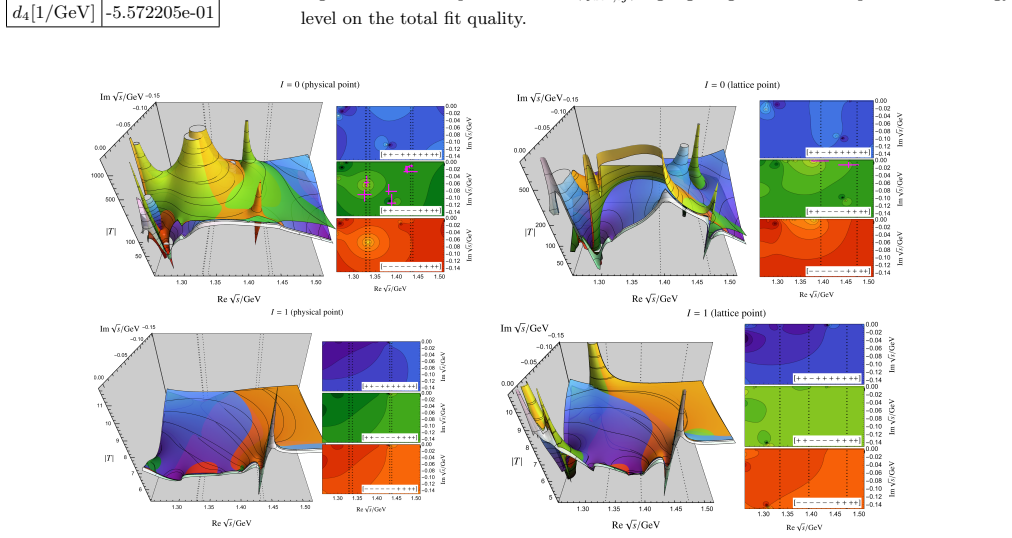
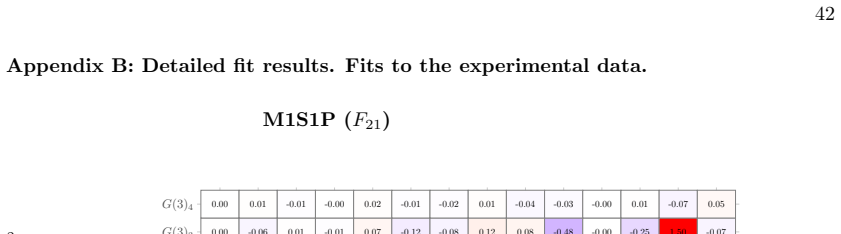
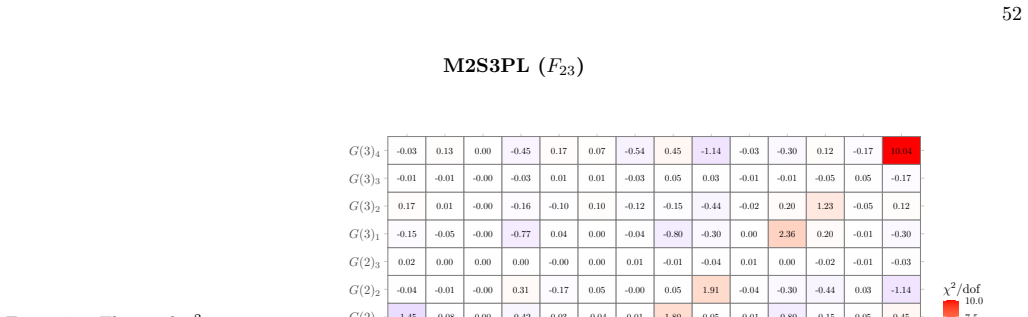
Summary. The manuscript reports a global chiral-unitary analysis of the S=−1 meson-baryon system in which, for the first time in this framework, the BaSc lattice QCD finite-volume spectra (14 levels from the D200 ensemble) and four lattice baryon masses are fitted together with 258 experimental data points (K−p cross sections, threshold ratios, SIDDHARTA shift/width, AMADEUS amplitude). The model space includes three interaction kernels (M1, M2, M3) and three regularization schemes (S1, S2, S3), with fits judged by a weighted χ2 and AIC/BIC. The main results are Table I pole positions at physical and lattice points: the two-pole structure of the Λ(1405)/Λ(1380) is found in all M3 combined fits, the Λ(1405) pole is stable, while the Λ(1380) appears as a resonance in the M3S1 fit (F17) and as a virtual bound state in M3S2/F16 and M3S3/F12 at the lattice point. Isovector pole predictions are given with large uncertainties.
Significance. The paper's ambition—quantifying both data-related and framework-related uncertainties in a combined lattice+experimental determination—is timely and, if realized, would settle an important consistency question about the two-pole structure. Several analysis choices are exemplary: multi-start minimization, bootstrap resampling of lattice inputs, correlated χ2 for the 14 levels, explicit treatment of left-hand cuts, and public access to the digitized experimental data. The broad scan over M1/M2/M3 and S1/S2/S3 is exactly what is needed to expose model dependence. However, two admitted limitations directly affect the headline: the ππΛ three-body cut is acknowledged to generate an unknown systematic error for the physical-point Λ(1405), and the resonance-vs-virtual-state dichotomy at the lattice point is selected by an unexplained rule. These issues make the paper valuable but not yet conclusive as a 'universal parameters' extraction.
major comments (3)
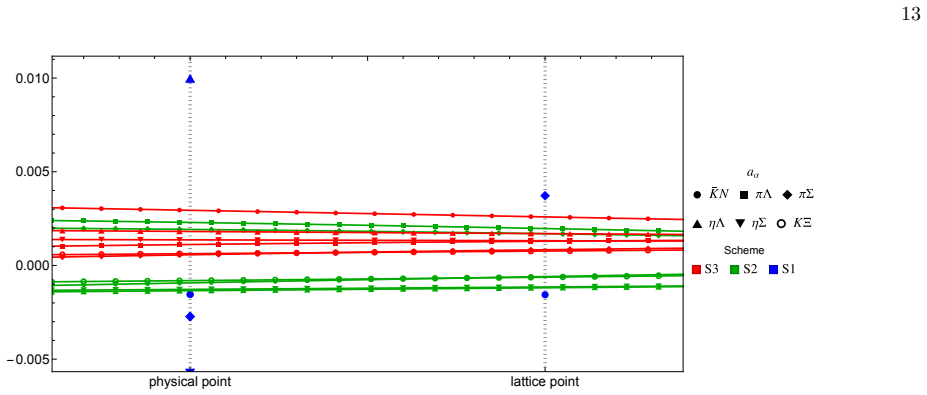
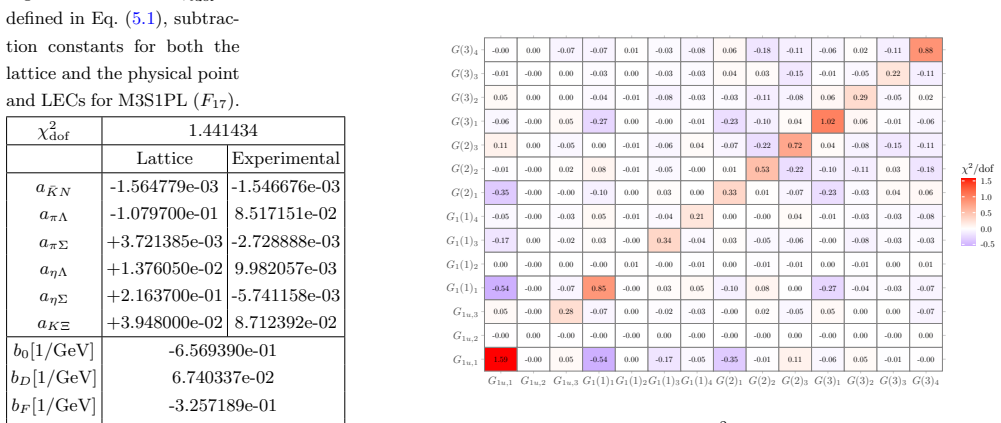
- [§V C and Table I (M3S1/F17 row)] The dichotomy between a resonance and a virtual bound state for the lattice-point Λ(1380) is decided by fit F17, which is selected by the rule stated in §V C ('we choose the one where all subtraction constants are smaller than 0.05 in absolute value'). This rule is not derived from data or information criteria, and §VI C describes the same S1 fits as 'too volatile, depending strongly on the starting values'; Fig. 8 indeed shows several converged solutions with essentially equal χ2_dof but different subtraction constants. Since F16 and F12 place the Λ(1380) on the real axis and only F17 produces a width of ~100 MeV, the paper's central 'scheme dependence' is not a robust property of the combined data but depends on an arbitrary final-selection step. I ask the authors to either justify the rule, average over the statistically equivalent basins, or add the basin choice to the systematic error budget; otherwise the qualitative conclusion should be softened.
- [§IV D, Fig. 5, and Table I] The authors explicitly conclude that at the physical point the ππΛ right-hand cut lies 'just between the estimated pole positions of the Λ(1380) and the Λ(1405)' and that 'the position of the latter state determined in the literature must carry a systematic, yet unknown uncertainty related to the neglected three-body states.' This is a load-bearing limitation for the physical-point Λ(1405) pole quoted in Table I (e.g., 1.432−i0.025 GeV for M3S1), because the quoted systematic uncertainties are built from model and data variations within two-body UCHPT and do not include this cut. The manuscript should either provide a quantitative estimate of the three-body effect (e.g., through a three-body quantization condition or a perturbative estimate) or explicitly restrict the claim of 'universal parameters including systematic uncertainties' to two-body dynamics.
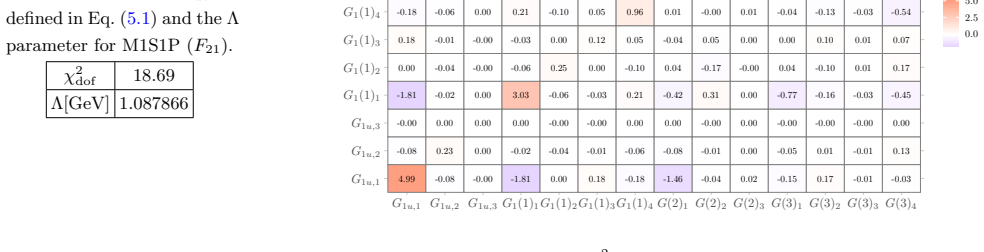
- [§V B, Eq. (5.1), and Fig. 7] Using χ2_dof from Eq. (5.1) as −2 log L in the AIC/BIC definitions of Eq. (5.2) is not a proper likelihood identification. χ2_dof is a weighted average over data sets with weights A/Na, so it is defined only up to additive/multiplicative conventions that depend on how the data are partitioned; the AIC/BIC differences reported in Fig. 7 therefore do not have the statistical meaning claimed when the text says S1 fits are 'disfavored by both information criteria.' This matters because the same S1 fit carries the resonance interpretation at the lattice point. Please either use a total χ2 statistic with a valid likelihood interpretation or present the model ranking as exploratory and check its stability under alternative weighting choices.
minor comments (5)
- [Table I] The rows F16 and F12 at the lattice point list numbers with no imaginary part (e.g., 1.389+0.006−0.007); please explicitly annotate these as virtual bound states on the real axis, since otherwise the table is ambiguous for readers.
- [Abstract] The statement that systematic uncertainties 'are quantified for the first time' is stronger than what is supported by §IV D, where the ππΛ three-body uncertainty is admitted to be unknown; please qualify the claim.
- [Figure 7] The column header 'Ndata|exp.+lat.+m' should be expanded to clarify that the three entries count experimental, lattice finite-volume, and lattice single-baryon data points.
- [§VI C] The phrase 'as shown in Sect. VI C' appears in a paragraph that is meant to refer to earlier results; please update the internal cross-reference to the appropriate earlier section (likely §V C for the fit rankings).
- [§II B, Eqs. (2.3)–(2.5)] The symbol pcm is used both as a scalar momentum and as a diagonal matrix entry; a sentence defining the matrix convention would improve readability.
Circularity Check
No significant circularity: pole positions are standard fit outputs and the experiment-only lattice-point comparison is an out-of-sample check.
full rationale
The paper's central outputs are pole positions obtained by minimizing a correlated chi-square against experimental cross sections, threshold data, and BaSc finite-volume levels through an explicitly written unitarized chiral amplitude (Eqs. (4.6)-(4.17)) and the Luscher quantization condition (Eq. (2.4)). This is an extraction, not a logical circle: the data constrain the parameters, and the poles are analytic continuations of the fitted amplitude. The most important potential circularity would be the claim that the BaSc pole structure is 'confirmed' at the lattice point; for the experiment-only fits F30/F13/F11, the lattice levels were not used, so the overlap with BaSc is an out-of-sample prediction. In the combined fits, agreement with BaSc reference values is a consistency check and is described as such ('provide a very good description'), not as independent confirmation. The 'predictions' for isovector poles are also derived from a fit that includes isovector-sensitive K-p cross sections; the word 'prediction' is loose, but the quantities are not fitted parameters renamed as predictions. The S1 final-fit selection rule, 'we choose the one where all subtraction constants are smaller than 0.05 in absolute value', is arbitrary and makes the F17 resonance-versus-virtual-state dichotomy less robust, but the paper explicitly discloses this rule, reports that F17 is disfavored by AIC/BIC, and presents the resonance option only as a 'shadow of a doubt'; this is a robustness/correctness caveat, not a circular reduction. The acknowledged three-body uncertainty in Sect. IV D is a limitation on the error budget, not a circular step, and the S1 scheme's stated lack of predictive power outside fitted quark-mass regions sits uneasily with the experiment-only extrapolation in Sect. VI B, which is an unstated assumption rather than circularity. Self-citations to the UCHPT framework are numerous but none are load-bearing: the kernels, loop functions, and regularization schemes are written out in the text and validated against external data such as SIDDHARTA, AMADEUS, and BaSc. No equation is defined in terms of its own output, and no fitted parameter is relabeled as a prediction.
Assumptions & free parameters
free parameters (3)
- Subtraction constants a_{alpha} (S1 scheme) =
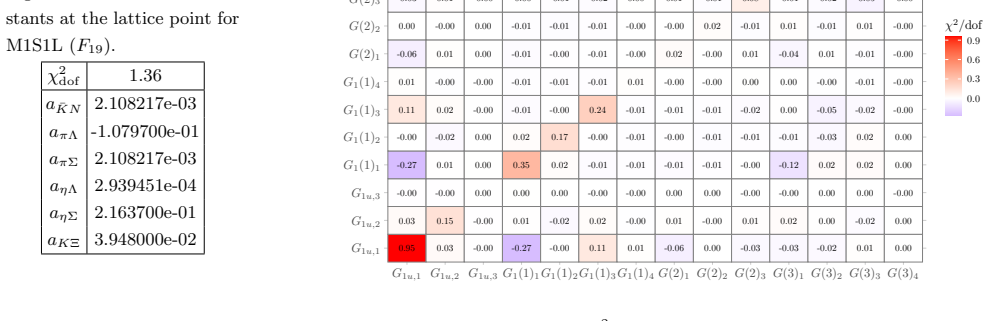
F17: a_KbarN approx -1.55e-3 (lattice), -1.55e-3 (physical); a_piLambda approx -0.108 (lattice), 0.0852 (physical)…
- NLO low-energy constants b0,bD,bF,d1,d2,d3,d4 =
F17: b0=-0.657 GeV^-1, bD=0.0674 GeV^-1, bF=-0.326 GeV^-1, d1=-0.252 GeV^-1, d2=0.0309 GeV^-1, d3=-0.0899 GeV^-1…
- Cutoff Lambda (S3 scheme) =
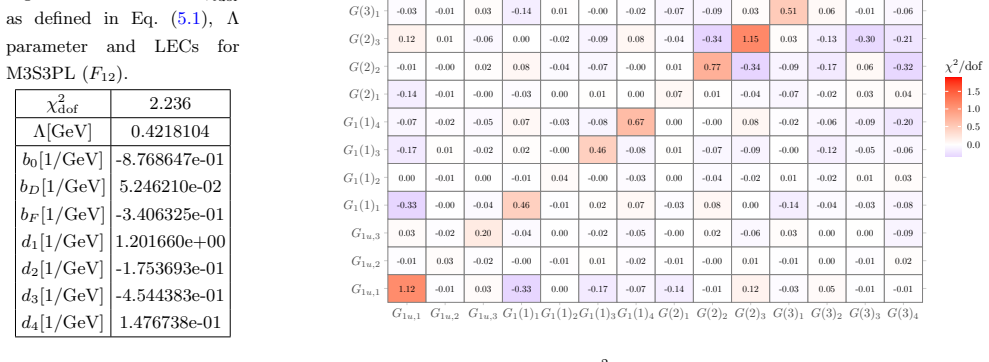
F12: 0.422 GeV
assumptions (6)
- domain assumption On-shell factorization of the Bethe-Salpeter equation: T = -V (1 - V G)^{-1}
- domain assumption Two-body unitarity only; pi pi Lambda three-body states are excluded from the unitarization
- ad hoc to paper Left-hand cut of the u-channel Born term is replaced by a constant above the critical region
- domain assumption Lattice scale setting and continuum extrapolation are taken as done by the BaSc collaboration
- ad hoc to paper Weighted chi-square definition of Eq. (5.1) is used as -2 log L for AIC/BIC
- domain assumption Older cross-section data are treated with standard chi-square despite known inconsistencies
Cite this review
Pith. "Pith review of Universal parameters of the $\Lambda(1380)$, the $\Lambda(1405)$ and their isospin partners from a combined analysis of Lattice QCD and experimental results." pith.science (2026). https://pith.science/paper/5PSLSNH2
@misc{pith2026250714283,
  author       = {Pith},
  title        = {Pith review of: Universal parameters of the $\Lambda(1380)$, the $\Lambda(1405)$ and their isospin partners from a combined analysis of Lattice QCD and experimental results},
  year         = {2026},
  howpublished = {\url{https://pith.science/paper/5PSLSNH2}},
  note         = {Machine review of arXiv:2507.14283}
}
read the original abstract
We perform a global analysis of lattice and experimental data on negative-strangeness meson-baryon scattering using a large set of variations of the theoretical framework based on the Chiral Unitary Approach. For the former, the L\"uscher formalism is utilized taking into account all pertinent coupled-channel effects. Through this, systematic uncertainties related to data scarcity, potential ambiguities, and possible framework dependence are quantified for the first time. The implementation of information criteria and other statistical tools is discussed. As a final result we provide pole positions for isoscalar resonances at the physical and lattice points including statistical and systematic uncertainties. Predictions for the isovector states are also provided showing large uncertainties.
Figures


Figures from the paper (78 more)
















Forward citations
Cited by 2 Pith papers
-
Combined Analysis of Lattice QCD and Experimental Data on the Pion Transition Form Factor
Feasibility study of combined LQCD and experimental data on pion TFF via modified z-expansion fit reports up to 3x uncertainty reduction in singly-virtual limit but only 1.5x improvement for the pion-pole g-2 contribution.
-
Finding Low Star Discrepancy 3D Kronecker Point Sets Using Algorithm Configuration Techniques
Optimizing the two Kronecker parameters with irace yields new state-of-the-art L∞ star discrepancy for 3D point sets of size at least 500 and for ranges of sizes.
Reference graph
Works this paper leans on
-
[1]
Review of particle physics,
S. Navas et al. (Particle Data Group), “Review of particle physics,” Phys. Rev. D 110, 030001 (2024)
2024
-
[2]
Annika Thiel, Farah Afzal, and Yannick Wunderlich, “Light Baryon Spectroscopy,” Prog. Part. Nucl. Phys. 125, 103949 (2022), arXiv:2202.05055 [nucl-ex]
arXiv 2022
-
[3]
Baryons as relativistic three-quark bound states,
Gernot Eichmann, Helios Sanchis-Alepuz, Richard Williams, Reinhard Alkofer, and Christian S. Fischer, “Baryons as relativistic three-quark bound states,” Prog. Part. Nucl. Phys. 91, 1–100 (2016), arXiv:1606.09602 [hep-ph]
arXiv 2016
-
[4]
Dynamical coupled-channel models for hadron dynamics,
Michael D¨ oring, Johann Haidenbauer, Maxim Mai, and Toru Sato, “Dynamical coupled-channel models for hadron dynamics,” (2025), arXiv:2505.02745 [nucl-th]
arXiv 2025
-
[5]
Towards a theory of hadron resonances,
Maxim Mai, Ulf-G. Meißner, and Carsten Urbach, “Towards a theory of hadron resonances,” Phys. Rept. 1001, 1–66 (2023), arXiv:2206.01477 [hep-ph]
arXiv 2023
-
[6]
The impact of γN and γ∗N interactions on our understanding of nucleon excitations,
Volker Burkert, Gernot Eichmann, and Eberhard Klempt, “The impact of γN and γ∗N interactions on our understanding of nucleon excitations,” (2025), arXiv:2506.16482 [hep-ph]
arXiv 2025
-
[7]
Chiral dynamics in the presence of bound states: Kaon nucleon interactions revisited,
J. A. Oller and Ulf-G. Meißner, “Chiral dynamics in the presence of bound states: Kaon nucleon interactions revisited,” Phys. Lett. B 500, 263–272 (2001), arXiv:hep-ph/0011146
arXiv 2001
-
[8]
Two-pole structures in QCD: Facts, not fantasy!
Ulf-G. Meißner, “Two-pole structures in QCD: Facts, not fantasy!” Symmetry 12, 981 (2020), arXiv:2005.06909 [hep-ph]
arXiv 2020
Show all 128 references
-
[9]
Review of the Λ(1405) A curious case of a strangeness resonance,
Maxim Mai, “Review of the Λ(1405) A curious case of a strangeness resonance,” Eur. Phys. J. ST 230, 1593–1607 (2021), arXiv:2010.00056 [nucl-th]
2021 arXiv
-
[10]
QCD and the strange baryon spectrum,
Tetsuo Hyodo and Masayuki Niiyama, “QCD and the strange baryon spectrum,” Prog. Part. Nucl. Phys. 120, 103868 (2021), arXiv:2010.07592 [hep-ph]
2021 arXiv
-
[11]
On the pole content of coupled channels chiral approaches used for the ¯KN system,
A. Ciepl´ y, M. Mai, Ulf-G. Meißner, and J. Smejkal, “On the pole content of coupled channels chiral approaches used for the ¯KN system,” Nucl. Phys. A 954, 17–40 (2016), arXiv:1603.02531 [hep-ph]
2016 arXiv
-
[12]
Chiral SU(3) theory of antikaon-nucleon interactions with improved threshold constraints,
Yoichi Ikeda, Tetsuo Hyodo, and Wolfram Weise, “Chiral SU(3) theory of antikaon-nucleon interactions with improved threshold constraints,” Nucl. Phys. A 881, 98–114 (2012), arXiv:1201.6549 [nucl-th]
2012 arXiv
-
[13]
Meson-baryon reactions with strangeness -1 within a chiral framework,
Zhi-Hui Guo and J. A. Oller, “Meson-baryon reactions with strangeness -1 within a chiral framework,” Phys. Rev. C 87, 035202 (2013), arXiv:1210.3485 [hep-ph]
2013 arXiv
-
[14]
Cross-Channel Constraints on Resonant Antikaon- Nucleon Scattering,
Jun-Xu Lu, Li-Sheng Geng, Michael Doering, and Maxim Mai, “Cross-Channel Constraints on Resonant Antikaon- Nucleon Scattering,” Phys. Rev. Lett. 130, 071902 (2023), arXiv:2209.02471 [hep-ph]
2023 arXiv
-
[15]
Isolating the Λ(1405) in Lattice QCD,
Benjamin J. Menadue, Waseem Kamleh, Derek B. Leinweber, and M. Selim Mahbub, “Isolating the Λ(1405) in Lattice QCD,” Phys. Rev. Lett. 108, 112001 (2012), arXiv:1109.6716 [hep-lat]. 28
2012 arXiv
-
[16]
Low-lying Λ baryons from the lattice,
Georg P. Engel, C. B. Lang, and Andreas Sch¨ afer (BGR (Bern-Graz-Regensburg)), “Low-lying Λ baryons from the lattice,” Phys. Rev. D 87, 034502 (2013), arXiv:1212.2032 [hep-lat]
2013 arXiv
-
[17]
Flavor structure of the excited baryon spectra from lattice QCD,
Robert G. Edwards, Nilmani Mathur, David G. Richards, and Stephen J. Wallace (Hadron Spectrum), “Flavor structure of the excited baryon spectra from lattice QCD,” Phys. Rev. D 87, 054506 (2013), arXiv:1212.5236 [hep-ph]
2013 arXiv
-
[18]
Lattice QCD Evidence that the Λ(1405) Resonance is an Antikaon-Nucleon Molecule,
Jonathan M. M. Hall, Waseem Kamleh, Derek B. Leinweber, Benjamin J. Menadue, Benjamin J. Owen, Anthony W. Thomas, and Ross D. Young, “Lattice QCD Evidence that the Λ(1405) Resonance is an Antikaon-Nucleon Molecule,” Phys. Rev. Lett. 114, 132002 (2015), arXiv:1411.3402 [hep-lat]
2015 arXiv
-
[19]
On the Structure of the Lambda 1405,
Jonathan M. M. Hall, Waseem Kamleh, Derek B. Leinweber, Benjamin J. Menadue, Benjamin J. Owen, Anthony W. Thomas, and Ross D. Young, “On the Structure of the Lambda 1405,” PoS LA TTICE2014, 094 (2014), arXiv:1411.3781 [hep-lat]
2014 arXiv
-
[20]
Lattice QCD study of πΣ-K¯N scattering and the Λ(1405) resonance,
John Bulava et al. (Baryon Scattering (BaSc)), “Lattice QCD study of πΣ-K¯N scattering and the Λ(1405) resonance,” Phys. Rev. D 109, 014511 (2024), arXiv:2307.13471 [hep-lat]
2024
-
[21]
Two-Pole Nature of the Λ(1405) resonance from Lattice QCD,
John Bulava et al. (Baryon Scattering (BaSc)), “Two-Pole Nature of the Λ(1405) resonance from Lattice QCD,” Phys. Rev. Lett. 132, 051901 (2024), arXiv:2307.10413 [hep-lat]
2024
-
[22]
Nucleon scattering from lattice QCD,
Colin Morningstar, “Nucleon scattering from lattice QCD,” in 11th International Workshop on Chiral Dynamics(2025) arXiv:2504.01950 [hep-lat]
2025 arXiv
-
[23]
Scattering processes and resonances from lattice QCD,
Raul A. Briceno, Jozef J. Dudek, and Ross D. Young, “Scattering processes and resonances from lattice QCD,” Rev. Mod. Phys. 90, 025001 (2018), arXiv:1706.06223 [hep-lat]
2018 arXiv
-
[24]
Two particle states on a torus and their relation to the scattering matrix,
Martin L¨ uscher, “Two particle states on a torus and their relation to the scattering matrix,” Nucl. Phys. B354, 531–578 (1991)
1991
-
[25]
Signatures of unstable particles in finite volume,
Martin L¨ uscher, “Signatures of unstable particles in finite volume,” Nucl. Phys. B 364, 237–251 (1991)
1991
-
[26]
Resonance scattering phase shifts on a nonrest frame lattice,
K. Rummukainen and Steven A. Gottlieb, “Resonance scattering phase shifts on a nonrest frame lattice,” Nucl. Phys. B 450, 397–436 (1995), arXiv:hep-lat/9503028
1995 arXiv
-
[27]
Finite-volume effects for two-hadron states in moving frames,
C. h. Kim, C. T. Sachrajda, and Stephen R. Sharpe, “Finite-volume effects for two-hadron states in moving frames,” Nucl. Phys. B 727, 218–243 (2005), arXiv:hep-lat/0507006
2005 arXiv
-
[28]
Two particle states and the S-matrix elements in multi-channel scattering,
Song He, Xu Feng, and Chuan Liu, “Two particle states and the S-matrix elements in multi-channel scattering,” JHEP 07, 011 (2005), arXiv:hep-lat/0504019
2005 arXiv
-
[29]
A Method to measure the antikaon-nucleon scattering length in lattice QCD,
Michael Lage, Ulf-G. Meißner, and Akaki Rusetsky, “A Method to measure the antikaon-nucleon scattering length in lattice QCD,” Phys. Lett. B 681, 439–443 (2009), arXiv:0905.0069 [hep-lat]
2009 arXiv
-
[30]
Two-particle multichannel systems in a finite volume with arbitrary spin,
Raul A. Briceno, “Two-particle multichannel systems in a finite volume with arbitrary spin,” Phys. Rev. D 89, 074507 (2014), arXiv:1401.3312 [hep-lat]
2014 arXiv
-
[31]
Scalar mesons in a finite volume,
V. Bernard, M. Lage, U.-G. Meißner, and A. Rusetsky, “Scalar mesons in a finite volume,” JHEP 01, 019 (2011), arXiv:1010.6018 [hep-lat]
2011 arXiv
-
[32]
Scattering phases for meson and baryon resonances on general moving-frame lattices,
M. G¨ ockeler, R. Horsley, M. Lage, U.-G. Meißner, P. E. L. Rakow, A. Rusetsky, G. Schierholz, and J. M. Zanotti, “Scattering phases for meson and baryon resonances on general moving-frame lattices,” Phys. Rev. D 86, 094513 (2012), arXiv:1206.4141 [hep-lat]
2012 arXiv
-
[33]
Chiral dynamics of the S11(1535) and S11(1650) resonances revisited,
Peter C. Bruns, Maxim Mai, and Ulf-G. Meißner, “Chiral dynamics of the S11(1535) and S11(1650) resonances revisited,” Phys. Lett. B 697, 254–259 (2011), arXiv:1012.2233 [nucl-th]
2011 arXiv
-
[34]
New insights into antikaon-nucleon scattering and the structure of the Lambda(1405),
Maxim Mai and Ulf-G. Meißner, “New insights into antikaon-nucleon scattering and the structure of the Lambda(1405),” Nucl. Phys. A 900, 51 – 64 (2013), arXiv:1202.2030 [nucl-th]
2013 arXiv
-
[35]
New insights into the pole parameters of the Λ(1380), the Λ(1405) and the Σ(1385),
Daniel Sadasivan, Maxim Mai, Michael D¨ oring, Ulf-G. Meißner, Felipe Amorim, John Paul Klucik, Jun-Xu Lu, and Li-Sheng Geng, “New insights into the pole parameters of the Λ(1380), the Λ(1405) and the Σ(1385),” Front. Phys. 11, 1139236 (2023), arXiv:2212.10415 [nucl-th]
2023 arXiv
-
[36]
H¨ ohler,Methods and Results of Phenomenological Analyses / Methoden und Ergebnisse ph¨ anomenologischer Analysen, edited by H
G. H¨ ohler,Methods and Results of Phenomenological Analyses / Methoden und Ergebnisse ph¨ anomenologischer Analysen, edited by H. Schopper, Landolt-Boernstein - Group I Elementary Particles, Nuclei and Atoms, Vol. 9b2 (Springer, 1983)
1983
-
[37]
Application of Dispersion Relations to Low-Energy Meson- Nucleon Scattering,
G. F. Chew, M. L. Goldberger, F. E. Low, and Y. Nambu, “Application of Dispersion Relations to Low-Energy Meson- Nucleon Scattering,” Phys. Rev. 106, 1337–1344 (1957)
1957
-
[38]
Estimating the two-particle K-matrix for multiple partial waves and decay channels from finite-volume energies,
Colin Morningstar, John Bulava, Bijit Singha, Ruair ´ ı Brett, Jacob Fallica, Andrew Hanlon, and Ben H¨ orz, “Estimating the two-particle K-matrix for multiple partial waves and decay channels from finite-volume energies,” Nucl. Phys. B 924, 29 477–507 (2017), arXiv:1707.05817...
2017 arXiv
-
[39]
Phase Conventions in Hadron Physics from the Perspective of the Quark Model,
Yu Lu, Hao-Jie Jing, and Jia-Jun Wu, “Phase Conventions in Hadron Physics from the Perspective of the Quark Model,” Symmetry 16, 1061 (2024), arXiv:2407.17131 [hep-ph]
2024 arXiv
-
[40]
Simulation of QCD with N f = 2 + 1 flavors of non-perturbatively improved Wilson fermions,
Mattia Bruno et al., “Simulation of QCD with N f = 2 + 1 flavors of non-perturbatively improved Wilson fermions,” JHEP 02, 043 (2015), arXiv:1411.3982 [hep-lat]
2015 arXiv
-
[41]
A Novel quark-field creation operator construction for hadronic physics in lattice QCD,
Michael Peardon, John Bulava, Justin Foley, Colin Morningstar, Jozef Dudek, Robert G. Edwards, Balint Joo, Huey- Wen Lin, David G. Richards, and Keisuke Jimmy Juge (Hadron Spectrum), “A Novel quark-field creation operator construction for hadronic physics in lattice QCD,” Phys...
2009 arXiv
-
[42]
Improved stochastic estimation of quark propagation with Laplacian Heaviside smearing in lattice QCD,
Colin Morningstar, John Bulava, Justin Foley, Keisuke J. Juge, David Lenkner, Mike Peardon, and Chik Him Wong, “Improved stochastic estimation of quark propagation with Laplacian Heaviside smearing in lattice QCD,” Phys. Rev. D 83, 114505 (2011), arXiv:1104.3870 [hep-lat]
2011 arXiv
-
[43]
The Λ(1405) from Lattice QCD: Determining the Finite-volume Spectra,
B´ arbara Cid-Mora et al., “The Λ(1405) from Lattice QCD: Determining the Finite-volume Spectra,” PoS LA T- TICE2023, 131 (2024), arXiv:2312.05154 [hep-lat]
2024 arXiv
-
[44]
Photoproduction of Σ 0(1385) and Λ(1405) on the proton near threshold,
Masayuki Niiyama (LEPS TPC), “Photoproduction of Σ 0(1385) and Λ(1405) on the proton near threshold,” Nucl. Phys. A 827, 261C–263C (2009)
2009
-
[45]
Measurement of the Σ π photoproduction line shapes near the Λ(1405),
K. Moriya et al. (CLAS), “Measurement of the Σ π photoproduction line shapes near the Λ(1405),” Phys. Rev. C 87, 035206 (2013), arXiv:1301.5000 [nucl-ex]
2013 arXiv
-
[46]
Differential Photoproduction Cross Sections of the Σ 0(1385), Λ(1405), and Λ(1520),
K. Moriya et al. (CLAS), “Differential Photoproduction Cross Sections of the Σ 0(1385), Λ(1405), and Λ(1520),” Phys. Rev. C 88, 045201 (2013), [Addendum: Phys.Rev.C 88, 049902 (2013)], arXiv:1305.6776 [nucl-ex]
2013 arXiv
-
[47]
Photoproduction of K +Λ(1405) → K +π0Σ0 extending to forward angles and low momentum transfer,
G. Scheluchin et al. (BGOOD), “Photoproduction of K +Λ(1405) → K +π0Σ0 extending to forward angles and low momentum transfer,” Phys. Lett. B 833, 137375 (2022), arXiv:2108.12235 [nucl-ex]
2022 arXiv
-
[48]
Hyperon III: K −p − πΣ coupled-channel dynamics in the Λ(1405) mass region,
A. V. Anisovich, A. V. Sarantsev, V. A. Nikonov, V. Burkert, R. A. Schumacher, U. Thoma, and E. Klempt, “Hyperon III: K −p − πΣ coupled-channel dynamics in the Λ(1405) mass region,” Eur. Phys. J. A 56, 139 (2020)
2020
-
[49]
Predictions for the Λ b → J/ψ Λ(1405) decay,
Luis Roca, Maxim Mai, Eulogio Oset, and Ulf-G. Meißner, “Predictions for the Λ b → J/ψ Λ(1405) decay,” Eur. Phys. J. C 75, 218 (2015), arXiv:1503.02936 [hep-ph]
2015 arXiv
-
[50]
Constraints on the chiral unitary ¯KN amplitude from πΣK + photoproduction data,
Maxim Mai and Ulf-G. Meißner, “Constraints on the chiral unitary ¯KN amplitude from πΣK + photoproduction data,” Eur. Phys. J. A 51, 30 (2015), arXiv:1411.7884 [hep-ph]
2015 arXiv
-
[51]
The Associated photoproduction of positive kaons and pi0 Lambda or pi Sigma pairs in the region of the Sigma(1385) and Lambda(1405) resonances,
Matthias F. M. Lutz and Madeleine Soyeur, “The Associated photoproduction of positive kaons and pi0 Lambda or pi Sigma pairs in the region of the Sigma(1385) and Lambda(1405) resonances,” Nucl. Phys. A 748, 499–512 (2005), arXiv:nucl-th/0407115
2005 arXiv
-
[52]
First simultaneous K −p → Σ0π0, Λπ0 cross section measurements at 98 MeV/c,
Kristian Piscicchia et al., “First simultaneous K −p → Σ0π0, Λπ0 cross section measurements at 98 MeV/c,” Phys. Rev. C 108, 055201 (2023), arXiv:2210.10342 [nucl-ex]
2023 arXiv
-
[53]
Data handling, reconstruction, and simulation for the KLOE experiment,
F. Ambrosino et al., “Data handling, reconstruction, and simulation for the KLOE experiment,” Nucl. Instrum. Meth. A 534, 403–433 (2004), arXiv:physics/0404100
2004 arXiv
-
[54]
Kaon scattering and charged sigma hyperon production in K −p interactions below 300 MeV/c,
J. Ciborowski et al., “Kaon scattering and charged sigma hyperon production in K −p interactions below 300 MeV/c,” J. Phys. G 8, 13–32 (1982)
1982
-
[55]
Low-Energy Interactions of K − Mesons in Hydrogen,
William E. Humphrey and Ronald R. Ross, “Low-Energy Interactions of K − Mesons in Hydrogen,” Phys. Rev. 127, 1305–1323 (1962)
1962
-
[56]
Low-Energy K − Meson Interactions In Hydrogen,
M. Sakitt, T. B. Day, R. G. Glasser, N. Seeman, J. H. Friedman, W. E. Humphrey, and R. R. Ross, “Low-Energy K − Meson Interactions In Hydrogen,” Phys. Rev. 139, B719 (1965)
1965
-
[57]
Analysis of Y ∗ 0 (1520) and Determination of the Σ Parity,
Mason B. Watson, Massimiliano Ferro-Luzzi, and Robert D. Tripp, “Analysis of Y ∗ 0 (1520) and Determination of the Σ Parity,” Phys. Rev. 131, 2248–2281 (1963)
1963
-
[58]
S- and p-wave structure of S = −1 meson-baryon scattering in the resonance region,
D. Sadasivan, M. Mai, and M. D¨ oring, “S- and p-wave structure of S = −1 meson-baryon scattering in the resonance region,” Phys. Lett. B 789, 329–335 (2019), arXiv:1805.04534 [nucl-th]
2019 arXiv
-
[59]
Data-driven Approach for Interpolation of Sparse Data,
R. F. Ferguson, D. G. Ireland, and B. McKinnon, “Data-driven Approach for Interpolation of Sparse Data,” (2025), arXiv:2505.01473 [physics]
2025 arXiv
-
[60]
Charged Sigma Hyperon Production by K- Meson Interactions at Rest,
R. J. Nowak et al., “Charged Sigma Hyperon Production by K- Meson Interactions at Rest,” Nucl. Phys. B 139, 61–71 (1978)
1978
-
[61]
Some properties of the charged sigma hyperons,
D. N. Tovee et al., “Some properties of the charged sigma hyperons,” Nucl. Phys. B 33, 493–504 (1971). 30
1971
-
[62]
A New Measurement of Kaonic Hydrogen X-rays,
M. Bazzi et al. (SIDDHARTA), “A New Measurement of Kaonic Hydrogen X-rays,” Phys. Lett. B 704, 113–117 (2011), arXiv:1105.3090 [nucl-ex]
2011 arXiv
-
[63]
Spectrum and decays of kaonic hydrogen,
Ulf-G. Meißner, Udit Raha, and Akaki Rusetsky, “Spectrum and decays of kaonic hydrogen,” Eur. Phys. J. C 35, 349–357 (2004), arXiv:hep-ph/0402261
2004 arXiv
-
[64]
Kaon-nucleon scattering lengths from kaonic deuterium experiments,
Ulf-G. Meißner, Udit Raha, and Akaki Rusetsky, “Kaon-nucleon scattering lengths from kaonic deuterium experiments,” Eur. Phys. J. C 47, 473–480 (2006), arXiv:nucl-th/0603029
2006 arXiv
-
[65]
Kaonic hydrogen versus the K −p low energy data,
A. Cieply and J. Smejkal, “Kaonic hydrogen versus the K −p low energy data,” Eur. Phys. J. A 34, 237–241 (2007), arXiv:0711.4928 [hep-ph]
2007 arXiv
-
[66]
Light Kaonic Atoms: From “Corrected
N. V. Shevchenko, “Light Kaonic Atoms: From “Corrected” to “Summed Up” Deser Formula,” Few Body Syst. 63, 22 (2022), arXiv:2110.03505 [nucl-th]
2022 arXiv
-
[67]
The SIDDHARTA-2 experiment for high precision kaonic atoms X-ray spectroscopy at DAΦNE,
F. Sgaramella et al., “The SIDDHARTA-2 experiment for high precision kaonic atoms X-ray spectroscopy at DAΦNE,” Nuovo Cim. C 47, 285 (2024)
2024
-
[68]
First measurement of the K −n → Λπ− non-resonant transition amplitude below threshold,
K. Piscicchia et al., “First measurement of the K −n → Λπ− non-resonant transition amplitude below threshold,” Phys. Lett. B 782, 339–345 (2018)
2018
-
[69]
Introduction to lattice QCD: Course,
Rajan Gupta, “Introduction to lattice QCD: Course,” in Les Houches Summer School in Theoretical Physics, Session 68: Probing the Standard Model of Particle Interactions(1997) pp. 83–219, arXiv:hep-lat/9807028
1997 arXiv
-
[70]
Relativistic, model-independent, three-particle quantization condition,
Maxwell T. Hansen and Stephen R. Sharpe, “Relativistic, model-independent, three-particle quantization condition,” Phys. Rev. D 90, 116003 (2014), arXiv:1408.5933 [hep-lat]
2014 arXiv
-
[71]
Three-body Unitarity in the Finite Volume,
M. Mai and M. D¨ oring, “Three-body Unitarity in the Finite Volume,” Eur. Phys. J. A 53, 240 (2017), arXiv:1709.08222 [hep-lat]
2017 arXiv
-
[72]
Nucleons with chiral loops,
J. Gasser, M. E. Sainio, and A. Svarc, “Nucleons with chiral loops,” Nucl. Phys. B 307, 779–853 (1988)
1988
-
[73]
Chiral structure of the nucleon,
Veronique Bernard, Norbert Kaiser, Joachim Kambor, and Ulf-G. Meißner, “Chiral structure of the nucleon,” Nucl. Phys. B 388, 315–345 (1992)
1992
-
[74]
A New approach to chiral perturbation theory for matter fields,
Hua-Bin Tang, “A New approach to chiral perturbation theory for matter fields,” (1996), arXiv:hep-ph/9607436
1996 arXiv
-
[75]
Baryon chiral perturbation theory in manifestly Lorentz invariant form,
Thomas Becher and H. Leutwyler, “Baryon chiral perturbation theory in manifestly Lorentz invariant form,” Eur. Phys. J. 9, 643–671 (1999), arXiv:hep-ph/9901384
1999 arXiv
-
[76]
Pion nucleon scattering in a new approach to chiral perturbation theory,
Paul J. Ellis and Hua-Bin Tang, “Pion nucleon scattering in a new approach to chiral perturbation theory,” Phys. Rev. C 57, 3356–3375 (1998), arXiv:hep-ph/9709354
1998 arXiv
-
[77]
Aspects of meson-baryon scattering in three and two-flavor chiral perturbation theory,
Maxim Mai, Peter C. Bruns, Bastian Kubis, and Ulf-G. Meißner, “Aspects of meson-baryon scattering in three and two-flavor chiral perturbation theory,” Phys. Rev. D 80, 094006 (2009), arXiv:0905.2810 [hep-ph]
2009 arXiv
-
[78]
SU(3) chiral dynamics with coupled channels: Eta and kaon photoproduction,
Norbert Kaiser, T. Waas, and W. Weise, “SU(3) chiral dynamics with coupled channels: Eta and kaon photoproduction,” Nucl. Phys. A 612, 297–320 (1997), arXiv:hep-ph/9607459
1997 arXiv
-
[79]
Relativistic chiral SU(3) symmetry, large N(c) sum rules and meson baryon scattering,
M. F. M. Lutz and E. E. Kolomeitsev, “Relativistic chiral SU(3) symmetry, large N(c) sum rules and meson baryon scattering,” Nucl. Phys. A 700, 193–308 (2002), arXiv:nucl-th/0105042
2002 arXiv
-
[80]
Chiral dynamics of kaon-nucleon interactions, revisited,
B. Borasoy, R. Nissler, and W. Weise, “Chiral dynamics of kaon-nucleon interactions, revisited,” Eur. Phys. J. A 25, 79–96 (2005), arXiv:hep-ph/0505239
2005 arXiv
-
[81]
Baryon Matrix Elements of the Vector Current in Chiral Perturbation Theory,
A. Krause, “Baryon Matrix Elements of the Vector Current in Chiral Perturbation Theory,” Helv. Phys. Acta 63, 3–70 (1990)
1990
-
[82]
Baryon masses, chiral extrapolations, and all that,
Matthias Frink, Ulf-G. Meißner, and Ilka Scheller, “Baryon masses, chiral extrapolations, and all that,” Eur. Phys. J. A 24, 395–409 (2005), arXiv:hep-lat/0501024
2005 arXiv
-
[83]
A Gauge invariant chiral unitary framework for kaon photo- and electroproduction on the proton,
B. Borasoy, P. C. Bruns, Ulf-G. Meißner, and R. Nissler, “A Gauge invariant chiral unitary framework for kaon photo- and electroproduction on the proton,” Eur. Phys. J. A 34, 161–183 (2007), arXiv:0709.3181 [nucl-th]
2007 arXiv
-
[84]
η-Photoproduction in a gauge-invariant chiral unitary framework,
Dino Rui´ c, Maxim Mai, and Ulf-G. Meißner, “η-Photoproduction in a gauge-invariant chiral unitary framework,” Phys. Lett. B 704, 659–662 (2011), arXiv:1108.4825 [nucl-th]
2011 arXiv
-
[85]
Pion photoproduction off the proton in a gauge-invariant chiral unitary framework,
Maxim Mai, Peter C. Bruns, and Ulf-G. Meißner, “Pion photoproduction off the proton in a gauge-invariant chiral unitary framework,” Phys. Rev. D 86, 094033 (2012), arXiv:1207.4923 [nucl-th]
2012 arXiv
-
[86]
Chiral symmetry constraints on resonant amplitudes,
Peter C. Bruns and Maxim Mai, “Chiral symmetry constraints on resonant amplitudes,” Phys. Lett. B 778, 43–47 (2018), arXiv:1707.08983 [hep-lat]
2018 arXiv
-
[87]
Theory of resonances,
Maxim Mai, “Theory of resonances,” (2025), arXiv:2502.02654 [hep-ph]. 31
2025 arXiv
-
[88]
Coupled-channel approach in hadron–hadron scattering,
J. A. Oller, “Coupled-channel approach in hadron–hadron scattering,” Prog. Part. Nucl. Phys. 110, 103728 (2020), arXiv:1909.00370 [hep-ph]
2020 arXiv
-
[89]
The K ¯N Interaction in Higher Partial Waves,
Albert Feijoo, Daniel Gazda, Volodymyr Magas, and Angels Ramos, “The K ¯N Interaction in Higher Partial Waves,” Symmetry 13, 1434 (2021), arXiv:2107.10560 [hep-ph]
2021 arXiv
-
[90]
New insights into the nature of the Λ(1380) and Λ(1405) resonances away from the SU(3) limit,
Feng-Kun Guo, Yuki Kamiya, Maxim Mai, and Ulf-G. Meißner, “New insights into the nature of the Λ(1380) and Λ(1405) resonances away from the SU(3) limit,” Phys. Lett. B 846, 138264 (2023), arXiv:2308.07658 [hep-ph]
2023 arXiv
-
[91]
Origin of the resonances in the chiral unitary approach,
Tetsuo Hyodo, Daisuke Jido, and Atsushi Hosaka, “Origin of the resonances in the chiral unitary approach,” Phys. Rev. C 78, 025203 (2008), arXiv:0803.2550 [nucl-th]
2008 arXiv
-
[92]
Chirally motivated ¯KN amplitudes for in-medium applications,
A. Cieply and J. Smejkal, “Chirally motivated ¯KN amplitudes for in-medium applications,” Nucl. Phys. A 881, 115–126 (2012), arXiv:1112.0917 [nucl-th]
2012 arXiv
-
[93]
SU(3) flavor symmetry considerations for the K ¯N coupled channels system,
P. C. Bruns and A. Ciepl´ y, “SU(3) flavor symmetry considerations for the K ¯N coupled channels system,” Nucl. Phys. A 1019, 122378 (2022), arXiv:2109.03109 [hep-ph]
2022 arXiv
-
[94]
Testing chiral unitary models for the Λ(1405) in K+ πΣ photoproduction,
P. C. Bruns, A. Ciepl´ y, and M. Mai, “Testing chiral unitary models for the Λ(1405) in K+ πΣ photoproduction,” Phys. Rev. D 106, 074017 (2022)
2022
-
[95]
Multi-particle systems on the lattice and chiral extrapolations: a brief review,
Maxim Mai, Michael D¨ oring, and Akaki Rusetsky, “Multi-particle systems on the lattice and chiral extrapolations: a brief review,” Eur. Phys. J. ST 230, 1623–1643 (2021), arXiv:2103.00577 [hep-lat]
2021 arXiv
-
[96]
Particle-dimer approach for the Roper resonance in a finite volume,
Daniel Severt, Maxim Mai, and Ulf-G. Meißner, “Particle-dimer approach for the Roper resonance in a finite volume,” JHEP 04, 100 (2023), arXiv:2212.02171 [hep-lat]
2023 arXiv
-
[97]
Analytic properties of the scattering amplitude and resonances parameters in a meson exchange model,
M. Doring, C. Hanhart, F. Huang, S. Krewald, and U.-G. Meißner, “Analytic properties of the scattering amplitude and resonances parameters in a meson exchange model,” Nucl. Phys. A 829, 170–209 (2009), arXiv:0903.4337 [nucl-th]
2009 arXiv
-
[98]
Lattice study of cc¯u¯s tetraquark channel in D(∗)D(∗) s scattering,
Tanishk Shrimal, Sara Collins, Priyajit Jana, M. Padmanath, and Sasa Prelovsek, “Lattice study of cc¯u¯s tetraquark channel in D(∗)D(∗) s scattering,” (2025), arXiv:2504.16931 [hep-lat]
2025
-
[99]
T + cc via the plane wave approach and including diquark-antidiquark operators,
Ivan Vujmilovic, Sara Collins, Luka Leskovec, Emmanuel Ortiz-Pacheco, Padmanath Madanagopalan, and Sasa Prelovsek, “T + cc via the plane wave approach and including diquark-antidiquark operators,” PoS LA TTICE2024, 112 (2025), arXiv:2411.08646 [hep-lat]
2025 arXiv
-
[100]
Lattice QCD investigation of a doubly-bottom ¯b¯bud tetraquark with quantum numbers I(J P ) = 0(1+),
Luka Leskovec, Stefan Meinel, Martin Pflaumer, and Marc Wagner, “Lattice QCD investigation of a doubly-bottom ¯b¯bud tetraquark with quantum numbers I(J P ) = 0(1+),” Phys. Rev. D 100, 014503 (2019), arXiv:1904.04197 [hep-lat]
2019 arXiv
-
[101]
Search for ¯b¯bus and ¯b¯cud tetraquark bound states using lattice QCD,
Stefan Meinel, Martin Pflaumer, and Marc Wagner, “Search for ¯b¯bus and ¯b¯cud tetraquark bound states using lattice QCD,” Phys. Rev. D 106, 034507 (2022), arXiv:2205.13982 [hep-lat]
2022 arXiv
-
[102]
Toward the quark mass dependence of T + cc from lattice QCD,
Sara Collins, Alexey Nefediev, M. Padmanath, and Sasa Prelovsek, “Toward the quark mass dependence of T + cc from lattice QCD,” Phys. Rev. D 109, 094509 (2024), arXiv:2402.14715 [hep-lat]
2024 arXiv
-
[103]
Role of Left-Hand Cut Contributions on Pole Extractions from Lattice Data: Case Study for Tcc(3875)+,
Meng-Lin Du, Arseniy Filin, Vadim Baru, Xiang-Kun Dong, Evgeny Epelbaum, Feng-Kun Guo, Christoph Hanhart, Alexey Nefediev, Juan Nieves, and Qian Wang, “Role of Left-Hand Cut Contributions on Pole Extractions from Lattice Data: Case Study for Tcc(3875)+,” Phys. Rev. Lett. 131, ...
2023 arXiv
-
[104]
Solving the left-hand cut problem in lattice QCD: Tcc(3875)+ from finite volume energy levels,
Lu Meng, Vadim Baru, Evgeny Epelbaum, Arseniy A. Filin, and Ashot M. Gasparyan, “Solving the left-hand cut problem in lattice QCD: Tcc(3875)+ from finite volume energy levels,” Phys. Rev. D 109, L071506 (2024), arXiv:2312.01930 [hep- lat]
2024 arXiv
-
[105]
Comparison of integral equations used to study T + cc,
Sebastian M. Dawid, Fernando Romero-L´ opez, and Stephen R. Sharpe, “Comparison of integral equations used to study T + cc,” (2025), arXiv:2505.05466 [nucl-th]
2025
-
[106]
Doubly heavy tetraquarks from lattice QCD: incorporating diquark-antidiquark operators and the left-hand cut,
S. Prelovsek, E. Ortiz-Pacheco, S. Collins, L. Leskovec, M. Padmanath, and I. Vujmilovic, “Doubly heavy tetraquarks from lattice QCD: incorporating diquark-antidiquark operators and the left-hand cut,” (2025), arXiv:2504.03473 [hep-lat]
2025 arXiv
-
[107]
Finite- volume energy spectrum of the K −K −K − system,
Andrei Alexandru, Ruair ´ ı Brett, Chris Culver, Michael D¨ oring, Dehua Guo, Frank X. Lee, and Maxim Mai, “Finite- volume energy spectrum of the K −K −K − system,” Phys. Rev. D 102, 114523 (2020), arXiv:2009.12358 [hep-lat]
2020 arXiv
-
[108]
Two- and three-meson scattering amplitudes with physical quark masses from lattice QCD,
Sebastian M. Dawid, Zachary T. Draper, Andrew D. Hanlon, Ben H¨ orz, Colin Morningstar, Fernando Romero-L´ opez, Stephen R. Sharpe, and Sarah Skinner, “Two- and three-meson scattering amplitudes with physical quark masses from lattice QCD,” (2025), arXiv:2502.17976 [hep-lat]
2025 arXiv
-
[109]
QCD Predictions for Physical Multimeson Scattering Amplitudes,
Sebastian M. Dawid, Zachary T. Draper, Andrew D. Hanlon, Ben H¨ orz, Colin Morningstar, Fernando Romero-L´ opez, Stephen R. Sharpe, and Sarah Skinner, “QCD Predictions for Physical Multimeson Scattering Amplitudes,” Phys. Rev. Lett. 135, 021903 (2025), arXiv:2502.14348 [hep-lat]. 32
2025 arXiv
-
[110]
ω Meson from Lattice QCD,
Haobo Yan, Maxim Mai, Marco Garofalo, Ulf-G. Meißner, Chuan Liu, Liuming Liu, and Carsten Urbach, “ ω Meson from Lattice QCD,” Phys. Rev. Lett. 133, 211906 (2024), arXiv:2407.16659 [hep-lat]
2024 arXiv
-
[111]
Three-body resonances in the φ4 theory,
Marco Garofalo, Maxim Mai, Fernando Romero-L´ opez, Akaki Rusetsky, and Carsten Urbach, “Three-body resonances in the φ4 theory,” JHEP 02, 252 (2023), arXiv:2211.05605 [hep-lat]
2023 arXiv
-
[112]
Pole position of the a1(1260) resonance in a three-body unitary framework,
Daniel Sadasivan, Andrei Alexandru, Hakan Akdag, Felipe Amorim, Ruair ´ ı Brett, Chris Culver, Michael D¨ oring, Frank X. Lee, and Maxim Mai, “Pole position of the a1(1260) resonance in a three-body unitary framework,” Phys. Rev. D 105, 054020 (2022), arXiv:2112.03355 [hep-ph]
2022 arXiv
-
[113]
Three-Body Dynamics of the a1(1260) Resonance from Lattice QCD,
Maxim Mai, Andrei Alexandru, Ruair ´ ı Brett, Chris Culver, Michael D¨ oring, Frank X. Lee, and Daniel Sadasivan (GWQCD), “Three-Body Dynamics of the a1(1260) Resonance from Lattice QCD,” Phys. Rev. Lett. 127, 222001 (2021), arXiv:2107.03973 [hep-lat]
2021 arXiv
-
[114]
Dalitz plots and lineshape of a1(1260) from a relativistic three- body unitary approach,
D. Sadasivan, M. Mai, H. Akdag, and M. D¨ oring, “Dalitz plots and lineshape of a1(1260) from a relativistic three- body unitary approach,” Phys. Rev. D 101, 094018 (2020), [Erratum: Phys.Rev.D 103, 019901 (2021)], arXiv:2002.12431 [nucl-th]
2020 arXiv
-
[115]
Information criteria for astrophysical model selection,
Andrew R. Liddle, “Information criteria for astrophysical model selection,” Monthly Notices of the Royal Astronomical Society: Letters 377, L74–L78 (2007)
2007
-
[116]
A new look at the statistical model identification,
H. Akaike, “A new look at the statistical model identification,” IEEE Transactions on Automatic Control 19, 716–723 (1974)
1974
-
[117]
Estimating the Dimension of a Model,
Gideon Schwarz, “Estimating the Dimension of a Model,” The Annals of Statistics 6, 461–464 (1978), publisher: Institute of Mathematical Statistics
1978
-
[118]
Chiral dynamics in nucleons and nuclei,
V. Bernard, Norbert Kaiser, and Ulf-G. Meissner, “Chiral dynamics in nucleons and nuclei,” Int. J. Mod. Phys. E 4, 193–346 (1995), arXiv:hep-ph/9501384
1995 arXiv
-
[119]
QCD in the chiral SU(3) limit from baryon masses on lattice QCD ensembles,
Matthias F. M. Lutz, Yonggoo Heo, and Renwick J. Hudspith, “QCD in the chiral SU(3) limit from baryon masses on lattice QCD ensembles,” Phys. Rev. D 110, 094046 (2024), arXiv:2406.07442 [hep-lat]
2024 arXiv
-
[120]
Mass and width of an unstable particle,
Scott Willenbrock, “Mass and width of an unstable particle,” Eur. Phys. J. Plus 139, 523 (2024), arXiv:2203.11056 [hep-ph]
2024 arXiv
-
[121]
K − nuclear potentials from in-medium chirally motivated models,
A. Cieply, E. Friedman, A. Gal, D. Gazda, and J. Mares, “K − nuclear potentials from in-medium chirally motivated models,” Phys. Rev. C 84, 045206 (2011), arXiv:1108.1745 [nucl-th]
2011 arXiv
-
[122]
Bayesian Analysis and Analytic Continuation of Scattering Amplitudes from Lattice QCD,
Miguel Salg, Fernando Romero-L´ opez, and William I. Jay, “Bayesian Analysis and Analytic Continuation of Scattering Amplitudes from Lattice QCD,” (2025), arXiv:2506.16161 [hep-lat]
2025
-
[123]
Cross-channel study of pion scattering from lattice QCD,
Maxim Mai, Chris Culver, Andrei Alexandru, Michael D¨ oring, and Frank X. Lee, “Cross-channel study of pion scattering from lattice QCD,” Phys. Rev. D 100, 114514 (2019), arXiv:1908.01847 [hep-lat]
2019 arXiv
-
[124]
Extraction of isoscalarππ phase-shifts from lattice QCD,
Dehua Guo, Andrei Alexandru, Raquel Molina, Maxim Mai, and Michael D¨ oring, “Extraction of isoscalarππ phase-shifts from lattice QCD,” Phys. Rev. D 98, 014507 (2018), arXiv:1803.02897 [hep-lat]
2018 arXiv
-
[125]
Pole structure of the Λ(1405) in a recent QCD simulation,
R. Molina and M. D¨ oring, “Pole structure of the Λ(1405) in a recent QCD simulation,” Phys. Rev. D 94, 056010 (2016), [Addendum: Phys.Rev.D 94, 079901 (2016)], arXiv:1512.05831 [hep-lat]
2016 arXiv
-
[126]
Chiral Extrapolation of the Sigma Resonance,
Michael D¨ oring, Bin Hu, and Maxim Mai, “Chiral Extrapolation of the Sigma Resonance,” Phys. Lett. B 782, 785–793 (2018), arXiv:1610.10070 [hep-lat]
2018 arXiv
-
[127]
Chirally motivated πΣ − ¯KN model in a finite volume,
Peter C. Bruns and Ales Cieply, “Chirally motivated πΣ − ¯KN model in a finite volume,” Eur. Phys. J. A 61, 44 (2025), arXiv:2412.12977 [hep-ph]
2025 arXiv
-
[128]
Pole trajectories of the Λ(1405) help establish its dynamical nature,
Zejian Zhuang, Raquel Molina, Jun-Xu Lu, and Li-Sheng Geng, “Pole trajectories of the Λ(1405) help establish its dynamical nature,” Sci. Bull. 70, 1953–1961 (2025), arXiv:2405.07686 [hep-ph]. 33 Appendix A: Detailed fit results. Fits to the lattice input. M1S1L (F19) Figure 15...
2025 arXiv
Reviewed August 6, 2026 · model on record in the stance chip above.
Discussion (0). Sign in to comment.