REVIEW 3 major objections 5 minor 44 references
Benefit from Reference: Retrieval-Augmented Cross-modal Point Cloud Completion
T0 review · 3 major / 5 minor · reviewed 2026-08-06 · deepseek-v4-flash
Pith's one-line read Retrieving a similar 3D object as a reference improves point cloud completion to state-of-the-art accuracy.
desk verdict Clever retrieval-augmented completion architecture, but the main benchmark results are uninterpretable unless the authors can rule out same-object retrieval leakage. read the letter →
The pith
A machine-rendered reading of the paper's core claim, the machinery that carries it, and where it could break.
The reading
What carries the argument
The central machinery is the pair of gating mechanisms inside a shared encoder and a progressive decoder. The Similarity & Absence Control Gates (SACG) are dual-channel gates: a similarity gate, computed as the sigmoid of MLP-encoded feature deltas between each reference proxy and its most semantically similar input proxies, masks in relevant reference structure; an absence gate, computed from the concatenation of the similarity encoding with the global input feature, senses which reference parts lie in missing or boundary regions of the input. The Progressive Retrieval-Augmented Generator (PRAG) first pools fused global features into a seed, then uses component-level attention with semantic K-nearest-neighbor search over reference proxies to transfer local geometric details. Together they let a retrieved reference act as an adjustable structural prior whose pose is ignored but whose local geometry is inherited.
What would settle it
Run the ShapeNet-ViPC evaluation again with a retrieval database that provably excludes the ground-truth complete point cloud of every test instance (for example by instance-ID holdout), and compare CD and F1; if the margin over EGIINet mostly disappears, the gain came from retrieving the answer rather than from structural priors. A quicker check is to measure how often the top CLIP retrieval for a test object is the same object's own ground-truth model.
Extended reading notes
Core claim
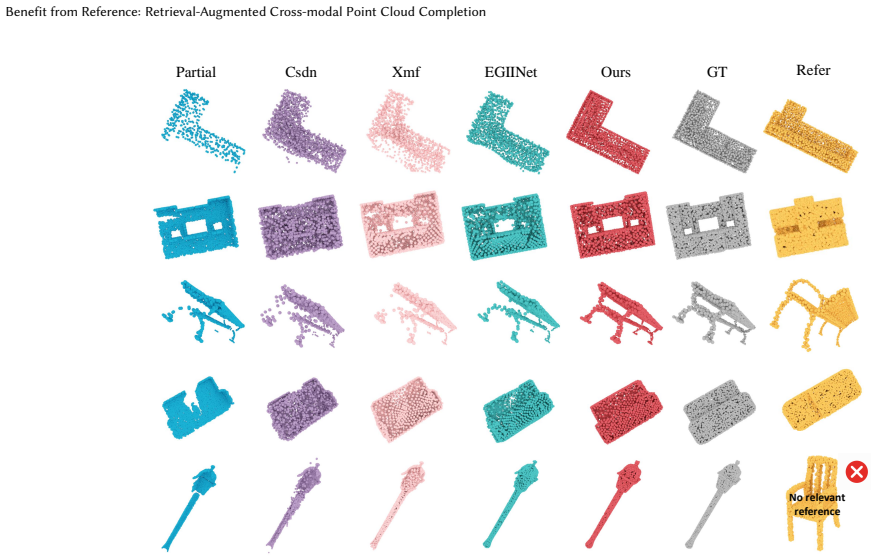
On its own terms, the paper claims that reformulating completion as retrieval-augmented joint generation is enough to reach state-of-the-art quality. Given an incomplete point cloud and its image, a cross-modal database built from ShapeNet and Objaverse is searched with CLIP embeddings to retrieve one similar point cloud. The SSFE encodes input and reference in a shared space without absolute position embedding for the reference, which avoids pose misalignment. The SACG computes a similarity gate from feature deltas and an absence gate from the intersection with the global input, so the reference contributes structure for missing regions rather than noise. PRAG generates a sparse seed from global features and then refines local details with semantic KNN cross-attention. The paper reports CD-ℓ1 of 0.988 and F1 of 0.889 on ShapeNet-ViPC, average CD-ℓ1 1.834 and F1 0.822 on five unseen categories, and KITTI fidelity 0.116 with MMD 0.281; the sparse-noisy variant degrades by only 0.071 in CD from the standard setting.
Load-bearing premise
The reported gains assume the retrieved reference is a different object, not the ground-truth complete model of the test object; the paper builds its retrieval database from the same ShapeNet source as the benchmark and never states that same-object references are excluded.
Editorial extensions
If this is right
- State-of-the-art results on ShapeNet-ViPC (CD-ℓ1 0.988, F1 0.889) imply that retrieval priors can be added on top of cross-modal completion without sacrificing fidelity.
- Graceful degradation when retrieval is irrelevant (ablation C1 is close to no-prior baseline B) suggests the gates learn to ignore bad references, making the method usable with imperfect retrieval.
- Small performance drop under 8x sparser and noisy inputs (CD 0.988 to 1.434) indicates the approach tolerates degraded LiDAR-style conditions.
- Improved completion on five unseen categories (average CD-ℓ1 1.834, F1 0.822) implies the reference prior transfers beyond training classes.
Reading between the lines
- If same-object leakage is absent, the method's real contribution is a controllable mechanism for injecting external geometric priors; a natural next test is a deliberate retrieval-quality sweep (perfect, similar, unrelated) to map how performance changes with reference relevance.
- The framework suggests a testable extension to text-only queries: since CLIP embeds text and images in one space, a text description could retrieve the reference without rendering images, which would make the method applicable when no image is available.
- A stronger evaluation would use a held-out retrieval database with class balance controlled, because ShapeNet-ViPC's categories may have near-duplicate objects across train and database.
Editorial analysis
A structured set of objections, weighed in public.
Referee Report
Summary. This paper proposes a retrieval-augmented cross-modal point cloud completion framework. Given an incomplete point cloud and a single image, it retrieves a similar complete 3D model from a database using CLIP embeddings, then uses a Structural Shared Feature Encoder (SSFE) with Similarity & Absence Control Gates (SACG) to encode and gate the reference, and a Progressive Retrieval-Augmented Generator (PRAG) to fuse the reference prior from global to local. The method is evaluated on ShapeNet-ViPC, unseen ShapeNet-ViPC categories, KITTI, and a sparse/noisy variant, and it reports state-of-the-art Chamfer Distance and F1 scores (e.g., CD-l1 0.988 and F1 0.889 on ShapeNet-ViPC).
Significance. If the reported results are valid, the idea of using retrieved similar objects as structural priors for point cloud completion is timely and potentially valuable. The paper provides a fairly complete modular description, explicit equations for the proposed components, and ablations for the encoder, gates, and decoder, and it additionally evaluates on real-world KITTI data and a sparse/noisy variant. However, the central quantitative claim is not secure because the retrieval database is built from the same ShapeNet source as the ShapeNet-ViPC benchmark and no same-instance exclusion is reported; the headline numbers could reflect copying of the ground-truth object rather than completion ability. The submission would need a substantial re-evaluation before its state-of-the-art claim can be accepted.
major comments (3)
- [§4.1.1, §4.2.1, Tables 1–2] The retrieval database is constructed from ShapeNet and Objaverse using 12 rendered images per object, and the ShapeNet-ViPC benchmark is built from ShapeNet with the same viewpoint setup. For a given test instance, its own complete model therefore appears to be a member of the retrieval database, and the query is that object's own render; CLIP retrieval would be expected to rank the exact object near the top. The manuscript never states that same-instance references are excluded, and no experiment reports the identity overlap between retrieved references and test targets. If the reference is the ground-truth object, the improvements reported in Tables 1 and 2 measure copying rather than completion, invalidating the central state-of-the-art claim. The authors must report same-instance hit rates, exclude the test instance (and ideally the same category) from the retrieval database, and re-run all benchmark comparisons.
- [Table 1] The AdaPoinTr row lists category-wise CD values identical to the SeedFormer row but reports an average CD-l1 of 2.423; averaging the eight listed category values gives approximately 2.952. This internally inconsistent baseline row undermines confidence in the numerical comparisons, and the authors should correct it and verify all other baseline rows against the original publications.
- [§4.3.1, Table 3] The KITTI evaluation is difficult to interpret because PoinTr and EGIINet are assigned FD=0 with the explanation that they splice inputs into the final result. A fidelity distance of exactly zero for methods that only copy visible input is not a meaningful comparison, and the reader cannot determine what is being measured. Please report the exact evaluation protocol, including how FD is computed for methods that preserve input points, and consider metrics that do not reward copying the partial input.
minor comments (5)
- [Eq. (10)] The Chamfer Distance formula should use |P1| and |P2| in the normalization terms; the current typesetting omits the absolute-value bars.
- [Table 2] The table lists 'PF-Net [40]' and 'MSN [24]', but reference [40] is PCN and reference [24] is TopNet; the citations appear mismatched and should be corrected.
- [§4.2.1, Tables 1–2] The dataset name is written inconsistently as 'ShapeNet-ViPC' and 'VIPC' across the text and tables; please use a single spelling throughout.
- [§4.2.1] The text says the unseen evaluation covers 5 categories 'including monitor and speaker', but Table 2 shows only Bench, Monitor, and Speaker; please specify the remaining two categories and their quantitative results.
- [§4.4, Table 5] The ablation study is reported without standard deviations or multiple seeds, and the claim that the fully irrelevant-reference case (C1) causes no significant negative impact is not supported by a statistical comparison; please add variance estimates or replicate runs.
Circularity Check
Central ShapeNet-ViPC SOTA benchmark is circular: the retrieval database constructed from ShapeNet can return each test object's own complete model as the 'reference prior', and the paper never excludes same-instance references.
-
self definitional
[Section 4.1.1 and Section 4.2.1; Tables 1-2; Eq. (11)]
"In order to obtain a reference point cloud, we construct a 3D model dataset based on the ShapeNet dataset and objaverse dataset [6] with their rendered 12 images of each object. In use, the corresponding models can be retrieved by image CLIP [22] embedding or text. ... The ShapeNet-ViPC dataset [43] comprises 38,328 objects spanning 13 categories. Each object in this dataset has a missing point cloud constructed from 24 viewpoints, with the same viewpoint setup as ShapeNetRendering [28]."
The retrieval database is built from the same ShapeNet source that generates the ShapeNet-ViPC benchmark, and it is indexed by rendered images. A ShapeNet-ViPC test query is the object's own rendered view (same ShapeNetRendering viewpoint setup), so the database contains both that object's complete point cloud and its matching render. Unless the authors explicitly suppress same-instance matches—which the paper never states—the CLIP retrieval returns the ground-truth completion as the 'reference prior' consumed by SSFE/PRAG. Eq. (11) evaluates the output with D_CD against Y_gt, the very shape that was just fed in as reference. Tables 1 and 2 therefore measure how well the decoder copies the retrieved target, not how well the method completes from partial evidence.
full rationale
The paper's flagship evaluation is contaminated by the retrieval setup as described. Since the database is built from ShapeNet and ShapeNet-ViPC test objects are ShapeNet objects rendered under ShapeNetRendering, the same object's complete model and rendered image can be the retrieved 'reference'. The paper never states that same-instance or ground-truth references are excluded, and no ablation reports the same-instance hit rate. Under the stated construction, the reference prior can be the target shape itself, so the reported CD/F1 improvements in Tables 1-2 may measure copying of the retrieved ground truth rather than completion ability. This makes the central SOTA claim reduce by construction, meriting a high circularity score. The KITTI experiment and the 'no relevant reference' ablation provide some independent signal but do not repair the main benchmark. The only self-citation, reference [11], appears in related work and is not load-bearing for the derivation; no uniqueness-import or ansatz-smuggling pattern is present.
Assumptions & free parameters
free parameters (4)
- Loss weights for L_seed, L_output, L_FT =
1, 1, 1
- SACG semantic neighbor count kappa =
4
- Training schedule =
2e-4 learning rate, 0.7 decay, 160 epochs
- Seed and output point counts =
512 seed points (inferred), 2048 output points
assumptions (4)
- domain assumption CLIP-based retrieval returns a semantically relevant reference from the ShapeNet/Objaverse database.
- domain assumption The retrieval database excludes the ground-truth object for every test sample.
- domain assumption A shared encoder without absolute position encoding can align arbitrary poses of reference and input.
- standard math Chamfer distance and F-score are faithful quality metrics for completion.
invented entities (3)
-
SACG (Similarity & Absence Control Gates)
-
PRAG (Progressive Retrieval-Augmented Generator)
-
SSFE (Structural Shared Feature Encoder)
Cite this review
Pith. "Pith review of Benefit from Reference: Retrieval-Augmented Cross-modal Point Cloud Completion." pith.science (2026). https://pith.science/paper/6ADCC563
@misc{pith2026250714485,
  author       = {Pith},
  title        = {Pith review of: Benefit from Reference: Retrieval-Augmented Cross-modal Point Cloud Completion},
  year         = {2026},
  howpublished = {\url{https://pith.science/paper/6ADCC563}},
  note         = {Machine review of arXiv:2507.14485}
}
read the original abstract
Completing the whole 3D structure based on an incomplete point cloud is a challenging task, particularly when the residual point cloud lacks typical structural characteristics. Recent methods based on cross-modal learning attempt to introduce instance images to aid the structure feature learning. However, they still focus on each particular input class, limiting their generation abilities. In this work, we propose a novel retrieval-augmented point cloud completion framework. The core idea is to incorporate cross-modal retrieval into completion task to learn structural prior information from similar reference samples. Specifically, we design a Structural Shared Feature Encoder (SSFE) to jointly extract cross-modal features and reconstruct reference features as priors. Benefiting from a dual-channel control gate in the encoder, relevant structural features in the reference sample are enhanced and irrelevant information interference is suppressed. In addition, we propose a Progressive Retrieval-Augmented Generator (PRAG) that employs a hierarchical feature fusion mechanism to integrate reference prior information with input features from global to local. Through extensive evaluations on multiple datasets and real-world scenes, our method shows its effectiveness in generating fine-grained point clouds, as well as its generalization capability in handling sparse data and unseen categories.
Figures



Figures from the paper (3 more)


Reference graph
Works this paper leans on
-
[1]
Emanuele Aiello, Diego Valsesia, and Enrico Magli. 2022. Cross-modal Learning for Image-Guided Point Cloud Shape Completion. In Advances in Neural Information Processing Systems , S. Koyejo, S. Mohamed, A. Agar- wal, D. Belgrave, K. Cho, and A. Oh (Eds.), Vol. 35. Curran Associates, Inc., 37349–37362. https://proceedings.neurips.cc/paper_files/paper/2022/...
work page 2022
-
[2]
Oron Ashual, Shelly Sheynin, Adam Polyak, Uriel Singer, Oran Gafni, Eliya Nachmani, and Yaniv Taigman. 2022. KNN-Diffusion: Image Generation via Large-Scale Retrieval. ArXiv abs/2204.02849 (2022). https://api.semanticscholar. org/CorpusID:247996596
arXiv 2022
-
[3]
Siheng Chen, Baoan Liu, Chen Feng, Carlos Vallespi-Gonzalez, and Carl K. Wellington. 2020. 3D Point Cloud Processing and Learning for Autonomous Driv- ing: Impacting Map Creation, Localization, and Perception.IEEE Signal Processing Magazine 38, 1 (2020), 68–86. https://doi.org/10.1109/MSP.2020.2984780
arXiv 2020
- [4]
-
[7]
Alexey Dosovitskiy, Lucas Beyer, Alexander Kolesnikov, Dirk Weissenborn, Xi- aohua Zhai, Thomas Unterthiner, Mostafa Dehghani, Matthias Minderer, Georg Heigold, Sylvain Gelly, Jakob Uszkoreit, and Neil Houlsby. 2020. An Image is Worth 16x16 Words: Transformers for Image Recognition at Scale. ArXiv abs/2010.11929 (2020). https://api.semanticscholar.org/Cor...
arXiv 2020
-
[8]
Haoqiang Fan, Hao Su, and Leonidas J. Guibas. 2017. A Point Set Gener- ation Network for 3D Object Reconstruction from a Single Image. In 2017 IEEE Conference on Computer Vision and Pattern Recognition (CVPR) . 2463–2471. https://doi.org/10.1109/CVPR.2017.264
-
[9]
Andreas Geiger, Philip Lenz, and Raquel Urtasun. 2012. Are We Ready for Autonomous Driving? The KITTI Vision Benchmark Suite. In 2012 IEEE Con- ference on Computer Vision and Pattern Recognition (CVPR) . 3354–3361. https: //doi.org/10.1109/CVPR.2012.6248074
arXiv 2012
-
[10]
Thibault Groueix, Matthew Fisher, Vladimir G. Kim, Bryan C. Russell, and Math- ieu Aubry. 2018. A Papier-Mache Approach to Learning 3D Surface Generation. In 2018 IEEE/CVF Conference on Computer Vision and Pattern Recognition (CVPR) . 216–224. https://doi.org/10.1109/CVPR.2018.00030
Show all 44 references
-
[11]
Hongye Hou, Xuehao Gao, Zhan Liu, and Yang Yang. 2024. Dig into Detailed Structures: Key Context Encoding and Semantic-based Decoding for Point Cloud Completion. In Proceedings of the 32nd ACM International Conference on Multime- dia (Melbourne VIC, Australia) (MM ’24). Associ...
2024
-
[12]
Ji Hou, Angela Dai, and Matthias Nießner. 2019. 3D-SIS: 3D Semantic Instance Segmentation of RGB-D Scans. In 2019 IEEE/CVF Conference on Computer Vision and Pattern Recognition (CVPR) . 4416–4425. https://doi.org/10.1109/CVPR.2019. 00455
2019 doi
-
[13]
Rehg, and Varun Jampani
Zixuan Huang, Mark Boss, Aaryaman Vasishta, James M. Rehg, and Varun Jampani. 2025. SPAR3D: Stable Point-Aware Reconstruction of 3D Objects from Single Images. arXiv:2501.04689 [cs.CV] https://arxiv.org/abs/2501.04689
2025 arXiv
-
[14]
Zitian Huang, Yikuan Yu, Jiawen Xu, Feng Ni, and Xinyi Le. 2020. PF-Net: Point Fractal Network for 3D Point Cloud Completion. In 2020 IEEE/CVF Conference on Computer Vision and Pattern Recognition (CVPR) . 7659–7667. https://doi.org/ 10.1109/CVPR42600.2020.00768
2020
-
[15]
Stephen James, Kentaro Wada, Tristan Laidlow, and Andrew J. Davison. 2022. Coarse-to-Fine Q-attention: Efficient Learning for Visual Robotic Manipulation via Discretisation. In 2022 IEEE/CVF Conference on Computer Vision and Pattern Recognition (CVPR). 13729–13738. https://doi...
2022
-
[16]
Kingma and Jimmy Ba
Diederik P. Kingma and Jimmy Ba. 2017. Adam: A Method for Stochastic Opti- mization. arXiv:1412.6980 [cs.LG] https://arxiv.org/abs/1412.6980
2017 arXiv
-
[17]
Patrick Lewis, Ethan Perez, Aleksandra Piktus, Fabio Petroni, Vladimir Karpukhin, Naman Goyal, Heinrich Küttler, Mike Lewis, Wen-tau Yih, Tim Rocktäschel, Sebastian Riedel, and Douwe Kiela. 2020. Retrieval-Augmented Generation for Knowledge-Intensive NLP Tasks. In Proceedings ...
2020
-
[18]
Ming Liang, Binh Yang, Shenlong Wang, and Raquel Urtasun. 2018. Deep Contin- uous Fusion for Multi-sensor 3D Object Detection. In 2018 European Conference on Computer Vision (ECCV) . https://doi.org/10.1007/978-3-030-01270-0_39
2018 doi
-
[19]
Yinyu Nie, Ji Hou, Xiaoguang Han, and Matthias Nießner. 2020. RfD-Net: Point Scene Understanding by Semantic Instance Reconstruction. In 2021 IEEE/CVF Conference on Computer Vision and Pattern Recognition (CVPR) . 4606–4616. https: //doi.org/10.1109/CVPR46437.2021.00458
2020
-
[20]
Mitra, Joachim Giesen, Markus Gross, and Leonidas J
Mark Pauly, Niloy J. Mitra, Joachim Giesen, Markus Gross, and Leonidas J. Guibas. 2005. Example-Based 3D Scan Completion. In Proceedings of the Third Eurographics Symposium on Geometry Processing (Vienna, Austria) (SGP ’05). Eurographics Association, Goslar, DEU, 23–es
2005
-
[21]
Qi, Hao Su, Kaichun Mo, and Leonidas J
Charles R. Qi, Hao Su, Kaichun Mo, and Leonidas J. Guibas. 2017. PointNet: Deep Learning on Point Sets for 3D Classification and Segmentation. In 2017 IEEE Conference on Computer Vision and Pattern Recognition (CVPR) . 77–85. https: //doi.org/10.1109/CVPR.2017.16
2017 doi
-
[22]
Alec Radford, Jong Wook Kim, Chris Hallacy, Aditya Ramesh, Gabriel Goh, Sandhini Agarwal, Girish Sastry, Amanda Askell, Pamela Mishkin, Jack Clark, Gretchen Krueger, and Ilya Sutskever. 2021. Learning Transferable Visual Models From Natural Language Supervision. In Internation...
2021
-
[23]
Richter, René Ranftl, Zhuwen Li, Vladlen Koltun, and Thomas Brox
Maxim Tatarchenko, Stephan R. Richter, René Ranftl, Zhuwen Li, Vladlen Koltun, and Thomas Brox. 2019. What Do Single-View 3D Reconstruction Networks Learn?. In 2019 IEEE/CVF Conference on Computer Vision and Pattern Recognition (CVPR). 3400–3409. https://doi.org/10.1109/CVPR.2...
2019
-
[24]
Tchapmi, Vineet Kosaraju, Hamid Rezatofighi, Ian Reid, and Silvio Savarese
Lyne P. Tchapmi, Vineet Kosaraju, Hamid Rezatofighi, Ian Reid, and Silvio Savarese. 2019. TopNet: Structural Point Cloud Decoder. In 2019 IEEE/CVF Conference on Computer Vision and Pattern Recognition (CVPR) . 383–392. https: //doi.org/10.1109/CVPR.2019.00047
2019
-
[25]
Gomez, Łukasz Kaiser, and Illia Polosukhin
Ashish Vaswani, Noam Shazeer, Niki Parmar, Jakob Uszkoreit, Llion Jones, Aidan N. Gomez, Łukasz Kaiser, and Illia Polosukhin. 2017. Attention is All you Need. In Proceedings of the 31st International Conference on Neural Informa- tion Processing Systems (NIPS’17) . 6000–6010. ...
2017
-
[26]
Jun Wang, Yinghan Cui, Dongyan Guo, Junxia Li, Qingshan Liu, and Chunhua Shen. 2022. PointAttN: You Only Need Attention for Point Cloud Completion. In AAAI Conference on Artificial Intelligence . https://api.semanticscholar.org/ CorpusID:247475731
2022
-
[27]
Peng-Shuai Wang, Yang Liu, Yu-Xiao Guo, Chun-Yu Sun, and Xin Tong. 2017. O-CNN: Octree-based Convolutional Neural Networks for 3D Shape Analysis. ACM Trans. Graph. 36, 4, Article 72 (jul 2017), 11 pages. https://doi.org/10.1145/ 3072959.3073608
2017
-
[28]
Weiyue Wang, Qiangeng Xu, Duygu Ceylan, Radomir Mech, and Ulrich Neu- mann. 2019. DISN: deep implicit surface network for high-quality single-view 3D reconstruction. Curran Associates Inc., Red Hook, NY, USA
2019
-
[29]
Sarma, Michael M
Yue Wang, Yongbin Sun, Ziwei Liu, Sanjay E. Sarma, Michael M. Bronstein, and Justin M. Solomon. 2019. Dynamic Graph CNN for Learning on Point Clouds. ACM Trans. Graph. 38, 5, Article 146 (oct 2019), 12 pages. https: //doi.org/10.1145/3326362
2019 doi
-
[30]
Zhenwei Wang, Tengfei Wang, Zexin He, Gerhard Petrus Hancke, Ziwei Liu, and Rynson W. H. Lau. 2025. Phidias: A Generative Model for Creating 3D Content from Text, Image, and 3D Conditions with Reference-Augmented Diffusion. In The Thirteenth International Conference on Learnin...
2025
-
[31]
Xiaoyang Wu, Li Jiang, Peng-Shuai Wang, Zhijian Liu, Xihui Liu, Yu Qiao, Wanli Ouyang, Tong He, and Hengshuang Zhao. 2024. Point Transformer V3: Simpler, Faster, Stronger. In 2024 IEEE/CVF Conference on Computer Vision and Pattern Recognition (CVPR). 4840–4851. https://doi.org...
2024
-
[32]
Jianfeng Xiang, Zelong Lv, Sicheng Xu, Yu Deng, Ruicheng Wang, Bowen Zhang, Dong Chen, Xin Tong, and Jiaolong Yang. 2024. Structured 3D Latents for Scalable and Versatile 3D Generation. arXiv:2412.01506 [cs.CV] https://arxiv. org/abs/2412.01506
2024 arXiv
-
[33]
Peng Xiang, Xin Wen, Yu-Shen Liu, Yan-Pei Cao, Pengfei Wan, Wen Zheng, and Zhizhong Han. 2021. SnowflakeNet: Point Cloud Completion by Snowflake Point Deconvolution with Skip-Transformer. In2021 IEEE/CVF International Conference on Computer Vision (ICCV) . 5479–5489
2021
-
[34]
Haozhe Xie, Hongxun Yao, Shangchen Zhou, Jiageng Mao, Shengping Zhang, and Wenxiu Sun. 2020. GRNet: Gridding Residual Network for Dense Point Cloud Completion. In 2020 European Conference on Computer Vision (ECCV) . https://doi.org/10.1007/978-3-030-58545-7_21
2020 doi
-
[35]
Hang Xu, Chen Long, Wenxiao Zhang, Yuan Liu, Zhen Cao, Zhen Dong, and Bisheng Yang. 2024. Explicitly Guided Information Interaction Network for Cross-modal Point Cloud Completion. arXiv:2407.02887 [cs.CV] https://arxiv. org/abs/2407.02887
2024 arXiv
-
[36]
Le Xue, Mingfei Gao, Chen Xing, Roberto Martín-Martín, Jiajun Wu, Caiming Xiong, Ran Xu, Juan Carlos Niebles, and Silvio Savarese. 2023. ULIP: Learn- ing a Unified Representation of Language, Images, and Point Clouds for 3D Understanding. In 2023 IEEE/CVF Conference on Compute...
2023
-
[37]
Yaoqing Yang, Chen Feng, Yiru Shen, and Dong Tian. 2018. FoldingNet: Point Cloud Auto-Encoder via Deep Grid Deformation. In 2018 IEEE/CVF Conference on Computer Vision and Pattern Recognition (CVPR) . 206–215. https://doi.org/10. 1109/CVPR.2018.00029 Someone et al
2018
-
[39]
Xumin Yu, Yongming Rao, Ziyi Wang, Jiwen Lu, and Jie Zhou. 2023. AdaPoinTr: Diverse Point Cloud Completion With Adaptive Geometry-Aware Transformers. IEEE Transactions on Pattern Analysis and Machine Intelligence 45, 12 (2023), 14114–14130. https://doi.org/10.1109/TPAMI.2023.3309253
2023
-
[40]
Wentao Yuan, Tejas Khot, David Held, Christoph Mertz, and Martial Hebert
-
[41]
Longwen Zhang, Ziyu Wang, Qixuan Zhang, Qiwei Qiu, Anqi Pang, Haoran Jiang, Wei Yang, Lan Xu, and Jingyi Yu. 2024. CLAY: A Controllable Large-scale Generative Model for Creating High-quality 3D Assets. arXiv:2406.13897 [cs.CV] https://arxiv.org/abs/2406.13897
2024 arXiv
-
[42]
Wenxiao Zhang, Huajian Zhou, Zhen Dong, Jun Liu, Qingan Yan, and Chunxia Xiao. 2023. Point Cloud Completion Via Skeleton-Detail Transformer. IEEE Transactions on Visualization and Computer Graphics 29, 10 (2023), 4229–4242. https://doi.org/10.1109/TVCG.2022.3185247
2023
-
[43]
Xuancheng Zhang, Yutong Feng, Siqi Li, Changqing Zou, Hai Wan, Xibin Zhao, Yandong Guo, and Yue Gao. 2021. View-Guided Point Cloud Completion. In Pro- ceedings of the IEEE/CVF Conference on Computer Vision and Pattern Recognition . 15890–15899
2021
-
[44]
Hengshuang Zhao, Li Jiang, Jiaya Jia, Philip Torr, and Vladlen Koltun. 2021. Point Transformer. In2021 IEEE/CVF International Conference on Computer Vision (ICCV). 16239–16248. https://doi.org/10.1109/ICCV48922.2021.01595
2021
-
[45]
Haoran Zhou, Yun Cao, Wenqing Chu, Junwei Zhu, Tong Lu, Ying Tai, and Chengjie Wang. 2022. SeedFormer: Patch Seeds Based Point Cloud Completion with Upsample Transformer. In 2022 European Conference on Computer Vision (ECCV). 416–432. https://doi.org/10.1007/978-3-031-20062-5_24
2022 doi
-
[46]
Zhe Zhu, Liangliang Nan, Haoran Xie, Honghua Chen, Jun Wang, Mingqiang Wei, and Jing Qin. 2024. CSDN: Cross-Modal Shape-Transfer Dual-Refinement Network for Point Cloud Completion. IEEE Transactions on Visualization and Computer Graphics 30, 7 (2024), 3545–3563. https://doi.or...
2024 doi
-
[2018]
In 2018 International Conference on 3D Vision (3DV)
PCN: Point Completion Network. In 2018 International Conference on 3D Vision (3DV). 728–737. https://doi.org/10.1109/3DV.2018.00088
2018
Reviewed August 6, 2026 · model on record in the stance chip above.
Discussion (0). Sign in to comment.