REVIEW 5 major objections 6 minor 1 cited by
Multimodal AI for Gastrointestinal Diagnostics: Tackling VQA in MEDVQA-GI 2025
T0 review · 5 major / 6 minor · reviewed 2026-08-06 · deepseek-v4-flash
Pith's one-line read A fine-tuned Florence-2 vision-language model answers gastrointestinal endoscopy questions from a 1% training slice, with a private-test METEOR of 0.49.
desk verdict A modest, honest low-data fine-tuning report whose main empirical numbers are undercut by an unclear evaluation protocol and an unsupported state-of-the-art claim. read the letter →
The pith
A machine-rendered reading of the paper's core claim, the machinery that carries it, and where it could break.
The reading
What carries the argument
The carrier is Florence-2, a unified vision foundation model that casts every vision-language task as sequence-to-sequence generation from an image plus a prompt. A frozen DaViT/ViT-L/14 vision encoder produces 196 visual tokens per image, and a multi-modal encoder-decoder with a 2.7B-parameter causal language decoder generates the answer, trained with cross-entropy loss on tokenized answer sequences. The paper's added machinery is a small set of domain-aware augmentations, namely random crop, flip, and color jitter selected to keep endoscopy-relevant cues visible, plus temperature sampling at inference with $T = 0.7$. The mechanism works by letting the frozen visual tower supply general representations while the fine-tuned decoder adapts to the 20-question-template, 502-answer linguistic landscape of Kvasir-VQA.
What would settle it
Run the same fine-tuned checkpoint on the official MEDVQA-GI 2025 Subtask 1 test inputs and score the outputs with the challenge's own evaluation script; if the official metric is not n-gram overlap or the reported public/private BLEU and METEOR values do not reproduce, the central claim fails.
Extended reading notes
Core claim
The central claim is that Florence-2's unified sequence-to-sequence design, which treats a question as a prompt and generates free-text answers, can be adapted to GI-endoscopy VQA by keeping the ViT-L/14 vision tower frozen and fine-tuning the multimodal encoder and 2.7B-parameter causal decoder. The paper reports that fine-tuned augmentation, meaning random crop, flip, and color jitter adjusted to preserve endoscopic features such as mucosal texture and bleeding points, raises METEOR from 0.31 with no augmentation to 0.44 on the public split and 0.49 on the private split, with BLEU 0.16 and ROUGE-L 0.88 on the private split. It also reports that heavy, unrealistic augmentations degrade performance to METEOR 0.25, and that performance is stronger on spatial and binary question types such as 'where' and 'have' than on procedural questions such as 'how'. On these grounds the paper states that its approach yields state-of-the-art performance on the Kvasir-VQA benchmark and provides a strong baseline for the MEDVQA-GI 2025 Subtask 1 challenge.
Load-bearing premise
The load-bearing premise is that the BLEU, ROUGE, and METEOR numbers computed on the paper's own public and private splits are what the MEDVQA-GI 2025 challenge actually grades, since the paper never names the official scoring metric and gives an ambiguous description of how the test splits were formed.
Editorial extensions
If this is right
- A 1% stratified slice of Kvasir-VQA moves a frozen-encoder Florence-2 from BLEU 0.00 to a private-test METEOR of 0.49, suggesting data-efficient medical VQA is feasible without full dataset access.
- Augmentation choice is decisive: domain-tuned standard augmentation improves METEOR from 0.31 to 0.44, while heavy unrealistic distortions drop it to 0.25, so augmentation design is a core component of the pipeline.
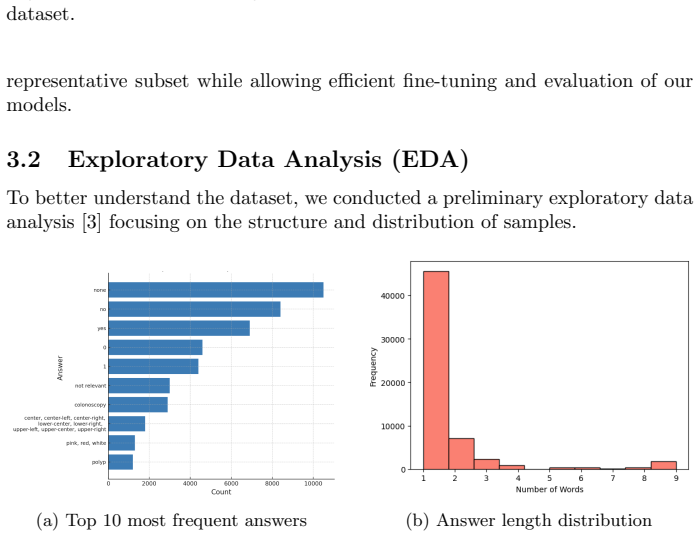
- The generative decoding approach can handle the dataset's class imbalance and multi-word answers, escaping the fixed-answer-set restriction of classification-based Med-VQA methods.
- Performance is uneven by question type: strong on spatial and binary questions such as 'where' (METEOR 0.58) and 'have' (0.77), weak on procedural 'how' (0.37), pointing future work toward reasoning-heavy templates.
- These scores provide a reproducible baseline for future MEDVQA-GI submissions, particularly for teams with limited computational resources.
Reading between the lines
- If the reported numbers reproduce under the official challenge metric, the same freeze-the-encoder, fine-tune-the-decoder recipe could transfer to other low-annotation medical imaging domains such as dermoscopy or pathology VQA, though the paper does not test this.
- Because Kvasir-VQA has only 20 question templates, the 1% subset may overrepresent common templates; a testable extension is to measure per-template coverage and see whether the reported gains concentrate in high-frequency questions.
- A clinician-rated correctness sample of private-test answers would clarify whether the METEOR gains reflect clinically usable answers, since n-gram overlap can reward paraphrases that change medical meaning; the paper reports no such evaluation.
- The paper's discussion of unanswerable questions suggests a next step of measuring abstention behavior on out-of-distribution or unanswerable queries, which the current n-gram metrics do not capture.
Editorial analysis
A structured set of objections, weighed in public.
Referee Report
Summary. The paper describes a fine-tuning pipeline for Subtask 1 of the ImageCLEFmed MEDVQA 2025 challenge, using Florence-2 as the backbone and a 1% stratified subset of Kvasir-VQA. The authors freeze the vision encoder, fine-tune the language decoder, and apply domain-specific augmentations. They report BLEU, ROUGE, and METEOR scores on splits they call 'Validation', 'Public', and 'Private', with the private-test METEOR of 0.49 as the headline result. The paper claims state-of-the-art performance on Kvasir-VQA and accurate responses on official challenge metrics, and it makes the code publicly available.
Significance. If the evaluation were properly documented, this paper would provide a useful, reproducible baseline for low-resource medical VQA: it uses a standard fine-tuning recipe, a frozen vision encoder, publicly available code, and fixed seeds. The augmentation ablation, though currently confounded, addresses a relevant practical question. However, the paper's central claims of state-of-the-art performance and accuracy on 'official challenge metrics' are not supported by the evidence as presented, because the test splits are undefined, the official metric is never identified, and no comparison to prior Kvasir-VQA methods is given. With revised evaluation and more modest claims, the work could serve as a legitimate challenge write-up, but in its current form the load-bearing results cannot be verified.
major comments (5)
- [3.1 (Dataset Description)] The split description is internally contradictory and leaves no test set. The text says the 1% subset was 'initially divided into 90% training and 10% testing. The testing portion was further split into 90% training and 10% validation, resulting in a final train/validation/test split.' Under this arithmetic, the original 10% testing portion becomes 9% additional training and 1% validation, with zero samples remaining for testing. Yet Table 1 reports scores on 'Public' and 'Private' test sets, which are never defined in terms of sample counts or construction. Because every reported accuracy number, including the headline METEOR 0.49 on 'Private', depends on these undefined partitions, the authors must specify exactly how the Public and Private test sets were formed, how many samples each contains, and that no model selection (including early stopping) used these partitions.
- [4.5 and 5 (Training Protocol and Results)] The early stopping procedure creates a risk of optimistic bias. Section 4.5 states 'Evaluation was done after each epoch, with early stopping after 3 epochs without improvement,' and the 'Clarification' in Section 5 confirms that evaluations were performed at each epoch. However, the paper never states which split drove early stopping. If the Public or Private test partitions were used for model selection, the reported numbers are the maximum of a noisy selection process rather than unbiased test estimates. Please report which split was used for early stopping, the epoch at which the Table 1 numbers were obtained, and per-epoch evaluation curves for the validation and test splits.
- [2 (Related Work) and Abstract] The claim of 'state-of-the-art performance on the Kvasir-VQA benchmark' is unsupported. No comparison to any prior Kvasir-VQA method appears anywhere in the manuscript; the only comparisons are the paper's own augmentation variants (Table 2). Likewise, the Abstract's 'accurate responses on the official challenge metrics' cannot be checked because the official ImageCLEFmed MEDVQA 2025 scoring metric is never identified. The authors should either (a) add a quantitative comparison to published Kvasir-VQA results on identical splits and metrics, or (b) remove the state-of-the-art and official-metric claims and instead state that the paper reports an evaluation of the proposed pipeline on the authors' own splits.
- [6 (Ablation Studies), Table 2] The augmentation ablation appears confounded with evaluation split. The 'Standard Augmentation' row (BLEU 0.12, ROUGE-L 0.77, METEOR 0.42) exactly matches the 'Validation' row of Table 1, and the 'Fine-Tuned Augmentation' row (BLEU 0.15, ROUGE-L 0.80, METEOR 0.44) exactly matches the 'Public' row of Table 1. The table does not state which split is used for each row. If the augmentation strategies were evaluated on different splits, the improvement cannot be attributed to the augmentation. All augmentation strategies should be evaluated on the same held-out split, and that split should be explicitly identified.
- [4.2 and 4.4 (Architecture and Fine-Tuning Setup)] The architecture description is inconsistent with the stated base model. Section 4.4 says the authors fine-tuned 'microsoft/Florence-2-base-ft', but Section 4.2 describes a '2.7B parameter causal language model', and Section 4.3 mentions parameter counts of 0.23B (base) and 0.77B (large). Florence-2-base has 0.23B parameters, so the 2.7B figure appears to describe a different model. The authors should correct the architecture description to match the checkpoint actually used and state precisely which components were fine-tuned versus frozen.
minor comments (6)
- [2 (Related Work)] This section says 'Kvasir-VQA consists of over 6,500 annotated image-question-answer (IQA) triplets,' but Section 3.1 says the dataset comprises 58,849 triplets associated with 6,500 images. Please clarify whether 6,500 refers to images and 58,849 to triplets, and use the terminology consistently.
- [4.5 and 4.6 (Training Protocol and Implementation Details)] Section 4.5 reports a cosine decay over 20 epochs, while Section 4.6 says the training used a '72-hour time budget over 10 epochs.' These are inconsistent; please align the stated number of epochs and the learning-rate schedule.
- [5 (Results and Evaluation), 'Clarification'] The 'Clarification' paragraph within the Results section repeats methodology already presented in Section 4. Consider moving or removing it to improve the paper's flow.
- [Abstract and Acknowledgments] The dataset name is spelled 'KASVIR' in the Abstract and Acknowledgments; it should be 'Kvasir'.
- [6 (Ablation Studies)] Table 2 is introduced by two consecutive 'Table 2:' captions, which is a formatting error. Also, the table caption should state the evaluation split used for each row.
- [4.5 (Training Protocol)] The sentence 'Baselines were compared using paired t-tests (p < 0.05)' is not accompanied by any reported test statistic, p-value, or description of what baselines were compared. Either report the results or delete the sentence.
Circularity Check
No circularity found: the paper's results come from a standard fine-tuning and held-out evaluation; the split/metric ambiguities are validity concerns, not circular reasoning.
full rationale
This is a standard empirical fine-tuning paper and there is no derivation chain that assumes its own conclusion. The central claim—that Florence-2 fine-tuned on a 1% Kvasir-VQA subset with augmentation yields the reported BLEU, ROUGE, and METEOR scores on validation, public, and private splits—is grounded in a held-out evaluation procedure as described. No parameter is fitted to the final test metric and then renamed a prediction: the augmentation comparison in Table 2 selects among strategies, and the private-test row is reported as a separate partition. The Section 2 claim of state-of-the-art performance is unsupported because no prior Kvasir-VQA results are cited for comparison, but an unsupported comparative assertion is a correctness/evidence problem, not circularity. Similarly, the Section 3.1 split arithmetic does not obviously produce a test set, and the official ImageCLEFmed metric is never identified; these are serious evaluation-validity risks that belong in a correctness review, but they do not show that the derivation reduces to its inputs. There are no load-bearing self-citations: the present authors do not appear among the cited prior works, and the cited Kvasir-VQA and ImageCLEF overview papers are external sources for the benchmark. Accordingly, the circularity score is 0.
Assumptions & free parameters
free parameters (7)
- learning_rate =
7.8e-6
- weight_decay =
0.1
- training_epochs =
10 (Section 4.6) vs 20 (Section 4.5)
- early_stopping_patience =
3 epochs
- sampling_temperature =
0.7
- data_subset_fraction =
1%
- fine-tuned_augmentation_hyperparameters =
unspecified
assumptions (4)
- domain assumption Florence-2's pretrained visual representations transfer to endoscopic images.
- domain assumption The 1% stratified subset is representative of the full Kvasir-VQA distribution.
- domain assumption BLEU, ROUGE, and METEOR are appropriate proxies for the official challenge metric.
- domain assumption Standard and 'fine-tuned' augmentations preserve clinically relevant visual features.
Cite this review
Pith. "Pith review of Multimodal AI for Gastrointestinal Diagnostics: Tackling VQA in MEDVQA-GI 2025." pith.science (2026). https://pith.science/paper/E5ZU2M5C
@misc{pith2026250714544,
  author       = {Pith},
  title        = {Pith review of: Multimodal AI for Gastrointestinal Diagnostics: Tackling VQA in MEDVQA-GI 2025},
  year         = {2026},
  howpublished = {\url{https://pith.science/paper/E5ZU2M5C}},
  note         = {Machine review of arXiv:2507.14544}
}
read the original abstract
This paper describes our approach to Subtask 1 of the ImageCLEFmed MEDVQA 2025 Challenge, which targets visual question answering (VQA) for gastrointestinal endoscopy. We adopt the Florence model-a large-scale multimodal foundation model-as the backbone of our VQA pipeline, pairing a powerful vision encoder with a text encoder to interpret endoscopic images and produce clinically relevant answers. To improve generalization, we apply domain-specific augmentations that preserve medical features while increasing training diversity. Experiments on the KASVIR dataset show that fine-tuning Florence yields accurate responses on the official challenge metrics. Our results highlight the potential of large multimodal models in medical VQA and provide a strong baseline for future work on explainability, robustness, and clinical integration. The code is publicly available at: https://github.com/TiwariLaxuu/VQA-Florence.git
Figures


Forward citations
Cited by 1 Pith paper
-
Measuring and Improving Complex-Atomic Answer Consistency in Endoscopic VQA
Vision-language models can answer complex endoscopic questions correctly while failing the same-image atomic sub-questions; EndoCA measures this gap and ASR reduces it.
Reference graph
Works this paper leans on
-
[1]
Vqa: Visual question an- swering
Stanislaw Antol, Aishwarya Agrawal, Jiasen Lu, Margaret Mitchell, Dhruv Batra, C Lawrence Zitnick, and Devi Parikh. Vqa: Visual question an- swering. In Proceedings of the IEEE international conference on computer vision, pages 2425–2433, 2015
work page 2015
-
[2]
Prompt to Polyp: Medical Text-Conditioned Image Synthesis with Diffu- sion Models
Mikhail Chaichuk, Sushant Gautam, Steven Hicks, and Elena Tutubalina. Prompt to Polyp: Medical Text-Conditioned Image Synthesis with Diffu- sion Models. arXiv, May 2025. doi:10.48550/arXiv.2505.05573
-
[3]
Chris Chatfield. Exploratory data analysis. European journal of operational research, 23(1):5–13, 1986
work page 1986
-
[4]
Mapping medical image-text to a joint space via masked modeling
Zhihong Chen, Yuhao Du, Jinpeng Hu, Yang Liu, Guanbin Li, Xi- ang Wan, and Tsung-Hui Chang. Mapping medical image-text to a joint space via masked modeling. Medical Image Analysis , 91:103018,
-
[5]
Vision- language transformer and query generation for referring segmentation
Henghui Ding, Chang Liu, Suchen Wang, and Xudong Jiang. Vision- language transformer and query generation for referring segmentation. In Proceedings of the IEEE/CVF international conference on computer vision, pages 16321–16330, 2021
work page 2021
-
[6]
Sedigheh Eslami, Christoph Meinel, and Gerard De Melo. Pubmedclip: How much does clip benefit visual question answering in the medical do- main? In Findings of the Association for Computational Linguistics: EACL 2023, pages 1181–1193, 2023. 12
work page 2023
-
[7]
Bridging Multimedia Modalities: Enhanced Multimodal AI Understanding and Intelligent Agents
Sushant Gautam. Bridging Multimedia Modalities: Enhanced Multimodal AI Understanding and Intelligent Agents. In ACM Conferences, pages 695–
-
[8]
Sushant Gautam, Michael A. Riegler, and P ˚ al Halvorsen. Kvasir-VQA- x1: A Multimodal Dataset for Medical Reasoning and Robust MedVQA in Gastrointestinal Endoscopy. arXiv, June 2025. arXiv:2506.09958, doi:10.48550/arXiv.2506.09958
Show all 27 references
-
[9]
Hicks, Vajira Thambawita, P ˚ al Halvorsen, and Michael A
Sushant Gautam, Andrea Stor ˚ as, Cise Midoglu, Steven A. Hicks, Vajira Thambawita, P ˚ al Halvorsen, and Michael A. Riegler. Kvasir-vqa: A text- image pair gi tract dataset. In Proceedings of the First International Work- shop on Vision-Language Models for Biomedical Applicat...
2024
-
[10]
Making the v in vqa matter: Elevating the role of image under- standing in visual question answering
Yash Goyal, Tejas Khot, Douglas Summers-Stay, Dhruv Batra, and Devi Parikh. Making the v in vqa matter: Elevating the role of image under- standing in visual question answering. In Proceedings of the IEEE confer- ence on computer vision and pattern recognition , pages 6904–6913, 2017
2017
-
[11]
Unk-vqa: A dataset and a probe into the abstention ability of multi- modal large models
Yangyang Guo, Fangkai Jiao, Zhiqi Shen, Liqiang Nie, and Mohan Kankan- halli. Unk-vqa: A dataset and a probe into the abstention ability of multi- modal large models. IEEE Transactions on Pattern Analysis and Machine Intelligence, 2024
2024
-
[12]
Unboxing the black box of attention mech- anisms in remote sensing big data using xai
Erfan Hasanpour Zaryabi, Loghman Moradi, Bahareh Kalantar, Naonori Ueda, and Alfian Abdul Halin. Unboxing the black box of attention mech- anisms in remote sensing big data using xai. Remote Sensing, 14(24):6254, 2022
2022
-
[13]
Bogdan Ionescu, Henning M¨ uller, Dan-Cristian Stanciu, Ahmad Idrissi- Yaghir, Ahmedkhan Radzhabov, Alba Garc ´ ıa Seco de Herrera, Alexandra Andrei, Andrea Stor ˚ as, Asma Ben Abacha, Benjamin Bracke, Benjamin Lecouteux, Benno Stein, C´ ecile Macaire, Christoph M. Friedrich, ...
2025
-
[14]
A good prompt is worth millions of parameters: Low-resource prompt-based learning for vision-language models
Woojeong Jin, Yu Cheng, Yelong Shen, Weizhu Chen, and Xiang Ren. A good prompt is worth millions of parameters: Low-resource prompt-based learning for vision-language models. arXiv preprint arXiv:2110.08484 , 2021
2021 arXiv
-
[15]
A dataset of clinically generated visual questions and answers about radiology images
Jason J Lau, Soumya Gayen, Asma Ben Abacha, and Dina Demner- Fushman. A dataset of clinically generated visual questions and answers about radiology images. Scientific data , 5(1):1–10, 2018
2018
-
[16]
Blip: Bootstrap- ping language-image pre-training for unified vision-language understanding and generation
Junnan Li, Dongxu Li, Caiming Xiong, and Steven Hoi. Blip: Bootstrap- ping language-image pre-training for unified vision-language understanding and generation. In International conference on machine learning , pages 12888–12900. PMLR, 2022
2022
-
[17]
Contrastive pre-training and representation distillation for medical visual question answering based on radiology images
Bo Liu, Li-Ming Zhan, and Xiao-Ming Wu. Contrastive pre-training and representation distillation for medical visual question answering based on radiology images. In Marleen de Bruijne, Philippe C. Cattin, St´ ephane Cotin, Nicolas Padoy, Stefanie Speidel, Yefeng Zheng, and Car...
2021
-
[18]
Slake: A semantically-labeled knowledge-enhanced dataset for medical vi- sual question answering
Bo Liu, Li-Ming Zhan, Li Xu, Lin Ma, Yan Yang, and Xiao-Ming Wu. Slake: A semantically-labeled knowledge-enhanced dataset for medical vi- sual question answering. In 2021 IEEE 18th international symposium on biomedical imaging (ISBI) , pages 1650–1654. IEEE, 2021
2021
-
[19]
Improved base- lines with visual instruction tuning
Haotian Liu, Chunyuan Li, Yuheng Li, and Yong Jae Lee. Improved base- lines with visual instruction tuning. In Proceedings of the IEEE/CVF Con- ference on Computer Vision and Pattern Recognition , pages 26296–26306, 2024
2024
-
[20]
Florence-2: Advancing a unified representation for a variety of vision tasks
Bin Xiao, Haiping Wu, Weijian Xu, Xiyang Dai, Houdong Hu, Yumao Lu, Michael Zeng, Ce Liu, and Lu Yuan. Florence-2: Advancing a unified representation for a variety of vision tasks. InProceedings of the IEEE/CVF Conference on Computer Vision and Pattern Recognition, pages 4818–...
2024
-
[21]
A survey of efficient fine-tuning methods for vision-language models—prompt and adapter
Jialu Xing, Jianping Liu, Jian Wang, Lulu Sun, Xi Chen, Xunxun Gu, and Yingfei Wang. A survey of efficient fine-tuning methods for vision-language models—prompt and adapter. Computers & Graphics , 119:103885, 2024
2024
-
[22]
Multi-modal concept align- ment pre-training for generative medical visual question answering
Quan Yan, Junwen Duan, and Jianxin Wang. Multi-modal concept align- ment pre-training for generative medical visual question answering. In Lun-Wei Ku, Andre Martins, and Vivek Srikumar, editors, Findings of 14 the Association for Computational Linguistics: ACL 2024 , pages 537...
2024 doi
-
[23]
Vqa and visual reasoning: An overview of recent datasets, methods and challenges
Rufai Yusuf Zakari, Jim Wilson Owusu, Hailin Wang, Ke Qin, Zaharad- deen Karami Lawal, and Yuezhou Dong. Vqa and visual reasoning: An overview of recent datasets, methods and challenges. arXiv preprint arXiv:2212.13296, 2022
2022 arXiv
-
[24]
Medical visual question answering via conditional reasoning
Li-Ming Zhan, Bo Liu, Lu Fan, Jiaxin Chen, and Xiao-Ming Wu. Medical visual question answering via conditional reasoning. In Proceedings of the 28th ACM International Conference on Multimedia, pages 2345–2354, 2020. 15
2020
-
[699]
Association for Computing Machinery, New York, NY, USA, October
-
[2023]
doi:10.1145/3577190.3614225
-
[2024]
URL: https://www.sciencedirect.com/science/article/pii/ S1361841523002785, doi:10.1016/j.media.2023.103018
2023
Reviewed August 6, 2026 · model on record in the stance chip above.
Discussion (0). Sign in to comment.