REVIEW 4 major objections 4 minor 1 cited by
Properties of compact objects in quadratic non-metricity gravity
T0 review · 4 major / 4 minor · reviewed 2026-08-06 · deepseek-v4-flash
Pith's one-line read In quadratic non-metricity gravity, a 2-solar-mass pulsar can have a soft equation of state with radial sound speed below the conformal bound and compactness below the Buchdahl limit.
desk verdict Competent but routine KB-ansatz star model in quadratic f(Q) whose headline sound-speed bound fails a continuity check; the algebra is checkable, but the physical claims are oversold. read the letter →
The pith
A machine-rendered reading of the paper's core claim, the machinery that carries it, and where it could break.
The reading
What carries the argument
The central object is the quadratic non-metricity Lagrangian $f(Q)=Q+\xi Q^2$ in symmetric teleparallel gravity, where the non-metricity scalar $Q = Q_{\lambda\mu\nu}P^{\lambda\mu\nu}$ is built from the connection rather than from curvature and $\xi$ is a length-squared coupling. The argument is carried by the Krori-Barua metric ansatz $a(r)=s_0(r/L_s)^2+s_1$, $b(r)=s_2(r/L_s)^2$, which reduces the field equations to algebraic expressions for density, radial pressure, and tangential pressure. Matching those expressions to the Schwarzschild exterior at $r=L_s$ fixes the constants and links $\xi$ to the compactness; expanding near the center yields a linear equation of state whose slopes are the squared radial and tangential sound speeds. The quadratic term also contributes an extra force $F_Q=2\xi_1 Q'$ to the Tolman-Oppenheimer-Volkoff balance, which for negative $\xi$ opposes collapse and lowers the radial sound speed.
What would settle it
A revised, more precise NICER/XMM measurement of PSR J0740+6620 that places its mass-radius combination outside the model's fitted curves, for example a radius below about 11 km at a mass near $2.07M_\odot$, or a measured compactness above $C=8/9$, would settle the central claim by falsifying the model.
Extended reading notes
Core claim
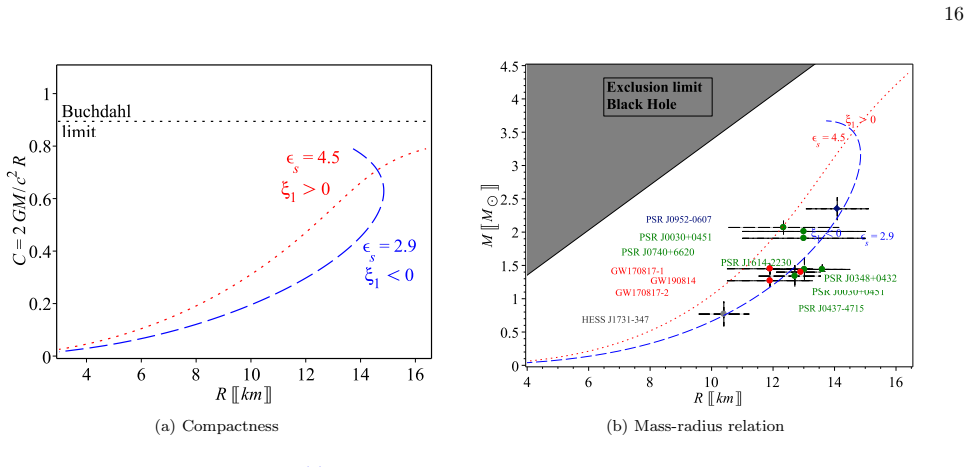
The central claim is that in the theory $f(Q)=Q+\xi Q^2$, anisotropic stellar models built on the Krori-Barua metric ansatz are stable and observationally consistent with PSR J0740+6620. With $\xi<0$, the model's radial sound speed stays below $c^2/3$, while with $\xi_1=0.03$ (positive) it rises to about $0.47c^2$; the tangential speed remains below $0.3c^2$ in both cases. Compactness $C=2GM/(c^2R)$ remains below the Buchdahl limit $C=8/9$ for both signs of $\xi$, and the derived linear equations of state, $P_r\simeq v_r^2(\epsilon-\epsilon_s)$ and $P_\perp\simeq v_\perp^2(\epsilon-\epsilon_{ii})$, have slopes that the authors identify as the squared sound speeds. The observed NICER+XMM mass and radius, $M=2.07\pm0.11\,M_\odot$ and $R=12.34^{+1.89}_{-1.67}$ km, are used to constrain the coupling to $|\xi_1|<0.03$, i.e. $|\xi|<3$ km$^2$. The paper's discovery is that the geometric quadratic term alone can keep the heavy pulsar's equation of state soft, below the perturbative-QCD conformal sound-speed limit, and simultaneously keep the object below black-hole compactness.
Load-bearing premise
The calculation assumes that the real interior of PSR J0740+6620 is exactly described by a simple quadratic-in-radius metric ansatz chosen for mathematical convenience, and that the equation of state read off from that ansatz remains the physical one throughout the star.
Editorial extensions
If this is right
- For $\xi_1=-0.03$, the model predicts a radial sound speed of about $0.25c^2$ and a tangential speed of about $0.18c^2$ at the core, implying a soft equation of state for PSR J0740+6620.
- The allowed coupling range $|\xi_1|<0.03$ is a concrete observational target: any future mass-radius measurement that cannot be fitted within this range would rule out the quadratic model.
- With negative $\xi$, the model produces maximum masses above 3 solar masses, and with positive $\xi$ above 4 solar masses depending on the surface density, so the theory permits neutron-star-like objects heavier than the roughly 2.1-solar-mass pulsars observed so far.
- Compactness remains below $C=8/9$ for both signs of $\xi$, in line with higher-order Gauss-Bonnet gravity but in contrast to $f(R)$ gravity, where compactness can exceed the Buchdahl limit.
Reading between the lines
- Because the sound-speed softening appears only for negative $\xi$, a natural next step is to solve the same $f(Q)=Q+\xi Q^2$ field equations with a realistic nuclear equation of state inserted at the center; if the sub-conformal radial speed survives, the effect is a property of the gravity theory, not just of the chosen metric.
- The same construction could be applied to other precisely measured pulsars such as PSR J1614-2230; a predicted mass-radius curve that matches all such objects would give an independent check that the quadratic non-metricity coupling is negative and of order $|\xi_1|\simeq0.03$.
- The paper leaves open whether the non-metricity term affects the moment of inertia and tidal deformability in a way that gravitational-wave observations of binary neutron star mergers could distinguish from general relativity; this is a testable extension of the TOV analysis presented here.
Editorial analysis
A structured set of objections, weighed in public.
Referee Report
Summary. The paper studies static, spherically symmetric, anisotropic compact stars in quadratic non-metricity gravity, f(Q)=Q+ξQ², using the Krori-Barua metric ansatz for the stellar interior. Matching to the observed mass and radius of PSR J0740+6620 fixes the model parameters, and the authors then examine density, pressure, energy conditions, sound speeds, TOV equilibrium, and mass-radius relations. The main advertised results are that the compactness stays below the Buchdahl limit and that, for negative ξ1, the radial sound speed remains below the pQCD conformal bound c_s²≤c²/3, which the authors present as a novel feature of the theory.
Significance. If the central claim were correct, it would be an interesting result: a modified-gravity explanation for a massive pulsar with a soft effective equation of state, without invoking exotic matter. The paper does provide explicit field-equation expressions, matching conditions, stability checks, and a comparison with NICER/XMM data, and the internal algebra appears largely self-consistent. However, the headline claim about the radial sound speed is not a property of the sign of ξ1; it holds only for the particular fitted value ξ1=−0.03. Moreover, the equation of state used for the pQCD comparison is derived from the same Krori-Barua ansatz and fitted parameters used to match the observed star, so the comparison is circular rather than predictive. These issues undermine the paper's main physical conclusions.
major comments (4)
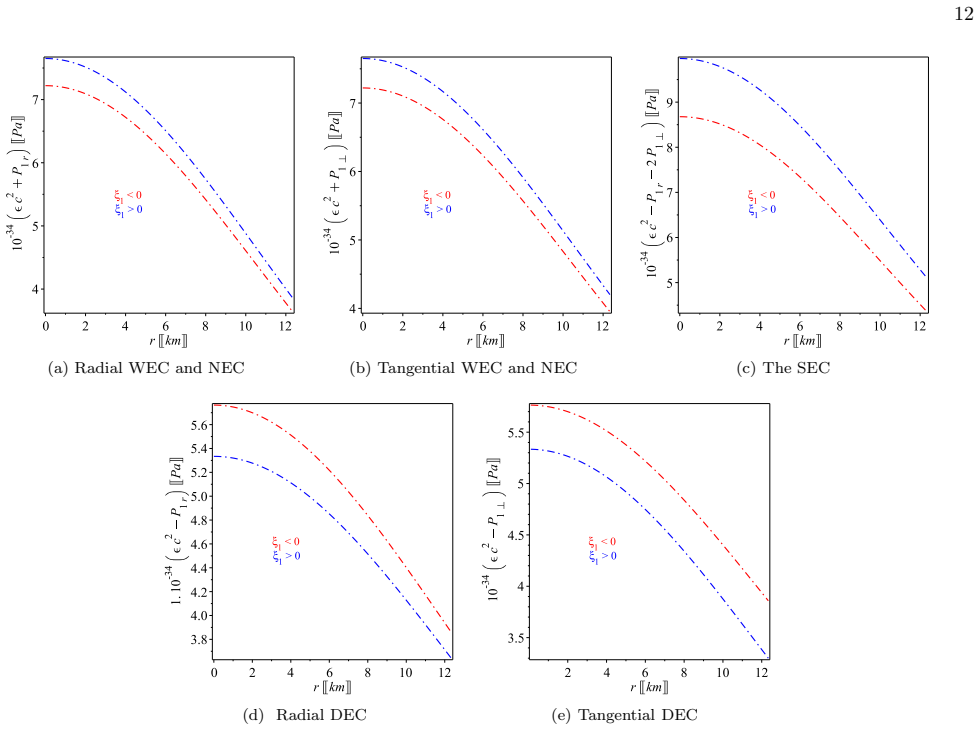
- [§IV F, Eq. (C1)] The claim that negative ξ1 guarantees v_r²<c²/3 is false. Setting ξ1=0 in Eq. (C1) gives b1/c²=(4s0−s2)/(5s2); with the paper's own fitted values s0≈0.491 and s2≈0.684 this is ≈0.374, exceeding 1/3, consistent with Fig. 5(b). Since the matching conditions determine s0 and s2 continuously in ξ1, b1(ξ1) is continuous, so there is an open interval of negative ξ1 near zero for which v_r²/c² still exceeds 1/3. Only the hand-picked value ξ1=−0.03 is shown to satisfy the bound. Therefore the abstract's and Sec. I's statement that the radial sound speed remains below the conformal upper limit is not established as a general property of quadratic non-metricity gravity.
- [§IV B, Eq. (27); §IV F] The comparison with the pQCD conformal bound is circular. The linear EoS (27) and the sound speeds (33) are derived from the same Krori-Barua metric ansatz (20) and the same fitted parameters ξ1, s0, s2 that were chosen to reproduce the observed mass and radius of PSR J0740+6620. The statement that the theory 'predicts' a soft EoS is therefore a restatement of the fit, not an independent test. A genuine prediction would require a microphysical EoS input or at least a demonstration that the conclusion is insensitive to the metric ansatz.
- [§V, Fig. 9] The mass-radius curves and maximum masses in Fig. 9 are obtained by fixing the surface density ǫs to fitted values (e.g., 2.7, 2.9, and 4.5×10^14 g/cm³) and integrating the KB-based density from Eq. (B1). These results are properties of the ad hoc Krori-Barua ansatz, not of quadratic non-metricity gravity as such. The claim that the compactness never exceeds the Buchdahl limit is thus not shown to be a general feature of the theory; it is a feature of this specific fitted model.
- [§IV G and §VI] There is a direct contradiction about the effect of negative ξ1. In §IV G and Fig. 6(c) the authors state that negative ξ1 partially counteracts gravitational collapse, while in §VI they state that when ξ1 is negative the force 'aids in gravitational collapse.' The final paragraph of §VI then says negative ξ1 'prevents gravitational collapsing and reduces the sound speed' but immediately reports v_r²≈0.47c², which is the value for ξ1=+0.03 from §IV F. This inconsistency needs to be resolved before the physical interpretation can be assessed.
minor comments (4)
- [§IV D] The bullet list giving the fitted parameter sets contains 'ξ1=0.3' where the context and all surrounding values indicate 'ξ1=0.03'; please correct this typo.
- [§IV B] The text refers to 'Fig. 1(d)' when describing the anisotropy plot; the relevant panel is Fig. 2(d).
- [Throughout] There are several typographical errors, including 'wither' for 'whether' and 'sellstar' for 'stellar,' and duplicated phrases such as 'where where ∇μ signifies.' A careful proofreading pass is needed.
- [§IV F] The paper quotes slightly different values for the fitted sound speeds in §IV B (v_r²≈0.50c² for ξ1=0.03) and in §V (v_r²≈0.47c² for the same case); the source of this discrepancy should be clarified.
Circularity Check
No construction-level circularity: the f(Q) stellar model is algebraically self-contained, and the pQCD sound-speed check is an external post-fit benchmark; the overbroad negative-ξ1 claim is a correctness flaw, not circularity.
full rationale
Although the paper contains several self-citations ([48], [49], [56], [57], [59], [60]) and phrases the pQCD sound-speed result as a 'novel feature' of negative ξ1, I find no step in which a derived output is equivalent to an input by construction. The field equations (11) are reduced with f(Q)=Q+ξQ² (17) and the KB ansatz (20); the boundary conditions (23) and observed M,R fix ξ1 and the metric parameters; the EoS (27) and sound speeds (33) are then computed from these parameters and compared with the external pQCD bound [50]. The pQCD bound is not used to fit ξ1, so the comparison is an independent (though post-fit) benchmark. The self-citations to f(R)/GB comparisons are contextual rather than load-bearing, and the Buchdahl claim is checked within the paper (Fig. 9). The statement that any negative ξ1 keeps v_r² below c²/3 is overbroad — continuity from the displayed GR case (v_r²/c² ≈ 0.374 from Eq. C1 with ξ1=0) means nearby negative values would violate the bound — but an over-generalized inference is a correctness risk, not a circularity. No specific reduction of a 'prediction' to its fitted inputs was found.
Assumptions & free parameters
free parameters (3)
- ξ1 (dimensionless quadratic coupling) =
±0.03
- Surface density ǫs =
2.5, 2.7, 2.9, 4.5 ×10^14 g/cm³
- KB metric parameters s0, s1, s2 =
e.g., {0.491, -1.1756, 0.684} for GR
assumptions (6)
- domain assumption The f(Q) field equations as given in Eq. (11) are valid.
- domain assumption The coincident gauge can be adopted, eliminating the connection via coordinate choice.
- ad hoc to paper The Krori-Barua metric ansatz (Eq. 20) describes the stellar interior.
- domain assumption The exterior spacetime is Schwarzschild and matches the interior at r=Ls.
- ad hoc to paper The linearized EoS (Eq. 27) is valid throughout the star.
- domain assumption The pQCD conformal bound c_s²≤c²/3 is a universal upper limit at neutron star densities.
Cite this review
Pith. "Pith review of Properties of compact objects in quadratic non-metricity gravity." pith.science (2026). https://pith.science/paper/W2TC2PQL
@misc{pith2026250714591,
  author       = {Pith},
  title        = {Pith review of: Properties of compact objects in quadratic non-metricity gravity},
  year         = {2026},
  howpublished = {\url{https://pith.science/paper/W2TC2PQL}},
  note         = {Machine review of arXiv:2507.14591}
}
read the original abstract
Astrophysical compact objects are studied in the context of quadratic non-metricity gravity. The solutions to the gravitational field equations, which include fluid components, are analyzed to investigate the density and pressure properties of radio pulsars. It is explicitly demonstrated that the theoretically stable models are consistent with astronomical data, due to the geometric features of the quadratic component. Furthermore, it is shown that, in contrast to the compactness limits of black holes in general relativity, the core density can significantly exceed the density at which nuclear saturation occurs, and the surface density can also surpass the value of nuclear saturation. Additionally, it is found that the radial sound speed remains below the conformal upper bound for sound velocity established by perturbative quantum chromodynamics.
Figures


Figures from the paper (6 more)


Forward citations
Cited by 1 Pith paper
-
Equivalence Principle violation in metric-affine gravity and finite-temperature effects
Metric-affine gravity formulates equivalence principle violations via non-metricity that parallel finite-temperature mass-ratio shifts, and a generalized Fermi-Walker derivative shows no orthonormal tetrad propagates ...
Reference graph
Works this paper leans on
-
[1]
K. Schwarzschild, Sitzungsberichte der k¨ oniglich pre ußischen Akademie der Wissenschaften zu Berlin pp. 424–434 (1916)
work page 1916
-
[2]
gives the nonzero torsion T λ µν ( ˜Γ λ µν ) . The La- grangian of teleparallel equivalent of general relativity consists of the torsion scalar, T = Sµν κ T κ µν, where Sµν β = 1 2 (K µν β + δµ β T θν θ − δν βT θµ θ ) and K µν β = − 1 2 (T µν β − T νµ β − T .µν β ) [ 51]. In the symmetric teleparallel gravity, Rκ λµν ( Γ λ µν ) = 0 represents a flat geomet...
-
[3]
The scalar of non-metricity provides the fundamental Lagrangian density of symmetric teleparallel gravity [ 52] Q = QλµνP λµν
defines the tensor of non-metricity. The scalar of non-metricity provides the fundamental Lagrangian density of symmetric teleparallel gravity [ 52] Q = QλµνP λµν . (5) 4 Here, P λ µν represents the components of the conjugate tensor, and it is giv en by P λ µν = − 1 4 Qλ µν + 1 2 Q λ (µ ν ) + 1 4 ( Qλ − ¯Qλ) gµν − 1 4 δλ (µQν), (6) where the Kronecker del...
-
[4]
P. S. Florides, Proceedings of the Royal Society of Londo n. A. Mathematical and Physical Sciences 337, 529 (1974)
work page 1974
- [5]
- [6]
-
[7]
L. Gabbanelli, J. Ovalle, A. Sotomayor, Z. Stuchlik, and R. Casadio, Eur. Phys. J. C 79, 486 (2019), 1905.10162
arXiv 2019
-
[8]
C. Posada and C. Chirenti, Class. Quant. Grav. 36, 065004 (2019), 1811.09589
arXiv 2019
Show all 82 references
-
[9]
Calmet, R
X. Calmet, R. Casadio, and F. Kuipers, Phys. Rev. D 102, 026018 (2020), 2007.05416. 19
2020 arXiv
-
[10]
R. C. Tolman, Proc. Nat. Acad. Sci. 20, 169 (1934)
1934
-
[11]
R. C. Tolman, Phys. Rev. 55, 364 (1939)
1939
-
[12]
J. R. Oppenheimer and G. M. Volkoff, Phys. Rev. 55, 374 (1939)
1939
-
[13]
C. E. Rhoades, Jr. and R. Ruffini, Phys. Rev. Lett. 32, 324 (1974)
1974
-
[14]
Chandrasekhar and E
S. Chandrasekhar and E. A. Milne, Mon. Not. Roy. Astron. Soc. 91, 456 (1931)
1931
-
[15]
S. L. Shapiro and S. A. Teukolsky, Black holes, white dwarfs, and neutron stars: The physics of compact objects (1983), ISBN 978-0-471-87316-7, 978-3-527-61766-1
1983
-
[16]
J. E. Horvath, L. S. Rocha, A. Bernardo, R. Valientim, an d M. G. B. de Avellar, Astron. Nachr. 342, 294 (2021)
2021
-
[17]
Margalit and B
B. Margalit and B. D. Metzger, Astrophys. J. Lett. 850, L19 (2017), 1710.05938
2017 arXiv
-
[18]
Shibata, S
M. Shibata, S. Fujibayashi, K. Hotokezaka, K. Kiuchi, K . Kyutoku, Y. Sekiguchi, and M. Tanaka, Phys. Rev. D 96, 123012 (2017), 1710.07579
2017 arXiv
-
[19]
M. Ruiz, S. L. Shapiro, and A. Tsokaros, Phys. Rev. D 97, 021501 (2018), 1711.00473
2018 arXiv
-
[20]
Rezzolla, E
L. Rezzolla, E. R. Most, and L. R. Weih, Astrophys. J. Let t. 852, L25 (2018), 1711.00314
2018 arXiv
- [21]
-
[22]
H. T. Cromartie et al. (NANOGrav), Nature Astron. 4, 72 (2019), 1904.06759
2019 arXiv
-
[23]
B. P. Abbott et al. (LIGO Scientific, Virgo), Astrophys. J. Lett. 892, L3 (2020), 2001.01761
2020 arXiv
-
[24]
Abbott et al
R. Abbott et al. (LIGO Scientific, Virgo), Astrophys. J. Lett. 896, L44 (2020), 2006.12611
2020 arXiv
-
[25]
Harko, K
T. Harko, K. S. Cheng, and Z. Kovacs, Mon. Not. Roy. Astro n. Soc. 400, 1632 (2009), 0908.2672
2009 arXiv
- [26]
-
[27]
N. K. Glendenning, Compact stars: Nuclear physics, particle physics, and gene ral relativity (1997)
1997
-
[28]
T. P. Sotiriou and V. Faraoni, Reviews of Modern Physics 82, 451 (2010)
2010
-
[29]
Capozziello and M
S. Capozziello and M. De Laurentis, Phys. Rept. 509, 167 (2011), 1108.6266
2011 arXiv
- [30]
-
[31]
Joyce, B
A. Joyce, B. Jain, J. Khoury, and M. Trodden, Phys. Rept. 568, 1 (2015), 1407.0059
2015 arXiv
-
[32]
Nojiri, S
S. Nojiri, S. D. Odintsov, and V. K. Oikonomou, Phys. Rep t. 692, 1 (2017), 1705.11098
2017 arXiv
- [33]
-
[34]
G. J. Olmo, D. Rubiera-Garcia, and A. Wojnar, Phys. Rept . 876, 1 (2020), 1912.05202
2020 arXiv
-
[35]
Y. C. Ong, K. Izumi, J. M. Nester, and P. Chen, Phys. Rev. D 88, 024019 (2013), 1303.0993
2013 arXiv
-
[36]
D. A. Gomes, J. Beltr´ an Jim´ enez, A. J. Cano, and T. S. Ko ivisto, Phys. Rev. Lett. 132, 141401 (2024), 2311.04201
2024 arXiv
- [37]
-
[38]
Beltr´ an Jim´ enez, L
J. Beltr´ an Jim´ enez, L. Heisenberg, and T. S. Koivisto, JCAP 08, 039 (2018), 1803.10185
2018 arXiv
-
[39]
Beltr´ an Jim´ enez, L
J. Beltr´ an Jim´ enez, L. Heisenberg, and T. Koivisto, Phys. Rev. D 98, 044048 (2018), 1710.03116
2018 arXiv
-
[40]
D’Ambrosio, S
F. D’Ambrosio, S. D. B. Fell, L. Heisenberg, and S. Kuhn, Phys. Rev. D 105, 024042 (2022), 2109.03174
2022 arXiv
-
[41]
Casalino, B
A. Casalino, B. Sanna, L. Sebastiani, and S. Zerbini, Ph ys. Rev. D 103, 023514 (2021), 2010.07609
2021 arXiv
- [42]
-
[43]
Lazkoz, F
R. Lazkoz, F. S. N. Lobo, M. Ortiz-Ba˜ nos, and V. Salzano , Phys. Rev. D 100, 104027 (2019), 1907.13219
2019 arXiv
-
[44]
Mandal, P
S. Mandal, P. K. Sahoo, and J. R. L. Santos, Phys. Rev. D 102, 024057 (2020), 2008.01563
2020 arXiv
-
[45]
Capozziello and M
S. Capozziello and M. Shokri, Phys. Dark Univ. 37, 101113 (2022), 2209.06670
2022 arXiv
-
[46]
Capozziello and R
S. Capozziello and R. D’Agostino, Phys. Lett. B 832, 137229 (2022), 2204.01015
2022 arXiv
-
[47]
K. Hu, T. Katsuragawa, and T. Qiu, Phys. Rev. D 106, 044025 (2022), 2204.12826
2022 arXiv
-
[48]
K. Hu, M. Yamakoshi, T. Katsuragawa, S. Nojiri, and T. Qi u, Phys. Rev. D 108, 124030 (2023), 2310.15507
2023 arXiv
-
[49]
Nojiri and S
S. Nojiri and S. D. Odintsov, Phys. Dark Univ. 45, 101538 (2024), 2404.18427
2024 arXiv
-
[50]
G. G. L. Nashed and S. Capozziello, Eur. Phys. J. C 84, 521 (2024), 2405.09590
2024 arXiv
-
[51]
G. G. L. Nashed and K. Bamba, Phys. Dark Univ. 44, 101485 (2024), 2407.03703
2024 arXiv
-
[52]
Bedaque and A
P. Bedaque and A. W. Steiner, Physical review letters 114, 031103 (2015)
2015
- [53]
-
[54]
J. M. Nester and H.-J. Yo, Chin. J. Phys. 37, 113 (1999), gr-qc/9809049
1999 arXiv
-
[55]
Beltr´ an Jim´ enez, L
J. Beltr´ an Jim´ enez, L. Heisenberg, and T. S. Koivisto, Universe 5, 173 (2019), 1903.06830
2019 arXiv
-
[56]
Beltr´ an Jim´ enez, L
J. Beltr´ an Jim´ enez, L. Heisenberg, T. S. Koivisto, and S. Pekar, Phys. Rev. D 101, 103507 (2020), 1906.10027
2020 arXiv
-
[57]
Y. Xu, G. Li, T. Harko, and S.-D. Liang, Eur. Phys. J. C 79, 708 (2019), 1908.04760
2019 arXiv
-
[58]
G. G. Nashed and S. Capozziello, The European Physical J ournal C 80, 1 (2020)
2020
-
[59]
Roupas and G
Z. Roupas and G. G. Nashed, The European Physical Journa l C 80, 1 (2020)
2020
-
[60]
K. D. Krori and J. Barua, Journal of Physics A 8, 508 (1975)
1975
-
[61]
G. G. L. Nashed, Eur. Phys. J. C 83, 698 (2023), 2308.08565
2023 arXiv
-
[62]
G. G. L. Nashed and W. El Hanafy, JCAP 09, 038 (2023), 2306.13396
2023 arXiv
- [63]
-
[64]
Goswami, A
R. Goswami, A. M. Nzioki, S. D. Maharaj, and S. G. Ghosh, P hys. Rev. D 90, 084011 (2014), 1409.2371
2014 arXiv
-
[65]
Ganguly, R
A. Ganguly, R. Gannouji, R. Goswami, and S. Ray, Physica l Review D 89, 064019 (2014)
2014
-
[66]
A. V. Astashenok, S. Capozziello, and S. D. Odintsov, Ph ys. Rev. D 89, 103509 (2014), 1401.4546
2014 arXiv
-
[67]
Lin and X.-H
R.-H. Lin and X.-H. Zhai, Phys. Rev. D 103, 124001 (2021), [Erratum: Phys.Rev.D 106, 069902 (2022)], 2105.01484
2021 arXiv
-
[68]
Fonseca et al., Astrophys
E. Fonseca et al., Astrophys. J. Lett. 915, L12 (2021), 2104.00880
2021 arXiv
-
[69]
M. C. Miller, F. Lamb, A. Dittmann, S. Bogdanov, Z. Arzou manian, K. Gendreau, S. Guillot, W. Ho, J. Lattimer, M. Loewenstein, et al., The Astrophysical Journal Letters 918, L28 (2021)
2021
-
[70]
T. E. Riley, A. L. Watts, P. S. Ray, S. Bogdanov, S. Guillo t, S. M. Morsink, A. V. Bilous, Z. Arzoumanian, D. Choudhury, 20 J. S. Deneva, et al., The Astrophysical Journal Letters 918, L27 (2021)
2021
-
[71]
Legred, K
I. Legred, K. Chatziioannou, R. Essick, S. Han, and P. La ndry, Phys. Rev. D 104, 063003 (2021), 2106.05313
2021 arXiv
-
[72]
Landry, R
P. Landry, R. Essick, and K. Chatziioannou, Physical Re view D 101, 123007 (2020)
2020
-
[73]
H. A. Buchdahl, Physical Review 116, 1027 (1959)
1959
-
[74]
B. V. Ivanov, Physical Review D 65, 104011 (2002)
2002
-
[75]
D. E. Barraco, V. H. Hamity, and R. J. Gleiser, Physical R eview D 67, 064003 (2003)
2003
-
[76]
B¨ ohmer and T
C. B¨ ohmer and T. Harko, Classical and Quantum Gravity 23, 6479 (2006)
2006
-
[77]
Y. B. Zeldovich and I. D. Novikov, Chicago: University o f Chicago Press (1971)
1971
-
[78]
De Felice and S
A. De Felice and S. Tsujikawa, Living Reviews in Relativ ity 13, 1 (2010)
2010
-
[79]
Herrera, Phys
L. Herrera, Phys. Lett. A 165, 206 (1992)
1992
-
[80]
Chandrasekhar, Astrophys
S. Chandrasekhar, Astrophys. J. 140, 417 (1964), [Erratum: Astrophys.J. 140, 1342 (1964)]
1964
-
[81]
R. Chan, L. Herrera, and N. Santos, Monthly Notices of th e Royal Astronomical Society 265, 533 (1993)
1993
-
[82]
Heintzmann and W
H. Heintzmann and W. Hillebrandt, Astronomy and Astrop hysics 38, 51 (1975)
1975
Reviewed August 6, 2026 · model on record in the stance chip above.
Discussion (0). Sign in to comment.