REVIEW 4 major objections 5 minor 50 references
Uncertainty-aware Probabilistic 3D Human Motion Forecasting via Invertible Networks
T0 review · 4 major / 5 minor · reviewed 2026-08-06 · deepseek-v4-flash
Pith's one-line read ProbHMI shows that 3D human motion forecasting can be formulated as explicit probability distributions over future poses, using invertible networks to map poses into a continuous latent space, so that accuracy, diversity, and calibrated…
desk verdict Solid accuracy results and a clean invertible-latent formulation, but the headline uncertainty calibration claim rests on an undefined multivariate quantile and a mirrored proxy that cannot validate it. read the letter →
The pith
A machine-rendered reading of the paper's core claim, the machinery that carries it, and where it could break.
The reading
What carries the argument
The load-bearing object is the Pose Transformation Module (PTM), an invertible network built from graph-convolution-based additive coupling layers, a topology-preserving variant of the NICE architecture. Each coupling layer splits the skeleton graph into two parts, for example upper and lower body, passes one part through unchanged, and adds to the other a graph-convolutional function of the first; because the map is bijective, the exact log-likelihood of a pose is available through the change-of-variables formula. This lets the Pose Forecasting Module, implemented as a single GRU with part-aware heads, treat the next latent code as a draw from a factorized Gaussian with predicted mean $\hat{z}$ and diagonal covariance $\Sigma$, rather than as an implicit sample. Invertibility is what converts an intractable pose distribution into a parametric latent distribution while still guaranteeing that sampled latent codes decode into plausible poses.
What would settle it
A direct calibration test would settle the claim: on a held-out split, for each predicted quantile q in {0.25, 0.40, 0.45, 0.50}, compute the empirical frequency with which the true future pose falls inside the predicted q-level region; systematic mismatch, such as the claimed 25th percentile actually containing half of the true futures, would falsify the uncertainty-calibration claim.
Extended reading notes
Core claim
The paper's central claim is that explicit probability distributions over future 3D poses can be learned without giving up accuracy or diversity: map each pose through a topology-preserving invertible network into a continuous latent space, forecast the mean and diagonal covariance of the next latent code with a single GRU, and decode samples back into poses. Reported results on Human3.6M and HumanEva-I indicate that this one design, with 0.36M parameters, achieves the lowest ADE (0.364) and FID (0.646) among compared diverse-forecasting methods on Human3.6M, improves deterministic mean angle error across all horizons, and degrades only mildly when the number of samples is cut from 50 to 5 (ADE increases 6.04% versus 50.82% for DLow). The same explicit distribution supplies frame- and sequence-level quantiles, which the authors validate against an empirical quantile constructed from test motions with similar histories.
Load-bearing premise
The load-bearing premise is that the true distribution of future motions is well captured by a factorized Gaussian with diagonal covariance in the invertibly mapped latent space, so that predicted variances and quantiles carry the same meaning in pose space.
Editorial extensions
If this is right
- A robot or autonomous system can query the forecast distribution directly, reading off a probability density or quantile per frame and per sequence, instead of approximating uncertainty by sampling many trajectories and measuring spread.
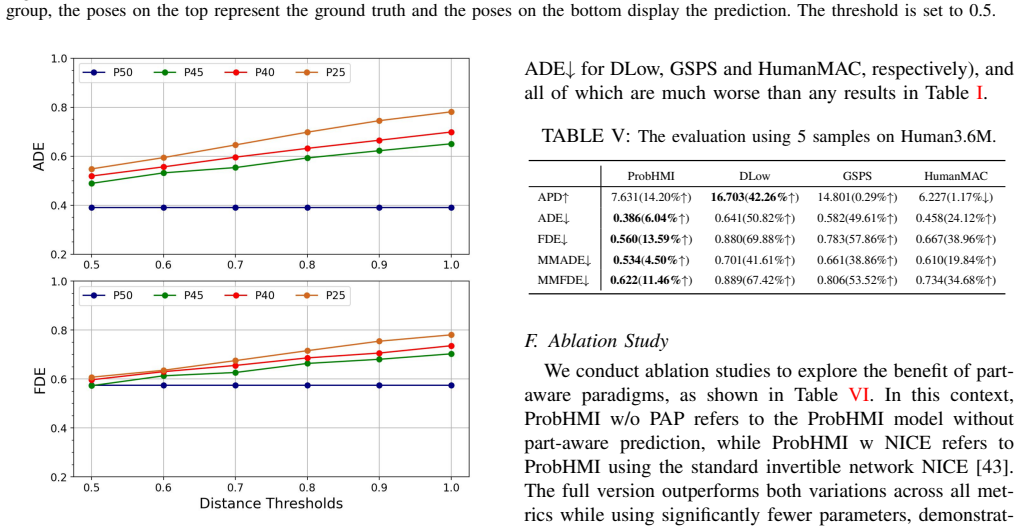
- Because the predicted distribution is parametric, few samples are needed to cover plausible futures: at five samples instead of fifty, ProbHMI's ADE rises only 6.04%, while DLow's rises 50.82%.
- Forecasting in the invertible latent space is itself beneficial for deterministic accuracy: ProbHMI beats the same recurrent architecture operating directly on poses, with 0.86 versus 1.18 mean angle error at 400 ms.
- The part-aware, topology-preserving design contributes to the gain: removing part-aware prediction or substituting the standard NICE invertible network increases ADE and FID.
- Explicit likelihood also enables alternative sampling schedules, such as the Poisson-disk sampling used in the five-sample evaluation, a tool not available to implicit generative models.
Reading between the lines
- Because the interface is a full predictive distribution, the framework could plug directly into conformal prediction or risk-sensitive control loops that consume quantiles; the paper does not build that layer.
- The factorized-Gaussian assumption in latent space could be tested action-by-action: motions with genuinely multi-modal futures, such as walking versus turning, may need a mixture or flow-based posterior, a natural extension.
- Calibration could be checked more directly on data with repeated takes of the same scripted motion, where the true future distribution is known, instead of the similar-past-motion proxy used in the paper's empirical quantile evaluation.
- If invertibility is the source of the gain, replacing the single GRU with a more expressive dynamics model while keeping the invertible pose map should improve accuracy further without changing the uncertainty interface.
Editorial analysis
A structured set of objections, weighed in public.
Referee Report
Summary. The manuscript proposes ProbHMI, a two-module framework for 3D human motion forecasting. A part-aware invertible network (PTM) maps poses to a disentangled latent space, and a single GRU (PFM) predicts per-frame factorized Gaussian parameters in that space. The paper claims state-of-the-art accuracy on Human3.6M and HumanEva-I for both deterministic and diverse prediction, validated uncertainty calibration via an empirical quantile evaluation, and efficient sampling with few samples. The central methodological novelty is the explicit probabilistic formulation enabled by invertible transformations.
Significance. If the uncertainty-calibration claim were fully supported, this would be a valuable contribution: ProbHMI uses only 0.36M parameters, achieves competitive ADE and the best FID on Human3.6M, and provides a concrete mechanism for extracting confidence values from a generative motion model. The part-aware coupling layer and the explicit latent-space Gaussian forecasting are sensible design choices, and the ablations support the benefit of the part-aware modules. However, the headline contribution over prior work is 'validated uncertainty calibration,' and the current evaluation does not establish it: the quantile used for sampling is not defined for a multivariate Gaussian, and the empirical calibration protocol in Section V-D is not a coverage test. The accuracy and efficiency results are also weakened by an uncontrolled sampling comparison in Section V-E. These issues are fixable but require additional experiments.
major comments (4)
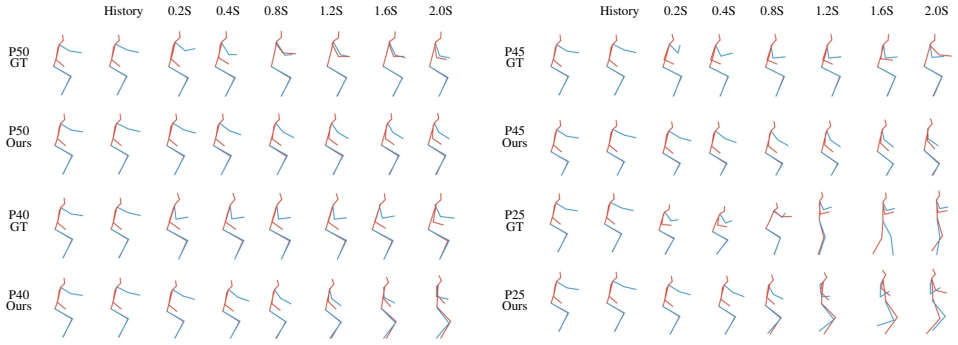
- [Section IV-E, Eq. (3), Eq. (5), Figure 5] In Section IV-E and Equation (3), the uncertainty for a sequence is defined by applying the 'same quantile to all frames' during sampling, and Figure 5 labels results as P50, P45, P40, P25. However, for the factorized diagonal Gaussian over the latent code (Eq. 5), a scalar quantile is not well-defined: if each coordinate is set to its q-th marginal quantile, the joint probability mass is q^d (or (1-2q)^d for a central region), not q. No definition of a joint or sequence-level quantile is provided, so the reported percentile labels do not correspond to a stated probability. This is load-bearing because the central claim is calibrated uncertainty.
- [Section V-D, Figure 5] Section V-D's calibration evaluation does not measure calibration. The authors build an empirical distribution from test sequences with sufficiently similar past motion, sort subsequent motions by distance, and then 'mirror the empirical distribution to match the form of the predicted distribution.' This mirroring removes skew in the empirical proxy and aligns the proxy's median with the model's symmetric median, so the low ADE/FDE values in Figure 5 are expected even for a miscalibrated model. The evaluation should instead report coverage rates or probability integral transform values for the predicted latent/pose distributions, and should not symmetrize the target distribution. The paper's own caveat about 'approximations in the empirical ground truth' does not fix this issue.
- [Section V-E, Table V] The sampling-efficiency comparison in Section V-E and Table V is not controlled: ProbHMI uses Poisson-Disk Sampling while DLow, GSPS, and HumanMAC use a vanilla sampling schedule. The reported advantage therefore conflates the sampling algorithm with the model. To support the claim that ProbHMI estimates the future distribution with few samples, all methods should use the same sample-selection strategy, or the paper should ablate the sampler within ProbHMI.
- [Section IV-D, Eq. (5)] Equation (5) writes the negative log-likelihood as (1/K) * sum [log(Sigma_i) + (z_i - z_hat_i)^2 / (2 (Sigma_i)^2)], and the text states that Sigma denotes variance. If Sigma is the variance, the quadratic term should be divided by 2*Sigma and the log term should be log(Sigma) without the additional square; if Sigma is the standard deviation, the notation should say so explicitly. As written, the optimized objective is not the Gaussian negative log-likelihood stated, which matters for a paper whose contribution is probabilistic modeling.
minor comments (5)
- [Section IV-D, Eq. (7)] The loss LN is described as minimizing a KL divergence but the expression is the negative log-likelihood of the latent code under the standard Gaussian plus a Jacobian term; please clarify the relationship between this objective and the stated KL goal.
- [Section IV-E] 'auto-aggressive' should be 'autoregressive.'
- [Figures 3 and 4] The visualization captions use opacity/quantile mappings without defining how opacity maps to the quantile levels; please add a legend or explicit mapping.
- [Section V-D] The hyperparameters for the empirical quantile evaluation (distance threshold 0.5 in Figure 4, the minimum of 50 pseudo-futures, and the mirroring procedure) are described only in prose; a precise algorithmic description would improve reproducibility.
- [Conclusion] The conclusion contains a grammatical error: 'incorporating stronger motion priors ... may holds promise' should be 'may hold promise.'
Circularity Check
No significant circularity: ProbHMI's accuracy claims are evaluated on external benchmarks, and the uncertainty-calibration heuristic is a validation weakness, not a definitional reduction.
full rationale
I walked the derivation chain from the pose transformation module (PTM) through the forecasting module (PFM) to the reported evaluations. The latent-space Gaussian is trained with an explicit NLL objective (Eq. 5), the pose-space objective is an L1 loss against ground truth (Eq. 6), and the reported ADE/FDE/FID figures are measured against held-out subjects in Human3.6M and HumanEva-I. There is no fitted parameter that is later renamed as a prediction, and no equation reduces to an input by construction. The paper contains no self-citations that carry a load-bearing argument, and the use of NICE/flow machinery is standard and externally attributable. The uncertainty-calibration section (V-D) builds an empirical quantile proxy by mirroring the empirical distribution, and the notion of a scalar 'quantile' for a multivariate sequence is under-specified; these are real limitations for the calibration claim, but they are empirical-validation weaknesses rather than circular reasoning: the predicted quantiles are not defined as the empirical quantiles, and the proxy is constructed from test data, not from the model's own outputs. Therefore the central accuracy and diversity claims have independent content, and no circular step is established.
Assumptions & free parameters
free parameters (3)
- loss weights alpha, beta, gamma =
0.1, 1.0, 5.0
- sampling variance scale beta =
0 during training, unspecified at inference
- similarity threshold for pseudo-futures =
0.5 (used in Fig. 4)
assumptions (3)
- domain assumption Future latent codes follow a Gaussian distribution with diagonal covariance
- domain assumption The invertible transformation produces a disentangled latent space where temporal dynamics are approximately linear and stationary
- ad hoc to paper Similar past motions in the test set, mirrored and grouped, approximate the true conditional future distribution
Cite this review
Pith. "Pith review of Uncertainty-aware Probabilistic 3D Human Motion Forecasting via Invertible Networks." pith.science (2026). https://pith.science/paper/6Q7SIQZL
@misc{pith2026250714694,
  author       = {Pith},
  title        = {Pith review of: Uncertainty-aware Probabilistic 3D Human Motion Forecasting via Invertible Networks},
  year         = {2026},
  howpublished = {\url{https://pith.science/paper/6Q7SIQZL}},
  note         = {Machine review of arXiv:2507.14694}
}
read the original abstract
3D human motion forecasting aims to enable autonomous applications. Estimating uncertainty for each prediction (i.e., confidence based on probability density or quantile) is essential for safety-critical contexts like human-robot collaboration to minimize risks. However, existing diverse motion forecasting approaches struggle with uncertainty quantification due to implicit probabilistic representations hindering uncertainty modeling. We propose ProbHMI, which introduces invertible networks to parameterize poses in a disentangled latent space, enabling probabilistic dynamics modeling. A forecasting module then explicitly predicts future latent distributions, allowing effective uncertainty quantification. Evaluated on benchmarks, ProbHMI achieves strong performance for both deterministic and diverse prediction while validating uncertainty calibration, critical for risk-aware decision making.
Figures


Figures from the paper (2 more)
Reference graph
Works this paper leans on
-
[1]
Prednet: a simple human motion prediction network for human-robot interaction,
M. El-Shamouty and A. Pratheepkumar, “Prednet: a simple human motion prediction network for human-robot interaction,” in 2021 26th IEEE International Conference on Emerging Technologies and Factory Automation (ETFA). IEEE, 2021, pp. 1–7
work page 2021
-
[2]
Fast user adaptation for human motion prediction in physical human–robot interaction,
H.-S. Moon and J. Seo, “Fast user adaptation for human motion prediction in physical human–robot interaction,” IEEE Robotics and Automation Letters, vol. 7, no. 1, pp. 120–127, 2021
work page 2021
-
[3]
A. Kanazawa, J. Kinugawa, and K. Kosuge, “Adaptive motion planning for a collaborative robot based on prediction uncertainty to enhance human safety and work efficiency,” IEEE Transactions on Robotics , vol. 35, no. 4, pp. 817–832, 2019
work page 2019
-
[4]
Pose forecasting in industrial human-robot collaboration,
A. Sampieri, G. M. D. di Melendugno, A. Avogaro, F. Cunico, F. Setti, G. Skenderi, M. Cristani, and F. Galasso, “Pose forecasting in industrial human-robot collaboration,” in European Conference on Computer Vision. Springer, 2022, pp. 51–69
work page 2022
-
[5]
Conformal prediction for uncertainty-aware planning with dif- fusion dynamics model,
J. Sun, Y . Jiang, J. Qiu, P. Nobel, M. J. Kochenderfer, and M. Schwa- ger, “Conformal prediction for uncertainty-aware planning with dif- fusion dynamics model,” Advances in Neural Information Processing Systems, vol. 36, 2024
work page 2024
-
[6]
Robots that ask for help: Uncertainty alignment for large language model planners,
A. Z. Ren, A. Dixit, A. Bodrova, S. Singh, S. Tu, N. Brown, P. Xu, L. T. Takayama, F. Xia, J. Varley et al. , “Robots that ask for help: Uncertainty alignment for large language model planners,” in Conference on Robot Learning (CoRL) . Proceedings of the Conference on Robot Learning (CoRL), 2023
work page 2023
-
[7]
Dlow: Diversifying latent flows for diverse human motion prediction,
Y . Yuan and K. Kitani, “Dlow: Diversifying latent flows for diverse human motion prediction,” in Computer Vision–ECCV 2020: 16th Eu- ropean Conference, Glasgow, UK, August 23–28, 2020, Proceedings, Part IX 16. Springer, 2020, pp. 346–364
work page 2020
-
[8]
Generating smooth pose se- quences for diverse human motion prediction,
W. Mao, M. Liu, and M. Salzmann, “Generating smooth pose se- quences for diverse human motion prediction,” in Proceedings of the IEEE/CVF International Conference on Computer Vision , 2021, pp. 13 309–13 318
work page 2021
Show all 50 references
-
[9]
We are more than our joints: Predicting how 3d bodies move,
Y . Zhang, M. J. Black, and S. Tang, “We are more than our joints: Predicting how 3d bodies move,” in Proceedings of the IEEE/CVF Conference on Computer Vision and Pattern Recognition , 2021, pp. 3372–3382
2021
-
[10]
Diverse human motion prediction via gumbel-softmax sampling from an auxiliary space,
L. Dang, Y . Nie, C. Long, Q. Zhang, and G. Li, “Diverse human motion prediction via gumbel-softmax sampling from an auxiliary space,” in Proceedings of the 30th ACM International Conference on Multimedia, 2022, pp. 5162–5171
2022
-
[11]
Hp-gan: Probabilistic 3d human motion prediction via gan,
E. Barsoum, J. Kender, and Z. Liu, “Hp-gan: Probabilistic 3d human motion prediction via gan,” in Proceedings of the IEEE conference on computer vision and pattern recognition workshops , 2018, pp. 1418– 1427
2018
-
[12]
Deligan: Generative adversarial networks for diverse and limited data,
S. Gurumurthy, R. Kiran Sarvadevabhatla, and R. Venkatesh Babu, “Deligan: Generative adversarial networks for diverse and limited data,” in Proceedings of the IEEE conference on computer vision and pattern recognition, 2017, pp. 166–174
2017
-
[13]
Human joint kinematics diffusion-refinement for stochastic motion prediction,
D. Wei, H. Sun, B. Li, J. Lu, W. Li, X. Sun, and S. Hu, “Human joint kinematics diffusion-refinement for stochastic motion prediction,” in Proceedings of the AAAI Conference on Artificial Intelligence, vol. 37, no. 5, 2023, pp. 6110–6118
2023
-
[14]
Humanmac: Masked motion completion for human motion prediction,
L.-H. Chen, J. Zhang, Y . Li, Y . Pang, X. Xia, and T. Liu, “Humanmac: Masked motion completion for human motion prediction,” arXiv preprint arXiv:2302.03665, 2023
2023 arXiv
-
[15]
Vision-based uncertainty-aware motion planning based on probabilistic semantic segmentation,
R. R ¨omer, A. Lederer, S. Tesfazgi, and S. Hirche, “Vision-based uncertainty-aware motion planning based on probabilistic semantic segmentation,” IEEE Robotics and Automation Letters , 2023
2023
-
[16]
Recurrent network models for human dynamics,
K. Fragkiadaki, S. Levine, P. Felsen, and J. Malik, “Recurrent network models for human dynamics,” in Proceedings of the IEEE interna- tional conference on computer vision , 2015, pp. 4346–4354
2015
-
[17]
Learning human motion models for long-term predictions,
P. Ghosh, J. Song, E. Aksan, and O. Hilliges, “Learning human motion models for long-term predictions,” in 2017 International Conference on 3D Vision (3DV) . IEEE, 2017, pp. 458–466
2017
-
[18]
On human motion prediction using recurrent neural networks,
J. Martinez, M. J. Black, and J. Romero, “On human motion prediction using recurrent neural networks,” in Proceedings of the IEEE confer- ence on computer vision and pattern recognition , 2017, pp. 2891– 2900
2017
-
[19]
Modeling human motion with quaternion-based neural networks,
D. Pavllo, C. Feichtenhofer, M. Auli, and D. Grangier, “Modeling human motion with quaternion-based neural networks,” International Journal of Computer Vision , vol. 128, pp. 855–872, 2020
2020
-
[20]
History repeats itself: Human motion prediction via motion attention,
W. Mao, M. Liu, and M. Salzmann, “History repeats itself: Human motion prediction via motion attention,” in Computer Vision–ECCV 2020: 16th European Conference, Glasgow, UK, August 23–28, 2020, Proceedings, Part XIV 16 . Springer, 2020, pp. 474–489
2020
-
[21]
Dynamic multiscale graph neural networks for 3d skeleton based human motion prediction,
M. Li, S. Chen, Y . Zhao, Y . Zhang, Y . Wang, and Q. Tian, “Dynamic multiscale graph neural networks for 3d skeleton based human motion prediction,” in Proceedings of the IEEE/CVF conference on computer vision and pattern recognition , 2020, pp. 214–223
2020
-
[22]
Multiscale spatio-temporal graph neural networks for 3d skeleton-based motion prediction,
——, “Multiscale spatio-temporal graph neural networks for 3d skeleton-based motion prediction,” IEEE Transactions on Image Pro- cessing, vol. 30, pp. 7760–7775, 2021
2021
-
[23]
Spatio-temporal gating- adjacency gcn for human motion prediction,
C. Zhong, L. Hu, Z. Zhang, Y . Ye, and S. Xia, “Spatio-temporal gating- adjacency gcn for human motion prediction,” in Proceedings of the IEEE/CVF Conference on Computer Vision and Pattern Recognition , 2022, pp. 6447–6456
2022
-
[24]
Spatiotemporal consistency learning from momentum cues for human motion prediction,
H. Chen, J. Hu, W. Zhang, and P. Su, “Spatiotemporal consistency learning from momentum cues for human motion prediction,” IEEE Transactions on Circuits and Systems for Video Technology , 2023
2023
-
[25]
Champ: A large- scale dataset for skeleton-based composite human motion prediction,
W. Zhang, M. Liu†, X. Wang, S. Zhao, and C. Wang, “Champ: A large- scale dataset for skeleton-based composite human motion prediction,” IEEE Transactions on Circuits and Systems for Video Technology , pp. 1–1, 2024
2024
-
[26]
Spotr: Spatio-temporal pose transformers for human motion prediction,
A. A. Nargund and M. Sra, “Spotr: Spatio-temporal pose transformers for human motion prediction,” arXiv preprint arXiv:2303.06277, 2023
2023 arXiv
-
[27]
Towards more realistic human motion prediction with attention to motion coordination,
P. Ding and J. Yin, “Towards more realistic human motion prediction with attention to motion coordination,” IEEE Transactions on Circuits and Systems for Video Technology , vol. 32, no. 9, pp. 5846–5858, 2022
2022
-
[28]
Towards realistic 3d human motion prediction with a spatio-temporal cross-transformer approach,
H. Yu, X. Fan, Y . Hou, W. Pei, H. Ge, X. Yang, D. Zhou, Q. Zhang, and M. Zhang, “Towards realistic 3d human motion prediction with a spatio-temporal cross-transformer approach,” IEEE Transactions on Circuits and Systems for Video Technology , 2023
2023
-
[29]
Collaborative multi-dynamic pattern modeling for human motion prediction,
J. Tang, J. Zhang, R. Ding, B. Gu, and J. Yin, “Collaborative multi-dynamic pattern modeling for human motion prediction,” IEEE Transactions on Circuits and Systems for Video Technology , 2023
2023
-
[30]
Multi-objective diverse human motion prediction with knowledge distillation,
H. Ma, J. Li, R. Hosseini, M. Tomizuka, and C. Choi, “Multi-objective diverse human motion prediction with knowledge distillation,” in Proceedings of the IEEE/CVF Conference on Computer Vision and Pattern Recognition, 2022, pp. 8161–8171
2022
-
[31]
Motron: Multimodal proba- bilistic human motion forecasting,
T. Salzmann, M. Pavone, and M. Ryll, “Motron: Multimodal proba- bilistic human motion forecasting,” in Proceedings of the IEEE/CVF Conference on Computer Vision and Pattern Recognition , 2022, pp. 6457–6466
2022
-
[32]
Deepar: Probabilistic forecasting with autoregressive recurrent networks,
D. Salinas, V . Flunkert, J. Gasthaus, and T. Januschowski, “Deepar: Probabilistic forecasting with autoregressive recurrent networks,” In- ternational journal of forecasting, vol. 36, no. 3, pp. 1181–1191, 2020
2020
-
[33]
Conformal time-series forecasting,
K. Stankeviciute, A. M Alaa, and M. van der Schaar, “Conformal time-series forecasting,” Advances in neural information processing systems, vol. 34, pp. 6216–6228, 2021
2021
-
[34]
Deep learning- based multivariate probabilistic forecasting for short-term scheduling in power markets,
J.-F. Toubeau, J. Bottieau, F. Vall ´ee, and Z. De Gr `eve, “Deep learning- based multivariate probabilistic forecasting for short-term scheduling in power markets,” IEEE Transactions on Power Systems , vol. 34, no. 2, pp. 1203–1215, 2018
2018
-
[35]
Autoregressive denoising diffusion models for multivariate probabilistic time se- ries forecasting,
K. Rasul, C. Seward, I. Schuster, and R. V ollgraf, “Autoregressive denoising diffusion models for multivariate probabilistic time se- ries forecasting,” in International Conference on Machine Learning . PMLR, 2021, pp. 8857–8868
2021
-
[36]
Deep unsupervised learning using nonequilibrium thermodynamics,
J. Sohl-Dickstein, E. Weiss, N. Maheswaranathan, and S. Ganguli, “Deep unsupervised learning using nonequilibrium thermodynamics,” in International conference on machine learning . PMLR, 2015, pp. 2256–2265
2015
-
[37]
A multi- horizon quantile recurrent forecaster. arxiv 2017,
R. Wen, K. Torkkola, B. Narayanaswamy, and D. Madeka, “A multi- horizon quantile recurrent forecaster. arxiv 2017,” arXiv preprint arXiv:1711.11053
2017 arXiv
-
[38]
Social lstm: Human trajectory prediction in crowded spaces,
A. Alahi, K. Goel, V . Ramanathan, A. Robicquet, L. Fei-Fei, and S. Savarese, “Social lstm: Human trajectory prediction in crowded spaces,” in Proceedings of the IEEE conference on computer vision and pattern recognition , 2016, pp. 961–971
2016
-
[39]
Where are you heading? dynamic trajectory prediction with expert goal examples,
H. Zhao and R. P. Wildes, “Where are you heading? dynamic trajectory prediction with expert goal examples,” in Proceedings of the IEEE/CVF International Conference on Computer Vision , 2021, pp. 7629–7638
2021
-
[40]
Learning lane graph representations for motion forecasting,
M. Liang, B. Yang, R. Hu, Y . Chen, R. Liao, S. Feng, and R. Urta- sun, “Learning lane graph representations for motion forecasting,” in Computer Vision–ECCV 2020: 16th European Conference, Glasgow, UK, August 23–28, 2020, Proceedings, Part II 16 . Springer, 2020, pp. 541–556
2020
-
[41]
Social- implicit: Rethinking trajectory prediction evaluation and the effec- tiveness of implicit maximum likelihood estimation,
A. Mohamed, D. Zhu, W. Vu, M. Elhoseiny, and C. Claudel, “Social- implicit: Rethinking trajectory prediction evaluation and the effec- tiveness of implicit maximum likelihood estimation,” in European Conference on Computer Vision . Springer, 2022, pp. 463–479
2022
-
[42]
Tra- jectron++: Dynamically-feasible trajectory forecasting with heteroge- neous data,
T. Salzmann, B. Ivanovic, P. Chakravarty, and M. Pavone, “Tra- jectron++: Dynamically-feasible trajectory forecasting with heteroge- neous data,” in Computer Vision–ECCV 2020: 16th European Confer- ence, Glasgow, UK, August 23–28, 2020, Proceedings, Part XVIII 16 . Springer, 2...
2020
-
[43]
Nice: Non-linear independent components estimation,
L. Dinh, D. Krueger, and Y . Bengio, “Nice: Non-linear independent components estimation,” arXiv preprint arXiv:1410.8516 , 2014
2014 arXiv
-
[44]
Density estimation using real nvp,
L. Dinh, J. Sohl-Dickstein, and S. Bengio, “Density estimation using real nvp,” arXiv preprint arXiv:1605.08803 , 2016
2016 arXiv
-
[45]
Glow: Generative flow with invertible 1x1 convolutions,
D. P. Kingma and P. Dhariwal, “Glow: Generative flow with invertible 1x1 convolutions,”Advances in neural information processing systems, vol. 31, 2018
2018
-
[46]
Invertible residual networks,
J. Behrmann, W. Grathwohl, R. T. Chen, D. Duvenaud, and J.-H. Jacobsen, “Invertible residual networks,” in International conference on machine learning . PMLR, 2019, pp. 573–582
2019
-
[47]
Residual flows for invertible generative modeling,
R. T. Chen, J. Behrmann, D. K. Duvenaud, and J.-H. Jacobsen, “Residual flows for invertible generative modeling,” Advances in Neural Information Processing Systems , vol. 32, 2019
2019
-
[48]
Human3. 6m: Large scale datasets and predictive methods for 3d human sensing in natural environments,
C. Ionescu, D. Papava, V . Olaru, and C. Sminchisescu, “Human3. 6m: Large scale datasets and predictive methods for 3d human sensing in natural environments,” IEEE transactions on pattern analysis and machine intelligence, vol. 36, no. 7, pp. 1325–1339, 2013
2013
-
[49]
Humaneva: Synchronized video and motion capture dataset and baseline algorithm for evaluation of articulated human motion,
L. Sigal, A. O. Balan, and M. J. Black, “Humaneva: Synchronized video and motion capture dataset and baseline algorithm for evaluation of articulated human motion,” International journal of computer vision, vol. 87, no. 1-2, pp. 4–27, 2010
2010
-
[50]
Accurate and diverse sampling of sequences based on a “best of many
A. Bhattacharyya, B. Schiele, and M. Fritz, “Accurate and diverse sampling of sequences based on a “best of many” sample objective,” in Proceedings of the IEEE Conference on Computer Vision and Pattern Recognition, 2018, pp. 8485–8493
2018
Reviewed August 6, 2026 · model on record in the stance chip above.
Discussion (0). Continue with ORCID to comment.