REVIEW 4 major objections 5 minor 4 cited by
Simulation-Prior Independent Neural Unfolding Procedure
T0 review · 4 major / 5 minor · reviewed 2026-08-06 · deepseek-v4-flash
Pith's one-line read SPINUP unfolds LHC data to parton level without inheriting the simulation prior, and it demonstrates percent-level recovery plus a correct CP-phase measurement in tHj production.
desk verdict SPINUP is a genuine, well-engineered forward-unfolding method with an honest failure analysis on the standard benchmark, but the headline claim of prior independence is only as good as the transfer network, and the one successful benchmark in the paper is circularly validated on synthetic data. read the letter →
The pith
A machine-rendered reading of the paper's core claim, the machinery that carries it, and where it could break.
The reading
What carries the argument
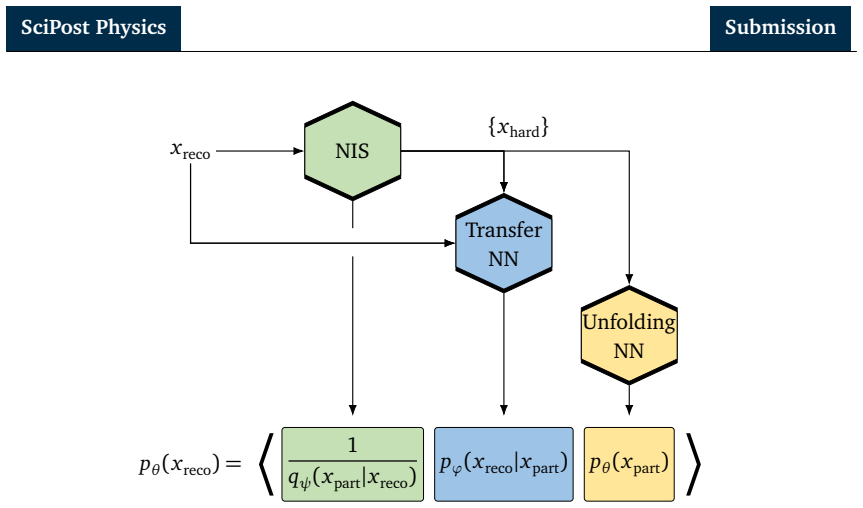
The load-bearing object is the forward transfer network $p_{\phi}(x_{\mathrm{reco}}|x_{\mathrm{part}})$, a normalizing-flow surrogate for the simulator's detector response trained on paired simulated events. SPINUP trains the unfolding network $p_{\theta}(x_{\mathrm{part}})$ by minimizing the KL divergence between the observed reco-level distribution and $p_{\theta}(x_{\mathrm{reco}})=\int dx_{\mathrm{part}}\,p(x_{\mathrm{reco}}|x_{\mathrm{part}})\,p_{\theta}(x_{\mathrm{part}})$, with the integral estimated by neural importance sampling using a network $q_{\psi}(x_{\mathrm{part}}|x_{\mathrm{reco}})$ trained on the inverse conditional distribution, and the gradient approximated by a single draw from a categorical distribution over Monte Carlo weights. Pre-training with one Monte Carlo sample initializes the unfolding network, and an ensemble of unfolding networks provides a lower bound on the uncertainty caused by information loss in the forward mapping.
What would settle it
Evaluate the trained transfer network on part-level events from a second generator and compare its predicted reco-level distribution with that generator's actual reco-level distribution; a visible mismatch, as the paper finds for the six jet-substructure observables, falsifies the central assumption for that observable set.
Extended reading notes
Core claim
The paper's central claim is that the unfolded distribution can be extracted directly by maximum-likelihood training against reco-level data, with no iterative reweighting toward the simulation prior. The method trains a generative unfolding network $p_{\theta}(x_{\mathrm{part}})$ so that, after convolution with a learned transfer network $p_{\phi}(x_{\mathrm{reco}}|x_{\mathrm{part}})$, the resulting reco-level distribution equals the observed data distribution. Neural importance sampling makes the required integral evaluation tractable, and ensembling the trained unfolding networks maps out degenerate solutions and gives a lower bound on the uncertainty from information loss in the forward process. The prior-independence claim is conditional: it holds only when the transfer network is a correct, prior-independent description of the forward process, which the paper shows is violated for the six jet-substructure observables and restored when parton-level variables carry the complete information of the forward process.
Load-bearing premise
The whole result rests on the learned transfer network matching the true detector response for the events in the data; if the transfer function is wrong or prior-dependent, the unfolded distribution silently inherits the simulation prior.
Editorial extensions
If this is right
- Unbinned, multidimensional unfolding can be performed without the iterative Bayesian reweighting that current methods use to suppress the simulation prior.
- Published parton-level data can be reused for arbitrary downstream analyses, including measuring parameters such as the CP phase $\alpha$ of the top Yukawa coupling.
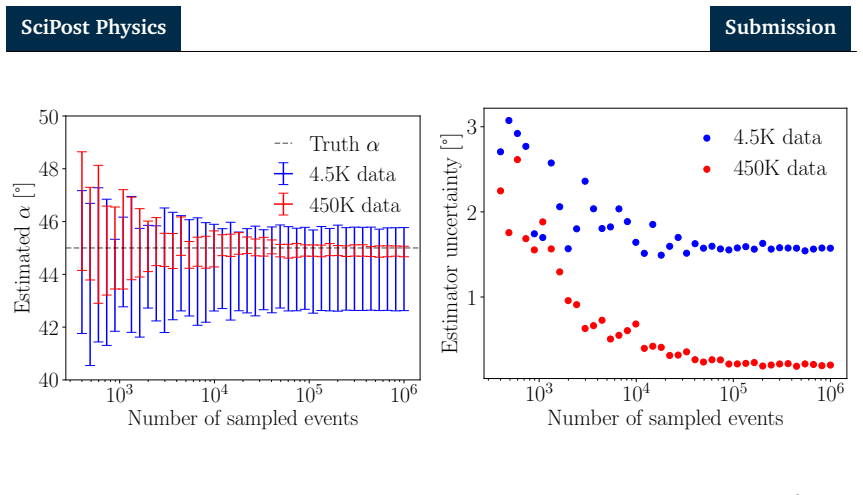
- The ensemble spread converts the statistical uncertainty of a finite reco-level sample into a systematic uncertainty on the unfolded distribution that covers the true parameter value.
- The jet-substructure result implies that unfolding onto lossy summary observables is only valid when the transfer network is itself prior-independent; otherwise the unfolded distribution inherits the simulation prior.
Reading between the lines
- A direct testable extension would unfold the same tHj reco-level events using transfer networks trained on $\alpha$-biased rather than $\alpha$-uniform simulation samples; any shift in the inferred CP phase would quantify how completely the seven parton-level variables encode the forward process.
- The failure mode identified for jet-substructure observables suggests a general design rule for future unfolding studies: the conditioning variables should be as close as possible to the complete event-level phase space, because compression into summary statistics reintroduces the prior dependence the method is designed to avoid.
- Since the unfolded distribution is a generative model, SPINUP could double as a parameter-inference engine: likelihoods for any parton-level parameter can be evaluated by sampling, provided the reco-level acceptance is corrected as in the paper's Eq. (35).
- One could test whether the ensemble spread tracks the Fisher information lost in the forward map; if it does, the ensemble could become a quantitative diagnostic of unfolding uncertainty rather than just a lower bound.
Editorial analysis
A structured set of objections, weighed in public.
Referee Report
Summary. SPINUP is presented as a simulation-prior-independent, unbinned unfolding method. It approximates the forward response p(x_reco|x_part) with a trained transfer network, introduces a neural importance sampling network, and trains an unfolding network p_theta(x_part) by minimizing the KL divergence between the folded model and observed reco-level data (Eqs. 4 and 12). Technical contributions include a categorical gradient approximation, pretraining, and ensembling for information-loss uncertainty. The method is demonstrated on a Gaussian toy, on the OmniFold jet-substructure benchmark using Pythia as simulation and Herwig as data, and on a tHj parton-level unfolding with CP-phase inference.
Significance. If the central claim holds, SPINUP would be a valuable addition: it avoids iterative reweighting, is unbinned, and the maximum-likelihood formulation is clean. The tHj application is a non-circular full-phase-space test with percent-level closure and successful alpha inference, and the paper provides architectural details and hyperparameters. However, the OmniFold benchmark fails on the original Herwig reco data (deviations up to 10%, Fig. 4), and the reported success on that benchmark uses synthetic data generated by the same learned transfer network, which is circular. The central claim of prior independence is therefore established only in settings where the part-level representation contains complete information for the forward process, and the paper should qualify the claim accordingly.
major comments (4)
- [Sec. 4, Figs. 4 and 5] The OmniFold benchmark is not passed on the original data. After training the transfer network on Pythia and unfolding the Herwig reco-level data, the jet mass shows deviations up to 10% (left panel of Fig. 4). The paper then replaces the Herwig reco-level data with synthetic reco-level observables generated from the same trained transfer network p_phi (paragraph after Eq. 29) and reports percent-level recovery (Fig. 5). This synthetic-data closure is circular: the 'data' and the unfolding share the same approximate forward model, so it cannot test prior independence or the correctness of the transfer network. The failure on original data is honestly reported and correctly attributed to lossy summary statistics via Eqs. (27)-(29), but the synthetic-data result should not be used as evidence for the central claim.
- [Sec. 2.2 and Sec. 4] The method's prior independence is conditional on the transfer network p_phi(x_reco|x_part) equaling the true forward response, as the paper acknowledges in Sec. 2. Section 4 demonstrates that this assumption is violated once events are compressed to jet-substructure observables. The abstract's claim that SPINUP is 'independent of the prior from the simulated training data' and Sec. 2.2's statement that it 'will avoid a prior dependence without any iteration' are therefore too broad. They should be qualified to state that the result is prior-independent given a correct and prior-independent transfer model; otherwise the central claim is not supported by the presented evidence.
- [Sec. 5, Eqs. (30)-(31), Figs. 7-8] The tHj test is the only non-circular evidence, but the alpha-independence of the transfer model is asserted rather than established. The parton-level x_part contains the momenta of the top, Higgs, and forward jet before decays, but not the top spin density matrix, which depends on the CP phase alpha. Because p(x_reco|x_part) is averaged over top spin states, it may depend on alpha even at fixed x_part. The statement that 'the parton-level momenta contain the complete information of the forward process' (Sec. 5) needs quantitative support; the check in Fig. 7 covers only a few reco-level observables and does not establish alpha-independence over the full support of x_part. Please provide a test such as training the transfer network separately on alpha=0 and alpha=90 simulated pairs and comparing the resulting unfolded distributions for alpha=45 data, or comparing the learned conditional densities on fixed x_part inputs across alpha.
- [Sec. 2.2 (Pre-training)] The claim that pretraining 'only impacts the convergence time and not the result itself' is asserted without a supporting comparison. Since the pretraining loss (Eq. 13) is a generative-unfolding objective that does inherit the simulation prior, this is a load-bearing point for the prior-independence claim. Please show a quantitative comparison between random initialization and pretrained initialization, e.g., final unfolded distributions and their ensemble spreads, or state the convergence behavior explicitly.
minor comments (5)
- [Eq. (8)] The notation 'logsumexp(p(x_reco|x_part,1), ...)' is unconventional because logsumexp is usually applied to log-probabilities; please clarify that the function returns log(sum_i p_i).
- [Sec. 5.2] The phrase 'extract the maximum-likelihood solution as the minimum of the resulting likelihood parabolas' should say 'minimum of the negative log-likelihood'.
- [Figs. 9 and related panels] The ratio labels 'Model/Truth' are ambiguous when the curve is labeled 'Data Reco'; please use consistent labels such as 'SPINUP/Truth' and 'SPINUP/Data'.
- [Sec. 4, Eq. (26)] The list of six observables includes 'N' (multiplicity) but the definition of N is not given; please define it (e.g., number of jet constituents).
- [Appendix B] The sentence 'This indicates that the method does not struggle with any prior dependence from the simulation top mass' is not directly supported by the shown test, since only a single unfolded sample is compared; please rephrase or add a systematic prior-dependence check.
Circularity Check
SPINUP's formal loss is prior-free, but its jet-substructure benchmark validation is circular: the 'fake Herwig data' are generated from the same learned transfer network used as the forward model, so percent-level closure is guaranteed by construction; the only real-data test fails with up to 10% deviations.
-
fitted input called prediction
[Sec. 4, after Eq. (29) and Fig. 5 caption]
"To stick to our established benchmark, we instead circumvent this issue with a slight change to the dataset: instead of using the reco-level Herwig data, we use the trained 6-dimensional forward surrogate pϕ(xreco|xpart)≈pPythia(xreco|xpart) to generate synthetic reco-level jet substructure observables for the Herwig sample. This way, the forward simulation generalizes."
The unfolding loss (Eq. 12) maximizes log pθ(xreco) = log ∫ dx_part p(x_reco|x_part) pθ(x_part) against pdata(x_reco). When the 'data' are generated by sampling x_part from the Herwig truth and x_reco from the same learned conditional pϕ(·|x_part) that appears inside the loss, the fitted transfer network enters on both sides of the likelihood. Setting pθ to the Herwig part-level truth is then a fixed point of the training objective, so the percent-level closure shown in Fig. 5 is guaranteed up to optimization and MC error. This test cannot detect prior dependence or transfer-model error. The paper's non-circular test on the actual Herwig reco-level data (Fig. 4) instead shows deviations up to 10%, so the circular surrogate test is what carries the claimed jet-substructure demonstration.
full rationale
SPINUP's training objective (Eq. 12) is defined purely on observed reco-level data, so the method itself is not circular: the unfolded distribution is obtained by maximizing the likelihood of the data under the model. The Gaussian toy and the tHj parton-level test provide non-circular checks. However, the main jet-substructure benchmark validation is circular: the paper replaces the true Herwig reco-level data with synthetic data generated from the same learned transfer network pϕ used as the forward model in the loss. Any distribution that maps well through pϕ to the synthetic data will be considered successful, so the percent-level closure of Fig. 5 is expected by construction and cannot validate prior independence. The only non-circular test on the actual Herwig reco-level data (Fig. 4) shows deviations up to 10%, and the paper attributes this to the learned conditional being prior-dependent (Eqs. 27-29). The paper explicitly labels the synthetic dataset as 'fake Herwig reco-distribution' (Fig. 5 caption), and the text admits the forward surrogate is used to generate the data. This satisfies the fitted-input-called-prediction pattern: the transfer network is fitted to Pythia pairs, and then synthetic data for the benchmark are generated from that same network, making the subsequent closure a test of self-consistency rather than of prior independence. The tHj application is genuinely forward because the transfer network is trained on mixed-α samples and the truth is the α=45° parton-level distribution, but the claim that the seven parton-level momenta 'contain the complete information of the forward process' is asserted and the top-decay spin information (α-dependent) is not part of x_part, so a residual prior dependence cannot be excluded. Overall, the central claim of simulation-prior independence is not fully established for compressed observables, but the method's objective itself is not defined in terms of its output. Score 6 rather than 8 because the formal algorithm is not circular; only the standard benchmark demonstration reduces to a fit.
Assumptions & free parameters
free parameters (4)
- NMC (Monte Carlo samples per event in loss) =
64
- Ensemble size =
32
- Pretraining epochs =
200 (jet substructure), 50 (tHj)
- Uniform alpha range for transfer training =
alpha in [-180, 180] deg
assumptions (5)
- domain assumption The forward transfer p(x_reco|x_part) is correctly described by the simulators and by the learned transfer network p_phi on the support of the observed data.
- domain assumption The NIS network q_psi(x_part|x_reco) approximates p_sim(x_part|x_reco) closely enough that the importance-sampling estimator has acceptable variance.
- ad hoc to paper Gradient descent on the categorical-approximation loss converges to a solution whose final part-level distribution is independent of the pretrained initialization.
- domain assumption In the tHj application, the 7-dimensional parton-level momenta contain complete information about the forward process, making p(x_reco|x_part) alpha-independent.
- standard math Standard background: normalizing flows and Transformer-based density estimators are sufficiently accurate for the studied phase spaces.
Cite this review
Pith. "Pith review of Simulation-Prior Independent Neural Unfolding Procedure." pith.science (2026). https://pith.science/paper/PHYIJWMX
@misc{pith2026250715084,
  author       = {Pith},
  title        = {Pith review of: Simulation-Prior Independent Neural Unfolding Procedure},
  year         = {2026},
  howpublished = {\url{https://pith.science/paper/PHYIJWMX}},
  note         = {Machine review of arXiv:2507.15084}
}
read the original abstract
Machine learning allows unfolding high-dimensional spaces without binning at the LHC. The new SPINUP method extracts the unfolded distribution based on a neural network encoding the forward mapping, making it independent of the prior from the simulated training data. It is made efficient through neural importance sampling, and ensembling can be used to estimate the effect of information loss in the forward process. We showcase SPINUP for unfolding detector effects on jet substructure observables and for unfolding to parton level of associated Higgs and single-top production.
Figures


Figures from the paper (12 more)




Forward citations
Cited by 4 Pith papers
-
Neural Control Variates at LO and NLO
Signed neural control variates from normalizing flows, combined with neural importance sampling, reduce weight ranges and negative weights for LO and NLO phase-space integration and event generation.
-
Agentic Re-Casting using Agentic Re-Simulations
An agentic AI system with a physicist in the loop re-casts an ATLAS ttZ measurement into a global top-quark SMEFT fit and recovers injected coloron Wilson coefficients in a repeatable benchmark.
-
Profiling systematic uncertainties in Simulation-Based Inference with Factorizable Normalizing Flows
Systematic uncertainties can be profiled in unbinned likelihood fits by factorizing the normalizing-flow transformation into per-nuisance linear-plus-quadratic terms and training amortized over the nuisance space.
-
An Introduction to Bayesian and Frequentist Simulation-Based Inference with Machine Learning
A structured introduction to ML-based simulation-based inference, contrasting Bayesian and frequentist frameworks and covering parameter inference, unfolding, and validation.
Reference graph
Works this paper leans on
-
[1]
J. M. Campbell et al., Event generators for high-energy physics experiments, SciPost Phys. 16 (2024) 5, 130, arXiv:2203.11110 [hep-ph]
arXiv 2024
-
[2]
Badger et al., Machine learning and LHC event generation, SciPost Phys
S. Badger et al., Machine learning and LHC event generation, SciPost Phys. 14 (2023) 4, 079, arXiv:2203.07460 [hep-ph]
arXiv 2023
- [3]
- [4]
-
[5]
Cowan, A survey of unfolding methods for particle physics, Conf
G. Cowan, A survey of unfolding methods for particle physics, Conf. Proc. C 0203181 (2002) 248
work page 2002
-
[6]
Spano,Unfolding in particle physics: a window on solving inverse problems, EPJ Web Conf
F . Spano,Unfolding in particle physics: a window on solving inverse problems, EPJ Web Conf. 55 (2013) 03002
work page 2013
-
[7]
Arratia et al., Publishing unbinned differential cross section results, JINST 17 (9,
M. Arratia et al., Publishing unbinned differential cross section results, JINST 17 (9,
-
[8]
A. Andreassen, P . T . Komiske, E. M. Metodiev, B. Nachman, and J. Thaler,OmniFold: A Method to Simultaneously Unfold All Observables, Phys. Rev. Lett.124 (2020) 18, 182001, arXiv:1911.09107 [hep-ph]
arXiv 2020
Show all 68 references
-
[9]
Bellagente, A
M. Bellagente, A. Butter, G. Kasieczka, T . Plehn, and R. Winterhalder,How to GAN away Detector Effects, SciPost Phys. 8 (2020) 4, 070, arXiv:1912.00477 [hep-ph]
2020 arXiv
-
[10]
Andreassen, P
A. Andreassen, P . T . Komiske, E. M. Metodiev, B. Nachman, A. Suresh, and J. Thaler, Scaffolding Simulations with Deep Learning for High-dimensional Deconvolution, arXiv:2105.04448 [stat.ML]
-
[11]
Datta, D
K. Datta, D. Kar, and D. Roy ,Unfolding with Generative Adversarial Networks, arXiv:1806.00433 [physics.data-an]
-
[12]
J. N. Howard, S. Mandt, D. Whiteson, and Y. Yang,Foundations of a Fast, Data-Driven, Machine-Learned Simulator, arXiv:2101.08944 [hep-ph]
-
[13]
Diefenbacher, G.-H
S. Diefenbacher, G.-H. Liu, V . Mikuni, B. Nachman, and W . Nie,Improving Generative Model-based Unfolding with Schrödinger Bridges, arXiv:2308.12351 [hep-ph]
-
[14]
Butter, T
A. Butter, T . Jezo, M. Klasen, M. Kuschick, S. Palacios Schweitzer, and T . Plehn,Kicking it off(-shell) with direct diffusion, SciPost Phys. Core 7 (2024) 3, 064, arXiv:2311.17175 [hep-ph]
2024 arXiv
-
[15]
Butter, S
A. Butter, S. Diefenbacher, N. Huetsch, V . Mikuni, B. Nachman, S. Palacios Schweitzer, and T . Plehn,Generative Unfolding with Distribution Mapping, arXiv:2411.02495 [hep-ph]
-
[16]
Bellagente, A
M. Bellagente, A. Butter, G. Kasieczka, T . Plehn, A. Rousselot, R. Winterhalder, L. Ardizzone, and U. Köthe, Invertible Networks or Partons to Detector and Back Again, SciPost Phys. 9 (2020) 074, arXiv:2006.06685 [hep-ph]. 23 SciPost Physics Submission
2020 arXiv
-
[17]
Vandegar, M
M. Vandegar, M. Kagan, A. Wehenkel, and G. Louppe,Neural Empirical Bayes: Source Distribution Estimation and its Applications to Simulation-Based Inference, in Proceedings of The 24th International Conference on Artificial Intelligence and Statistics, A. Banerjee and K. Fukumi...
2021 arXiv
-
[18]
Backes, A
M. Backes, A. Butter, M. Dunford, and B. Malaescu, An unfolding method based on conditional invertible neural networks (cINN) using iterative training, SciPost Phys. Core 7 (2024) 1, 007, arXiv:2212.08674 [hep-ph]
2024 arXiv
-
[19]
Leigh, J
M. Leigh, J. A. Raine, and T . Golling,ν-Flows: conditional neutrino regression, arXiv:2207.00664 [hep-ph]
-
[20]
Ackerschott, R
J. Ackerschott, R. K. Barman, D. Gonçalves, T . Heimel, and T . Plehn,Returning CP-observables to the frames they belong, SciPost Phys. 17 (2024) 1, 001, arXiv:2308.00027 [hep-ph]
2024 arXiv
-
[21]
Shmakov, K
A. Shmakov, K. Greif, M. Fenton, A. Ghosh, P . Baldi, and D. Whiteson,End-To-End Latent Variational Diffusion Models for Inverse Problems in High Energy Physics, arXiv:2305.10399 [hep-ex]
-
[22]
Shmakov, K
A. Shmakov, K. Greif, M. J. Fenton, A. Ghosh, P . Baldi, and D. Whiteson,Full Event Particle-Level Unfolding with Variable-Length Latent Variational Diffusion, SciPost Phys. 18 (2025) 117, arXiv:2404.14332 [hep-ex]
2025 arXiv
-
[23]
Huetsch et al., The landscape of unfolding with machine learning, SciPost Phys
N. Huetsch et al., The landscape of unfolding with machine learning, SciPost Phys. 18 (2025) 2, 070, arXiv:2404.18807 [hep-ph]
2025 arXiv
-
[24]
L. B. Lucy ,An iterative technique for the rectification of observed distributions, Astron. J. 79 (1974) 745
1974
-
[25]
D’Agostini, A Multidimensional unfolding method based on Bayes’ theorem, Nucl
G. D’Agostini, A Multidimensional unfolding method based on Bayes’ theorem, Nucl. Instrum. Meth. A362 (1995) 487
1995
-
[26]
Hocker and V
A. Hocker and V . Kartvelishvili,SVD approach to data unfolding, Nucl. Instrum. Meth. A372 (1996) 469, arXiv:hep-ph/9509307 [hep-ph]
1996 arXiv
-
[27]
Schmitt, TUnfold: an algorithm for correcting migration effects in high energy physics, JINST 7 (2012) T10003, arXiv:1205.6201 [physics.data-an]
S. Schmitt, TUnfold: an algorithm for correcting migration effects in high energy physics, JINST 7 (2012) T10003, arXiv:1205.6201 [physics.data-an]
2012 arXiv
-
[28]
Backes, A
M. Backes, A. Butter, M. Dunford, and B. Malaescu, Event-by-event Comparison between Machine-Learning- and Transfer-Matrix-based Unfolding Methods, arXiv:2310.17037 [physics.data-an]
-
[29]
Favaro, R
L. Favaro, R. Kogler, A. Paasch, S. Palacios Schweitzer, T . Plehn, and D. Schwarz,How to Unfold Top Decays, arXiv:2501.12363 [hep-ph]
-
[30]
Andreevet al., Measurement of lepton-jet correlation in deep-inelastic scattering with the H1 detector using machine learning for unfolding, arXiv:2108.12376 [hep-ex]
H1, V . Andreevet al., Measurement of lepton-jet correlation in deep-inelastic scattering with the H1 detector using machine learning for unfolding, arXiv:2108.12376 [hep-ex]
-
[31]
Andreevet al., Unbinned deep learning jet substructure measurement in high Q2ep collisions at HERA, Phys
H1, V . Andreevet al., Unbinned deep learning jet substructure measurement in high Q2ep collisions at HERA, Phys. Lett. B 844 (2023) 138101, arXiv:2303.13620 [hep-ex]
2023
-
[32]
Aaij et al., Multidifferential study of identified charged hadron distributions in Z-tagged jets in proton-proton collisions atps =13 TeV, Phys
LHCb, R. Aaij et al., Multidifferential study of identified charged hadron distributions in Z-tagged jets in proton-proton collisions atps =13 TeV, Phys. Rev. D108 (2023) L031103, arXiv:2208.11691 [hep-ex]. 24 SciPost Physics Submission
2023 arXiv
-
[33]
P . T . Komiske, S. Kryhin, and J. Thaler,Disentangling quarks and gluons in CMS open data, Phys. Rev. D106 (2022) 9, 094021, arXiv:2205.04459 [hep-ph]
2022 arXiv
-
[34]
Song,Measurement of CollinearDrop jet mass and its correlation with SoftDrop groomed jet substructure observables inps = 200 GeV pp collisions by STAR, arXiv:2307.07718 [nucl-ex]
STAR, Y. Song,Measurement of CollinearDrop jet mass and its correlation with SoftDrop groomed jet substructure observables inps = 200 GeV pp collisions by STAR, arXiv:2307.07718 [nucl-ex]
-
[35]
M. R. Buckley and D. Goncalves, Boosting the Direct CP Measurement of the Higgs-Top Coupling, Phys. Rev. Lett.116 (2016) 9, 091801, arXiv:1507.07926 [hep-ph]
2016 arXiv
-
[36]
J. Ren, L. Wu, and J. M. Yang,Unveiling CP property of top-Higgs coupling with graph neural networks at the LHC, Phys. Lett. B 802 (2020) 135198, arXiv:1901.05627 [hep-ph]
2020 arXiv
-
[37]
Bortolato, J
B. Bortolato, J. F . Kamenik, N. Košnik, and A. Smolkoviˇc, Optimized probes of C P -odd effects in the t ¯th process at hadron colliders, Nucl. Phys. B 964 (2021) 115328, arXiv:2006.13110 [hep-ph]
2021 arXiv
-
[38]
H. Bahl, P . Bechtle, S. Heinemeyer, J. Katzy , T . Klingl, K. Peters, M. Saimpert, T . Stefaniak, and G. Weiglein,Indirect CP probes of the Higgs-top-quark interaction: current LHC constraints and future opportunities, JHEP 11 (2020) 127, arXiv:2007.08542 [hep-ph]
2020 arXiv
-
[39]
Martini, R.-Q
T . Martini, R.-Q. Pan, M. Schulze, and M. Xiao,Probing the CP structure of the top quark Yukawa coupling: Loop sensitivity versus on-shell sensitivity, Phys. Rev. D104 (2021) 5, 055045, arXiv:2104.04277 [hep-ph]
2021 arXiv
-
[40]
Gonçalves, J
D. Gonçalves, J. H. Kim, K. Kong, and Y. Wu,Direct Higgs-top CP-phase measurement with t th at the 14 TeV LHC and 100 TeV FCC, JHEP 01 (2022) 158, arXiv:2108.01083 [hep-ph]
2022 arXiv
-
[41]
R. K. Barman, D. Gonçalves, and F . Kling,Machine Learning the Higgs-Top CP Phase, Phys. Rev. D105 (10, 2021) 035023, arXiv:2110.07635 [hep-ph]
2021 arXiv
-
[42]
Bahl and S
H. Bahl and S. Brass, Constraining CP-violation in the Higgs-top-quark interaction using machine-learning-based inference, JHEP 03 (10, 2021) 017, arXiv:2110.10177 [hep-ph]
2021 arXiv
-
[43]
Kraus, T
M. Kraus, T . Martini, S. Peitzsch, and P . Uwer,Exploring BSM Higgs couplings in single top-quark production, arXiv:1908.09100 [hep-ph]
1908 arXiv
-
[44]
Plehn, A
T . Plehn, A. Butter, B. Dillon, T . Heimel, C. Krause, and R. Winterhalder,Modern Machine Learning for LHC Physicists, arXiv:2211.01421 [hep-ph]
-
[45]
Butter, T
A. Butter, T . Heimel, T . Martini, S. Peitzsch, and T . Plehn,Two invertible networks for the matrix element method, SciPost Phys. 15 (2023) 3, 094, arXiv:2210.00019 [hep-ph]
2023 arXiv
-
[46]
Heimel, N
T . Heimel, N. Huetsch, R. Winterhalder, T . Plehn, and A. Butter,Precision-machine learning for the matrix element method, SciPost Phys. 17 (2024) 5, 129, arXiv:2310.07752 [hep-ph]
2024 arXiv
-
[47]
Heimel, R
T . Heimel, R. Winterhalder, A. Butter, J. Isaacson, C. Krause, F . Maltoni, O. Mattelaer, and T . Plehn,MadNIS - Neural multi-channel importance sampling, SciPost Phys. 15 (2023) 4, 141, arXiv:2212.06172 [hep-ph]
2023 arXiv
-
[48]
Heimel, N
T . Heimel, N. Huetsch, F . Maltoni, O. Mattelaer, T . Plehn, and R. Winterhalder,The MadNIS reloaded, SciPost Phys. 17 (2024) 1, 023, arXiv:2311.01548 [hep-ph]. 25 SciPost Physics Submission
2024 arXiv
-
[49]
Heimel, O
T . Heimel, O. Mattelaer, T . Plehn, and R. Winterhalder,Differentiable MadNIS-Lite, SciPost Phys. 18 (2025) 1, 017, arXiv:2408.01486 [hep-ph]
2025 arXiv
-
[50]
Burda, R
Y. Burda, R. Grosse, and R. Salakhutdinov,Importance weighted autoencoders, arXiv:1509.00519 [cs.LG]
-
[51]
Butter, N
A. Butter, N. Huetsch, S. Palacios Schweitzer, T . Plehn, P . Sorrenson, and J. Spinner,Jet diffusion versus JetGPT – Modern networks for the LHC, SciPost Phys. Core 8 (2025) 026, arXiv:2305.10475 [hep-ph]
2025 arXiv
-
[52]
Desai, B
K. Desai, B. Nachman, and J. Thaler, Moment extraction using an unfolding protocol without binning, Phys. Rev. D110 (2024) 11, 116013, arXiv:2407.11284 [hep-ph]
2024 arXiv
-
[53]
Sjöstrand, S
T . Sjöstrand, S. Ask, J. R. Christiansen, R. Corke, N. Desai, P . Ilten, S. Mrenna, S. Prestel, C. O. Rasmussen, and P . Z. Skands,An introduction to PYTHIA 8.2, Comput. Phys. Commun. 191 (2015) 159, arXiv:1410.3012 [hep-ph]
2015 arXiv
-
[54]
Bellm et al., Herwig 7.0/Herwig++ 3.0 release note, Eur
J. Bellm et al., Herwig 7.0/Herwig++ 3.0 release note, Eur. Phys. J. C76 (2016) 4, 196, arXiv:1512.01178 [hep-ph]
2016 arXiv
-
[55]
de Favereau, C
DELPHES 3, J. de Favereau, C. Delaere, P . Demin, A. Giammanco, V . Lemaître, A. Mertens, and M. Selvaggi, DELPHES 3, A modular framework for fast simulation of a generic collider experiment, JHEP 02 (2014) 057, arXiv:1307.6346 [hep-ex]
2014 arXiv
-
[56]
Cacciari, G
M. Cacciari, G. P . Salam, and G. Soyez,The anti-kt jet clustering algorithm, JHEP 04 (2008) 063, arXiv:0802.1189 [hep-ph]
2008 arXiv
-
[57]
Cacciari, G
M. Cacciari, G. P . Salam, and G. Soyez,FastJet User Manual, Eur. Phys. J. C 72 (2012) 1896, arXiv:1111.6097 [hep-ph]
2012 arXiv
-
[58]
A. J. Larkoski, S. Marzani, G. Soyez, and J. Thaler, Soft Drop, JHEP 05 (2014) 146, arXiv:1402.2657 [hep-ph]
2014 arXiv
-
[59]
Dasgupta, A
M. Dasgupta, A. Fregoso, S. Marzani, and G. P . Salam,Towards an understanding of jet substructure, JHEP 09 (2013) 029, arXiv:1307.0007 [hep-ph]
2013 arXiv
-
[60]
Thaler and K
J. Thaler and K. Van Tilburg, Identifying Boosted Objects with N-subjettiness, JHEP 03 (2011) 015, arXiv:1011.2268 [hep-ph]
2011 arXiv
-
[61]
Artoisenetet al., A framework for Higgs characterisation, JHEP 11 (2013) 043, arXiv:1306.6464 [hep-ph]
P . Artoisenetet al., A framework for Higgs characterisation, JHEP 11 (2013) 043, arXiv:1306.6464 [hep-ph]
2013 arXiv
-
[62]
Demartin, F
F . Demartin, F . Maltoni, K. Mawatari, and M. Zaro,Higgs production in association with a single top quark at the LHC, Eur. Phys. J. C 75 (2015) 6, 267, arXiv:1504.00611 [hep-ph]
2015 arXiv
-
[63]
Cranmer and T
K. Cranmer and T . Plehn,Maximum significance at the LHC and Higgs decays to muons, Eur. Phys. J. C 51 (2007) 415, arXiv:hep-ph/0605268
2007 arXiv
-
[64]
Alwall, R
J. Alwall, R. Frederix, S. Frixione, V . Hirschi, F . Maltoni, O. Mattelaer, H. S. Shao, T . Stelzer, P . Torrielli, and M. Zaro,The automated computation of tree-level and next-to-leading order differential cross sections, and their matching to parton shower simulations, JHEP...
2014 arXiv
-
[65]
I. W . Stewart, F . J. Tackmann, J. Thaler, C. K. Vermilion, and T . F . Wilkason,Xcone: N-jettiness as an exclusive cone jet algorithm, Journal of High Energy Physics 2015 (Nov.,
2015
-
[66]
CMS, A. Tumasyan et al., Measurement of the differential tt production cross section as a function of the jet mass and extraction of the top quark mass in hadronic decays of boosted top quarks, Eur. Phys. J. C 83 (2023) 7, 560, arXiv:2211.01456 [hep-ex]. 27
2023 arXiv
-
[2015]
26 SciPost Physics Submission
-
[2022]
P01024, arXiv:2109.13243 [hep-ph]
Reviewed August 6, 2026 · model on record in the stance chip above.
Discussion (0). Sign in to comment.