REVIEW 4 major objections 5 minor 78 references
Beyond Model Base Retrieval: Weaving Knowledge to Master Fine-grained Neural Network Design
T0 review · 4 major / 5 minor · reviewed 2026-08-06 · deepseek-v4-flash
Pith's one-line read The paper reports that reusing fine-grained edit gains from past tasks finds the best architecture in 26 of 33 task-data pairs within 100 evaluations.
desk verdict A serious AutoML systems paper whose 26/33 'design-space best' claim is likely over-stated because the released MKB size matches only 11 full design-space sweeps; the retrieval-refinement idea itself is still worth refereeing. read the letter →
The pith
A machine-rendered reading of the paper's core claim, the machinery that carries it, and where it could break.
The reading
What carries the argument
The machinery that carries the argument is the modification-gain graph $G_i^\Delta$, a directed graph whose vertices are architecture configurations and whose edges are feasible one-hop edits, with each edge weighted by the historical performance gain of that edit on task $D_i$. This representation makes stored knowledge composable and reversible: gains can be chained along a trajectory and combined across source tasks rather than treated as static checkpoint scores. The selection rule that uses it is the woven-gain objective of Equation (7), $\Delta\theta^*_t=\arg\max_{\Delta\theta\in C_t}\sum_i S_t(D_u,D_i)\,g_{i,t}^{\Delta P}(\Delta\theta)$, with the similarity weights $S_t$ maintained by a Bayesian update whose likelihood is the Gaussian gain-consistency model, and with $g_{i,t}^{\Delta P}$ supplied by an edge-regression GNN predictor when recorded gains are absent or unreliable. The dynamic similarity update is what distinguishes the method from prior static transferability estimators: it lets the retrieval strategy be corrected online as the architecture moves across the performance landscape.
What would settle it
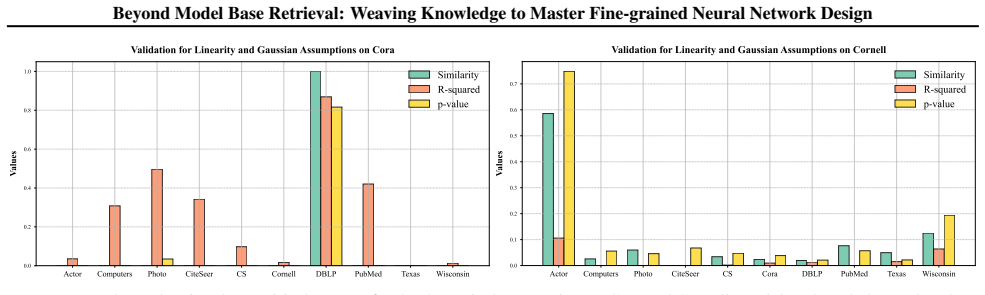
On a held-out OOD task, record every (benchmark-gain, observed-gain) pair along a refinement run and fit the linear model of Equation (6) after each Bayesian update. The gain-consistency claim predicts the fit's $R^2$ should improve once the similarity belief adapts; if on many OOD tasks it stays near the reported unadapted Cornell value of 0.03 even after adaptation, the linear-transfer assumption is not carrying the result.
Extended reading notes
Core claim
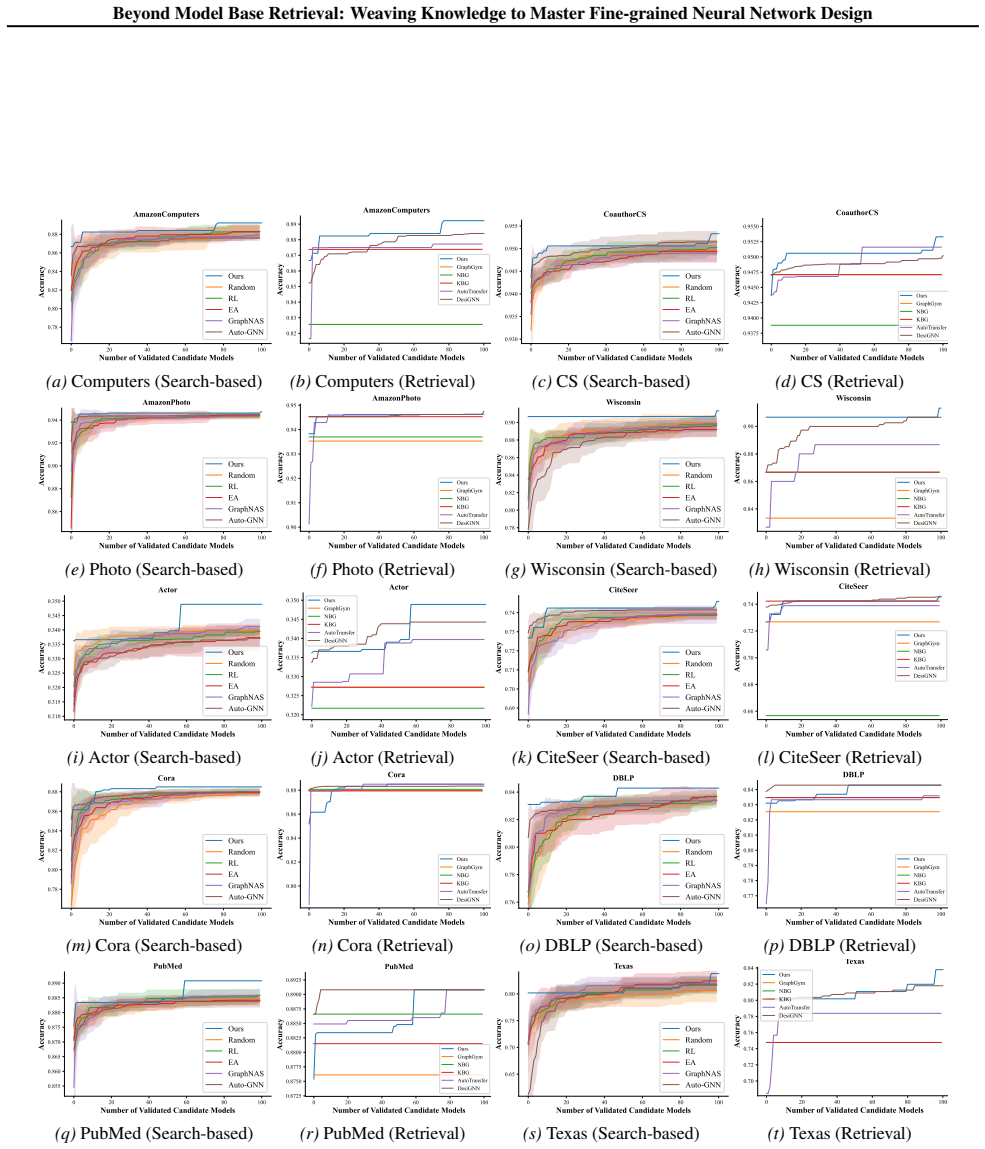
The core discovery, on the paper's own terms, is that fine-grained modification gains transfer across tasks and can drive a retrieval-augmented refinement loop. Historical evaluations are organized as an architecture modification-gain graph $G_i^\Delta=(V,E_i,\omega_i)$ whose directed edges carry the observed performance delta $\omega_i(\theta\to\theta')=P(\theta',D_i)-P(\theta,D_i)$. For an unseen task $D_u$, the next edit is chosen by the woven-gain objective $\Delta\theta^*_t=\arg\max_{\Delta\theta\in C_t}\sum_i S_t(D_u,D_i)\,g_{i,t}^{\Delta P}(\Delta\theta)$, where $S_t$ is a Bayesian belief updated online from observed gains through a Gaussian observation model $P(\Delta P^u_t\mid \Delta P^i_t)=\mathcal{N}(\Delta P^u_t;\gamma_{i,t}\Delta P^i_t,\sigma^2)$, and where $g_{i,t}^{\Delta P}$ falls back on predicted gains from per-task edge-regression planners when direct evidence is missing or transfer is weak. The paper reports that this procedure reaches the search-space-best architecture in 26 of 33 task-data pairs under 100 evaluations and that its dynamic similarity belief tracks the true evolving local modification consistency better than a static similarity (average Kendall correlation 0.34 versus 0.08).
Load-bearing premise
The load-bearing premise is that for tasks judged similar, the performance gain of a one-hop architecture edit on the new task is approximately a linear function, plus Gaussian noise, of the same edit's gain on the benchmark task; if that local gain-consistency fails, both the woven-gain selection rule and the Bayesian similarity update lose their justification.
Editorial extensions
If this is right
- If the central claim is right, model repositories gain a new editing semantics: storing pairwise architecture deltas lets a later task chain modifications from multiple prior tasks, so the value of a knowledge base grows with every task it serves rather than saturating at the best stored checkpoint.
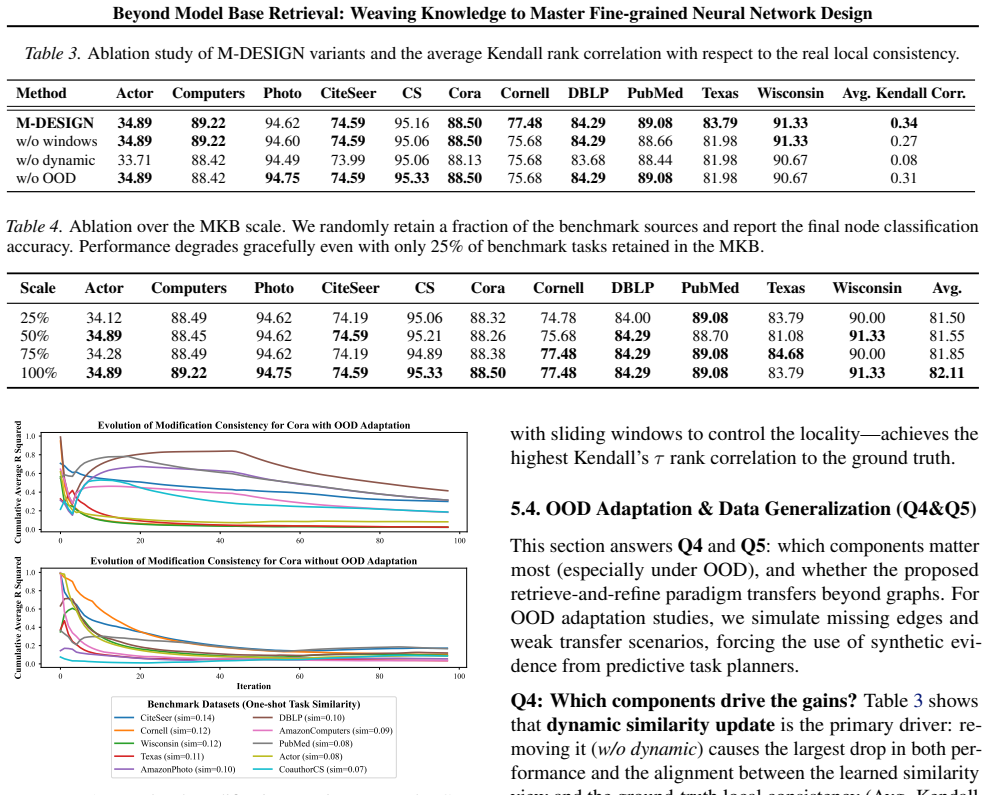
- Static transferability becomes a known failure mode: the ablation shows the largest performance drop and the drop in Kendall correlation (0.34 to 0.08) when the dynamic update is removed, so retrieval-based design systems should re-estimate task similarity from observed local gains rather than fixing it at initialization.
- Repository under-coverage is not fatal: retaining only 25% of benchmark tasks in the base keeps average node-classification accuracy within about 0.6 points of the full base (81.50 vs 82.11), indicating graceful degradation and a role for predictive planners in filling gaps.
- Out-of-distribution tasks benefit specifically from multi-hop gain prediction: on Cornell the gain correlation with the closest benchmark rises from $R^2=0.03$ without OOD adaptation to $R^2=0.11$ with it, which is the paper's evidence that predictive planners prevent negative transfer when direct evidence misleads.
- The retrieve-then-refine pattern generalizes beyond graphs: on tabular HPOBench, a simplified variant lands near the top of a 62,208-model space (e.g., rank 6/62208 on Naval), while on image benchmarks one-shot retrieval is already near-optimal, suggesting the benefit of iterative refinement depends on how data-sensitive the modality is.
Reading between the lines
- An implicit consequence the authors do not develop: the dynamic similarity belief should become more accurate over a run, so plotting Kendall correlation between $S_t$ and true local consistency per iteration on held-out tasks would test whether the mechanism is genuinely self-correcting rather than merely benefiting from a good prior.
- A testable extension: because the Bayesian update assumes gain-consistency parameters stay constant within a sliding window, one could adapt the window size to local landscape curvature; the paper's fixed windows of 30–40 might be too wide where the performance surface is bumpy and too narrow where it is smooth.
- An economic implication left implicit: the reported 100-evaluation budget counts online evaluations, not the offline cost of populating the 67,760-model knowledge base, so the number of downstream tasks needed to amortize that construction is the natural next calculation for a practitioner.
Editorial analysis
A structured set of objections, weighed in public.
Referee Report
Summary. The paper proposes M-DESIGN, a retrieval-augmented framework that reframes neural architecture refinement as adaptive retrieval over modification-gain graphs. For an unseen task, M-DESIGN initializes from a model knowledge base (MKB), iteratively selects one-hop architecture modifications by weaving gain evidence from benchmark tasks, and maintains a Bayesian online belief over task similarity using observed gains. Predictive task planners are introduced to extrapolate multi-hop gains under out-of-distribution shift or missing evidence. The empirical study covers 33 graph task-data pairs under a 100-model evaluation budget and reports that M-DESIGN reaches the best architecture in the design space for 26 of 33 cases; additional experiments ablate the dynamic-similarity component and extend the framework to tabular and image benchmarks.
Significance. If the central claims are verified, this is a useful contribution to the model-retrieval and NAS literature. The paper formulates fine-grained edit-effect evidence as a graph structure, releases a sizeable MKB of 67,760 evaluated GNN configurations, and evaluates with a thoughtful held-out protocol: target datasets are removed from the MKB, baselines share the same design space, and results are averaged over 10 trials. The online Bayesian similarity update is principled, and the mechanism-level analysis in Section 5.3 is an honest attempt to test the underlying assumptions rather than assume them. The tabular and image extensions, even though simpler variants, strengthen the generality claim. The main reservation is that the headline 'search-space-best' result depends on the completeness of the MKB, which the reported record counts do not currently support.
major comments (4)
- [§5.2, §B.3, Tables 1/10/11] The claim that M-DESIGN 'discovers the best model architecture in the design space for 26 out of 33 task-data pairs' is not supported by the reported MKB size. The released MKB contains 67,760 evaluated model configurations across 33 task-dataset databases (Appendix B.3), i.e., about 2,053 records per task-data pair, whereas Section B.4 defines a 6,160-architecture design space. If the 'Space Optimum' rows are maxima over the recorded subset rather than the full design space, the '*' markers and the 26/33 count overstate what was demonstrated. The authors should report per-task record counts and explain the provenance of the Space Optimum rows, or evaluate all 6,160 architectures per task and recompute the count.
- [§5.3, Figure 6] The mechanistic validation of the gain-consistency assumption is weak for the OOD case that motivates the method. Figure 6 reports R²=0.03 for Cornell versus its closest benchmark without OOD adaptation and R²=0.11 after adaptation; the text in §5.3 nevertheless concludes that modification gains transfer across similar tasks and that OOD adaptation makes multi-hop evidence 'more predictive.' With R²=0.11, the linear-Gaussian model explains almost none of the variance, so the claim that Equation (9) is validated empirically should be softened or supplemented with confidence intervals and a formal test of the fitted assumption on a larger set of task pairs.
- [Table 3, Figure 7] The 'real local consistency' or 'ground-truth modification consistency' used to compute the Kendall correlations in Table 3 is never defined. If it is computed from the same observed gains that drive the Bayesian update, then the high Kendall value (0.34 vs 0.08) partly reflects self-consistency rather than an independent ground truth. The authors should define the ground-truth consistency, describe how it is computed, and ideally report the correlation of the dynamic similarity with held-out gains not used in the update.
- [§B.1, Equations (6) and (7)] The derivation of Equation (7) from the gain-consistency condition treats γ_{i,t} and ϵ_{i,t} as independent of Δθ within the 1-hop candidate set and absorbs them into the per-task evidence. This is a substantive local-stationarity assumption that is not stated as such or tested. Since γ and ϵ are estimated from the same interaction history, the derivation should at least state the assumption explicitly and provide evidence (or a sensitivity analysis) that it holds across the candidate set.
minor comments (5)
- [Abstract vs §B.3] The abstract says the MKB spans 22 datasets while Appendix B.3 says 33 task-dataset databases; please clarify the relationship between datasets and task-data pairs.
- [Table 1] Table 1 contains rendering issues such as '95.1688.50' in the AutoTransfer row and inconsistent placement of the '*' marker; the table should be cleaned so that numeric values and significance markers are unambiguous.
- [§4.1] The first paragraph of Section 4 refers to 'Theorem 3.1' and later text refers to 'Theorem 4.1' and 'Theorem 4.2', but the manuscript does not state these theorems; the cross-references should be corrected to the actual definition or theorem numbering.
- [Figure 6] Figure 6 lacks axis labels and units; the text refers to modification gains, but the reader cannot tell whether the axes are raw accuracies, AUC values, or normalized gains.
- [Table 2] Table 2's row labels and the final M-DESIGN row are difficult to align with the column headers, and the threshold defining 'high-performance level' appears only in the main text; please make the table self-contained.
Circularity Check
Mechanistic validation of dynamic similarity is circular; the 26/33 effectiveness claim is held-out and non-circular.
-
fitted input called prediction
[Section 4.1 (Definition 4.1, Eqs. 8–9) and Section 5.3 (Table 3)]
"Definition 4.1: 'we define a task similarity S(·,·) such that when S(Du, Di) ≥ δ, the modification gain on Du is locally consistent with that on Di: E[ΔP u t (Δθ)|ΔP i t (Δθ),S(D u, Di)≥δ] = γ i,t ΔP i t (Δθ) + ϵ i,t.' Section 5.3: 'We quantify this behavior in Table 3, where the dynamic similarity variant—with sliding windows to control the locality—achieves the highest Kendall’s τ rank correlation to the ground truth.'"
The Table 3 target, 'ground-truth local modification consistency,' is never defined independently. The paper's only formal definition of local consistency is the conditional linearity in Definition 4.1, and Eq. (9) posits exactly that linear-Gaussian relation, with γ and σ estimated from the observed gain history. The dynamic similarity St is thus a normalized function of how well each source's gains predict the target gains already observed on the current trajectory; any 'true consistency' computed from the same (ΔP^u, ΔP^i) pairs ranks sources in the same order as the fitted likelihood. A static prior that never consumes those gains is expected to rank worse. The 0.34 vs 0.08 Kendall gap compares a fitted quantity with its own training signal, not with an independent ground truth.
full rationale
The main headline result is not circular. The evaluation protocol removes the target dataset's performance records from the MKB (Section 5.1), the search-space optimum is fixed by the recorded benchmark evaluations rather than by M-DESIGN's choices, and final accuracies/AUCs are measured on held-out task data; the 26/33 count and efficiency comparisons could have gone against the method. The derivation of Eq. (7) in Appendix B.1 is an algebraic consequence of the stated gain-consistency and model-averaging assumptions, not a restatement of the conclusion. The Bayesian update is a legitimate online estimator. The circular element is confined to the mechanism-level validation in Section 5.3 and Table 3: the quantity used as 'ground truth' for local consistency is not measured independently of the gain observations that the Bayesian update is fitted to, so the claim that dynamic similarity tracks true local consistency better than static similarity is close to tautological. Separately, the MKB size (67,760 records over 33 task-data pairs, about 2,053 per pair) is smaller than the stated 6,160-architecture design space, so the 'Space Optimum' rows may be maxima over the recorded subset rather than provable global optima; this is a verifiability and correctness concern rather than a circularity, and I do not count it in the score. Overall score 4: partial circularity in a supporting mechanistic claim, with the central effectiveness claim having independent content.
Assumptions & free parameters
free parameters (5)
- gamma_i,t transfer scaling =
estimated from sliding window of observed gain pairs, default gamma_0=1.0
- sigma^2 observation variance =
estimated from sliding window, initial sigma^2_0=0.01
- window size w =
30 to 40
- OOD threshold delta =
discarded in practice
- epsilon_i,t residual discrepancy =
absorbed into calibrated evidence g, estimated from history
assumptions (5)
- domain assumption Local modification gains transfer linearly between sufficiently similar tasks (Equation 6).
- domain assumption Modification gains follow a Gaussian distribution for similar tasks (Equation 9).
- domain assumption Modification gains are composable and reversible across tasks (graph edges can be chained).
- domain assumption The design space in Table 7 covers the relevant architectural variation for the evaluated tasks.
- domain assumption Initial task similarity S0 can be computed from data statistics and LLM priors without test-set signal.
invented entities (2)
-
Architecture Modification-Gain Graph G_i_delta
independent evidence
-
Predictive Task Planners (edge-regression GNNs f_psi_i)
independent evidence
Cite this review
Pith. "Pith review of Beyond Model Base Retrieval: Weaving Knowledge to Master Fine-grained Neural Network Design." pith.science (2026). https://pith.science/paper/AEZHBX6F
@misc{pith2026250715336,
  author       = {Pith},
  title        = {Pith review of: Beyond Model Base Retrieval: Weaving Knowledge to Master Fine-grained Neural Network Design},
  year         = {2026},
  howpublished = {\url{https://pith.science/paper/AEZHBX6F}},
  note         = {Machine review of arXiv:2507.15336}
}
read the original abstract
Designing high-performance neural networks for new tasks requires balancing optimization quality with search efficiency. Current methods fail to achieve this balance: neural architectural search is computationally expensive, while model retrieval often yields suboptimal static checkpoints. To resolve this dilemma, we model the performance gains induced by fine-grained architectural modifications as edit-effect evidence and build evidence graphs from prior tasks. By constructing a retrieval-augmented model refinement framework, our proposed M-DESIGN dynamically weaves historical evidence to discover near-optimal modification paths. M-DESIGN features an adaptive retrieval mechanism that quickly calibrates the evolving transferability of edit-effect evidence from different sources. To handle out-of-distribution shifts, we introduce predictive task planners that extrapolate gains from multi-hop evidence, thereby reducing reliance on an exhaustive repository. Based on our model knowledge base of 67,760 graph neural networks across 22 datasets, extensive experiments demonstrate that M-DESIGN consistently outperforms baselines, achieving the search-space best performance in 26 out of 33 cases under a strict budget.
Figures


Figures from the paper (6 more)



Reference graph
Works this paper leans on
-
[1]
write newline
" write newline "" initialize.prev.this.status FUNCTION begin.bib " write newline preamble empty 'skip preamble write newline if " thebibliography " longest.label * " " * write newline " [1] #1 " write newline " url@samestyle " write newline " " write newline " [2] #2 " write newline " =0pt " write newline " " ALTinterwordstretchfactor * " " * write newli...
-
[2]
11em plus .33em minus .07em 4000 4000 100 4000 4000 500 `\.=1000 = #1 \@IEEEnotcompsoconly \@IEEEcompsoconly #1 * [1] 0pt [0pt][0pt] #1 * [1] 0pt [0pt][0pt] #1 * \| ** #1 \@IEEEauthorblockNstyle \@IEEEcompsocnotconfonly \@IEEEauthorblockAstyle \@IEEEcompsocnotconfonly \@IEEEcompsocconfonly \@IEEEauthordefaulttextstyle \@IEEEcompsocnotconfonly \@IEEEauthor...
-
[3]
F. Rosenblatt, ``The perceptron: a probabilistic model for information storage and organization in the brain.'' Psychological review, vol. 65, no. 6, p. 386, 1958
work page 1958
-
[4]
Vaswani, ``Attention is all you need,'' Advances in Neural Information Processing Systems, 2017
A. Vaswani, ``Attention is all you need,'' Advances in Neural Information Processing Systems, 2017
2017
-
[5]
Krizhevsky, I
A. Krizhevsky, I. Sutskever, and G. E. Hinton, ``Imagenet classification with deep convolutional neural networks,'' Advances in neural information processing systems, vol. 25, 2012
2012
-
[6]
K. He, X. Zhang, S. Ren, and J. Sun, ``Deep residual learning for image recognition,'' in Proceedings of the IEEE conference on computer vision and pattern recognition, 2016, pp. 770--778
2016
-
[7]
T. N. Kipf and M. Welling, ``Semi-supervised classification with graph convolutional networks,'' arXiv preprint arXiv:1609.02907, 2016
arXiv 2016
-
[8]
J. Devlin, M.-W. Chang, K. Lee, and K. Toutanova, ``Bert: Pre-training of deep bidirectional transformers for language understanding,'' arXiv preprint arXiv:1810.04805, 2018
arXiv 2018
Show all 78 references
-
[9]
B. Zoph, V. Vasudevan, J. Shlens, and Q. V. Le, ``Learning transferable architectures for scalable image recognition,'' in Proceedings of the IEEE conference on computer vision and pattern recognition, 2018, pp. 8697--8710
2018
-
[10]
H. Pham, M. Guan, B. Zoph, Q. Le, and J. Dean, ``Efficient neural architecture search via parameters sharing,'' in International conference on machine learning. 1em plus 0.5em minus 0.4em PMLR, 2018, pp. 4095--4104
2018
-
[11]
LeDell and S
E. LeDell and S. Poirier, ``H2o automl: Scalable automatic machine learning,'' in Proceedings of the AutoML Workshop at ICML, vol. 2020. 1em plus 0.5em minus 0.4em ICML San Diego, CA, USA, 2020
2020
-
[12]
K. Zhou, X. Huang, Q. Song, R. Chen, and X. Hu, ``Auto-gnn: Neural architecture search of graph neural networks,'' Frontiers in big Data, vol. 5, p. 1029307, 2022
2022
-
[13]
W. Wang, M. Zhang, G. Chen, H. Jagadish, B. C. Ooi, and K.-L. Tan, ``Database meets deep learning: Challenges and opportunities,'' ACM Sigmod Record, vol. 45, no. 2, pp. 17--22, 2016
2016
-
[14]
Boehm, S
M. Boehm, S. Tatikonda, B. Reinwald, P. Sen, Y. Tian, D. R. Burdick, and S. Vaithyanathan, ``Hybrid parallelization strategies for large-scale machine learning in systemml,'' Proceedings of the VLDB Endowment, vol. 7, no. 7, pp. 553--564, 2014
2014
-
[15]
W. Wang, J. Gao, M. Zhang, S. Wang, G. Chen, T. K. Ng, B. C. Ooi, J. Shao, and M. Reyad, ``Rafiki: machine learning as an analytics service system,'' Proceedings of the VLDB Endowment, vol. 12, no. 2, pp. 128--140, 2018
2018
-
[16]
Aberger, A
C. Aberger, A. Lamb, K. Olukotun, and C. R \'e , ``Levelheaded: A unified engine for business intelligence and linear algebra querying,'' in 2018 IEEE 34th International Conference on Data Engineering (ICDE). 1em plus 0.5em minus 0.4em IEEE, 2018, pp. 449--460
2018
-
[17]
J. V. D'silva, F. De Moor, and B. Kemme, ``Aida: Abstraction for advanced in-database analytics,'' Proceedings of the VLDB Endowment, vol. 11, no. 11, pp. 1400--1413, 2018
2018
-
[18]
Stonebraker, P
M. Stonebraker, P. Brown, D. Zhang, and J. Becla, ``Scidb: A database management system for applications with complex analytics,'' Computing in Science & Engineering, vol. 15, no. 3, pp. 54--62, 2013
2013
-
[19]
Z. Luo, S. Cai, J. Gao, M. Zhang, K. Y. Ngiam, G. Chen, and W.-C. Lee, ``Adaptive lightweight regularization tool for complex analytics,'' in 2018 IEEE 34th International Conference on Data Engineering (ICDE). 1em plus 0.5em minus 0.4em IEEE, 2018, pp. 485--496
2018
-
[20]
S. S. Sandha, W. Cabrera, M. Al-Kateb, S. Nair, and M. Srivastava, ``In-database distributed machine learning: demonstration using teradata sql engine,'' Proceedings of the VLDB Endowment, vol. 12, no. 12, 2019
2019
-
[21]
X. Li, B. Cui, Y. Chen, W. Wu, and C. Zhang, ``Mlog: Towards declarative in-database machine learning,'' Proceedings of the VLDB Endowment, vol. 10, no. 12, pp. 1933--1936, 2017
1933
-
[22]
K. Kara, K. Eguro, C. Zhang, and G. Alonso, ``Columnml: Column-store machine learning with on-the-fly data transformation,'' Proceedings of the VLDB Endowment, vol. 12, no. 4, pp. 348--361, 2018
2018
-
[23]
B. C. Ooi, S. Cai, G. Chen, Y. Shen, K.-L. Tan, Y. Wu, X. Xiao, N. Xing, C. Yue, L. Zeng et al., ``Neurdb: an ai-powered autonomous data system,'' Science China Information Sciences, vol. 67, no. 10, p. 200901, 2024
2024
-
[24]
X.-Z. Wu, W. Xu, S. Liu, and Z.-H. Zhou, ``Model reuse with reduced kernel mean embedding specification,'' IEEE Transactions on Knowledge and Data Engineering, vol. 35, no. 1, pp. 699--710, 2023
2023
-
[25]
H. Miao, A. Li, L. S. Davis, and A. Deshpande, ``Modelhub: Towards unified data and lifecycle management for deep learning,'' arXiv preprint arXiv:1611.06224, 2016
2016 arXiv
-
[26]
Vartak, H
M. Vartak, H. Subramanyam, W.-E. Lee, S. Viswanathan, S. Husnoo, S. Madden, and M. Zaharia, ``Modeldb: a system for machine learning model management,'' in Proceedings of the Workshop on Human-In-the-Loop Data Analytics, 2016, pp. 1--3
2016
-
[27]
Kumar, R
A. Kumar, R. McCann, J. Naughton, and J. M. Patel, ``Model selection management systems: The next frontier of advanced analytics,'' ACM SIGMOD Record, vol. 44, no. 4, pp. 17--22, 2016
2016
-
[28]
J. You, Z. Ying, and J. Leskovec, ``Design space for graph neural networks,'' Advances in Neural Information Processing Systems, vol. 33, pp. 17\,009--17\,021, 2020
2020
-
[29]
N. Xing, S. Cai, G. Chen, Z. Luo, B. C. Ooi, and J. Pei, ``Database native model selection: Harnessing deep neural networks in database systems,'' Proceedings of the VLDB Endowment, vol. 17, no. 5, pp. 1020--1033, 2024
2024
-
[30]
L. Zeng, N. Xing, S. Cai, G. Chen, B. C. Ooi, J. Pei, and Y. Wu, ``Powering in-database dynamic model slicing for structured data analytics,'' arXiv preprint arXiv:2405.00568, 2024
2024 arXiv
-
[31]
Z. Li, H. Van Der Wilk, D. Zhan, M. Khosla, A. Bozzon, and R. Hai, ``Model selection with model zoo via graph learning,'' in 2024 IEEE 40th International Conference on Data Engineering (ICDE). 1em plus 0.5em minus 0.4em IEEE, 2024, pp. 1296--1309
2024
-
[32]
H. Liu, S. Di, J. Wang, Z. Wang, J. Wang, X. Zhou, and L. Chen, ``Structuring benchmark into knowledge graphs to assist large language models in retrieving and designing models,'' in The Thirteenth International Conference on Learning Representations, 2025
2025
-
[33]
K. Cao, J. You, J. Liu, and J. Leskovec, ``Autotransfer: Automl with knowledge transfer--an application to graph neural networks,'' arXiv preprint arXiv:2303.07669, 2023
2023 arXiv
-
[34]
J. Wang, S. Di, H. Liu, Z. Wang, J. Wang, L. Chen, and X. Zhou, ``Computation-friendly graph neural network design by accumulating knowledge on large language models,'' arXiv preprint arXiv:2408.06717, 2024
2024
-
[35]
Z. Wang, S. Di, and L. Chen, ``A message passing neural network space for better capturing data-dependent receptive fields,'' in Proceedings of the 29th ACM SIGKDD Conference on Knowledge Discovery and Data Mining, 2023, pp. 2489--2501
2023
-
[36]
K. T. Chitty-Venkata, M. Emani, V. Vishwanath, and A. K. Somani, ``Neural architecture search benchmarks: Insights and survey,'' IEEE Access, vol. 11, pp. 25\,217--25\,236, 2023
2023
-
[37]
Y. Qin, Z. Zhang, X. Wang, Z. Zhang, and W. Zhu, ``Nas-bench-graph: Benchmarking graph neural architecture search,'' Advances in neural information processing systems, vol. 35, pp. 54--69, 2022
2022
-
[38]
X. He, K. Zhao, and X. Chu, ``Automl: A survey of the state-of-the-art,'' Knowledge-based systems, vol. 212, p. 106622, 2021
2021
-
[39]
T. Li, J. Zhong, J. Liu, W. Wu, and C. Zhang, ``Ease. ml: Towards multi-tenant resource sharing for machine learning workloads,'' Proceedings of the VLDB Endowment, vol. 11, no. 5, pp. 607--620, 2018
2018
-
[40]
Nakandala, Y
S. Nakandala, Y. Zhang, and A. Kumar, ``Cerebro: A data system for optimized deep learning model selection,'' Proceedings of the VLDB Endowment, vol. 13, no. 12, pp. 2159--2173, 2020
2020
-
[41]
Tan, J.-D
Z.-H. Tan, J.-D. Liu, X.-D. Bi, P. Tan, Q.-C. Zheng, H.-T. Liu, Y. Xie, X.-C. Zou, Y. Yu, and Z.-H. Zhou, ``Beimingwu: A learnware dock system,'' in Proceedings of the 30th ACM SIGKDD Conference on Knowledge Discovery and Data Mining, ser. KDD '24. 1em plus 0.5em minus 0.4em N...
2024
-
[42]
Jeong, H
W. Jeong, H. Lee, G. Park, E. Hyung, J. Baek, and S. J. Hwang, ``Task-adaptive neural network search with meta-contrastive learning,'' Advances in Neural Information Processing Systems, vol. 34, pp. 21\,310--21\,324, 2021
2021
-
[43]
Y. Zhao, R. A. Rossi, and L. Akoglu, ``Automatic unsupervised outlier model selection,'' in Proceedings of the 35th International Conference on Neural Information Processing Systems, ser. NIPS '21. 1em plus 0.5em minus 0.4em Red Hook, NY, USA: Curran Associates Inc., 2021
2021
-
[44]
Zheng, X
M. Zheng, X. Su, S. You, F. Wang, C. Qian, C. Xu, and S. Albanie, ``Can gpt-4 perform neural architecture search?'' arXiv preprint arXiv:2304.10970, 2023
2023 arXiv
-
[45]
Zhang, C
S. Zhang, C. Gong, L. Wu, X. Liu, and M. Zhou, ``Automl-gpt: Automatic machine learning with gpt,'' arXiv preprint arXiv:2305.02499, 2023
2023 arXiv
-
[46]
Brown, B
T. Brown, B. Mann, N. Ryder, M. Subbiah, J. D. Kaplan, P. Dhariwal, A. Neelakantan, P. Shyam, G. Sastry, A. Askell et al., ``Language models are few-shot learners,'' Advances in neural information processing systems, vol. 33, pp. 1877--1901, 2020
1901
-
[47]
Touvron, T
H. Touvron, T. Lavril, G. Izacard, X. Martinet, M.-A. Lachaux, T. Lacroix, B. Rozi \`e re, N. Goyal, E. Hambro, F. Azhar et al., ``Llama: Open and efficient foundation language models,'' arXiv preprint arXiv:2302.13971, 2023
2023 arXiv
-
[48]
White, W
C. White, W. Neiswanger, and Y. Savani, ``Bananas: Bayesian optimization with neural architectures for neural architecture search,'' in Proceedings of the AAAI conference on artificial intelligence, vol. 35, no. 12, 2021, pp. 10\,293--10\,301
2021
-
[49]
Zoph, ``Neural architecture search with reinforcement learning,'' arXiv preprint arXiv:1611.01578, 2016
B. Zoph, ``Neural architecture search with reinforcement learning,'' arXiv preprint arXiv:1611.01578, 2016
2016 arXiv
-
[50]
M. Shi, Y. Tang, X. Zhu, Y. Huang, D. Wilson, Y. Zhuang, and J. Liu, ``Genetic-gnn: Evolutionary architecture search for graph neural networks,'' Knowledge-based systems, vol. 247, p. 108752, 2022
2022
-
[51]
H. Liu, K. Simonyan, and Y. Yang, ``Darts: Differentiable architecture search,'' 2019. [Online]. Available: https://arxiv.org/abs/1806.09055
2019 arXiv
-
[52]
Elsken, J
T. Elsken, J. H. Metzen, and F. Hutter, ``Neural architecture search: A survey,'' Journal of Machine Learning Research, vol. 20, no. 55, pp. 1--21, 2019
2019
-
[53]
B. M. Oloulade, J. Gao, J. Chen, T. Lyu, and R. Al-Sabri, ``Graph neural architecture search: A survey,'' Tsinghua Science and Technology, vol. 27, no. 4, pp. 692--708, 2021
2021
-
[54]
Antonio, ``Sequential model based optimization of partially defined functions under unknown constraints,'' Journal of Global Optimization, vol
C. Antonio, ``Sequential model based optimization of partially defined functions under unknown constraints,'' Journal of Global Optimization, vol. 79, no. 2, pp. 281--303, 2021
2021
-
[55]
P. I. Frazier, ``Bayesian optimization,'' in Recent advances in optimization and modeling of contemporary problems. 1em plus 0.5em minus 0.4em Informs, 2018, pp. 255--278
2018
-
[56]
Y. Wang, Y. Sun, Z. Liu, S. E. Sarma, M. M. Bronstein, and J. M. Solomon, ``Dynamic graph cnn for learning on point clouds,'' ACM Transactions on Graphics (tog), vol. 38, no. 5, pp. 1--12, 2019
2019
-
[57]
J. Shen, Y. Qu, W. Zhang, and Y. Yu, ``Wasserstein distance guided representation learning for domain adaptation,'' in Proceedings of the AAAI conference on artificial intelligence, vol. 32, no. 1, 2018
2018
-
[58]
Pearson, ``Liii
K. Pearson, ``Liii. on lines and planes of closest fit to systems of points in space,'' The London, Edinburgh, and Dublin philosophical magazine and journal of science, vol. 2, no. 11, pp. 559--572, 1901
1901
-
[59]
Li and A
L. Li and A. Talwalkar, ``Random search and reproducibility for neural architecture search,'' in Uncertainty in artificial intelligence. 1em plus 0.5em minus 0.4em PMLR, 2020, pp. 367--377
2020
-
[60]
E. Real, A. Aggarwal, Y. Huang, and Q. V. Le, ``Regularized evolution for image classifier architecture search,'' in Proceedings of the aaai conference on artificial intelligence, vol. 33, no. 01, 2019, pp. 4780--4789
2019
-
[61]
Y. Gao, H. Yang, P. Zhang, C. Zhou, and Y. Hu, ``Graph neural architecture search,'' in International joint conference on artificial intelligence. 1em plus 0.5em minus 0.4em International Joint Conference on Artificial Intelligence, 2021
2021
-
[62]
Paszke, S
A. Paszke, S. Gross, F. Massa, A. Lerer, J. Bradbury, G. Chanan, T. Killeen, Z. Lin, N. Gimelshein, L. Antiga et al., ``Pytorch: An imperative style, high-performance deep learning library,'' Advances in neural information processing systems, vol. 32, 2019
2019
-
[63]
Chase, `` LangChain ,'' Oct
H. Chase, `` LangChain ,'' Oct. 2022. [Online]. Available: https://github.com/langchain-ai/langchain
2022
-
[64]
Fey and J
M. Fey and J. E. Lenssen, ``Fast graph representation learning with pytorch geometric,'' arXiv preprint arXiv:1903.02428, 2019
1903 arXiv
-
[65]
S. S. Shapiro and M. B. Wilk, ``An analysis of variance test for normality (complete samples),'' Biometrika, vol. 52, no. 3-4, pp. 591--611, 1965
1965
-
[66]
Klein and F
A. Klein and F. Hutter, ``Tabular benchmarks for joint architecture and hyperparameter optimization,'' arXiv preprint arXiv:1905.04970, 2019
1905 arXiv
-
[67]
X. Dong, L. Liu, K. Musial, and B. Gabrys, ``Nats-bench: Benchmarking nas algorithms for architecture topology and size,'' IEEE transactions on pattern analysis and machine intelligence, vol. 44, no. 7, pp. 3634--3646, 2021
2021
-
[68]
Eason, B
G. Eason, B. Noble, and I. N. Sneddon, ``On certain integrals of Lipschitz-Hankel type involving products of Bessel functions,'' Phil. Trans. Roy. Soc. London, vol. A247, pp. 529--551, April 1955
1955
-
[69]
Clerk Maxwell, A Treatise on Electricity and Magnetism, 3rd ed., vol
J. Clerk Maxwell, A Treatise on Electricity and Magnetism, 3rd ed., vol. 2. Oxford: Clarendon, 1892, pp.68--73
-
[70]
I. S. Jacobs and C. P. Bean, ``Fine particles, thin films and exchange anisotropy,'' in Magnetism, vol. III, G. T. Rado and H. Suhl, Eds. New York: Academic, 1963, pp. 271--350
1963
-
[71]
Elissa, ``Title of paper if known,'' unpublished
K. Elissa, ``Title of paper if known,'' unpublished
-
[72]
Nicole, ``Title of paper with only first word capitalized,'' J
R. Nicole, ``Title of paper with only first word capitalized,'' J. Name Stand. Abbrev., in press
-
[73]
Yorozu, M
Y. Yorozu, M. Hirano, K. Oka, and Y. Tagawa, ``Electron spectroscopy studies on magneto-optical media and plastic substrate interface,'' IEEE Transl. J. Magn. Japan, vol. 2, pp. 740--741, August 1987 [Digests 9th Annual Conf. Magnetics Japan, p. 301, 1982]
1987
-
[74]
Young, The Technical Writer's Handbook
M. Young, The Technical Writer's Handbook. Mill Valley, CA: University Science, 1989
1989
-
[75]
D. P. Kingma and M. Welling, ``Auto-encoding variational Bayes,'' 2013, arXiv:1312.6114. [Online]. Available: https://arxiv.org/abs/1312.6114
2013 arXiv
-
[76]
Liu, ``Wi-Fi Energy Detection Testbed (12MTC),'' 2023, gitHub repository
S. Liu, ``Wi-Fi Energy Detection Testbed (12MTC),'' 2023, gitHub repository. [Online]. Available: https://github.com/liustone99/Wi-Fi-Energy-Detection-Testbed-12MTC
2023
-
[77]
Department of Health and Human Services, Substance Abuse and Mental Health Services Administration, Office of Applied Studies, August, 2013, DOI:10.3886/ICPSR30122.v2
``Treatment episode data set: discharges (TEDS-D): concatenated, 2006 to 2009.'' U.S. Department of Health and Human Services, Substance Abuse and Mental Health Services Administration, Office of Applied Studies, August, 2013, DOI:10.3886/ICPSR30122.v2
2006 doi
-
[78]
Eves and J
K. Eves and J. Valasek, ``Adaptive control for singularly perturbed systems examples,'' Code Ocean, Aug. 2023. [Online]. Available: https://codeocean.com/capsule/4989235/tree
2023
Reviewed August 6, 2026 · model on record in the stance chip above.
Discussion (0). Sign in to comment.