REVIEW 4 major objections 5 minor 31 references
Scaling Decentralized Learning with FLock
T0 review · 4 major / 5 minor · reviewed 2026-08-06 · deepseek-v4-flash
Pith's one-line read The paper claims that FLock replaces the federated-learning central server with stake-weighted blockchain validators, making secure fine-tuning of a 70B-parameter LLM across untrusted parties practical and cutting backdoor attack success…
desk verdict Ambitious 70B decentralized fine-tuning experiment, but the backdoor defense claim rests on a validator mechanism the paper never defines, and the round-count inconsistency makes the attack results hard to trust. read the letter →
The pith
A machine-rendered reading of the paper's core claim, the machinery that carries it, and where it could break.
The reading
What carries the argument
The load-bearing mechanism is the stake-weighted consensus score. Each validator submits a score vector over all submitted model updates; the protocol aggregates these vectors weighted by validator stake, and individual rewards depend on geometric rank weights for training nodes and a modified softmax that penalizes validators whose scores deviate from the consensus. Because reward and stake are tied to agreement and performance, a poisoned submission is economically self-defeating rather than merely technically detectable. On the efficiency side, QLoRA low-rank adapters replace the roughly 280 GB full-gradient payload per client, which is what makes a 70B model communication-feasible in this setting.
What would settle it
Re-run the Section 5 poisoning experiment with the exact aggregation rule used in the FLock-protected run; if a plain weighted average of LoRA adapters without validator gating reproduces the flat near-zero backdoor curve, then the claimed defense is an artifact of the aggregation rather than the validator mechanism.
Extended reading notes
Core claim
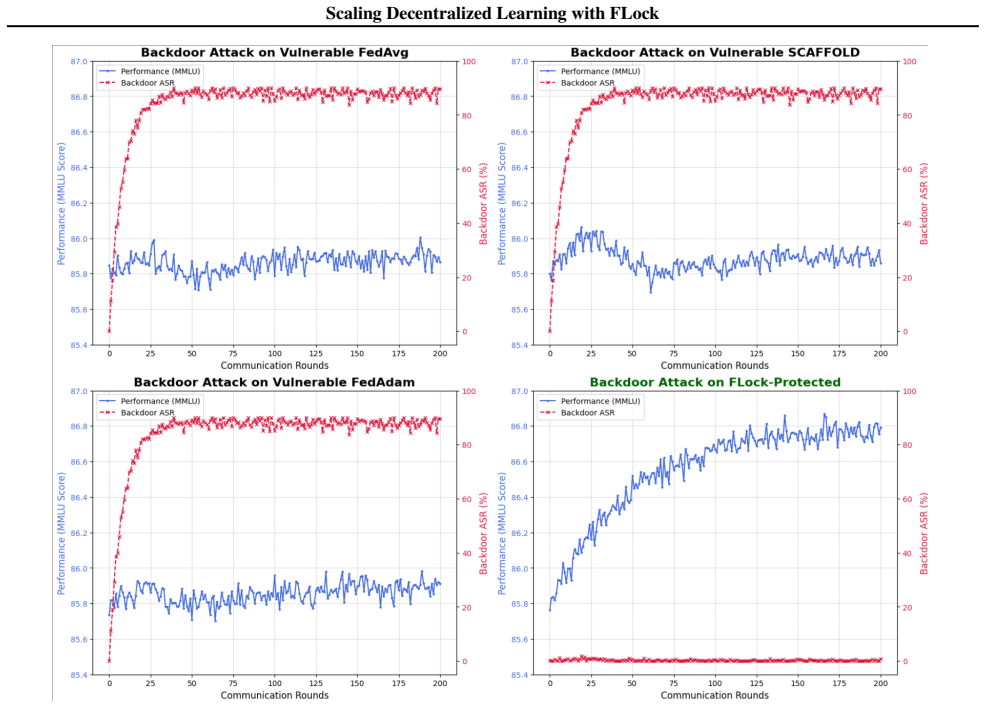
On the paper's own terms, the discovery is that replacing the central aggregator with a stake-weighted validator committee does not degrade—and in the reported experiments improves—both security and generalization of a fine-tuned 72B model. Over 200 communication rounds, a single malicious legal-domain client plants a backdoor that reaches roughly 90% attack success under FedAvg, SCAFFOLD, and FedAdam, while the FLock-protected run keeps backdoor success near zero and lifts MMLU from the baseline to above 86.6%. On the robustness benchmarks, the collaborative model drops AB-GCG attack success from 38.3 to 12.1, a reduction of more than 68%, while AdvBench falls from 9.3 to 6.3 for the best client. The authors interpret this as proof that validator consensus, backed by staking and slashing, rejects poisoned updates before they reach the global model.
Load-bearing premise
The robustness result assumes the Section 5 experiment actually runs the stake-weighted validator rejection described in Section 3.2, but no algorithm or pseudocode for scoring and rejecting updates is given.
Editorial extensions
If this is right
- If the 70B result generalizes, the central server is no longer a structural necessity for large-model fine-tuning, removing its single point of failure.
- Standard federated optimizers remain vulnerable to a single backdoored client, so practical decentralized training needs an explicit update-validation layer, not just a stronger averaging rule.
- Multi-domain collaboration can improve robustness and cross-domain accuracy relative to isolated fine-tuning, meaning organizations that cannot share raw data can still pool model knowledge.
- The security guarantee is carried partly by economic parameters (stake, rank weights, slashing), so operators must set those parameters carefully in deployment.
Reading between the lines
- The paper leaves open whether the flat near-zero backdoor curve in Section 5 comes from the described validator gating or from an unspecified aggregation detail, since no scoring or rejection algorithm is given.
- The paper compares against unprotected federated optimizers but not against a trusted central aggregator running the same LoRA fine-tuning, so the reported synergy might be a multi-task learning effect rather than an effect of decentralization.
- Because consensus is stake-weighted, an attacker who controls enough validator stake could plausibly steer scores; a natural stress test is varying the attacker's share of validator stake and watching when backdoor success rises.
- The 68% figure is measured on GCG-style AdvBench attacks; other backdoor trigger designs are untested, so the defense's breadth across attack variants remains unestablished.
Editorial analysis
A structured set of objections, weighed in public.
Referee Report
Summary. The paper presents FLock, a blockchain-based decentralized fine-tuning framework for large language models, and reports experiments fine-tuning Qwen2.5 72B across eight domain-specific clients using QLoRA. The claimed contributions are (i) the first empirical validation of 70B-scale secure decentralized fine-tuning, (ii) a more than 68% reduction in backdoor attack success rate under a poisoning attack, and (iii) synergistic cross-domain generalization. Section 3 formalizes a reward-distribution protocol with validator judgments but does not specify how validators score or reject model updates. Sections 4 and 5 report benchmark results and a poisoning-resilience experiment comparing FLock-Protected training with FedAvg, SCAFFOLD, and FedAdam.
Significance. If the claims held, this would be a significant systems result: scaling federated fine-tuning to a 70B model under untrusted participants with demonstrable backdoor resistance would go beyond currently reported practice, and the computational effort described (64 H800 GPUs) is nontrivial. The paper's strength is its explicit attempt to connect blockchain-based economic incentives to LLM fine-tuning. However, the current evidence does not substantiate the central security claim: the validator scoring and rejection mechanism is absent from the protocol specification, the poisoning experiment is not reproducible from the stated hyperparameters, and no statistical analysis supports the paper's "statistically significant" language. The cross-domain transfer result is presented qualitatively and rests on a weak local-training baseline.
major comments (4)
- [Section 3.2 and Section 5] The core security mechanism is never specified. Equations (1)-(6) only allocate rewards after validator scores r_ji are given; no definition is provided of how a validator produces r_ji, what data or objective it uses, or what score threshold causes an update to be rejected. Section 5's claim that "FLock's stake-weighted validator committee successfully identified and rejected the malicious model updates" therefore has no algorithmic grounding. The near-zero ASR in Figure 3 cannot be reproduced or attributed to the described FLock protocol; it may reflect an unstated filter in the implementation.
- [Section 5 vs. Appendix B] The poisoning experiment is described as running "over 200 communication rounds," while Appendix B states that FL training used "10 global communication rounds" with 20 local steps per client. The paper must reconcile this discrepancy and provide the attack setup (trigger design, poisoned fraction, attacker update construction, and evaluation protocol). Without these details, the defense result cannot be verified or compared with the baseline algorithms.
- [Section 4.3 and Table 1] The "Local Training" baseline is defined as averaging results from only two randomly sampled clients, not all eight clients, and no standard deviations, confidence intervals, or statistical tests are reported anywhere. The Introduction's phrase "statistically significant performance improvements" is therefore unsupported. The cross-domain heatmap in Figure 2 is presented qualitatively; the underlying numeric matrix should be included so that the claimed "synergistic knowledge transfer" can be checked.
- [Section 5] The comparison in the poisoning experiment is not controlled. FedAvg, SCAFFOLD, and FedAdam are fully specified algorithms, but the "FLock-Protected" system is not; without specifying the aggregation rule, validator scoring, and rejection criterion, the experiment conflates the defense result with an arbitrary robust-aggregation scheme and does not validate the economic-incentive layer that the paper highlights.
minor comments (5)
- [Abstract and Section 1] The manuscript contains numerous grammatical and typographical errors, including "Fine-tuning the large language models are prevented," "a a privacy-preserving model training solution," "impovement," "auditible," and "Acknowledment." A careful proofreading pass is needed.
- [Table 1] Table 1 appears misaligned: the Baseline row has too few entries relative to the header, and the caption does not clearly separate the local-training block from the FL block. The text also refers to "Table 4.1" when the table is numbered Table 1.
- [Section 4.1] Client#3 is labeled "AI2 (Wangyue Li, 2024)" but the text describes the ARC dataset; the dataset name and citation should be made consistent and accurate.
- [Section 3.2.1] The "stake-weighted consensus score" formula is only a weighted average of validator judgments; the judgment vectors r_ji themselves are undefined. The text should clarify whether these vectors come from a concrete evaluation procedure or are assumed to be external inputs.
- [Figure 3] Figure 3 shows learning curves without error bars, and the exact FLock MMLU endpoint ("over 86.6%") is only given in prose. The figure caption or accompanying text should report the precise values and the number of independent runs.
Circularity Check
FLock's defense result is attributed to a self-cited prior framework (Dong et al., 2024) with no specified scoring/rejection mechanism, making the security claim partially circular.
-
self citation load bearing
[Section 2.2 and Section 5 (Results on Resilience to Poisoning Attacks)]
"To defend against malicious clients who might submit poisoned updates, these systems introduce a peer-to-peer (P2P) review mechanism, where a committee of participants (“voters”) evaluates the quality of aggregated updates. ... This is direct empirical evidence that FLock’s stake-weighted validator committee successfully identified and rejected the malicious model updates submitted by the attacker, preventing the poison from corrupting the global model."
The paper's central security claim—that FLock defends against backdoor poisoning—rests on the Section 5 experiment, whose conclusion is quoted above. But the validator scoring rule and rejection threshold are never specified in Sections 3.1–3.2; those sections only give reward-distribution equations (1)–(6). The P2P review mechanism is instead imported from Dong et al. (2024), which shares co-author Jiahao Sun with the present paper. The near-zero ASR is therefore interpreted through a self-cited, unspecified mechanism: the defense conclusion reduces to the prior paper's framework plus an unreproducible experimental procedure, rather than to a self-contained derivation.
-
self definitional
[Section 3.2.4, Eq. (4)]
"Validators receive their reward in direct proportion to the accuracy of their judgments, that being the closeness of their scores to the eventual stake-weighted consensus."
The consensus score r is defined in Section 3.2.1 as the stake-weighted average of all validator judgments, and Eq. (4) measures each validator's error as its distance from that same consensus. Thus 'accuracy' is defined as agreement with the aggregate being evaluated; a colluding stake-weighted majority would define what counts as accurate. This self-referential validation measure is the only mechanism described in the paper, and Section 5 attributes the backdoor defense to this validator committee, completing the circular chain.
full rationale
Most of the empirical content—the 70B QLoRA fine-tuning, Table 1, the cross-domain heatmap, and the 68% ASR reduction computed from measured AdvBench/AB-GCG scores—is self-contained and not circular in the equation-fitting sense. The circularity is concentrated in the security/defense claim. Section 2.2 delegates the entire security architecture to Dong et al. (2024), a reference with overlapping authorship (Jiahao Sun appears in both papers), and Section 3.2 provides no scoring rule, no rejection threshold, and no algorithm for the validator committee, only reward-split equations. Section 5 then concludes from near-zero ASR that 'FLock's stake-weighted validator committee successfully identified and rejected the malicious model updates.' Because the mechanism is imported from a self-cited prior paper and never specified here, the defense result cannot be reproduced and is attributed to the framework rather than demonstrated. Additionally, Eq. (4) defines validator accuracy as closeness to the stake-weighted consensus, so the only validation-quality mechanism described is self-referential. These issues make the 'secure' part of the central claim partially circular, while the fine-tuning feasibility and generalization results remain independent evidence.
Assumptions & free parameters
assumptions (3)
- domain assumption The FLock security layer, as described in Dong et al. (2024), provides the defense attributed to it in Section 5 of this paper.
- standard math QLoRA fine-tuning with the stated hyperparameters preserves the base model's general capabilities.
- domain assumption GPT-4 Judge provides a valid evaluation of domain-specific answer quality.
Cite this review
Pith. "Pith review of Scaling Decentralized Learning with FLock." pith.science (2026). https://pith.science/paper/PYJIIBTD
@misc{pith2026250715349,
  author       = {Pith},
  title        = {Pith review of: Scaling Decentralized Learning with FLock},
  year         = {2026},
  howpublished = {\url{https://pith.science/paper/PYJIIBTD}},
  note         = {Machine review of arXiv:2507.15349}
}
read the original abstract
Fine-tuning the large language models (LLMs) are prevented by the deficiency of centralized control and the massive computing and communication overhead on the decentralized schemes. While the typical standard federated learning (FL) supports data privacy, the central server requirement creates a single point of attack and vulnerability to poisoning attacks. Generalizing the result in this direction to 70B-parameter models in the heterogeneous, trustless environments has turned out to be a huge, yet unbroken bottleneck. This paper introduces FLock, a decentralized framework for secure and efficient collaborative LLM fine-tuning. Integrating a blockchain-based trust layer with economic incentives, FLock replaces the central aggregator with a secure, auditable protocol for cooperation among untrusted parties. We present the first empirical validation of fine-tuning a 70B LLM in a secure, multi-domain, decentralized setting. Our experiments show the FLock framework defends against backdoor poisoning attacks that compromise standard FL optimizers and fosters synergistic knowledge transfer. The resulting models show a >68% reduction in adversarial attack success rates. The global model also demonstrates superior cross-domain generalization, outperforming models trained in isolation on their own specialized data.
Figures


Figures from the paper (1 more)

Reference graph
Works this paper leans on
-
[1]
N., Chakraborty, S., Mittal, P., and Calo, S
Bhagoji, A. N., Chakraborty, S., Mittal, P., and Calo, S. Analyzing federated learning through an adversarial lens. In International conference on machine learning, pp.\ 634--643. PMLR, 2019
work page 2019
-
[2]
Bharti, G. Finance alpaca. https://huggingface.co/datasets/gbharti/finance-alpaca, 2023
work page 2023
-
[3]
Che, T., Liu, J., Zhou, Y., Ren, J., Zhou, J., Sheng, V. S., Dai, H., and Dou, D. Federated learning of large language models with parameter-efficient prompt tuning and adaptive optimization. In Bouamor, H., Pino, J., and Bali, K. (eds.), Proceedings of the 2023 Conference on Empirical Methods in Natural Language Processing, EMNLP 2023, Singapore, Decembe...
-
[4]
Chen, M., Tworek, J., Jun, H., Yuan, Q., Pinto, H. P. D. O., Kaplan, J., Edwards, H., Burda, Y., Joseph, N., Brockman, G., et al. Evaluating large language models trained on code. arXiv preprint arXiv:2107.03374, 2021
arXiv 2021
-
[5]
Qlora: Efficient finetuning of quantized llms
Dettmers, T., Pagnoni, A., Holtzman, A., and Zettlemoyer, L. Qlora: Efficient finetuning of quantized llms. arXiv preprint arXiv: 2305.14314, 2023
arXiv 2023
-
[6]
Defending against poisoning attacks in federated learning with blockchain
Dong, N., Wang, Z., Sun, J., Kampffmeyer, M., Knottenbelt, W., and Xing, E. Defending against poisoning attacks in federated learning with blockchain. IEEE Transactions on Artificial Intelligence, 2024
work page 2024
-
[7]
Foo, J., Prasad, P. S., and Khoo, S. Know or not: a library for evaluating out-of-knowledge base robustness. arXiv preprint arXiv:2505.13545, 2025
arXiv 2025
-
[8]
Geiping, J., Bauermeister, H., Dr \"o ge, H., and Moeller, M. Inverting gradients-how easy is it to break privacy in federated learning? Advances in neural information processing systems, 33: 0 16937--16947, 2020
work page 2020
Show all 31 references
-
[9]
E., Ré, C., Chilton, A., Narayana, A., Chohlas-Wood, A., Peters, A., Waldon, B., Rockmore, D
Guha, N., Nyarko, J., Ho, D. E., Ré, C., Chilton, A., Narayana, A., Chohlas-Wood, A., Peters, A., Waldon, B., Rockmore, D. N., Zambrano, D., Talisman, D., Hoque, E., Surani, F., Fagan, F., Sarfaty, G., Dickinson, G. M., Porat, H., Hegland, J., Wu, J., Nudell, J., Niklaus, J., ...
2023
-
[10]
Measuring massive multitask language understanding
Hendrycks, D., Burns, C., Basart, S., Zou, A., Mazeika, M., Song, D., and Steinhardt, J. Measuring massive multitask language understanding. In ICLR 2021, Virtual Event, Austria, May 3-7, 2021. OpenReview.net, 2021. URL https://openreview.net/forum?id=d7KBjmI3GmQ
2021
-
[11]
J., Shen, Y., Wallis, P., Allen-Zhu, Z., Li, Y., Wang, S., Wang, L., Chen, W., et al
Hu, E. J., Shen, Y., Wallis, P., Allen-Zhu, Z., Li, Y., Wang, S., Wang, L., Chen, W., et al. Lora: Low-rank adaptation of large language models. ICLR, 1 0 (2): 0 3, 2022
2022
-
[12]
Meetingbank: A benchmark dataset for meeting summarization
Hu, Y., Ganter, T., Deilamsalehy, H., Dernoncourt, F., Foroosh, H., and Liu, F. Meetingbank: A benchmark dataset for meeting summarization. In Proceedings of the 61st Annual Meeting of the Association for Computational Linguistics (ACL), Toronto, Canada, 2023. Association for ...
2023
-
[13]
W., and Lu, X
Jin, Q., Dhingra, B., Liu, Z., Cohen, W. W., and Lu, X. Pub M edqa: A dataset for biomedical research question answering. arXiv preprint arXiv:1909.06146, 2019
1909 arXiv
-
[14]
B., Avent, B., Bellet, A., Bennis, M., Bhagoji, A
Kairouz, P., McMahan, H. B., Avent, B., Bellet, A., Bennis, M., Bhagoji, A. N., Bonawitz, K., Charles, Z., Cormode, G., Cummings, R., et al. Advances and open problems in federated learning. Foundations and trends in machine learning , 14 0 (1--2): 0 1--210, 2021
2021
-
[15]
P., Kale, S., Mohri, M., Reddi, S., Stich, S., and Suresh, A
Karimireddy, S. P., Kale, S., Mohri, M., Reddi, S., Stich, S., and Suresh, A. T. Scaffold: Stochastic controlled averaging for federated learning. In International conference on machine learning, pp.\ 5132--5143. PMLR, 2020
2020
-
[16]
B., Yu, F
Kone c n \`y , J., McMahan, H. B., Yu, F. X., Richt \'a rik, P., Suresh, A. T., and Bacon, D. Federated learning: Strategies for improving communication efficiency. arXiv preprint arXiv:1610.05492, 2016
2016 arXiv
-
[17]
K., Talwalkar, A., and Smith, V
Li, T., Sahu, A. K., Talwalkar, A., and Smith, V. Federated learning: Challenges, methods, and future directions. IEEE signal processing magazine, 37 0 (3): 0 50--60, 2020
2020
-
[18]
EDGAR - CORPUS : Billions of tokens make the world go round
Loukas, L., Fergadiotis, M., Androutsopoulos, I., and Malakasiotis, P. EDGAR - CORPUS : Billions of tokens make the world go round. In Proceedings of the Third Workshop on Economics and Natural Language Processing, pp.\ 13--18, Punta Cana, Dominican Republic, November 2021. As...
2021
-
[19]
Peft: State-of-the-art parameter-efficient fine-tuning methods
Mangrulkar, S., Gugger, S., Debut, L., Belkada, Y., Paul, S., and Bossan, B. Peft: State-of-the-art parameter-efficient fine-tuning methods. https://github.com/huggingface/peft, 2022
2022
-
[20]
McMahan, B., Moore, E., Ramage, D., Hampson, S., and y Arcas, B. A. Communication-efficient learning of deep networks from decentralized data. In Artificial intelligence and statistics, pp.\ 1273--1282. PMLR, 2017
2017
-
[21]
Nepatec1.0: National environmental policy act text corpus 1.0
PolicyAI. Nepatec1.0: National environmental policy act text corpus 1.0. https://huggingface.co/datasets/PolicyAI/NEPATEC1.0, 2024
2024
-
[22]
Deepspeed: System optimizations enable training deep learning models with over 100 billion parameters
Rasley, J., Rajbhandari, S., Ruwase, O., and He, Y. Deepspeed: System optimizations enable training deep learning models with over 100 billion parameters. In Proceedings of the 26th ACM SIGKDD international conference on knowledge discovery & data mining, pp.\ 3505--3506, 2020
2020
-
[23]
J., Charles, Z., Zaheer, M., Garrett, Z., Rush, K., Kone c n \`y , J., Kumar, S., and McMahan, H
Reddi, S. J., Charles, Z., Zaheer, M., Garrett, Z., Rush, K., Kone c n \`y , J., Kumar, S., and McMahan, H. B. Adaptive federated optimization. In International Conference on Learning Representations, 2021
2021
-
[24]
Qwen2.5: A party of foundation models, September 2024
Team, Q. Qwen2.5: A party of foundation models, September 2024. URL https://qwenlm.github.io/blog/qwen2.5/
2024
-
[25]
Aya model: An instruction finetuned open-access multilingual language model
\"U st \"u n, A., Aryabumi, V., Yong, Z.-X., Ko, W.-Y., D'souza, D., Onilude, G., Bhandari, N., Singh, S., Ooi, H.-L., Kayid, A., et al. Aya model: An instruction finetuned open-access multilingual language model. arXiv preprint arXiv:2402.07827, 2024
2024 arXiv
-
[26]
Wangyue Li, Liangzhi Li, T. X. X. L. W. D. N. G. Can multiple-choice questions really be useful in detecting the abilities of llms? arXiv preprint arXiv:2403.17752, 2024
2024 arXiv
-
[27]
Federated learning over wireless device-to-device networks: Algorithms and convergence analysis
Xing, H., Simeone, O., and Bi, S. Federated learning over wireless device-to-device networks: Algorithms and convergence analysis. IEEE Journal on Selected Areas in Communications, 39 0 (12): 0 3723--3741, 2021
2021
-
[28]
Judging llm-as-a-judge with mt-bench and chatbot arena
Zheng, L., Chiang, W.-L., Sheng, Y., Zhuang, S., Wu, Z., Zhuang, Y., Lin, Z., Li, Z., Li, D., Xing, E., et al. Judging llm-as-a-judge with mt-bench and chatbot arena. Advances in Neural Information Processing Systems, 36: 0 46595--46623, 2023
2023
-
[29]
When foundation model meets federated learning: Motivations, challenges, and future directions
Zhuang, W., Chen, C., and Lyu, L. When foundation model meets federated learning: Motivations, challenges, and future directions. arXiv preprint arXiv:2306.15546, 2023
2023 arXiv
-
[30]
Z., and Fredrikson, M
Zou, A., Wang, Z., Carlini, N., Nasr, M., Kolter, J. Z., and Fredrikson, M. Universal and transferable adversarial attacks on aligned language models. arXiv preprint arXiv:2307.15043, 2023
2023 arXiv
-
[31]
write newline
" write newline "" before.all 'output.state := FUNCTION n.dashify 't := "" t empty not t #1 #1 substring "-" = t #1 #2 substring "--" = not "--" * t #2 global.max substring 't := t #1 #1 substring "-" = "-" * t #2 global.max substring 't := while if t #1 #1 substring * t #2 gl...
Reviewed August 6, 2026 · model on record in the stance chip above.
Discussion (0). Sign in to comment.