REVIEW 4 major objections 6 minor 57 references
Metaphor and Large Language Models: When Surface Features Matter More than Deep Understanding
T0 review · 4 major / 6 minor · reviewed 2026-08-06 · deepseek-v4-flash
Pith's one-line read Large language models appear to understand metaphor on current benchmarks, but the paper argues this is an artifact of lexical overlap and sentence length rather than figurative understanding.
desk verdict Worth reading for the scope, not the headline; the literal-paraphrase comparison is contaminated by label shift, so the surface-features claim needs a re-analysis. read the letter →
The pith
A machine-rendered reading of the paper's core claim, the machinery that carries it, and where it could break.
The reading
What carries the argument
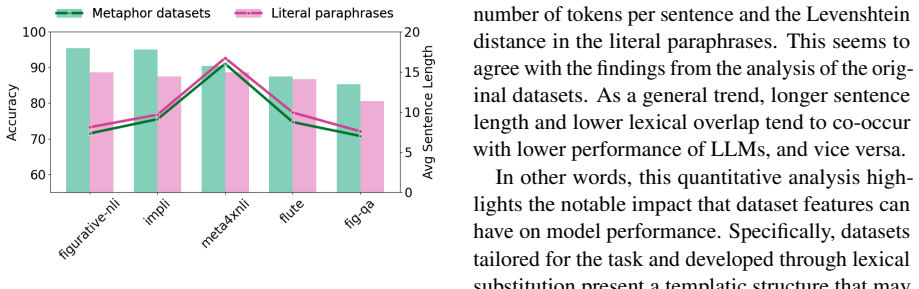
The central mechanism is an adversarial control condition: every metaphorical sentence is rewritten as a literal paraphrase using an instruction-tuned model, creating a paired literal version of each dataset that is scored against the same gold labels as the original metaphorical version. The argument then uses two surface diagnostics, Levenshtein distance between premise and hypothesis as a proxy for lexical overlap, and average sentence length, to show that accuracy differences align with these features rather than with metaphor content. That is, the literal versions are longer and have lower overlap, and the models do worse on them; the paper takes this as evidence that the metaphor datasets' templatic, high-overlap structure is what carries performance.
What would settle it
A reader could have two annotators verify whether each automatically generated literal paraphrase preserves the gold entailment label and contains no metaphor, then recompute accuracy on the label-preserving subset; if literal accuracy remains at the level of the metaphorical accuracy on that subset, the central claim would be undermined. Alternatively, constructing literal and metaphorical stimuli matched for lexical overlap and sentence length and showing equal accuracy would falsify the surface-feature explanation.
Extended reading notes
Core claim
On the paper's own terms, the discovery is that LLMs' performance on metaphor interpretation is more sensitive to lexical overlap and sentence length than to the presence of metaphorical content. When the metaphor-containing sentences are rewritten as literal paraphrases, model accuracy generally falls, even though the paraphrase is meant to remove the figurative difficulty; meanwhile, datasets with higher premise-hypothesis overlap and shorter sentences yield higher accuracy. The paper reads this as evidence against emergent metaphor understanding, attributing the apparent ability to surface-level features, in-context learning, and linguistic knowledge. It also finds that few-shot and chain-of-thought prompting outperform fine-tuned encoder baselines on most of these benchmarks, further undermining the need for metaphor-specific training data.
Load-bearing premise
The load-bearing assumption is that the literal paraphrase removes the metaphor while preserving the original inference label, so that a drop in accuracy on the literal version can be attributed to the loss of metaphor rather than to label shift or paraphrase quality.
Editorial extensions
If this is right
- Benchmarks built by lexical replacement overstate LLM metaphor understanding, because high premise-hypothesis overlap alone can drive high accuracy.
- Few-shot and chain-of-thought prompting can match or exceed fine-tuned encoder baselines on metaphor-interpretation tasks, so task-specific annotated training sets are less decisive than prompt design.
- Metaphor-interpretation evaluations should report or control lexical overlap and sentence length before interpreting differences between models or conditions.
- The 'emergent ability' framing should be replaced by a surface-feature-plus-knowledge explanation unless new evidence appears.
- Naturally occurring metaphorical text provides a harder and more realistic test than lexicon-substituted data.
Reading between the lines
- A sharper test would hold length and overlap fixed while toggling metaphoricity, which no current dataset does.
- The same lexical-substitution confound likely affects claims about other figurative phenomena, such as idiom and irony benchmarks, not just metaphor.
- Because the literal paraphrases were machine-generated and sometimes contain metaphors or shift labels, the true gap between metaphorical and literal performance could be either larger or smaller than reported; manual paraphrase validation would settle which.
- If human-authored literal paraphrases that preserve labels also lower accuracy, then the paper's surface-feature explanation would be supported; if they do not, part of the observed drop is an artifact of automatic paraphrase generation.
Signed reviews
Editorial analysis
A structured set of objections, weighed in public.
Referee Report
Summary. This paper evaluates seven instruction-tuned LLMs on five English datasets for metaphor interpretation framed as Natural Language Inference (NLI) and Question Answering (QA), under zero-shot, few-shot, and chain-of-thought prompting. The authors also generate 'literal' paraphrases of the metaphorical sentences using Command R+ and compare model accuracy on the original metaphorical datasets (-met) and the paraphrased literal versions (-lit). They report that accuracy on -lit is generally lower, that the paraphrases have higher Levenshtein distance and longer average sentence length, and conclude that LLM performance is driven more by surface features such as lexical overlap and sentence length than by metaphorical content, arguing that purported emergent metaphor understanding is actually a combination of surface cues, in-context learning, and linguistic knowledge.
Significance. If the central claim were established, this would be an important cautionary result for the metaphor-processing evaluation community: current benchmarks would be shown to reward shallow pattern matching rather than deep figurative understanding. The paper's strengths include a broad multi-dataset, multi-model, multi-prompt evaluation; public release of code and data; and an honest error analysis that identifies concrete failure modes. The empirical basis, however, is currently not firm because the pivotal -met versus -lit comparison is scored against original gold labels despite documented label shifts, and because the paraphrase manipulation changes several properties at once. The work is useful as a comprehensive evaluation resource, but the headline claim about emergent abilities is stronger than the evidence supports.
major comments (4)
- [§6.2, Table 4] The pivotal -met vs. -lit accuracy comparison in Tables 2 and 10 is scored against the original gold labels for both versions, but Section 6.2 explicitly documents paraphrases that change the entailment relation. The Meta4XNLI example makes the point: under the literal paraphrase 'She worked as a model for Channel for seven years', the hypothesis 'She was Chanel's muse' is genuinely not entailed, so the model's 'not_entailment' prediction is correct for the paraphrased pair and is counted as an error only because the original gold label is retained. The frequency of such label shifts is not reported, and any non-negligible rate systematically depresses -lit accuracy, contaminating the gap on which the central claim rests. The authors should quantify the label-shift rate, re-score the -lit sets with re-annotated labels, or exclude shifted instances and show that the conclusions are unchanged.
- [§4.2, §6.2] The literal paraphrase manipulation is not a clean removal of metaphor. Section 6.2 acknowledges that some generated paraphrases still contain metaphorical expressions (e.g., 'sharp' in the Fig-QA paraphrase and 'arrive' in the FLUTE paraphrase). The -lit condition therefore changes sentence length, lexical overlap, label validity, and residual metaphoricity simultaneously, so the observed accuracy drop cannot be uniquely attributed to the absence of metaphorical content. A controlled paraphrase set with human verification, or an instance-level analysis that separates paraphrases that are fully literal and label-preserving from those that are not, is required to support the surface-features interpretation.
- [§6.1, Table 3] The quantitative evidence for the surface-features claim is a cross-dataset comparison of aggregate Levenshtein distance and mean sentence length against mean accuracy for one model and prompt configuration (Qwen2.5-72B with CoT). With only five datasets, no statistical test or regression is reported, and dataset difficulty, label balance, and other properties are uncontrolled. The statement that performance is 'more influenced' by lexical overlap and sentence length than by metaphorical content is a causal claim that these correlations do not establish. The authors should provide per-instance analyses, a regression that includes both surface features and metaphor-related controls, or a controlled construction that varies one feature at a time.
- [Abstract, §7] The concluding claim that 'any alleged emergent abilities of LLMs to understand metaphorical language are the result of a combination of surface-level features, in-context learning, and linguistic knowledge' is stronger than the evidence. In Table 2, -lit accuracy is sometimes higher than -met accuracy (e.g., Fig-QA with Llama-3-8B-Instruct under CoT: 81.58 vs. 76.17), and the label-shift and residual-metaphor issues described above prevent the -met/-lit gap from being interpreted as a loss of metaphor understanding. The conclusions should be restricted to the demonstrated sensitivity to lexical overlap and sentence length, with the broader claim about the absence of metaphor understanding presented as a hypothesis requiring further study.
minor comments (6)
- [Table 2] The table contains formatting artifacts that should be cleaned up, including '87.57s' in the IMPLI-lit row, inconsistent column headers ('Qwen-7B' vs. 'Qwen2.5-7B'), and the spacing in 'A vg_met' and 'A vg_lit'.
- [Table 1] The FLUTE row does not clearly indicate whether metaphors occur in premises, hypotheses, or both; the 'Met loc.' column should be unambiguous for every dataset, especially since the paraphrase generation targets only sentences containing metaphors.
- [§4.2] The text states 'temperature=3' for Mistral-7B-Instruct during paraphrase generation; if this is accurate, it is an unusually high sampling temperature and should be justified, and if it is a typo for 0.3 it should be corrected.
- [References] Several references contain author-name encoding or duplication problems, such as 'Coms, a' (should be Comşa), 'Grici¯ut˙e', and duplicate entries for Bollegala and Shutova (2013a/b) and Shutova (2010/2013); these should be normalized.
- [Figure 2] The legend and axis labels are small and the dual y-axes are not explained in the caption; please label the bars as accuracy, the lines as average sentence length, and identify the datasets more legibly.
- [§5.1] The phrase 'Mistral-7B-Instruct is the worse performing model' should read 'the worst-performing model'.
Circularity Check
No circular derivation: the central empirical claim does not reduce to its inputs; only a minor, non-load-bearing self-citation and a validity confound in the literal-paraphrase comparison are present.
full rationale
This paper is an empirical evaluation rather than a derivation, and its main claim does not reduce to a fitted parameter or a definitional identity. The argument is that LLMs perform better on original metaphorical datasets than on literal paraphrases, and that this gap is associated with higher lexical overlap and shorter sentence length. This is measured, not assumed: accuracy is computed against gold labels and then compared with Levenshtein distance and sentence length as post-hoc explanatory variables. No parameter is fitted to the data and then renamed as a prediction, and no target result is defined in terms of the analysis metric. The only self-citation is to the authors' own Meta4XNLI dataset, used as one of five evaluation sets, and to their prior observation that metaphorical contexts outperform literal ones; this is not load-bearing because the same comparison is also run on four externally constructed datasets (Figurative-NLI, IMPLI, FLUTE, and Fig-QA). The paper's own admission in Section 6.2 and Table 4 that some paraphrases change the inference label is a genuine validity concern for the -met versus -lit comparison, but it is not a circularity: the -lit accuracy is not defined to equal lexical overlap or sentence length, and the paper does not present the label-shift rate as a fitted output. The stated limitations, including the need for manual paraphrase inspection, further confirm that the authors do not treat the paraphrase manipulation as equivalent to the conclusion. Accordingly, the central claim has independent empirical content and the paper is best characterized as having no significant circularity, with at most a minor self-citation that does not affect the derivation.
Assumptions & free parameters
assumptions (3)
- domain assumption Generated literal paraphrases preserve the inference label of the original pair.
- domain assumption Levenshtein distance and sentence length capture the surface features responsible for performance differences.
- domain assumption The LLM-generated literal paraphrases are free of metaphors and preserve semantics.
Cite this review
Pith. "Pith review of Metaphor and Large Language Models: When Surface Features Matter More than Deep Understanding." pith.science (2026). https://pith.science/paper/O3NKVE5X
@misc{pith2026250715357,
  author       = {Pith},
  title        = {Pith review of: Metaphor and Large Language Models: When Surface Features Matter More than Deep Understanding},
  year         = {2026},
  howpublished = {\url{https://pith.science/paper/O3NKVE5X}},
  note         = {Machine review of arXiv:2507.15357}
}
read the original abstract
This paper presents a comprehensive evaluation of the capabilities of Large Language Models (LLMs) in metaphor interpretation across multiple datasets, tasks, and prompt configurations. Although metaphor processing has gained significant attention in Natural Language Processing (NLP), previous research has been limited to single-dataset evaluations and specific task settings, often using artificially constructed data through lexical replacement. We address these limitations by conducting extensive experiments using diverse publicly available datasets with inference and metaphor annotations, focusing on Natural Language Inference (NLI) and Question Answering (QA) tasks. The results indicate that LLMs' performance is more influenced by features like lexical overlap and sentence length than by metaphorical content, demonstrating that any alleged emergent abilities of LLMs to understand metaphorical language are the result of a combination of surface-level features, in-context learning, and linguistic knowledge. This work provides critical insights into the current capabilities and limitations of LLMs in processing figurative language, highlighting the need for more realistic evaluation frameworks in metaphor interpretation tasks. Data and code are publicly available.
Figures

Reference graph
Works this paper leans on
-
[1]
Rodrigo Agerri. 2008. Metaphor in Textual Entailment . In COLING, pages 3--6
work page 2008
-
[2]
Ehsan Aghazadeh, Mohsen Fayyaz, and Yadollah Yaghoobzadeh. 2022. https://aclanthology.org/2022.acl-long.144 Metaphors in pre-trained language models: Probing and generalization across datasets and languages . In Proceedings of the 60th Annual Meeting of the Association for Computational Linguistics (Volume 1: Long Papers), pages 2037--2050, Dublin, Irelan...
work page 2022
-
[3]
Mikel Artetxe, Gorka Labaka, and Eneko Agirre. 2020. https://aclanthology.org/2020.emnlp-main.618 Translation artifacts in cross-lingual transfer learning . In Proceedings of the 2020 Conference on Empirical Methods in Natural Language Processing (EMNLP), pages 7674--7684, Online. Association for Computational Linguistics
work page 2020
-
[4]
Daniel Baleato Rodr \'i guez, Verna Dankers, Preslav Nakov, and Ekaterina Shutova. 2023. https://doi.org/10.18653/v1/2023.findings-eacl.35 Paper bullets: Modeling propaganda with the help of metaphor . In Findings of the Association for Computational Linguistics: EACL 2023, pages 472--489, Dubrovnik, Croatia. Association for Computational Linguistics
-
[5]
Yuri Bizzoni and Shalom Lappin. 2018. https://doi.org/10.18653/v1/W18-0906 Predicting human metaphor paraphrase judgments with deep neural networks . In Proceedings of the Workshop on Figurative Language Processing, pages 45--55, New Orleans, Louisiana. Association for Computational Linguistics
-
[6]
Joanne Boisson, Luis Espinosa-Anke, and Jose Camacho-Collados. 2023. https://doi.org/10.18653/v1/2023.emnlp-main.406 Construction artifacts in metaphor identification datasets . In Proceedings of the 2023 Conference on Empirical Methods in Natural Language Processing, pages 6581--6590, Singapore. Association for Computational Linguistics
-
[7]
Joanne Boisson, Asahi Ushio, Hsuvas Borkakoty, Kiamehr Rezaee, Dimosthenis Antypas, Zara Siddique, Nina White, and Jose Camacho-Collados. 2024. https://doi.org/10.18653/v1/2024.conll-1.28 How are metaphors processed by language models? the case of analogies . In Proceedings of the 28th Conference on Computational Natural Language Learning, pages 365--387,...
-
[8]
Danushka Bollegala and Ekaterina Shutova. 2013 a . https://doi.org/10.1371/journal.pone.0074304 Metaphor interpretation using paraphrases extracted from the web . PLOS ONE, 8(9):1--10
Show all 57 references
-
[9]
Danushka Bollegala and Ekaterina Shutova. 2013 b . Metaphor Interpretation Using Paraphrases Extracted from the Web . PloS one, 8(9):e74304
2013
-
[10]
Tom Brown, Benjamin Mann, Nick Ryder, Melanie Subbiah, Jared D Kaplan, Prafulla Dhariwal, Arvind Neelakantan, Pranav Shyam, Girish Sastry, Amanda Askell, and 1 others. 2020. Language models are few-shot learners. Advances in neural information processing systems, 33:1877--1901
2020
-
[11]
Oana-Maria Camburu, Tim Rockt\" a schel, Thomas Lukasiewicz, and Phil Blunsom. 2018. https://proceedings.neurips.cc/paper_files/paper/2018/file/4c7a167bb329bd92580a99ce422d6fa6-Paper.pdf e-snli: Natural language inference with natural language explanations . In Advances in Neu...
2018
-
[12]
Tuhin Chakrabarty, Debanjan Ghosh, Adam Poliak, and Smaranda Muresan. 2021 a . https://doi.org/10.18653/v1/2021.findings-acl.297 Figurative language in recognizing textual entailment . In Findings of the Association for Computational Linguistics: ACL-IJCNLP 2021, pages 3354--3...
2021 doi
-
[13]
Tuhin Chakrabarty, Arkadiy Saakyan, Debanjan Ghosh, and Smaranda Muresan. 2022. https://doi.org/10.18653/v1/2022.emnlp-main.481 FLUTE : Figurative language understanding through textual explanations . In Proceedings of the 2022 Conference on Empirical Methods in Natural Langua...
2022 doi
-
[14]
Tuhin Chakrabarty, Xurui Zhang, Smaranda Muresan, and Nanyun Peng. 2021 b . https://doi.org/10.18653/v1/2021.naacl-main.336 MERMAID : Metaphor generation with symbolism and discriminative decoding . In Proceedings of the 2021 Conference of the North American Chapter of the Ass...
2021 doi
-
[15]
Iulia Com s a, Julian Eisenschlos, and Srini Narayanan. 2022. https://doi.org/10.18653/v1/2022.aacl-short.46 M i QA : A benchmark for inference on metaphorical questions . In Proceedings of the 2nd Conference of the Asia-Pacific Chapter of the Association for Computational Lin...
2022 doi
-
[16]
Alexis Conneau, Kartikay Khandelwal, Naman Goyal, Vishrav Chaudhary, Guillaume Wenzek, Francisco Guzm \'a n, Edouard Grave, Myle Ott, Luke Zettlemoyer, and Veselin Stoyanov. 2020. https://doi.org/10.18653/v1/2020.acl-main.747 Unsupervised cross-lingual representation learning ...
2020 doi
-
[17]
Alexis Conneau, Ruty Rinott, Guillaume Lample, Adina Williams, Samuel Bowman, Holger Schwenk, and Veselin Stoyanov. 2018. https://aclanthology.org/D18-1269 XNLI : Evaluating cross-lingual sentence representations . In Proceedings of the 2018 Conference on Empirical Methods in ...
2018
-
[18]
Jacob Devlin, Ming-Wei Chang, Kenton Lee, and Kristina Toutanova. 2019. BERT : Pre-training of deep bidirectional transformers for language understanding. In Proceedings of the 2019 Conference of the North A merican Chapter of the Association for Computational Linguistics: Hum...
2019
-
[19]
Alexander Vladislavovitch Dmitrijev, Elena Sergeevna Krupnova, and Anastasia Aleksandrovna Protopopova. 2024. Metaphors and analogies in the context of large language models. In Scenarios, Fictions, and Imagined Possibilities in Science, Engineering, and Education, pages 326--...
2024
-
[20]
Abhimanyu Dubey, Abhinav Jauhri, Abhinav Pandey, Abhishek Kadian, Ahmad Al-Dahle, Aiesha Letman, Akhil Mathur, Alan Schelten, Amy Yang, Angela Fan, Anirudh Goyal, Anthony Hartshorn, Aobo Yang, Archi Mitra, Archie Sravankumar, Artem Korenev, Arthur Hinsvark, Arun Rao, Aston Zha...
2024 arXiv
-
[21]
Donatelli
Bernadeta Griciūtė, Marc Tanti, and L. Donatelli. 2022. https://api.semanticscholar.org/CorpusID:256461174 On the cusp of comprehensibility: Can language models distinguish between metaphors and nonsense? Proceedings of the 3rd Workshop on Figurative Language Processing (FLP)
2022
-
[22]
Paul Jaccard. 1912. https://doi.org/10.1111/j.1469-8137.1912.tb05611.x The distribution of the flora in the alpine zone. i . New Phytologist, 11(2):37--50
1912
-
[23]
Arthur M. Jacobs. 2018. https://doi.org/10.3389/fdigh.2018.00005 The gutenberg english poetry corpus: Exemplary quantitative narrative analyses . Frontiers in Digital Humanities, 5
2018
-
[24]
Albert Q. Jiang, Alexandre Sablayrolles, Arthur Mensch, Chris Bamford, Devendra Singh Chaplot, Diego de las Casas, Florian Bressand, Gianna Lengyel, Guillaume Lample, Lucile Saulnier, Lélio Renard Lavaud, Marie-Anne Lachaux, Pierre Stock, Teven Le Scao, Thibaut Lavril, Thomas ...
2023 arXiv
-
[25]
Anubha Kabra, Emmy Liu, Simran Khanuja, Alham Fikri Aji, Genta Winata, Samuel Cahyawijaya, Anuoluwapo Aremu, Perez Ogayo, and Graham Neubig. 2023. https://doi.org/10.18653/v1/2023.findings-acl.525 Multi-lingual and multi-cultural figurative language understanding . In Findings...
2023 doi
-
[26]
Ruben Sinu Kurian, Chandramani Chaudhary, Abhay Unni Nambiar, and Abhina Sunny. 2025. Metan: Metaphoric temporal attention network for depression detection on social media. In Web Information Systems Engineering -- WISE 2024, pages 90--104, Singapore. Springer Nature Singapore
2025
-
[27]
Gonzalez, Hao Zhang, and Ion Stoica
Woosuk Kwon, Zhuohan Li, Siyuan Zhuang, Ying Sheng, Lianmin Zheng, Cody Hao Yu, Joseph E. Gonzalez, Hao Zhang, and Ion Stoica. 2023. Efficient memory management for large language model serving with pagedattention. In Proceedings of the ACM SIGOPS 29th Symposium on Operating S...
2023
-
[28]
George Lakoff and Mark Johnson. 1980. Metaphors We Live By
1980
-
[29]
Jens Lemmens, Ilia Markov, and Walter Daelemans. 2021. https://doi.org/10.18653/v1/2021.nlp4if-1.2 Improving hate speech type and target detection with hateful metaphor features . In Proceedings of the Fourth Workshop on NLP for Internet Freedom: Censorship, Disinformation, an...
2021 doi
-
[30]
Vladimir Iosifovich Levenshtein. 1966. Binary codes capable of correcting deletions, insertions and reversals. Soviet Physics Doklady, 10(8):707--710. Doklady Akademii Nauk SSSR, V163 No4 845-848 1965
1966
-
[31]
H. J. Levesque, E. Davis, and L. Morgenstern. 2012. The winograd schema challenge. In Proceedings of the Thirteenth International Conference on the Principles of Knowledge Representation and Reasoning (KR-12)
2012
-
[32]
Emmy Liu, Chenxuan Cui, Kenneth Zheng, and Graham Neubig. 2022. https://doi.org/10.18653/v1/2022.naacl-main.330 Testing the ability of language models to interpret figurative language . In Proceedings of the 2022 Conference of the North American Chapter of the Association for ...
2022 doi
-
[33]
Yinhan Liu, Myle Ott, Naman Goyal, Jingfei Du, Mandar Joshi, Danqi Chen, Omer Levy, Mike Lewis, Luke Zettlemoyer, and Veselin Stoyanov. 2019. https://arxiv.org/abs/1907.11692 Roberta: A robustly optimized bert pretraining approach . Preprint, arXiv:1907.11692
2019 arXiv
-
[34]
Rui Mao, Chenghua Lin, and Frank Guerin. 2021. https://arxiv.org/abs/2104.03391 Interpreting verbal metaphors by paraphrasing . Preprint, arXiv:2104.03391
2021 arXiv
-
[35]
Saif Mohammad, Ekaterina Shutova, and Peter Turney. 2016. https://doi.org/10.18653/v1/S16-2003 Metaphor as a medium for emotion: An empirical study . In Proceedings of the Fifth Joint Conference on Lexical and Computational Semantics, pages 23--33, Berlin, Germany. Association...
2016 doi
-
[36]
Tomlinson, and D
Michael Mohler, Marc T. Tomlinson, and D. Bracewell. 2013. https://api.semanticscholar.org/CorpusID:13014556 Applying textual entailment to the interpretation of metaphor . 2013 IEEE Seventh International Conference on Semantic Computing, pages 118--125
2013
-
[37]
Aakanksha Naik, Abhilasha Ravichander, Norman Sadeh, Carolyn Rose, and Graham Neubig. 2018. https://aclanthology.org/C18-1198 Stress test evaluation for natural language inference . In Proceedings of the 27th International Conference on Computational Linguistics, pages 2340--2...
2018
-
[38]
Long Ouyang, Jeffrey Wu, Xu Jiang, Diogo Almeida, Carroll Wainwright, Pamela Mishkin, Chong Zhang, Sandhini Agarwal, Katarina Slama, Alex Ray, John Schulman, Jacob Hilton, Fraser Kelton, Luke Miller, Maddie Simens, Amanda Askell, Peter Welinder, Paul F Christiano, Jan Leike, a...
2022
-
[39]
Kishore Papineni, Salim Roukos, Todd Ward, and Wei-Jing Zhu. 2002. https://doi.org/10.3115/1073083.1073135 B leu: a method for automatic evaluation of machine translation . In Proceedings of the 40th Annual Meeting of the Association for Computational Linguistics, pages 311--3...
2002
-
[40]
Paolo Pedinotti, Eliana Di Palma, Ludovica Cerini, and Alessandro Lenci. 2021. https://doi.org/10.18653/v1/2021.blackboxnlp-1.13 A howling success or a working sea? testing what BERT knows about metaphors . In Proceedings of the Fourth BlackboxNLP Workshop on Analyzing and Int...
2021 doi
-
[41]
Colin Raffel, Noam Shazeer, Adam Roberts, Katherine Lee, Sharan Narang, Michael Matena, Yanqi Zhou, Wei Li, and Peter J. Liu. 2023. https://arxiv.org/abs/1910.10683 Exploring the limits of transfer learning with a unified text-to-text transformer . Preprint, arXiv:1910.10683
2023 arXiv
-
[42]
Geetanjali Rakshit and Jeffrey Flanigan. 2023. https://aclanthology.org/2023.ranlp-1.100 Does the `` most sinfully decadent cake ever '' taste good? answering yes/no questions from figurative contexts . In Proceedings of the 14th International Conference on Recent Advances in ...
2023
-
[43]
Elisa Sanchez-Bayona and Rodrigo Agerri. 2024. https://arxiv.org/abs/2404.07053 Meta4xnli: A crosslingual parallel corpus for metaphor detection and interpretation . Preprint, arXiv:2404.07053
2024 arXiv
-
[44]
Ekaterina Shutova. 2010. Automatic Metaphor Interpretation as a Paraphrasing Task . In Human Language Technologies: The 2010 Annual Conference of the North American Chapter of the Association for Computational Linguistics, pages 1029--1037. Association for Computational Linguistics
2010
-
[45]
Ekaterina Shutova, T. V. D. Cruys, and Anna Korhonen. 2012. https://api.semanticscholar.org/CorpusID:6048192 Unsupervised metaphor paraphrasing using a vector space model . In International Conference on Computational Linguistics
2012
-
[46]
Ekaterina Shutova, Simone Teufel, and Anna Korhonen. 2013. Statistical Metaphor Processing . Computational Linguistics, 39(2):301--353
2013
-
[47]
Brown, Adam Santoro, Aditya Gupta, Adrià Garriga-Alonso, Agnieszka Kluska, Aitor Lewkowycz, Akshat Agarwal, Alethea Power, Alex Ray, Alex Warstadt, Alexander W
Aarohi Srivastava, Abhinav Rastogi, Abhishek Rao, Abu Awal Md Shoeb, Abubakar Abid, Adam Fisch, Adam R. Brown, Adam Santoro, Aditya Gupta, Adrià Garriga-Alonso, Agnieszka Kluska, Aitor Lewkowycz, Akshat Agarwal, Alethea Power, Alex Ray, Alex Warstadt, Alexander W. Kocurek, Ali...
2023 arXiv
-
[48]
G. Steen. 2010. https://books.google.es/books?id=lrc0-OXtnA0C A Method for Linguistic Metaphor Identification: From MIP to MIPVU . Converging evidence in language and communication research. John Benjamins Publishing Company
2010
-
[49]
Kevin Stowe, Prasetya Utama, and Iryna Gurevych. 2022. https://doi.org/10.18653/v1/2022.acl-long.369 IMPLI : Investigating NLI models ' performance on figurative language . In Proceedings of the 60th Annual Meeting of the Association for Computational Linguistics (Volume 1: Lo...
2022 doi
-
[50]
Gemma Team, Thomas Mesnard, Cassidy Hardin, Robert Dadashi, Surya Bhupatiraju, and 1 others. 2024. https://arxiv.org/abs/2403.08295 Gemma: Open models based on gemini research and technology . Preprint, arXiv:2403.08295
2024 arXiv
-
[51]
Qwen Team. 2024. https://qwenlm.github.io/blog/qwen2.5/ Qwen2.5: A party of foundation models
2024
-
[52]
Xiaoyu Tong, Rochelle Choenni, Martha Lewis, and Ekaterina Shutova. 2024. https://doi.org/10.18653/v1/2024.acl-long.193 Metaphor understanding challenge dataset for LLM s . In Proceedings of the 62nd Annual Meeting of the Association for Computational Linguistics (Volume 1: Lo...
2024 doi
-
[53]
Hugo Touvron, Thibaut Lavril, Gautier Izacard, Xavier Martinet, Marie-Anne Lachaux, Timothée Lacroix, Baptiste Rozière, Naman Goyal, Eric Hambro, Faisal Azhar, Aurelien Rodriguez, Armand Joulin, Edouard Grave, and Guillaume Lample. 2023. https://arxiv.org/abs/2302.13971 Llama:...
2023 arXiv
-
[54]
Omnia Zayed, John Philip McCrae, and Paul Buitelaar. 2020. https://aclanthology.org/2020.lrec-1.712 Figure me out: A gold standard dataset for metaphor interpretation . In Proceedings of the Twelfth Language Resources and Evaluation Conference, pages 5810--5819, Marseille, Fra...
2020
-
[55]
Dongyu Zhang, Nan Shi, Ciyuan Peng, Abdul Aziz, Wenhong Zhao, and Feng Xia. 2021. Mam: A metaphor-based approach for mental illness detection. In Computational Science -- ICCS 2021, pages 570--583, Cham. Springer International Publishing
2021
-
[56]
online" 'onlinestring :=
ENTRY address archivePrefix author booktitle chapter edition editor eid eprint eprinttype howpublished institution journal key month note number organization pages publisher school series title type volume year doi pubmed url lastchecked label extra.label sort.label short.list...
-
[57]
write newline
" write newline "" before.all 'output.state := FUNCTION n.dashify 't := "" t empty not t #1 #1 substring "-" = t #1 #2 substring "--" = not "--" * t #2 global.max substring 't := t #1 #1 substring "-" = "-" * t #2 global.max substring 't := while if t #1 #1 substring * t #2 gl...
Reviewed August 6, 2026 · model on record in the stance chip above.
Discussion (0). Continue with ORCID to comment.