REVIEW 4 major objections 4 minor 3 cited by
Effectiveness of Hybrid Optimization Method for Quantum Annealing Machines
T0 review · 4 major / 4 minor · reviewed 2026-08-06 · deepseek-v4-flash
Pith's one-line read A hybrid method that fixes stable spins with simulated annealing and sends only the unstable core to a quantum annealer improves solutions even when the full Ising model cannot be embedded.
desk verdict A careful but thin extension of the authors' hybrid annealing method to unembeddable sizes; the headline claim is plausible, the mechanism analysis is idealized, and the empirical support needs more instances and a fair baseline. read the letter →
The pith
A machine-rendered reading of the paper's core claim, the machinery that carries it, and where it could break.
The reading
What carries the argument
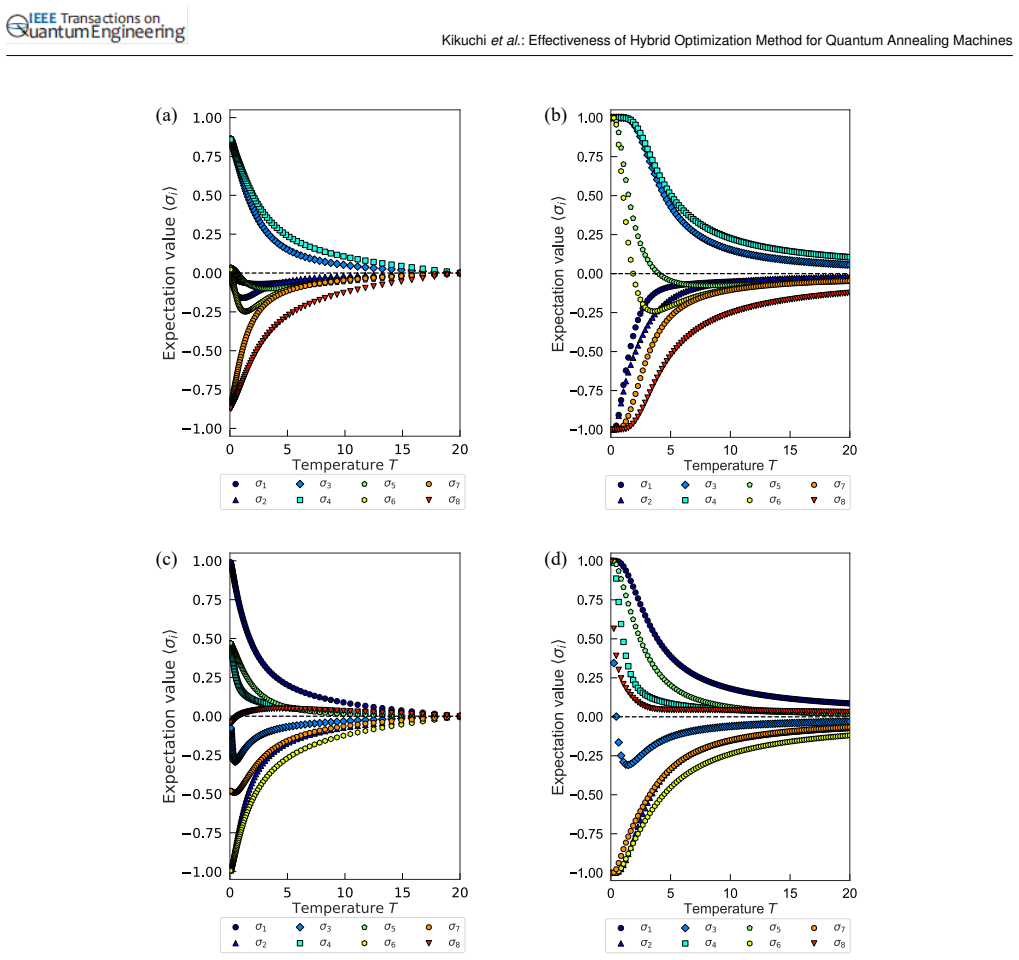
The load-bearing object is the spin-fixed sub-Ising model generated from multiple SA solutions by sample persistence. A spin is deemed stable when it takes the same value in many tentative solutions and unstable when its disagreement count is high; the $m$ most unstable spins form the subproblem, while the rest are fixed to values from a tentative solution, producing an effective field $R_i$ and a constant $C$ in $H_{\mathrm{sub}}$. The argument then runs through the minimum energy gap of this sub-Hamiltonian: fixing stable spins compresses the spectrum so the low-energy part survives, and sub-Ising models with unstable spins have large constants but wider minimum gaps than the original, making QA more accurate on them. The paper uses exact master-equation SA and time-dependent Schr\"odinger-equation QA on eight-spin fully connected models to watch how this gap behavior and the choice of submodel size interact.
What would settle it
Compare, on a small fully connected Ising model with a known ground state, the minimum energy gaps of sub-Ising models with spins fixed to ground-state values versus fixed to tentative simulated-annealing values, and run the hybrid method across sub-Ising sizes and annealing times; the central claim fails if wrong-fixed submodels do not show wider gaps than the original or if longer annealing time does not shift the best sub-Ising size upward.
Extended reading notes
Core claim
On the paper's own terms, the central discovery is that spin-fixed sub-Ising models are systematically easier for quantum annealing than the original Ising model, but only if the fixed spins are chosen well. Preprocessing SA separates spins into stable ones, whose expectation values sit near $\pm 1$, and unstable ones with expectation values near zero; sub-Ising models are built by fixing stable spins to tentative solution values and leaving unstable spins in the subproblem. Computing minimum energy gaps shows that sub-Ising models containing unstable spins have smaller gaps than models without them, yet still larger gaps than the original full model, and that the average gap widens as the submodel shrinks. The hybrid method therefore profits in two stages: QA is more accurate on the smaller, wider-gap submodel, while removing stable spins keeps the low-energy spectrum intact. The remaining size dependence is governed by the number of unstable spins and by QA accuracy: if the submodel is too small, some unstable spins get fixed wrongly and the ground state becomes unreachable; if it is too large, QA loses accuracy. Increasing annealing time shifts the best sub-Ising size upward, which the paper verifies in simulations and on hardware with short versus long annealing.
Load-bearing premise
The load-bearing premise is that the gap-widening effect seen when excluded spins are fixed to their ground-state values also holds when they are fixed to tentative simulated-annealing solutions, even though the paper concedes that wrong fixing prevents the sub-Ising solve from reaching the ground state.
Editorial extensions
If this is right
- Even when the original Ising model cannot be embedded in the quantum annealing machine, the hybrid method can return lower-energy solutions than preprocessing simulated annealing alone, as shown for fully connected models of 240 to 640 spins.
- The useful sub-Ising size is set by a trade-off: it must include all unstable spins so none are fixed wrongly, but it must stay small enough that the quantum annealer remains accurate.
- Longer annealing times improve quantum-annealer accuracy and therefore move the best sub-Ising size upward, as verified both in Schr\"odinger-equation simulations and in hardware with short versus long annealing.
- Minimum energy gaps provide a practical diagnostic: sub-Ising models containing unstable spins have wider gaps than the original model, which is why solving them with QA gives higher solution accuracy.
- As quantum annealing hardware accuracy improves, the hybrid method should handle effectively larger problems, because the optimal subproblem size grows with annealing accuracy.
Reading between the lines
- The same trade-off should appear for other spin-fixing preprocessing schemes, so the paper's mechanism can be tested by substituting a different non-quantum solver and re-checking the gap-widening signature.
- The benefit of the hybrid method may be largest on instances with many near-degenerate low-energy states, where sample persistence isolates a genuinely hard core; on easy instances the gain could vanish.
- An adaptive variant could grow the sub-Ising model until the unstable-spin condition is satisfied, removing the need to know the number of unstable spins in advance.
- Because the mechanism is gap-based, it suggests a tuning recipe: choose the sub-Ising size in proportion to the number of unstable spins and increase it as the quantum annealer's accuracy improves.
Editorial analysis
A structured set of objections, weighed in public.
Referee Report
Summary. This paper evaluates a hybrid optimization method for Ising machines that combines simulated-annealing-based preprocessing (solution pooling and sample-persistence spin fixing) with quantum annealing on the resulting sub-Ising model. Section IV reports D-Wave Advantage experiments on fully connected random Ising models of sizes 240, 320, 480, and 640 that cannot be embedded in the device, and observes that the hybrid method lowers the energy density relative to preprocessing SA. Section V uses small fully connected models (n = 8, 6, 10) with exact master-equation and Schrödinger-equation dynamics to analyze the separation of spins into stable and unstable groups, the minimum energy gaps of sub-Ising models, and the dependence of solution accuracy on sub-Ising size and annealing time. The paper concludes that the hybrid method remains effective for non-embeddable sizes, that sub-Ising models with unstable spins have wider gaps than the original model but narrower gaps than sub-Ising models without unstable spins, and that the optimal sub-Ising size is controlled by the number of unstable spins and the accuracy of the quantum annealer.
Significance. The paper addresses a practically relevant question: how to use a limited-size quantum annealer through spin reduction, and it offers a falsifiable qualitative prediction that increasing annealing time shifts the optimal sub-Ising size upward. The small-system analysis is a strength: the master-equation spin-expectation calculations, exhaustive enumeration of spin states, and Schrödinger-equation QA simulations are carefully specified and reproducible in principle. The empirical D-Wave results, however, rest on a very small number of instances, and the mechanism proposed in Section V is not yet connected to the realized algorithm in a fully supported way.
major comments (4)
- [Section V-B and Section V-C] The minimum-energy-gap analysis in Section V-B is performed under the assumption that 'the fixed spins took the values corresponding to the ground state.' In the actual hybrid algorithm (Section II-B, Eqs. (2)-(4)), the fixed spins take values from tentative SA solutions, and Section V-C deliberately uses solution pools 'that did not include the ground state' and concedes that 'if the fixed spins are different from the ground state, solving the sub-Ising model will not reach the ground state of the original Ising model.' The mechanistic claim that QA is more accurate on sub-Ising models because their gaps are wider is therefore established only in an idealized setting and does not, as written, transfer to the realized algorithm. Please provide a gap analysis (or an analytic argument) for sub-Ising models generated with tentatively fixed spins, or restrict the mechanism claim to the ground-state-fixing regime.
- [Section IV-A and Figure 3] The headline empirical claim that the hybrid method improves over preprocessing SA for models that cannot be embedded in the quantum annealer rests on a single random fully connected Ising model instance for each size (n = 240, 320, 480, 640), as stated in Section IV-A ('One instance was prepared for each model'). Figure 3 shows ten simulations, but these are repeated runs on the same instance, so they do not quantify instance variability. The same limitation applies to Figure 11. Please add multiple random instances per size, or at minimum report error bars or instance-by-instance results, before claiming a general improvement for this class of models.
- [Appendix A and Figure 8] The counts of sub-Ising models given in the caption of Figure 8 are not consistent with the stated unstable-spin sets. For Ising model A with unstable spins {sigma_1, sigma_2, sigma_5, sigma_6}, the numbers of sub-Ising models containing all four unstable spins would be 1, 4, 6, 4 for sizes m = 4, 5, 6, 7 and zero for m < 4, while the caption reports 1, 6, 15, 20, 15, 6 for sizes m = 2, ..., 7; the reported values also do not match the counts for 'at least one unstable spin.' The same issue occurs for model B (reported counts 1, 4, 6, 4 for m = 4, ..., 7). Since Figure 8 is used to support the size-dependency explanation in Section V-C, please clarify exactly which sub-Ising models enter the average and verify the counts; error bars should be added.
- [Section V-C and Figure 7] The text states that '100 sets of solution pools that did not include the ground state were prepared,' but it does not state whether the same 100 pools are used for every sub-Ising size m and annealing time tau. If the pools differ across conditions, the comparisons in Figure 7 mix algorithmic effects with sampling variability, and no error bars are shown for the averages. Please specify the experimental design (shared versus independent pools) and report the spread across the 100 sets.
minor comments (4)
- [Section IV-A] There is a typographical spacing error in 'D-Wave Advantage has5, 627 qubits'; it should read 'has 5,627 qubits.'
- [Appendix B, Figure 8] The statement 'Error bars are not shown in the figure' should be replaced by actual error bars or a clear explanation of why they are omitted; as written it weakens the comparison in Figure 8.
- [Section V-C] The inference that 'the number of unstable spins' controls the size dependency is based on only two 8-spin instances; a sentence acknowledging this limited basis would help the reader calibrate the strength of the claim.
- [Reproducibility] The paper does not state whether code or data are available; depositing the instance-generation and analysis scripts would improve reproducibility.
Circularity Check
No significant circularity: the hybrid method's improvement is measured against external solvers, and the gap analysis is an acknowledged idealization, not a self-referential derivation.
full rationale
The central empirical claims are experimental: Fig. 3 compares hybrid energy densities against preprocessing SA using SA and D-Wave Advantage, both external algorithms with their own dynamics; Figs. 5 and 7 are obtained by exact diagonalization and master-equation/Schrödinger integration via QuTiP, not by reinserting the target result. The sub-Ising Hamiltonians in Eqs. (2)-(4) are algebraic reductions of the original Ising Hamiltonian, so no prediction is an input by construction. The minimum-gap analysis in Sec. V-B fixes excluded spins to ground-state values ('The fixed spins took the values corresponding to the ground state'), but this is an explicitly stated modeling idealization, and the paper itself concedes the limitation in Sec. V-C: 'If the fixed spins are different from the ground state, solving the sub-Ising model will not reach the ground state of the original Ising model.' That gap between idealization and realized algorithm is a validity concern, not a circular reduction: the gap values are computed, not assumed. The 'improvement' over preprocessing SA is partly protected by the algorithm's carry-forward of the best SA solution, but strict improvement is not guaranteed (the paper reports that updates are 'less likely' for m=40 and m=160), so the empirical comparison retains content. Self-citations [72] and [95] are antecedents or consistency checks, not load-bearing premises: the method is re-specified in Section II, and the Appendix C D-Wave result is an independent experiment. No fitted parameter is renamed as a prediction, and no uniqueness result is imported. Score 2 reflects only minor non-load-bearing self-citation plus the acknowledged idealization, not circularity.
Assumptions & free parameters
free parameters (5)
- sub-Ising model size m =
m in {40, 80, 120, 160} in Section IV; m in {1,...,8} in Section V-C.
- NS (number of solutions used for spin fixing) =
10 in Section IV, 5 in Section V-C.
- Unstable-spin expectation threshold =
|average spin| within 0 to 0.25 in Section V-A.
- QA accuracy schedule (annealing time) =
Simulated tau in {0.1,...,1.0}; D-Wave 2, 20, and 200 microseconds.
- SA cooling rate r =
r=0.555 for 10 outer loops, r=0.948 for 100 outer loops; Section IV sets r for final T=0.1.
assumptions (4)
- domain assumption Adiabatic theorem and minimum-gap hardness proxy: QA accuracy is governed by the minimum energy gap between ground and first excited state.
- domain assumption Gaussian(0,1) fully-connected random Ising models without degeneracy are representative benchmarks for large-scale Ising models.
- domain assumption Closed-system Schrodinger dynamics (Eq. 11, QuTiP mesolve) captures the accuracy-relevant behavior of a real quantum annealing machine.
- domain assumption The spin-fixing reduction in Eqs. (2) to (4) with fixed values from tentative solutions preserves the low-energy structure of the original problem sufficiently for improvement.
Cite this review
Pith. "Pith review of Effectiveness of Hybrid Optimization Method for Quantum Annealing Machines." pith.science (2026). https://pith.science/paper/B5RQ22ZV
@misc{pith2026250715544,
  author       = {Pith},
  title        = {Pith review of: Effectiveness of Hybrid Optimization Method for Quantum Annealing Machines},
  year         = {2026},
  howpublished = {\url{https://pith.science/paper/B5RQ22ZV}},
  note         = {Machine review of arXiv:2507.15544}
}
read the original abstract
To enhance the performance of quantum annealing machines, several methods have been proposed to reduce the number of spins by fixing spin values through preprocessing. We proposed a hybrid optimization method that combines a simulated annealing (SA)-based non-quantum-type Ising machine with a quantum annealing machine. However, its applicability remains unclear. Therefore, we evaluated the performance of the hybrid method on large-size Ising models and analyzed its characteristics. The results indicate that the hybrid method improves upon solutions obtained by the preprocessing SA, even if the Ising models cannot be embedded in the quantum annealing machine. We analyzed the method from three perspectives: preprocessing, spin-fixed sub-Ising model generation method, and the accuracy of the quantum annealing machine. From the viewpoint of the minimum energy gap, we found that solving the sub-Ising model with a quantum annealing machine results in a higher solution accuracy than solving the original Ising model. Additionally, we demonstrated that the number of fixed spins and the accuracy of the quantum annealing machine affect the dependency of the solution accuracy on the sub-Ising model size.
Figures


Figures from the paper (8 more)


Forward citations
Cited by 3 Pith papers
-
High-Order Epistasis Detection Using Factorization Machine with Quadratic Optimization Annealing and MDR-Based Evaluation
FMQA optimizes MDR classification error rates to identify predefined high-order epistatic interactions in simulated genetic datasets within limited iterations.
-
Stage-dependent integer-binary encoding in factorization-machine black-box optimization
Stage-dependent encoding in FMQA black-box optimization, using one-hot for learning and domain-wall for search, improves residual error on discretized Rastrigin functions under finer discretization and higher dimensio...
-
Evaluating the Performance of Direct Higher-Order Formulations in Combinatorial Optimization Problems
Direct PUBO solving beat order-reduced QUBO solving on LABS and distance-balanced VRP benchmarks on the same annealing platform in fixed 60-second runs.
Reference graph
Works this paper leans on
-
[72]
Hybrid optimization method using simulated-annealing-based Ising machine and quantum annealer,
S. Kikuchi, N. Togawa, and S. Tanaka, “Hybrid optimization method using simulated-annealing-based Ising machine and quantum annealer,” J. Phys. Soc. Jpn., vol. 92, no. 12, p. 124002, 2023
work page 2023
-
[1]
Reducibility among combinatorial problems,
R. M. Karp, “Reducibility among combinatorial problems,” in Complexity of Computer Computations, ser. The IBM Research Symposia Series, R. E. Miller, J. W. Thatcher, and J. D. Bohlinger, Eds. Boston, MA: Springer, 1972
1972
-
[2]
Ising machines as hardware solvers of combinatorial optimization problems,
N. Mohseni, P. L. McMahon, and T. Byrnes, “Ising machines as hardware solvers of combinatorial optimization problems,” Nat. Rev. Phys., vol. 4, no. 6, p. 363, 2022
2022
-
[3]
Quantum annealing for industry applications: Introduction and review,
S. Yarkoni, E. Raponi, T. Bäck, and S. Schmitt, “Quantum annealing for industry applications: Introduction and review,” Rep. Prog. Phys., vol. 85, no. 10, p. 104001, 2022
2022
-
[4]
Traffic flow optimization using a quantum annealer,
F. Neukart, G. Compostella, C. Seidel, D. V on Dollen, S. Yarkoni, and B. Parney, “Traffic flow optimization using a quantum annealer,” Front. ICT, vol. 4, p. 29, 2017
2017
-
[5]
Quantum annealing of vehicle routing problem with time, state and capacity,
H. Irie, G. Wongpaisarnsin, M. Terabe, A. Miki, and S. Taguchi, “Quantum annealing of vehicle routing problem with time, state and capacity,” in International Workshop on Quantum Technology and Optimization Prob- lems. Springer, 2019, p. 145
2019
-
[6]
Control of auto- mated guided vehicles without collision by quantum annealer and digital devices,
M. Ohzeki, A. Miki, M. J. Miyama, and M. Terabe, “Control of auto- mated guided vehicles without collision by quantum annealer and digital devices,” Front. Comput. Sci., vol. 1, p. 9, 2019
2019
-
[7]
An approach to the vehicle routing problem with balanced pick-up using Ising machines,
S. Bao, M. Tawada, S. Tanaka, and N. Togawa, “An approach to the vehicle routing problem with balanced pick-up using Ising machines,” in 2021 International Symposium on VLSI Design, Automation and Test (VLSI- DAT), 2021
2021
Show all 99 references
-
[8]
Multi-day travel planning using Ising machines for real-world ap- plications,
——, “Multi-day travel planning using Ising machines for real-world ap- plications,” in 2021 IEEE International Intelligent Transportation Systems Conference (ITSC), 2021, p. 3704
2021
-
[9]
An Ising machine- based solver for visiting-route recommendation problems in amusement parks,
Y . Mukasa, T. Wakaizumi, S. Tanaka, and N. Togawa, “An Ising machine- based solver for visiting-route recommendation problems in amusement parks,” IEICE Trans. Inf. Syst., vol. 104, no. 10, pp. 1592–1600, 2021
2021
-
[10]
Travel time optimization on multi- AGV routing by reverse annealing,
R. Haba, M. Ohzeki, and K. Tanaka, “Travel time optimization on multi- AGV routing by reverse annealing,” Sci. Rep., vol. 12, no. 1, p. 17753, 2022. 12 VOLUME 4, 2016 Kikuchi et al.: Effectiveness of Hybrid Optimization Method for Quantum Annealing Machines (a) (b) FIGURE 9: D...
2022
-
[11]
Hybrid subQUBO an- nealing with a correction process for multi-day intermodal trip planning,
T. Noguchi, K. Fukada, S. Bao, and N. Togawa, “Hybrid subQUBO an- nealing with a correction process for multi-day intermodal trip planning,” IEEE Access, 2025
2025
-
[12]
ISAAQ: Ising machine assisted quantum compiler,
S. Naito, Y . Hasegawa, Y . Matsuda, and S. Tanaka, “ISAAQ: Ising machine assisted quantum compiler,” arXiv preprint arXiv:2303.02830, 2023
2023 arXiv
-
[13]
Observation of topological phenomena in a programmable lattice of 1,800 qubits,
A. D. King, J. Carrasquilla, J. Raymond, I. Ozfidan, E. Andriyash, A. Berkley, M. Reis, T. Lanting, R. Harris, F. Altomare et al., “Observation of topological phenomena in a programmable lattice of 1,800 qubits,” Nature, vol. 560, no. 7719, pp. 456–460, 2018
2018
-
[14]
Phase transitions in a programmable quantum spin glass simulator,
R. Harris, Y . Sato, A. J. Berkley, M. Reis, F. Altomare, M. Amin, K. Boothby, P. Bunyk, C. Deng, C. Enderud et al., “Phase transitions in a programmable quantum spin glass simulator,” Science, vol. 361, no. 6398, pp. 162–165, 2018
2018
-
[15]
A quantum annealing approach to ionic diffusion in solids,
K. Utimula, T. Ichibha, G. I. Prayogo, K. Hongo, K. Nakano, and R. Mae- zono, “A quantum annealing approach to ionic diffusion in solids,” Sci. Rep., vol. 11, no. 1, 2021
2021
-
[16]
A phase-field model by an Ising machine and its application to the phase-separation structure of a diblock polymer,
K. Endo, Y . Matsuda, S. Tanaka, and M. Muramatsu, “A phase-field model by an Ising machine and its application to the phase-separation structure of a diblock polymer,” Sci. Rep., vol. 12, no. 1, p. 10794, 2022
2022
-
[17]
Quantum annealing boosts prediction of multimolecular adsorption on solid surfaces avoiding com- binatorial explosion,
H. Sampei, K. Saegusa, K. Chishima, T. Higo, S. Tanaka, Y . Yayama, M. Nakamura, K. Kimura, and Y . Sekine, “Quantum annealing boosts prediction of multimolecular adsorption on solid surfaces avoiding com- binatorial explosion,” JACS Au, vol. 3, pp. 991–996, 2023
2023
-
[18]
Development of optimization method for truss structure by quantum annealing,
R. Honda, K. Endo, T. Kaji, Y . Suzuki, Y . Matsuda, S. Tanaka, and M. Muramatsu, “Development of optimization method for truss structure by quantum annealing,” Sci. Rep., vol. 14, no. 1, p. 13872, 2024
2024
-
[19]
Quantum annealing-assisted lattice optimization,
Z. Xu, W. Shang, S. Kim, E. Lee, and T. Luo, “Quantum annealing-assisted lattice optimization,” npj Comput. Mater., vol. 11, no. 1, p. 4, 2025
2025
-
[20]
Formulation of correction term in QUBO form for phase-field model,
S. Aoki, K. Endo, Y . Matsuda, Y . Seki, S. Tanaka, and M. Muramatsu, “Formulation of correction term in QUBO form for phase-field model,” Int. J. Numer. Methods Eng., vol. 126, no. 6, p. e70019, 2025
2025
-
[21]
Solving the optimal trading trajectory problem using a quan- tum annealer,
G. Rosenberg, P. Haghnegahdar, P. Goddard, P. Carr, K. Wu, and M. L. VOLUME 4, 2016 13 Kikuchi et al.: Effectiveness of Hybrid Optimization Method for Quantum Annealing Machines (a) (b) FIGURE 11: Energy densities of the hybrid optimization method and preprocessing SA, when th...
2016
-
[22]
Application of Ising machines and a software development for Ising machines,
K. Tanahashi, S. Takayanagi, T. Motohashi, and S. Tanaka, “Application of Ising machines and a software development for Ising machines,” J. Phys. Soc. Jpn., vol. 88, no. 6, p. 061010, 2019
2019
-
[23]
Real-time trading system based on selections of potentially profitable, un- correlated, and balanced stocks by NP-hard combinatorial optimization,
K. Tatsumura, R. Hidaka, J. Nakayama, T. Kashimata, and M. Yamasaki, “Real-time trading system based on selections of potentially profitable, un- correlated, and balanced stocks by NP-hard combinatorial optimization,” IEEE Access, vol. 11, pp. 120 023–120 033, 2023
2023
-
[24]
Performance of objective functions and optimisation procedures for parameter estimation in system biology models,
A. Degasperi, D. Fey, and B. N. Kholodenko, “Performance of objective functions and optimisation procedures for parameter estimation in system biology models,” npj Syst. Biol. Appl., vol. 3, no. 1, p. 20, 2017
2017
-
[25]
Quantum annealing versus classical machine learning applied to a simplified computational biology problem,
R. Y . Li, R. Di Felice, R. Rohs, and D. A. Lidar, “Quantum annealing versus classical machine learning applied to a simplified computational biology problem,” npj Quantum Inf., vol. 4, no. 1, p. 14, 2018
2018
-
[26]
Designing metamaterials with quantum annealing and factorization ma- chines,
K. Kitai, J. Guo, S. Ju, S. Tanaka, K. Tsuda, J. Shiomi, and R. Tamura, “Designing metamaterials with quantum annealing and factorization ma- chines,” Phys. Rev. Res., vol. 2, no. 1, p. 013319, 2020
2020
-
[27]
Continuous black-box optimization with an Ising machine and random subspace coding,
S. Izawa, K. Kitai, S. Tanaka, R. Tamura, and K. Tsuda, “Continuous black-box optimization with an Ising machine and random subspace coding,” Phys. Rev. Res., vol. 4, no. 2, p. 023062, 2022
2022
-
[28]
Towards optimization of photonic-crystal surface-emitting lasers via quantum annealing,
T. Inoue, Y . Seki, S. Tanaka, N. Togawa, K. Ishizaki, and S. Noda, “Towards optimization of photonic-crystal surface-emitting lasers via quantum annealing,” Opt. Express, vol. 30, no. 24, pp. 43 503–43 512, 2022
2022
-
[29]
Black-box optimization for integer- variable problems using Ising machines and factorization machines,
Y . Seki, R. Tamura, and S. Tanaka, “Black-box optimization for integer- variable problems using Ising machines and factorization machines,” arXiv preprint arXiv:2209.01016, 2022
2022 arXiv
-
[30]
Quantum annealing designs nonhemolytic antimicrobial peptides in a discrete latent space,
A. Tu ˇcs, F. Berenger, A. Yumoto, R. Tamura, T. Uzawa, and K. Tsuda, “Quantum annealing designs nonhemolytic antimicrobial peptides in a discrete latent space,” ACS Med. Chem. Lett., vol. 14, pp. 577–582, 2023
2023
-
[31]
Quantum annealing optimization method for the design of barrier materials in magnetic tunnel junctions,
K. Nawa, T. Suzuki, K. Masuda, S. Tanaka, and Y . Miura, “Quantum annealing optimization method for the design of barrier materials in magnetic tunnel junctions,” Phys. Rev. Appl., vol. 20, no. 2, p. 024044, 2023
2023
-
[32]
A 20k-spin Ising chip to solve combinatorial optimization problems with CMOS annealing,
M. Yamaoka, C. Yoshimura, M. Hayashi, T. Okuyama, H. Aoki, and H. Mizuno, “A 20k-spin Ising chip to solve combinatorial optimization problems with CMOS annealing,” IEEE J. Solid-State Circuits, vol. 51, no. 1, pp. 303–309, 2016
2016
-
[33]
A 2 × 30k-spin multi-chip scalable CMOS annealing processor based on a processing-in-memory approach for solving large-scale combinatorial op- timization problems,
T. Takemoto, M. Hayashi, C. Yoshimura, and M. Yamaoka, “A 2 × 30k-spin multi-chip scalable CMOS annealing processor based on a processing-in-memory approach for solving large-scale combinatorial op- timization problems,” IEEE J. Solid-State Circuits, vol. 55, no. 1, pp. 145– 156, 2019
2019
-
[34]
An Ising computer based on simulated quantum annealing by path integral Monte Carlo method,
T. Okuyama, M. Hayashi, and M. Yamaoka, “An Ising computer based on simulated quantum annealing by path integral Monte Carlo method,” in 2017 IEEE international conference on rebooting computing (ICRC). IEEE, 2017, pp. 1–6
2017
-
[35]
Binary optimization by momentum annealing,
T. Okuyama, T. Sonobe, K. Kawarabayashi, and M. Yamaoka, “Binary optimization by momentum annealing,” Phys. Rev. E, vol. 100, no. 1, p. 012111, 2019
2019
-
[36]
An accelerator architecture for combinatorial optimization problems,
S. Tsukamoto, M. Takatsu, S. Matsubara, and H. Tamura, “An accelerator architecture for combinatorial optimization problems,” Fujitsu Scientific and Technical Journal, vol. 53, no. 5, pp. 8–13, 2017
2017
-
[37]
Ising-model optimizer with parallel-trial bit-sieve engine,
S. Matsubara, H. Tamura, M. Takatsu, D. Yoo, B. Vatankhahghadim, H. Yamasaki, T. Miyazawa, S. Tsukamoto, Y . Watanabe, K. Takemoto et al., “Ising-model optimizer with parallel-trial bit-sieve engine,” in Com- plex, Intelligent, and Software Intensive Systems: Proceedings of th...
2017
-
[38]
Physics-inspired optimization for quadratic uncon- strained problems using a digital annealer,
M. Aramon, G. Rosenberg, E. Valiante, T. Miyazawa, H. Tamura, and H. G. Katzgraber, “Physics-inspired optimization for quadratic uncon- strained problems using a digital annealer,” Front. Phys., vol. 7, p. 48, 2019
2019
-
[39]
Digital annealer for high-speed solving of combinatorial optimization problems and its applications,
S. Matsubara, M. Takatsu, T. Miyazawa, T. Shibasaki, Y . Watanabe, K. Takemoto, and H. Tamura, “Digital annealer for high-speed solving of combinatorial optimization problems and its applications,” in 2020 25th Asia and South Pacific Design Automation Conference (ASP-DAC). IEE...
2020
-
[40]
FPGA-based simulated bi- furcation machine,
K. Tatsumura, A. R. Dixon, and H. Goto, “FPGA-based simulated bi- furcation machine,” in 2019 29th International Conference on Field Pro- grammable Logic and Applications (FPL). IEEE, 2019, pp. 59–66
2019
-
[41]
High-performance combinatorial optimization based on classical mechanics,
H. Goto, K. Endo, M. Suzuki, Y . Sakai, T. Kanao, Y . Hamakawa, R. Hi- daka, M. Yamasaki, and K. Tatsumura, “High-performance combinatorial optimization based on classical mechanics,” Sci. Adv., vol. 7, no. 6, p. eabe7953, 2021
2021
-
[42]
Fixstars Amplify Annealing Engine: Fixstars Amplify,
“Fixstars Amplify Annealing Engine: Fixstars Amplify,” [https://amplify. fixstars.com/en/]
-
[43]
100,000-spin coherent Ising machine,
T. Honjo, T. Sonobe, K. Inaba, T. Inagaki, T. Ikuta, Y . Yamada, T. Kazama, K. Enbutsu, T. Umeki, R. Kasahara et al., “100,000-spin coherent Ising machine,” Sci. Adv., vol. 7, no. 40, p. eabh0952, 2021
2021
-
[44]
Next-generation topol- ogy of D-Wave quantum processors,
K. Boothby, P. Bunyk, J. Raymond, and A. Roy, “Next-generation topol- ogy of D-Wave quantum processors,” arXiv preprint arXiv:2003.00133, 2020
2003 arXiv
-
[45]
The advantage system: Performance update,
C. McGeoch and P. Farré, “The advantage system: Performance update,” in D-Wave Technical Report Series 14-1054A-A, 2021, [https://www.dwavesys.com/media/kjtlcemb/14-1054a- a_advantage_system_performance_update.pdf]. 14 VOLUME 4, 2016 Kikuchi et al.: Effectiveness of Hybrid Opt...
2021
-
[46]
Quantum annealing in the transverse Ising model,
T. Kadowaki and H. Nishimori, “Quantum annealing in the transverse Ising model,” Phys. Rev. E, vol. 58, no. 5, p. 5355, 1998
1998
-
[47]
Quantum computation by adiabatic evolution,
E. Farhi, J. Goldstone, S. Gutmann, and M. Sipser, “Quantum computation by adiabatic evolution,” arXiv preprint quant-ph/0001106, 2000
2000 arXiv
-
[48]
A quantum adiabatic evolution algorithm applied to random instances of an NP-complete problem,
E. Farhi, J. Goldstone, S. Gutmann, J. Lapan, A. Lundgren, and D. Preda, “A quantum adiabatic evolution algorithm applied to random instances of an NP-complete problem,” Science, vol. 292, no. 5516, pp. 472–475, 2001
2001
-
[49]
Quantum annealing for combinatorial optimization: A benchmarking study,
S. Kim, S.-W. Ahn, I.-S. Suh, A. W. Dowling, E. Lee, and T. Luo, “Quantum annealing for combinatorial optimization: A benchmarking study,” npj Quantum Inf., vol. 11, no. 1, p. 77, 2025
2025
-
[50]
Optimization by simulated annealing,
S. Kirkpatrick, C. D. Gelatt, and M. P. Vecchi, “Optimization by simulated annealing,” Science, vol. 220, no. 4598, pp. 671–680, 1983
1983
-
[51]
Opti- mization by simulated annealing: An experimental evaluation; part I, graph partitioning,
D. S. Johnson, C. R. Aragon, L. A. McGeoch, and C. Schevon, “Opti- mization by simulated annealing: An experimental evaluation; part I, graph partitioning,” Oper. Res., vol. 37, no. 6, pp. 865–892, 1989
1989
-
[52]
Optimization by simulated annealing: An experimental evaluation; part II, graph coloring and number partitioning,
——, “Optimization by simulated annealing: An experimental evaluation; part II, graph coloring and number partitioning,” Oper. Res., vol. 39, no. 3, pp. 378–406, 1991
1991
-
[53]
Optimised simulated annealing for Ising spin glasses,
S. V . Isakov, I. N. Zintchenko, T. F. Rønnow, and M. Troyer, “Optimised simulated annealing for Ising spin glasses,” Comput. Phys. Commun., vol. 192, pp. 265–271, 2015
2015
-
[54]
Beitrag zur Theorie des Ferromagnetismus,
E. Ising, “Beitrag zur Theorie des Ferromagnetismus,” Zeitschrift für Physik, vol. 31, no. 1, pp. 253–258, 1925
1925
-
[55]
The unconstrained binary quadratic programming problem: A survey,
G. Kochenberger, J.-K. Hao, F. Glover, M. Lewis, Z. Lü, H. Wang, and Y . Wang, “The unconstrained binary quadratic programming problem: A survey,” J. Comb. Optim., vol. 28, pp. 58–81, 2014
2014
-
[56]
Ising formulations of many NP problems,
A. Lucas, “Ising formulations of many NP problems,” Front. Phys., vol. 2, no. 5, 2014
2014
-
[57]
Tanaka, R
S. Tanaka, R. Tamura, and B. K. Chakrabarti, Quantum Spin Glasses, Annealing and Computation. Cambridge University Press, 2017
2017
-
[58]
Minor-embedding in adiabatic quantum computation: II. Minor- universal graph design,
V . Choi, “Minor-embedding in adiabatic quantum computation: II. Minor- universal graph design,” Quantum Inf. Process., vol. 10, no. 3, pp. 343– 353, 2011
2011
-
[59]
A practical heuristic for finding graph minors,
J. Cai, W. G. Macready, and A. Roy, “A practical heuristic for finding graph minors,” arXiv preprint arXiv:1406.2741, 2014
2014 arXiv
-
[60]
A fully-connected Ising model embedding method and its evaluation for CMOS annealing machines,
D. Oku, K. Terada, M. Hayashi, M. Yamaoka, S. Tanaka, and N. Togawa, “A fully-connected Ising model embedding method and its evaluation for CMOS annealing machines,” IEICE Trans. Inf. Syst., vol. 102, no. 9, pp. 1696–1706, 2019
2019
-
[61]
Improving solutions by embedding larger subproblems in a D-Wave quantum annealer,
S. Okada, M. Ohzeki, M. Terabe, and S. Taguchi, “Improving solutions by embedding larger subproblems in a D-Wave quantum annealer,” Sci. Rep., vol. 9, no. 2098, 2019
2019
-
[62]
Guiding principle for minor- embedding in simulated-annealing-based Ising machines,
T. Shirai, S. Tanaka, and N. Togawa, “Guiding principle for minor- embedding in simulated-annealing-based Ising machines,” IEEE Access, vol. 8, pp. 210 490–210 502, 2020
2020
-
[63]
How to reduce the bit- width of an Ising model by adding auxiliary spins,
D. Oku, M. Tawada, S. Tanaka, and N. Togawa, “How to reduce the bit- width of an Ising model by adding auxiliary spins,” IEEE Trans. Comput., vol. 71, no. 1, pp. 223–234, 2022
2022
-
[64]
An efficient combined bit-width reducing method for Ising models,
Y . Yachi, M. Tawada, and N. Togawa, “An efficient combined bit-width reducing method for Ising models,” IEICE Trans. Inf. Syst., vol. 106, no. 4, pp. 495–508, 2023
2023
-
[65]
Dynamical process of a bit-width reduced Ising model with simulated annealing,
S. Kikuchi, N. Togawa, and S. Tanaka, “Dynamical process of a bit-width reduced Ising model with simulated annealing,” IEEE Access, vol. 11, pp. 95 493–95 506, 2023
2023
-
[66]
Partitioning optimization problems for hybrid classical/quantum execution,
M. Booth, S. P. Reinhardt, and A. Roy, “Partitioning optimization problems for hybrid classical/quantum execution,” in D-Wave Technical Report Series 14-1006A-A, 2017, [https://docs.ocean.dwavesys.com/projects/qbsolv/en/latest/index.html]
2017
-
[67]
Boosting quantum annealer performance via sample persistence,
H. Karimi and G. Rosenberg, “Boosting quantum annealer performance via sample persistence,” Quantum Inf. Process., vol. 16, no. 7, p. 166, 2017
2017
-
[68]
Effective optimization using sample persistence: A case study on quantum annealers and various Monte Carlo optimization methods,
H. Karimi, G. Rosenberg, and H. G. Katzgraber, “Effective optimization using sample persistence: A case study on quantum annealers and various Monte Carlo optimization methods,” Phys. Rev. E, vol. 96, no. 4, p. 043312, 2017
2017
-
[69]
Hybrid quantum annealing via molecular dynamics,
H. Irie, H. Liang, T. Doi, S. Gongyo, and T. Hatsuda, “Hybrid quantum annealing via molecular dynamics,” Sci. Rep., vol. 11, no. 1, p. 8426, 2021
2021
-
[70]
Hybrid annealing method based on subQUBO model extraction with multiple solution instances,
Y . Atobe, M. Tawada, and N. Togawa, “Hybrid annealing method based on subQUBO model extraction with multiple solution instances,” IEEE Trans. Comput., vol. 71, no. 10, pp. 2606–2619, 2022
2022
-
[71]
Trip planning based on subQUBO annealing,
T. Noguchi, K. Fukada, S. Bao, and N. Togawa, “Trip planning based on subQUBO annealing,” IEEE Access, vol. 11, pp. 100 383–100 395, 2023
2023
-
[73]
Hybrid quantum annealing for larger-than-QPU lattice-structured problems,
J. Raymond, R. Stevanovic, W. Bernoudy, K. Boothby, C. C. McGeoch, A. J. Berkley, P. Farré, J. Pasvolsky, and A. D. King, “Hybrid quantum annealing for larger-than-QPU lattice-structured problems,” ACM Trans. Quantum Comput., vol. 4, no. 3, pp. 1–30, 2023
2023
-
[74]
Hybrid algorithm of linear programming relaxation and quantum annealing,
T. Takabayashi and M. Ohzeki, “Hybrid algorithm of linear programming relaxation and quantum annealing,” J. Phys. Soc. Jpn., vol. 93, no. 3, p. 034001, 2024
2024
-
[75]
Statistical qubit freezing extending physical limit of quantum annealers,
J. R. Lee, J.-K. K. Rhee, C. Kim, and B. H. Choi, “Statistical qubit freezing extending physical limit of quantum annealers,” arXiv preprint arXiv:2405.12594, 2024
2024 arXiv
-
[76]
Annealing-assisted column generation for inequality-constrained combinatorial optimization problems,
H. Kanai, M. Yamashita, K. Tanahashi, and S. Tanaka, “Annealing-assisted column generation for inequality-constrained combinatorial optimization problems,” IEEE Access, vol. 12, pp. 157 669–157 685, 2024
2024
-
[77]
Equation of state calculations by fast computing machines,
N. Metropolis, A. W. Rosenbluth, M. N. Rosenbluth, A. H. Teller, and E. Teller, “Equation of state calculations by fast computing machines,” J. Chem. Phys., vol. 21, no. 6, pp. 1087–1092, 1953
1953
-
[78]
Monte Carlo sampling methods using Markov chains and their applications,
W. K. Hastings, “Monte Carlo sampling methods using Markov chains and their applications,” Biometrika, vol. 57, no. 1, pp. 97–109, 1970
1970
-
[79]
Time-dependent statistics of the Ising model,
R. J. Glauber, “Time-dependent statistics of the Ising model,” J. Math. Phys., vol. 4, no. 2, pp. 294–307, 1963
1963
-
[80]
Stochastic relaxation, Gibbs distributions, and the Bayesian restoration of images,
S. Geman and D. Geman, “Stochastic relaxation, Gibbs distributions, and the Bayesian restoration of images,” IEEE Trans. Pattern Anal. Mach. Intell., vol. PAMI-6, no. 6, pp. 721–741, 1984
1984
-
[81]
On the adiabatic theorem of quantum mechanics,
T. Kato, “On the adiabatic theorem of quantum mechanics,” J. Phys. Soc. Jpn., vol. 5, no. 6, pp. 435–439, 1950
1950
-
[82]
Messiah, Quantum mechanics
A. Messiah, Quantum mechanics. North-Holland Publishing, 1962, vol. 2
1962
-
[83]
Bounds for the adiabatic approxi- mation with applications to quantum computation,
S. Jansen, M.-B. Ruskai, and R. Seiler, “Bounds for the adiabatic approxi- mation with applications to quantum computation,” J. Math. Phys., vol. 48, no. 10, 2007
2007
-
[84]
Solver parameters - D-Wave system documentation,
“Solver parameters - D-Wave system documentation,” [https://docs. dwavesys.com/docs/latest/c_solver_parameters.html]
-
[85]
Pegasus: The second connec- tivity graph for large-scale quantum annealing hardware,
N. Dattani, S. Szalay, and N. Chancellor, “Pegasus: The second connec- tivity graph for large-scale quantum annealing hardware,” arXiv preprint arXiv:1901.07636, 2019
1901 arXiv
-
[86]
The Advantage system: Performance update,
“The Advantage system: Performance update,” [https://www.dwavesys. com/media/kjtlcemb/14-1054a-a_advantage_system_performance_ update.pdf]
-
[87]
Ordering in certain statistical systems of Ising spins,
H. Nakano, “Ordering in certain statistical systems of Ising spins,” Prog. Theor. Phys., vol. 39, no. 5, pp. 1121–1132, 1968
1968
-
[88]
A decorated Ising lattice with three transition temperatures,
I. Syozi, “A decorated Ising lattice with three transition temperatures,” Prog. Theor. Phys., vol. 39, no. 5, pp. 1367–1368, 1968
1968
-
[89]
Ising models with several phase transi- tions,
E. Fradkin and T. P. Eggarter, “Ising models with several phase transi- tions,” Phys. Rev. A, vol. 14, no. 1, p. 495, 1976
1976
-
[90]
Spin correlation functions on frustrated lattices,
S. Miyashita, “Spin correlation functions on frustrated lattices,” Prog. Theor. Phys., vol. 69, no. 3, pp. 714–724, 1983
1983
-
[91]
Reentrant phase transitions in the two-dimensional Ising model with competing nearest neighbour interactions,
H. Kitatani, S. Miyashita, and M. Suzuki, “Reentrant phase transitions in the two-dimensional Ising model with competing nearest neighbour interactions,” Phys. Lett. A, vol. 108, no. 1, pp. 45–49, 1985
1985
-
[92]
Dynamical properties of temperature chaos and memory effect,
S. Tanaka and S. Miyashita, “Dynamical properties of temperature chaos and memory effect,” Prog. Theor. Phys. Supp., vol. 157, pp. 34–37, 2005
2005
-
[93]
Nonmonotonic relaxation in systems with reentrant-type interaction,
S. Miyashita, S. Tanaka, and M. Hirano, “Nonmonotonic relaxation in systems with reentrant-type interaction,” J. Phys. Soc. Jpn., vol. 76, no. 8, pp. 083 001–083 001, 2007
2007
-
[94]
Nonmonotonic dynamics in a frustrated Ising model with time-dependent transverse field,
S. Tanaka and S. Miyashita, “Nonmonotonic dynamics in a frustrated Ising model with time-dependent transverse field,” Phys. Rev. E, vol. 81, no. 5, p. 051138, 2010
2010
-
[95]
Advantages of fixing spins in quantum annealing,
T. Hattori, H. Irie, T. Kadowaki, and S. Tanaka, “Advantages of fixing spins in quantum annealing,” J. Phys. Soc. Jpn., vol. 94, no. 1, p. 013001, 2025
2025
-
[96]
QuTiP: An open-source Python framework for the dynamics of open quantum systems,
J. R. Johansson, P. D. Nation, and F. Nori, “QuTiP: An open-source Python framework for the dynamics of open quantum systems,” Comput. Phys. Commun., vol. 183, no. 8, pp. 1760–1772, 2012
2012
-
[97]
QuTiP 2: A Python framework for the dynamics of open quantum systems,
——, “QuTiP 2: A Python framework for the dynamics of open quantum systems,” Comput. Phys. Commun., vol. 184, no. 4, pp. 1234–1240, 2013
2013
-
[98]
Experimental investigation of performance differences between coherent Ising machines and a quantum annealer,
R. Hamerly, T. Inagaki, P. L. McMahon, D. Venturelli, A. Marandi, T. Onodera, E. Ng, C. Langrock, K. Inaba, T. Honjo et al., “Experimental investigation of performance differences between coherent Ising machines and a quantum annealer,” Sci. Adv., vol. 5, no. 5, p. eaau0823, 2019
2019
-
[99]
Quantum critical VOLUME 4, 2016 15 Kikuchi et al.: Effectiveness of Hybrid Optimization Method for Quantum Annealing Machines dynamics in a 5,000-qubit programmable spin glass,
A. D. King, J. Raymond, T. Lanting, R. Harris, A. Zucca, F. Altomare, A. J. Berkley, K. Boothby, S. Ejtemaee, C. Enderud et al., “Quantum critical VOLUME 4, 2016 15 Kikuchi et al.: Effectiveness of Hybrid Optimization Method for Quantum Annealing Machines dynamics in a 5,000-q...
2016
Reviewed August 6, 2026 · model on record in the stance chip above.
Discussion (0). Sign in to comment.