REVIEW 3 major objections 5 minor 29 references
Uncovering Critical Features for Deepfake Detection through the Lottery Ticket Hypothesis
T0 review · 3 major / 5 minor · reviewed 2026-08-06 · deepseek-v4-flash
Pith's one-line read Deepfake detection networks contain sparse 'winning ticket' subnetworks that retain close to full accuracy at 80% sparsity.
desk verdict Useful IMP-for-deepfake study undercut by a missing LTH reset; the 'winning tickets' claim is not actually tested in the current protocol. read the letter →
The pith
A machine-rendered reading of the paper's core claim, the machinery that carries it, and where it could break.
The reading
What carries the argument
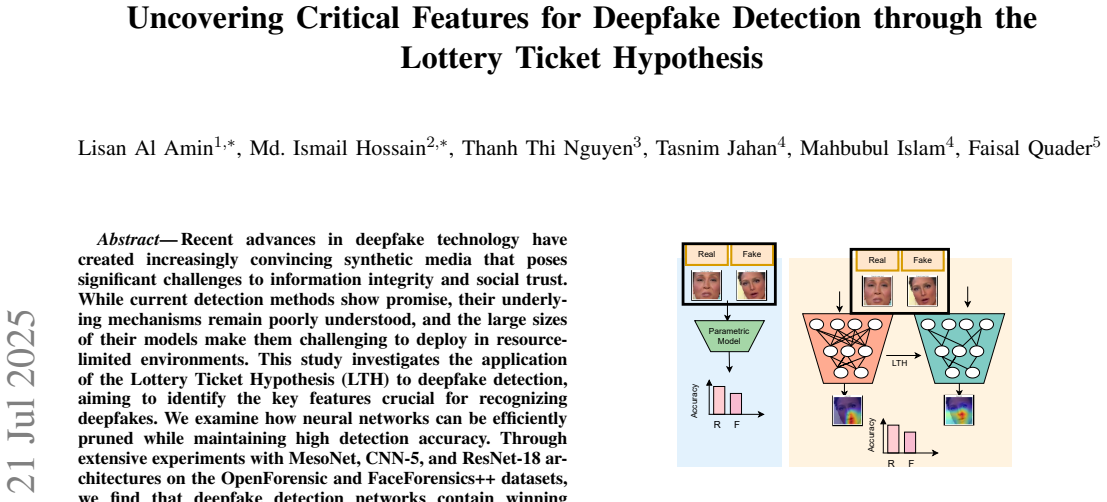
The carrying mechanism is iterative magnitude pruning (IMP) with a binary mask: train the network, remove the smallest-magnitude weights (20% per round, up to 80% sparsity), update the mask, and retrain the surviving subnetwork. The winning ticket is the subnetwork selected by that mask, and the paper's main comparison is between global pruning, which ranks weights across the whole network, and local pruning, which ranks weights within each layer, with one-shot pruning as a baseline. Grad-CAM heatmaps are then used to check whether the pruned subnetwork still attends to the same facial evidence as the dense model.
What would settle it
A decisive test would be to take each reported sparse subnetwork, reset its surviving weights to the original initialization, retrain it on the target dataset, and check whether it reaches the dense model's accuracy; the paper's transfer numbers come from evaluating the trained pruned model directly, so they do not yet rule out the possibility that the sparse weights are simply a good fixed feature extractor.
Extended reading notes
Core claim
The central claim is that the Lottery Ticket Hypothesis transfers to deepfake detection: a randomly initialized detector contains a sparse subnetwork that, after iterative magnitude pruning and retraining, performs at or near the level of the dense network. The paper reports that at 80% sparsity, ResNet-18 retains 94.29% accuracy on OpenForensic (essentially its dense 94.3%), CNN-5 retains 90.88% of 91.41%, and XceptionNet retains 96.11% of 96.20%, while the lightweight MesoNet drops to 56.2% from 62.6%. On FaceForensics++, the authors find that local, layer-wise pruning outperforms global pruning, especially for ResNet-18, which keeps 83% accuracy at 80% sparsity under local pruning. The authors interpret this as evidence that deepfake detection relies on task-specific, artifact-sensitive features that global magnitude pruning can discard, and that the surviving subnetworks remain focused on the facial regions used for detection.
Load-bearing premise
The transferability claim rests on treating the accuracy of an already-pruned source model evaluated directly on a second dataset as evidence of a transferable winning ticket, instead of retraining the sparse subnetwork on the target dataset as the lottery-ticket protocol normally requires.
Editorial extensions
If this is right
- Deepfake detectors can be pruned to 80% sparsity with only a few percentage points of accuracy loss on the tested datasets, which translates to a roughly five-fold reduction in parameters.
- Iterative magnitude pruning is the safer compression choice for deepfake detection, because it consistently outperforms one-shot pruning, with the gap widening at high sparsity.
- The best pruning criterion depends on the data: global magnitude pruning works better on the cleaner OpenForensic images, while local layer-wise pruning is needed on the compressed FaceForensics++ set.
- Larger, more redundant architectures such as ResNet-18 are much more pruning-friendly than compact detectors like MesoNet, so pruning budgets should be chosen with architecture in mind.
- Grad-CAM maps at 60% and 80% sparsity remain concentrated on the same facial regions as the dense model, suggesting that the sparse subnetwork keeps a meaningful, inspectable decision basis.
Reading between the lines
- If the winning-ticket pattern generalizes to other deepfake datasets and generation methods, sparse detectors could run on phones and embedded cameras where dense models do not fit.
- The paper's cross-dataset transfer experiment evaluates the already-pruned source model directly on a second dataset; the standard lottery-ticket transfer test retrains the sparse mask on the target data, so the stronger transfer claim remains to be demonstrated.
- A natural extension is to prune temporal or video-based detectors, since the reported frame-level experiments do not test whether sparse subnetworks preserve the temporal inconsistency cues used in video deepfake detection.
- The finding that local pruning helps most on compressed data suggests that manipulation artifacts are encoded in layer-specific patterns; this could be tested by comparing the masks found by local and global pruning to see where they diverge.
Editorial analysis
A structured set of objections, weighed in public.
Referee Report
Summary. The paper applies iterative magnitude pruning (IMP) and one-shot pruning to four deepfake detection architectures (MesoNet, CNN-5, ResNet-18, XceptionNet) on two datasets (OpenForensic and a FaceForensics++/Celeb-DF-derived set). It reports accuracy at sparsity levels up to 80%, Grad-CAM attention maps, and a cross-dataset transfer experiment, interpreting the results as evidence that deepfake detectors contain lottery tickets, that iterative pruning outperforms one-shot pruning, and that pruned subnetworks transfer across datasets. The paper also proposes global versus local pruning thresholds and discusses dataset-dependent behavior.
Significance. If the central claims were valid, the paper would be a useful empirical contribution: high-sparsity operation of compact deepfake detectors could inform deployable systems, and the observed dataset-dependence of pruning strategies is an interesting finding. The study has strengths: it evaluates held-out test accuracy across multiple architectures and datasets, documents the pruning protocol, and candidly lists limitations in Section VI. However, the defining LTH reset is absent from the protocol, so the paper's main framing is not tested; the results as reported support a narrower claim about iterative magnitude pruning with fine-tuning, not about lottery tickets. With a corrected protocol or a reframed contribution, the empirical content could still be of value.
major comments (3)
- [Section III.A and Algorithm 1] The protocol never performs the reset-to-initialization step that defines a lottery ticket. Algorithm 1 line 10 sets theta <- m * theta, so training continues from the already-trained pruned weights, and Section III.A step 2 likewise trains F(x; m * theta) for 'a single cycle' without reinitializing to the original theta_0. Under the standard Frankle-Carbin definition, a winning ticket is a subnetwork that, after pruning, is reset to its original initialization and retrained in isolation. The reported 80%-sparsity accuracies therefore establish that iterative magnitude pruning with fine-tuning preserves accuracy, not that deepfake detectors contain winning tickets. Because the abstract's central claim is exactly about winning tickets, this is a load-bearing issue: either run the standard reset protocol and report those results, or reframe the contribution as a study of pruning, not LTH.
- [Section III.D and Table I] The transferability experiment does not test transfer of a lottery ticket. The formula theta_2 = m_1 * theta_1 in Section III.D directly evaluates the pruned source-network weights on dataset D2; standard ticket transfer keeps the mask and retrains the masked subnetwork on the target dataset. Consequently, Table I reports cross-dataset generalization of a fixed pruned model, not the transferability of winning tickets. The claim in Section V.E that sparse subnetworks 'demonstrate significant transferability across tasks' is unsupported by the described experiment; the authors should either retrain on the target dataset under a transferred mask or explicitly reframe Table I as cross-dataset accuracy of pruned source models.
- [Sections V.A and V.B] The two result subsections make contradictory summary claims. Section V.A states that on OpenForensic, IMP-Global outperforms IMP-Local in 4 of 4 models, while Section V.B states that 'IMP-Local mostly outperforms both IMP-Global and one-shot pruning across all architectures and datasets.' The latter sentence is misleading unless 'mostly' explicitly carves out the OpenForensic exception, and the paper should state the dataset-dependent conclusion directly. In addition, all accuracy numbers are single point estimates without error bars, multiple seeds, or significance testing; since the paper repeatedly claims consistent or superior performance, this omission undermines the comparison claims and needs to be addressed.
minor comments (5)
- [Figure 2 and Section V.A] The caption of Figure 2 says 'three different model architectures' but lists four models (MesoNet, CNN-5, ResNet-18, XceptionNet); Section V.A also says 'three model architectures' while describing four. The text should be corrected to say four.
- [Section IV.C] The pruning schedule is ambiguous: the text says '8 iterative rounds' and 'prune 20% of the weights ... in each iteration' but also says 'pruning rates progressively upto 80%.' If 20% of the remaining weights are pruned each round, eight rounds give approximately 83.2% sparsity; if 20% of the original weights are pruned per round, 80% sparsity is reached in four rounds. Please clarify the exact schedule.
- [Section III.C] The text says 'we propose an IMP approach,' but IMP is a standard method from the literature (as acknowledged in the references). The proposed aspect should be limited to the application setting, the global/local threshold comparison, and the empirical study, rather than the base algorithm.
- [Section III.B] The notation P(F(x; m * theta) | r_i) >= tau is used without defining the probability space or how the sensitivity threshold tau is estimated; please clarify the intended meaning.
- [Section IV.C] The GPU is named 'NVIDIA V4090'; please verify this model name, and also report the number of epochs, batch size, and dataset split details for reproducibility.
Circularity Check
No significant circularity: the reported accuracies are held-out test measurements of pruned networks, and no fitted parameter is renamed as a prediction.
full rationale
The paper's central empirical claims—sparse subnetworks retain accuracy, IMP beats one-shot pruning, and Grad-CAM attention remains stable—are all evaluated on held-out test splits (Section IV.C: "we evaluate our work by examining testing accuracy and the network pruning rate"; Section V reports test accuracies). No parameter is fitted to test data, and the pruning equations in Section III.C (mask update m_l[i]=0 if |θ_l[i]|≤α; θ^(j)=m^(j)⊙θ^(j−1)) define the procedure rather than baking in the outcome. The comparison against one-shot pruning is a direct experimental contrast on the same test sets, not a derivation. The transfer experiment in Section III.D defines θ2=m1⊙θ1 and measures a′2 on D2; this is a cross-dataset evaluation with no fitting to D2, so it is not a fitted-input-called-prediction pattern. Citations [6] and [19] supply the standard LTH concept and standard IMP description; although [19] shares a co-author with this paper, the measurements here stand on their own held-out results, so the self-citation is not load-bearing. One non-circular validity caveat should be flagged: Algorithm 1 line 10 sets θ←m⊙θ, continuing from pruned weights, and Section III.A never rewinds to the original initialization; the abstract's phrase "winning tickets, i.e., subnetworks" therefore does not test the strict Frankle-Carbin train-in-isolation property. That is an omitted-protocol or labeling issue, not a by-construction circularity, and it does not undermine the factual accuracy measurements for pruned deepfake detectors.
Assumptions & free parameters
free parameters (4)
- IMP pruning increment =
20% per iteration
- Number of IMP rounds =
8 (to reach 80% sparsity)
- Adam learning rate =
1e-4
- Early stopping patience =
10
assumptions (5)
- domain assumption Labels in the Kaggle versions of OpenForensic and FaceForensics++ are correct ground truth for real versus fake.
- domain assumption Frame-level face-cropped images carry enough discriminative signal for binary deepfake detection.
- standard math The standard LTH protocol from Frankle and Carbin (train, prune by magnitude, retrain) is the correct operationalization of 'winning tickets'.
- domain assumption Grad-CAM heatmaps accurately represent the regions a pruned network relies on.
- domain assumption Adam optimization with early stopping trains each architecture to a representative minimum.
Cite this review
Pith. "Pith review of Uncovering Critical Features for Deepfake Detection through the Lottery Ticket Hypothesis." pith.science (2026). https://pith.science/paper/6WHK2R3L
@misc{pith2026250715636,
  author       = {Pith},
  title        = {Pith review of: Uncovering Critical Features for Deepfake Detection through the Lottery Ticket Hypothesis},
  year         = {2026},
  howpublished = {\url{https://pith.science/paper/6WHK2R3L}},
  note         = {Machine review of arXiv:2507.15636}
}
read the original abstract
Recent advances in deepfake technology have created increasingly convincing synthetic media that poses significant challenges to information integrity and social trust. While current detection methods show promise, their underlying mechanisms remain poorly understood, and the large sizes of their models make them challenging to deploy in resource-limited environments. This study investigates the application of the Lottery Ticket Hypothesis (LTH) to deepfake detection, aiming to identify the key features crucial for recognizing deepfakes. We examine how neural networks can be efficiently pruned while maintaining high detection accuracy. Through extensive experiments with MesoNet, CNN-5, and ResNet-18 architectures on the OpenForensic and FaceForensics++ datasets, we find that deepfake detection networks contain winning tickets, i.e., subnetworks, that preserve performance even at substantial sparsity levels. Our results indicate that MesoNet retains 56.2% accuracy at 80% sparsity on the OpenForensic dataset, with only 3,000 parameters, which is about 90% of its baseline accuracy (62.6%). The results also show that our proposed LTH-based iterative magnitude pruning approach consistently outperforms one-shot pruning methods. Using Grad-CAM visualization, we analyze how pruned networks maintain their focus on critical facial regions for deepfake detection. Additionally, we demonstrate the transferability of winning tickets across datasets, suggesting potential for efficient, deployable deepfake detection systems.
Figures


Reference graph
Works this paper leans on
-
[1]
M. R. Shoaib, Z. Wang, M. T. Ahvanooey, and J. Zhao, “Deepfakes, misinformation, and disinformation in the era of frontier AI, generative AI, and large AI models,” in 2023 International Conference on Computer and Applications (ICCA) . IEEE, 2023, pp. 1–7
work page 2023
-
[2]
Generative AI and deep fakes in media industry– An innovation resistance theory perspective,
D. Pramod, K. P. Patil, D. Kumar, D. R. Singh, C. S. Dodiya, and D. Noble, “Generative AI and deep fakes in media industry– An innovation resistance theory perspective,” in 2024 International Conference on Electrical Electronics and Computing Technologies (ICEECT), vol. 1. IEEE, 2024, pp. 1–5
work page 2024
-
[3]
A deepfake compressed video detection method based on dense dynamic CNN,
X. Mao, L. Sun, H. Zhang, and S. Zhang, “A deepfake compressed video detection method based on dense dynamic CNN,” in Interna- tional Conference on Computer Graphics, Artificial Intelligence, and Data Processing (ICCAID 2022), vol. 12604. SPIE, 2023, pp. 54–65
work page 2022
-
[4]
J. Hu, X. Liao, W. Wang, and Z. Qin, “Detecting compressed deep- fake videos in social networks using frame-temporality two-stream convolutional network,” IEEE Transactions on Circuits and Systems for Video Technology, vol. 32, no. 3, pp. 1089–1102, 2021
work page 2021
-
[5]
A lightweight CNN for efficient deepfake detection of low-resolution images in frequency domain,
D. Sabareshwar, S. Raghul, S. Ravi, M. Varalakshmi, and P. M. PU, “A lightweight CNN for efficient deepfake detection of low-resolution images in frequency domain,” in 2024 Second International Confer- ence on Emerging Trends in Information Technology and Engineering (ICETITE). IEEE, 2024, pp. 1–6
work page 2024
-
[6]
The lottery ticket hypothesis: Finding sparse, trainable neural networks,
J. Frankle and M. Carbin, “The lottery ticket hypothesis: Finding sparse, trainable neural networks,” in International Conference on Learning Representations, 2018
work page 2018
-
[7]
Exploiting deepfakes by analyzing temporal feature inconsistency
J. Gu, Y . Xu, J. Sun, and W. Liu, “Exploiting deepfakes by analyzing temporal feature inconsistency.” International Journal of Advanced Computer Science & Applications , vol. 14, no. 12, 2023
work page 2023
-
[8]
MesoNet: a compact facial video forgery detection network,
D. Afchar, V . Nozick, J. Yamagishi, and I. Echizen, “MesoNet: a compact facial video forgery detection network,” in 2018 IEEE International Workshop on Information Forensics and Security (WIFS). IEEE, 2018, pp. 1–7
work page 2018
Show all 29 references
-
[9]
Deep residual learning for image recognition,
K. He, X. Zhang, S. Ren, and J. Sun, “Deep residual learning for image recognition,” in Proceedings of the IEEE Conference on Computer Vision and Pattern Recognition , 2016, pp. 770–778
2016
-
[10]
Faceforensics: A large-scale video dataset for forgery detection in human faces,
A. R ¨ossler, D. Cozzolino, L. Verdoliva, C. Riess, J. Thies, and M. Nießner, “Faceforensics: A large-scale video dataset for forgery detection in human faces,” ArXiv, vol. abs/1803.09179, 2018. [Online]. Available: https://api.semanticscholar.org/CorpusID:4395181
2018 arXiv
-
[11]
The open images dataset v4: Unified image classi- fication, object detection, and visual relationship detection at scale,
A. Kuznetsova, H. Rom, N. Alldrin, J. Uijlings, I. Krasin, J. Pont- Tuset, S. Kamali, S. Popov, M. Malloci, A. Kolesnikov, T. Duerig, and V . Ferrari, “The open images dataset v4: Unified image classi- fication, object detection, and visual relationship detection at scale,” In...
2020
-
[12]
FaceForensics++: Learning to detect manipulated facial images,
A. Rossler, D. Cozzolino, L. Verdoliva, C. Riess, J. Thies, and M. Nießner, “FaceForensics++: Learning to detect manipulated facial images,” in Proceedings of the IEEE/CVF International Conference on Computer Vision , 2019, pp. 1–11
2019
-
[13]
Fake- buster: A lightweight solution for deepfake detection,
N. Hubens, M. Mancas, B. Gosselin, M. Preda, and T. Zaharia, “Fake- buster: A lightweight solution for deepfake detection,” in Applications of Digital Image Processing XLIV , vol. 11842, 2021, pp. 146–154
2021
-
[14]
Neural geometric level of detail: Real-time rendering with implicit 3D shapes,
T. Takikawa, J. Litalien, K. Yin, K. Kreis, C. Loop, D. Nowrouzezahrai, A. Jacobson, M. McGuire, and S. Fidler, “Neural geometric level of detail: Real-time rendering with implicit 3D shapes,” in Proceedings of the IEEE/CVF Conference on Computer Vision and Pattern Recognition...
2021
-
[15]
LLM-Pruner: On the structural pruning of large language models,
X. Ma, G. Fang, and X. Wang, “LLM-Pruner: On the structural pruning of large language models,” Advances in Neural Information Processing Systems, vol. 36, pp. 21 702–21 720, 2023
2023
-
[16]
Pruning for robust concept erasing in diffusion models,
T. Yang, J. Cao, and C. Xu, “Pruning for robust concept erasing in diffusion models,” in Safe Generative AI Workshop at NeurIPS 2024, 2024. [Online]. Available: https://openreview.net/forum?id= jD1eWpUMOf
2024
-
[17]
Pruning convolutional neural networks for resource efficient inference,
P. Molchanov, S. Tyree, T. Karras, T. Aila, and J. Kautz, “Pruning convolutional neural networks for resource efficient inference,” in International Conference on Learning Representations (ICLR) , 2017. [Online]. Available: https://openreview.net/pdf?id=SJGCiw5gl
2017
-
[18]
RTMobile: Beyond real-time mobile acceleration of rnns for speech recognition,
P. Dong, S. Wang, W. Niu, C. Zhang, S. Lin, Z. Li, Y . Gong, B. Ren, X. Lin, and D. Tao, “RTMobile: Beyond real-time mobile acceleration of rnns for speech recognition,” in 2020 57th ACM/IEEE Design Automation Conference (DAC). IEEE, 2020, pp. 1–6
2020
-
[19]
3D point cloud network pruning: When some weights do not matter,
A. Biswas, M. I. Hossain, M. M. L. Elahi, A. Cheraghian, F. Rahman, N. Mohammed, and S. Rahman, “3D point cloud network pruning: When some weights do not matter,” in 35th British Machine Vision Conference (BMVC) . BMV A, 2024. [Online]. Available: https://bmva-archive.org.uk/b...
2024
-
[20]
Deepfake video detection: challenges and opportunities,
A. Kaur, A. Noori Hoshyar, V . Saikrishna, S. Firmin, and F. Xia, “Deepfake video detection: challenges and opportunities,” Artificial Intelligence Review, vol. 57, no. 6, pp. 1–47, 2024
2024
-
[21]
What do compressed deep neural networks forget?
S. Hooker, A. Courville, G. Clark, Y . Dauphin, and A. Frome, “What do compressed deep neural networks forget?” arXiv preprint arXiv:1911.05248, 2019
1911 arXiv
-
[22]
Grad-CAM: Visual explanations from deep networks via gradient-based localization,
R. R. Selvaraju, M. Cogswell, A. Das, R. Vedantam, D. Parikh, and D. Batra, “Grad-CAM: Visual explanations from deep networks via gradient-based localization,” International Journal of Computer Vision, vol. 128, no. 2, pp. 336–359, 2020
2020
-
[23]
Adaptive knowledge dis- tillation for classification of hand images using explainable vision transformers,
T. T. Nguyen, C. Wilson, and J. Dalins, “Adaptive knowledge dis- tillation for classification of hand images using explainable vision transformers,” in Joint European Conference on Machine Learning and Knowledge Discovery in Databases . Springer, 2024, pp. 235– 252
2024
-
[24]
Celeb-DF: A large- scale challenging dataset for deepfake forensics,
Y . Li, X. Yang, P. Sun, H. Qi, and S. Lyu, “Celeb-DF: A large- scale challenging dataset for deepfake forensics,” in Proceedings of the IEEE/CVF Conference on Computer Vision and Pattern Recognition , 2020, pp. 3207–3216
2020
-
[25]
Stabilizing the lottery ticket hypothesis,
J. Frankle, G. K. Dziugaite, D. M. Roy, and M. Carbin, “Stabilizing the lottery ticket hypothesis,” 2020. [Online]. Available: https://arxiv.org/abs/1903.01611
2020 arXiv
-
[26]
Coarsening the granularity: Towards structurally sparse lottery tickets,
T. Chen, X. Chen, X. Ma, Y . Wang, and Z. Wang, “Coarsening the granularity: Towards structurally sparse lottery tickets,” in Interna- tional Conference on Machine Learning , 2022, pp. 3025–3039
2022
-
[27]
SNIP: Single-shot network pruning based on connection sensitivity,
N. Lee, T. Ajanthan, and P. H. S. Torr, “SNIP: Single-shot network pruning based on connection sensitivity,” 2019. [Online]. Available: https://arxiv.org/abs/1810.02340
2019 arXiv
-
[28]
Picking winning tickets before training by preserving gradient flow,
C. Wang, G. Zhang, and R. Grosse, “Picking winning tickets before training by preserving gradient flow,” in International Conference on Learning Representations , 2020. [Online]. Available: https://openreview.net/forum?id=SkgsACVKPH
2020
-
[29]
Shallowing deep networks: Layer-wise pruning based on feature representations,
S. Chen and Q. Zhao, “Shallowing deep networks: Layer-wise pruning based on feature representations,” IEEE Transactions on Pattern Analysis and Machine Intelligence , vol. 41, no. 12, pp. 3048–3056, 2019
2019
Reviewed August 6, 2026 · model on record in the stance chip above.
Discussion (0). Continue with ORCID to comment.