REVIEW 3 major objections 5 minor 1 cited by
Systematic Improvement of Hamiltonian Truncation Effective Theory
T0 review · 3 major / 5 minor · reviewed 2026-08-06 · deepseek-v4-flash
Pith's one-line read This paper shows that Hamiltonian truncation errors in 1+1D $\lambda\phi^4$ theory fall as $1/E_{\max}^4$ once next-order nonlocal matching terms are included.
desk verdict A careful NLO extension of HTET with a useful consistency check; worth refereeing, but the headline error-scaling claim rests on a smoothness assumption the paper does not fully test. read the letter →
The pith
A machine-rendered reading of the paper's core claim, the machinery that carries it, and where it could break.
The reading
What carries the argument
The matching observable is the overlap $\Sigma_{fi} = \langle \Psi_f | i\rangle$ between interacting and free eigenstates, built from the Møller operator that adiabatically switches the interaction on and maps free states to interacting states. Expanding this overlap perturbatively in the interaction gives the matching condition for each correction, for example $\langle f|H_2|i\rangle = \sum_{E_\alpha>E_{\max}} \langle f|V|\alpha\rangle\langle\alpha|V|i\rangle/(E_f-E_\alpha)$. At next-to-leading order the step functions that enforce the cutoff do not combine into purely local operators; expanding them in powers of $1/E_{\max}$ produces nonlocal structures such as $H_0$ times local fields. The eigenvalue error scaling is then the diagnostic that tells whether the matching has accounted for all states above the cutoff.
What would settle it
Compute the low-lying eigenvalue error with the next-to-leading-order nonlocal terms included at several increasing cutoffs, holding the volume and coupling fixed, and fit $\log(\text{error})$ versus $\log E_{\max}$; if the best-fit slope is not close to $-4$, or if the matched coefficients change noticeably when the volume or mass is varied, the central claim is contradicted.
Extended reading notes
Core claim
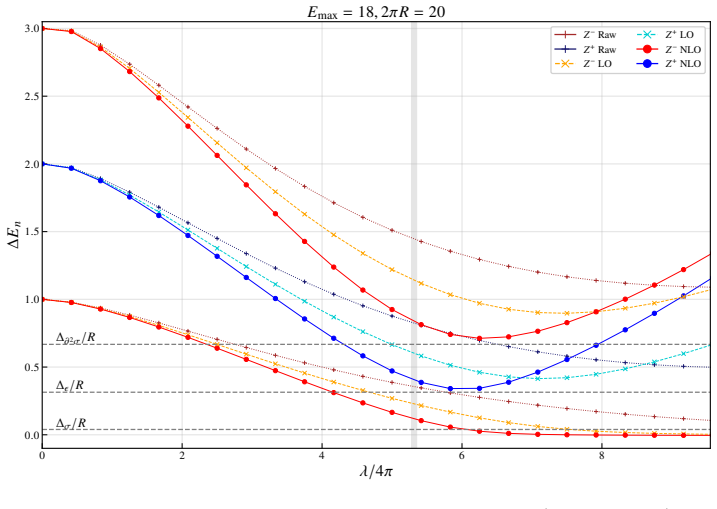
The central claim is that the matching condition defined by the overlap $\Sigma_{fi} = \langle \Psi_f | i\rangle$ between interacting and free eigenstates determines an effective Hamiltonian $H_{\rm eff}=H_0+H_1+H_2+\cdots$ whose coefficients at order $1/E_{\max}^3$ are sufficient only when nonlocal, non-Hermitian terms are included. In particular, at this order the effective Hamiltonian contains operators of the form $H_0 \int R\,d\theta :\phi^2:$ alongside local $:\phi^4:$ and $:\phi^2:$ terms. The paper computes these coefficients for 1+1D $\lambda\phi^4$ theory, including the step-function expansions in Eqs. (2.34a)-(2.34b), and finds numerically that after including them the low-lying eigenvalues converge with residual error $\sim 1/E_{\max}^4$ rather than $1/E_{\max}^3$. The same calculation shows that the short-distance coefficients remain insensitive to the volume and mass, so separation of scales persists; the authors take this as evidence the effective theory can be built order by order.
Load-bearing premise
The overlap between free and interacting eigenstates is assumed to be computable by a convergent perturbative expansion at the matching scale, and the density of states near the cutoff is assumed to be smooth enough to expand the step functions in powers of $1/E_{\max}$; if either fails, the claimed $1/E_{\max}^4$ error scaling would not appear.
Editorial extensions
If this is right
- If the paper is right, the improvement scheme works beyond leading order: the operator basis used at order $1/E_{\max}^3$, including nonlocal terms, is sufficient to realize the predicted convergence.
- Eigenvalue errors gain one power of the cutoff at each included order, so more accuracy can be obtained without enlarging the truncated Hilbert space.
- The matching procedure can be extended to higher orders with nonlocal, non-Hermitian corrections without breaking the effective-field-theory power count.
- Separation of scales persists at this order, meaning the matching coefficients are genuinely ultraviolet and can be transferred to other infrared observables.
- The improved spectrum gives a numerical estimate of the critical coupling where $\lambda\phi^4$ flows to the 2D Ising conformal field theory, providing a nonperturbative anchor for future applications.
Reading between the lines
- A testable extension of this work: repeat the same next-to-leading-order matching for a different interaction, such as a derivative coupling, and check whether the residual eigenvalue error still gains exactly one power of $1/E_{\max}$; the local-versus-nonlocal split should change but the power count should not.
- Because the nonlocality enters as $H_0$ times a local operator, the effective Hamiltonian at this order is not Hermitian; using the improved convergence for spectral functions or time evolution rather than only low-lying eigenvalues would require dealing with that non-Hermiticity explicitly.
- The separation-of-scales check is performed at fixed finite volume; extrapolating the matched coefficients to $R\to\infty$ and comparing with known infinite-volume critical behaviour would test whether the nonlocal terms stay controlled when the infrared scale is the lightest mass rather than the volume.
- If the step-function expansion is the right mechanism, similar $H_0$ times local-operator terms should appear in any truncation scheme that imposes a total-energy cutoff, not just this Fock-space construction; searching for them in other truncation setups would test the universality of the method.
Editorial analysis
A structured set of objections, weighed in public.
Referee Report
Summary. The manuscript extends Hamiltonian Truncation Effective Theory (HTET) for (1+1)-dimensional λφ^4 theory to next-to-leading order in the 1/Emax expansion. It computes the O(V^2) matching correction H2 through order 1/Emax^3, including nonlocal and non-Hermitian terms such as H0∫:φ^2: and H0∫:φ^4:. The authors diagonalize the resulting effective Hamiltonian in two volumes, report that eigenvalue errors scale as 1/Emax^4, estimate the critical coupling for the flow to the 2D Ising conformal field theory, and check separation of scales. The central claim is that the observed 1/Emax^4 scaling validates the EFT power counting and the completeness of the operator basis at NLO.
Significance. If the central claim is correct, the paper is a substantial methodological advance: it demonstrates that HTET can be extended beyond leading order, that nonlocal matching operators can be incorporated systematically, and that the framework remains predictive in the strongly coupled IR while using perturbative matching in the UV. The explicit diagrammatic rules and the complete NLO expressions are a useful resource for practitioners, and the paper makes a falsifiable numerical prediction for λ_c/m^2 as well as a check of separation of scales. The main weakness is that the headline validation is largely an internal power-counting consistency check; the step-function expansion on which the NLO Hamiltonian rests is not proven uniformly valid, and the numerical fits do not directly test the coefficients of the new nonlocal terms.
major comments (3)
- [Sec. 2.2.2, Eqs. (2.34a)-(2.34b)] The 1/Emax expansion of H2 is obtained by expanding integrands containing the Heaviside functions Θ(Ef − ω3 − ω4 + ω5 + ω6 − Emax) and Θ(Ef + ω1 + ω2 + ω5 + ω6 − Emax). These functions are discontinuous in the intermediate-state energies, and in the finite-volume theory on a circle the spectrum is discrete with a level spacing near the cutoff of order 1/(R^2 Emax), which can be much smaller than 1/Emax. A Taylor expansion in 1/Emax therefore treats the above-cutoff density of states as smooth and assumes no intermediate state lies within O(1/Emax) of the cutoff; this is not guaranteed. Boundary contributions from the step can produce nonanalytic terms, such as logarithms of Emax, that are not represented by the operator basis kept at order 1/Emax^3. To support the central claim of 1/Emax^4 residual errors, the authors should evaluate the exact sum in (2.30) numerically for representative matrix elements and several placements of Emax, and compare it with the expanded expression. Without such a comparison, the derivation of the NLO Hamiltonian is incomplete.
- [Sec. 3 (numerical results)] The evidence for the claimed 1/Emax^4 scaling is a fit of eigenvalue errors versus Emax over a limited window. Because the matching procedure is constructed to cancel lower-order errors, observing the expected next-order exponent largely confirms that the operator basis is complete; it does not verify the numerical coefficients of the NLO nonlocal terms. A coefficient error that does not alter the power would pass the test, and a limited Emax range can absorb nonanalytic contamination into an effective fitted exponent. The λ_c/m^2 estimate in Sec. 3.3 is an external anchor, but the extrapolation to the Ising point is indirect. The authors should add a coefficient-level test, for example comparing one matrix element of H2 with an exact evaluation of the above-cutoff sum, or comparing a predicted energy difference against an independent Hamiltonian-truncation calculation.
- [Sec. 2.2, Eq. (2.21)] The matching observable Σ_fi is expanded perturbatively in V using the adiabatic switching defined in Eqs. (2.15)-(2.19). The paper assumes the hierarchy (2.12) but does not state a quantitative condition under which the perturbative series for the interacting eigenstates converges in finite volume. Near-degeneracies among low-lying free states can make the iϵ denominators in (2.21) small, and the expansion in V is not uniform in the level spacing. This affects the derivation of H2 and the order-by-order matching claim. The authors should either prove a bound on the expansion or demonstrate numerically, for a fixed small Emax, that the successive terms in the Σ expansion are controlled for the states used in the matching.
minor comments (5)
- [Abstract and Introduction] The abstract contains the typo 'nontrival' for 'nontrivial', and the Introduction uses 'compliment' where 'complement' is meant.
- [Eq. (2.13) and Sec. 2.3] The power-counting formula in Eq. (2.13) is schematic; it would help to state precisely which local and nonlocal operators are assumed to be absent at order 1/Emax^3, since the nonlocal terms H0∫:φ^2: and H0∫:φ^4: are later claimed to be the only nontrivial structures at this order.
- [After Eqs. (2.34a)-(2.34b)] The text explains that the step functions enforce Eα > Emax; it would be useful to state explicitly that the iϵ prescription can be dropped because Eα > Emax > Ef, so the energy denominators never vanish for the retained sums.
- [Sec. 2.3] The final form of Heff should be displayed in coordinate space so that the nonlocal structure of the NLO terms is unambiguous; as written, the reader must reconstruct it from the diagrammatic expressions.
- [Sec. 3.3] The critical-coupling estimate should quote a systematic uncertainty coming from the 1/Emax^4 residual errors and from the fitting window, in addition to the statistical fit error.
Circularity Check
No significant circularity: H2 is solved from the matching condition (2.24b) and the 1/E^4 residual is an internal consistency check, not a fitted prediction.
full rationale
The paper's central derivation chain is self-contained: the effective Hamiltonian corrections H1 and H2 are obtained by matching the overlap observable Sigma_fi between the full and truncated theories order by order in V, as in Eqs. (2.20)-(2.24). The O(V^2) matching condition (2.24b) defines <f|H2|i> as an explicit sum over above-cutoff states, so the nonlocal 1/E^3 terms are computed, not fitted to eigenvalue data. The step-function integrals (2.34a)-(2.34b) are then expanded in powers of 1/Emax, and the resulting H2 is added before numerical diagonalization. The reported 1/E^4 eigenvalue error is therefore an a posteriori consistency check: if the expansion of H2 or the operator basis were incomplete, the residual error would remain at 1/E^3. This validates the paper's own power-counting assumption but does not reduce the prediction to an input by construction. Citations to [29] provide the framework and diagrammatic rules, which are restated in Appendix A, and no load-bearing uniqueness theorem or unverified prior result is imported. The potential non-uniformity of the step-function expansion near Emax is a correctness or rigor concern, not a circularity.
Assumptions & free parameters
free parameters (2)
- Error scaling exponent fitted from numerical data =
≈4 (expected value 4)
- Critical coupling λ_c/m² for the flow to 2D Ising =
not stated in the accessible text
assumptions (4)
- domain assumption Interacting eigenstates are smoothly connected to free Fock states via the adiabatic switching in Eqs. (2.15)-(2.19), and the perturbative expansion (2.21) of the matching observable is valid.
- domain assumption The hierarchy ωi, ωf ≪ Ei, Ef ≪ Emax in Eq. (2.12) holds, making the states dilute and the operator basis (2.13) complete.
- ad hoc to paper The step functions enforcing Eα > Emax in Eqs. (2.34a)-(2.34b) can be expanded smoothly in 1/Emax.
- domain assumption UV divergences are fully removed by normal-ordering the operators in the finite-volume theory.
invented entities (1)
-
Nonlocal matching operators added to Heff, e.g., H0∫:φ²: and H0∫:φ⁴:
Cite this review
Pith. "Pith review of Systematic Improvement of Hamiltonian Truncation Effective Theory." pith.science (2026). https://pith.science/paper/BQEE7QLI
@misc{pith2026250715941,
  author       = {Pith},
  title        = {Pith review of: Systematic Improvement of Hamiltonian Truncation Effective Theory},
  year         = {2026},
  howpublished = {\url{https://pith.science/paper/BQEE7QLI}},
  note         = {Machine review of arXiv:2507.15941}
}
abstract
Hamiltonian Truncation Effective Theory is a framework that aims to improve the results of Hamiltonian truncation in a systematic, order-by-order fashion using Effective Field Theory methodology. The result is a truncated effective Hamiltonian with corrections that result from a matching procedure. We establish the rigor of this method by calculating nontrival next-to-leading order corrections in a $1/E_{\rm max}$ expansion, where $E_{\rm max}$ is our effective theory cutoff. We illustrate this explicitly using 1+1D $\lambda \phi^4$ theory, calculating corrections up to order $1/E_{\rm max}^3$. At this order, novel nonlocal contributions to the matching conditions must be incorporated. We show that by including these nonlocal terms, the error scales as $1/E_{\rm max}^4$, as expected from the Effective Field Theory power counting, providing a nontrivial check that this method is consistent and robust. We also estimate the critical coupling at which this theory flows to the 2D Ising conformal field theory and confirm that separation of scales, an essential feature of Effective Field Theory, persists at this order. These results establish Hamiltonian Truncation Effective Theory as a generic, systematic framework for improving convergence in Hamiltonian truncation and lay the groundwork to apply this method to more complex systems in higher dimensions.
Figures


Figures from the paper (8 more)



Forward citations
Cited by 1 Pith paper
-
Higher-order structure of Hamiltonian truncation effective theory
All-order local and O(Emax⁻⁴) non-local corrections are derived for Hamiltonian truncation effective theory of 2D λφ⁴; numerically, NNLO barely improves on NLO.
Reference graph
Works this paper leans on
-
[1]
M. Troyer and U.-J. Wiese,Computational complexity and fundamental limitations to fermionic quantum Monte Carlo simulations, Phys. Rev. Lett.94 (2005) 170201 [cond-mat/0408370]
arXiv 2005
-
[2]
A. Alexandru, G. Basar, P.F. Bedaque, S. Vartak and N.C. Warrington,Monte Carlo Study of Real Time Dynamics on the Lattice, Phys. Rev. Lett.117 (2016) 081602 [1605.08040]
arXiv 2016
-
[3]
E.D. Brooks, III and S.C. Frautschi,Scalars Coupled to Fermions in (1+1)-dimensions, Z. Phys. C 23 (1984) 263
work page 1984
-
[4]
V.P. Yurov and A.B. Zamolodchikov,TRUNCATED CONFORMAL SPACE APPROACH TO SCALING LEE-YANG MODEL, Int. J. Mod. Phys. A5 (1990) 3221
work page 1990
-
[5]
V.P. Yurov and A.B. Zamolodchikov,Truncated fermionic space approach to the critical 2-D Ising model with magnetic field, Int. J. Mod. Phys. A6 (1991) 4557
work page 1991
-
[6]
E. Katz, G. Marques Tavares and Y. Xu,Solving 2D QCD with an adjoint fermion analytically, JHEP 05 (2014) 143 [1308.4980]
arXiv 2014
-
[7]
M. Hogervorst, S. Rychkov and B.C. van Rees,Truncated conformal space approach in d dimensions: A cheap alternative to lattice field theory?, Phys. Rev. D91 (2015) 025005 [1409.1581]
arXiv 2015
-
[8]
E. Katz, G. Marques Tavares and Y. Xu,A solution of 2D QCD at FiniteN using a conformal basis, 1405.6727
Show all 70 references
-
[9]
Rychkov and L.G
S. Rychkov and L.G. Vitale,Hamiltonian truncation study of theϕ4 theory in two dimensions, Phys. Rev. D91 (2015) 085011 [1412.3460]
2015 arXiv
-
[10]
Rychkov and L.G
S. Rychkov and L.G. Vitale,Hamiltonian truncation study of theϕ4 theory in two dimensions. II. TheZ2 -broken phase and the Chang duality, Phys. Rev. D93 (2016) 065014 [1512.00493]
2016 arXiv
-
[11]
Elias-Miro, M
J. Elias-Miro, M. Montull and M. Riembau,The renormalized Hamiltonian truncation method in the largeET expansion, JHEP 04 (2016) 144 [1512.05746]
2016 arXiv
-
[12]
Bajnok and M
Z. Bajnok and M. Lajer,Truncated Hilbert space approach to the 2dϕ4 theory, JHEP 10 (2016) 050 [1512.06901]
2016 arXiv
-
[13]
Katz, Z.U
E. Katz, Z.U. Khandker and M.T. Walters,A Conformal Truncation Framework for Infinite-Volume Dynamics, JHEP 07 (2016) 140 [1604.01766]
2016 arXiv
-
[14]
Rakovszky, M
T. Rakovszky, M. Mestyán, M. Collura, M. Kormos and G. Takács,Hamiltonian truncation approach to quenches in the Ising field theory, Nucl. Phys. B 911 (2016) 805 [1607.01068]
2016 arXiv
-
[15]
Anand, V.X
N. Anand, V.X. Genest, E. Katz, Z.U. Khandker and M.T. Walters,RG flow fromϕ4 theory to the 2D Ising model, JHEP 08 (2017) 056 [1704.04500]
2017 arXiv
-
[16]
Elias-Miro, S
J. Elias-Miro, S. Rychkov and L.G. Vitale,NLO Renormalization in the Hamiltonian Truncation, Phys. Rev. D96 (2017) 065024 [1706.09929]
2017 arXiv
-
[17]
Rutter and B.C
D. Rutter and B.C. van Rees,Counterterms in Truncated Conformal Perturbation Theory, 1803.05798
-
[18]
Fitzpatrick, J
A.L. Fitzpatrick, J. Kaplan, E. Katz, L.G. Vitale and M.T. Walters,Lightcone effective Hamiltonians and RG flows, JHEP 08 (2018) 120 [1803.10793]
2018 arXiv
-
[19]
Hogervorst,RG flows onSd and Hamiltonian truncation, 1811.00528
M. Hogervorst,RG flows onSd and Hamiltonian truncation, 1811.00528. – 35 –
-
[20]
Delacrétaz, A.L
L.V. Delacrétaz, A.L. Fitzpatrick, E. Katz and L.G. Vitale,Conformal Truncation of Chern-Simons Theory at LargeNf, JHEP 03 (2019) 107 [1811.10612]
2019 arXiv
-
[21]
Fitzpatrick, E
A.L. Fitzpatrick, E. Katz, M.T. Walters and Y. Xin,Solving the 2D SUSY Gross-Neveu-Yukawa model with conformal truncation, JHEP 01 (2021) 182 [1911.10220]
2021 arXiv
-
[22]
Elias-Miró and E
J. Elias-Miró and E. Hardy,Exploring Hamiltonian Truncation ind = 2 + 1, Phys. Rev. D 102 (2020) 065001 [2003.08405]
2020 arXiv
-
[23]
Anand, A.L
N. Anand, A.L. Fitzpatrick, E. Katz, Z.U. Khandker, M.T. Walters and Y. Xin,Introduction to Lightcone Conformal Truncation: QFT Dynamics from CFT Data, 2005.13544
2005 arXiv
-
[24]
Anand, E
N. Anand, E. Katz, Z.U. Khandker and M.T. Walters,Nonperturbative dynamics of (2+1)d ϕ4-theory from Hamiltonian truncation, JHEP 05 (2021) 190 [2010.09730]
2021 arXiv
-
[25]
Tilloy,Relativistic continuous matrix product states for quantum fields without cutoff, Phys
A. Tilloy,Relativistic continuous matrix product states for quantum fields without cutoff, Phys. Rev. D104 (2021) 096007 [2102.07741]
2021 arXiv
-
[26]
Hogervorst, M
M. Hogervorst, M. Meineri, J. Penedones and K.S. Vaziri,Hamiltonian truncation in Anti-de Sitter spacetime, JHEP 08 (2021) 063 [2104.10689]
2021 arXiv
-
[27]
Chen, A.L
H. Chen, A.L. Fitzpatrick and D. Karateev,Form factors and spectral densities from Lightcone Conformal Truncation, JHEP 04 (2022) 109 [2107.10285]
2022 arXiv
-
[28]
Anand, A.L
N. Anand, A.L. Fitzpatrick, E. Katz and Y. Xin,Chiral limit of 2d QCD revisited with lightcone conformal truncation, JHEP 01 (2024) 189 [2111.00021]
2024 arXiv
-
[29]
Cohen, K
T. Cohen, K. Farnsworth, R. Houtz and M.A. Luty,Hamiltonian Truncation Effective Theory, SciPost Phys. 13 (2022) 011 [2110.08273]
2022 arXiv
-
[30]
Elias Miro and J
J. Elias Miro and J. Ingoldby,Hamiltonian Truncation with larger dimensions, JHEP 05 (2022) 151 [2112.09049]
2022 arXiv
-
[31]
Emonts and I
P. Emonts and I. Kukuljan,Reduced density matrix and entanglement of interacting quantum field theories with Hamiltonian truncation, Phys. Rev. Res.4 (2022) 033039 [2202.11113]
2022 arXiv
-
[32]
Chen, A.L
H. Chen, A.L. Fitzpatrick, E. Katz and Y. Xin,Giving Hamiltonian Truncation a Boost, 2207.01659
-
[33]
Delacretaz, A.L
L.V. Delacretaz, A.L. Fitzpatrick, E. Katz and M.T. Walters,Thermalization and chaos in a 1+1d QFT, JHEP 02 (2023) 045 [2207.11261]
2023 arXiv
-
[34]
Henning, H
B. Henning, H. Murayama, F. Riva, J.O. Thompson and M.T. Walters,Towards a nonperturbative construction of the S-matrix, JHEP 05 (2023) 197 [2209.14306]
2023 arXiv
-
[35]
Elias Miro and J
J. Elias Miro and J. Ingoldby,Effective Hamiltonians and Counterterms for Hamiltonian Truncation, JHEP 07 (2023) 052 [2212.07266]
2023 arXiv
-
[36]
Chen, A.L
H. Chen, A.L. Fitzpatrick, E. Katz and Y. Xin,Large Momentum EFT and Lightcone Quantization, 2306.13171
-
[37]
Lájer and R.M
M.K. Lájer and R.M. Konik,Krylov spaces for truncated spectrum methodologies, Phys. Rev. D 109 (2024) 045016 [2308.00277]
2024 arXiv
-
[38]
Fitzpatrick and Z
A.L. Fitzpatrick and Z. Mei,LSZ in action: extracting form factors from correlators nonperturbatively in 2dϕ4 theory, JHEP 03 (2024) 154 [2308.11091]
2024 arXiv
-
[39]
Fitzpatrick, E
A.L. Fitzpatrick, E. Katz and Y. Xin,Lightcone Hamiltonian for Ising Field Theory I: T< T_c, 2311.16290. – 36 –
-
[40]
Delouche, J
O. Delouche, J. Elias Miro and J. Ingoldby,Hamiltonian Truncation Crafted for UV-divergent QFTs, SciPost Phys. 16 (2024) 105 [2312.09221]
2024 arXiv
-
[41]
Schmoll, J
P. Schmoll, J. Naumann, A. Nietner, J. Eisert and S. Sotiriadis,Hamiltonian truncation tensor networks for quantum field theories, 2312.12506
-
[42]
Ingoldby, M
J. Ingoldby, M. Spannowsky, T. Sypchenko and S. Williams,Enhancing quantum field theory simulations on NISQ devices with Hamiltonian truncation, Phys. Rev. D110 (2024) 096016 [2407.19022]
2024 arXiv
-
[43]
Delouche, J
O. Delouche, J. Elias Miro and J. Ingoldby,Testing the RG-flowM (3, 10) + ϕ1,7 → M (3, 8) with Hamiltonian Truncation, 2412.09295
-
[44]
Fitzpatrick, E
A.L. Fitzpatrick, E. Katz and Y. Xin,Toolkit for General 2d Scalar Potential in LCT, 2412.12255
-
[45]
Ingoldby, M
J. Ingoldby, M. Spannowsky, T. Sypchenko, S. Williams and M. Wingate,Real-Time Scattering on Quantum Computers via Hamiltonian Truncation, 2505.03878
-
[46]
James, R.M
A.J.A. James, R.M. Konik, P. Lecheminant, N.J. Robinson and A.M. Tsvelik, Non-perturbative methodologies for low-dimensional strongly-correlated systems: From non-abelian bosonization to truncated spectrum methods, Rept. Prog. Phys.81 (2018) 046002 [1703.08421]
2018 arXiv
-
[47]
Fitzpatrick and E
A.L. Fitzpatrick and E. Katz,Snowmass White Paper: Hamiltonian Truncation, 2201.11696
-
[48]
Lee,Quasisparse eigenvector diagonalization and stochastic error correction, Nucl
D. Lee,Quasisparse eigenvector diagonalization and stochastic error correction, Nucl. Phys. B Proc. Suppl.90 (2000) 199 [cond-mat/0008457]
2000 arXiv
-
[49]
Feverati, K
G. Feverati, K. Graham, P.A. Pearce, G.Z. Toth and G. Watts,A Renormalisation group for the truncated conformal space approach, J. Stat. Mech.0803 (2008) P03011 [hep-th/0612203]
2008 arXiv
-
[50]
Giokas and G
P. Giokas and G. Watts,The renormalisation group for the truncated conformal space approach on the cylinder, 1106.2448
-
[51]
Kleinert,Particles And Quantum Fields, World Scientific Publishing Company (2016)
H. Kleinert,Particles And Quantum Fields, World Scientific Publishing Company (2016)
2016
-
[52]
Luscher,Volume Dependence of the Energy Spectrum in Massive Quantum Field Theories
M. Luscher,Volume Dependence of the Energy Spectrum in Massive Quantum Field Theories. 1. Stable Particle States, Commun. Math. Phys.104 (1986) 177
1986
-
[53]
Luscher,Volume Dependence of the Energy Spectrum in Massive Quantum Field Theories
M. Luscher,Volume Dependence of the Energy Spectrum in Massive Quantum Field Theories. 2. Scattering States, Commun. Math. Phys.105 (1986) 153
1986
-
[54]
Chen, A.L
H. Chen, A.L. Fitzpatrick and D. Karateev,Bootstrapping 2d ϕ4 theory with Hamiltonian truncation data, JHEP 02 (2022) 146 [2107.10286]
2022 arXiv
-
[55]
Milsted, J
A. Milsted, J. Haegeman and T.J. Osborne,Matrix product states and variational methods applied to critical quantum field theory, Phys. Rev. D88 (2013) 085030 [1302.5582]
2013 arXiv
-
[56]
Bronzin, B
S. Bronzin, B. De Palma and M. Guagnelli,New Monte Carlo determination of the critical coupling in ϕ24 theory, Phys. Rev. D99 (2019) 034508 [1807.03381]
2019 arXiv
-
[57]
Pelissetto and E
A. Pelissetto and E. Vicari,Critical mass renormalization in renormalizedϕ4 theories in two and three dimensions, Phys. Lett. B751 (2015) 532 [1508.00989]
2015 arXiv
-
[58]
Serone, G
M. Serone, G. Spada and G. Villadoro,λϕ4 Theory I: The Symmetric Phase Beyond NNNNNNNNLO, JHEP 08 (2018) 148 [1805.05882]. – 37 –
2018 arXiv
-
[59]
Serone, G
M. Serone, G. Spada and G. Villadoro,λϕ4 2 theory — Part II. the broken phase beyond NNNN(NNNN)LO, JHEP 05 (2019) 047 [1901.05023]
2019 arXiv
-
[60]
Heymans and M.B
G.O. Heymans and M.B. Pinto,Critical behavior of the 2d scalar theory: resumming the N8LO perturbative mass gap, JHEP 07 (2021) 163 [2103.00354]
2021 arXiv
-
[61]
Vanhecke, F
B. Vanhecke, F. Verstraete and K. Van Acoleyen,Entanglement scaling forλϕ24, Phys. Rev. D 106 (2022) L071501 [2104.10564]
2022 arXiv
-
[62]
Reinicke,FINITE SIZE SCALING FUNCTIONS AND CONFORMAL INVARIANCE, J
P. Reinicke,FINITE SIZE SCALING FUNCTIONS AND CONFORMAL INVARIANCE, J. Phys. A 20 (1987) 4501
1987
-
[63]
Reinicke,Analytical and Nonanalytical Corrections to Finite Size Scaling, J
P. Reinicke,Analytical and Nonanalytical Corrections to Finite Size Scaling, J. Phys. A20 (1987) 5325
1987
-
[64]
Läuchli, L
A.M. Läuchli, L. Herviou, P.H. Wilhelm and S. Rychkov,Exact Diagonalization, Matrix Product States and Conformal Perturbation Theory Study of a 3D Ising Fuzzy Sphere Model, 2504.00842
-
[65]
Schaich and W
D. Schaich and W. Loinaz,An Improved lattice measurement of the critical coupling in phi(2)**4 theory, Phys. Rev. D79 (2009) 056008 [0902.0045]
2009 arXiv
-
[66]
Bosetti, B
P. Bosetti, B. De Palma and M. Guagnelli,Monte Carlo determination of the critical coupling in ϕ4 2 theory, Phys. Rev. D92 (2015) 034509 [1506.08587]
2015 arXiv
-
[67]
Kadoh, Y
D. Kadoh, Y. Kuramashi, Y. Nakamura, R. Sakai, S. Takeda and Y. Yoshimura,Tensor network analysis of critical coupling in two dimensionalϕ4 theory, JHEP 05 (2019) 184 [1811.12376]
2019 arXiv
-
[68]
Delcamp and A
C. Delcamp and A. Tilloy,Computing the renormalization group flow of two-dimensionalϕ4 theory with tensor networks, Phys. Rev. Res.2 (2020) 033278 [2003.12993]
2020 arXiv
-
[69]
Anderson,Infrared Catastrophe in Fermi Gases with Local Scattering Potentials, Phys
P.W. Anderson,Infrared Catastrophe in Fermi Gases with Local Scattering Potentials, Phys. Rev. Lett.18 (1967) 1049
1967
-
[70]
Molinari,Another proof of gell-mann and low’s theorem, Journal of Mathematical Physics 48 (2007)
L.G. Molinari,Another proof of gell-mann and low’s theorem, Journal of Mathematical Physics 48 (2007) . – 38 –
2007
Reviewed August 6, 2026 · model on record in the stance chip above.
Discussion (0). Sign in to comment.