REVIEW 3 major objections 5 minor 149 references
Exact model of aerotactic band: From Fokker-Planck equation to band structure and fluid flow
T0 review · 3 major / 5 minor · reviewed 2026-08-06 · deepseek-v4-flash
Pith's one-line read An exact model yields the aerotactic band shape and the flow it drives.
desk verdict Worth refereeing, but the central 'exact' Laplace-band derivation has a factor-k scaling error that needs fixing before the exactness claim holds. read the letter →
The pith
A machine-rendered reading of the paper's core claim, the machinery that carries it, and where it could break.
The reading
What carries the argument
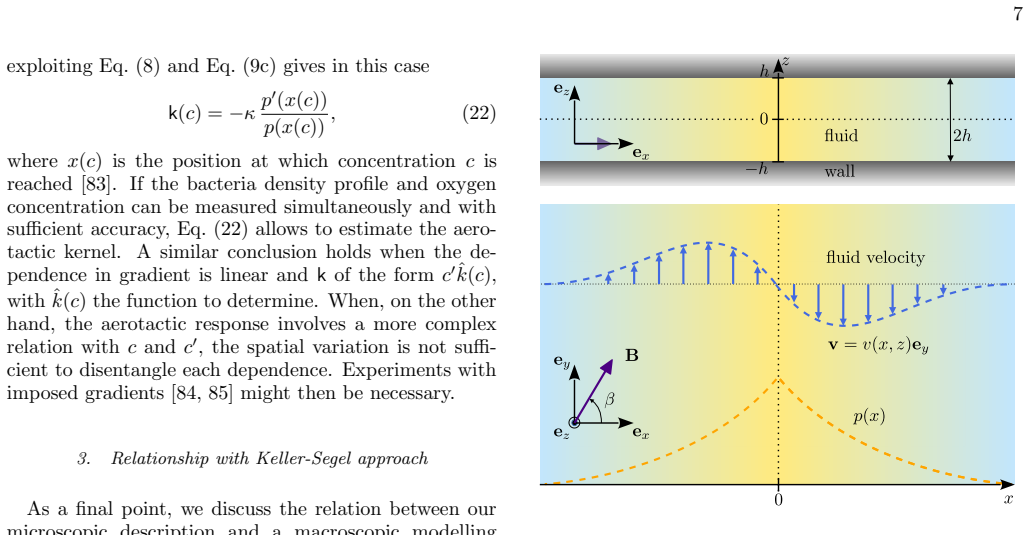
The load-bearing object is the Fokker-Planck equation for the bacterial distribution $p(x,\theta,t)$, with self-propulsion, rotational diffusion, and a tumbling rate $\lambda(x,\theta)=\lambda_o(1+k(x)\cos\theta)$. In steady state this equation admits the solution $p\propto e^{-K(x)/\kappa}$, and combining it with oxygen diffusion and consumption gives the single equation $-\kappa c'''=c''k(c,c')$, where $k(c,c')$ is the aerotactic kernel. For binary sensitivity $k=k\,\mathrm{sign}(c_*-c)$, matched asymptotic expansions in the small parameter $\epsilon$ solve this equation and produce the Laplace band. For the flow problem, the second ingredient is the active stress tensor $T_a=\sigma_o\rho L\,p(x)(\langle ee\rangle-I/2)$, whose divergence provides the force density driving the Stokes flow; the capillary geometry enters through the Green function $G(x)$ of $\Delta G=-\delta(x)$, approximated by $G_{\mathrm{app}}(x)=\frac{\Lambda}{2}e^{-|x|/\Lambda}$, $\Lambda=8Ch/\pi^2$. Convolving this Green function with the force density yields the closed-form velocity profile.
What would settle it
Measure the orientation distribution $p(\theta)$ at the band center under the same capillary and field conditions as the flow measurement. The low-field prediction contains a $\sin\theta$ modulation but no $\sin2\theta$ term, whereas flow-induced Jeffery rotation would add a $\sin2\theta$ component proportional to the shear rate; detecting that component at the predicted flow speeds would rule out the quasi-spherical assumption on which the velocity formula rests.
Extended reading notes
Core claim
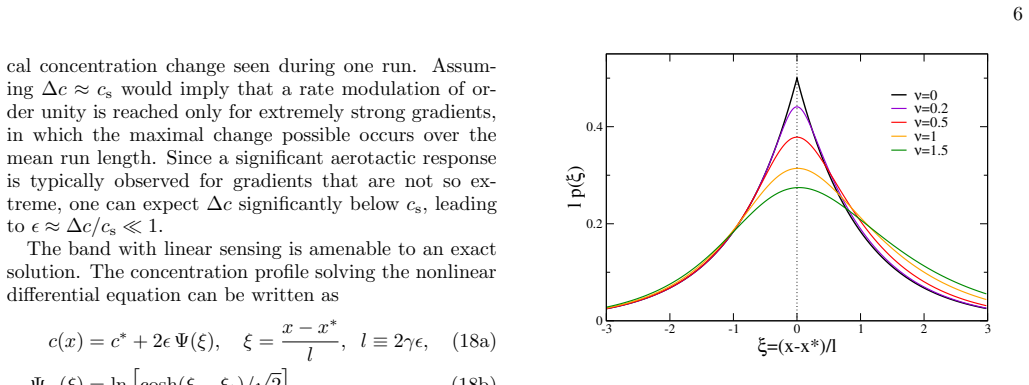
The central claim is that a band formed by bacteria with binary aerotactic sensitivity has the exact density profile $p(x)=\frac{1}{2l}e^{-|x|/l}$, with width $l=v_o\lambda_o^{-1}\bar\alpha_o/k$, while the oxygen concentration is piecewise linear away from the band and crosses over exponentially inside it. For magnetotactic bacteria at low magnetic field, the orientation distribution can be computed to second order in the field, and from it the active stress tensor follows; the divergence of that stress acts as a force density on the fluid. Solving the Stokes equation with the no-slip capillary walls through an approximate Green function gives the antisymmetric flow profile $v(x)=V\sin(2\beta)\frac{b^2}{8}\frac{\mathrm{sign}(x)}{l^2/\Lambda^2-1}\left(e^{-|x|/l}-e^{-|x|/\Lambda}\right)$, with velocity scale $V=\pi^2\sigma_o\rho L/\eta$ and hydrodynamic length $\Lambda=8Ch/\pi^2$. This profile, rescaled by its maximum, collapses onto the experimental master curve with no free parameters, and the inferred bacterial force-dipole moment and characteristic magnetic field fall in the biologically expected range. The paper presents these results as an exact, microscopic model of the band and of the flow it induces.
Load-bearing premise
The most fragile premise is that the swimmers are quasi-spherical, so the self-generated flow does not rotate their bodies; if real elongated magnetotactic bacteria rotate in the shear flow, the orientation distribution, active stress, and predicted velocity profile would all change.
Editorial extensions
If this is right
- A band with binary sensitivity always has an exponential density profile, so measuring the width of a real band gives the combination of run time, tumble efficiency, and modulation strength.
- The oxygen concentration is piecewise linear outside a sharp interior layer, a two-scale structure that could be looked for with oxygen-sensitive dyes.
- The induced flow is antisymmetric across the band, scales as $\sin(2\beta)$ with the magnetic-field angle, and its rescaled shape depends only on the ratio of capillary half-thickness to band width.
- The maximum flow speed saturates in thick capillaries at $V\sin(2\beta)$ and grows as the square of the capillary thickness in thin ones.
- Using the reported experiments, the model infers a pusher force-dipole moment around $1.5\times10^{-19}\,\mathrm{J}$ and a characteristic magnetic field near $1\,\mathrm{mT}$.
Reading between the lines
- One could invert Eq. (41) on individual experimental profiles to extract the force-dipole moment per experiment, testing whether the inferred $\sigma_o$ depends on bacterial density or field strength; the paper does not perform this test.
- The same third-order equation with a sign kernel should produce exponential bands for any chemical taxis with a preferred concentration, not only oxygen; a direct extension would be chemotaxis to an attractant with a steep consumption profile.
- Real M. gryphiswaldense cells are elongated, so the $C_B=0$ assumption is the fragile point: a testable signature of its failure would be a $\sin2\theta$ component in the orientation distribution inside the band, which the low-field prediction (28a) does not contain.
Editorial analysis
A structured set of objections, weighed in public.
Referee Report
Summary. This paper develops a microscopic Fokker-Planck description of a steady aerotactic band and of the fluid flow induced by a magnetotactic band. The author derives a third-order equation for the oxygen concentration (Eq. 8), solves it analytically for binary and linear sensing kernels, and obtains a Laplace density profile for the band. For magnetotactic bacteria in a weak magnetic field, a second-order expansion in field strength yields the orientation distribution and the active stress; convolution with an approximate Green function gives a closed-form velocity profile (Eq. 41). The velocity profile is compared with the experimental master curve of Marmol et al., without fitting the shape.
Significance. The paper is significant because it provides one of the few analytical, microscopic treatments of aerotactic band structure and connects it to a quantitative prediction for flow in magnetotactic bands. The Laplace-band solution and the parameter-free shape comparison in Fig. 8 are valuable and, if correct, would constitute a solid reference model for aerotaxis-driven self-organization. The derivation of the basic ODE, the matched-asymptotic structure, and the hydrodynamic Green-function computation are mostly clean and well documented. However, the central 'exact' solution for the binary-sensitivity band contains a factor-k inconsistency, and the low-field expansion rests on an unproven finite Fourier truncation; both points affect the quantitative claims and need to be fixed.
major comments (3)
- [Sec. II B 1, Eqs. (9a), (11), (13)-(15)] The inner solution (13)-(14) does not satisfy the governing equation for k<1. For x>x*, substitution of c_in into Eq. (9a) gives -epsilon c''' = e^{-u}/(2 gamma epsilon) while c'' k(c,c') = k e^{-u}/(2 gamma epsilon); balance requires k=1, and the same problem occurs on x<x*. The correct inner scale is delta = epsilon/k, leading to p(x) = k/(2 epsilon) exp(-k|x-x*|/epsilon), a band-position shift epsilon/(2k) in Eq. (12a), and a dimensional width l = v_o lambda_o^{-1} bar_alpha_o / k. As printed, Eq. (14) is therefore not exact for general k, and the factor-k error propagates into the parameter estimates and the simulation comparison in footnote [79].
- [Appendix C, around Eq. (C6)] The finite Fourier truncation |l| <= m is postulated rather than derived. Since the source term S(l) contains p_{m-1} with support |l| <= m-1 and the shift operator T can in principle generate |l| = m+1 from a term f_m(l +/- 1), it is not evident that the truncation is exact. The active stress in Eq. (33) and the flow prediction Eq. (41) depend on p_2, so the expansion's exactness is load-bearing. Please provide an inductive proof of the support bound or verify explicitly that the displayed p_1 and p_2 satisfy Eq. (C3), including the boundary and normalization conditions.
- [Sec. III C 1 and III D] The model sets C_B=0 and is then compared quantitatively to M. gryphiswaldense, which is elongated; this is acknowledged as a limitation, but the paper does not estimate the magnitude of the omitted Jeffery flux at the inferred shear rates. Because the fluid velocity is O(b^2) and the leading orientation distribution is isotropic, the Jeffery term is not a priori negligible. Please estimate C_B v'(x) relative to the retained terms, or restrict the quantitative claims accordingly and make the lower-bound argument in footnote [119] quantitative.
minor comments (5)
- [Eq. (15)] The division by k is not clear in the typeset formula; make l identical to v_o lambda_o^{-1} bar_alpha_o / k explicit, and ensure consistency with the statement that the band width decreases when the tumbling modulation is stronger.
- [Fig. 1 caption] The caption cites 'Codutti et al., PLoS Comput. Biol. 15(12) e1007548 (2009)', but the reference list gives the year as 2019; please correct the caption.
- [Sec. III D 2] The phrase 'without any free free parameter' contains a duplicated word; also, while the profile shape is parameter-free, the magnitude involves sigma_o inferred from the same data set, so the wording should be qualified.
- [Appendix C, Eq. (C8b)] The notations D[1,4]_r and D[4]_r are hard to follow; define them explicitly in the text before first use, for example as (1+D_r)(1+4D_r) and (1+4D_r).
- [Eq. (28a) and following text] The orientation modulation is written for x>0; the text says the negative side is obtained by substitutions, but it would help to state explicitly that p(x,theta) is continuous at x=0 under those substitutions.
Circularity Check
No circularity: the Laplace band and flow profile are derived from the model's own Fokker–Planck and Stokes equations, with the a posteriori dipole-moment inference explicitly labeled as an estimate.
full rationale
The central band result, Eq. (15), is obtained by substituting the inner ansatz Eqs. (13a)-(13b) into the model's own dimensionless band equation Eq. (9a) with the binary kernel Eq. (11); no fitted parameter enters the exponential form, and the comparison to the Codutti et al. density profile uses the independently measured band width l = 73 µm. The flow result, Eq. (41), is likewise derived within the paper: the Fokker–Planck expansion at small magnetic field gives the active stress, Eq. (33), and the velocity follows by convolving that stress with the Green function of the Stokes problem, Eqs. (39)-(40). This is a parameter-free shape prediction, and the force dipole sigma_o is inferred only afterwards in Sec. III D 2(v) from the measured maximal velocity, with the text explicitly saying it 'allows to estimate' sigma_o, not that sigma_o was predicted. The main external imports are Schnitzer's continuum random-walk solution [62], standard active-stress results [56,58], and the hydrodynamics of Jeffery/Bretherton; none are self-citations, and the paper's own self-citations ([16] and [45]) are contextual or technical rather than load-bearing. The acknowledged limitations (C_B = 0 quasi-spherical swimmers, transient experimental band, two-dimensional orientation) are scoped assumptions, not means of importing the target results. A reviewer concern that the claimed inner solution Eq. (14) may balance Eq. (9a) only for k = 1 is an internal algebraic accuracy question, not a circularity, and therefore does not affect this circularity score, though it should be checked separately.
Assumptions & free parameters
free parameters (5)
- k (tumbling modulation magnitude) =
0.5
- c* (preferred oxygen concentration)
- c'_o (characteristic gradient in linear sensing)
- sigma_o (force dipole moment) =
-1.5e-19 J
- l (band width) =
15 um
assumptions (8)
- domain assumption The Fokker-Planck equation (Eq 1) describes the bacterial position-orientation distribution.
- domain assumption Tumbling rate is Markovian with lambda(x,theta) = lambda_o (1 + k(x) cos theta) (Eq 4).
- domain assumption Steady-state solution p(x,theta) = N exp(-K/kappa) (Eq 5) from Schnitzer (1993) [62].
- domain assumption Per-bacterium oxygen consumption is constant, Phi = q_o.
- ad hoc to paper Binary sensitivity kernel k(c,c') = k sign(c* - c) (Eq 11).
- ad hoc to paper Low-field expansion in b with finite Fourier truncation |l| <= m (Appendix C).
- ad hoc to paper Green function approximation G_app = Lambda/2 exp(-|x|/Lambda) (Eq 39).
- ad hoc to paper Quasi-spherical swimmers with CB = 0 (Sec III C 1).
Cite this review
Pith. "Pith review of Exact model of aerotactic band: From Fokker-Planck equation to band structure and fluid flow." pith.science (2026). https://pith.science/paper/CB6VYSZP
@misc{pith2026250716314,
  author       = {Pith},
  title        = {Pith review of: Exact model of aerotactic band: From Fokker-Planck equation to band structure and fluid flow},
  year         = {2026},
  howpublished = {\url{https://pith.science/paper/CB6VYSZP}},
  note         = {Machine review of arXiv:2507.16314}
}
read the original abstract
A variety of bacterial species spontaneously assemble in aerotactic band, local accumulation at a fixed distance from the air-water interface. Although the phenomenon is long known, its modelling is so far limited to mesoscopic, one-dimensional or numerical descriptions. We investigate band properties at the microscopic scale using exact solutions to the Fokker-Planck equation. First, we show that the interplay between oxygen consumption and tumbling modulation is governed by a third-order nonlinear differential equation relating the oxygen concentration to the aerotactic response. For two model aerotactic behaviors, we present analytical solutions and discuss the resulting band structure. Second, we investigate how an aerotactic band of magnetotactic bacteria in a magnetic field induces a spontaneous fluid flow, as observed in experiments [Marmol et al, arXiv 2025]. In the low field limit, we determine the bacterial distribution and the active stress tensor. Using the Green function of the hydrodynamic problem, we obtain a prediction for the fluid flow that is both simple and consistent with observations. Altogether, our results provide a model system of aerotactic band and solid ground to analyze aerotaxis-driven self-organization.
Figures


Figures from the paper (4 more)


Reference graph
Works this paper leans on
-
[79]
W. Xing, M. Yin, Q. Lv, Y. Hu, C. Liu, and J. Zhang, Oxygen Solubility, Diffusion Coefficient, and Solu- tion Viscosity, in Rotating Electrode Methods and Oxy- gen Reduction Electrocatalysts (Elsevier B.V., 2014) Chap. 1, pp. 1–31
work page 2014
-
[119]
The probability distribution is thus proportional to δ(θ − β)
-
[1]
In particular, microaerophile bacteria seek oxy- gen levels well below the saturation ( c∗ ≪ cs)
Toy sensing: the Laplace band A commonly observed aerotactic behavior is the drive toward a preferred oxygen concentration c∗ [24, 25, 31, 32, 36]. In particular, microaerophile bacteria seek oxy- gen levels well below the saturation ( c∗ ≪ cs). Probably the simplest way to encapsulate the preference toward c∗ in the tumble rate kernel is to write k(c, c′...
-
[2]
Dimensionless form and interior layer It is useful to express the problem in dimensionless form. To do so, the capillary length L is taken as unit length and the oxygen saturation value cs as unit con- centration, giving the governing equations −ϵ c′′′(x) = c′′(x)k(c, c′), (9a) c(0) = 1, c ′(0) = −γ−1, c ′(1) = 0, (9b) p(x) = γc′′(x), (9c) where from now ...
-
[3]
an aerotactic re- sponse proportional to the perceived oxygen gradient, as is the case in linear response
Linear sensing: an asymmetric band We now consider linear sensing, i.e. an aerotactic re- sponse proportional to the perceived oxygen gradient, as is the case in linear response. Keeping the assumption of binary sensitivity, the rate modulation is now k(c, c′) = − c′(x) c′o sign (c∗ − c) , (16) where c′ o > 0 is a characteristic concentration gradient in-...
-
[4]
One particular feature that may appear unphysical is the dis- continuity in aerotactic response
Continuous aerotactic kernel Binary sensitivity has the advantage of tractability but is likely, for most bacteria, to remain an idealization. One particular feature that may appear unphysical is the dis- continuity in aerotactic response. Instead, one could ex- pect a smooth crossover between the two saturation val- ues, for at least two reasons. At the ...
-
[5]
Can we infer from the data the under- lying aerotactic behavior? If the kernel depends only on oxygen concentration c, the answer is positive
Inference of aerotactic kernel Band profiles that are neither exponential nor sym- metric have been observed for several bacteria species in experiments [36]. Can we infer from the data the under- lying aerotactic behavior? If the kernel depends only on oxygen concentration c, the answer is positive. Indeed, 7 exploiting Eq. (8) and Eq. (9c) gives in this...
-
[6]
Such a framework has been extensively used to describe chemo- tactic band, aggregation and patterns [50, 51]
Relationship with Keller-Segel approach As a final point, we discuss the relation between our microscopic description and a macroscopic modelling based on Keller-Segel type equation [47, 48]. Such a framework has been extensively used to describe chemo- tactic band, aggregation and patterns [50, 51]. In this approach, the bacterial flux J(x) is written as...
Show all 149 references
-
[7]
In particular, it predicts a fluid flow but starting from a Fokker-Planck equation where the effects of flow are absent
Simplifying assumptions The model developed so far relies on a number of sim- plifications. In particular, it predicts a fluid flow but starting from a Fokker-Planck equation where the effects of flow are absent. Besides, only the active contribution to stress tensor was accou...
-
[8]
Here we do not carry out a perturbative analysis on the bacterial distribution
Strong field limit After investigating the weak field regime, we turn briefly to the limit of strong magnetic field. Here we do not carry out a perturbative analysis on the bacterial distribution. To obtain an approximate estimate, we sim- ply consider that all bacteria are pe...
-
[9]
(48b) The characteristic field Bc delineates the boundary be- tween the low and high field regimes
Interpolation between weak and strong field With the weak and strong field limits in hand, and since the velocity profile keeps a similar form, one can propose in the intermediate regime a simple interpolation for the maximum fluid velocity, namely vm = V sin(2β) F (Λ/l) ˆb2 1...
-
[10]
Model limitations We are finally in a position to compare our results to the experimental observations of Marmol et al. [59]. As a preliminary to this discussion, let us point three limi- tations of our description. First, we assumed two-dimensional orientation of bac- teria. ...
-
[11]
Quantitative comparison and microscopic parameters A direct test of our prediction is not straightforward because the microscopic properties of Magnetospirillum gryphiswaldense were not measured in the experiments of Ref. [59]. We thus use the experimental observations to infe...
2020
-
[12]
T. He, M. Zhu, B. J. Mills, P. M. Wynn, A. Y. Zhu- ravlev, R. Tostevin, P. A. Pogge von Strandmann, A. Yang, S. W. Poulton, and G. A. Shields, Possible 16 links between extreme oxygen perturbations and the Cambrian radiation of animals, Nat. Geosci 12, 468 (2019)
2019
-
[13]
X. Chen, H. F. Ling, D. Vance, G. A. Shields-Zhou, M. Zhu, S. W. Poulton, L. M. Och, S. Y. Jiang, D. Li, L. Cremonese, and C. Archer, Rise to modern levels of ocean oxygenation coincided with the Cambrian radia- tion of animals, Nat. Commun. 6, 7142 (2015)
2015
-
[14]
Schmidt-Rohr, Oxygen Is the High-Energy Molecule Powering Complex Multicellular Life: Fundamental Corrections to Traditional Bioenergetics, ACS Omega 5, 2221 (2020)
K. Schmidt-Rohr, Oxygen Is the High-Energy Molecule Powering Complex Multicellular Life: Fundamental Corrections to Traditional Bioenergetics, ACS Omega 5, 2221 (2020)
2020
-
[15]
K. L. Crossin, Oxygen levels and the regulation of cell adhesion in the nervous system, Cell Adh. Migr. 6, 49 (2012)
2012
-
[16]
Fathollahipour, P
S. Fathollahipour, P. S. Patil, and N. D. Leipzig, Oxygen regulation in development: Lessons from embryogenesis towards tissue engineering, Cells Tissues Organs 205, 350 (2018)
2018
-
[17]
Scully, E
D. Scully, E. Keane, E. Batt, P. Karunakaran, D. F. Higgins, and N. Itasaki, Hypoxia promotes production of neural crest cells in the embryonic head, Development 143, 1742 (2016)
2016
-
[18]
M. C. Simon and B. Keith, The role of oxygen availabil- ity in embryonic development and stem cell function, Nat. Rev. Mol. Cell Biol. 9, 285 (2008)
2008
-
[19]
B. L. Taylor, I. B. Zhulin, and M. S. Johnson, Aerotaxis and other energy-sensing behavior in bacteria, Annu. Rev. Microbiol. 53, 103 (1999)
1999
-
[20]
Morse, R
M. Morse, R. Colin, L. G. Wilson, and J. X. Tang, The Aerotactic Response of Caulobacter crescentus, Biophys. J. 110, 2076 (2016)
2016
-
[21]
Bouvard, C
J. Bouvard, C. Douarche, P. Mergaert, H. Auradou, and F. Moisy, Direct measurement of the aerotactic response in a bacterial suspension, Phys. Rev. E 106, 034404 (2022), arXiv:2203.04656
2022 arXiv
-
[22]
Deygas, R
M. Deygas, R. Gadet, G. Gillet, R. Rimokh, P. Gonzalo, and I. Mikaelian, Redox regulation of EGFR steers mi- gration of hypoxic mammary cells towards oxygen, Nat. Commun. 9, 4545 (2018)
2018
-
[23]
Godet, Y
I. Godet, Y. J. Shin, J. A. Ju, I. C. Ye, G. Wang, and D. M. Gilkes, Fate-mapping post-hypoxic tumor cells re- veals a ROS-resistant phenotype that promotes metas- tasis, Nat. Commun. 10, 4862 (2019)
2019
-
[24]
G. L. Semenza, Molecular mechanisms mediating metas- tasis of hypoxic breast cancer cells, Trends. Mol. Med. 18, 534 (2012)
2012
-
[25]
Fenchel and B
T. Fenchel and B. Finlay, Oxygen and the spatial structure of microbial communities, Biol. Rev. 83, 553 (2008)
2008
-
[26]
Cochet-Escartin, M
O. Cochet-Escartin, M. Demircigil, S. Hirose, B. Al- lais, P. Gonzalo, I. Mikaelian, K. Funamoto, C. Anjard, V. Calvez, and J. P. Rieu, Hypoxia triggers collective aerotactic migration in Dictyostelium discoideum, eLife 10, 64731 (2021)
2021
-
[27]
Carr` ere, J
A. Carr` ere, J. D’Alessandro, O. Cochet-Escartin, J. Hesnard, N. Ghazi, C. Rivi` ere, C. Anjard, F. Detcheverry, and J.-P. Rieu, Microphase separation of living cells, Nat. Commun. 14, 796 (2023)
2023
-
[28]
Brune, P
A. Brune, P. Frenzel, and H. Cypionka, Life at the oxic- anoxic interface: Microbial activities and adaptations, FEMS Microbiol. Rev. 24, 691 (2000)
2000
-
[29]
B. L. Taylor, How do bacteria find the optimal concen- tration of oxygen?, Trends Biochem. Sci. 8, 438 (1983)
1983
-
[30]
Fenchel, B
T. Fenchel, B. J. Finlay, and A. Giann ` ı, Microaerophily in ciliates: Responses of an Euplotes species (hy- potrichida) to oxygen tension, Arch. Protistenkunde 137, 317 (1989)
1989
-
[31]
Baracchini and J
O. Baracchini and J. C. Sherris, The chemotactic effect of oxygen on bacteria, J. Path. Bact. 77, 565 (1959)
1959
-
[32]
Barak, I
R. Barak, I. Nur, Y. Okon, and Y. Henis, Aerotactic response of Azospirillum brasilense , J. Bacteriol. 152, 643 (1982)
1982
-
[33]
R. N. Grishanin, I. I. Chalmina, and I. B. Zhulin, Be- haviour of Azospirillum brasilense in a spatial gradient of oxygen and in a ’redox’ gradient of an artificial elec- tron acceptor, J. Gen. Microbiol. 137, 2781 (1991)
1991
-
[34]
I. B. Zhulin and J. P. Armitage, Motility, Chemokinesis, and Methylation-Independent Chemotaxis in Azospiril- lum brasilense, J. Bacteriol. 175, 952 (1993)
1993
-
[35]
I. B. Zhulin, V. A. Bespalov, M. S. Johnson, and B. L. Taylor, Oxygen taxis and proton motive force in Azospirillum brasilense , J. Bacteriol. 178, 5199 (1996)
1996
-
[36]
Fenchel, Motility and chemosensory behaviour of the sulphur bacterium Thiovulum majus, Microbiology 140, 3109 (1994)
T. Fenchel, Motility and chemosensory behaviour of the sulphur bacterium Thiovulum majus, Microbiology 140, 3109 (1994)
1994
-
[37]
L. S. Wong, M. S. Johnson, I. B. Zhulin, and B. L. Tay- lor, Role of methylation in aerotaxis in Bacillus subtilis , J. Bacteriol. 177, 3985 (1995)
1995
-
[38]
E. P. Greenberg and E. Canale-Parola, Chemotaxis in Spirochaeta aurantia, J. Bacteriol. 130, 485 (1977)
1977
-
[39]
Stricker, I
L. Stricker, I. Guido, T. Breithaupt, M. G. Mazza, and J. Vollmer, Hybrid sideways/longitudinal swimming in the monoflagellate ’ Shewanella oneidensis : From aero- tactic band to biofilm, J. R. Soc. Interface 17, 20200559 (2020)
2020
-
[40]
Krekeler, A
D. Krekeler, A. Teske, and H. Cypionka, Strategies of sulfate-reducing bacteria to escape oxygen stress in a cyanobacterial mat, FEMS Microbiol. Ecol. 25, 89 (1998)
1998
-
[41]
Eschemann, M
A. Eschemann, M. K¨ uhl, and H. Cypionka, Aerotaxis in Desulfovibrio, Environ. Microbiol. 1, 489 (1999)
1999
-
[42]
J. P. Fischer and H. Cypionka, Analysis of aerotac- tic band formation by Desulfovibrio desulfuricans in a stopped-flow diffusion chamber, FEMS Microbiol. Ecol. 55, 186 (2006)
2006
-
[43]
Ghosh, B
D. Ghosh, B. Chakrabarti, and X. Cheng, Breathe in, breathe out : Bacterial density determines collective migration in aerotaxis, bioRxiv , https://doi.org/10. 1101/2025.04.02.646741 (2025)
2025
-
[44]
R. B. Frankel, D. A. Bazylinski, M. S. Johnson, and B. L. Taylor, Magneto-aerotaxis in marine coccoid bac- teria, Biophys. J. 73, 994 (1997)
1997
-
[45]
M. J. Smith, P. E. Sheehan, L. L. Perry, K. O’Connor, L. N. Csonka, B. M. Applegate, and L. J. Whitman, Quantifying the magnetic advantage in magnetotaxis, Biophys. J. 91, 1098 (2006)
2006
-
[46]
Erglis, D
K. Erglis, D. Zhulenkovs, M. Belovs, J. Valeinis, and A. Cebers, Band formation by magnetostatic spirillum bacteria in oxygen concentration gradient, Magnetohy- drodynamics 48, 607 (2012)
2012
-
[47]
C. T. Lef` evre, M. Bennet, L. Landau, P. Vach, D. Pig- nol, D. A. Bazylinski, R. B. Frankel, S. Klumpp, and D. Faivre, Diversity of magneto-aerotactic behaviors and oxygen sensing mechanisms in cultured magneto- tactic bacteria, Biophys. J. 107, 527 (2014)
2014
-
[48]
F. Popp, J. P. Armitage, and D. Sch¨ uler, Polarity of bacterial magnetotaxis is controlled by aerotaxis 17 through a common sensory pathway, Nat. Commun. 5, 10.1038/ncomms6398 (2014)
2014 doi
-
[49]
C. T. Lef` evre and D. A. Bazylinski, Ecology, Diver- sity, and Evolution of Magnetotactic Bacteria, Micro- biol. Mol. Biol. Rev. 77, 497 (2013)
2013
-
[50]
Klumpp, C
S. Klumpp, C. T. Lef` evre, M. Bennet, and D. Faivre, Swimming with magnets: From biological organisms to synthetic devices, Phys. Rep. 789, 1 (2019)
2019
-
[51]
Marmol, E
M. Marmol, E. Gachon, and D. Faivre, Colloquium: Magnetotactic bacteria: From flagellar motor to collec- tive effects, Rev. Mod. Phys. 96, 21001 (2024)
2024
-
[52]
Bennet, A
M. Bennet, A. McCarthy, D. Fix, M. R. Edwards, F. Repp, P. Vach, J. W. Dunlop, M. Sitti, G. S. Buller, S. Klumpp, and D. Faivre, Influence of magnetic fields on magneto-aerotaxis, PLoS ONE 9, 101150 (2014)
2014
-
[53]
B. C. Mazzag, B. Zhulin, and A. Mogilner, Model of Bacterial Band Formation in Aerotaxis, Biophys. J. 85, 3558 (2003)
2003
-
[54]
H. Berg, E. coli in motion (Springer-Verlag, New York, 2004)
2004
-
[55]
Grognot and K
M. Grognot and K. M. Taute, More than propellers: how flagella shape bacterial motility behaviors, Curr. Opin. Microbiol. 61, 73 (2021)
2021
-
[56]
Detcheverry, Generalized run-and-turn motions: From bacteria to L´ evy walks, Phys
F. Detcheverry, Generalized run-and-turn motions: From bacteria to L´ evy walks, Phys. Rev. E96, 012415 (2017)
2017
-
[57]
Codutti, K
A. Codutti, K. Bente, D. Faivre, and S. Klumpp, Chemotaxis in external fields: Simulations for active magnetic biological matter, PLoS Comput. Biol. 15, 1007548 (2019)
2019
-
[58]
E. F. Keller and L. A. Segel, Model for Chemotaxis, J. Theor. Biol. 30, 225 (1971)
1971
-
[59]
E. F. Keller and L. A. Segel, Traveling Bands of Chemo- tactic Bacteria: A Theoretical Analysis, J. Theor. Biol. 30, 235 (1971)
1971
-
[60]
Rosen, Steady-state distribution of bacteria chemo- tactic toward oxygen, Bull
G. Rosen, Steady-state distribution of bacteria chemo- tactic toward oxygen, Bull. Math. Biol. 40, 671 (1978)
1978
-
[61]
M. J. Tindall, P. K. Maini, S. L. Porter, and J. P. Ar- mitage, Overview of mathematical approaches used to model bacterial chemotaxis II: Bacterial populations, Bull. Math. Biol. 70, 1570 (2008)
2008
-
[62]
Z. A. Wang, Mathematics of traveling waves in chemo- taxis - Review paper, Discret. Contin. Dyn. S. 18, 601 (2013)
2013
-
[63]
J., Block, S
Schnitzer, M. J., Block, S. M., Berg, H. C. and Pur- cell, E. M., Strategies for chemotaxis, in Biology of the Chemotactic Response , edited by Armitage J. P. and Lackie J. M. (Cambridge Univ. Press, 1990) p. 15–34
1990
-
[64]
Knosalla and T
P. Knosalla and T. Nadzieja, Stationary solutions of aerotaxis equations, Applicationes Mathematicae 42, 125 (2015)
2015
-
[65]
Knosalla, Asymptotic behavior of global solutions of aerotaxis equations, J
P. Knosalla, Asymptotic behavior of global solutions of aerotaxis equations, J. Math. Anal. Appl. 475, 337 (2019)
2019
-
[66]
B. M. Haines, I. S. Aranson, L. Berlyand, and D. A. Karpeev, Effective viscosity of dilute bacterial suspen- sions: A two-dimensional model, Phys. Biol. 5, 046003 (2008), arXiv:0804.2270
2008 arXiv
-
[67]
Saintillan, The Dilute Rheology of Swimming Sus- pensions: A Simple Kinetic Model, Exp
D. Saintillan, The Dilute Rheology of Swimming Sus- pensions: A Simple Kinetic Model, Exp. Mech. 50, 1275 (2010)
2010
-
[68]
Vincenti, C
B. Vincenti, C. Douarche, and E. Clement, Actu- ated rheology of magnetic micro-swimmers suspensions: Emergence of motor and brake states, Phys. Rev. F 3, 33302 (2018), arXiv:1710.01954
2018 arXiv
-
[69]
Saintillan, Rheology of Active Fluids, Annu
D. Saintillan, Rheology of Active Fluids, Annu. Rev. Fluid Mech. 50, 563 (2018)
2018
-
[70]
Marmol, C
M. Marmol, C. Cottin-Bizonne, A. Cebers, D. Faivre, and C. Ybert, Driven shear flow in biological magneto- active fluids, arXiv , https://arxiv.org/abs/2507. 13851 (2025), arXiv:2507.13851
2025 arXiv
-
[71]
θturn is the angle between direction before tumble and direction after tumble
-
[72]
P. G. De Gennes, Chemotaxis: The role of internal de- lays, Eur. Biophys. J 33, 691 (2004)
2004
-
[73]
M. J. Schnitzer, Theory of continuum random walks and application to chemotaxis, Phys. Rev. E 48, 2553 (1993)
1993
-
[74]
Reference [10] assume τ = τo(1−k cos θ), which is equiv- alent to our expression, for k sufficiently small
-
[75]
For higher derivative, the inner layer argument presented in Sec
The second derivative c′′(x) may be involved as well. For higher derivative, the inner layer argument presented in Sec. II A 2 may break down
-
[76]
It is not the cap- illary length associated to the air-liquid surface tension and that would be involved in the description of the meniscus
Said otherwise, L is the tube length. It is not the cap- illary length associated to the air-liquid surface tension and that would be involved in the description of the meniscus
-
[77]
[45] for details
See Appendix A in Ref. [45] for details
-
[78]
We assume forward and backward modes have strictly identical properties, including velocity and reversal rate
-
[80]
Elmas, V
M. Elmas, V. Alexiades, L. O’Neal, and G. Alexan- dre, Modeling aerotaxis band formation in Azospirillum brasilense, BMC Microbiol. 19, 101 (2019)
2019
-
[81]
M. H. Holmes, Introduction to perturbation methods (Springer, New York, 2013) arXiv:arXiv:1011.1669v3
2013 arXiv
-
[82]
White, Viscous fluid flow (McGraw-Hill, New York, 1991)
F. White, Viscous fluid flow (McGraw-Hill, New York, 1991)
1991
-
[83]
Pozrikidis, Introduction to Theoretical and Compu- tational Fluid Dynamics (Oxford University Press, New York, 2011)
C. Pozrikidis, Introduction to Theoretical and Compu- tational Fluid Dynamics (Oxford University Press, New York, 2011)
2011
-
[84]
2 of Ref
An experimental oxygen profile consistent with those expectations is given in Fig. 2 of Ref. [24]
-
[85]
Verhulst, Methods and Applications of Singular Per- turbations (Springer, 2010)
F. Verhulst, Methods and Applications of Singular Per- turbations (Springer, 2010)
2010
-
[86]
The solution for arbitrary ϵ can also be written but dif- fers by exponentially small terms such as exp( −x∗/ϵ), which are negligible in practice
-
[87]
Dimensional results are recovered with the substitution x → x/L, p → Lp and c → c/cs
-
[88]
Perrin, Mouvement brownien et r´ ealit´ e mol´ eculaire, Ann
J. Perrin, Mouvement brownien et r´ ealit´ e mol´ eculaire, Ann. Chim. Phys. 19, 5 (1909)
1909
-
[89]
In this analysis, we have neglected the presence of an imposed magnetic field along the capillary axis because at least to the naked eye, the bacterial trajectories sug- gest no strong alignment along the magnetic field
-
[90]
It is unclear which differences between the model and the simulation explains this discrepancy
Given the parameters vo = 14 µm s−1, ¯αo = 2, k = 1, our model would predict a band width l ≃ 14 µm, well below the value of 75 µm reported for simulation. It is unclear which differences between the model and the simulation explains this discrepancy
-
[91]
[25] may also be described as a Laplace band
As a first approximation, the aerotactic band reported for Thiovulum majus in Ref. [25] may also be described as a Laplace band. 18
-
[92]
p−(ξ) ≃ exp(− √ 2|ξ|)/2 for small ξ while p+(ξ) ≃ 4 exp(−2|ξ − ξ1|) for large ξ
-
[93]
The effective kernel would be k(c, c′) averaged over the probability distribution P (c∗) of c∗
-
[94]
A bijective relation between x and c should exist since c(x) at steady state should be strictly decreasing, at least in the presence of bacteria
-
[95]
Y. V. Kalinin, L. Jiang, Y. Tu, and M. Wu, Logarithmic sensing in Escherichia coli bacterial chemotaxis, Bio- phys. J. 96, 2439 (2009)
2009
-
[96]
Adler, M
M. Adler, M. Erickstad, E. Gutierrez, and A. Groisman, Studies of bacterial aerotaxis in a microfluidic device, Lab Chip 12, 4835 (2012)
2012
-
[97]
Lovely and F
P. Lovely and F. Dahlquist, Statistical measures of bac- terial motility and chemotaxis, J. Theor. Biol. 50, 477 (1975)
1975
-
[98]
Taktikos, H
J. Taktikos, H. Stark, and V. Zaburdaev, How the motil- ity pattern of bacteria affects their dispersal and chemo- taxis., PLoS ONE 8, 81936 (2013)
2013
-
[99]
With typical values Dr = 0.1 s−1 and λ−1 o = 1 s, the product Drλ−1 o is small compared to unity
This is often the case. With typical values Dr = 0.1 s−1 and λ−1 o = 1 s, the product Drλ−1 o is small compared to unity
-
[100]
The distribution of turning angle is then h(θturn) = 1/2π and αo = 1 − ¯αo = 0
-
[101]
The minus sign is included for convenience so as to make the Green function positive
-
[102]
We assume everywhere that the bacteria distribution is invariant in the z-direction and thus neglect surface effects induced by the capillary walls
-
[103]
Guyon, J
E. Guyon, J. P. Hulin, and L. Petit, Physical hydrody- namics (Oxford University Press, 2001)
2001
-
[104]
In the particular case l = Λ, the velocity profile isv(x) = V sin(2β)xe−|x|/l/2l
-
[105]
In the thin capillary limit (h ≪ l), xm = Λ | log r|
The position of the maximum is given by xm/l = r log r/(r − 1), with r ≡ Λ/l. In the thin capillary limit (h ≪ l), xm = Λ | log r|. In the thick capillary limit (h ≫ l), xm = l log r. Up to a logarithmic factor, xm is governed by the smallest length among Λ and l
-
[106]
Note also the particular value F (1) = (2e)−1
-
[107]
G. B. Jeffery, The motion of ellipsoidal particles im- mersed in a viscous fluid, Proc. R. Soc. A 102, 161 (1922)
1922
-
[108]
F. P. Bretherton, The motion of rigid particles in a shear flow at low Reynolds number, J. Fluid Mech. 14, 284 (1962)
1962
-
[109]
Junk and R
M. Junk and R. Illner, A new derivation of Jeffery’s equation, J. Math. Fluid Mech. 9, 455 (2007)
2007
-
[110]
C. J. Petrie, The rheology of fibre suspensions, J. Non- Newtonian Fluid Mech. 87, 369 (1999)
1999
-
[111]
Ishimoto, Jeffery’s Orbits and Microswimmers in Flows: A Theoretical Review, J
K. Ishimoto, Jeffery’s Orbits and Microswimmers in Flows: A Theoretical Review, J. Phys. Soc. Jpn. 92, 062001 (2023), arXiv:2303.00195
2023 arXiv
-
[112]
The relation between fluid velocity and bacterial density is complicated since the former results from a convolu- tion between the latter’s derivative and the hydrody- namic Green function
-
[113]
E. J. Hinch and L. G. Leal, Time-dependent shear flows of a suspension of particles with weak Brownian rota- tions, J. Fluid Mech. 57, 753 (1973)
1973
-
[114]
E. J. Hinch and L. G. Leal, Constitutive equations in suspension mechanics. Part 2. Approximate forms for a suspension of rigid particles affected by Brownian rota- tions, J. Fluid Mech. 76, 187 (1976)
1976
-
[115]
Larson, The structure and rheology of complex fluids (Oxford University Press, New York, 1999)
R. Larson, The structure and rheology of complex fluids (Oxford University Press, New York, 1999)
1999
-
[116]
E. J. Hinch and L. G. Leal, The effect of Brownian mo- tion on the rheological properties of a suspension of non- spherical particles, J. Fluid Mech. 52, 683 (1972)
1972
-
[117]
P. Ilg, M. Kr¨ oger, and S. Hess, Magnetoviscosity and orientational order parameters of dilute ferrofluids, J. Chem. Phys. 116, 9078 (2002)
2002
-
[118]
F. R. Cunha and R. G. Gontijo, Revisiting the govern- ing equations of a magnetic suspension of polar parti- cles: From microhydrodynamics analysis to rheological response, Phys. Fluids 36, 081303 (2024)
2024
-
[120]
This is possible for instance with biflagellated bacteria. In contrast, a monoflagellated bacteria performing run- reverse by changing motor direction would alternate be- tween puller and pusher mode, which would require a different framework
-
[121]
Talbot, C
J. Talbot, C. Antoine, P. Claudin, E. Somfai, and T. B¨ orzs¨ onyi, Exploring noisy Jeffery orbits: A com- bined Fokker-Planck and Langevin analysis in two and three dimensions, Phys. Rev. E 110, 44143 (2024)
2024
-
[122]
One could call intrinsic those bands where the oxygen profile is dictated only by bacteria from the band, and extrinsic the bands where oxygen is also governed by ex- ternal factors, such as imposed gradients in a microflu- idic experiment or the presence of additional bacteri...
-
[123]
1b of Ref
From Fig. 1b of Ref. [59] and taking an experimental cell with length L = 8 mm, the fraction of bacteria in the band is less than 0 .5%
-
[124]
3 of Ref
The distribution of velocity may in fact be bimodal, as reported in Fig. 3 of Ref. [128] for South Seeker MTB, but not necessarily for North Seeker MTB
-
[125]
Personal communication from Christophe Ybert
-
[126]
Because the hydrodynamic length scale Λ is significantly larger than the band, the flow profile is not very sensitive to the precise shape of the density profile, as long as it can be characterized by a single length scale l
-
[127]
We consider the limit of strong field ˆb ≫ 1, which is closer to the experimental data available
-
[128]
[59] can have two origins: a distinct treatment of the strong field limit and a more accurate hydrodynamic Green function, which does not rely on a lubrication approximation
Apart from the basic modelling assumptions, such as the type of reorientation event, the difference with the higher value inferred in Ref. [59] can have two origins: a distinct treatment of the strong field limit and a more accurate hydrodynamic Green function, which does not ...
-
[129]
For an Escherichia coli bacteria swimming at average velocity vo = 22 µm s−1, Drescher et al
On dimensional grounds [56], the force dipole can be written as σo = Aηvoa2, with a a characteristic size and A a numerical constant, unknown in general and likely to be species-dependent. For an Escherichia coli bacteria swimming at average velocity vo = 22 µm s−1, Drescher e...
-
[130]
There are several reasons to believe that our estimate for σo is a lower bound. First, whereas the model con- siders the fluid velocity in the midplane z = 0, where 19 it is presumably the highest, the experimental velocity is averaged over a finite thickness ∆ z, which may no...
-
[131]
[136] on the bacteria Magnetospiril- lum magneticum
Depending on the method employed, the estimate of the magnetic moment can cover almost a decade, as reported by Ref. [136] on the bacteria Magnetospiril- lum magneticum . We used the value of Ref. [128] for M. gryphiswaldense , see also Ref. [137]
-
[132]
For an ellipsoid with semi-axis lengthesaE = 5 µm and bE = 1 µm, Γ o = πηa 3 E/(3 log(2aE/bE) − 1/2) ≃ 7 10−20 J s [138]
For a sphere of radius as = 1 .4 µm, Γ o = 8 πηa 3 s ≃ 7 10−20 J s. For an ellipsoid with semi-axis lengthesaE = 5 µm and bE = 1 µm, Γ o = πηa 3 E/(3 log(2aE/bE) − 1/2) ≃ 7 10−20 J s [138]
-
[133]
Belovs, R
M. Belovs, R. Livanoviˇ cs, and A. Cebers, Synchronized rotation in swarms of magnetotactic bacteria, Phys. Rev. E 96, 042408 (2017)
2017
-
[134]
Birjukovs, K
M. Birjukovs, K. Bente, D. Faivre, G. Kitenbergs, and A. Cebers, Magnetic control of magnetotactic bac- teria swarms, arXiv , https://arxiv.org/abs/2404. 18941v1 (2024), arXiv:2404.18941
2024 arXiv
-
[135]
F. R. Koessel and S. Jabbari-Farouji, Emergent pattern formation of active magnetic suspensions in an external field, New J. Phys.22, 103007 (2020), arXiv:2006.03352
2020 arXiv
-
[136]
D. C. Guell, H. Brenner, R. B. Frankel, and H. Hartman, Hydrodynamic forces and band formation in swimming magnetotactic bacteria, J. Theor. Biol. 135, 525 (1988)
1988
-
[137]
Th´ ery, L
A. Th´ ery, L. Le Nagard, J. C. Ono-dit Biot, C. Fradin, K. Dalnoki-Veress, and E. Lauga, Self-organisation and convection of confined magnetotactic bacteria, Sci. Rep. 10, 1 (2020)
2020
-
[138]
C. J. Pierce, H. Wijesinghe, E. Mumper, B. H. Lower, S. K. Lower, and R. Sooryakumar, Hydrodynamic Inter- actions, Hidden Order, and Emergent Collective Behav- ior in an Active Bacterial Suspension, Phys. Rev. Lett. 121, 188001 (2018)
2018
-
[139]
Reufer, R
M. Reufer, R. Besseling, J. Schwarz-Linek, V. A. Mar- tinez, A. N. Morozov, J. Arlt, D. Trubitsyn, F. B. Ward, and W. C. Poon, Switching of swimming modes in Magnetospirillium gryphiswaldense , Biophys. J. 106, 37 (2014)
2014
-
[140]
K. Son, D. R. Brumley, and R. Stocker, Live from un- der the lens: exploring microbial motility with dynamic imaging and microfluidics, Nat. Rev. Microbiol. 13, 761 (2015)
2015
-
[141]
Codutti, M
A. Codutti, M. A. Charsooghi, K. Marx, E. Cerd´ a- Do˜ nate, O. Munoz, P. Zaslansky, V. Telezki, T. Robin- son, D. Faivre, and S. Klumpp, Escape problem of magnetotactic bacteria - physiological magnetic field strength help magnetotactic bacteria navigate in sim- ulated sedime...
2024
-
[142]
It is assumed, as everywhere else, that the concentration varies only along the x-axis
-
[143]
The toy sensing approximation implies that the mi- croorganism can detect gradient direction, a feature that is not expected if aerotaxis relies on temporal sens- ing but is conceivable for large microorganisms endowed with spatial sensing if they can sample concentration diff...
-
[144]
Because it simply switches the left and right side of the band
-
[145]
Gradshteyn and I
I. Gradshteyn and I. Ryzhik, Table of integrals, series, and products (Academic Press, London, 2007)
2007
-
[146]
Drescher, J
K. Drescher, J. Dunkel, L. H. Cisneros, S. Ganguly, and R. E. Goldstein, Fluid dynamics and noise in bacterial cell-cell and cell-surface scattering, Proc. Natl. Acad. Sci. USA 108, 10940 (2011), arXiv:1107.2176
2011 arXiv
-
[147]
Nadkarni, S
R. Nadkarni, S. Barkley, and C. Fradin, A comparison of methods to measure the magnetic moment of magne- totactic bacteria through analysis of their trajectories in external magnetic fields, PLoS ONE 8, e82064 (2013)
2013
-
[148]
M. P. Pichel, T. A. Hageman, I. S. Khalil, A. Manz, and L. Abelmann, Magnetic response of Magnetospirillum gryphiswaldense observed inside a microfluidic channel, J. Magn. Magn. Mater. 460, 340 (2018)
2018
-
[149]
H. C. Berg, Random walks in biology (Princeton Uni- versity Press, 1983)
1983
Reviewed August 6, 2026 · model on record in the stance chip above.
Discussion (0). Continue with ORCID to comment.