REVIEW 4 major objections 6 minor 1 cited by
EarthCrafter: Scalable 3D Earth Generation via Dual-Sparse Latent Diffusion
T0 review · 4 major / 6 minor · reviewed 2026-08-06 · deepseek-v4-flash
Pith's one-line read EarthCrafter: a dual-sparse latent diffusion framework trained on 50,028 annotated 600-meter aerial scenes can generate plausible 3D terrain from a semantic map, a single image, or no condition at all.
desk verdict Aerial-Earth3D is a real contribution and EarthCrafter is a serious engineering effort, but the paper's 'substantially better' claim is not supported by the numbers as presented. read the letter →
The pith
A machine-rendered reading of the paper's core claim, the machinery that carries it, and where it could break.
The reading
What carries the argument
The load-bearing mechanism is the dual-sparse latent decomposition: two VAEs compress geometry and appearance into separate small latents so that the diffusion models run on cheap representations instead of full Earth-scale volumes. For geometry, StructVAE downsamples via stride-2 3D sparse convolutions and upsamples through novel Pseudo-Sparse to Sparse (PSS) blocks, where a sparse pixel shuffle creates pseudo-sparse voxels, a classification head decides which are valid, and the rest are pruned; the paper reports that this classification scaffold is what makes accurate sparse upsampling possible, reaching 97.1% structural accuracy. For appearance, TexVAE deliberately avoids spatial compression—the paper's ablation shows that spatially compressing texture features degrades recovery—and instead compresses channels, consuming fine-grained low-channel image-VAE features (66 channels, about 31M storage per scene rather than 471M for large-channel alternatives) and decoding to voxelized 2D Gaussian Splats with 16 primitives per voxel. Two flow-matching generators sit on these latents: coarse-to-fine StructFM separates voxel classification from latent prediction because the paper finds that fusing them in one dense model hurts both tasks, and TexFM uses additive condition injection rather than cross-attention because cross-attention showed little correspondence between condition pixels and generated texture.
What would settle it
Regenerate a subset of the dataset's footprints with EarthCrafter and compare the outputs voxel-by-voxel against independent airborne LiDAR or high-resolution satellite stereo meshes of the same sites, using the paper's L/8 and L-level mIoU metrics. If the scores against LiDAR-derived geometry drop sharply while scores against the paper's InstantNGP meshes stay high, the learned geometry encodes reconstruction artifacts rather than real terrain; if the scores hold, the InstantNGP ground truth was not the limiting factor.
Extended reading notes
Core claim
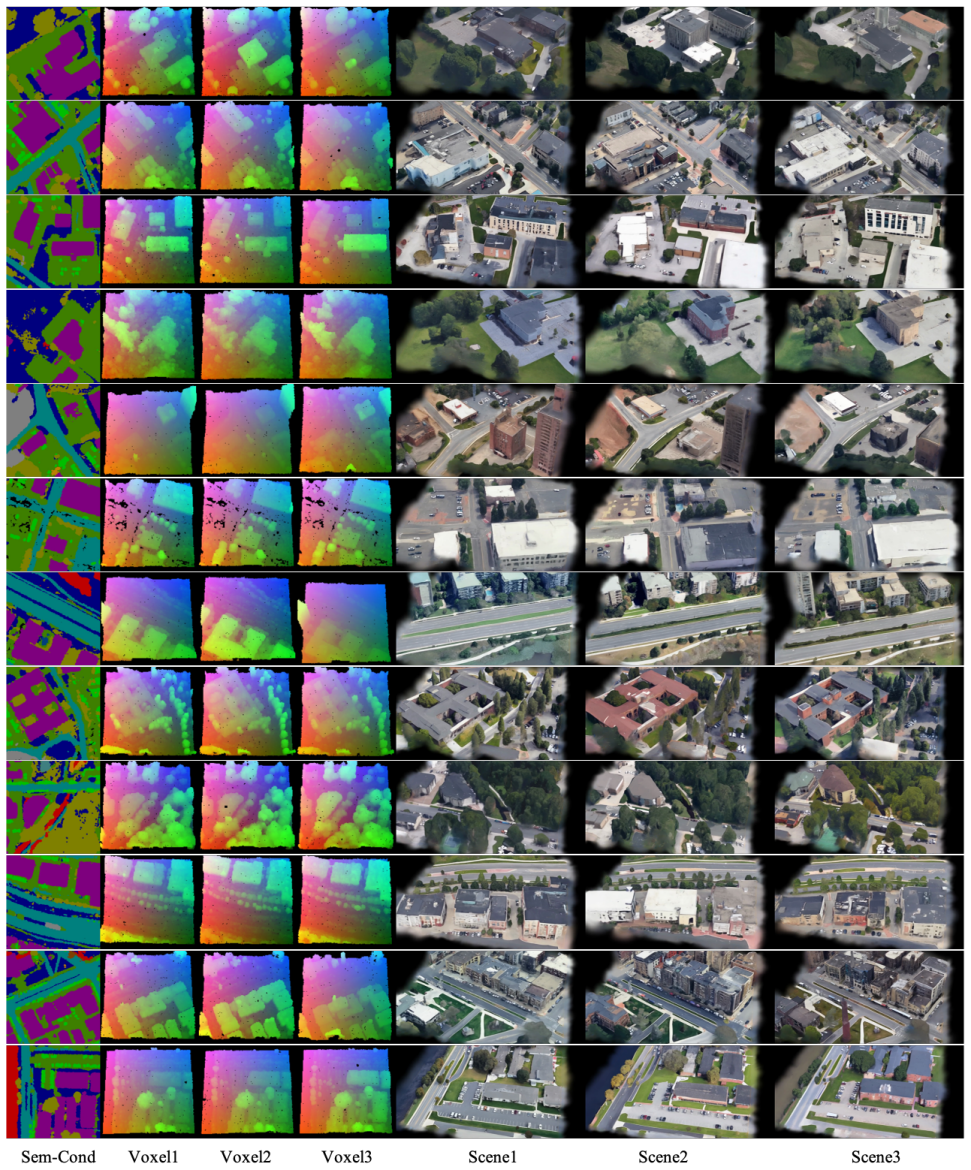
The central claim is that large-scale 3D Earth generation can be split into two much smaller generative problems without losing geographic plausibility. EarthCrafter trains a structural VAE (StructVAE) that compresses a full voxel coordinate grid $V_c \in \mathbb{R}^{L^3 \times 3}$ into a structural latent $S_{La} \in \mathbb{R}^{(L/8)^3 \times 32}$ using Pseudo-Sparse to Sparse (PSS) blocks that upsample pseudo-sparse voxels and classify away invalid ones, and a texture VAE (TexVAE) that sends 66-channel voxelized features—hierarchical image-VAE features plus RGB and normals—into an 8-channel textural latent without spatial downsampling, decoding to 16 Gaussian primitives per voxel. Two condition-aware flow-matching models act on these latents: StructFM works coarse-to-fine, first classifying activated voxels at $L/8$ resolution and then refining coordinates while predicting structural latents, while TexFM generates textural latents on the decoded voxels with a U-Net that mixes sparse Swin attention at fine scales with full attention at coarse scales. A single forward pass at $L=256$ therefore produces a 146-square-meter scene, and a sliding-window inpainting scheme on a large semantic map extends this to 412-square-meter regions; the prior that keeps unconditioned terrain geographically plausible comes from training on the 50,028-scene dataset. Evidence consists of architectural ablations (voxel classification accuracy of 97.1%, PSNR and LPIPS texture gains, and a +3.3 mIoU gain from the coarse-to-fine separation) plus qualitative comparisons against prior urban generators, with the paper concluding that the gains are largest specifically in the extremely-large-scale regime.
Load-bearing premise
The pipeline assumes that InstantNGP reconstructions from a limited set of Google Earth aerial views are accurate enough to serve as ground-truth geometry for both training and evaluation, so any systematic reconstruction error—holes at tree corners, distortions on building tops and facades—is baked into what the models learn and how they are judged.
Editorial extensions
If this is right
- A single forward pass yields a 146-square-meter 3D scene, and applying the same generative model in a sliding window over a large semantic map extends this to 412-square-meter regions and, by iteration, arbitrarily large areas.
- The same trained framework covers semantic-guided urban layout generation, single-image RGBD-conditioned generation, and fully unconditional terrain synthesis, because the flow models are trained on mixed conditions including an explicit empty condition.
- Aerial-Earth3D, with 50,028 scenes and 45 million multi-view frames together with depth, normal, semantic, and pose annotations, is positioned as the substrate that later 3D and 2D tasks—semantic segmentation, building height estimation, outline prediction, outdoor reconstruction—can build on.
- Splitting structure from texture lets each part be compressed to its own latent scale (1/256 volume for geometry, channel-compressed full-resolution for texture), which the paper credits for making extreme-scale generation tractable where dense object-level frameworks are not.
- The coarse-to-fine StructFM results imply that voxel classification and latent feature prediction conflict when forced into one dense model; separating them improves voxel classification by 3.3 mIoU at the coarse level and also improves fine-level voxel quality.
Reading between the lines
- A practical extension the paper leaves implicit is text- or layout-conditioned planning: reversing the semantic-prior direction, so that a land-use sketch is first synthesized from a text prompt and then fed to EarthCrafter, would turn the framework into a testable urban-planning sandbox.
- Given the paper's own limitation about facade and tree-corner distortion, incorporating street-level or oblique imagery into the reconstruction is the most direct attack on the weakest part of the ground truth; a testable prediction is that voxel IoU on building side surfaces will be the dominant bottleneck in any independent geometric evaluation.
- All comparisons at the 412-square-meter scale are qualitative; a quantitative validation against a real aerial mosaic of the same footprint, or a perceptual study comparing generated and real renders, would be the natural next step and would determine how much of the claimed large-scale advantage is photorealism rather than geographic fidelity.
- The dataset's semantic distribution is dominated by woodland, grassland, building, pavement, and road, so the diversity gains from the paper's height-weighted sampling are most likely concentrated in the long tail of rare classes such as water, bridges, vehicles, and helipads rather than in common ground cover.
Editorial analysis
A structured set of objections, weighed in public.
Referee Report
Summary. EarthCrafter proposes a two-stage framework for large-scale 3D Earth generation. It introduces Aerial-Earth3D, a dataset of 50,028 curated 600m x 600m scenes with 45M multi-view Google Earth frames, plus dual sparse VAEs that compress geometry voxels and 2D Gaussian splatting features into compact latents, and flow-matching models that generate structure and texture under semantic, RGBD, or empty conditioning. The paper also contributes a coarse-to-fine structural flow model, a pseudo-sparse-to-sparse upsampling block, and an infinite-scene extension via sliding-window inpainting. The central claim is that EarthCrafter performs substantially better in extremely large-scale generation than prior work.
Significance. The Aerial-Earth3D dataset, if released, is a substantial resource: it is an order of magnitude larger than existing aerial 3D scene datasets and includes multi-view images, depth, normals, semantics, and camera poses. The architectural ideas, especially the PSS block for sparse upsampling, the coarse-to-fine StructFM, and the use of low-channel Flux-VAE features for texture, are well motivated and are supported by internal ablations. However, the comparative and generalization claims are not yet supported by the evaluation: the only cross-method comparison is qualitative, and the headline quantitative numbers are reported on training data. This is a promising systems contribution whose central claim needs stronger evidence before acceptance.
major comments (4)
- [Qualitative Comparison / Figure 6] The abstract and introduction claim that EarthCrafter performs substantially better in extremely large-scale generation, but the only cross-method evidence is the qualitative comparison in Figure 6, which the authors explicitly characterize as non-quantitative because no research shares similar settings. This is load-bearing: a comparative superiority claim needs either quantitatively comparable baselines on a shared protocol (for example, running CityDreamer and SceneDreamer on the same semantic maps and computing FID, KVD, or geometry statistics on held-out scenes) or a revised claim that the contribution is the first scalable framework rather than substantially better. As written, the central claim is not established by the experiments.
- [Tables 3, 4, 16] The headline quantitative numbers are computed on training data. Table 3 reports StructVAE accuracy on ablation and train data, with the 97.1% figure coming from the global training rows; Table 4 is captioned 'Results of StructFlows on train data under image condition'; Table 16 likewise reports train-data mIoU. A validation split of 3,068 samples (2,801 for the flow models) is described in Data Preparation, but no validation numbers are reported for these models. Reporting only training-set reconstruction and generation metrics does not demonstrate generalization and can reflect memorization; the authors should report the corresponding validation metrics or explicitly justify why train-data metrics are the appropriate evidence.
- [Data Preparation; Infinite Scene Generation] The evaluation protocol is not held out at the scene level. The train/validation split in Data Preparation is performed by height-stratified sampling from the same 450k voxel-feature pool, which is generated by sliding-crop from the 50k scenes; thus crops from the same 600m scene can appear in both training and validation. Moreover, the note in Infinite Scene Generation states that the large semantic map used for the flagship Figure 7 is taken from a validation patch whose source scene mesh has overlap with training patches. This is train/evaluation leakage and undermines the claim that Figure 7 demonstrates scalable generation of novel large scenes. Please re-run the infinite-scene demonstration and any quantitative extension metrics on a geographically disjoint held-out region and report the overlap statistics.
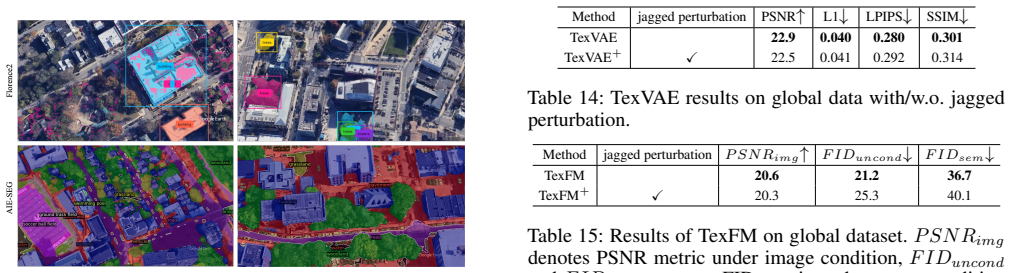
- [Achievement of Annotated Mesh; Limitations] The ground-truth geometry for both training and evaluation is the InstantNGP reconstruction from a limited set of Google Earth aerial views. The Limitations section admits noticeable holes and distortions at the corners of trees and the upper portions of tall buildings, and that side surfaces such as facades are lower fidelity. Because all reported structure and texture metrics compare against this voxelized proxy, systematic reconstruction errors could be learned by the models and scored as geographic plausibility even when generated scenes deviate from real terrain. This does not invalidate the system, but it is a correctness risk for absolute accuracy claims such as the 97.1% StructVAE accuracy. A concrete mitigation would be to validate the proxy on a small set of scenes with higher-quality reconstructions (more views or LiDAR-derived mesh) and report how the metrics change, or at least discuss the direction of the bias.
minor comments (6)
- [StructVAE ablations] The section header contains a typo: 'StruceV AE' should be 'StructVAE'.
- [Table 12] The baseline row of the TexFM ablation table lacks explicit markers for the C-Block, Layers, Channels, and Cross columns, making it difficult to identify which configuration is being compared; please align the table with clear symbols for all configurations.
- [Data Preparation] The text states that each voxel represents an area of 0.56m^3, calculated as 200/360; 200/360 is a side length in meters, so the units should be corrected to a voxel side length or volume.
- [Figure 6] The caption refers only to CityDreamer, but the surrounding text discusses SceneDreamer as well; please ensure the figure labels and caption match the methods discussed.
- [Limitations] The first sentence of the Limitations section is a run-on ('While EarthCrafter exhibits enhanced and diverse capabilities... However it does have...'); please rephrase.
- [References] The references for Google Earth Studio, GoogleMap, and PyMeshFix are listed without full citation details; please complete these entries.
Circularity Check
No definitional circularity: the claimed generation pipeline is self-contained; the principal weaknesses are evaluation leakage and train-set reporting, which are evidence issues, not circular reasoning.
full rationale
The paper's central derivation — StructFM samples a structural latent from noise, StructVAE decodes it to voxel coordinates, TexFM samples a textural latent conditioned on those coordinates, and TexVAE decodes it to 2DGS — is a standard conditional flow-matching generation chain. Every reported quantity (StructVAE accuracy, mIoU, PSNR, FID, LPIPS) is computed against an external voxelized proxy (InstantNGP-reconstructed meshes) rather than being defined in terms of the model's own outputs; none of the loss equations (Ltexvae, Lstructvae, or the flow-matching objective) reduces a predicted quantity to its own input. The self-citation for score aggregation (VCD-Texture, Liu et al. 2024b) is a non-load-bearing design choice with an independent external publication. The manuscript itself flags the two genuine validity threats: Table 3, Table 4, and Table 16 are explicitly reported on train data, and the Infinite Scene Generation note admits that the large semantic map is taken from a validation patch's source scene mesh that overlaps with training patches. These are evaluation-leakage and evidence-strength problems that undermine the comparative 'substantially better' claim, but they are not circularity: the model's outputs are not equivalent by construction to its training inputs or to any cited self-result. No circular step is exhibited, so the circularity score is 0.
Assumptions & free parameters
free parameters (10)
- TexVAE loss weights =
lambda_l1=20, lambda_ssim=2, lambda_vgg=1.4, lambda_alex=0.6
- StructVAE classification loss weights =
lambda_0=lambda_1=lambda_2=5
- Latent voxel activation thresholds =
SLa > 0.3 and >50% of channels above threshold
- Flow matching scheduler shift =
3.0
- CFG strength and sampling steps =
3.0 and 25 steps
- Score aggregation exponents =
tau_s=3, tau_d=3, Z_far=2.0
- Unbalanced sampling exponent alpha =
not reported
- Normal drop threshold sigma_s =
not reported
- Voxel side length =
0.56 m (200 m / 360 voxels)
- Dummy depth for semantic/empty conditions =
z=128
assumptions (6)
- domain assumption Google Earth imagery and Google Earth Studio rendering are available and permissible for dataset construction and release
- domain assumption InstantNGP reconstructions from about 72 aerial views per scene produce sufficiently accurate 3D meshes to serve as ground truth geometry
- domain assumption AIE-SEG semantic predictions from aerial views are reliable enough to serve as semantic ground truth
- domain assumption FLUX-VAE low-channel features preserve texture information sufficient to train a 2DGS texture decoder
- standard math Flow matching objective from Trellis transfers to the dual-sparse setting
- domain assumption Sparse voxel geometry with 0.56m voxel resolution captures the structural detail needed for geographic-scale generation
Cite this review
Pith. "Pith review of EarthCrafter: Scalable 3D Earth Generation via Dual-Sparse Latent Diffusion." pith.science (2026). https://pith.science/paper/Z5FAJTNZ
@misc{pith2026250716535,
  author       = {Pith},
  title        = {Pith review of: EarthCrafter: Scalable 3D Earth Generation via Dual-Sparse Latent Diffusion},
  year         = {2026},
  howpublished = {\url{https://pith.science/paper/Z5FAJTNZ}},
  note         = {Machine review of arXiv:2507.16535}
}
read the original abstract
Despite the remarkable developments achieved by recent 3D generation works, scaling these methods to geographic extents, such as modeling thousands of square kilometers of Earth's surface, remains an open challenge. We address this through a dual innovation in data infrastructure and model architecture. First, we introduce Aerial-Earth3D, the largest 3D aerial dataset to date, consisting of 50k curated scenes (each measuring 600m x 600m) captured across the U.S. mainland, comprising 45M multi-view Google Earth frames. Each scene provides pose-annotated multi-view images, depth maps, normals, semantic segmentation, and camera poses, with explicit quality control to ensure terrain diversity. Building on this foundation, we propose EarthCrafter, a tailored framework for large-scale 3D Earth generation via sparse-decoupled latent diffusion. Our architecture separates structural and textural generation: 1) Dual sparse 3D-VAEs compress high-resolution geometric voxels and textural 2D Gaussian Splats (2DGS) into compact latent spaces, largely alleviating the costly computation suffering from vast geographic scales while preserving critical information. 2) We propose condition-aware flow matching models trained on mixed inputs (semantics, images, or neither) to flexibly model latent geometry and texture features independently. Extensive experiments demonstrate that EarthCrafter performs substantially better in extremely large-scale generation. The framework further supports versatile applications, from semantic-guided urban layout generation to unconditional terrain synthesis, while maintaining geographic plausibility through our rich data priors from Aerial-Earth3D. Our project page is available at https://whiteinblue.github.io/earthcrafter/
Figures


Figures from the paper (22 more)









Forward citations
Cited by 1 Pith paper
-
Sat2RealCity: Geometry-Aware and Appearance-Controllable 3D Urban Generation from Satellite Imagery
A satellite-to-3D-city pipeline that generates building entities with OSM geometry priors and MLLM/T2I appearance guidance reports strong gains over existing city-generation baselines.
Reference graph
Works this paper leans on
-
[1]
Cao, C.; Yu, C.; Liu, S.; Wang, F.; Xue, X.; and Fu, Y. 2024. MVGenMaster: Scaling Multi-View Generation from Any Image via 3D Priors Enhanced Diffusion Model. arXiv preprint arXiv:2411.16157
arXiv 2024
-
[2]
Chan, E. R.; Nagano, K.; Chan, M. A.; Bergman, A. W.; Park, J. J.; Levy, A.; Aittala, M.; De Mello, S.; Karras, T.; and Wetzstein, G. 2023. Generative novel view synthesis with 3d-aware diffusion models. In Proceedings of the IEEE/CVF International Conference on Computer Vision, 4217--4229
work page 2023
-
[3]
Chen, M.; Hu, Q.; Yu, Z.; Thomas, H.; Feng, A.; Hou, Y.; McCullough, K.; Ren, F.; and Soibelman, L. 2022. Stpls3d: A large-scale synthetic and real aerial photogrammetry 3d point cloud dataset. arXiv preprint arXiv:2203.09065
arXiv 2022
-
[4]
Chen, Y.; Zheng, C.; Xu, H.; Zhuang, B.; Vedaldi, A.; Cham, T.-J.; and Cai, J. 2024. Mvsplat360: Feed-forward 360 scene synthesis from sparse views. arXiv preprint arXiv:2411.04924
arXiv 2024
-
[5]
Contributors, S. 2022. Spconv: Spatially Sparse Convolution Library. https://github.com/traveller59/spconv
work page 2022
-
[6]
Deng, J.; Chai, W.; Huang, J.; Zhao, Z.; Huang, Q.; Gao, M.; Guo, J.; Hao, S.; Hu, W.; Hwang, J.-N.; et al. 2024. Citycraft: A real crafter for 3d city generation. arXiv preprint arXiv:2406.04983
arXiv 2024
-
[7]
Earth-centered, E.-f. 2021. Earth-centered, Earth-fixed
work page 2021
-
[8]
East-North-Up. 2012. East-North-Up
work page 2012
Show all 77 references
-
[9]
Engstler, P.; Shtedritski, A.; Laina, I.; Rupprecht, C.; and Vedaldi, A. 2025. SynCity: Training-Free Generation of 3D Worlds. arXiv preprint arXiv:2503.16420
2025 arXiv
-
[10]
Esser, P.; Kulal, S.; Blattmann, A.; Entezari, R.; M \"u ller, J.; Saini, H.; Levi, Y.; Lorenz, D.; Sauer, A.; Boesel, F.; et al. 2024. Scaling rectified flow transformers for high-resolution image synthesis. In Forty-first international conference on machine learning
2024
-
[11]
Fridman, R.; Abecasis, A.; Kasten, Y.; and Dekel, T. 2023. Scenescape: Text-driven consistent scene generation. Advances in Neural Information Processing Systems, 36
2023
-
[12]
P.; Barron, J
Gao*, R.; Holynski*, A.; Henzler, P.; Brussee, A.; Martin-Brualla, R.; Srinivasan, P. P.; Barron, J. T.; and Poole*, B. 2024. CAT3D: Create Anything in 3D with Multi-View Diffusion Models. Advances in Neural Information Processing Systems
2024
-
[13]
GlobalMLBF. 2022. GlobalMLBF
2022
-
[14]
???? Accessed: 2024-08-12
GoogleEarth . ???? Accessed: 2024-08-12
2024
-
[15]
???? Accessed: 2024-08-12
GoogleMap . ???? Accessed: 2024-08-12
2024
-
[16]
o llein, L.; Bo z i c , A.; M \
H \"o llein, L.; Bo z i c , A.; M \"u ller, N.; Novotny, D.; Tseng, H.-Y.; Richardt, C.; Zollh \"o fer, M.; and Nie ner, M. 2024. Viewdiff: 3d-consistent image generation with text-to-image models. In Proceedings of the IEEE/CVF conference on computer vision and pattern recogn...
2024
-
[17]
H \"o llein, L.; Cao, A.; Owens, A.; Johnson, J.; and Nie ner, M. 2023. Text2room: Extracting textured 3d meshes from 2d text-to-image models. In Proceedings of the IEEE/CVF International Conference on Computer Vision, 7909--7920
2023
-
[18]
Hong, Y.; Zhang, K.; Gu, J.; Bi, S.; Zhou, Y.; Liu, D.; Liu, F.; Sunkavalli, K.; Bui, T.; and Tan, H. 2024. Lrm: Large reconstruction model for single image to 3d. In International Conference on Learning Representations
2024
-
[19]
Hu, Q.; Yang, B.; Khalid, S.; Xiao, W.; Trigoni, N.; and Markham, A. 2021. Towards semantic segmentation of urban-scale 3D point clouds: A dataset, benchmarks and challenges. In Proceedings of the IEEE/CVF conference on computer vision and pattern recognition, 4977--4987
2021
-
[20]
Huang, B.; Yu, Z.; Chen, A.; Geiger, A.; and Gao, S. 2024 a . 2d gaussian splatting for geometrically accurate radiance fields. In ACM SIGGRAPH 2024 conference papers, 1--11
2024
-
[21]
Huang, B.; Yu, Z.; Chen, A.; Geiger, A.; and Gao, S. 2024 b . 2D Gaussian Splatting for Geometrically Accurate Radiance Fields. In SIGGRAPH 2024 Conference Papers. Association for Computing Machinery
2024
-
[22]
Kerbl, B.; Kopanas, G.; Leimk \"u hler, T.; and Drettakis, G. 2023. 3D Gaussian Splatting for Real-Time Radiance Field Rendering. ACM Trans. Graph., 42(4): 139--1
2023
-
[23]
S.; Jeong, J.; Sohn, K.; and Shin, J
Kim, S.; Lee, K.; Choi, J. S.; Jeong, J.; Sohn, K.; and Shin, J. 2023. Collaborative score distillation for consistent visual editing. Advances in Neural Information Processing Systems, 36: 73232--73257
2023
-
[24]
Labs, B. F. 2024. FLUX. https://github.com/black-forest-labs/flux
2024
-
[25]
Li, X.; Lai, Z.; Xu, L.; Qu, Y.; Cao, L.; Zhang, S.; Dai, B.; and Ji, R. 2024. Director3d: Real-world camera trajectory and 3d scene generation from text. Advances in Neural Information Processing Systems, 37: 75125--75151
2024
-
[26]
Li, Y.; Jiang, L.; Xu, L.; Xiangli, Y.; Wang, Z.; Lin, D.; and Dai, B. 2023. Matrixcity: A large-scale city dataset for city-scale neural rendering and beyond. In Proceedings of the IEEE/CVF International Conference on Computer Vision, 3205--3215
2023
-
[27]
Liang, Y.; Yang, X.; Lin, J.; Li, H.; Xu, X.; and Chen, Y. 2024. Luciddreamer: Towards high-fidelity text-to-3d generation via interval score matching. In Proceedings of the IEEE/CVF Conference on Computer Vision and Pattern Recognition, 6517--6526
2024
-
[28]
Lin, L.; Liu, Y.; Hu, Y.; Yan, X.; Xie, K.; and Huang, H. 2022. Capturing, Reconstructing, and Simulating: the UrbanScene3D Dataset. In ECCV, 93--109
2022
-
[29]
Liu, M.; Shi, R.; Chen, L.; Zhang, Z.; Xu, C.; Wei, X.; Chen, H.; Zeng, C.; Gu, J.; and Su, H. 2024 a . One-2-3-45++: Fast single image to 3d objects with consistent multi-view generation and 3d diffusion. In Proceedings of the IEEE/CVF conference on computer vision and patter...
2024
-
[30]
Liu, M.; Xu, C.; Jin, H.; Chen, L.; Varma T, M.; Xu, Z.; and Su, H. 2023 a . One-2-3-45: Any single image to 3d mesh in 45 seconds without per-shape optimization. Advances in Neural Information Processing Systems, 36: 22226--22246
2023
-
[31]
Liu, R.; Wu, R.; Van Hoorick, B.; Tokmakov, P.; Zakharov, S.; and Vondrick, C. 2023 b . Zero-1-to-3: Zero-shot one image to 3d object. In Proceedings of the IEEE/CVF international conference on computer vision, 9298--9309
2023
-
[32]
Liu, S.; Yu, C.; Cao, C.; Qian, W.; and Wang, F. 2024 b . VCD-Texture: Variance Alignment based 3D-2D Co-Denoising for Text-Guided Texturing. In European Conference on Computer Vision, 373--389. Springer
2024
-
[33]
Liu, Z.; Lin, Y.; Cao, Y.; Hu, H.; Wei, Y.; Zhang, Z.; Lin, S.; and Guo, B. 2021. Swin transformer: Hierarchical vision transformer using shifted windows. In Proceedings of the IEEE/CVF international conference on computer vision, 10012--10022
2021
-
[34]
P.; Tancik, M.; Barron, J
Mildenhall, B.; Srinivasan, P. P.; Tancik, M.; Barron, J. T.; Ramamoorthi, R.; and Ng, R. 2021. Nerf: Representing scenes as neural radiance fields for view synthesis. Communications of the ACM, 65(1): 99--106
2021
-
[35]
Models, D. E. 2001. Digital Elevation Models
2001
-
[36]
M\"uller, T.; Evans, A.; Schied, C.; and Keller, A. 2022. Instant Neural Graphics Primitives with a Multiresolution Hash Encoding. ACM Trans. Graph., 41(4): 102:1--102:15
2022
-
[37]
R.; Novotny, D.; Gordon, T.; Lo, W.-Y.; Johnson, J.; and Gkioxari, G
Nikhila Ravi, J. R.; Novotny, D.; Gordon, T.; Lo, W.-Y.; Johnson, J.; and Gkioxari, G. 2020. Accelerating 3D Deep Learning with PyTorch3D. arXiv:2007.08501
2020 arXiv
-
[38]
OpenStreetMap. 2004. OpenStreetMap
2004
-
[39]
Oquab, M.; Darcet, T.; Moutakanni, T.; Vo, H.; Szafraniec, M.; Khalidov, V.; Fernandez, P.; Haziza, D.; Massa, F.; El-Nouby, A.; et al. 2023. Dinov2: Learning robust visual features without supervision. arXiv preprint arXiv:2304.07193
2023 arXiv
-
[40]
T.; and Mildenhall, B
Poole, B.; Jain, A.; Barron, J. T.; and Mildenhall, B. 2023. Dreamfusion: Text-to-3d using 2d diffusion. In International Conference on Learning Representations
2023
-
[41]
???? Accessed: 2024-08-12
PyMeshFix . ???? Accessed: 2024-08-12
2024
-
[42]
P.; and Koltun, V
Qian-Yi Zhou, J. P.; and Koltun, V. 2018. Open3D : A Modern Library for 3D Data Processing. arXiv:1801.09847
2018 arXiv
-
[43]
Ren, X.; Huang, J.; Zeng, X.; Museth, K.; Fidler, S.; and Williams, F. 2024 a . Xcube: Large-scale 3d generative modeling using sparse voxel hierarchies. In Proceedings of the IEEE/CVF conference on computer vision and pattern recognition, 4209--4219
2024
-
[44]
Ren, X.; Lu, Y.; Liang, H.; Wu, Z.; Ling, H.; Chen, M.; Fidler, S.; Williams, F.; and Huang, J. 2024 b . Scube: Instant large-scale scene reconstruction using voxsplats. Advances in Neural Information Processing Systems
2024
-
[45]
Rombach, R.; Blattmann, A.; Lorenz, D.; Esser, P.; and Ommer, B. 2022. High-resolution image synthesis with latent diffusion models. In Proceedings of the IEEE/CVF conference on computer vision and pattern recognition, 10684--10695
2022
-
[46]
H.; Karras, T.; Seol, Y.; Lehtinen, J.; and Aila, T
Samuli Laine, J. H.; Karras, T.; Seol, Y.; Lehtinen, J.; and Aila, T. 2020. Modular Primitives for High-Performance Differentiable Rendering. ACM Transactions on Graphics, 39(6)
2020
-
[47]
R.; Lagun, D.; Fei-Fei, L.; Sun, D.; et al
Sargent, K.; Li, Z.; Shah, T.; Herrmann, C.; Yu, H.-X.; Zhang, Y.; Chan, E. R.; Lagun, D.; Fei-Fei, L.; Sun, D.; et al. 2024. Zeronvs: Zero-shot 360-degree view synthesis from a single image. In Proceedings of the IEEE/CVF Conference on Computer Vision and Pattern Recognition,...
2024
-
[48]
Shang, Y.; Lin, Y.; Zheng, Y.; Fan, H.; Ding, J.; Feng, J.; Chen, J.; Tian, L.; and Li, Y. 2024. UrbanWorld: An Urban World Model for 3D City Generation. arXiv preprint arXiv:2407.11965
2024 arXiv
-
[49]
Shi, R.; Chen, H.; Zhang, Z.; Liu, M.; Xu, C.; Wei, X.; Chen, L.; Zeng, C.; and Su, H. 2023 a . Zero123++: a Single Image to Consistent Multi-view Diffusion Base Model. arXiv:2310.15110
2023 arXiv
-
[50]
Shi, Y.; Wang, P.; Ye, J.; Long, M.; Li, K.; and Yang, X. 2023 b . Mvdream: Multi-view diffusion for 3d generation. arXiv preprint arXiv:2308.16512
2023 arXiv
-
[51]
Shriram, J.; Trevithick, A.; Liu, L.; and Ramamoorthi, R. 2024. Realmdreamer: Text-driven 3d scene generation with inpainting and depth diffusion. arXiv preprint arXiv:2404.07199
2024 arXiv
-
[52]
Tang, J.; Chen, Z.; Chen, X.; Wang, T.; Zeng, G.; and Liu, Z. 2024. Lgm: Large multi-view gaussian model for high-resolution 3d content creation. In European Conference on Computer Vision, 1--18. Springer
2024
-
[53]
Wang, P.; and Shi, Y. 2023. Imagedream: Image-prompt multi-view diffusion for 3d generation. arXiv preprint arXiv:2312.02201
2023 arXiv
-
[54]
Wang, Z.; Lu, C.; Wang, Y.; Bao, F.; Li, C.; Su, H.; and Zhu, J. 2023. Prolificdreamer: High-fidelity and diverse text-to-3d generation with variational score distillation. Advances in Neural Information Processing Systems, 36
2023
-
[55]
Wang Ruisheng, S. Y. H. 2023. Building3D: A urban-scale dataset and benchmarks for learning roof structures from point clouds. In Proceedings of the IEEE/CVF International Conference on Computer Vision, 20076--20086
2023
-
[56]
Williams, F.; Huang, J.; Swartz, J.; Klar, G.; Thakkar, V.; Cong, M.; Ren, X.; Li, R.; Fuji-Tsang, C.; Fidler, S.; Sifakis, E.; and Museth, K. 2024 a . fVDB: A Deep-Learning Framework for Sparse, Large Scale, and High Performance Spatial Intelligence. ACM Transactions on Graph...
2024
-
[57]
Williams, F.; Huang, J.; Swartz, J.; Klar, G.; Thakkar, V.; Cong, M.; Ren, X.; Li, R.; Fuji-Tsang, C.; Fidler, S.; et al. 2024 b . fvdb: A deep-learning framework for sparse, large scale, and high performance spatial intelligence. ACM Transactions on Graphics (TOG), 43(4): 1--15
2024
-
[58]
P.; Verbin, D.; Barron, J
Wu, R.; Mildenhall, B.; Henzler, P.; Park, K.; Gao, R.; Watson, D.; Srinivasan, P. P.; Verbin, D.; Barron, J. T.; Poole, B.; et al. 2024. Reconfusion: 3d reconstruction with diffusion priors. In Proceedings of the IEEE/CVF conference on computer vision and pattern recognition,...
2024
-
[59]
Xiang, J.; Lv, Z.; Xu, S.; Deng, Y.; Wang, R.; Zhang, B.; Chen, D.; Tong, X.; and Yang, J. 2025. Structured 3D Latents for Scalable and Versatile 3D Generation. In Proceedings of the IEEE/CVF Conference on Computer Vision and Pattern Recognition
2025
-
[60]
Xiao, B.; Wu, H.; Xu, W.; Dai, X.; Hu, H.; Lu, Y.; Zeng, M.; Liu, C.; and Yuan, L. 2023. Florence-2: Advancing a Unified Representation for a Variety of Vision Tasks. arXiv:2311.06242
2023 arXiv
-
[61]
Xie, H.; Chen, Z.; Hong, F.; and Liu, Z. 2024. Citydreamer: Compositional generative model of unbounded 3d cities. In Proceedings of the IEEE/CVF conference on computer vision and pattern recognition, 9666--9675
2024
-
[62]
Xie, H.; Chen, Z.; Hong, F.; and Liu, Z. 2025 a . CityDreamer4D : Compositional Generative Model of Unbounded 4 D Cities. arXiv 2501.08983
2025 arXiv
-
[63]
Xie, H.; Chen, Z.; Hong, F.; and Liu, Z. 2025 b . GaussianCity: Generative Gaussian splatting for unbounded 3D city generation. In Proceedings of the IEEE/CVF Conference on Computer Vision and Pattern Recognition
2025
-
[64]
Xu, H.; Man, Y.; Yang, M.; Wu, J.; Zhang, Q.; and Wang, J. 2023 a . Analytical insight of earth: a cloud-platform of intelligent computing for geospatial big data. arXiv preprint arXiv:2312.16385
2023 arXiv
-
[65]
Xu, Y.; Tan, H.; Luan, F.; Bi, S.; Wang, P.; Li, J.; Shi, Z.; Sunkavalli, K.; Wetzstein, G.; Xu, Z.; et al. 2023 b . Dmv3d: Denoising multi-view diffusion using 3d large reconstruction model. arXiv preprint arXiv:2311.09217
2023 arXiv
-
[66]
Yang, Y.; Shao, J.; Li, X.; Shen, Y.; Geiger, A.; and Liao, Y. 2024. Prometheus: 3D-Aware Latent Diffusion Models for Feed-Forward Text-to-3D Scene Generation. arXiv preprint arXiv:2412.21117
2024 arXiv
-
[67]
Ye, V.; Li, R.; Kerr, J.; Turkulainen, M.; Yi, B.; Pan, Z.; Seiskari, O.; Ye, J.; Hu, J.; Tancik, M.; and Kanazawa, A. 2025. gsplat: An open-source library for Gaussian splatting. Journal of Machine Learning Research, 26(34): 1--17
2025
-
[68]
T.; and Wu, J
Yu, H.-X.; Duan, H.; Herrmann, C.; Freeman, W. T.; and Wu, J. 2024 a . WonderWorld: Interactive 3D Scene Generation from a Single Image. arXiv preprint arXiv:2406.09394
2024 arXiv
-
[69]
T.; Cole, F.; Sun, D.; Snavely, N.; Wu, J.; et al
Yu, H.-X.; Duan, H.; Hur, J.; Sargent, K.; Rubinstein, M.; Freeman, W. T.; Cole, F.; Sun, D.; Snavely, N.; Wu, J.; et al. 2024 b . Wonderjourney: Going from anywhere to everywhere. In Proceedings of the IEEE/CVF Conference on Computer Vision and Pattern Recognition, 6658--6667
2024
-
[70]
A.; Shechtman, E.; and Wang, O
Zhang, R.; Isola, P.; Efros, A. A.; Shechtman, E.; and Wang, O. 2018. The unreasonable effectiveness of deep features as a perceptual metric. In Proceedings of the IEEE conference on computer vision and pattern recognition, 586--595
2018
-
[71]
Zhang, S.; Wang, J.; Xu, Y.; Xue, N.; Rupprecht, C.; Zhou, X.; Shen, Y.; and Wetzstein, G. 2025. Flare: Feed-forward geometry, appearance and camera estimation from uncalibrated sparse views. arXiv preprint arXiv:2502.12138
2025
-
[72]
Zhao, Z.; Lai, Z.; Lin, Q.; Zhao, Y.; Liu, H.; Yang, S.; Feng, Y.; Yang, M.; Zhang, S.; Yang, X.; et al. 2025. Hunyuan3d 2.0: Scaling diffusion models for high resolution textured 3d assets generation. arXiv preprint arXiv:2501.12202
2025 arXiv
-
[73]
Zhou, S.; Fan, Z.; Xu, D.; Chang, H.; Chari, P.; Bharadwaj, T.; You, S.; Wang, Z.; and Kadambi, A. 2024. Dreamscene360: Unconstrained text-to-3d scene generation with panoramic gaussian splatting. In European Conference on Computer Vision, 324--342. Springer
2024
-
[74]
Zhu, J.; and Zhuang, P. 2023. HiFA: High-fidelity Text-to-3D Generation with Advanced Diffusion Guidance. arXiv:2305.18766
2023 arXiv
-
[75]
Zou, Z.-X.; Yu, Z.; Guo, Y.-C.; Li, Y.; Liang, D.; Cao, Y.-P.; and Zhang, S.-H. 2024. Triplane meets gaussian splatting: Fast and generalizable single-view 3d reconstruction with transformers. In Proceedings of the IEEE/CVF conference on computer vision and pattern recognition...
2024
-
[76]
, " * write output.state after.block = add.period write newline
ENTRY address archivePrefix author booktitle chapter edition editor eid eprint howpublished institution isbn journal key month note number organization pages publisher school series title type volume year label extra.label sort.label short.list INTEGERS output.state before.all...
-
[77]
write newline
" write newline "" before.all 'output.state := FUNCTION n.dashify 't := "" t empty not t #1 #1 substring "-" = t #1 #2 substring "--" = not "--" * t #2 global.max substring 't := t #1 #1 substring "-" = "-" * t #2 global.max substring 't := while if t #1 #1 substring * t #2 gl...
Reviewed August 6, 2026 · model on record in the stance chip above.
Discussion (0). Sign in to comment.