REVIEW 2 major objections 4 minor 16 references
Stereo performance of SST-1M at different altitudes
T0 review · 2 major / 4 minor · reviewed 2026-08-06 · deepseek-v4-flash
Pith's one-line read For the chosen telescope layouts, moving the SST-1M pair to 1420 m nearly preserves the high-energy stereo effective area while improving low energies, whereas a 4270 m site trades a 2.6-fold loss above about 10 TeV for faster detection…
desk verdict Useful, honest simulation study giving quantitative SST-1M stereo performance at three altitudes; the qualitative trend is expected, and the main caveat is the unoptimized, single-energy-anchored telescope spacing. read the letter →
The pith
A machine-rendered reading of the paper's core claim, the machinery that carries it, and where it could break.
The reading
What carries the argument
The argument is carried by a Monte Carlo chain: CORSIKA v7.7402 generates extensive air showers and Cherenkov light with UrQMD and QGSJet II-04 hadronic models, sim_telarray simulates light attenuation and telescope response using site-specific atmospheric density profiles, light attenuation, and geomagnetic field, and the sst1mpipe pipeline performs the reconstruction with random forests trained separately for each site. The link that makes the three sites comparable is the telescope spacing: Malargüe is simulated with 120 m ground spacing and Hanle with 64 m, chosen by scaling to the Cherenkov light cone under the assumption that the shower maximum sits at 7.5 km a.s.l. for a roughly 5 TeV gamma ray, while the actual Ondřejov spacing is 155.2 m. This spacing choice is what makes the altitude comparison coherent, and the paper itself notes that spacing has strong, partly opposing effects on angular resolution and effective area.
What would settle it
Run a Monte Carlo set with the Hanle atmosphere, geomagnetic field, and telescope response but the Ondřejov effective spacing of 147.31 m, and compare the above-10 TeV stereo effective area with the 63.01 m Hanle result; if the high-energy suppression disappears, the altitude trend is confounded with layout.
Extended reading notes
Core claim
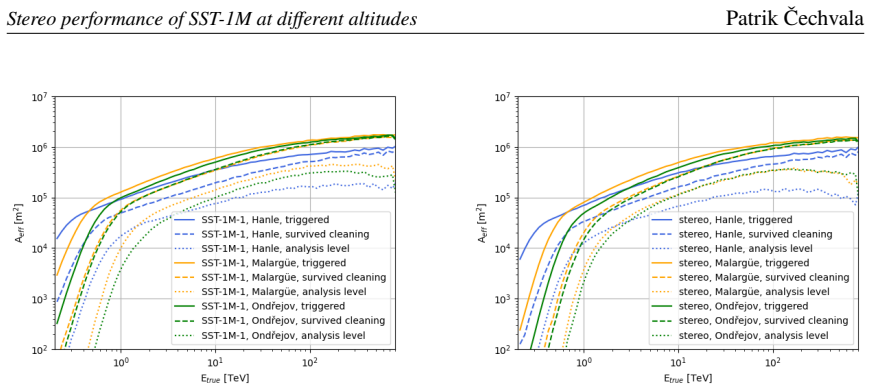
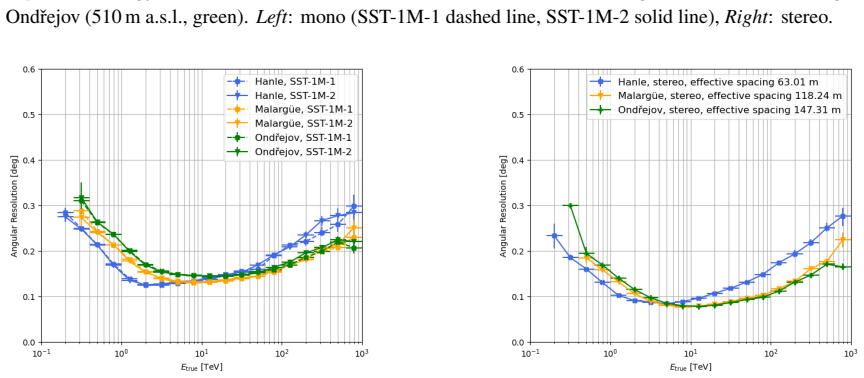
The central claim is that for the SST-1M stereo pair, altitude shifts the accessible energy window instead of uniformly improving performance. In the simulations, raising the site from 510 m to 1420 m leaves the high-energy effective area essentially intact, a loss of about 2.4 percent at 100 TeV, while roughly doubling the effective area near 1 TeV and shortening the Crab Nebula 5-sigma stereo detection time from 0.78 h to 0.62 h. Raising the site to 4270 m expands the low-energy reach further, with about 4.7 times the 1 TeV effective area and a 0.47 h Crab detection time, but it degrades performance above about 10 TeV: the stereo effective area is about 1.7 times smaller at 10 TeV and about 2.6 times smaller at 100 TeV, with worse energy and angular resolution at high energies. The paper attributes this to the expected physics of shower development and Cherenkov-light attenuation, quantified for the first time for this instrument.
Load-bearing premise
The comparison assumes that scaling each site's telescope spacing to the Cherenkov light cone makes the three layouts equivalent, but the paper used a single unoptimized spacing per site even though spacing strongly changes angular resolution and effective area.
Editorial extensions
If this is right
- Relocating to Malargüe would give a stereo array whose 100 TeV effective area is within about 2.4 percent of Ondřejov while improving low-energy sensitivity across the whole studied range.
- At Hanle, stereo observations below about 3 TeV become markedly more sensitive, with a Crab Nebula detection time of 0.47 h instead of 0.78 h, but sources whose signal peaks above about 10 TeV become harder to detect.
- Stereo observation improves energy resolution and energy bias at all three sites, especially below 10 TeV, but high-altitude high-energy angular resolution deteriorates at Hanle.
- A site decision should not be made on altitude alone: telescope spacing must be optimized per site, because wider spacing improves angular resolution while reducing effective area.
Reading between the lines
- If the spacing-scaling assumption is relaxed, a wider layout at Hanle could recover some angular resolution but would likely reduce effective area further; the optimal high-altitude layout may differ substantially from a simple Cherenkov-cone scaling.
- The high-altitude low-energy gain suggests that Hanle would pair naturally with lower-energy instruments or transient and soft-spectrum sources, while it is a poorer match for ultra-high-energy science above 100 TeV.
- A real-data check at a second site, such as measuring the Crab Nebula detection time after relocation, would test whether the simulated altitude trend survives in practice.
- The two candidate sites are in different hemispheres and therefore see different astrophysical sources; that sky-access difference may outweigh the modest performance gap between Malargüe and Ondřejov.
Editorial analysis
A structured set of objections, weighed in public.
Referee Report
Summary. Using the standard SST-1M simulation and analysis chain (CORSIKA v7.7402, sim_telarray, sst1mpipe v0.7.4), the authors compute mono and stereo instrument response functions for the SST-1M telescope pair placed at three altitudes: the current site Ondřejov (510 m a.s.l.), Malargüe (1420 m), and Hanle (4270 m). The telescope spacing is scaled to the Cherenkov light cone assuming a 5 TeV shower maximum at 7.5 km, giving effective spacings of 147.31 m, 118.24 m, and 63.01 m, respectively. The paper reports that low-energy sensitivity (≲3 TeV) improves with altitude, while high-energy performance degrades, strongly so for Hanle (e.g., stereo effective area at 100 TeV is about 2.6 times smaller than at Ondřejov, and the 5σ Crab detection time improves from 0.78 h to 0.47 h in stereo). The authors explicitly note that only one selected spacing per site is considered and that spacing optimization is future work.
Significance. The study is potentially valuable as a quantitative, simulation-based input to the SST-1M relocation decision, and it demonstrates a reproducible pipeline with version-numbered tools. The transparency about the single-spacing assumption is a strength. However, because altitude and telescope spacing vary simultaneously and the spacing scaling is anchored to a single energy, the central quantitative claims about the altitude dependence are not yet established; the paper currently measures the combined effect of altitude and a particular layout prescription.
major comments (2)
- [Sections 2.1 and 4] The main conclusion that Hanle loses high-energy performance (e.g., stereo effective area at 100 TeV about 2.6 times smaller, sensitivity suppression above about 10 TeV) is confounded with the telescope layout. The spacing is scaled using a 5 TeV anchor (shower maximum at 7.5 km), yielding 63.01 m at Hanle versus 147.31 m at Ondřejov, but the paper does not show that this scaling produces equivalent layouts across the 1-300 TeV range. The authors themselves note (Section 3, after Fig. 4) that increasing spacing improves angular resolution but lowers effective area. I request that the analysis either (a) repeat the Hanle comparison with the Ondřejov physical spacing or a spacing scan, or (b) explicitly reframe all cross-site statements as conditional on the chosen scaled layout, with the high-energy Hanle loss no longer attributed to altitude alone.
- [Section 4] The conclusion states: 'An improvement in performance with increasing altitude can be observed at energies lower than few TeV' and 'this improvement ... comes at the expense of the degradation of performance at the highest energies.' These statements generalize the single-layout result into an altitude trend. Given the acknowledged spacing dependence, the conclusion should be rephrased to state that the trend holds for the considered scaled layouts and may change under spacing optimization, particularly at Hanle.
minor comments (4)
- [Section 4] There are typos in the text: 'perfomance' should be 'performance' (also in the Section 3 header) and 'significanly' should be 'significantly'.
- [Section 3] The text says 'The same quality cuts were applied as in [2]' but does not list the cut values; please provide a table or explicit reference to the exact cuts for reproducibility.
- [Section 2.2] The azimuth is set to 0° for Malargüe and 180° for Hanle to cover culmination, but the geomagnetic field orientation and azimuth dependence are not discussed; a brief note on the expected systematic effect on the energy-dependent effective area would strengthen the comparison.
- [Abstract] The abstract states 'Stereo performance' while the paper reports both mono and stereo; consider adjusting the title or abstract to reflect the mono results as well.
Circularity Check
No significant circularity: the altitude-dependent performance metrics are Monte Carlo outputs, not imposed inputs.
full rationale
The paper's central claims are the effective area, angular/energy resolution, and sensitivity of SST-1M at three altitudes, obtained from a full Monte Carlo chain (CORSIKA showers, sim_telarray photon propagation and detector response, sst1mpipe reconstruction). These metrics are outputs of the simulation and analysis pipeline, not quantities fixed by the inputs. The only input choices are the site-dependent atmosphere, geomagnetic field, telescope spacing, and quality cuts; the cuts are optimized on Monte Carlo for a Crab-like spectrum, but this optimization does not predetermine the altitude trend, and the comparison with Ondrejov is an independent output. The spacing is scaled to the Cherenkov light cone using a 5 TeV shower-maximum assumption, which is a modeling assumption that may confound altitude effects with layout effects, but that is a robustness concern rather than circularity. The paper explicitly acknowledges that only one spacing per site was studied and that further spacing optimization could change the results. Self-citations to the collaboration's own pipeline papers [2, 9, 10] describe standard analysis procedures and are not invoked as an external theorem forcing the conclusion. No equation in the paper equates a predicted quantity to an input by construction, and no fitted parameter is renamed as a prediction. The derivation is therefore self-contained and non-circular.
Assumptions & free parameters
free parameters (2)
- Telescope spacing per site =
63.01 m (Hanle), 118.24 m (Malargue), 147.31 m (Ondrejov) effective
- Quality cuts =
not specified numerically
assumptions (4)
- domain assumption CORSIKA and sim_telarray accurately simulate EAS development, Cherenkov emission, and telescope response at all three sites.
- domain assumption The atmospheric density and attenuation profiles for Malargue and Hanle are realistic and were correctly implemented.
- domain assumption The SST-1M analysis and random forest reconstruction trained for each site transfers to the simulated conditions, and the standard cuts are appropriate for comparing sites.
- ad hoc to paper Scaling the telescope spacing with the Cherenkov light cone makes the three layouts equivalent for comparing altitude effects.
Cite this review
Pith. "Pith review of Stereo performance of SST-1M at different altitudes." pith.science (2026). https://pith.science/paper/PQZEOU3P
@misc{pith2026250716681,
  author       = {Pith},
  title        = {Pith review of: Stereo performance of SST-1M at different altitudes},
  year         = {2026},
  howpublished = {\url{https://pith.science/paper/PQZEOU3P}},
  note         = {Machine review of arXiv:2507.16681}
}
read the original abstract
The SST-1M telescopes are a pair of Imaging Atmospheric Cherenkov Telescopes (IACTs) that have been operating at the Ond\v{r}ejov Observatory (510 m a.s.l.) in the Czech Republic since 2022. Optimized for detecting gamma rays in the energy range 1-300 TeV, they are capable of performing both mono and stereo observations. Despite challenging atmospheric conditions, SST-1M has successfully detected several galactic and extragalactic gamma-ray sources with energies reaching up to 200 TeV during its ongoing commissioning. In this study, we analyze the performance of the SST-1M telescopes at different locations to assess the impact of altitude and relative telescope spacing on their physics performance. The low-altitude site at 510 m a.s.l. has already been investigated using both Monte Carlo simulations and real data. For comparison, we selected an intermediate-altitude site at 1420 m a.s.l. corresponding to Pampa Amarilla in Argentina and a high-altitude site at 4270 m a.s.l. corresponding to Hanle in India - both of which offer favorable astronomical conditions.
Figures


Figures from the paper (2 more)

Reference graph
Works this paper leans on
-
[1]
C. Alispach, A. Araudo, M. Balbo, V. Beshley, A. Biland, J. Blažek et al.,JCAP2025(2025) 047 [2409.11310]
arXiv 2025
-
[2]
C. Alispach, A. Araudo, M. Balbo, V. Beshley, J. Blažek, J. Borkowski et al.,Astron. Astrophys.(2025)
work page 2025
-
[3]
for the VERITAS collaboration,SciPost Phys
S.R.P. for the VERITAS collaboration,SciPost Phys. Proc.(2023) 035
work page 2023
- [4]
-
[5]
D. Heck, J. Knapp, J.N. Capdevielle, G. Schatz and T. Thouw,CORSIKA: a Monte Carlo code to simulate extensive air showers., Report FZKA 6019, Forschungszentrum Karlsruhe (1998)
work page 1998
- [6]
- [7]
-
[8]
Bernlöhr,Astroparticle Physics30(2008) 149
K. Bernlöhr,Astroparticle Physics30(2008) 149
work page 2008
Show all 16 references
-
[9]
Jurysek, T
J. Jurysek, T. Tavernier, V. Novotny, P. Hamal, M. Heller, J. Blazek et al.,sst1mpipe: v0.7.3. 5 february 2025, Feb., 2025. 10.5281/zenodo.14808846
2025 doi
-
[10]
Jurysek, T
J. Jurysek, T. Tavernier, V. Novotný, M. Heller, D. Mandat, M. Pech et al.,Mono and stereo performance of the two SST-1M telescope prototypes, in38th International Cosmic Ray Conference, p. 592, Sept., 2024
2024
-
[11]
Aleksić, S
J. Aleksić, S. Ansoldi, L. Antonelli, P. Antoranz, A. Babic, P. Bangale et al.,Astroparticle Physics72(2016) 76
2016
-
[12]
H. Abe, K. Abe, S. Abe, A. Aguasca-Cabot, I. Agudo, N. Alvarez Crespo et al.,The Astrophysical Journal956 (2023) 80
2023
-
[13]
A., Aguasca-Cabot, A., Agudo, I
Abe, H., Abe, K., Abe, S., Acciari, V. A., Aguasca-Cabot, A., Agudo, I. et al.,A&A680(2023) A66. [14]DAMPE CollaborationCollaboration,Phys. Rev. D109(2024) L121101
2023
-
[15]
Acharyya, I
A. Acharyya, I. Agudo, E. Angüner, R. Alfaro, J. Alfaro, C. Alispach et al.,Astroparticle Physics111(2019) 35
2019
-
[16]
Bernlöhr, A
K. Bernlöhr, A. Barnacka, Y. Becherini, O. Blanch Bigas, E. Carmona, P. Colin et al.,Astroparticle Physics43 (2013) 171
2013
-
[17]
S. Lee, S. Einecke, G. Rowell, C. Balazs, J.A. Bellido, S. Dai et al.,Publications of the Astronomical Society of Australia39(2022) e041. 8 Stereo performance of SST-1M at different altitudesPatrik Čechvala Full Authors List: SST-1M Collaboration C. Alispach1, A. Araudo2, M. B...
2022
Reviewed August 6, 2026 · model on record in the stance chip above.
Discussion (0). Sign in to comment.