REVIEW 4 major objections 4 minor 32 references
Atomic-scale Frustrated Josephson Coupling and Multi-condensate Visualization in FeSe
T0 review · 4 major / 4 minor · reviewed 2026-08-06 · deepseek-v4-flash
Pith's one-line read Atomic-scale Josephson tunneling between Nb and FeSe shows destructive interference from sign-changing gaps, giving the first condensate-resolved superfluid images.
desk verdict A serious, well-executed SJTM study whose two headline claims are more conditional than the text lets on, because both load the same under-tested N=2 model. read the letter →
The pith
A machine-rendered reading of the paper's core claim, the machinery that carries it, and where it could break.
The reading
What carries the argument
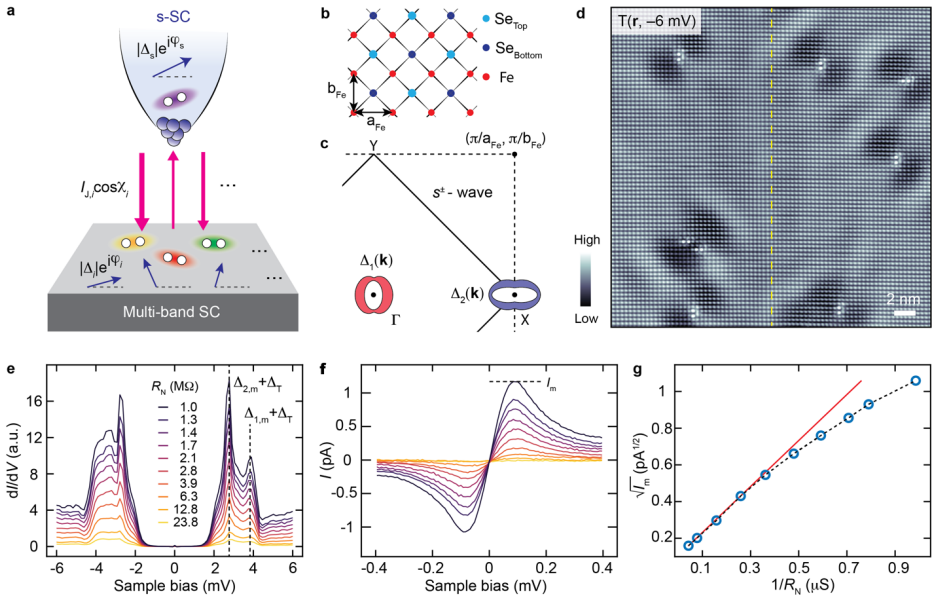
The central object is the $N=2$ inversion of the Ambegaokar-Baratoff equations. In a junction with two bands and an s-wave tip, the total critical current is the phase-sensitive sum $I_c = I_{c,1}\cos\chi_1 + I_{c,2}\cos\chi_2$, with $\chi_2-\chi_1 = \pi$ for $s^\pm$ pairing. Combining this with the asymmetric A-B formula $I_{c,i} R_{n,i} = (\pi/4)\Delta_{\mathrm{eff},i}$ and the parallel-resistance relation $1/R_n = 1/R_{n,1}+1/R_{n,2}$ makes the four channel quantities exactly solvable from measured $I_c$, $R_n$, $\Delta_{\mathrm{eff},1}$, and $\Delta_{\mathrm{eff},2}$. The two-condensate Ginzburg-Landau free energy with inter-band Josephson and gradient-coupling terms then explains the anti-correlation: the observed near-$\pi$ spatial phase between superfluid-density modulations indicates that inter-band scattering contributes significantly relative to the Josephson coupling.
What would settle it
Measure $I_c(\mathbf{r})$ and $R_n(\mathbf{r})$ on a clean FeSe region with a Nb tip while independently extracting the two gap maps, and test whether every pixel satisfies $I_c R_n \ge (\pi/4)\Delta_{\mathrm{eff,min}}$ once the two measured gaps are used. If the inequality holds at all pixels, the destructive-interference interpretation fails. A second check is to repeat the identical protocol on a known $s^{++}$ two-band superconductor: the model predicts no sub-unity $\lambda_i$ and no anti-correlation.
Extended reading notes
Core claim
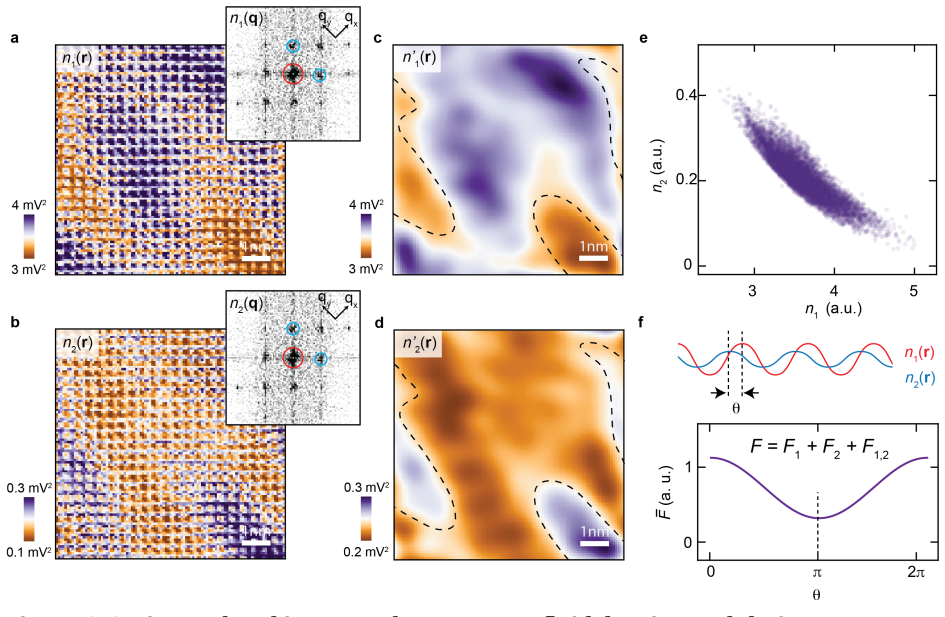
The paper's central claim is that a superconducting Nb tip tunnel-coupled to FeSe measures a normalized Josephson critical current below the single-band lower bound, $I_c R_n < (\pi/4)\Delta_{\mathrm{eff,min}}$ with both $\lambda_1 \equiv \Delta_{\mathrm{eff}}/\Delta_{\mathrm{eff},1}$ and $\lambda_2 \equiv \Delta_{\mathrm{eff}}/\Delta_{\mathrm{eff},2}$ below unity, and that this suppression is the signature of destructive interference between Josephson currents from the hole pocket at $\Gamma$ and the electron pocket at $X$, whose gaps have opposite signs. Using the exactly solvable $N=2$ case, the paper decomposes the measured total critical current and resistance into per-channel values, imaging the two condensates' superfluid densities $n_i(\mathbf{r})$ separately. These images show spatially anti-correlated modulations (cross-correlation $-0.72$), which the authors attribute to the competition between inter-band Josephson coupling and inter-band scattering, and the channel-resolved transparency ratio $\varepsilon(\mathbf{r}) = R_{n,1}/R_{n,2}$ varies with junction resistance in a way that suggests approach to a $0$-$\pi$ transition.
Load-bearing premise
The load-bearing premise is that FeSe is effectively a two-band superconductor at the measured energies, so that the total junction current and resistance can be uniquely split into one hole-pocket channel and one electron-pocket channel.
Editorial extensions
If this is right
- FeSe-Nb junctions provide a local, quantitative test of $s^\pm$ pairing: the inequality $I_c R_n < (\pi/4)\Delta_{\mathrm{eff,min}}$ is the predicted signature of destructive interference and would be absent for sign-preserving two-band pairing.
- The channel-resolved inversion converts scanned Josephson tunneling microscopy into a condensate-resolved microscope, letting future experiments image superfluid densities per band near vortices, twin boundaries, and impurities.
- The observed anti-correlation of $n_1(\mathbf{r})$ and $n_2(\mathbf{r})$ implies that inter-band scattering is not negligible on atomic length scales and should be included in models of FeSe's local superconducting response.
- The decrease of $I_c R_n$ with increasing $\varepsilon = R_{n,1}/R_{n,2}$, together with the sublinear $\sqrt{I_J}$ versus $1/R_n$ scaling, indicates that sufficiently transparent SJTM junctions could reach the long-sought $0$-$\pi$ transition.
Reading between the lines
- A natural next test is to repeat the protocol on a known $s^{++}$ two-band superconductor or on a single-band control; the model predicts both $\lambda$ indices should stay at or above unity and no anti-correlation should appear.
- The same $N=2$ inversion could be applied to other two-band systems, but for materials with more than two bands the channel-resolved images would require a generalized inversion with extra constraints; the published two-band result may not transfer directly.
- The Ginzburg-Landau argument implies that the anti-correlation should grow stronger at shorter modulation wavelengths, so measuring the cross-correlation as a function of Fourier-filter bandwidth is a testable prediction the paper does not explicitly make.
Editorial analysis
A structured set of objections, weighed in public.
Referee Report
Summary. The manuscript reports scanning Josephson tunneling microscopy (SJTM) measurements on Nb–FeSe junctions at 0.3 K. The authors simultaneously measure the maximum Josephson current I_J, the junction resistance R_n, and quasiparticle tunneling spectra at the same atomic locations. They fit the FeSe density of states with a two-band anisotropic gap model, extract effective gaps Δ_eff,h and Δ_eff,e for the hole (Γ) and electron (X) pockets, and form the ratios λ_i = Δ_eff/Δ_eff,i. They find λ_1, λ_2 < 1, which they interpret as quantitative evidence of frustrated Josephson tunneling caused by the sign-changing s± order parameter of FeSe. Under the assumption of exactly two tunneling channels with χ_1 = 0 and χ_2 = π, they invert the total I_c and R_n into channel-resolved currents and resistances (Eqs. 9–10), image superfluid densities n_i, and report a cross-correlation of –0.72 between the two condensate maps. A two-component Ginzburg-Landau model with inter-band Josephson coupling (η_1) and gradient inter-band scattering (ν) is used to argue that anti-correlated superfluid modulations require νq^2 + η_1 > 0.
Significance. If correct, this work would be the first atomic-scale observation of frustrated Josephson coupling in an s± superconductor and the first simultaneous visualization of two superconducting condensates by SJTM. The experimental effort is impressive: simultaneous Josephson and quasiparticle spectroscopy at 0.3 K, internal calibration against Nb-Nb junctions, and a valuable internal check in which the s++ assignment produces unphysical negative channel resistances (Supplementary Fig. 11). The quantitative inequality test based on Eq. (5) is a promising and falsifiable approach. However, several load-bearing assumptions and missing uncertainty analyses must be addressed before the central claims are established.
major comments (4)
- [§2, Eq. (8)] The paper presents λ1 < 1 and λ2 < 1 as two independent pieces of evidence, but λ1 < 1 carries no evidential weight. From Eq. (8), Δ_eff = (Δ_eff,h − ε Δ_eff,e)/(1 + ε), so for any ε > 0 and Δ_eff,h > Δ_eff,e, λ1 = Δ_eff/Δ_eff,h is strictly less than 1 by construction. Only λ2 < 1 is a nontrivial test of frustration. The central quantitative claim should be reformulated around λ2 and Eq. (5), and the text in §2 and the Fig. 2i caption should be corrected accordingly.
- [§2, Eqs. (5), (9)–(10)] Both the frustration test and the channel-resolved inversion assume that FeSe is fully described by exactly two tunneling channels with the fitted effective gaps Δ_eff,h and Δ_eff,e. FeSe has additional Fermi-surface sheets and the electron pockets are nematically split; if any unmodeled sheet has an effective gap smaller than Δ_eff,e, then Eq. (5) can be satisfied without sign-changing interference, and the solution of Eqs. (9)–(10) is not the unique physical decomposition. Please provide a three-band (or at least a sensitivity) analysis of the same data, or a quantitative justification for why all other sheets contribute negligibly to Cooper-pair tunneling.
- [Figs. 2i and 3h] No error bars are reported for I_c, R_n, Δ_eff,i, or λ_i. The central claim that “both indices are smaller than unity” is a statistical statement, and the histograms in Fig. 2i do not show uncertainties. The authors should propagate uncertainties from the measurement noise, the Nb-tip calibration, the DOS deconvolution, and the fitting parameters, and show that λ2 < 1 (the nontrivial condition) is robust under these variations. Without this, the quantitative inequality test is not fully supported.
- [§4, Eq. (12)] The visualization claim is presented more strongly than the data support. From Eq. (2) and Eq. (12), n_i(r) ∝ [I_c,i(r) R_n,i(r)]^2 ∝ Δ_eff,i(r)^2, so Figs. 4a,b are essentially the squares of the two fitted gap maps, not independent measurements of superfluid density. The reported cross-correlation of –0.72 is therefore a property of the two-gap fit output and may reflect compensating parameters in the fit. To support the anti-correlation and the Ginzburg-Landau interpretation of Eq. (16), show that the anti-correlation persists when the fit is varied within its confidence region or when additional bands are included.
minor comments (4)
- [Fig. 3 caption] The caption mislabels the second and third resistance panels as “b” and “c”; they should be “e” and “f” to match the figure.
- [Abstract and main text] The phrase “anti correlated” is missing a hyphen and should be “anti-correlated” throughout. Also, the term “multi-condensate visualization” should be calibrated to reflect that the condensate maps are derived from the gap fits (see Major Comment 4).
- [§3, Eq. (16)] The notation for the free energy per unit length in Eq. (16) is difficult to parse; please rewrite it with conventional integral notation.
- [Fig. 2c and Supplementary Note 3] The fitted parameters Δ1,max, Δ2,max, a1, and a2 are reported, but the text does not state explicitly how Δ_eff,i is computed from these parameters. The definition ⟨Δ_i(k)⟩ over the Fermi surface is not sufficient for a twofold-symmetric gap; please give the explicit formula.
Circularity Check
Multi-condensate visualization reduces to squared fitted gap maps via Eq. (2)+Eq. (12), making the anti-correlation a fit output; the frustration inequality itself is not circular.
-
renaming known result
[Eqns. (2) and (12); Figs. 2e-f and 4a-b]
"the asymmetric Ambegaokar-Baratoff (A-B) formula6 I_{c,i}R_{n,i}=...≡(π/4)Δ_eff,i (2) ... Therefore, based on Eqn. 1, the superfluid density of each condensate can be measured as n_i(r)∝(I_{c,i}R_{n,i})^2∝... (12) ... In Figs. 4a,b, we show n_i(r) measured in the same FOV as in Fig. 2 ... Indeed, such anti-correlation is confirmed by a cross-correlation coefficient of –0.72 between Figs. 4a and 4b"
By Eq. (2), each channel obeys I_{c,i}R_{n,i}=(π/4)Δ_eff,i. Inserting this into Eq. (12) yields n_i(r) ∝ Δ_eff,i(r)^2. The Δ_eff,i(r) maps are outputs of the two-gap DOS fit (Figs. 2e-f), and the total measured I_c and R_n cancel out of the product. Hence the channel-resolved Josephson inversion in Eqns. (9)-(10) adds no independent information to n_i; the maps in Fig. 4 are deterministic transforms of the fitted gap maps. The reported cross-correlation of –0.72 is therefore the correlation of the squared fitted hole-gap and electron-gap maps, so the claimed observation of anti-correlated superfluid modulations is forced by the fit, not an independent Josephson measurement. Attributing this anti-correlation to inter-band scattering (ν term, Eq.
full rationale
The central frustration test (Eq. 5 vs. Eq. 8) is not circular: I_c and R_n are measured Josephson quantities, the Δ_eff,i are extracted from independent DOS fits, and the sublinear I_c(1/R_n) behavior is compared with the model using measured ε rather than fitted to force agreement. The ratio λ_1<1 is a weaker discriminator (it also follows for any two positive gaps with Δ_e<Δ_h), but that is a model-sensitivity caveat, not a circular reduction. The N=2 assumption and possible additional pockets/nematic splitting are correctness risks, not circularity. Self-citations (Refs. 10, 13, 23, 24 for SJTM methods) are not load-bearing for the physics claims. The clear reduction is in the multi-condensate visualization: Eq. (2) combined with Eq. (12) makes n_i(r) nothing more than (π/4)^2 Δ_eff,i(r)^2, so the anti-correlated superfluid density maps and the –0.72 correlation are properties of the two-gap DOS fit, not an independent simultaneous measurement of two condensates. This partial circularity affects a central advertised result, giving a score of 6.
Assumptions & free parameters
free parameters (4)
- Delta1,max (hole pocket maximum gap) =
2.55 meV (representative fit; map values with statistics in text)
- Delta2,max (electron pocket maximum gap) =
1.56 meV (representative fit)
- a1 (anisotropy parameter for hole pocket) =
0.215 +/- 0.013 (map average)
- a2 (anisotropy parameter for electron pocket) =
0.264 +/- 0.023 (map average)
assumptions (4)
- domain assumption FeSe has s±-wave pairing with opposite-sign order parameters on the hole (Gamma) and electron (X) pockets.
- domain assumption The I-Z phase-diffusive theory (Eq. 6) describes the voltage-biased SJTM junction, with a single pair-current maximum governed by I_c and constant impedance Z.
- domain assumption The total junction resistance obeys R_n = 1/(sum_i 1/R_n,i) and the two-channel decomposition (Eqns. 9-10) is exact (N=2).
- domain assumption The G-L free energy functional (Eqns. 13-15) with inter-band Josephson coupling eta1 and gradient coupling nu is a valid description of the two-condensate system.
Cite this review
Pith. "Pith review of Atomic-scale Frustrated Josephson Coupling and Multi-condensate Visualization in FeSe." pith.science (2026). https://pith.science/paper/LPCTOGI2
@misc{pith2026250716758,
  author       = {Pith},
  title        = {Pith review of: Atomic-scale Frustrated Josephson Coupling and Multi-condensate Visualization in FeSe},
  year         = {2026},
  howpublished = {\url{https://pith.science/paper/LPCTOGI2}},
  note         = {Machine review of arXiv:2507.16758}
}
abstract
In a Josephson junction involving multi-band superconductors, competition between inter-band and inter-junction Josephson coupling gives rise to frustration and spatial disjunction of superfluid densities among superconducting condensates. Such frustrated coupling manifests as quantum interference of Josephson currents from different tunneling channels and becomes tunable if channel transparency can be varied. To explore these unconventional effects in the prototypical $s^\pm$-wave superconductor FeSe, we use atomic resolution scanned Josephson tunneling microscopy SJTM for condensate resolved imaging and junction tuning -- capabilities unattainable in macroscopic Josephson devices with fixed characteristics. We quantitatively demonstrate frustrated Josephson tunneling by examining two tunneling inequalities. The relative transparency of two parallel tunneling pathways is found tunable, revealing a tendency towards a 0-pi transition with decreasing SJTM junction resistance. Simultaneous visualization of both superconducting condensates reveals anti correlated superfluid modulations, highlighting the role of inter-band scattering. Our study establishes SJTM as a powerful tool enabling new research frontiers of multi condensate superconductivity.
Figures


Figures from the paper (1 more)
Reference graph
Works this paper leans on
-
[1]
Ota, Y., Machida, M., Koyama, T. & Matsumoto, H. Theory of heterotic superconductor-insulator-superconductor Josephson junctions between single- and multiple-gap superconductors. Phys. Rev. Lett. 102, 237003 (2009)
work page 2009
-
[2]
Koshelev, A. E. Phase diagram of Josephson junction between s and s± superconductors in the dirty limit. Phys. Rev. B 86, 214502 (2012)
work page 2012
-
[3]
Ota, Y. et al. Ambegaokar-Baratoff relations for Josephson critical current in heterojunctions with multigap superconductors. Phys. Rev. B 81, 214511 (2010)
work page 2010
-
[4]
Agterberg, D. F., Demler, E. & Janko, B. Josephson effects between multigap and single-gap superconductors. Phys. Rev. B 66, 214507 (2002)
work page 2002
-
[5]
Wang, D., Lu, H.-Y. & Wang, Q.-H. The finite temperature effect on Josephson junction between an s-wave superconductor and an s±-wave superconductor. Chinese Phys. Lett. 30, 077404 (2013)
work page 2013
-
[6]
Lin, S.-Z. Josephson effect between a two-band superconductor with s++ or s± pairing symmetry and a conventional s-wave superconductor. Phys. Rev. B 86, 014510 (2012)
work page 2012
-
[7]
Linder, J., Sperstad, I. B. & Sudbø, A. 0-p phase shifts in Josephson junctions as a signature for the s±-wave pairing state. Phys. Rev. B 80, 020503 (2009)
work page 2009
-
[8]
Stanev, V. G. & Koshelev, A. E. Anomalous proximity effects at the interface of s- and s±- superconductors. Phys. Rev. B 86, 174515 (2012)
work page 2012
Show all 32 references
-
[9]
Fernandes, R. M. et al. Iron pnictides and chalcogenides: a new paradigm for superconductivity. Nature 601, 35–44 (2022)
2022
-
[10]
T., Feldman, B
Randeria, M. T., Feldman, B. E., Drozdov, I. K. & Yazdani, A. Scanning Josephson spectroscopy on the atomic scale. Phys. Rev. B 93, 161115 (2016)
2016
-
[11]
Hamidian, M. H. et al. Detection of a Cooper-pair density wave in Bi2Sr2CaCu2O8+x. Nature 532, 343–347 (2016)
2016
-
[12]
M., Chatzopoulos, D., Gu, G
Cho, D., Bastiaans, K. M., Chatzopoulos, D., Gu, G. D. & Allan, M. P. A strongly inhomogeneous superfluid in an iron-based superconductor. Nature 571, 541-545 (2019)
2019
-
[13]
X., Sharma, R
Liu, X., Chong, Y. X., Sharma, R. & Davis, J. C. S. Discovery of a Cooper-pair density wave state in a transition-metal dichalcogenide. Science 372, 1447-1452 (2021)
2021
-
[14]
& Tešanović, Z
Stanev, V. & Tešanović, Z. Three-band superconductivity and the order parameter that breaks time-reversal symmetry. Phys. Rev. B 81, 134522 (2010)
2010
-
[15]
& Chubukov, A
Khodas, M. & Chubukov, A. V., Interpocket pairing and gap symmetry in Fe-based superconductors with only electron pockets. Phys. Rev. Lett. 108, 247003 (2012)
2012
-
[16]
Kang, J., Chubukov, A. V. & Fernandes, R. M. Time-reversal symmetry-breaking nematic superconductivity in FeSe. Phys. Rev. B 98, 064508 (2018)
2018
-
[17]
Moshchalkov, V. et al. Type-1.5 superconductivity. Phys. Rev. Lett. 102, 117001 (2009)
2009
-
[18]
& Speight, M
Babaev, E., Carlström, J. & Speight, M. Type-1.5 superconducting state from an intrinsic proximity effect in two-band superconductors. Phys. Rev. Lett. 105, 067003 (2010)
2010
-
[19]
& Levchenko, A
Vakaryuk, V., Stanev, V., Lee, W.-C. & Levchenko, A. Topological defect-phase soliton and the pairing symmetry of a two-band superconductor: role of the proximity effect. Phys. Rev. Lett. 109, 227003 (2012)
2012
-
[20]
Iguchi, Y. et al. Superconducting vortices carrying a temperature-dependent fraction of the flux quantum. Science 380, 1244-1247 (2023). 13
2023
-
[21]
Zheng, Y. et al. Direct observation of quantum vortex fractionalization in multiband superconductors. Preprint at https://arxiv.org/abs/2407.18610 (2024)
2024 arXiv
-
[22]
& Zhang, F.-C
Chen, W.-Q., Ma, F., Lu, Z.-Y. & Zhang, F.-C. 𝜋 junction to probe antiphase 𝑠-wave pairing in iron pnictide superconductors. Phys. Rev. Lett. 103, 207001 (2009)
2009
-
[23]
X., Sharma, R
Liu, X., Chong, Y. X., Sharma, R. & Davis, J. C. S. Atomic-scale visualization of electron fluid flow. Nat. Mater. 20, 1480–1484 (2021)
2021
-
[24]
Chiral kagome superconductivity modulations with residual Fermi arcs
Deng, H., et al. Chiral kagome superconductivity modulations with residual Fermi arcs. Nature 632, 775-781 (2024)
2024
-
[25]
Sprau, P. O. et al. Discovery of orbital-selective Cooper pairing in FeSe. Science 357, 75-80 (2017)
2017
-
[26]
Ivanchenko, Yu. M. & Zil’Berman L. A. The Josephson effect in small tunnel contacts. Soviet Physics JETP 28, 1272-1276 (1969)
1969
-
[27]
& Dynes, R
Naaman, O., Teizer, W. & Dynes, R. C. Fluctuation dominated Josephson tunneling with a scanning tunneling microscope. Phys. Rev. Lett. 87, 097004 (2001)
2001
-
[28]
P., Ono, S., Ando, Y
Kimura, H., Barber, Jr., R. P., Ono, S., Ando, Y. & Dynes, R. C. Josephson scanning tunneling microscopy: A local and direct probe of the superconducting order parameter. Phys. Rev. B 80, 144506 (2009)
2009
-
[29]
Uhl, M. et al. Multiband Josephson effect in an atomic scale Pb tunnel junction. Phys. Rev. Res. 6, 043233 (2024)
2024
-
[30]
& Speight, M
Carlstrom, J., Babaev, E. & Speight, M. Type-1.5 superconductivity in multiband systems: effects of interband couplings. Phys. Rev. B 83, 174509 (2011)
2011
-
[31]
Grigorishin, K. V. Effective Ginzburg–Landau free energy functional for multi-band isotropic superconductors. Phys. Lett. A 380, 1781-1787 (2016). Methods SJTM experiments are performed on a Unisoku USM1300J systems at a base temperature of 0.3 K. Single crystals of FeSe are s...
2016
-
[32]
& Zhao, Z
Dong, X., Zhou, F. & Zhao, Z. Electronic and superconducting properties of some FeSe- based single crystals and films grown hydrothermally. Front. Phys. 8, 586182 (2020)
2020
Reviewed August 6, 2026 · model on record in the stance chip above.
Discussion (0). Continue with ORCID to comment.