REVIEW 4 major objections 4 minor 34 references
A Hybrid CNN-VSSM model for Multi-View, Multi-Task Mammography Analysis: Robust Diagnosis with Attention-Based Fusion
T0 review · 4 major / 4 minor · reviewed 2026-08-06 · deepseek-v4-flash
Pith's one-line read The paper proposes a four-view, two-task mammography model whose hybrid CNN–VSSM backbone with gated attention fusion outperforms plain ResNet and VSSM baselines on every task, reaching an AUC of 0.9967 on the BI-RADS 1-versus-5 comparison.
desk verdict The hybrid CNN-VSSM assembly is sensible and the multi-view/multi-task framing is useful, but the validation-only evaluation doesn't support the 'consistently outperform' claim. read the letter →
The pith
A machine-rendered reading of the paper's core claim, the machinery that carries it, and where it could break.
The reading
What carries the argument
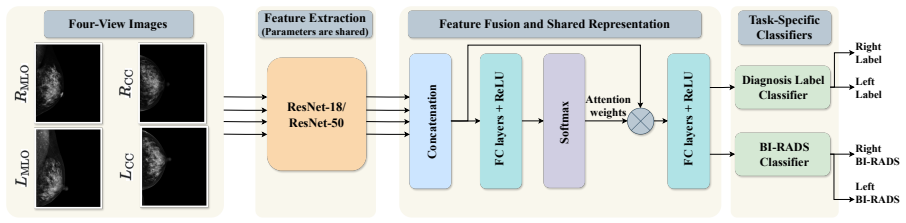
The load-bearing mechanism is a two-stage cascade: a pretrained ResNet-18 encoder (early layers only) converts each mammogram into mid-level feature maps rich in local texture and structure, and those maps, treated as sequences of tokens, pass through VSSM blocks whose 2D Selective Scan (SS2D) sweeps image patches along multiple directions to capture long-range dependencies in linear time. The four view-feature vectors are then combined by a gated attention fusion module: a two-layer MLP reads the concatenation of all four views, produces softmax weights, scales each view's vector by its weight, and concatenates the scaled vectors for the task heads. Two classification heads per breast then emit a diagnostic label and a BI-RADS score, with the total loss a weighted sum of class-balanced cross-entropies. This design is what the paper argues lets the model exploit inter-view context while tolerating missing views (zero tensors excluded from the loss) and staying cheaper than transformer cross-attention.
What would settle it
Take the same five architectures and training recipe, but evaluate on a held-out test cohort never used for checkpoint selection or hyperparameter choices, and compare the shared hybrid against the best ResNet and best VSSM baseline on the BI-RADS 1-versus-5 task with bootstrap confidence intervals; if the hybrid's AUC and F1 do not exceed the baselines by more than chance variation, the paper's central claim that hybrids consistently outperform baselines is refuted.
Extended reading notes
Core claim
On the TOMPEI-CMMD cohort of 1,360 patients, split 80/20 at the patient level, the paper trains shared and view-specific versions of ResNet-18/50, VSSM, and hybrid CNN-VSSM backbones; all use gated attention fusion across the four views (L-CC, L-MLO, R-CC, R-MLO) and two classification heads per breast that jointly predict a normal-versus-malignant label and a BI-RADS 1-5 score. The central claim is that the hybrid cascade, early pretrained ResNet layers for local features followed by VSSM blocks for global context, consistently beats both plain CNN and plain VSSM baselines in single-task and multi-task settings. The strongest result is for the shared hybrid on the easy BI-RADS 1-versus-5 contrast: 0.9967 AUC and 0.9830 F1. Performance drops as ambiguity grows: 0.7790 F1 on BI-RADS 1/3/5 and 0.4904 F1 on the full five-class task, which the paper attributes to the inherent difficulty of intermediate BI-RADS categories rather than a failure of the hybrid mechanism.
Load-bearing premise
The paper treats the validation set's best-checkpoint results as the measure of true performance, with no separate test set, so the load-bearing assumption is that tuning and checkpoint selection on this validation set did not inflate the reported scores.
Editorial extensions
If this is right
- If the hybrid advantage is real, the same two-stage CNN-plus-state-space design should transfer to other multi-view medical imaging tasks where local detail and global context both matter.
- Shared, weight-tied models are the safer choice for fine-grained BI-RADS grading: they beat view-specific models at five-class AUC and F1, and the paper attributes this to regularization from parameter sharing.
- Multi-task training helps when the auxiliary task is strongly related (normal versus malignant for binary and ternary BI-RADS), but the benefit is inconsistent for five-class grading, so joint training should not be assumed helpful a priori.
- The gated attention weights give each prediction a per-view importance map, which could support clinical explainability even without additional localization supervision.
- The five-class F1 ceiling near 0.5 across all models implies automatic BI-RADS 1-5 assignment is not yet clinically usable on this data, and future work should target better separation of intermediate categories or use ordinal losses.
Reading between the lines
- Because the best checkpoint is selected on the same validation set that reports the final numbers, the hybrid's margins over baselines are likely inflated; a reader should expect smaller gaps on an untouched test set or under nested cross-validation.
- The paper asserts missing-view tolerance only structurally, with missing views zero-filled and excluded from the loss, but reports no experiment that deletes views and measures the AUC drop; adding one would directly test the fusion module's claimed advantage.
- The attention weights could be validated against radiologist lesion conspicuity: if the most-weighted view is usually the view where the finding is most visible, the same weights double as a cheap interpretability signal.
- The dataset is a single curated cohort; testing the shared hybrid on another four-view mammography set with both BI-RADS and diagnostic labels would show whether the consistent-outperformance claim is dataset-specific.
Editorial analysis
A structured set of objections, weighed in public.
Referee Report
Summary. The paper proposes a multi-view, multi-task mammography classification framework that takes four standard mammography views as input, uses a hybrid CNN-VSSM backbone (early ResNet-18 layers followed by VSSM blocks), and fuses view-level features with a gated attention module. It compares six model variants (ResNet-18, ResNet-50, VSSM shared/view-specific, hybrid shared/view-specific) under single-task and multi-task training on three BI-RADS classification tasks using a cohort derived from CMMD/TOMPEI-CMMD. The headline results are the shared hybrid model reaching an AUC of 0.9967 and F1 of 0.9830 on binary BI-RADS 1 vs. 5, and the paper claims that hybrid models consistently outperform baselines across all tasks. The internal comparisons are broad, but the evaluation is based entirely on validation-set checkpoint selection, the hybrid versus VSSM comparison is confounded by pretraining, and the provenance of the four-view data is not clearly established, so the central outperformance claim is not supported as presented.
Significance. The clinical problem is relevant, and the multi-view, multi-task framing with gated attention is a reasonable direction. The paper provides a fairly wide internal comparison across backbone choices, task complexities, and single- versus multi-task training, which is useful if the results hold. If the hybrid advantage were confirmed on a genuinely held-out test set with uncertainty estimates and a controlled pretraining comparison, the architecture would be a meaningful contribution. However, the current significance is limited by the validation-only evaluation, the pretraining confound, and unresolved data-provenance questions. The paper also does not provide code or a reproducibility statement, which reduces the confirmability of the reported numbers.
major comments (4)
- [§4.3, Tables 2–4] The central claim that hybrid models 'consistently outperform' baselines is not supported by the evaluation protocol. Section 4.3 states that hyperparameters (number of VSSM blocks, learning rates) were selected on the validation set and that the 'best performing checkpoint on the validation set' was saved for final analysis, and Tables 2–4 are explicitly labeled 'Best Validation Performance.' No independent test set, repeated-seed runs, confidence intervals, or statistical tests are reported. Because model selection and final evaluation use the same data, the reported AUC/F1 values are optimistically biased, and the bias can differ across architectures. The reported margins, for example the 0.9967 versus 0.9820 AUC in Table 2, are therefore not established as out-of-sample. The authors should hold out a test set or use nested cross-validation, select hyperparameters and checkpoints on validation only, and report test-set metrics with multiple seeds.
- [§4.2–4.3, Figure 3] The comparison between the proposed hybrid and the pure VSSM baselines is confounded by pretraining. The hybrid uses the early layers of an ImageNet-pretrained ResNet-18, while Section 4.3 states that the VSSM models have 'lack of any pre-training.' The hybrid's advantage over the VSSM baselines could therefore be due to transfer learning rather than to the CNN–VSSM cascade itself. To support the architectural claim, the authors should compare against a VSSM baseline with equivalent pretraining, or against a hybrid without pretrained initialization, and report both variants.
- [§3] The data provenance of the four-view cohort is unclear. Section 3 describes TOMPEI-CMMD as a dataset that 'focused exclusively on the MLO views,' yet the study's architecture and experiments are based on complete four-view studies (R-CC, R-MLO, L-CC, L-MLO) and on excluding cases with missing views. The paper should state explicitly where the CC images and their labels come from, give per-view case counts, and explain how the 1,775 TOMPEI-CMMD studies map to the 1,360-patient four-view cohort. Without this clarification, the multi-view claims cannot be properly evaluated.
- [§3, §3.1] The claimed robustness to missing views is not actually tested. The text says incomplete cases were preserved to enhance clinical applicability, but then says cases with missing views were excluded from the final cohort, and Section 3.1 states that instances with missing views are 'excluded from loss computation during training and omitted from performance evaluation during testing.' No experiment reports performance on incomplete-view cases, so the missing-data behavior of the gated attention module, listed as one of the contributions, is unvalidated.
minor comments (4)
- [Table 4] Table 4's heading says 'Ternary BI-RADS Task (All classes)' but the task is the five-class BI-RADS classification; the heading should read 'Five-class' or 'Full BI-RADS (1–5).'
- [§5] The first paragraph of Section 5 contains a duplicated sentence: 'This section presents a comprehensive analysis of the experimental outcomes This section presents a comprehensive analysis...'
- [Tables 2–4, §4.4] The paper reports AUC for three- and five-class BI-RADS tasks without specifying how multiclass AUC is computed; please state whether it is macro-averaged one-vs-rest AUC and use the same convention in all tables.
- [Table 4] In Table 4, the VSSM (View-specific) single-task entry for Normal/Malignant AUC reads '0.0.9215'; this appears to be a typo and should be corrected.
Circularity Check
No circularity: the reported hybrid-model gains are empirical validation measurements, not quantities forced by construction or by self-citation.
full rationale
This is an empirical deep-learning study whose central claim, that the hybrid CNN-VSSM models outperform CNN and VSSM baselines, is supported by measured AUC and F1-macro values in Tables 2-4. These numbers are outputs of training and evaluation on data; they are not defined in terms of the claim they support, and no fitted parameter is renamed as a prediction. The architecture is assembled from externally published components: the VSSM/SS2D design is attributed to VMamba [10] and the CNN-plus-VSSM block structure to MedMamba [11], neither of which is the present authors' prior work. The self-citations that appear ([4], [9], [19]) support background statements about AI in healthcare and stroke segmentation and are not load-bearing for the mammography results. The only selection procedure uses the validation set to pick hyperparameters and checkpoints, and the result tables are explicitly labeled 'Best Validation Performance,' so the paper does not present these as held-out test predictions. That validation-only evaluation is a legitimate limitation for out-of-sample generalization, but it is a correctness and robustness concern, not circularity: the hybrid models' superiority is not forced by construction, because they could have underperformed. No derivation step in the paper reduces to its own inputs by definition or through a self-citation chain. Therefore the circularity score is 0.
Assumptions & free parameters
free parameters (6)
- Number of VSSM blocks =
4 for pure VSSM, 2 for hybrid
- Initial learning rate =
1e-4 for ResNet and hybrid, 1e-5 for VSSM
- Multi-task loss weights =
w_label = 0.5, w_birads = 0.5
- Image resolution =
512 x 512 pixels
- Class imbalance weights =
Inverse class frequencies in the training set
- Dropout rate =
0.5
assumptions (5)
- domain assumption The TOMPEI-CMMD/CMMD labels, including BI-RADS and diagnostic labels, are accurate ground truth.
- ad hoc to paper Complete four-view studies are available for the 1,360-patient cohort.
- ad hoc to paper The validation set can serve as final evaluation after checkpoint selection.
- domain assumption ImageNet pretrained weights transfer to grayscale mammography when images are replicated to three channels.
- standard math The state space model discretization and convolution kernel formulas are valid standard constructions.
Cite this review
Pith. "Pith review of A Hybrid CNN-VSSM model for Multi-View, Multi-Task Mammography Analysis: Robust Diagnosis with Attention-Based Fusion." pith.science (2026). https://pith.science/paper/UIEDRLGZ
@misc{pith2026250716955,
  author       = {Pith},
  title        = {Pith review of: A Hybrid CNN-VSSM model for Multi-View, Multi-Task Mammography Analysis: Robust Diagnosis with Attention-Based Fusion},
  year         = {2026},
  howpublished = {\url{https://pith.science/paper/UIEDRLGZ}},
  note         = {Machine review of arXiv:2507.16955}
}
read the original abstract
Early and accurate interpretation of screening mammograms is essential for effective breast cancer detection, yet it remains a complex challenge due to subtle imaging findings and diagnostic ambiguity. Many existing AI approaches fall short by focusing on single view inputs or single-task outputs, limiting their clinical utility. To address these limitations, we propose a novel multi-view, multitask hybrid deep learning framework that processes all four standard mammography views and jointly predicts diagnostic labels and BI-RADS scores for each breast. Our architecture integrates a hybrid CNN VSSM backbone, combining convolutional encoders for rich local feature extraction with Visual State Space Models (VSSMs) to capture global contextual dependencies. To improve robustness and interpretability, we incorporate a gated attention-based fusion module that dynamically weights information across views, effectively handling cases with missing data. We conduct extensive experiments across diagnostic tasks of varying complexity, benchmarking our proposed hybrid models against baseline CNN architectures and VSSM models in both single task and multi task learning settings. Across all tasks, the hybrid models consistently outperform the baselines. In the binary BI-RADS 1 vs. 5 classification task, the shared hybrid model achieves an AUC of 0.9967 and an F1 score of 0.9830. For the more challenging ternary classification, it attains an F1 score of 0.7790, while in the five-class BI-RADS task, the best F1 score reaches 0.4904. These results highlight the effectiveness of the proposed hybrid framework and underscore both the potential and limitations of multitask learning for improving diagnostic performance and enabling clinically meaningful mammography analysis.
Figures


Figures from the paper (1 more)

Reference graph
Works this paper leans on
-
[1]
Breast cancer statistics, 2022,
A. N. Giaquinto, H. Sung, K. D. Miller, J. L. Kramer, L. A. Newman, A. Minihan, A. Jemal, and R. L. Siegel, “Breast cancer statistics, 2022,” CA: a cancer journal for clinicians , vol. 72, no. 6, pp. 524–541, 2022
work page 2022
-
[2]
Breast cancer screening, mammography, and other modalities,
J. V . Fiorica, “Breast cancer screening, mammography, and other modalities,” Clinical obstetrics and gynecology, vol. 59, no. 4, pp. 688–709, 2016
work page 2016
-
[3]
C. E. Comstock, C. Gatsonis, G. M. Newstead, B. S. Snyder, I. F. Gareen, J. T. Bergin, H. Rahbar, J. S. Sung, C. Jacobs, J. A. Harvey, et al., “Comparison of abbreviated breast mri vs digital breast tomosynthesis for breast cancer detection among women with dense breasts undergoing screening,” Jama, vol. 323, no. 8, pp. 746–756, 2020
work page 2020
-
[4]
W. Hussain, M. Mabrok, H. Gao, F. A. Rabhi, and E. A. Rashed, “Revolutionising healthcare with artificial intelligence: A bibliometric analysis of 40 years of progress in health systems,” Digital Health, vol. 10, p. 20552076241258757, 2024. 13
work page 2024
-
[5]
H. Yu, L. T. Yang, Q. Zhang, D. Armstrong, and M. J. Deen, “Convolutional neural networks for medical image analysis: state-of-the-art, comparisons, improvement and perspectives,”Neurocom- puting, vol. 444, pp. 92–110, 2021
work page 2021
-
[6]
An image is worth 16x16 words: Transformers for image recognition at scale,
A. Dosovitskiy, L. Beyer, A. Kolesnikov, D. Weissenborn, X. Zhai, T. Unterthiner, M. Dehghani, M. Minderer, G. Heigold, S. Gelly, et al., “An image is worth 16x16 words: Transformers for image recognition at scale,” arXiv preprint arXiv:2010.11929, 2020
arXiv 2010
-
[7]
Swin transformer: Hierar- chical vision transformer using shifted windows,
Z. Liu, Y . Lin, Y . Cao, H. Hu, Y . Wei, Z. Zhang, S. Lin, and B. Guo, “Swin transformer: Hierar- chical vision transformer using shifted windows,” in Proceedings of the IEEE/CVF international conference on computer vision, pp. 10012–10022, 2021
work page 2021
-
[8]
Transformers in medical imaging: A survey,
F. Shamshad, S. Khan, S. W. Zamir, M. H. Khan, M. Hayat, F. S. Khan, and H. Fu, “Transformers in medical imaging: A survey,” Medical image analysis, vol. 88, p. 102802, 2023
work page 2023
Show all 34 references
-
[9]
Transformers-based architectures for stroke segmentation: A review,
Y . Zafari-Ghadim, E. A. Rashed, A. Mohamed, and M. Mabrok, “Transformers-based architectures for stroke segmentation: A review,”Artificial Intelligence Review, vol. 57, no. 11, p. 307, 2024
2024
-
[10]
Vmamba: Visual state space model,
Y . Liu, Y . Tian, Y . Zhao, H. Yu, L. Xie, Y . Wang, Q. Ye, J. Jiao, and Y . Liu, “Vmamba: Visual state space model,” Advances in neural information processing systems , vol. 37, pp. 103031–103063, 2024
2024
-
[11]
Medmamba: Vision mamba for medical image classification,
Y . Yue and Z. Li, “Medmamba: Vision mamba for medical image classification,” arXiv preprint arXiv:2403.03849, 2024
2024 arXiv
-
[12]
Vm-unet: Vision mamba unet for medical image segmentation,
J. Ruan, J. Li, and S. Xiang, “Vm-unet: Vision mamba unet for medical image segmentation,” arXiv preprint arXiv:2402.02491, 2024
2024 arXiv
-
[13]
Delving into ipsilat- eral mammogram assessment under multi-view network,
T. T. Truong, H. T. Nguyen, T. B. Lam, D. V . Nguyen, and P. H. Nguyen, “Delving into ipsilat- eral mammogram assessment under multi-view network,” in International Workshop on Machine Learning in Medical Imaging, pp. 367–376, Springer, 2023
2023
-
[14]
Independent evaluation of a multi-view multi-task convolutional neural network breast cancer classification model using finnish mammography screening data,
A. Isosalo, S. I. Inkinen, T. Turunen, P. S. Ipatti, J. Reponen, and M. T. Nieminen, “Independent evaluation of a multi-view multi-task convolutional neural network breast cancer classification model using finnish mammography screening data,”Computers in Biology and Medicine, ...
2023
-
[15]
Mammodg: Generalisable deep learning breaks the limits of cross-domain multi-center breast cancer screening,
Y . Yang, S. Wang, L. Liu, S. Hickman, F. J. Gilbert, C.-B. Sch ¨onlieb, and A. I. Aviles-Rivero, “Mammodg: Generalisable deep learning breaks the limits of cross-domain multi-center breast cancer screening,” arXiv preprint arXiv:2308.01057, 2023
2023 arXiv
-
[16]
Mv-swin-t: mammogram classification with multi-view swin transformer,
S. Sarker, P. Sarker, G. Bebis, and A. Tavakkoli, “Mv-swin-t: mammogram classification with multi-view swin transformer,” in 2024 IEEE International Symposium on Biomedical Imaging (ISBI), pp. 1–5, IEEE, 2024
2024
-
[17]
Multi-view analysis of unregistered medical images us- ing cross-view transformers,
G. Van Tulder, Y . Tong, and E. Marchiori, “Multi-view analysis of unregistered medical images us- ing cross-view transformers,” in Medical Image Computing and Computer Assisted Intervention– MICCAI 2021: 24th International Conference, Strasbourg, France, September 27–October ...
2021
-
[18]
Mammography classification with multi-view deep learning techniques: Investigating graph and transformer-based architectures,
F. Manigrasso, R. Milazzo, A. S. Russo, F. Lamberti, F. Strand, A. Pagnani, and L. Morra, “Mammography classification with multi-view deep learning techniques: Investigating graph and transformer-based architectures,” Medical Image Analysis, vol. 99, p. 103320, 2025
2025
-
[19]
Deep models for stroke segmentation: do complex architectures always perform better?,
A. Soliman, Y . Zafari-Ghadim, Y . Yousif, A. Ibrahim, A. Mohamed, E. A. Rashed, and M. Mabrok, “Deep models for stroke segmentation: do complex architectures always perform better?,” IEEE Access, 2024. 14
2024
-
[20]
A curated mam- mography data set for use in computer-aided detection and diagnosis research,
R. S. Lee, F. Gimenez, A. Hoogi, K. K. Miyake, M. Gorovoy, and D. L. Rubin, “A curated mam- mography data set for use in computer-aided detection and diagnosis research,” Scientific data, vol. 4, no. 1, pp. 1–9, 2017
2017
-
[21]
Transform- ers improve breast cancer diagnosis from unregistered multi-view mammograms,
X. Chen, K. Zhang, N. Abdoli, P. W. Gilley, X. Wang, H. Liu, B. Zheng, and Y . Qiu, “Transform- ers improve breast cancer diagnosis from unregistered multi-view mammograms,” Diagnostics, vol. 12, no. 7, p. 1549, 2022
2022
-
[22]
Vindr-mammo: A large-scale benchmark dataset for computer-aided diagnosis in full-field digital mammography,
H. T. Nguyen, H. Q. Nguyen, H. H. Pham, K. Lam, L. T. Le, M. Dao, and V . Vu, “Vindr-mammo: A large-scale benchmark dataset for computer-aided diagnosis in full-field digital mammography,” Scientific Data, vol. 10, no. 1, p. 277, 2023
2023
-
[23]
Breast microcalcification diagnosis using deep convolutional neural network from digital mammograms,
H. Cai, Q. Huang, W. Rong, Y . Song, J. Li, J. Wang, J. Chen, and L. Li, “Breast microcalcification diagnosis using deep convolutional neural network from digital mammograms,” Computational and mathematical methods in medicine, vol. 2019, no. 1, p. 2717454, 2019
2019
-
[24]
Discrimination of breast cancer with mi- crocalcifications on mammography by deep learning,
J. Wang, X. Yang, H. Cai, W. Tan, C. Jin, and L. Li, “Discrimination of breast cancer with mi- crocalcifications on mammography by deep learning,” Scientific reports, vol. 6, no. 1, p. 27327, 2016
2016
-
[25]
Act like a radiologist: towards reliable multi-view correspondence reasoning for mammogram mass detection,
Y . Liu, F. Zhang, C. Chen, S. Wang, Y . Wang, and Y . Yu, “Act like a radiologist: towards reliable multi-view correspondence reasoning for mammogram mass detection,” IEEE Transactions on Pattern Analysis and Machine Intelligence, vol. 44, no. 10, pp. 5947–5961, 2021
2021
-
[26]
A multi-million mammography image dataset and population-based screening cohort for the training and evaluation of deep neural networks—the cohort of screen-aged women (csaw),
K. Dembrower, P. Lindholm, and F. Strand, “A multi-million mammography image dataset and population-based screening cohort for the training and evaluation of deep neural networks—the cohort of screen-aged women (csaw),” Journal of digital imaging , vol. 33, no. 2, pp. 408–413, 2020
2020
-
[27]
Current status of the digital database for screening mammography,
M. Heath, K. Bowyer, D. Kopans, P. Kegelmeyer Jr, R. Moore, K. Chang, and S. Munishkumaran, “Current status of the digital database for screening mammography,” in Digital Mammography: Nijmegen, 1998, pp. 457–460, Springer, 1998
1998
-
[28]
Mamba: Linear-time sequence modeling with selective state spaces,
A. Gu and T. Dao, “Mamba: Linear-time sequence modeling with selective state spaces,” arXiv preprint arXiv:2312.00752, 2023
2023 arXiv
-
[29]
Deep residual learning for image recognition,
K. He, X. Zhang, S. Ren, and J. Sun, “Deep residual learning for image recognition,” in Proceed- ings of the IEEE conference on computer vision and pattern recognition, pp. 770–778, 2016
2016
-
[30]
Efficiently modeling long sequences with structured state spaces,
A. Gu, K. Goel, and C. R ´e, “Efficiently modeling long sequences with structured state spaces,” arXiv preprint arXiv:2111.00396, 2021
2021 arXiv
-
[31]
The mammographic images analysis society digital mammogram database,
J. Suckling, “The mammographic images analysis society digital mammogram database,” in Ex- erpta Medica. International Congress Series, 1994, vol. 1069, pp. 375–378, 1994
1994
-
[32]
Inbreast: toward a full-field digital mammographic database,
I. C. Moreira, I. Amaral, I. Domingues, A. Cardoso, M. J. Cardoso, and J. S. Cardoso, “Inbreast: toward a full-field digital mammographic database,” Academic radiology, vol. 19, no. 2, pp. 236– 248, 2012
2012
-
[33]
The chinese mammography database (cmmd): An online mammography database with biopsy confirmed types for machine diagnosis of breast,
C. Cui, L. Li, H. Cai, Z. Fan, L. Zhang, T. Dan, J. Li, and J. Wang, “The chinese mammography database (cmmd): An online mammography database with biopsy confirmed types for machine diagnosis of breast,” The Cancer Imaging Archive, vol. 1, 2021
2021
-
[34]
Tompei-cmmd dataset (version 1) [dataset],
Y . Kashiwada, E. Takaya, M. Hiroya, N. Matsuda, T. Yashima, T. Kobayashi, G. Tamiya, and T. Ueda, “Tompei-cmmd dataset (version 1) [dataset],”The Cancer Imaging Archive, 2025. 15
2025
Reviewed August 6, 2026 · model on record in the stance chip above.
Discussion (0). Sign in to comment.